
As the sun sinks fast behind Deer Isle last night, its glitter path finds Great Cove.
(Brooklin, Maine)
JOURNAL
As the sun sinks fast behind Deer Isle last night, its glitter path finds Great Cove.

(Brooklin, Maine)
November, historically, has been celebrated for the completion of the fall harvest and the arrival of month’s enormous full moon, called by many the Harvest Moon. Early European settlers alternatively called that moon the Beaver Moon because it comes when the beaver traps had to be set before the marshes froze. This year, the actual full moon was not visible to us due to cloud cover, but the next day's moon was -- and it seemed full to us:

Some of our original European settlers famously held a festival after their first really successful harvest. This event was idealized and later enacted as Thanksgiving with a capital “T.” Nowadays, thoughts of the harvest and freezing marshes usually give way to celebrations of well-being and friendship, watching too much football, and eating too much food. We watched our marshes freeze and thaw periodically and celebrated the harvest by devouring too much turkey dinner with neighboring settlers.


November also is the time when many lobster fishermen (male and female) haul up their traps and power home to spend the winter doing things on land. Some, however, tie-up at the Town dock to re-fit their boats with dredging equipment for the scallop season in early December.


This year, mild weather allowed us to see the extension of October colors into November. The delicately-colored Shadblow leaves were striking as were the golden Tamarack (aka Larch) trees and abundant (but invasive) bittersweet berries.


Many of the deciduous trees amid the coniferous woods delayed dropping their leaves until mid-November, when the canopy there opened and let light spill onto the trails.

In terms of wildlife, we rarely saw a buck White-Tail Deer during the month, perhaps because they sense November means primary deer hunting season here. However, we did see many does and fawns in the golden early-morning light of November. We also saw, among other animals, pesky local Red Squirrels and a Northern River Otter exploring a nearby pond, probably looking for a nesting site to use after mating in December.


This November was especially good for mushrooms, including False Chanterelles and Red-Belted Polypores.


Our local community of American Crows loudly celebrates their prosperity everyday throughout the winter; but they don’t let strangers get close. They post sentinels high in the spruce and other trees to caw as soon as they see human or predatory movement and the flock disappears complaining raucously.

Perhaps the best thing about November, as far as Down East residents are concerned, is that it begins the winter sunset season, which can be breathtaking.

For larger versions of the above images, as well as many additional images of special moments in this November, click on the link below. (We recommend that your initial viewing be in full-screen mode, which can be achieved by clicking on the Slideshow [>] icon above the featured image in the gallery to which the link will take you.) Here’s the link for more:
https://leightons.smugmug.com/US-States/Maine/Out/2017-in-Maine/November-Postcards-From-Maine/
A bank of rain clouds is sprinkling us and Great Cove last night as the sun goes down, but there’s a band of clearing sky beyond Deer Isle in the west:

As the sun disappears, a good wind comes and scatters the lower clouds, allowing some reflected light through while the rain eases off and stops:

The sky soon clears and the stars and planets shine brightly. The familiar profiles of the actors stay the same, but their moods and costumes continually change in this marvelous play. (Brooklin, Maine)
We have a profusion of wild Winterberry fruit this year, which means a tough winter is coming, according to some folklore.

These little red berries are a major ingredient in nature’s winter survival kit for 49 species of birds, deer, raccoons, and white mice. The birds and other animals tend to visit this deciduous holly bush later in the winter because its berries contain less fat than other winter berries.

This is a good deal for us: We get more time to enjoy the Winterberry bush’s contrasting red sprays among gray branches and above snowy landscapes. (Brooklin, Maine)
Here we have a Northern River Otter cavorting yesterday in the large marsh pond on Wooden Boat’s campus.

It’s a good sign for us, since these large weasels will not inhabit polluted areas.


Northern River Otters, which also commonly inhabit lakes and ponds, are specially adapted for hunting and playing in water: webbed paws; powerful undulating tails; ears and noses that can be sealed shut; unusual lungs that allow submersion for up to eight minutes; eyes that can see through dark water, and whiskers that sense vibrations caused by underwater prey. (Brooklin, Maine)
Here are the incoming tide swells being chased by wind gusts in Great Cove. Our November high tides have ranged from about 10 to 12 feet, according to National Oceanic and Atmospheric Administration data.
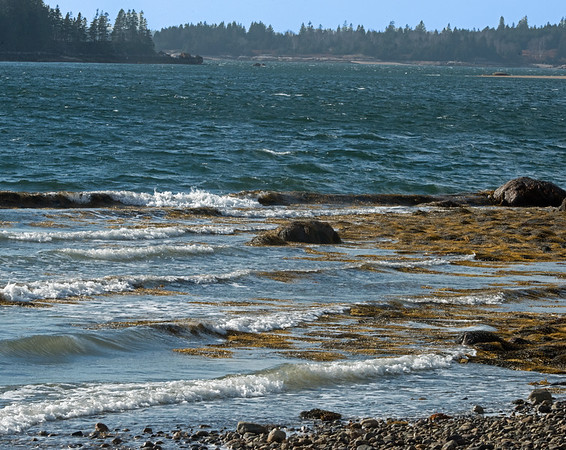
Thus, basically, if you stuck a six-foot measuring post into the low tide line, the top of the post would be under four to six feet of water in less than six hours. Of course, posts and/or sliding floats are no longer used to officially measure the tides.

NOAA uses sophisticated acoustical and electronic equipment to record tide heights along the coast, including Brooklin’s Center Harbor. Basically, the equipment sends signals continuously down a sounding tube that is within a protective pipe in the water; the time that it takes for the signal’s reflected sound to travel back and be received on the water surface is measured and converted into streaming linear data. (Brooklin, Maine)
Our Black-Capped Chickadees are starting to hoard food for the winter, when they will consume up to 10 times what they consume in summer.

There are seven native Chickadee species in North America, but the Black-Capped is our most common as well as our State Bird.


All Chickadees get their last name from their usual call: “Chicka-Dee,” which they vary based on circumstance. “Chicka-Dee” and “Chicka-Dee-Dee” usually mean they’re happy. The more “Dees” at the end, the more worried the birds are. Usually, the addition of five or more such suffixes (“Chicka-Dee-Dee-Dee- Dee- Dee!“) means that the bird is frantic due to the approach of a predator, such as a cat or a bird hawk. (Brooklin, Maine)
We’ve had a couple of good rains this month, enough to revive some of the mossy spring-fed streams in our woods from bone dry to chortling streamlets. November is averaging about half the precipitation we historically get and our summer and fall also were dryer than usual.

The resurgence of the springs hidden in the woods relieves a strain on thirsty animals that want a sweet drink during the day without too much exposure. This is especially true for the deer, which seem to realize they’re being hunted now. (Brooklin, Maine)
All the conditions are right this 2017-18 winter for another Snowy Owl irruption in which many of these birds will leave Arctic Canada and take a winter vacation in the United States. That’s according to a recent report by Project Snowstorm, a Snowy research and monitoring organization in Canada.

Basically, the lemming population is surging in Canada, as it does about every four years. This plentiful source of rodents results in nesting Snowies producing more surviving owlets than there are hunting territories available for the youngsters up there. The homeless birds come south and the first stop for many of them is Maine.

This young male Snowy took up residence at nearby Trenton (aka Bar Harbor) Airport during the last irruption in the winter of 2014-15. (Brooklin, Maine)
We have much to be thankful for. Some we’ll celebrate with silent awe; some we’ll celebrate with affection toward others. We hope that you also have much to celebrate.

(Brooklin, Maine)
This Oriental Bittersweet is a reminder of the dangers of basing a relationship on the impulsive pursuit of physical beauty. It’s an Asian plant that was introduced here in the 19th Century to bring spectacular fall colors to gray winter landscapes. Then, it started taking over those landscapes, killing our native American Bittersweet, trees, and other plants by squeezing and/or shading them to death.

The bark of Oriental and American Bittersweet is initially sweet to the taste, but then turns bitter and may cause nausea or worse side-effects; hence their common last name. On the positive side, Oriental Bittersweet feeds birds and is good material for winter wreathes. (Brooklin, Maine)
This is Brooklin’s Judith Ann powering into Naskeag Harbor yesterday with a full load of her recently-hoisted lobster traps. She’s the latest of many local fishing boats that will end their lobster season in November.


But, not all fishermen will be leaving the water this winter. Some will continue lobstering. Some will turn to dredging scallops soon. Others will don SCUBA equipment and dive in the cold waters to hand-harvest the choice diver scallops, which we and other neighbors will buy by the gallon. They’re beyond delicious! (Brooklin, Maine)
The trunks of tall trees dominate the early winter woods: gray pillars of spruce, fir, and pine.
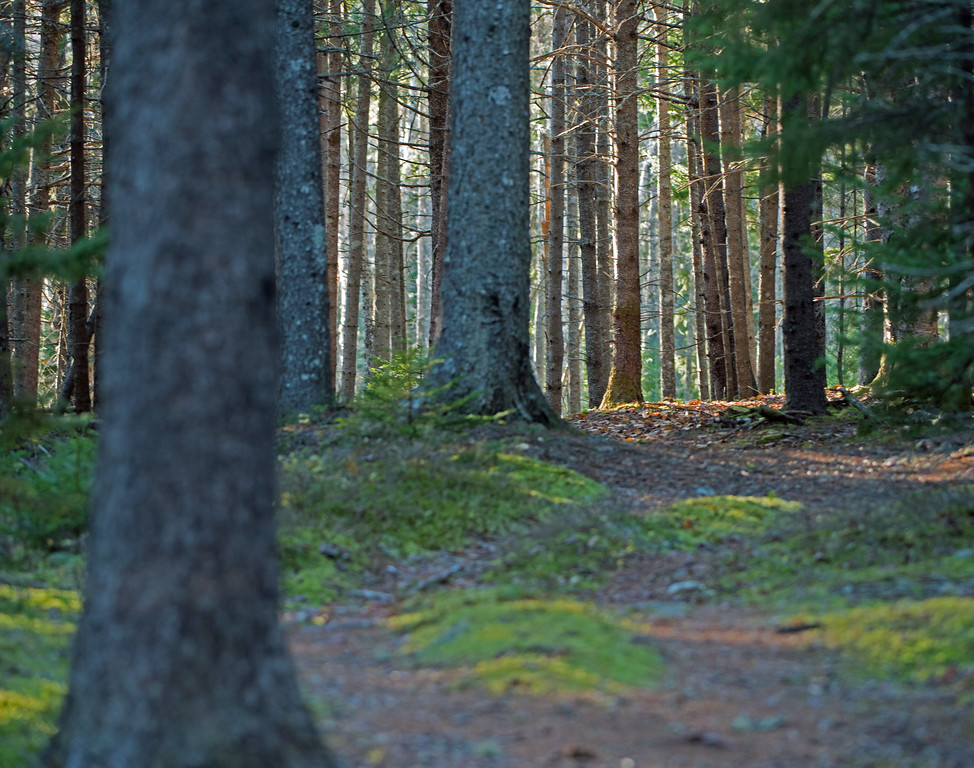
The understory shrubs and ferns no longer obscure sight; we can walk among the pillars with a vivid sense of three dimensionality.

Also gone are the high maple and birch leaves, their loss leaving jagged holes in the canopy. Sunlight sneaks through the new openings in splashes and slices. It’s silent; the air is pure, and it's the right kind of cold. (Brooklin, Maine)
Consistent with the times, we’ve got a lot of swell-headed males around here. Fortunately, ours are Bufflehead Ducks that are arriving from Canada for their winter vacations. Their name is shorthand for “buffalo-headed,” a reference to what many call the American Bison.

The darker females also have disproportionately large heads, but their heads are not as disproportionate as those of the males and are all black except for a white cheek spot.
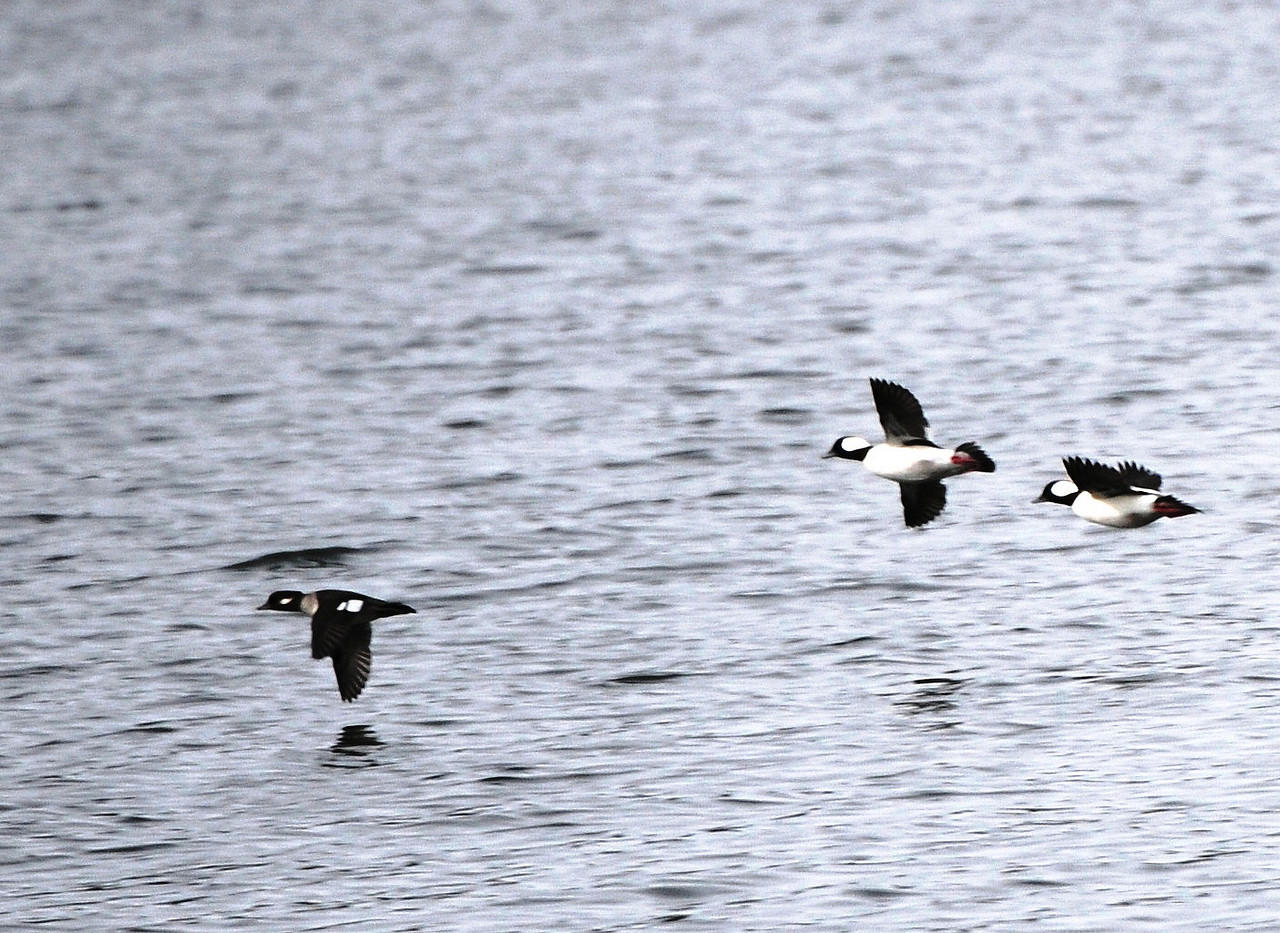
These tiny (14-inch) birds are unique among sea ducks: they not only nest in tree holes created by large woodpeckers (Northern Flickers and Pileated Woodpeckers), they’re monogamous for years at a time. (Brooklin, Maine)
We’re watching yesterday morning’s nor’wester sweeping down Eggemoggin Reach and charging into Great Cove.

Its winds are gusting up to 30 miles per hour, which is not a worrisome event, unless you’re an inexperienced sailor in a small boat without a life jacket. Such winds make our usually lazy waters get up and line dance.

In nearby Naskeag Harbor, fishing boats bucked and pulled at their moorings while sea gulls hunkered down and faced into the wind.


In natural coves and man-made harbors, the entering trains of ocean waves are forced by the land’s shape and shallower water to bend (“refract’) and fan out toward the shore in fascinating whitecap (“spilling wave”) patterns.


There are extraordinarily complex phenomena going on here. For those interested in finding out what they are, we recommend How to Read Water by Tristan Gooley (The Experiment, LLC, 2016). (Brooklin, Maine)
Some artists – Monet, Turner, and Church come easily to mind – have gotten close to communicating the preciousness of ever-changing evening light on familiar waters. But no one really can capture such a moment and give it to another.

This image of Great Cove Monday evening is trifling compared to being there and seeing the sea turn psychedelic lavender before going dark. (Brooklin, Maine)
We continue to be amazed at the tenacity of some of the wild apple trees (green- and red-fruited) and crabapple trees (red-fruited) around here.

The above Jackson-Pollock-like image was taken yesterday of fruit-bearing but leafless crabapple branches hanging over the edge of Great Cove’s shore line. A nearby green apple tree was equally tenacious:

That is, there is nothing between these red and green apples and the prevailing, often powerful sea winds. More significantly, there was nothing between them and the superstorm at the end of October in which gusts coming off the ocean there exceeded 70 miles per hour and torrents of driving rain pounded the coast.

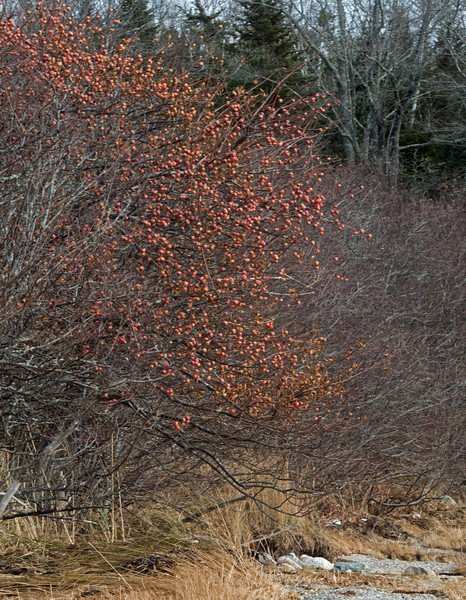
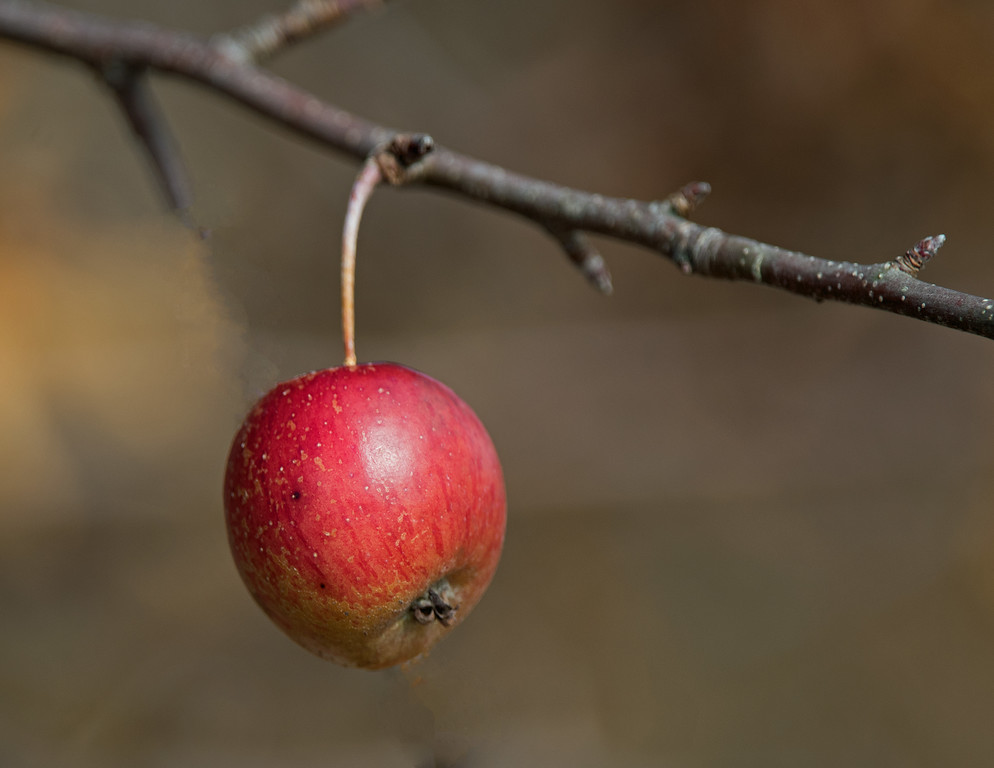
These tough trees could teach NFL running backs some lessons about holding on. (Brooklin, Maine)
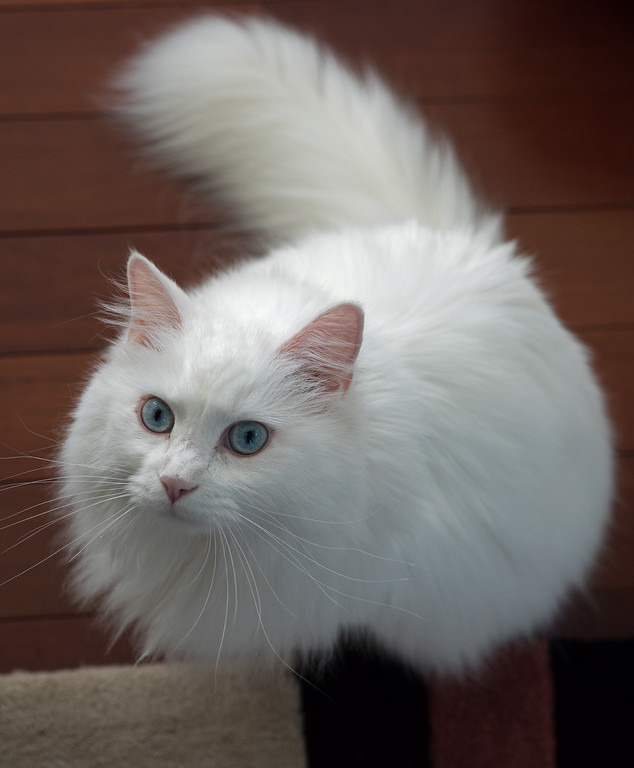
Meet Bianca, our hairy, all-white, fat, blue-eyed, six-year-old, constantly surprising, mostly Maine Coon, indoor cat.

Before we met her, she was a barn cat, a profession at which she did not succeed. We met her at the Hancock County Society for the Prevention of Cruelty to Animals, when she was named Sissy. She was alone in a cage there because she had a “trait”: she hated cats. We had to promise not to get a cat when we got Sissy.
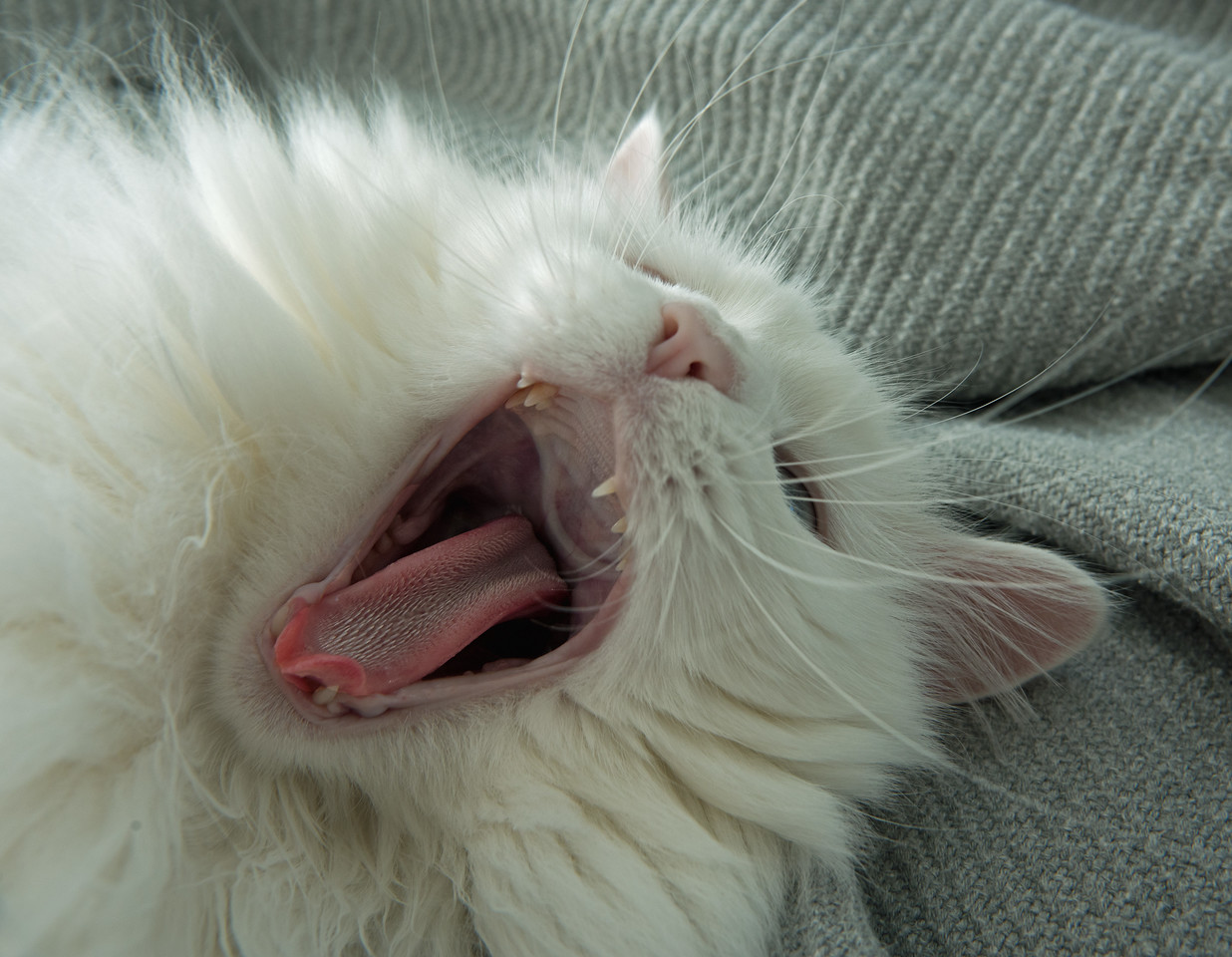

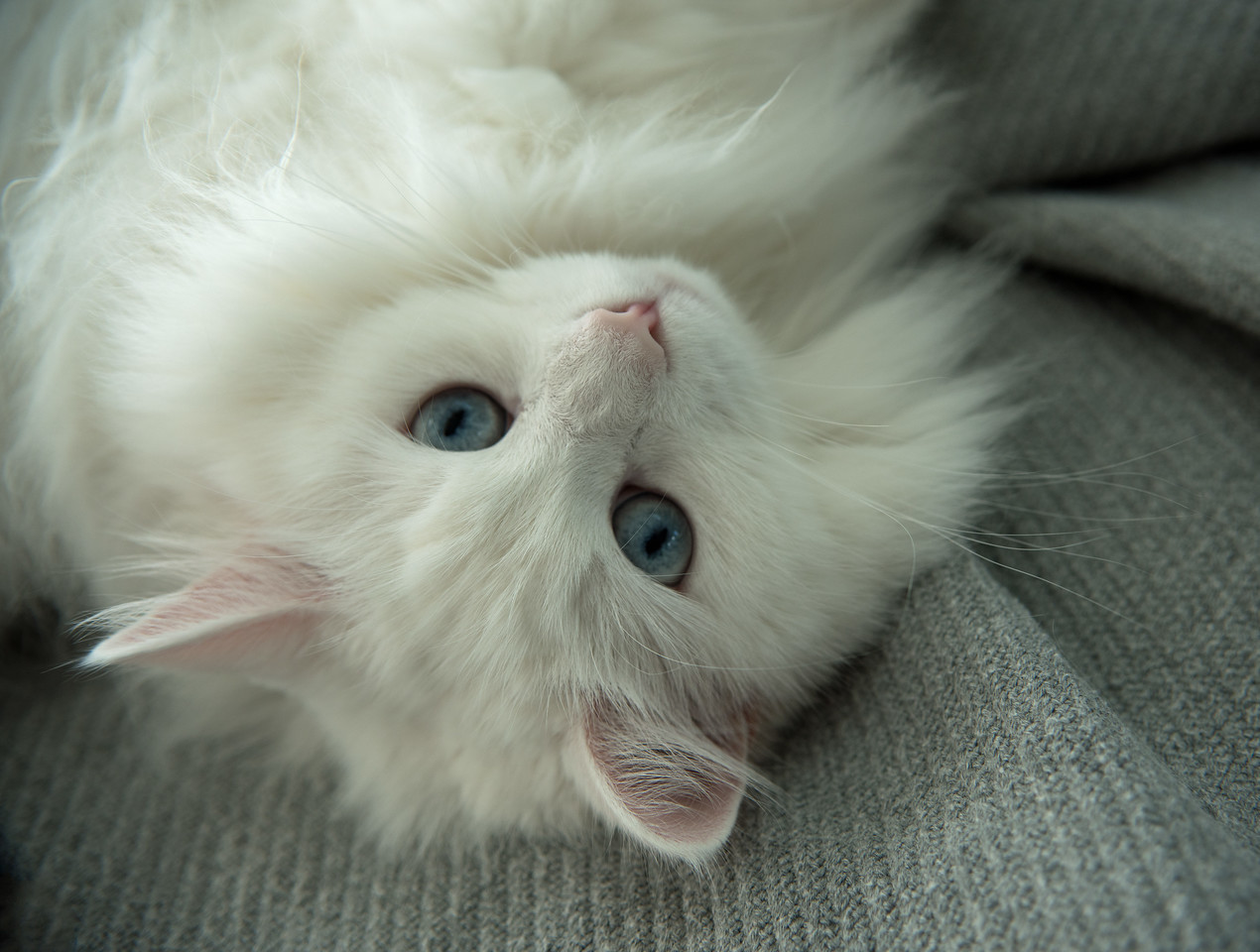
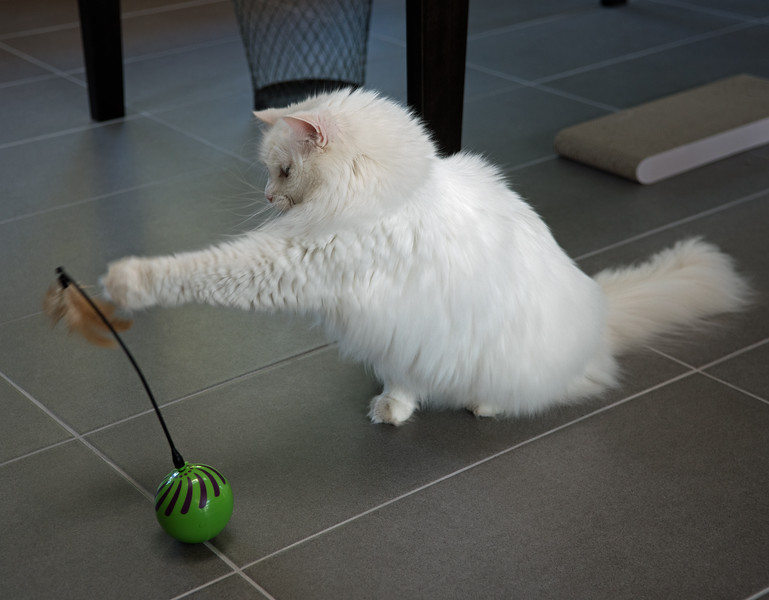
Soon after we changed her name to Bianca (Italian for white), we learned that she had another trait: she thought that she was a dog. She follows us from room to room, keeps putting her head in our hand to be rubbed, and excitedly greets visitors at the door. She also often sleeps or rests on her back shamelessly (but trustfully) splayed with all four legs up. She frequently does this in her spot on the bed, forcing us to pick her purring heftiness up to make the bed.

When not splayed, Bianca can be stunning.

Fortunately, she’s not aware of that. Yet. (Brooklin, Maine)
There are signs that our faux winter is over and the real thing has started creeping up on us. The first harbingers are the marsh ponds that freeze.

These are the ultimate reminders for procrastinating Wood Ducks and other migrating waterfowl to get their act together and fly south.

Most of our Loons and other over-wintering waterfowl seem to have completed the shift of their operations from ponds and lakes to the ocean. At the edges of the ocean, sea ice is starting to appear in the pockets that receive the least sun.


It’s time for wildlife (and us) to begin adjusting for the most pervasive seasonal change of the year. (Brooklin, Maine)
This is the sky over Great Cove and our dark North Field last night, as the sun sets in the west and the temperatures fall.

This is of the same area this morning, as the sun rises in the east to meet the frosted field and islands.

Once again, the mariner’s mnemonic was right:
Red sky at night, sailors’ delight,
Red sky at morning, sailors take warning.
This couplet usually proves true for the middle latitudes, meteorologists say. Red sky in the evening often means that the reflected sunlight is coming unobstructed from the west, where the prevailing winds bring weather.
On the other hand, if morning skies are reddish, it’s likely that moisture-laden clouds are reflecting light from the sunrise in the east. (Brooklin, Maine)

