Comment

In the Right Place: Wimp

Sea ice is having trouble forming around here, as you can see by the recent images below. We’re beginning to wonder whether we’ll see significant cold and snow this winter.

Dec 01.jpg

December is turning out to be a wimp. Our daily December temperatures consistently have been warmer than their historical averages, according to the National Oceanographic and Atmospheric Administration’s records for Hancock County (measuring Bar Harbor mostly).

Dec 02.jpg

No major snowstorms are predicted for here in January – yet. Historically, January is our coldest month, but there is no prediction of Arctic blasts coming down from Canada any time soon.

Dec 03.jpg

All the same, based on experience, we won’t be putting away the show shovels until mid-April. (Brooklin, Maine)

Comment

Comment

In the Right Place: al Fresco

It’s snowing here and has been for hours. The weather doesn’t seem to bother our neighbors who prefer to dine al fresco, as you can see from this image taken this morning.

WT 01.jpg

That’s probably because there’s no wind, it’s relatively warm (34oF as we speak), and it’s getting warmer – the kind of day that turns to rain. But, so far, it’s been a nice flurry.

WT 03.jpg

(Brooklin, Maine)

Comment

Comment

In the Right Place: Speed

With the regular National Football League schedule coming to an end, it’s time to consider the proverbial question: Why are Bald Eagles like Rob Gronkowski? As with the Patriots’ famous tight end, the size of Bald Eagles makes it difficult to appreciate their travel speed. The birds can travel horizontally at 30 miles per hour on their long, loping wings, often an eight-foot spread.

Eagle 01.jpg

The natural speed can become obvious when the 265-pound Gronk is running among linebackers and the 12- to 14- pound Eagles are diving (“stooping”) from great heights. The birds plummet at up to 100 miles per hour on partially folded wings. If you’re close enough, you can hear the wind whip through their feathers, including their leg chaps.

Eagle 03.jpg

(Brooklin, Maine)

Comment

Comment

In the Right Place: Close

Sometimes, on a December morning in ice-skimmed Great Cove, when Mother Nature thinks that no one is watching, she tries to copy Tom Curry. She never succeeds, but she often gets close.

i-fNQbw2V-XL.jpg

(Brooklin, Maine)

Comment

Comment

In the Right Place: Jelly

Chimney 01.jpg

“Christmastime” and “Christmas” mean different things to those along the spectrum of Devout Christian to Devout Consumer. Somewhere in the middle of that spectrum tere must be a shared sense that a time of giving and receiving and merriment and joy and food and song is a good thing for everyone, even if a little fictionalized folklore is mixed in.

For example, tonight is the part of Christmastime when Santa Claus (or St. Nicholas) arrives for children who believe in him. For some of those children in rural communities, he’ll be expected to land his deer sled on the roof and come down the chimney; for those in apartment buildings, he’ll have a pass-key to the apartments of those children who believe.

Around here, it looks like we have only one combination of reindeer-supportable roof and a Santa-sized chimney, and it’s over 100 years old. See the image above of the WoodenBoat administration building. Other local house chimneys may seem to cynics to be too small for an old man who has a little round belly that shakes when he laughs like a bowlful of jelly. Don’t believe them.

Chimney 02.jpg

(Brooklin, Maine)

Comment

Comment

In the Right Place: Spectacle

These images were taken on and from Capitol Hill almost exactly five years ago on the day that a bipartisan deal was made in the Senate and a Government shutdown was avoided.

RJL_7821_edited-1-X2.jpg

The biggest spectacle in Washington then was the Government’s holiday lights.

RJL_1795_edited-1-L.jpg

(Brooklin, Maine)

Comment

Comment

In the Right Place: Playful

This is Sun’s Up warming Conary Cove on December 20. It may be the only yellow-hulled fishing vessel around here.

Conary 01.jpg

In days of yore, many English, Irish, and Scottish commercial fishing boats were painted the dour colors of the local sea to hide favorite fishing grounds from competitors.  We have many white- and black-hulled fishing vessels here with some reds and greens and a few blues. Given modern custom-mixing methods, the hull color choice seems almost infinite.

i-JH6DV3c-XL.jpg

There also are many ready-mixed yellow hull paints available. The name that we like best is “Fighting Lady Yellow”; there also are “Bold Yellow,” “Bright Yellow,” Canary Yellow,” “Signal Yellow,” “Yellow-Gold,” and even “Van Gogh Yellow” hull paints. But, nothing seems to match Sun’s Up’s playful hue. (Blue Hill, Maine)

Comment

1 Comment

In the Right Place: Heartfelt

Here we have a December Amaryllis caught in the soft morning sunlight that slants through an east window. The tropical flower is named after the mythical Greek nymph, Amaryllis, who loved Alteo, a shepherd.

i-VQxzVgF-XL.jpg

Unfortunately, Alteo paid Amaryllis no attention, even when she pierced her heart with a golden arrow and spilled drops of her blood on the path she took to plead with Alteo. However, after 30 days, each drop grew into a beautiful red flower. This finally got Alteo’s attention and he fell in love with Amaryllis. (Talk about playing “hard to get!”) In actuality, the Amaryllis originated in South Africa and its bulb cultivation and marketing began in the early 1700s. (Brooklin, Maine)

1 Comment

Comment

In the Right Place: Shirtsleeves

This is the golden phase of last night’s dusk, as the last of the sun slides behind Deer Isle to our west and darkness begins to creep over Great Cove and up the snow-clad field.

121918 Sunset.jpg

Shortly after darkness, the sunset’s afterglow turned the clouds into bands of pink wool and the deer began to arrive in the field. But, by then, I had beaten a hasty retreat to the warmth of the house. [Note to self: you simply must stop running outside in shirtsleeves on beautiful, cold nights.] (Brooklin, Maine)

Comment

Comment

In the Right Place: Eyeful

This neighbor from Amen Farm down the road got us thinking about eyes — actually, the differences in some eyes.

Goat 01.jpg

Big cats (e.g., cheetahs and lions) and big canines (e.g., wolves and dogs) have round pupils, as do humans.

Cheetah Zoo Captive

Cheetah Zoo Captive

Siberian Husky

Siberian Husky

House cats and other smaller predators (e.g., foxes) have pupils that can become vertical slits.

Eye 01.jpg

Goats and some other grazing animals have horizontal rectangular pupils.

Goat 03.jpg

The latest theory apparently is that rectangular pupils give grazers, such as goats, a wider side-to-side view to see approaching predators. Pupils that can become vertical slits maximize the leaping and striking of wait-and-pounce ambushers that have eyes relatively close to the ground, such as small cats and poisonous snakes. Round pupils maximize the accuracy of larger predators that historically have needed a “full-frame” view to find and run their prey down, such as big felines, canines, and early humans.

Of course, nowadays, the prey that many domestic dogs run down may be something like a tennis ball and domestic cats never show their snake eyes when posing comfortably:

Eye 04.jpg
Eye 05.jpg

(Brooklin, Maine)

Comment

Comment

In the Right Place: Modest

We had a modest snow storm last night and early this morning — enough to paint out winter grays for a moment, but not enough to be troublesome. The sun battled the clouds in the morning, its light sometimes disappearing, but it eventually won and it is a sunny, clear day as we speak.

A skiff on the WoodenBoat campus got a much needed, but temporary, paint job:

Snow 01.jpg

Along Back Road, a gust of wind picks up some snow:

S0now 1.jpg

During some of the dark periods, it looked like the sun would lose the battle:

Snow 02.jpg

Looking up and down the plowed Back Road:

A graceful maple tree:

Snow 04.jpg

Signs of humanity:

Signs of a neat fisherman:

Snow 09.jpg

Country lanes and paths take on an unusual light:

Snow 17.jpg

At this time of the year, Great Blue Herons get a bit abstract, but they try to achieve a certain holiday cheer:

A just-plowed circular driveway, with a peek at Great Cove:

Snow 13.jpg

Ornamental grasses add color when there’s no sun:

Snow 20.jpg


(Brooklin, Maine)


Comment

1 Comment

In the Right Place: Bagaduce Chorale Holiday Concert

The regionally renowned Bagaduce Chorale gave two performances of its 2018 Holiday Concert in Blue Hill and on in Ellsworth. In a word, this year’s program was Wonderful — perhaps the Chorale’s best in many years, and that’s saying a lot.

Chorale 01.jpg

Mozart’s many-mooded Mass in Honor of the Holy Trinity showed the Chorale’s impressive range and kept the audience totally engaged for the first half. Of course, one reason for such engagement was the Chorale’s famed and dynamic Director, Bronwyn Kortge, who at times becomes the music.

Chorale 07.jpg
Chorale 06.jpg

After the Intermission, the lights were dimmed and the Chorale surrounded the audience, which joined them in singing Silent Night, Angels We Have Heard, and Once in Royal David’s City.

Chorale 14.jpg

Then, the Chorale returned to the tiered stage for the featured piece, John Rutter’s lovely and extraordinary Mass of the Children. Soprano Katelyn Bray, Baritone Isaac Bray, and the Ellsworth Community Music Institute Youth Chorale gave scintillating performances, as did the Bagaduce Chorale and the GEMS (Gaining Experience through Mentors) Orchestra.

Chorale 10.jpg
Chorale 11.jpg

After the official program, as usual, Director Kortge invited all former members of the Chorale onstage to join in Peter Lutkin’s Benediction.

Chorale 20.jpg
Chorale 21.jpg


(Blue Hill, Maine)

1 Comment

1 Comment

In the Right Place: Fame

Our chances of seeing this celebrity performing in a Maine city park on a very cold December 14 morning should have been less than those of seeing Beyoncė singing there then. Yet, there it was: an immature Great Black Hawk of the Central American subspecies.

GBH 01.jpg

The bird’s main act as of late November has been preying on gray squirrels in downtown Portland’s Deering Oaks Park.

GBH 03.jpg

It’s the subject of frequent Cornell Lab Rare Maine Bird e-Reports by visitors from many states and Canada. Experts have estimated that this bird is in its second annual molt cycle, when its sex is not determinable without physical examination. It’s fairly big (maybe the size of an Osprey) and has long legs on which it often chases squirrels on the ground – usually winning the deadly race!

GBH 02.jpg

Unfortunately, when it flew near enough for us to photograph it without obstruction, it quickly spun and offered a part of its anatomy that may indicate its attitude toward us:

GBH 06.jpg

For wildlife photographers: Nikon D850 body; Nikkor f/4 500mm lens with 1/7 teleconverter (850mm total); tripod-mounted; ISO was usually at 1000; apperatures mostly at f/8; shutter speeds varied from 1/125th to 1/6400th sec.

(Portland, Maine)

1 Comment

Comment

In the Right Place: Stimulation

The Isamu Noguchi exhibit at the Portland (Maine) Museum of Art is not for everyone. But, for those who like to charge their imaginations visually, the show is satisfying. It’s at the PMA through January 1. The works shown are a stimulating sample of experiments in form and function by the famed Japanese-American artist, landscape architect, furniture designer, and theater set designer who died in 1988. Notably, a sample of what may be his most famous creation, the Noguchi Coffee Table, is not shown, probably because it has become a production piece.

A wonderful example for form-and-function fans is Noguchi’s large Play Sculpture (1975-76), which is made out of sewer pipe and designed for adults and children who love playgrounds:

PMA 01.jpg

Noguchi’s 1986 experiments combining Japanese tradition and American modernism resulted in his Akari Light Sculptures made with silk or paper, bamboo and wire:

PMA 02.jpg
PMA 04.jpg

.Low-slung furniture experiments by the artist resulted in graceful forms, but (in our opinion) inhospitable living rooms:

PMA 06.jpg

Here we see the works of a mind without borders. The three small images are : Memorial to Buddha (1957); My Arizona (1943; while he was a voluntary internee at an internment camp there); Becoming (1966-67). The large image is Black and Blue (1958-59).

PMA 09.jpg

Abstract form, natural materials (marble and wood), and function are created in Table (1971):

PMA 07.jpg

This is Slide Mantra (1988), perhaps symbolic of the show.

PMA 08.jpg

(Portland Maine, December 15, 2018)


Comment

Comment

In the Right Place: Persuasion

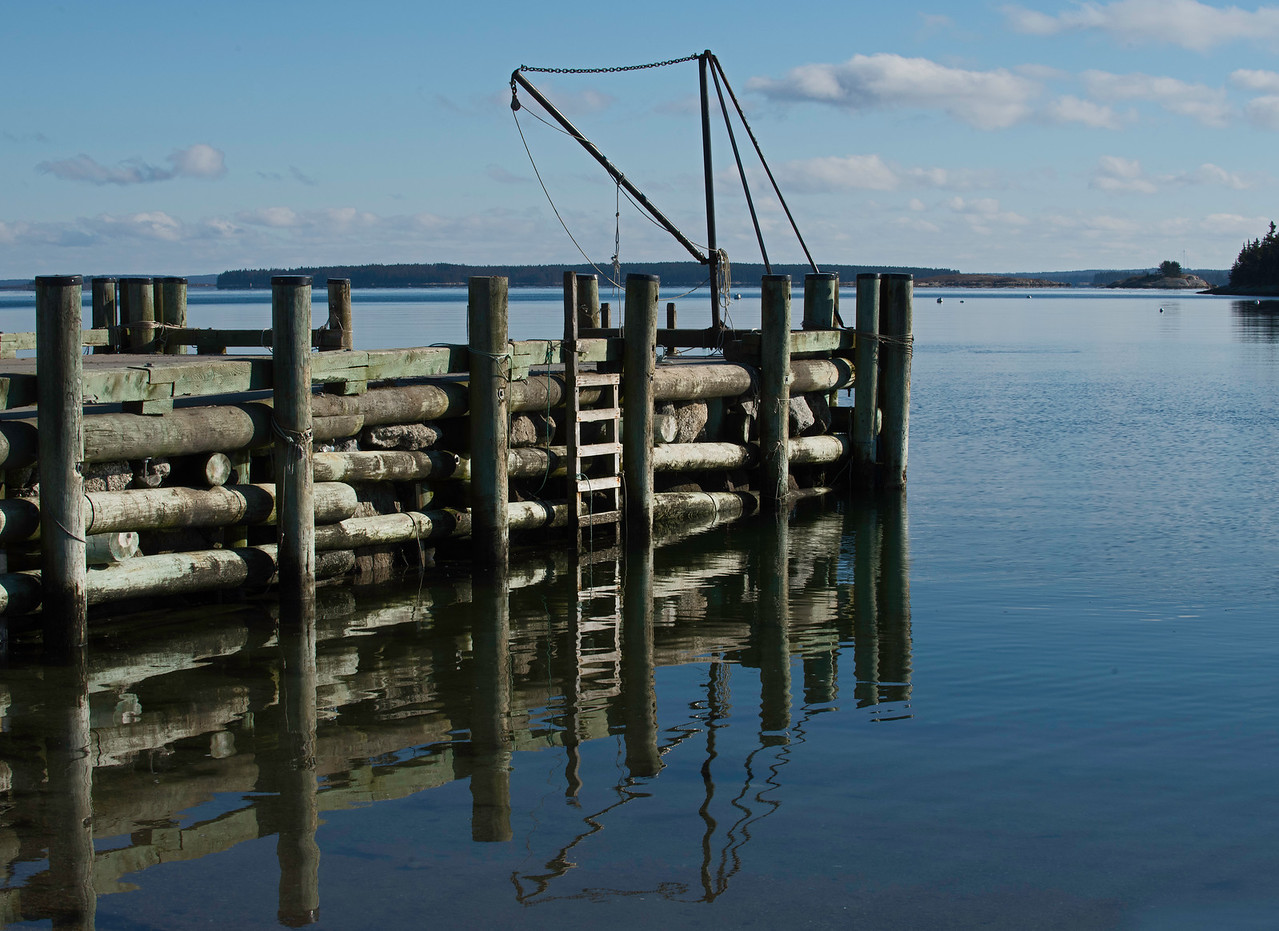
If the Town of Brooklin has a heart – and we think it does – it’s a three-chambered one. It consists of a General Store, Public Library, and Town Pier. Yesterday, as you can see below, the crib-style Pier was waiting in a calm and empty Naskeag Harbor; all the winter fishermen apparently were out scalloping.

P1ier 0.jpg

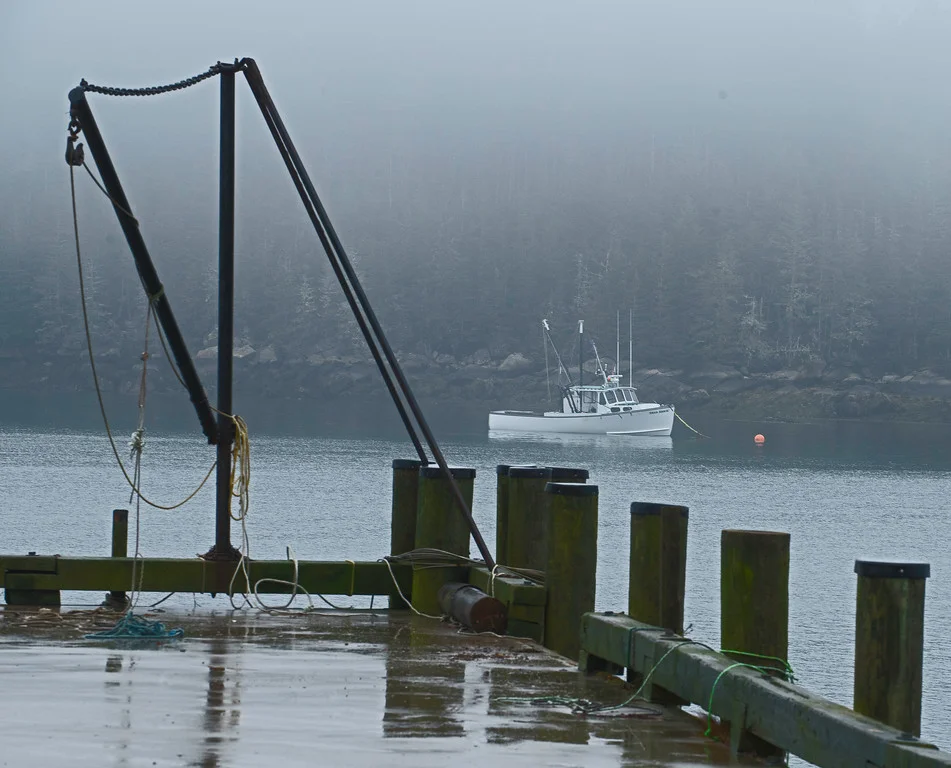
Here’s a view from the Pier during some rainy fog earlier this month; that’s Dear Abbie:, rigged for scallops, moored in the Harbor:

Fog 01.jpg

The Pier, which is only about 13 years old, is the ultimate result of a petition being filed with Town (and, then, State) officials by about 10 percent of Brooklin residents. They pointed out that “the thriving fishing village of Brooklin has no town pier, the fishermen — whose livelihood depends on their getting to their boats — haul gear upwards of 200 feet at low tide, sometimes in below-freezing temperatures and frequently in the dark….” Persuasive stuff.

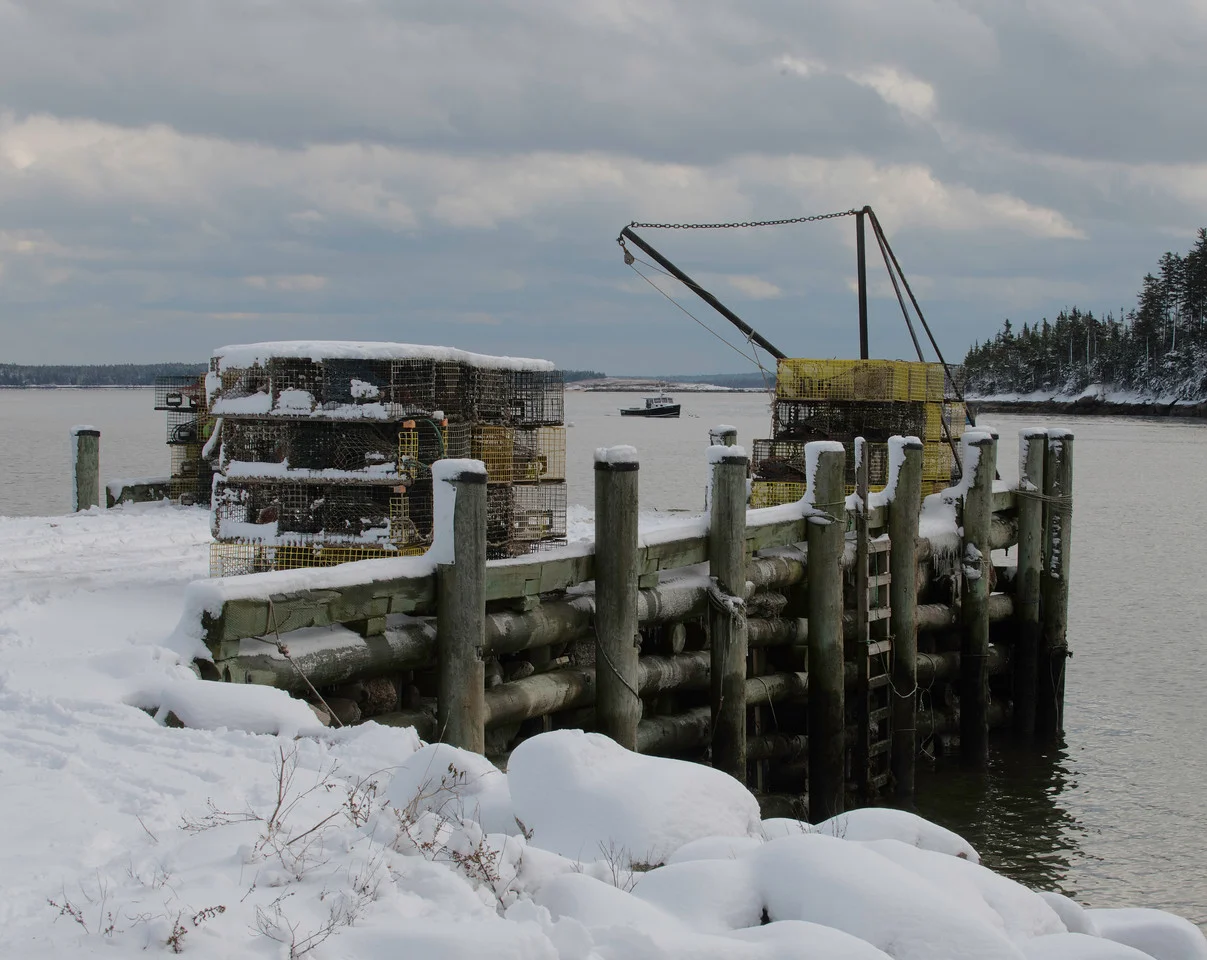
Here’s an image of the Pier after a snow storm last month, when many fishermen were ending their season and bringing in their traps:

Pier 02.jpg

(Brooklin, Maine)

Comment

Comment

In the Right Place: Vanes and Barbs

Let’s face it, the neck, head, and legs of a Wild Turkey are not pretty. But, the rest of the bird is magnificent.

WT 03.jpg

Wild Turkey feathers, especially on the males, are a miracle combination of engineering and art. Their chest and back feather vanes and barbs refract the light into an iridescence resembling a fine-tailored suit of chain mail.

WT 02.jpg

Their long primary and tail feathers are colorful, sturdy, and historically were among the best for writing quills, along with goose and swan quills. (We know that the Declaration of Independence was written and signed with quill pens, but are not sure which birds deserve the honor.)

WT 01.jpg

Even today, there is a surprisingly robust market for Wild Turkey feathers for use in arts and crafts – Amazon will deliver them free to Prime customers. See also the image in the first Comment space. (Brooklin, Maine)

Comment

Comment

In the Right Place: Mummy Dearest

Yesterday and the day before were perfect days to be outdoors – if you were dressed for 20-degrees (F). The winter woods were silent; with one exception, not a creature was stirring:

Walk 06.jpg

The exception was Yours Truly, the photographer who looks like a bloody mummy when he’s out and about in sub-freezing weather. We have an image of that strange sight thanks to neighbor Jon Wilson. Jon saw the creature taking a shortcut across part of his WoodenBoat School campus yesterday, stopped his car, got out, and insisted on memorializing the weirdness with his cell phone camera:

Walk 03.jpg

Many people have asked about that outfit, which has a number of variations depending on the weather. Yesterday, starting at the top, it was a knit cap, over an insulated head-ear band, over a balaclava hood. On the torso, there’s a cotton (breathable) turtleneck, under a flannel shirt, under a fleece jacket, under a rubberized (waterproof) shell jacket that’s bright enough for hunters to see. On the hands, there are photographers’ winter gloves (thumb and index finger tops fold back) and one ski pole for crossing ice patches in the woods and on the shore. On the legs are an old pair of jeans (long johns not used until the temperature goes below 10 degrees). Finally, on the feet, there are insulated boots high enough to wade through small streams and around difficult shoreline obstacles in Great Cove.

Back to the important stuff. Woods’ streams are icing up, despite the fast-moving water:

Walk 04.jpg

Some marsh and field ponds have relatively clear ice; others have the frosty variety. However, they’re all ready for ice skates and casting Valentine’s shadows.

Walk 01.jpg
Walk 02.jpg

On Great Cove’s shore, sea ice is starting to form, but it’s still in its pancake ice form:

Walk 07.jpg
Walk 08.jpg

(Brooklin, Maine)

Comment

Comment

In the Right Place: Vision

It’s amazing: Brooklin, a town of about 800 permanent residents, has a public library that is as good as (or better than) many libraries in communities with populations greater than 100 times ours. Our Friend Memorial Library, pictured here, is one of the most-used libraries in the State. It not only provides the latest books, CDs, and DVDs, you can download its e-books; use its computers and Wi-Fi network to surf the web; attend stimulating readings and other get-togethers there, and view its monthly exhibits by our many creative neighbors.

RJL_3316_edited-2-XL.jpg

The Library originated in 1896 and, in 1912, moved to its present location on land donated by Brooklin’s Friend family. The FML has gone through several renovations and has had many loyal and generous supporters. Among these were Brooklin’s Katherine and E.B. White, both of New Yorker fame, who were instrumental in revitalizing the library. Katherine, especially, helped form the vision of what a first-class rural library could be. (Brooklin, Maine)

Comment

Comment

In the Right Place: Insurance

It’s been eye-poppingly clear here, but brain-piercingly cold: 9 degrees (F) at 6 a.m.; 11 degrees as we speak at about 9:15 a.m. The already-frozen field ponds are cracking and moaning as the ice builds and creeps. The image below is of a local pond that looked sugar-coated yesterday morning due to a brief sunlight flurry of fat snow.

i-bH8KRJk-XL.jpg

As in many rural communities, ours has no central water source. Many of the ponds built near houses and barns were dug as “fire ponds”: small reservoirs that could be pumped by firemen when there was a need. Having a pond also often reduced the cost of fire insurance. Some of the ponds have “dry hydrants”: an unpressurized pipe from the pond water to a hydrant that has a capped outlet to which a hose may be attached. (Brooklin, Maine)

Comment