Comment

In the Right Place: Seeing

Friday’s (November 8’s) sunset afterglow was one of the more dramatic dusks that we’ve had recently.

3.jpg

At that in-between time, when we may be remembering more than we’re seeing, our view from the ridge could not be much different than what the Penobscot and Passamaquoddy peoples saw from here centuries ago. In fact, if you look hard at this image, you might “see” that Viking knörr ship sailing in from the southwest (left) toward its island shelter. (Brooklin, Maine)

Comment

Comment

In the Right Place: Snowshoe Wood

While filing this local image we realized that we didn’t show and talk about Tamarack Trees when they were at their golden peaks here in late October and early November.

3.jpg

Now that we’ve had a few freezing nights (and today’s morning that is still below freezing as we speak), the trees’ supple branches are almost bare

In the summer, at a distance, it’s hard to tell Tamaracks from Spruces and Firs. They’re all green and all have cones. But, in late fall and early winter, only the Tamarack needles turn into yellow fluorescence:

4.jpg

Now, Tamarack needles are dropping like golden rain.

This tree also is called a Larch, but Tamarack seems to be the most popular name for them here. That name is the Algonquin word for “snowshoe wood,” which is what the tree’s flexible wood trunk and branches could become in the hands of a good craftsman. (Brooklin, Maine)

Comment

Comment

In the Right Place: Urges

In one sense, this is just a sign on the WoodenBoat School campus at the crest of an unpaved private lane, where large fields are to its right and left. (See below.)

3.jpg

However, its unusual appearance sometimes provokes an urge to consider it just the first word in a warning or advice:

SLOW Saint Peter Ahead, or

SLOW Fawns Playing, or

“SLOW But Steady Wins the Day” (Aesop).

5.jpg

(Brooklin, Maine)

Comment

Comment

In the Right Place: Battle Medals

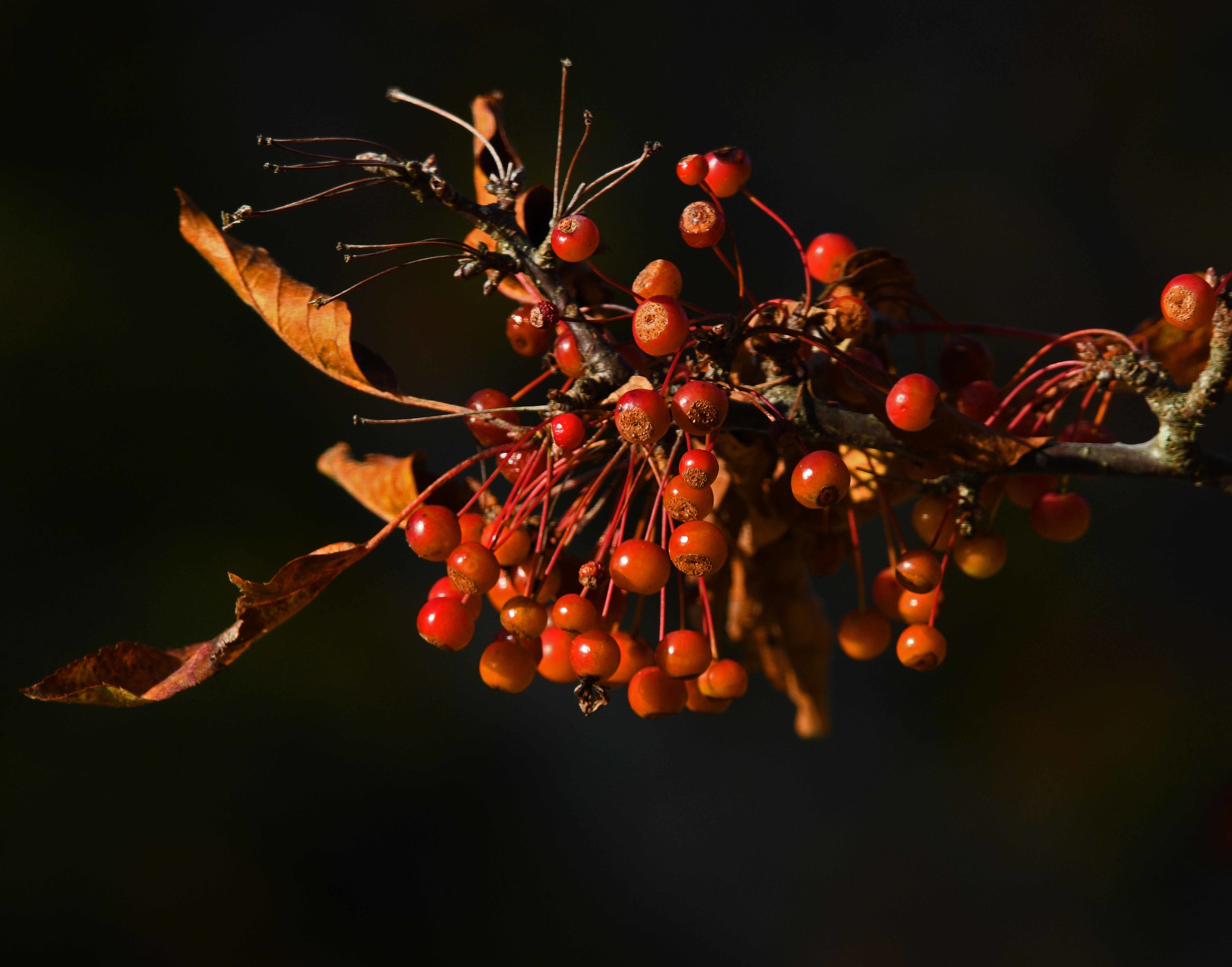
Storms and high winds are taking their tolls on leaves and branches around here, but our crooked old apple trees continue to fight against the odds, holding tightly onto as many of their fruits and twisted limbs as they can.

2.jpg

When the sun comes out, these wounded warriors seem to come to attention and wear their remaining apples like battle medals, daring the elements to come at them again.

1.jpg

(Brooklin, Maine)

Comment

Comment

In the Right Place: Hoodies

It was a nice surprise to see a pair of Hooded Mergansers in one of our marsh ponds last week, since the few fish there are too tiny to be even appetizers for these diving ducks. Understandably, we haven’t seen them since.

Hoodies are the smallest and oddest of the three American Mergansers. When excited, or just when they feel like it, they erect their proportionately massive hoods (crests, really) into feather fans. This is particularly spectacular on the orange-eyed, black-faced male, which has a white half moon hood:

#8.jpg

When he’s calm and out for a paddle with his cute brown mate, his crest is down and his hood becomes a racing stripe:

#10.jpg

(Brooklin, Maine)

Comment

Comment

In the Right Place: Appreciations

The leaves have fallen from many of the Winterberry bushes now, bringing the last significant color to our roadsides. This year’s crop is one of the best we’ve seen in 30 years, as you may be able to tell from this image taken yesterday..

#3.jpg

Most of the time, to most people, these shy native bushes are indistinguishable from the crowd of roadside weeds that they prefer as neighbors. But, unlike their neighbors, they like to celebrate the Thanksgiving season with little red appreciations that all can enjoy.

#4.jpg

(Brooklin, Maine)

Comment

Comment

In the Right Place: Perspective

Last night’s dialog with self:

            [Deep Sniff; Slow-Rolling Swallow]

            “That sunset goes really well with this wine.”

            [Sniff; Pause; Slow Swallow; Clouds Increase]

            “No, it’s the wine that goes well with the sunset.”

            [Two Sips; One Rolling Swallow; Darker]

            “Does it matter which is which?”

            [Long Pause; Very Slow-Rolling Swallow; Great Cove and Babson Island Disappear; Chilled Air]

            “Of course.”

3.jpg


(Brooklin, Maine)

Comment

Comment

In the Right Place: Avengers

Here we see the incoming tide (“flood tide”) starting to cover the intertidal zone of Great Cove, where the November high tides will range from about 9 to 12 feet, according to local charts. (Yesterday’s high tide was reported at 10.7 feet.)

2.jpg

Our tides are high enough (hence fast enough) for us to see their steadfast progress and, usually, to hear the enchanting musical crinkling of small waves coming ashore in rhythmic intervals.

The causes and effects of tides have been studied and written about by scientists and philosophers since at least 150 B.C. Isaac Newton was the first person to define the tides as the results of the gravitational pull of the moon and sun. The rotation of the earth has been discovered to be the third major factor. Scientific study of the tides has become even more important now, as the effects of human Climate Change may turn the tides into Nature’s avengers. (Brooklin, Maine)

Comment

Comment

In the Right Place: Rollercoaster Ride

November made a nasty first impression yesterday. It greeted us on Halloween and during the wee hours of November 1 with driving rain and wind gusts clocked here on the ridge at up to 70 miles per hour. Many trees and branches were blown down and hundreds of thousands of Mainers lost electricity. Fortunately, we only had a few digital clock palpitations and one spruce blown down at the edge of our woods.

1.jpg

Above, we see the bait hut and lobster smack raft in Naskeag Harbor yesterday morning. It’s being pummeled by 30- to-40-mile-per-hour wind gusts after the storm cleared out. Other scenes at that time show the fishing vessel Ms Max straining at her mooring, a white-capped Eggemoggin Reach, and an indifferent Cadillac Mountain in Acadia National Park across Blue Hill Bay:

4.jpg
7.jpg

Around the home front, we see those gusts taking our Japanese Silver Grass for a rollercoaster ride and the wind-twisted base of the spruce that was blown down:

However, as we speak, it’s clear and calm, with four MPH gusts from the northwest. (Brooklin, Maine)

Comment

October Postcards From Maine

Comment

October Postcards From Maine

October is a month of many dramatic endings and few promising beginnings. But, it’s when Summer makes her brilliant exit, which usually is our most colorful scene of the year. This year was no exception. The Blueberry fields turned scarlet and trees became daubs of reds, yellows, and greens. The woods became a cool world of sunny canopies, bronzed ferns, jeweled floors, and bubbling streams.

1.jpg
13.jpg
16.jpg
7.jpg

Our fields started turning to gold almost immediately after their usual October mowing.

With the fields mowed, we got a better view of the White-Tailed Deer that sleep in them. By October, the coats of the Deer and Red Squirrels were turning to winter gray. We saw what we think were the last of many of our Summer fauna in October, including Damselflies, Monarch Butterflies (which had a very good Summer here), and Sandpipers. But we also saw our resident American Crows starting to come together in their winter defensive colonies that will have more eyes and ears when the leaves are gone and they become more obvious to resident owls and eagles.

20.jpg
19.jpg

October also usually is when we see the last of the sailboats in our coves. The final Outward Bound sailing class of the year rowed into Great Cove during a squall this October. To our surprise, Eigyr, a Brooklin boat, sailed into the Cove in drizzly fog on October 30. Most other smaller recreational boats have been hauled ashore for storage, along with their mooring gear. (The moored one shown below was brought ashore in late October.)

28.jpg

Many of the fishermen started bringing their lobster traps ashore for storage in October. Some of their vessels will be fishing for Scallops in the winter; others will be (or already are) “hardscaped” until June.

36.jpg
35.jpg

In the October gardens, we saw the last of the year’s many of the leaves, vegetables, flowers, and berries . These included, among many others, Viburnum; Tomatoes; Montauk (Fall) Daisies; Morning Glories; Hydrangea; Hostas; Barberry; two hues of Redvein Enkianthus, and the last Rose:

47.jpg
39.jpg
49.jpg
40.jpg

Similarly, much of the wild flora made their last stands in the October fields, woods, and ponds. These steadfast plants included, among many others, Queen Anne’s Lace; Asters; Asian Bittersweet, Euonymus (Burning Bush); Winterberry, and Green Arrow Arum.

50.jpg
51.jpg

As far as trees are concerned, the October Spruce were choking on cones; Stewartia leaves turned wine-purple; Red Maples finally become red, and the Mountain Ash and Apple Trees were showing what appear to be record numbers of fruits.

54.jpg
56.jpg
59.jpg

In mid-October, we had a serious Nor’Easter that blew down trees and power lines, leaving hundreds of thousands of Mainers without standard electricity. (Many generators were humming for 24 hours or more.)

65.jpg

Of course, Halloween is in October. This year, unfortunately, it was very windy and rainy that night, limiting the tricking and treating. But the imaginative Halloween decorations abounded.

68.jpg
70.jpg

Finally, one of the compensations for losing Summer is the Winter sunsets, which started this year in October. The Hunter’s Full Moon came up this year on a clear October night and was as large as ever.

(All images in this post were taken in Down East Maine during October 2019.)

Comment

Comment

In the Right Place: Roaming

We recently met a pair of locals who seem friendly, but are a bit strange. She lives in a tree trunk; he practices rodeo riding so much that he’s as thin as can be.

##1.jpg
##2.jpg

Lately, they’ve been hanging out at the Mainescape Nursery in Blue Hill during the day, but we hear that they’ll be roaming the rural areas tonight. We recommend that you give them a treat if they visit you. (Blue Hill, Maine)

Comment

Comment

In the Right Place: The beginning of the End

We return to the waterfront at high tide Here we see two of Brooklin’s finest, Judith Ann and (partly visible) Dear Abbie: at the Town Pier yesterday morning. Their crews are discharging their lobster fishing gear and adding a little color to a drizzly day.

#1.jpg

The fishing season for many of our fishermen (a term that includes females) is in the process of ending now. However, some will refit their vessels and dredge for scallops during the winter. A few will even get out the SCUBA equipment and hunt for premium “Diver’s Scallops” along the bottom in the dark, cold waters.

#2.jpg

(Brooklin, Maine)

Comment

Comment

In the Right Place: Pregnant

When all the Fall colors are falling and fading, you can always count on Redvein Enkianthus to come to the rescue and provide a spectacular fireworks finale. The leaves of some Enkianthus plants are now brightly-burning embers;:

#1.jpg

Those of others are dark pouring wine; both are decorated with antique necklaces of seed pods:

#2.jpg

The name Enkianthus derives from the Greek words for pregnant and flower and relates to the swelling at the base of each of its lovely, bell-shaped spring flowers. (Brooklin, Maine)

Comment

Comment

In the Right Place: Letting Go

October 27, 2019

October is a time with few beginnings and many ends. Sailboats and other recreational vessels are no longer bobbing at moorings in Great Cove and Naskeag Harbor and pleasant summer memories of them are fading. But, seeing this little sailboat on a misty morning in Conary Cove last week brought a smile and made letting go of summer easier.

3.jpg

(Blue Hill, Maine)

Comment

Comment

In the Right Place: Marketable

We have this enchanted little rose bush that provides us with beautiful pink-tinged yellow blooms and a real rose scent until the edge of Winter. This image of it was taken yesterday and -- despite hard rain and low temperatures last night – there is a new bud on the bush as we speak.

1.jpg

Why roses are so popular has been a matter of conjecture for eons. Most theories seem to rely to some degree on scent and their well-balanced design that can be imagined as humanly sexual. The Greek legend goes a little further: Roses were created by Aphrodite, the goddess of love, by combining her tears with the blood of her lover, Adonis, the god of beauty and desire.

Nonetheless, the rose is probably the world’s most cultivated and commercial flower. Competitive growers and exhibitors have been developing variations of the flowers for centuries. They continue to create species and give them marketable (and trademarked) names. For example, this little plant is an Italian Ice® rose. (Brooklin, Maine)

Comment

Comment

In the Right Place: Turning Point

Many of our fishermen have been pulling up their lobster traps and bringing them ashore for winter storage.

1.jpg

It’s another one of those bittersweet Fall turning points like seeing colorful leaves falling, but in reverse – seeing colorful traps leaving the summer residences that they've enjoyed since June. They're going back on the decks of our good-looking fishing vessels to be hauled and stacked and soon, perhaps, covered again by water in the form of snow.

2.jpg

As to how good a season it was, the catch (“lobster landings”) data won’t be published by the State until 2020. From the unofficial reports that we’ve seen, Spring started slowly and landings never picked up enough to match the past few years of very good catches. However, when compared to overall historical averages, 2019 might be viewed as a reasonably good year. Let’s hope so. (Brooklin, Maine)

Comment

Comment

In the Right Place: Nodding Off

The Summer’s lush and dense Green Arrow Arum plants (Peltandra virginica) are now slowly nodding off into the pond waters and disappearing, while the surrounding Water Lily pads are randomly sinking out of sight. Soon, there will be no greenery in our marsh waters.

#1.jpg

The Arum, also known as Tuckahoe, is a perennial native to our freshwater wetlands. One of the ways that it reproduces is interesting: It forms a nesting area for Chloropid Flies and dapples them with pollen when they arrive; the flies, in turn, visit other plants and pollinate them. (Brooklin, Maine)

Comment

Comment

In the Right Place: Disgusting

It’s been a warm October so far and some of our summer birds apparently are enjoying themselves too much to think about migrating. For example, we saw this Greater Yellowlegs Sandpiper yesterday morning.

#2.jpg

You don’t get a chance to see all of these birds’ long legs and feet when they’re fishing. However, their namesakes become startlingly obvious when the birds look for dessert on the intertidal mudflats.

#1.jpg

Sometimes they fish in water up to their chests and look like dabbling ducks.

#5.jpg

By the way, the thin, yellow-streaming legs attached to Greater and Lesser Yellowlegs Sandpipers earned them the most disgusting collective name in bird terminology: — a group is called an “Incontinence of Yellowlegs.” (Brooklin, Maine)

Comment

Comment

In the Right Place: Evil

Now that the leaves are disappearing, we can see the invaders casting aside their cautionary yellow sheaths and exposing their dangerous red weapons.

2.jpg

The golden husks on the Asian Bittersweet vines (Celastrus orbiculatus) are opening to offer, like the Devil in Eden, their destructive red berries to the innocent birds. The birds then spread this tempting and beautiful evil seed so profusely that humankind has not found an effective way to prevent the python-like vines from sprouting anew to suffocate more and more trees.

1.jpg

The State of Maine has admitted that this plant’s killing is too rampant to be stopped. However, to slow down the damage, it has listed the Asian Bittersweet as an invasive species and prohibited its sale and distribution here.

3.jpg

There is a native version, equally beautiful and aptly named American Bittersweet (Celastrus scandens), that is environmentally innocuous. But, that’s another story. (Brooklin, Maine)

Comment

Comment

In the Right Place: All in the Family

Today we’ll consider two cousins that we saw on Wednesday (October 16). We suspect that they were the last of their kind that we’ll see here in 2019. Each is well under two inches long and both are members of the famous Odonata family, but there the similarity stops.

1.jpg

The one shown above apparently is a Blue-Fronted Dancer, a Damselfly that slowly rises and dips in flight, as if doing a solitary waltz. Below, we see an apparent Autumn Meadowhawk, a Dragonfly that skims over the ground and water like a strafing fighter plane.

2.jpg

The physical differences between all Damselfly and all Dragonfly members of the Family are most easily seen when the cousins are resting: The smaller Damsels politely fold their wings together above their bodies; the impatient Dragons hold their wings out, ready to leave.

There are other differences: Damsels have “bugged” eyes with spaces between them, while Dragons have larger, wrap-around eyes; the Damsels’ two sets of wings are usually the same size and shape, while the Dragons’ hind wings are larger than their front ones; the Damsels’ delicate abdomens seem to be brittle-thin, while the Dragons’ stouter abdomens are sturdy-looking.

(Brooklin, Maine)

Comment