Comment

In the Right Place: A Selfish Thanks

It’s snowing half-seriously as we speak on this Thanksgiving Day, yet yesterday was clear, almost balmy, and ended with the dramatic sunset that you see here.

Thanksgiving.jpg

We’re able to enjoy it all, and we’re very thankful for that. But, there seems to be a selfishness in giving thanks for such things while our generation’s environmental neglect is increasingly jeopardizing the joy and health of future generations. They will not be thankful for our legacy unless we become less self-centered and change our ways soon. (Brooklin, Maine)

Comment

Comment

In the Right Place: Welcome

It looks like about 100 Common Eiders already have flown in from the sea to their annual winter home just outside Blue Hills Reversing Falls. They’ve been accumulating there this year since their scouts started to arrive in October.

#3.jpg

We’ve taken rough counts of as many as 400 there within the past decade, but in the last two years that number seems to have been dwindling. Perhaps that’s because one of their favorite foods, Blue Mussels, is declining along our coast. Nonetheless, their return always is a welcome and reassuring (canary-in-the-mine-like) sight. 

#4.jpg

Common Eiders are our largest native ducks, growing up to 28 inches in body length. The can fly up to 70 miles per hour, but we see them mostly floating about 100 yards offshore in large white-and-black (male) and brown (female) “paddlings.”

#2.jpg

When the tide is changing, these ducks will stream into the Falls’ fast water and dive for crustaceans and mollusks. The swiftness of the water there prevents it’s freezing and provides a winter-long feast. (Blue Hill, Maine)

Comment

Comment

In the Right Place: Stirrings

It was clear and warm for November yesterday when we went down to Great Cove to hear and feel the ocean’s mysterious call.

9.jpg

It was one of those seas “whose gently awful stirrings seem to speak of some hidden soul beneath ….” Herman Melville’s Ishmael in Moby Dick at Chapter CXL.

4.jpg

(Brooklin, Maine)

Comment

Comment

In the Right Place: The Grace of the World

“When despair for the world grows in me *** I go and lie down where the wood drake rests in beauty on the water, and the great heron feeds. *** I come into the peace of wild things who do not tax their lives with forethought of grief. *** For a time I rest in the grace of the world and am free.”

9.jpg
12.jpg

Wendell Berry, The Peace of Wild Things. (Brooklin, Maine)

Comment

Comment

In the Right Place: Land of Plenty

Here, we’re looking at Cadillac Mountain on a crisp November 4 day. It’s about 18 miles east-north-east of us, across Blue Hill Bay in Acadia National Park.

2.jpg

During the 17th Century, this area and much of North America’s northeast (including what is now much of Canada’s east coast) was the French Colony of L’Acadie. (“Acadia” is a transliteration of Native American words for “Land of Plenty.”) The mountain was named in honor of French explorer Antoine Laumet de La Mothe Sieur de Cadillac to whom, in 1688, France gave ownership of vast tracks of land that included what became the National Park.

Most of the year, the summit of Cadillac Mountain wins the contest for the place where the first sun rays reach the United States, according to a study by Yankee Magazine. Lubec and Eastport, Maine, are sometimes first, however. (Brooklin, Maine)

Comment

Comment

In the Right Place: Cyclops Returns

ITRP will be a little spotty in the next few days while I recuperate from an eye operation. Nonetheless, I am doing a one-eyed review of recent images and, from time to time, will share a few that you haven't seen. Here’s last Sunday’s (November 17th’s) red sunset afterglow reflected in Great Cove.

1.jpg

(Brooklin, Maine)

Comment

Comment

In the Right Place: "N.C. Wyeth: New Perspectives" at the PMA

The wide spectrum of N.C. Wyeth’s artistic talents is on display through January 12, 2020, in this fascinating exhibit at the Portland [Maine] Museum of Art. It seems that most people today, if they know anything about Newell Convers Wyeth, recognize him as the father of Andrew and grandfather of Jamie Wyeth, two renowned artists of more recent times.

#1.jpg

Some people also may remember N.C., who died in a tragic accident in 1945, as the foremost illustrator of books and other publications during the first half of the 20th Century. A representative portion of the PMA exhibit is of those illustrations and it includes (among others) the following:

Bucking Bronco (1903), Saturday Evening Post Cover

Bucking Bronco (1903), Saturday Evening Post Cover

Treasure Island by Robert Louis Stevenson (1911)

Treasure Island by Robert Louis Stevenson (1911)

The Last of the Mohicans by James Fenimore Cooper (1919)

The Last of the Mohicans by James Fenimore Cooper (1919)

But, what may be of most interest to today’s art lovers and potential art lovers are the exhibit’s many examples of N.C.’s extraordinary explorations of other forms of so-called “noncommercial” or “fine” art.

#8.jpg

One of our favorites is N.C.’s 1939 painting titled Island Funeral, above, which reflects his love of Maine and his magical ability to interpret Maine’s clouds, water, and light. By the way, the island above is Teel’s Island near Port Clyde, where N.C. had his summer residence. Other sea-related works include Yes, ‘N, He’d Let a Roar Outer Him, An Mebbe He’d Sing, “Hail Columbia, Happy Land!” (1914) (aka The Roaring Skipper); Dark Harbor Fishermen (1943) and The Lobsterman (1944) (aka The Doryman):

#11.jpg

There are several haunting portrayals in the PMA show that show a master of dark light at work, including this one:

Nightfall (1945)

Nightfall (1945)

Among the joys of this exhibit is seeing the fascination of people of all ages with much of it. Perhaps this should not be surprising, since one of N.C. Wyeth’s talents was to instinctively know how to illustrate classics that were read and loved by all ages.

#16.jpg

(Portland, Maine)

Comment

Comment

In the Right Place: Placeholder

This image of last night’s sunset afterglow will be our last posting for a few days. It will be our placeholder while we’re at an exhibition.

1.jpg

Hope to be back with you sometime next week. (Brooklin, Maine)

Comment

Comment

In the Right Place: Waterfront Report


Unofficial data indicate that the 2019 lobster season has been disappointing, especially when compared to last year’s catch, according to the Associated Press. Many of our lobster fishermen are in transition to either winter vacations or to scallop fishing beginning in early December.

#1.jpg

Thus, we’re seeing a lot of lobster traps being hauled out of the water and trailered to storage while we’re also receiving notices from neighboring fishermen that we should sign up now for our deliveries of fresh scallops just hours out of the water.

#2.jpg

(Brooklin, Maine)

Comment

Comment

In the Right Place: Eyefuls

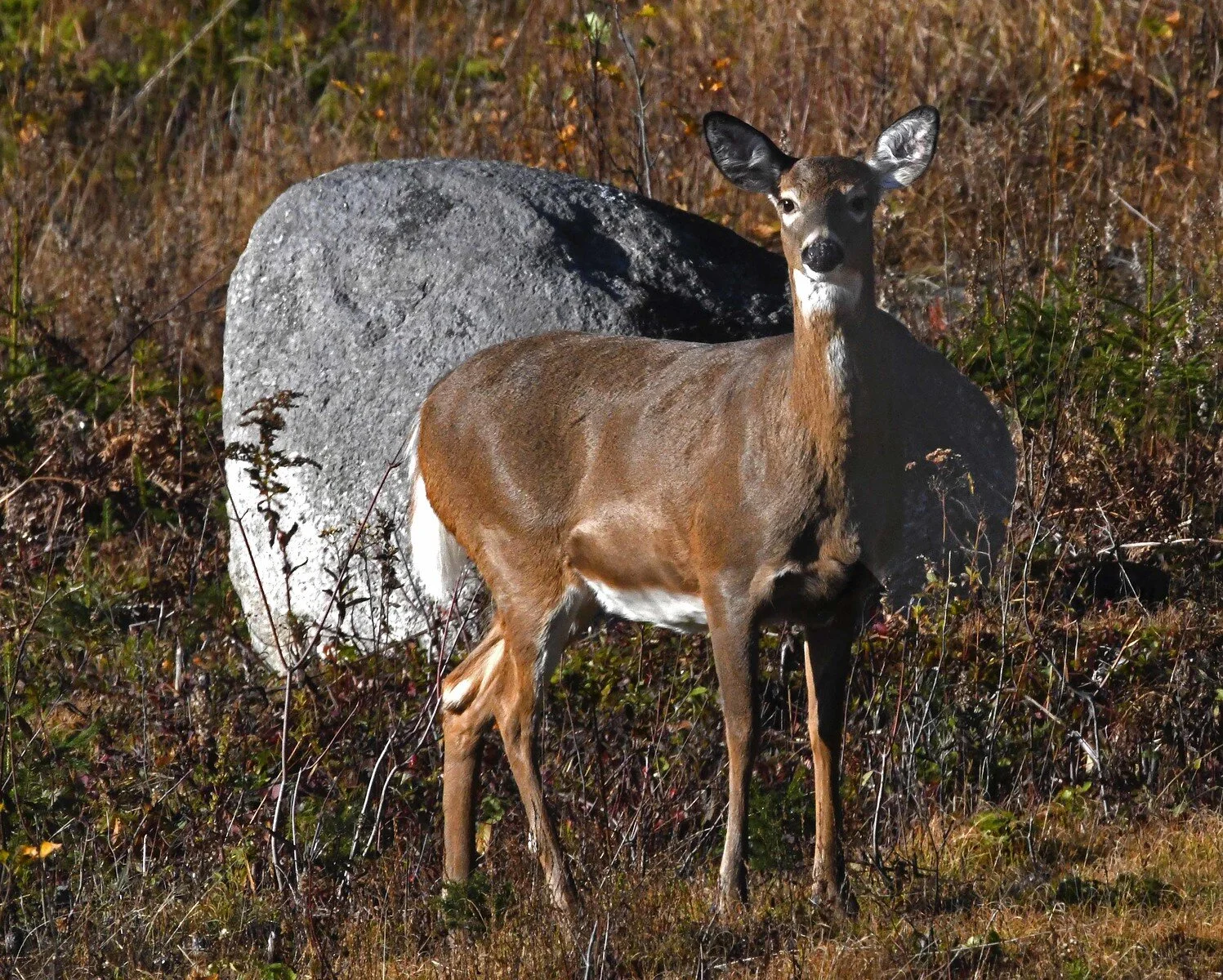
Our White-Tailed Deer population is entering its most difficult season in very good shape, from what we can see. Most of their darkening coats glisten with health, as this image (taken last week) shows.

1.jpg

This doe wasn’t quite sure what was making that clicking sound and she never figured it out. Yet, I was less than 100 yards away from her and clad in a bright red jacket and a blaze orange vest – which brings to mind a few interesting facts about sighting deer and deer sight.

As the temperatures plummet, we’ll see more deer (especially does and yearlings) browsing the remote fields in the sunny middle hours of the day, rather than just at dusk and dawn. But, they don’t have good bright-day vision, according to researchers. Their eyes contain more rods than cones, which gives them very good night vision as a trade-off. Also, orange, red, and green appear as variations of gray to these deer. The bright colors that humans should wear in the woods now are only for other humans, especially hunters. (Brooklin, Maine)

Comment

Comment

In the Right Place: Contrast

Yesterday morning and this morning provided starkly contrasting coastal experiences. Yesterday was miserable: simultaneous rain and fog, temperatures that rose from morning freezing only to the 40s, and wind gusts that were just enough to make the raw mix sting your face.

2.jpg
1.jpg

Last night, there was a very light dusting of snow and we awoke to a brilliantly clear dawn, albeit a cold one (15 degrees (F) with wind gusts up to 29 MPH at 6 a.m.).

6.jpg
3.jpg
7.jpg

(Brooklin, Maine)


Comment

Comment

In the Right Place: Pendulous

This is one of the uncommon specimen trees in Brooklin that we keep an eye (and camera) on in all seasons. You’ll notice that is holding on tightly to almost all its leaves as of last week, when the image was taken. It usually does not let them go until December or January, if then (a phenomenon called “marcescence”). 

3.jpg

The tree is a Weeping Beech (Fagus sylvatica, 'Pendula') and a landmark on Naskeag Road at Amen Farm. Its family name is derived from its most noticeable characteristic: pendulous branches. Here’s a closeup in a January snow flurry:

3A.jpg

These trees can grow to more than 80 feet in height and often are wider than they are high. They were selectively bred from European Beeches in England in 1836 and were introduced into the United States in 1847.

(Brooklin, Maine)

Comment

Comment

In the Right Place: Homicide Squad

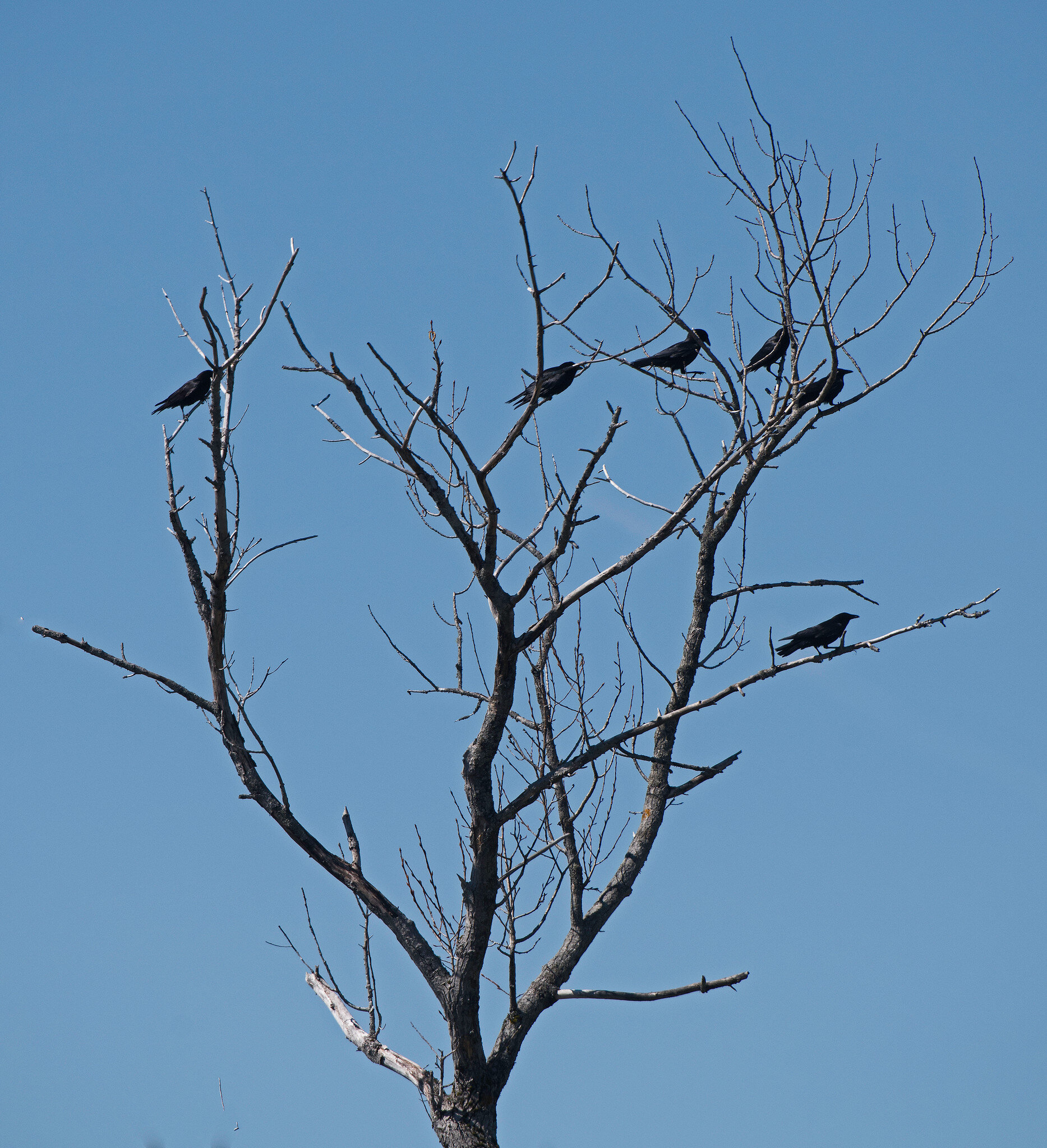
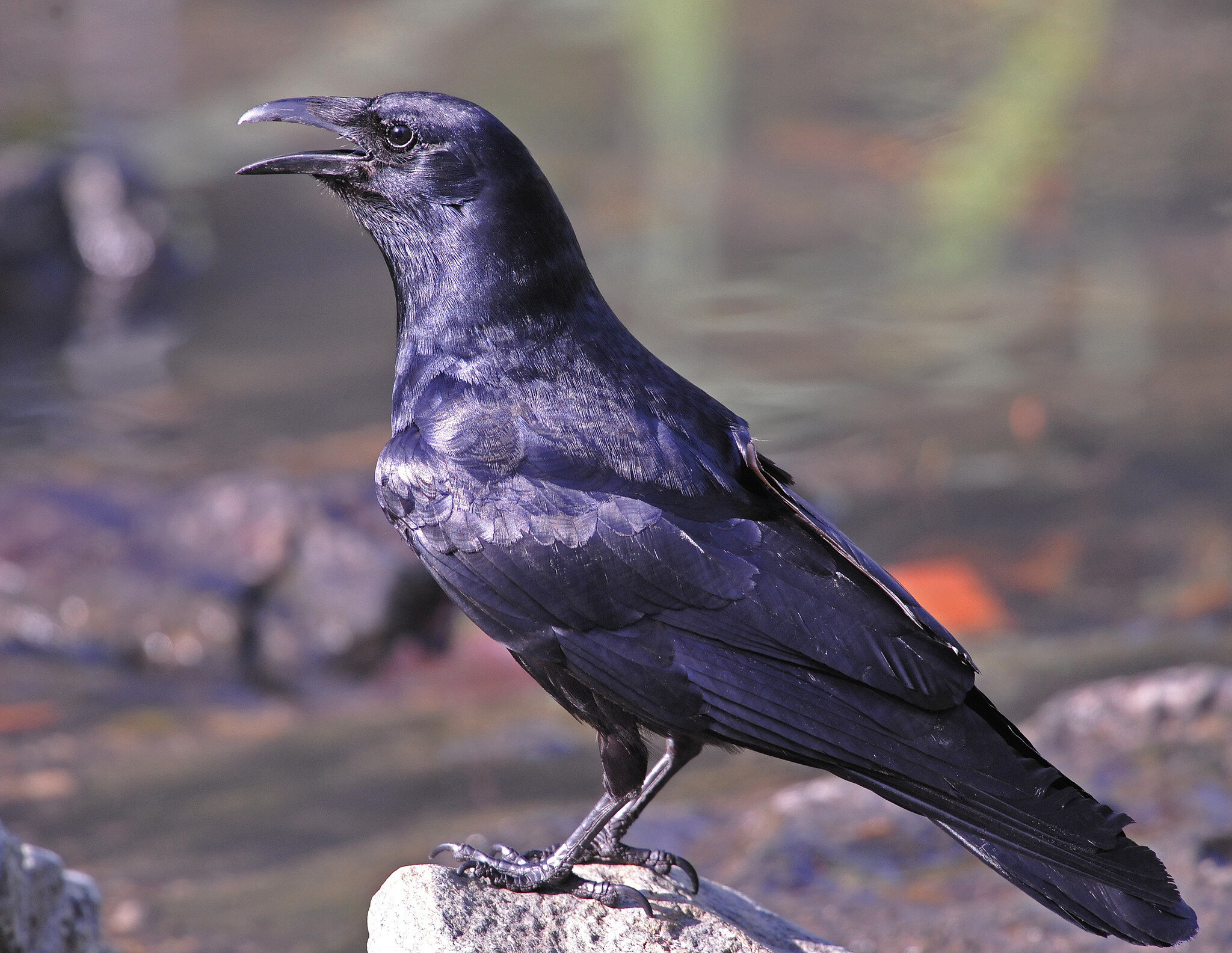
Now that most of the deciduous trees have shed their leaves, our resident American Crows are starting to pick out roosting areas where they’ll huddle through the nights, often with cousins whom they couldn’t stand in the summer or never saw then. (Inland Crows often come to the coast in the fall, seemingly sensing that food-rich tidal areas usually don’t get covered in impenetrable snow.)

5.jpg

During the spring and summer, Crows aggressively maintain small atomic family territories. The extended family roosts that they form in the winter are thought to be defensive creations. These dark birds are very visible against the dusk sky at the time that their arch enemies, Great Horned Owls, are hunting. More Crow eyes, ears, and beaks lessen the odds that they’ll be surprised by a quiet-flying raptor with murderous talons.

4.jpg

Speaking of murder, there is the folk tale that assures us that the real reason that Crows gather is to decide whether to put one of their own family to death for violating the intricate Crow society’s norms. Thus, a group of Crows often is called a “Murder of Crows.” (Brooklin, Maine)

Comment

Comment

In the Right Place: Seeing

Friday’s (November 8’s) sunset afterglow was one of the more dramatic dusks that we’ve had recently.

3.jpg

At that in-between time, when we may be remembering more than we’re seeing, our view from the ridge could not be much different than what the Penobscot and Passamaquoddy peoples saw from here centuries ago. In fact, if you look hard at this image, you might “see” that Viking knörr ship sailing in from the southwest (left) toward its island shelter. (Brooklin, Maine)

Comment

Comment

In the Right Place: Snowshoe Wood

While filing this local image we realized that we didn’t show and talk about Tamarack Trees when they were at their golden peaks here in late October and early November.

3.jpg

Now that we’ve had a few freezing nights (and today’s morning that is still below freezing as we speak), the trees’ supple branches are almost bare

In the summer, at a distance, it’s hard to tell Tamaracks from Spruces and Firs. They’re all green and all have cones. But, in late fall and early winter, only the Tamarack needles turn into yellow fluorescence:

4.jpg

Now, Tamarack needles are dropping like golden rain.

This tree also is called a Larch, but Tamarack seems to be the most popular name for them here. That name is the Algonquin word for “snowshoe wood,” which is what the tree’s flexible wood trunk and branches could become in the hands of a good craftsman. (Brooklin, Maine)

Comment

Comment

In the Right Place: Urges

In one sense, this is just a sign on the WoodenBoat School campus at the crest of an unpaved private lane, where large fields are to its right and left. (See below.)

3.jpg

However, its unusual appearance sometimes provokes an urge to consider it just the first word in a warning or advice:

SLOW Saint Peter Ahead, or

SLOW Fawns Playing, or

“SLOW But Steady Wins the Day” (Aesop).

5.jpg

(Brooklin, Maine)

Comment

Comment

In the Right Place: Battle Medals

Storms and high winds are taking their tolls on leaves and branches around here, but our crooked old apple trees continue to fight against the odds, holding tightly onto as many of their fruits and twisted limbs as they can.

2.jpg

When the sun comes out, these wounded warriors seem to come to attention and wear their remaining apples like battle medals, daring the elements to come at them again.

1.jpg

(Brooklin, Maine)

Comment

Comment

In the Right Place: Hoodies

It was a nice surprise to see a pair of Hooded Mergansers in one of our marsh ponds last week, since the few fish there are too tiny to be even appetizers for these diving ducks. Understandably, we haven’t seen them since.

Hoodies are the smallest and oddest of the three American Mergansers. When excited, or just when they feel like it, they erect their proportionately massive hoods (crests, really) into feather fans. This is particularly spectacular on the orange-eyed, black-faced male, which has a white half moon hood:

#8.jpg

When he’s calm and out for a paddle with his cute brown mate, his crest is down and his hood becomes a racing stripe:

#10.jpg

(Brooklin, Maine)
Comment

Comment

In the Right Place: Appreciations

The leaves have fallen from many of the Winterberry bushes now, bringing the last significant color to our roadsides. This year’s crop is one of the best we’ve seen in 30 years, as you may be able to tell from this image taken yesterday..

#3.jpg

Most of the time, to most people, these shy native bushes are indistinguishable from the crowd of roadside weeds that they prefer as neighbors. But, unlike their neighbors, they like to celebrate the Thanksgiving season with little red appreciations that all can enjoy.

#4.jpg

(Brooklin, Maine)

Comment