
This image of a proud Mom appeared yesterday in our monthly column in the Ellsworth American:
To read the column, click here: http://www.5backroad.com/montly-column
JOURNAL
This image of a proud Mom appeared yesterday in our monthly column in the Ellsworth American:

To read the column, click here: http://www.5backroad.com/montly-column
This early morning, as has been the case for several days, is brightly clear and unseasonably cold (in the high 30s [F]); but there is little wind. Yesterday and the day before, however, also came with March-like Westerly winds (gusts in the 20’s [MPH]) that produced March-like shudders. They were days to watch powerful forces work within a beautiful land and seascape.

The white-capped tides were approaching full low then and moving fast. They irreverently slapped granite-ledged shorelines that had been kneaded like dough millions of years ago by immense glaciers; they also raced in channels between previously submerged rock and sand spits at the entrances to harbors.

The first image here, of the western entrance to Naskeag Harbor, was taken on May 12. The other mage, of the northwest entrance to Great Cove, was taken on May 13. (Brooklin, Maine)
This Northern Parula Warbler was easy to see flitting in the low and leafless branches here on May 5. (Sex assumed.) But soon, he and his kind will be virtually invisible in the leafy tree tops.

A Parula is just a little bigger than a credit card. From below, it\ looks like a bit of the bright sky; from the side, it looks like a dapple of sunlight in blue-gray shadows:

Leighton Archive Image
John James Audubon named these birds Blue Yellow-Backed Warblers for easy identification. However, later name-givers, who gave little thought to encouraging public bird identification, had a "better" idea. They thought that these birds looked like titmice (genus Parus); so, they gave these warblers the little understood Latin name Parula (“little titmice”).

Leighton Archive Image
This Northern species lives mostly in the United States and Canada, while the yellower Tropical Parulas live mostly in Central and South America. (Brooklin, Maine)
This is picturesque Stonington Harbor on Sunday (May 10):
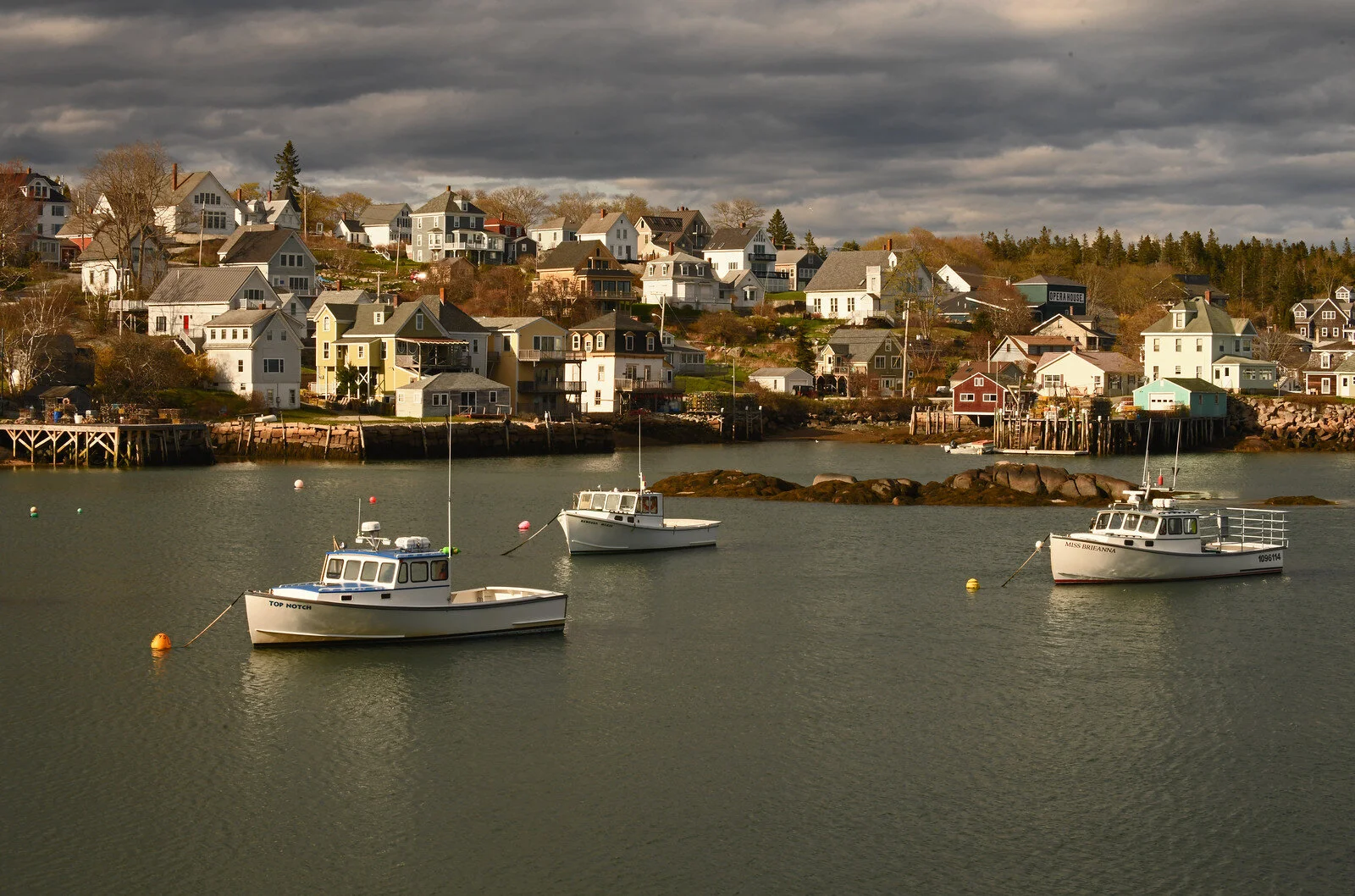
The gathering clouds were performing a magnificent shell game with the honeyed afternoon light: showing it here, then there, then nowhere, while the lobster boats seemed to smile to themselves on their day of rest. There should have been tourists here for this performance, even at this early date; but, we saw none.
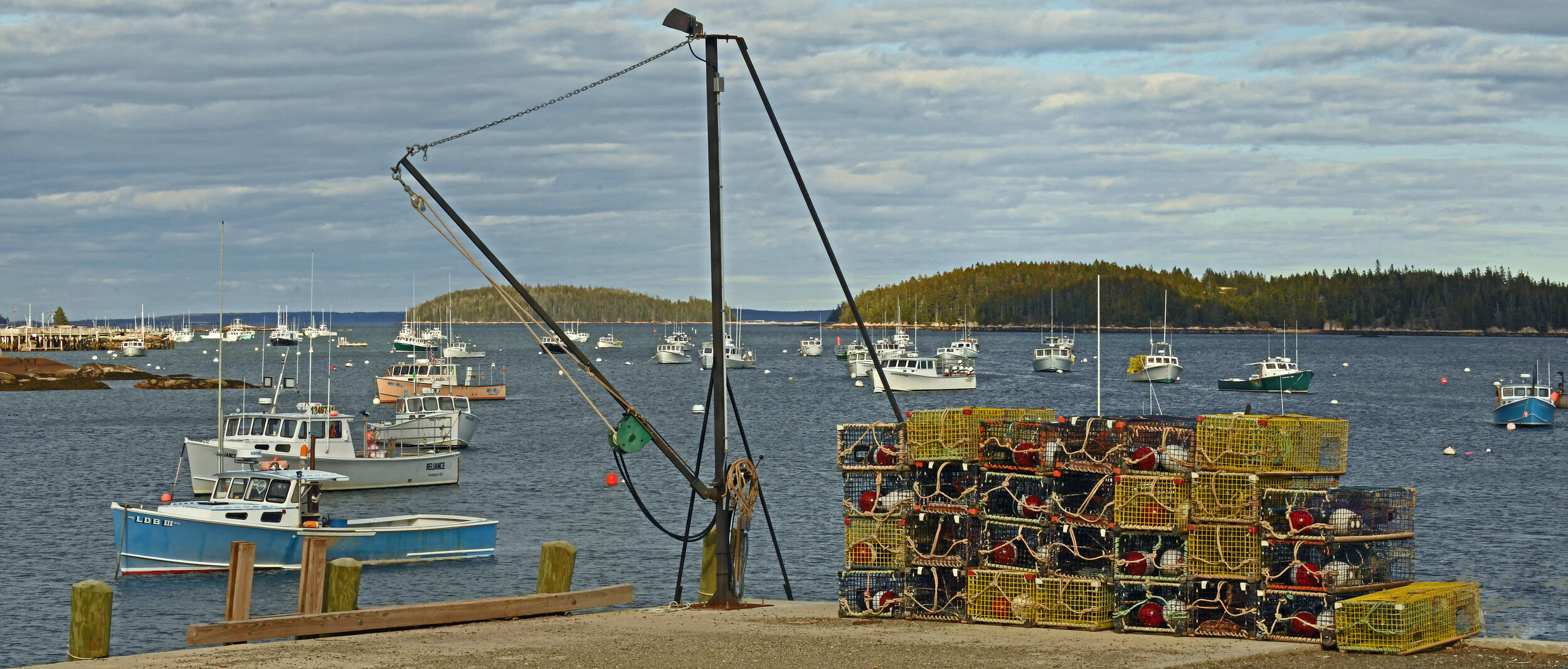
Stonington, historically famous for its fine granite, has been Maine’s leading lobster port in recent years. And, of course, Maine has been the leading lobster catching (“landing”) state in the nation for quite some time. It’s a win-win kind of place when there’s no plague to worry about. But now our world is changing and we wonder what it will look and feel like in the future. (Stonington, Maine)
For about two weeks, we’ve been seeing these two Painted Turtles basking in our pond on warmer days. They’re apparently male. (Males have longer, wider-based tails; females have thin stubs.) If history is prologue, these two soon will be joined by three or four additional male and female summer painters to form a “bale” of basking turtles.
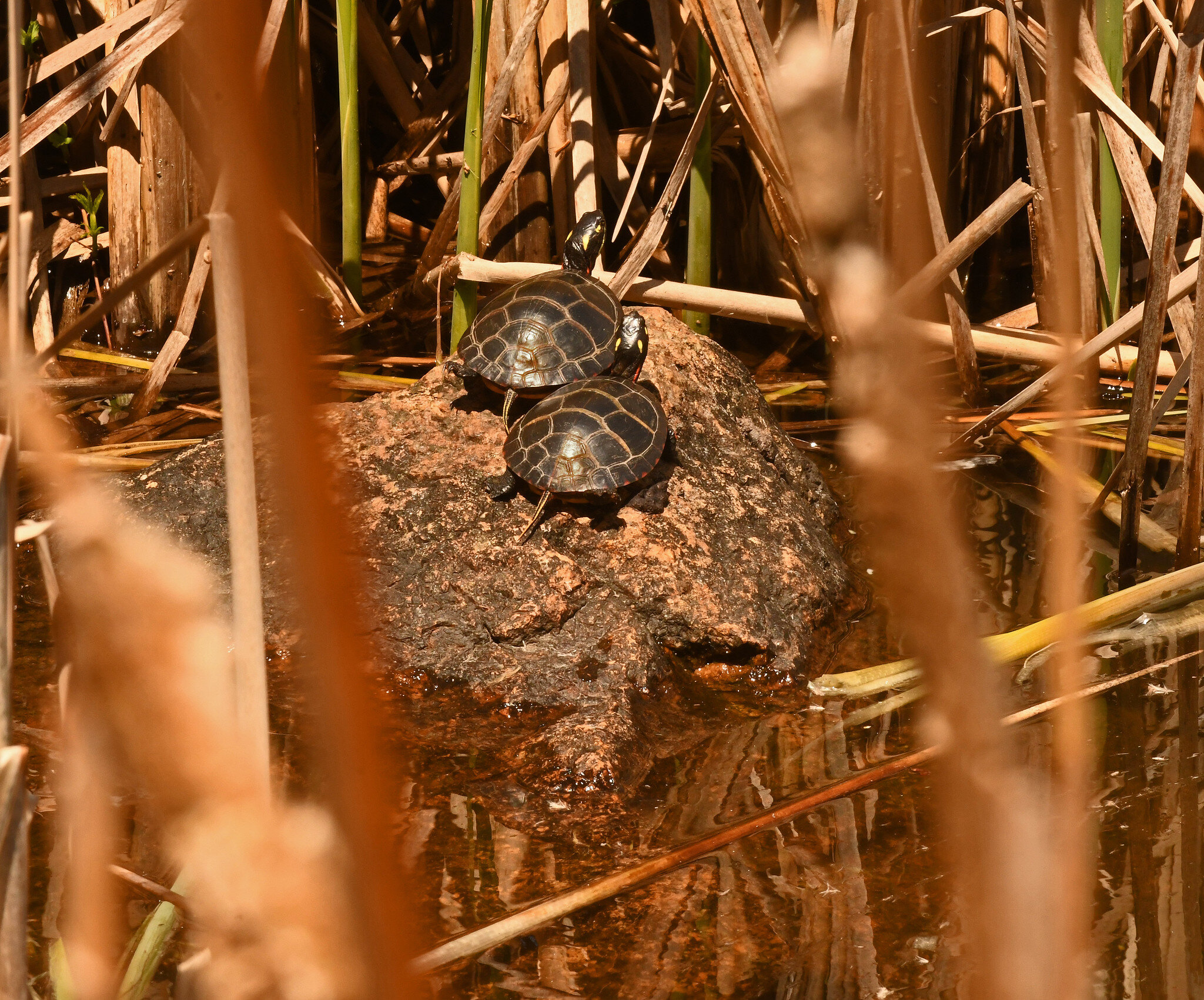
Painted Turtles are shy and gentle creatures; they scrabble off their rock if anyone or anything gets close. When alone and at the right time, the male asks the female the important question by stroking her face with his front claw; if she agrees, they’ll disappear into the depths of the pond and mate. Soon thereafter, she’ll climb up into our North Field, make her nest, lay her eggs, and return to the pond while the eggs incubate.
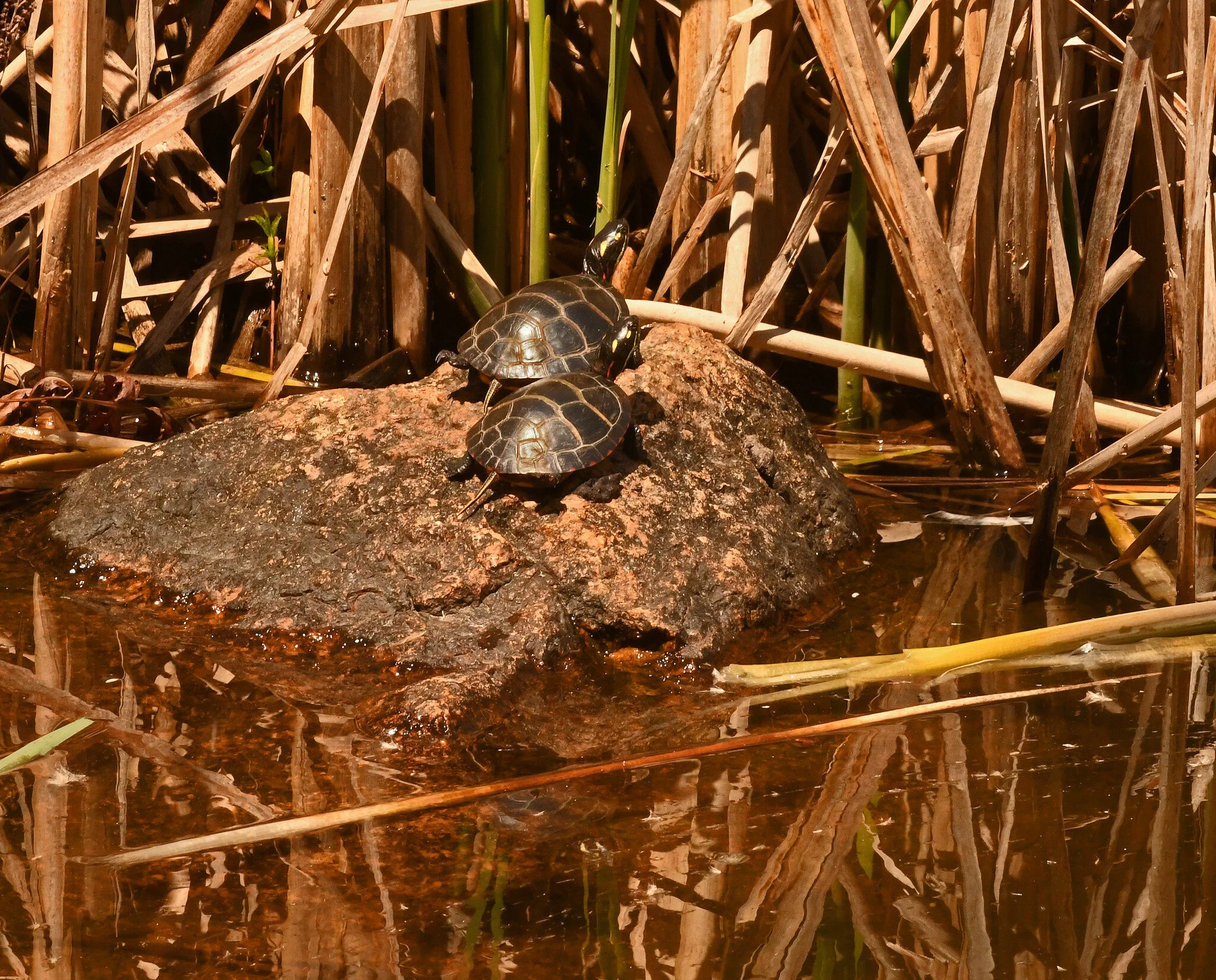
If the raccoons, skunks, coyotes, and crows don’t find the eggs, some of the hatchlings may come back to our pond; others will look elsewhere for a summer place with a water view. (Brooklin, Maine)

Leighton Archive

Leighton Archive
(Brooklin, Maine)
This usually is a pleasing spring sight here. As with emerging flowers, we look forward to seeing lobster traps and buoys all clean and neat and sea-ready being trailered to the water.

This year, however, the covid-19 pandemic has made everything uncertain for lobstermen (male and female). Consider just this one fact: two of the best markets for Maine lobsters are cruiser ships and China. But, perhaps there is time for answers to unprecedented questions to be found.
The lobster fishing season normally is slow in the April-through-June quarter taken as a whole; the number of boats going out usually is building then. State statistics indicate that, on average, 69 percent of active fisherman have their gear in the water by the end of June in normal times. Those data also indicate that things usually peak for Maine lobstermen during the July through November a period. That’s when they sell 84 percent of their annual catch, which accounts for 80 percent of the overall value of the Maine harvest. (Brooklin, Maine; image taken May 7)
Last night, this year’s Flower Full Moon burst big and red from behind the trees in Acadia National Park far across Blue Hill Bay. At first, as you can see here, it was an imperfect form for those of us so far away, like molten glass being shaped on the glass blower’s blowpipe.


As it quickly rose, we saw it seemingly shed its birthing redness and irregularities and grow into a ghostly silver orb on its tireless way to circle the earth.


The May full moon is named the Flower Full Moon because it appears as flowers are blooming in many parts of this country and many Native Americans called it that or similar names.
To our eyes, full moons initially greet us as compressed, blurry, and red or orange because they are low relative to us and their light at this point is passing through, and being bent by, more of Earth’s atmosphere than when they are high. The blue light in the low moonlight is scattered away more than the red light and all of the light is bent more on the horizon than above it. (Brooklin, Maine)
It’s bad enough to be informally called a Yellow-Rumped Warbler. But, when your full given name is “Eastern Myrtle Form Yellow-Rumped Warbler,” it’s time to go hide in the dense bushes. That’s what this little male was doing Tuesday (May 5):

He then rudely “mooned” us with his yellow rump:

His mate, who was flitting with him, also has a yellow rump, but her back is brownish:

The American Ornithologist’s Union dictated that each of five American warblers that had a patch of yellow on their lower backs should all be called a “form” of Yellow-Rumped Warbler. The one that we have here in Maine is the Eastern Myrtle form.
The powers that be did not name this bird Myrtle because that was their great aunt’s name. Myrtle warblers are the only ones that eat toxic wax-myrtle berries, which they do when insects are not available. That non-insect feeding helps them to be among the first and last migrating warblers that we see here. (Brooklin, Maine)
We were at a nearby marsh pond yesterday trying to keep warblers in focus when we heard the lovely gurgling sound of the still water’s surface being parted. This young muskrat had come out through his underwater tunnel from his home up in a distant bank. (Sex assumed.)

He swam silently to a patch of new, green cattail leaves, bit some off at their base, and returned with them in his mouth to where he had surfaced. Once there, he returned home by quickly slipping under the surface, spring bedding or food pantry materials in mouth.

Muskrats are powerful swimmers. They use their webbed hind feet and side-swishing flattened tails to swim forward and can swim backwards using their feet alone. They also can hold their breath up to 20 minutes. Muskrats once were hunted widely for their soft fur and rabbit-like taste. (Julia Child recommended sautéing them.) Of course, they get their name from the strong, musky scent that they use to mark their territory and their rat-like looks. (Brooklin, Maine)
Common (Bronzed) Grackles have been back for more than two weeks. (The images here were taken Saturday, April 2., except for the archive image.)
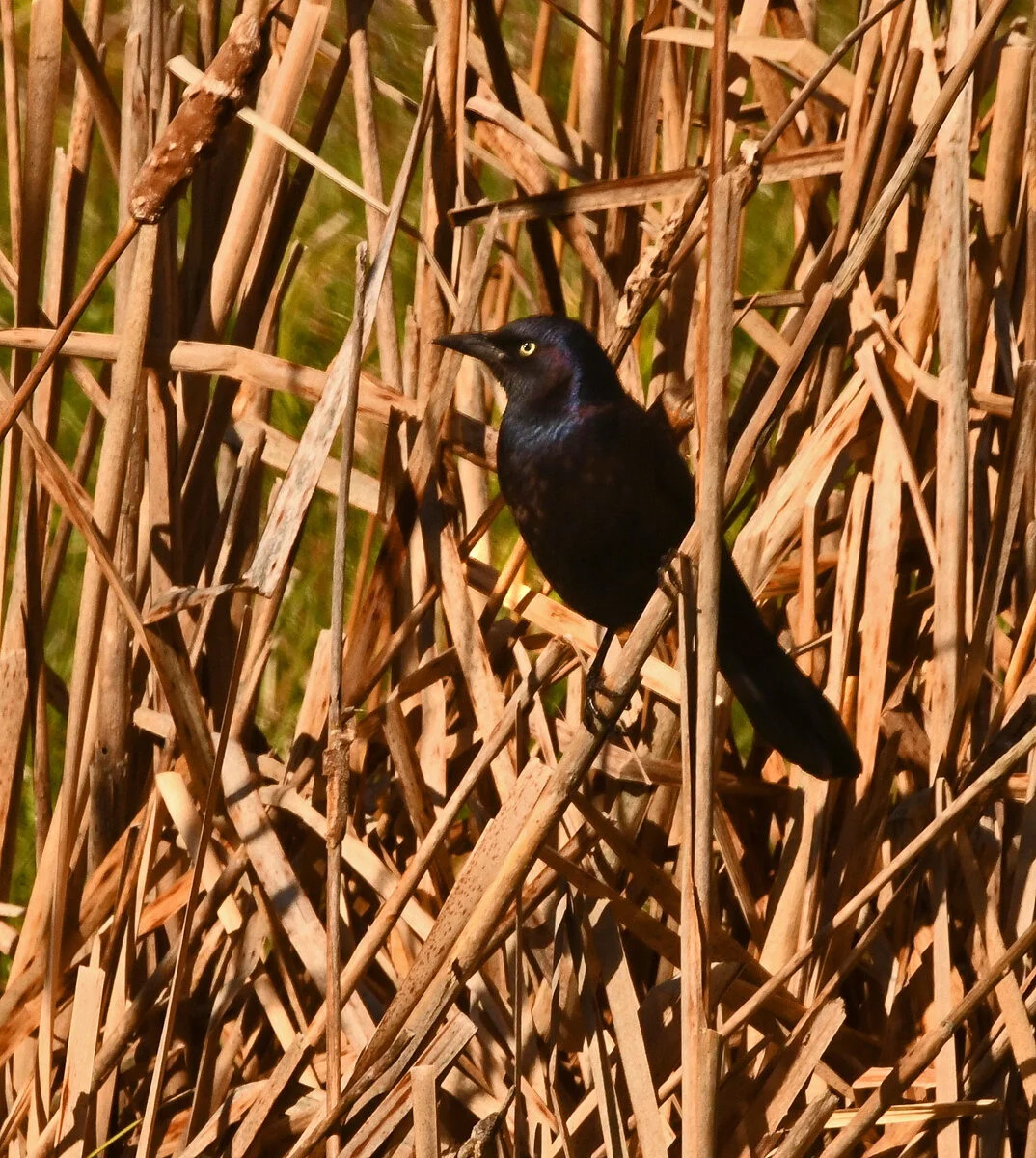
Many appear to be nesting or looking for nest sites deep among the cattails. Some people call these birds “blackbirds,” but they can glow with iridescent hues of purple, blue, or bronzy-brown, depending on the light.
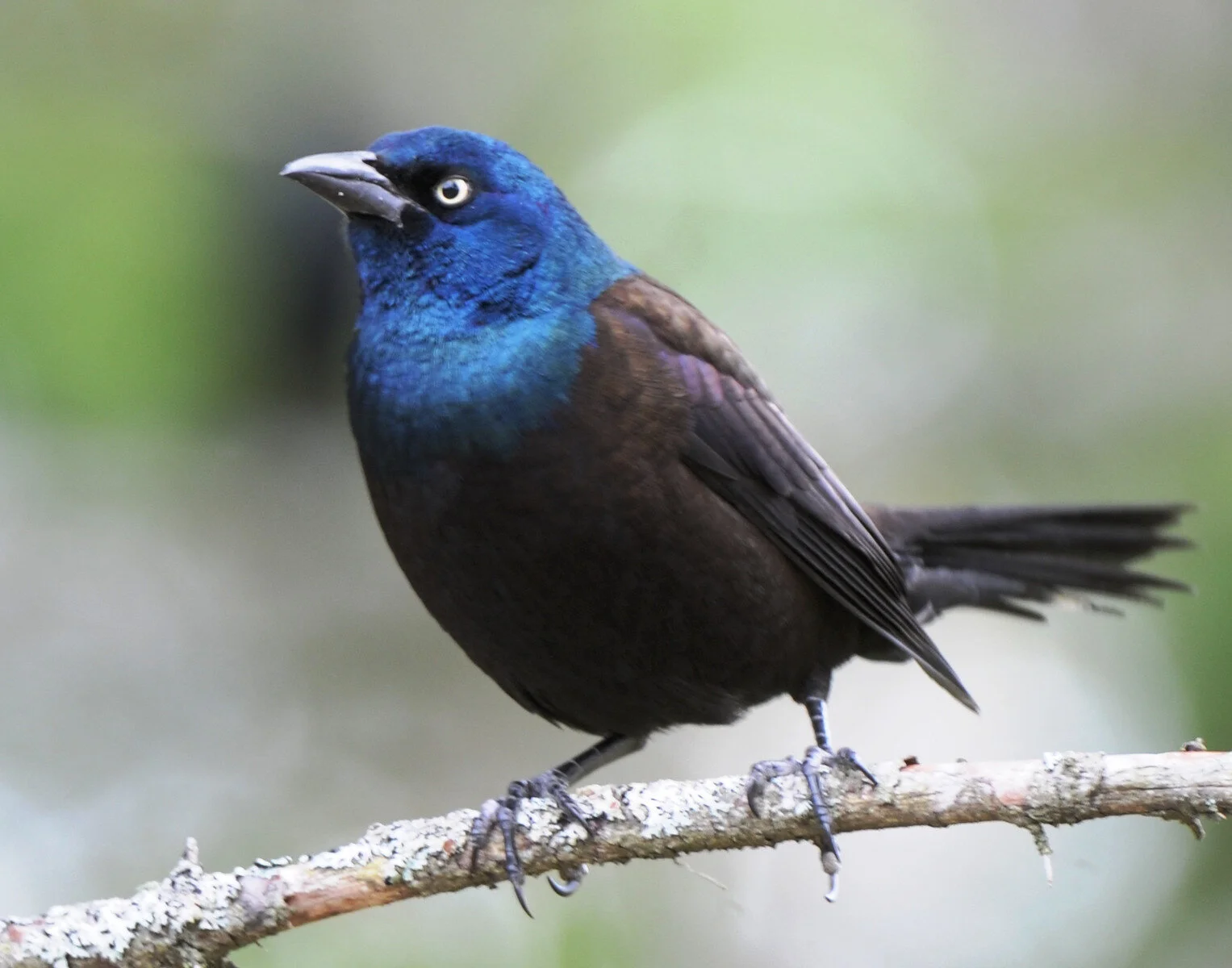
Leighton Archive Image
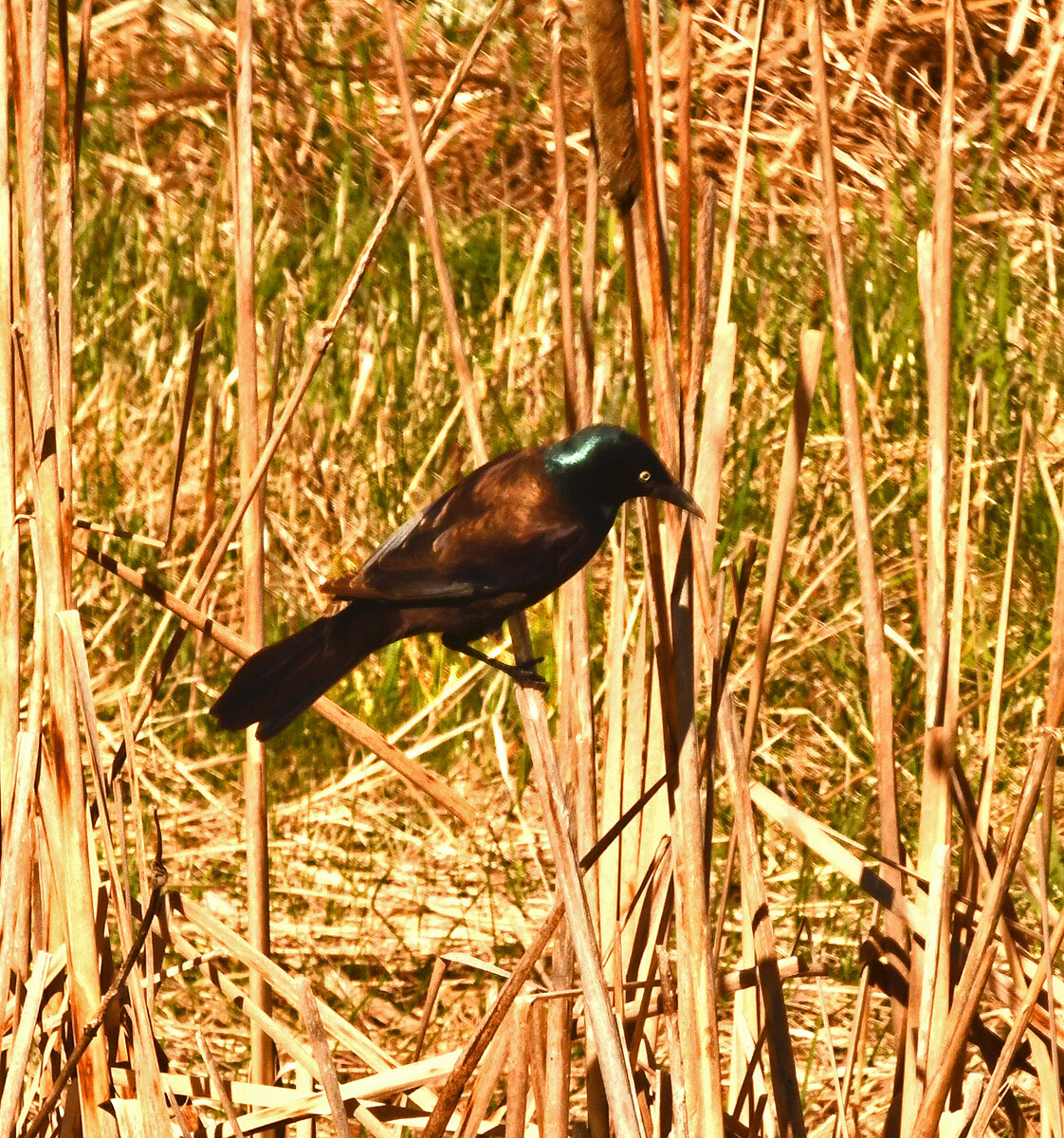
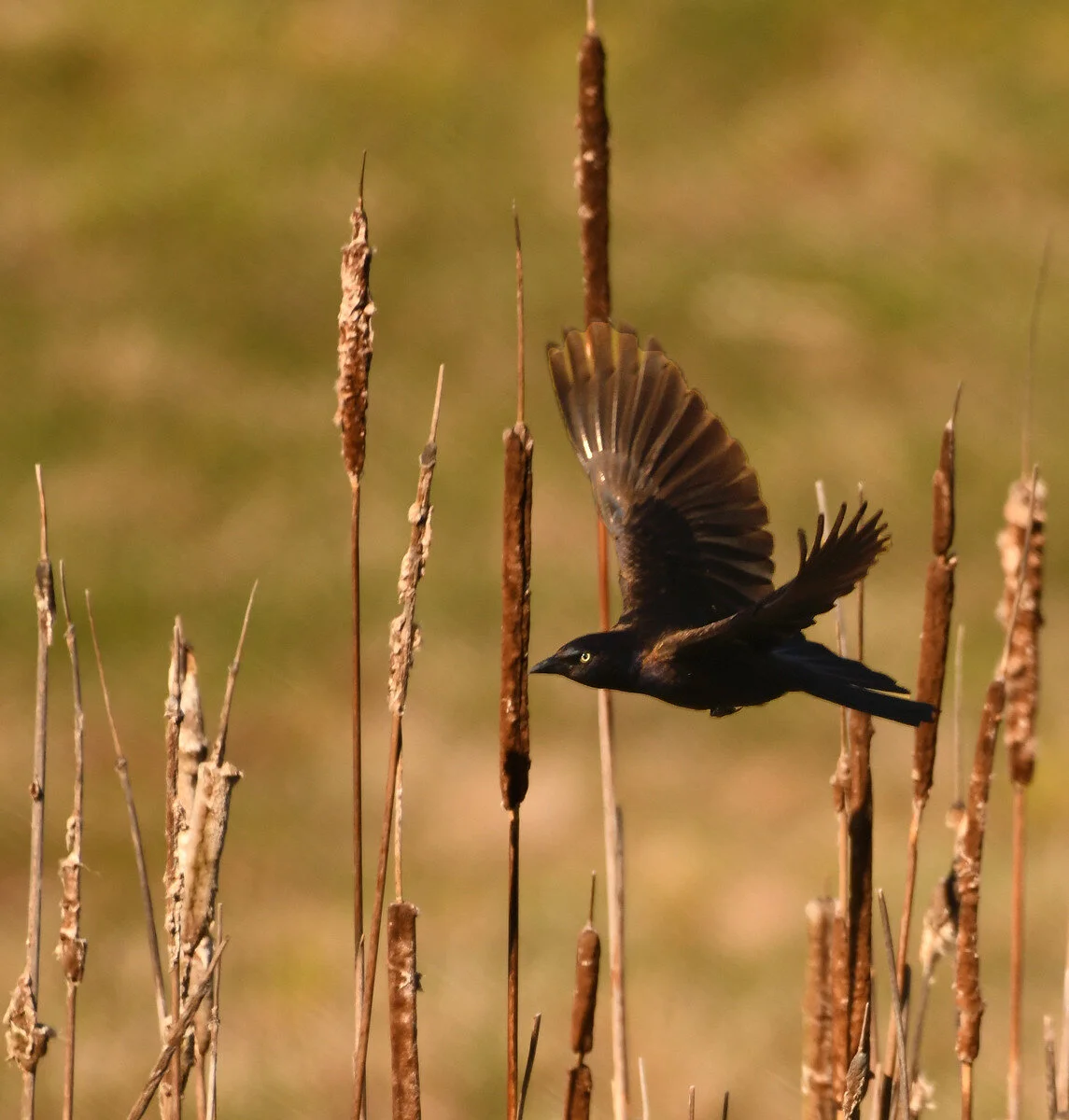
Their strange name reportedly comes from its Latin root, “Gracula,” which either referred to the European crow named a jackdaw or was transliterated from one of the calls made by Grackles. Grackles apparently will eat anything that looks like it has nutrients, including smaller birds and parts of food-caked wrappers left behind by tourists. (Brooklin, Maine)
Saturday (April 2) was beautiful to begin with. In the afternoon, that beauty became heavenly as a waxing gibbous moon sailed slowly through the blue sky above maple trees flowering in the bright sunlight.

Waxing gibbous moons usually rise after noon to give matinée performances on clear days. As you may know, “waxing” means getting larger; “gibbous,” from the Latin for humpbacked, in this context means a moon that is more than half whole, but not whole (full).
The red maple flowers are impressive now, especially the males with their long stamens that are about to pitch their pollen:

The less spikey female flowers patiently crouch, ready to catch the pollen in their catchers’ mitt stigmas. (Brooklin, Maine)
As some of you know, for almost a month, we’ve been monitoring a pair of Ospreys that are nesting nearby.. We know them well enough now to call them Ozzie and Harriet, rather than “the male” and “the female.” At first, they were enjoying domestic bliss yesterday morning, as you can see from this image taken then:

But, unbeknownst to them, danger was lurking. Another Osprey, which we’ll call Brutus, had been circling high above their nest for several days. (When the first Ospreys arrived last month, there were three of them, two males courting Harriett; she chose Ozzie. Perhaps Brutus was the other suitor.) Ozzie always flew up and ran Brutus off before he could get close to the nest. Yesterday, however, was different.
Brutus power dived silently and unseen out of the sun and barely missed scalping Ozzie, who pulled back just in time. Harriett flew away immediately; Ozzie recovered quickly and gave hot pursuit to Brutus, leaving the nest empty. It still was empty an hour later. To be continued. Here’s part of the series of images taken then within no more than two seconds, starting when Ozzie first sees Brutus bearing down on the nest and Harriet leaves the scene::

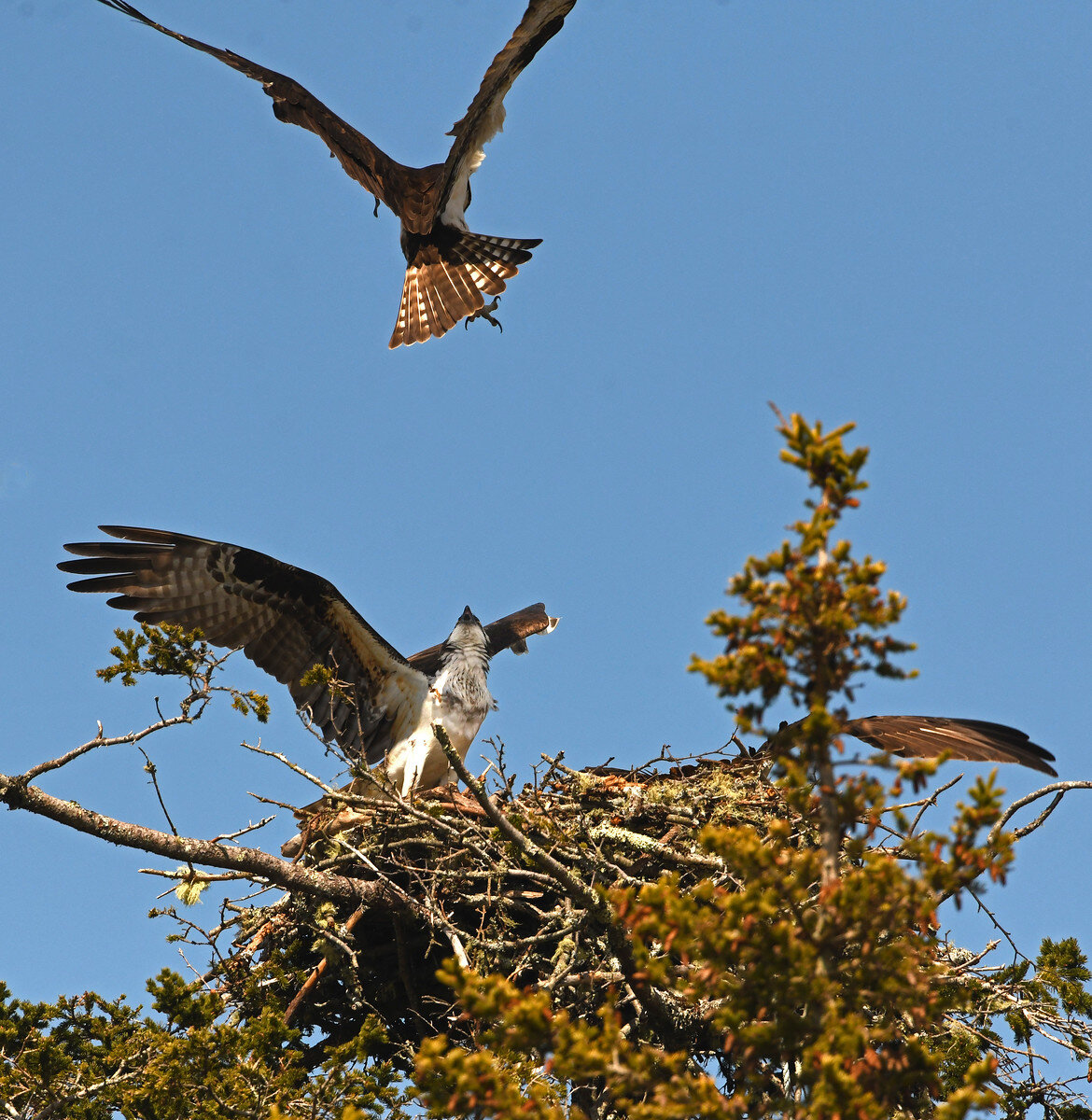


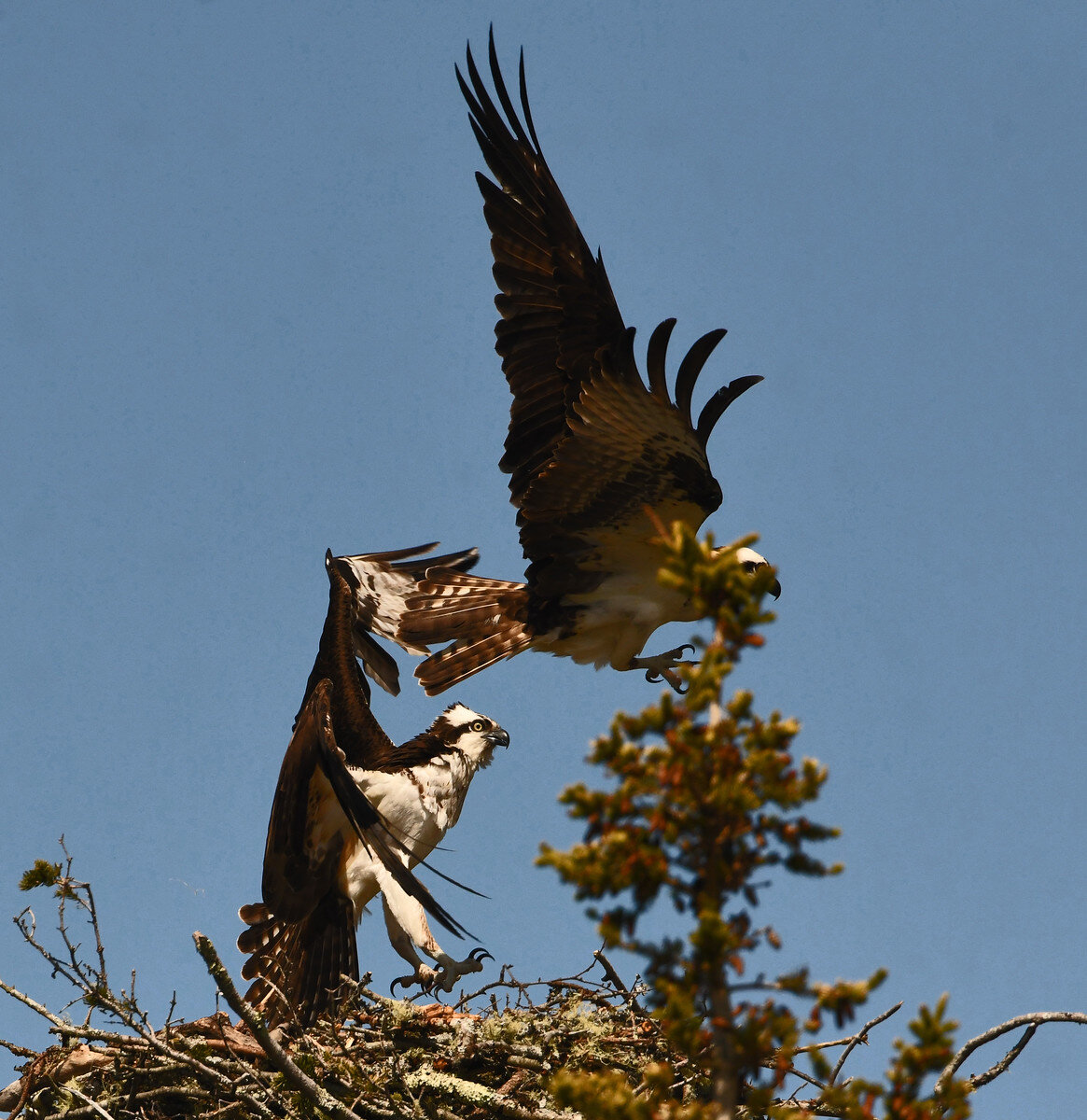

(Brooklin, Maine)
This rain in Maine stays mainly on the pane. Here, during yesterday’s rain, we glimpsed through a windowpane the beauty of a blossoming forsythia bush.

We also learned yesterday that this rain in Maine can stay mainly on the stern, in some circumstances:

We had to get wet to admire the above composition of a Brooklin Reserved Parking space. (Brooklin, Maine, with apologies to Alan Jay Lerner and Frederick Loewe.)
If April showers bring May flowers, we’re going to be buried in flowers soon. Precipitation was the headline for April this year — we had well more than average. The skunk cabbage spathes in the bogs thought it was wonderful, but the rain chains were overcome, and the last of the year’s snowstorms — we hope — reminded us that we were in Maine.

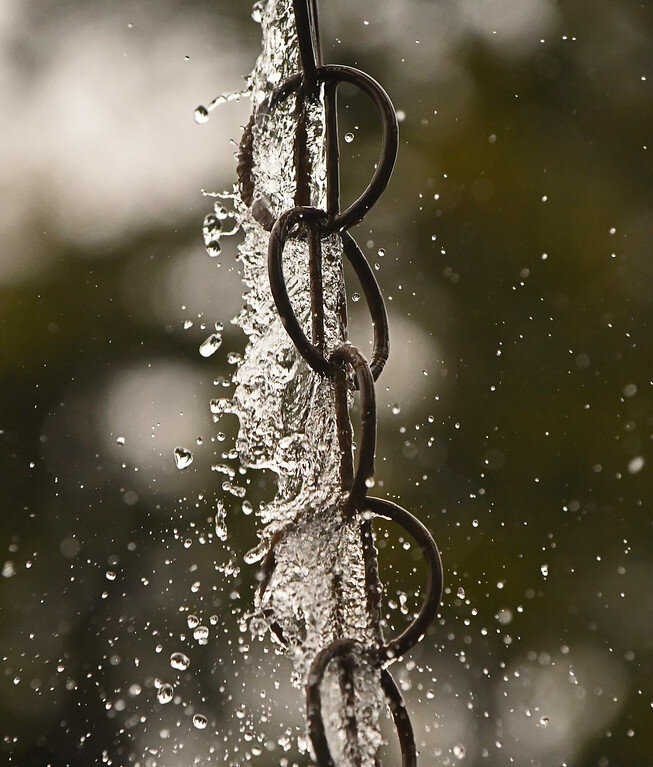
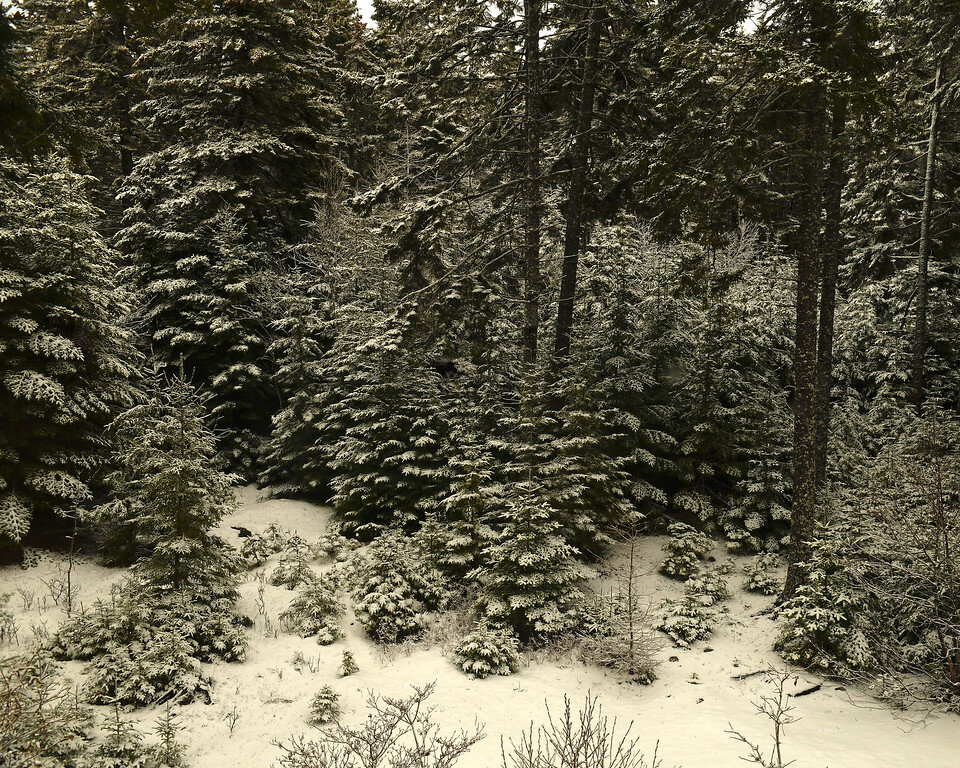
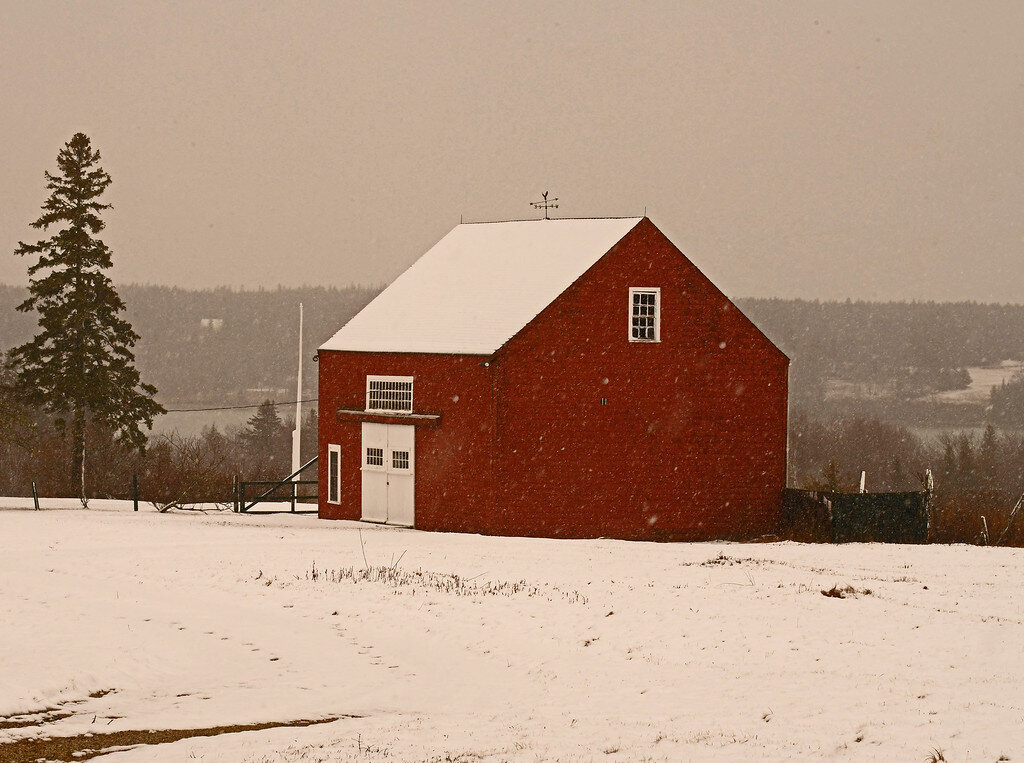
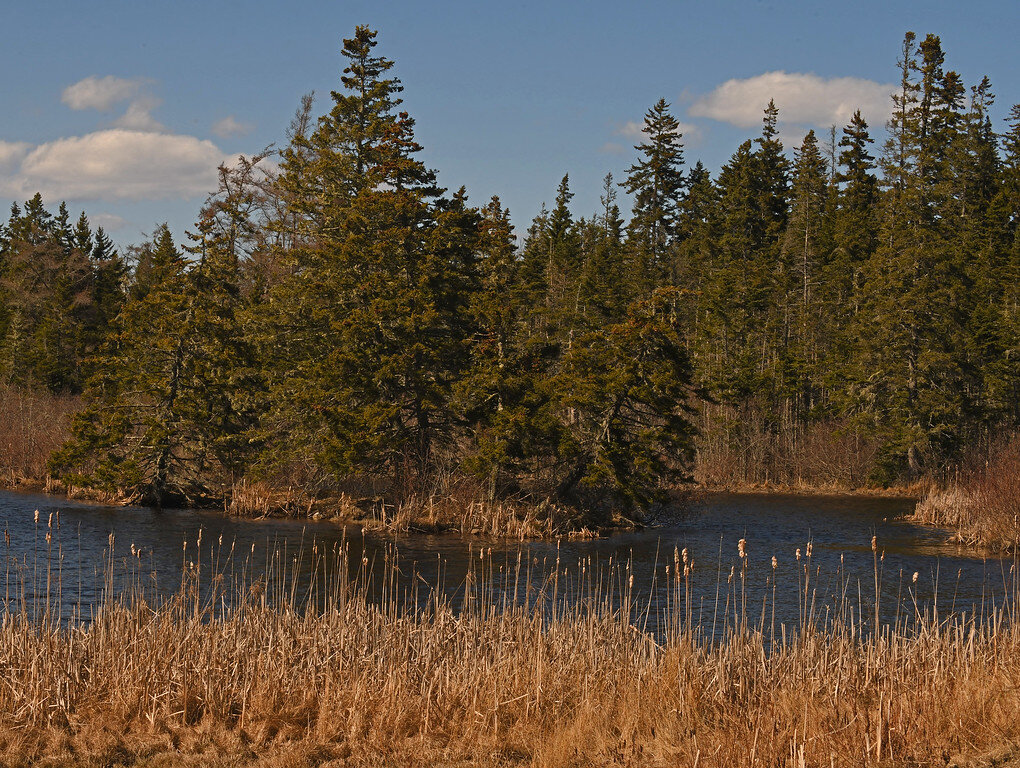
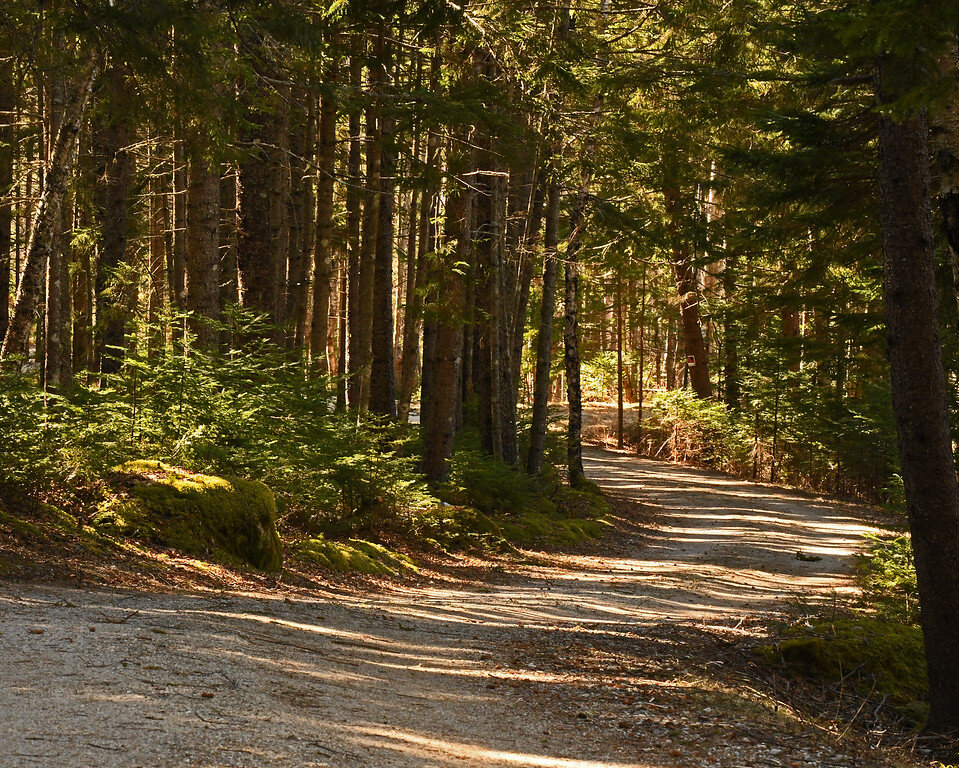
However, April delivered its fair share of beautiful days here. We enjoyed clear vistas over Blue Hill Bay to Acadia National Park, very full marsh ponds, sun-speckled country lanes, and balsam-scented woods.


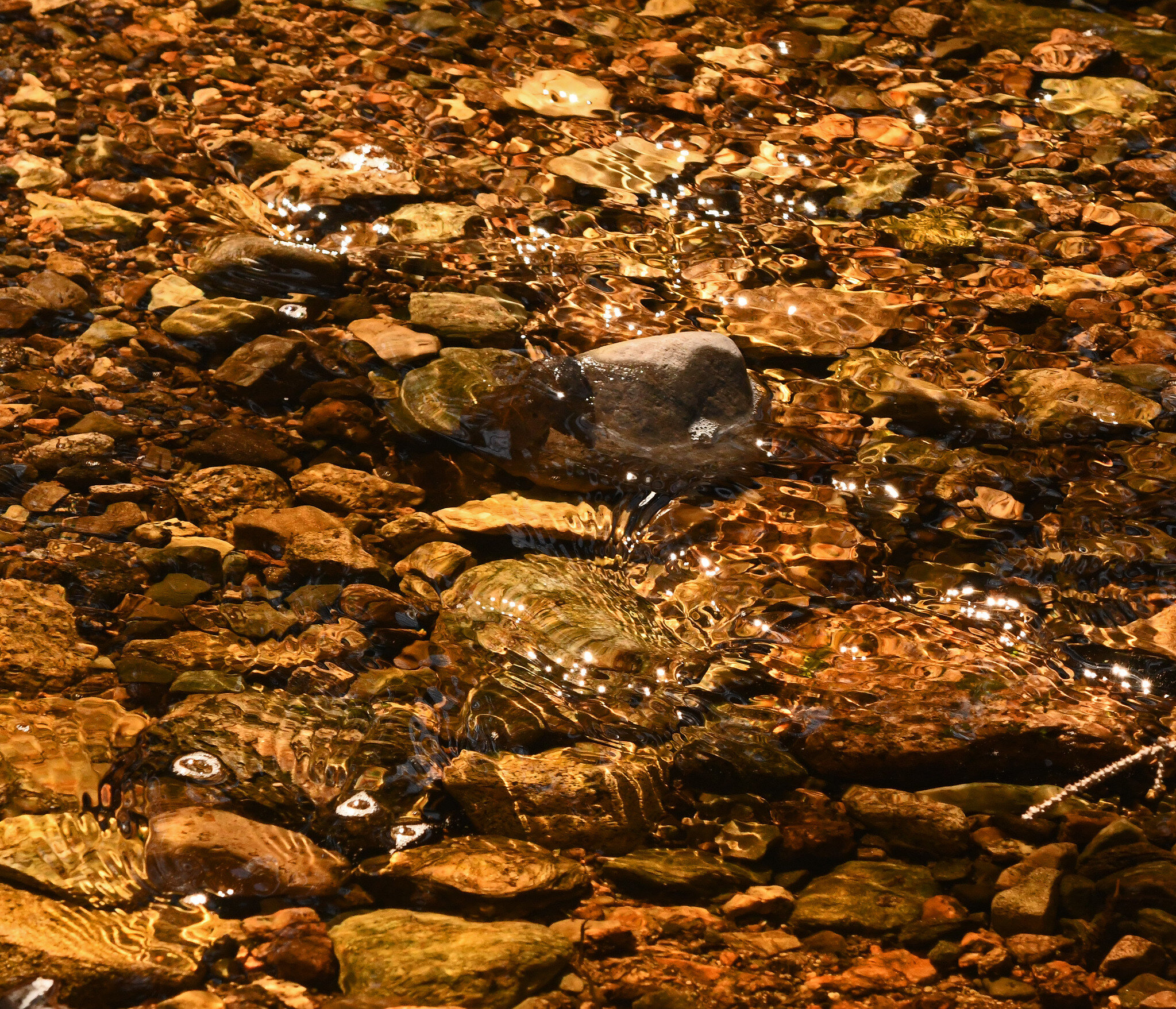
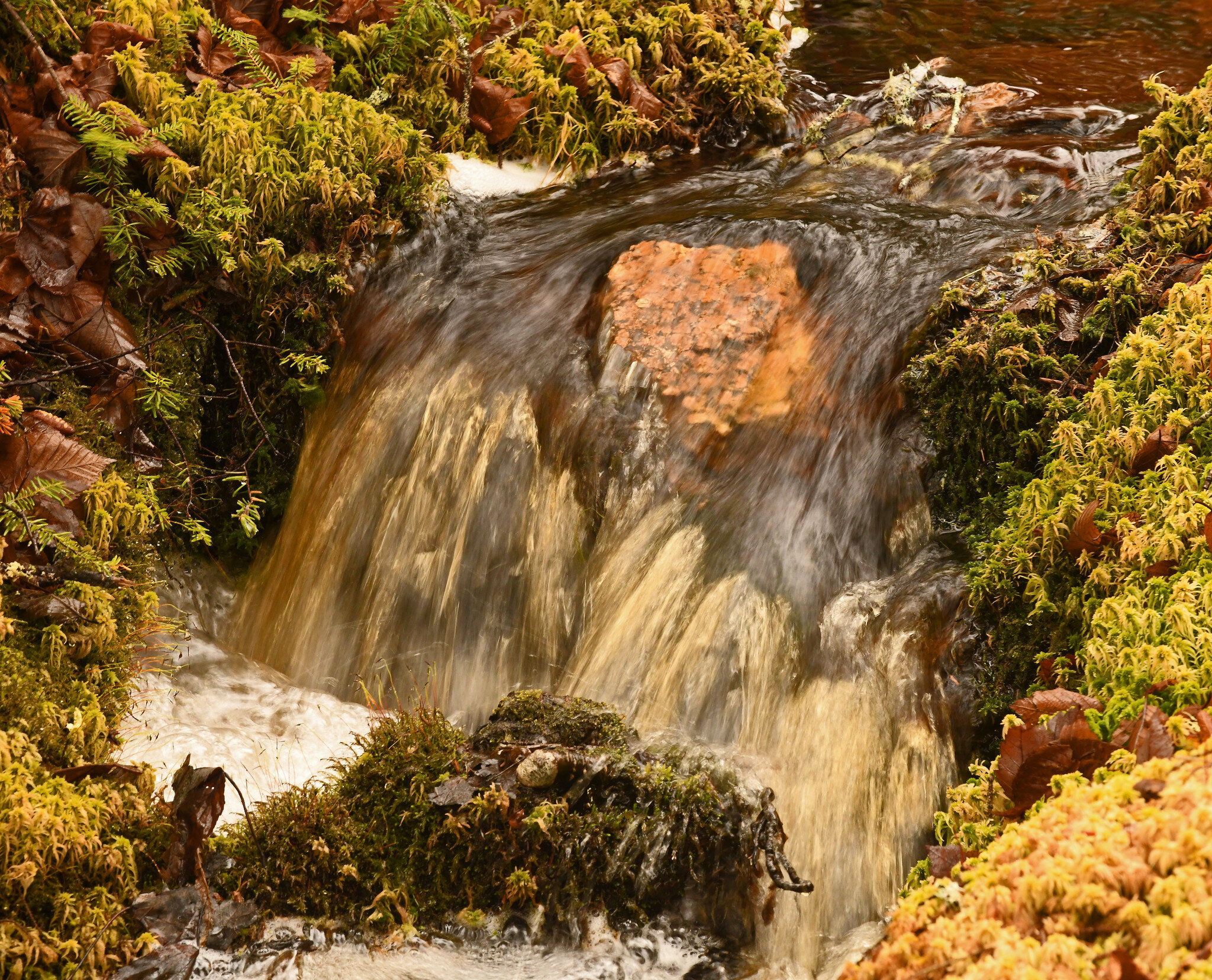
The rain-swollen streams hurtled through their mossy banks in April, providing a little day music.

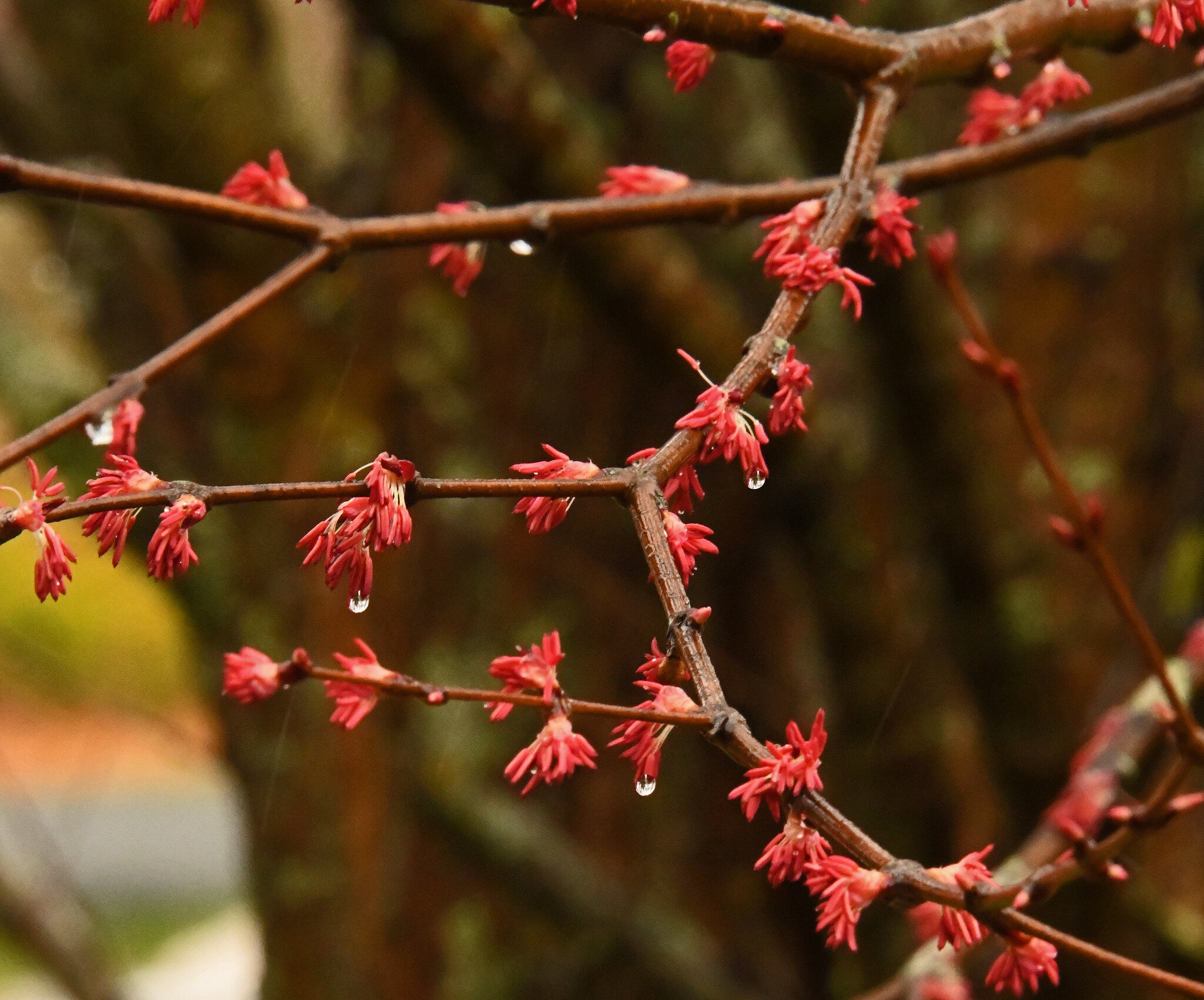
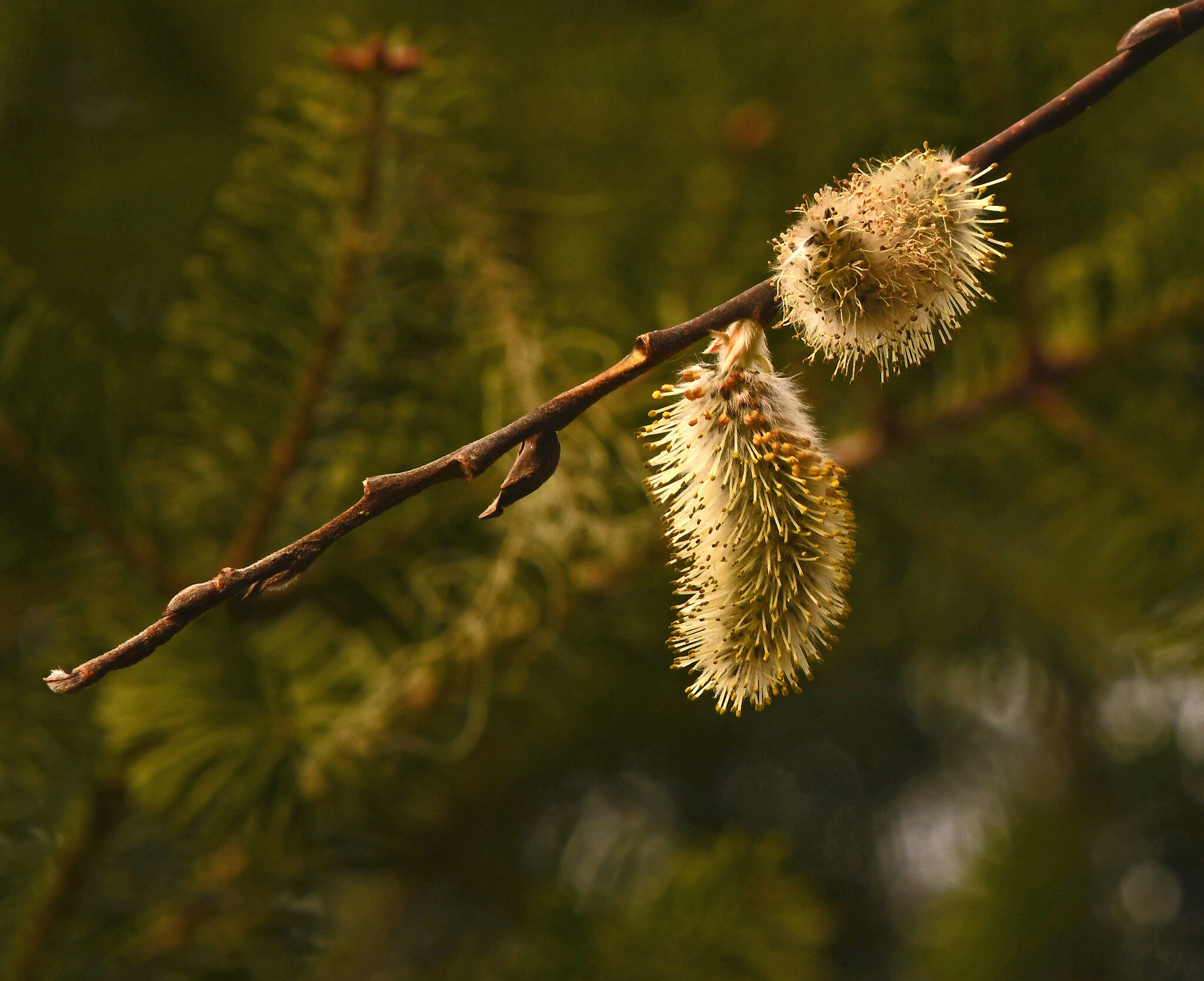
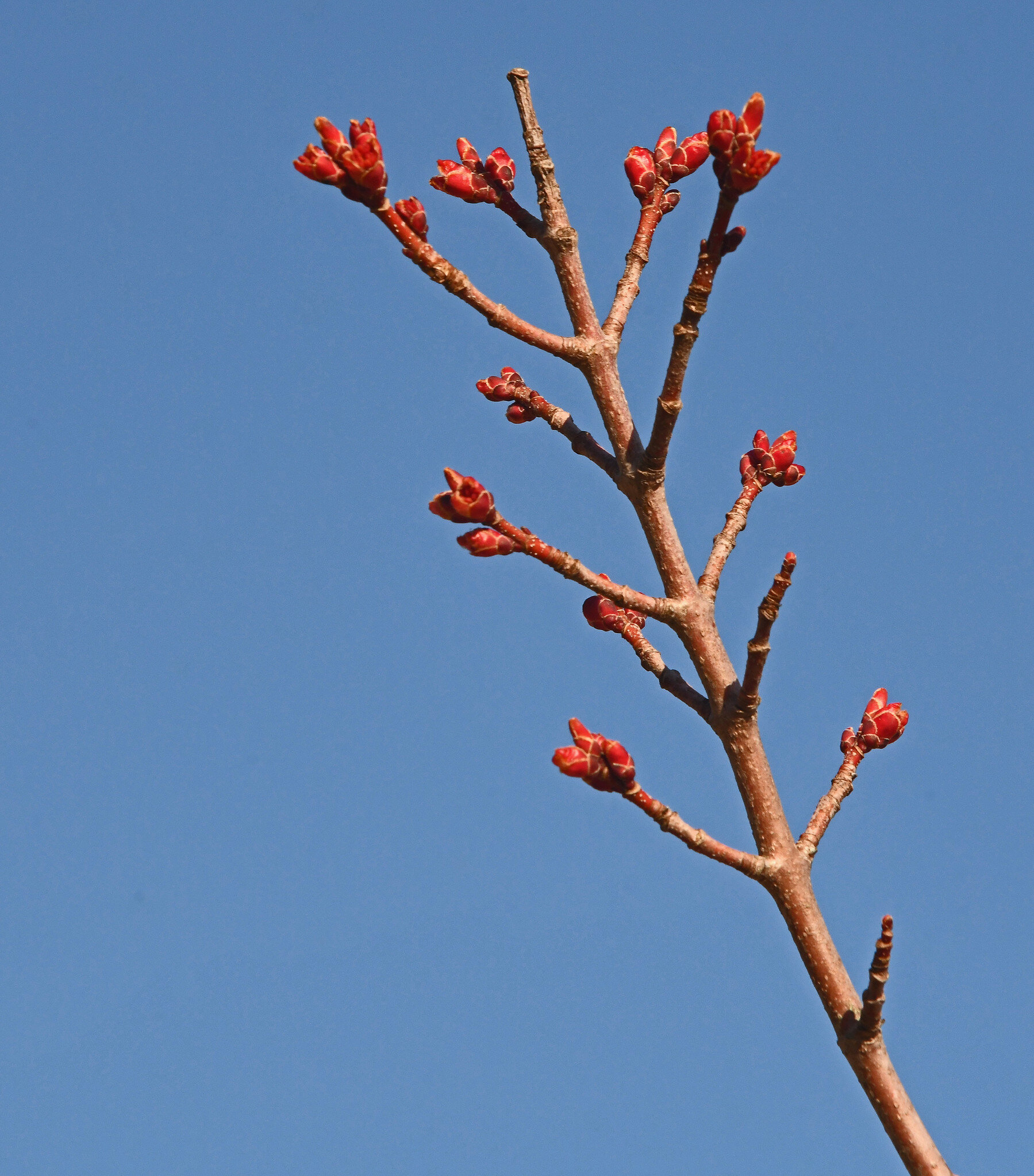
There are no leaves here in April, but it is the month when early-budding plants give us a promise of lush times to come, including katsura tree flowers, pussy willow catkins, and red maple tree buds. And, of course, there were the blossoming forsythia plants that are almost at their peak during April.

There were virtually no spring break tourists here during the ongoing covid-19 pandemic. However, we did get some good-looking winged visitors on their way north. Flocks of big-beaked surf scoters and big-necked Canadian geese were among them.
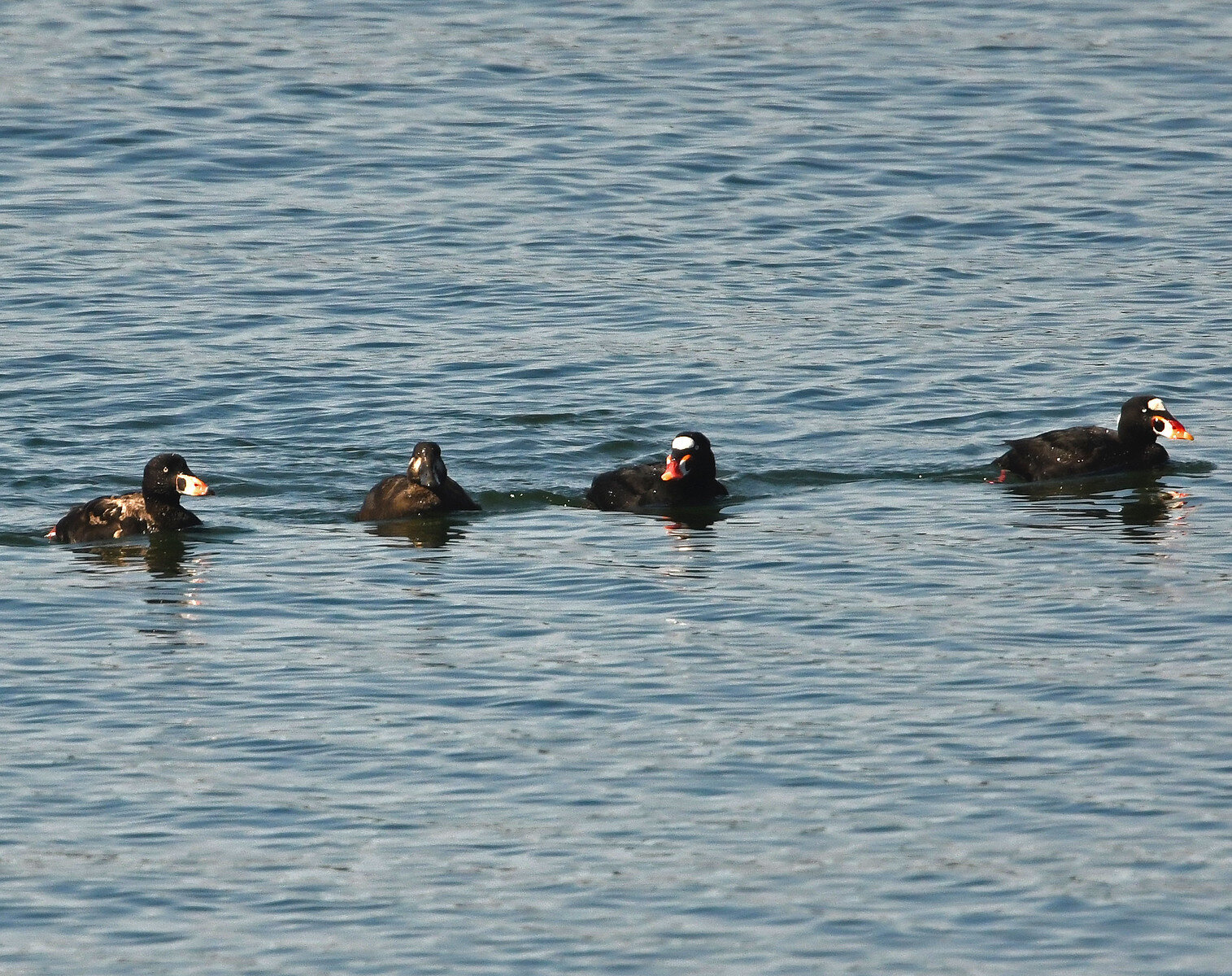
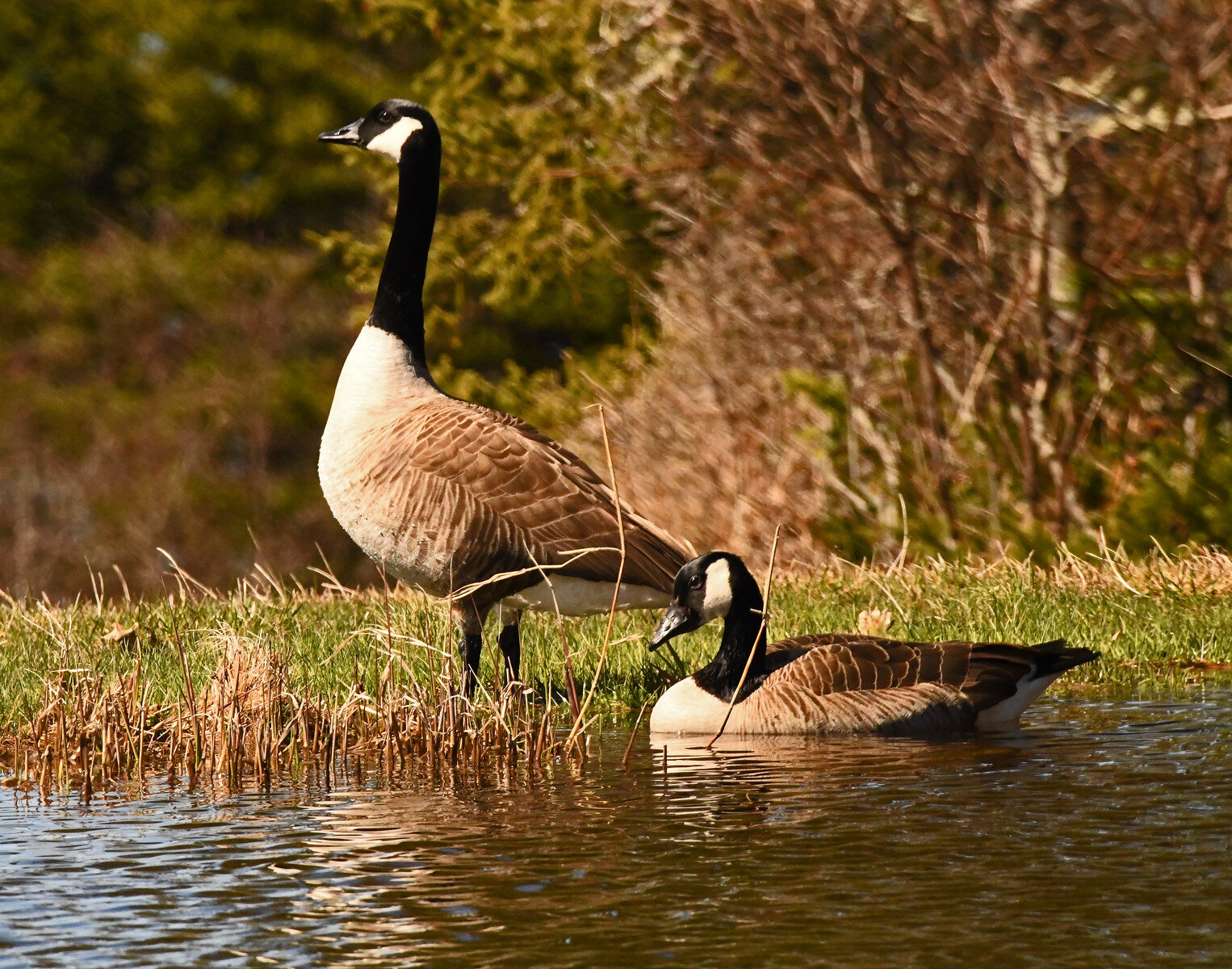
But, we were most grateful to see our annual winged summer residents, small and large, that came north again to nest among us. Those in the small and unobtrusive category included Eastern Phoebes.

In the large and loud category, our spectacular ospreys returned in April to their summer residences here. They displayed courting behavior, such as males feeding fish to begging females, and extraordinary aerial maneuvers. It looks like we’ll again have some nestlings in May.

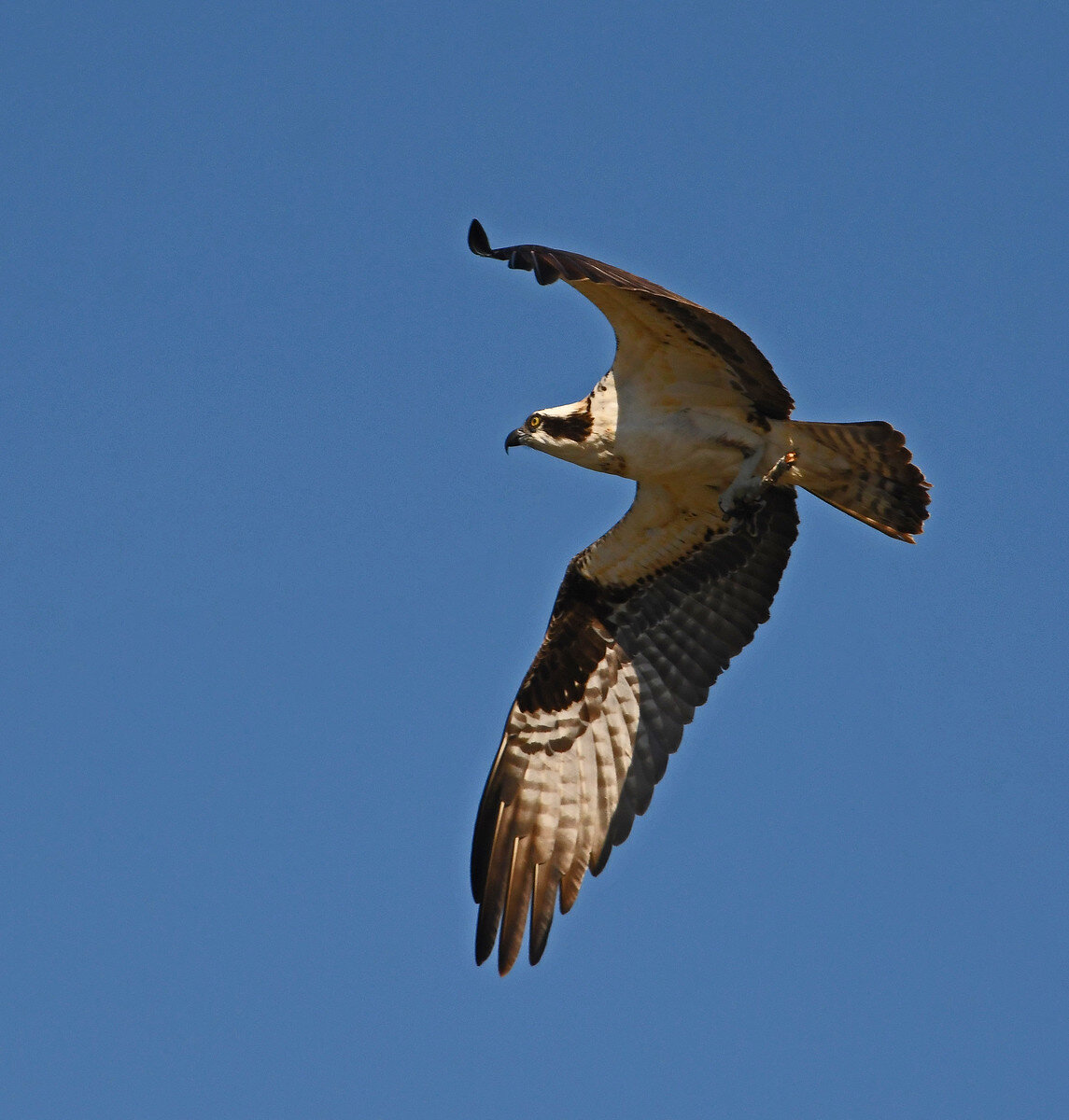
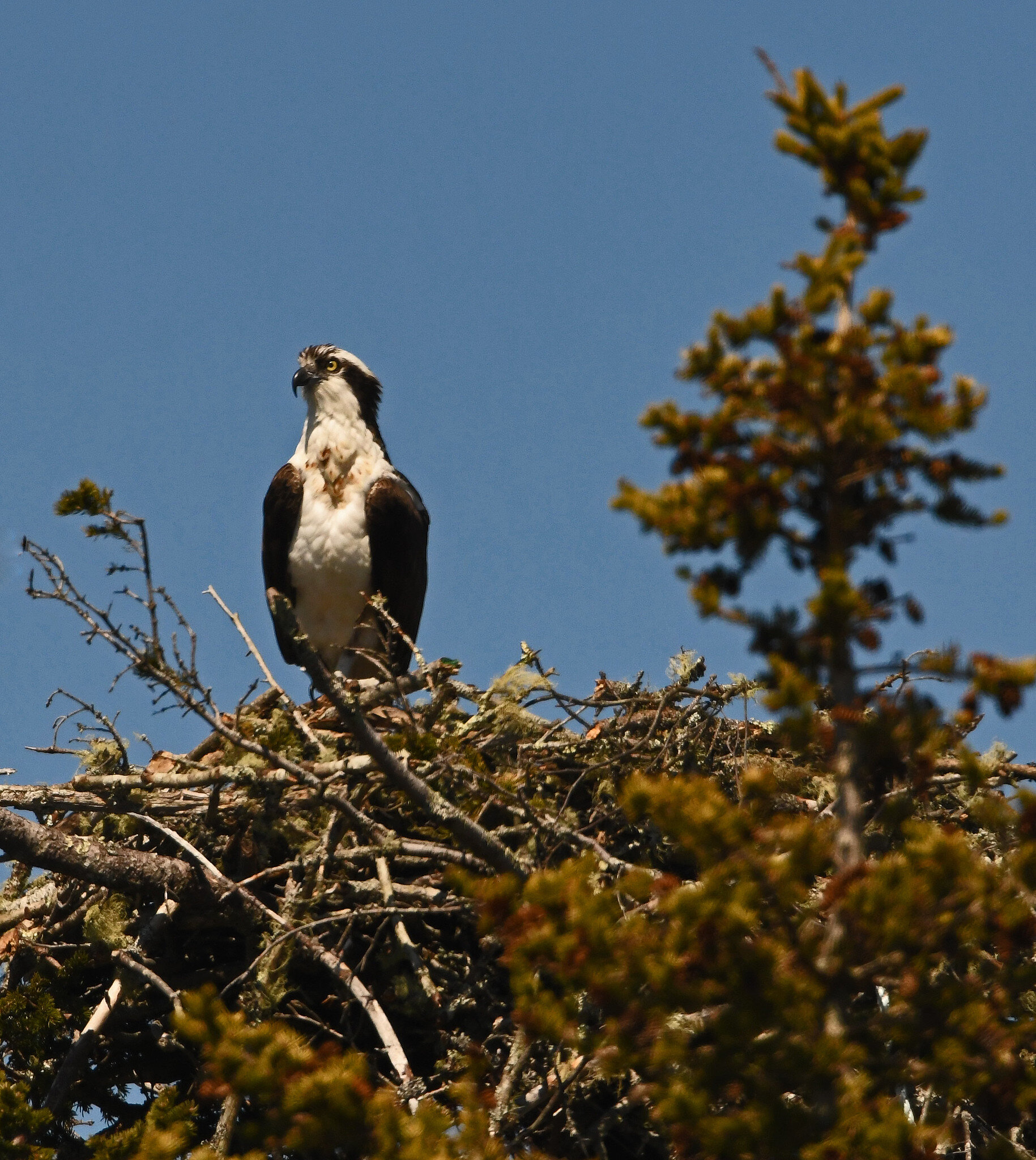

April also is the month that our full-time white-tailed deer residents get frisky, frolicking in the fields and jumping large stone walls just for the hell of it.

April winds here were much stronger than average, often producing white caps in usually placid Great Cove. But, we also had still days when the sea was virtually motionless.
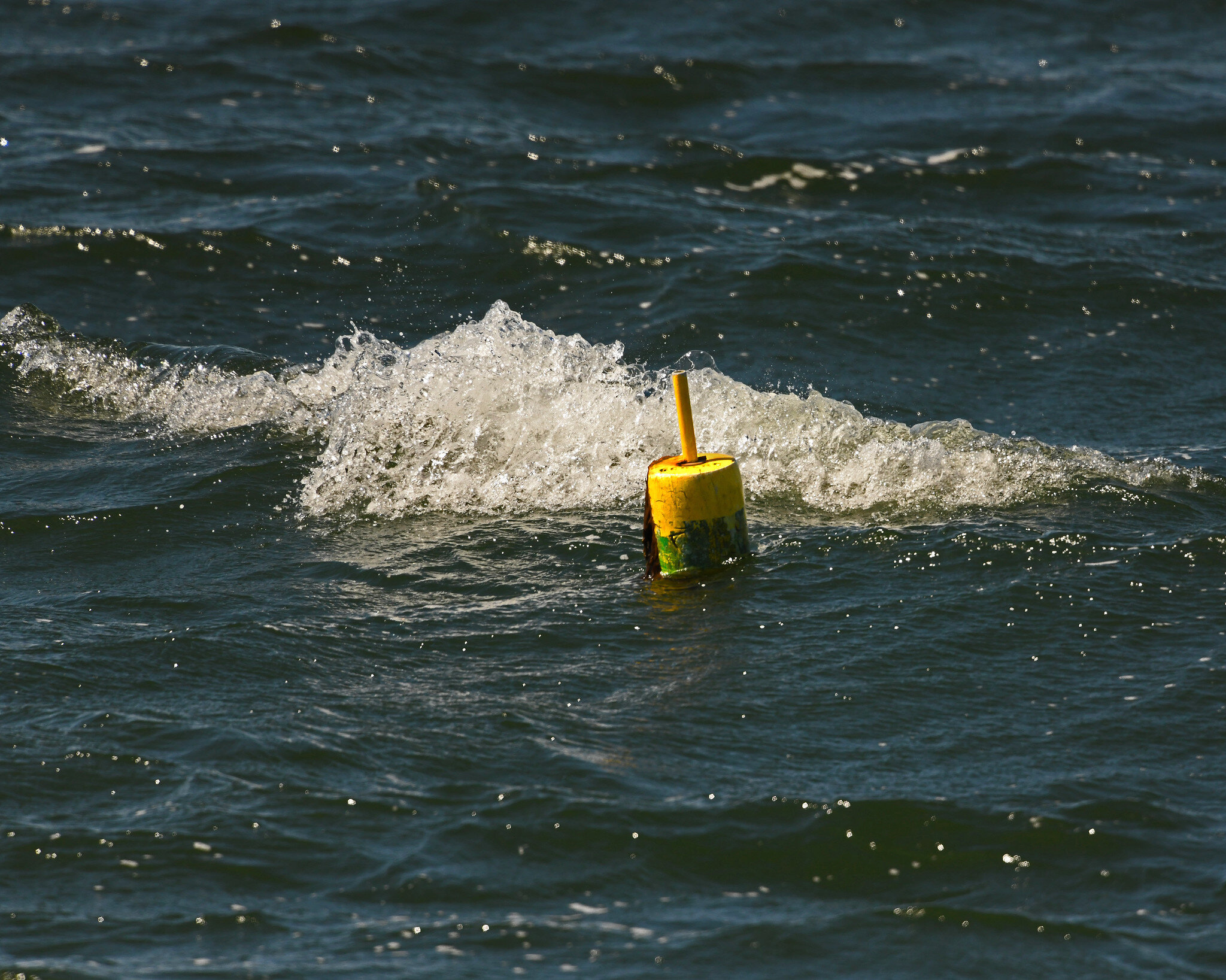
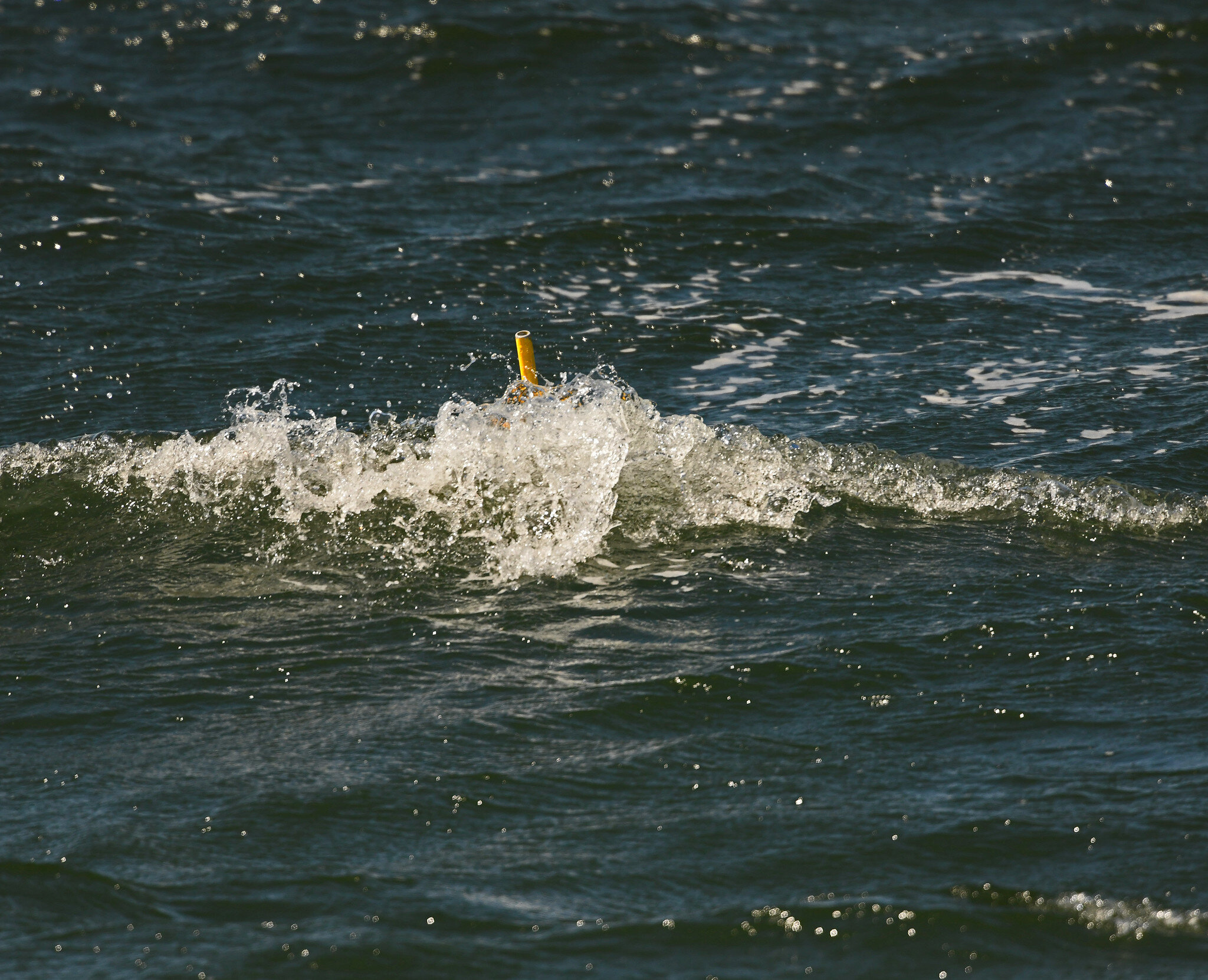

Brooklin’s famous WoodenBoat School cancelled it’s early summer classes due to the virus. The gear for its fleet of small boats remains waiting for good times that may not come this year.

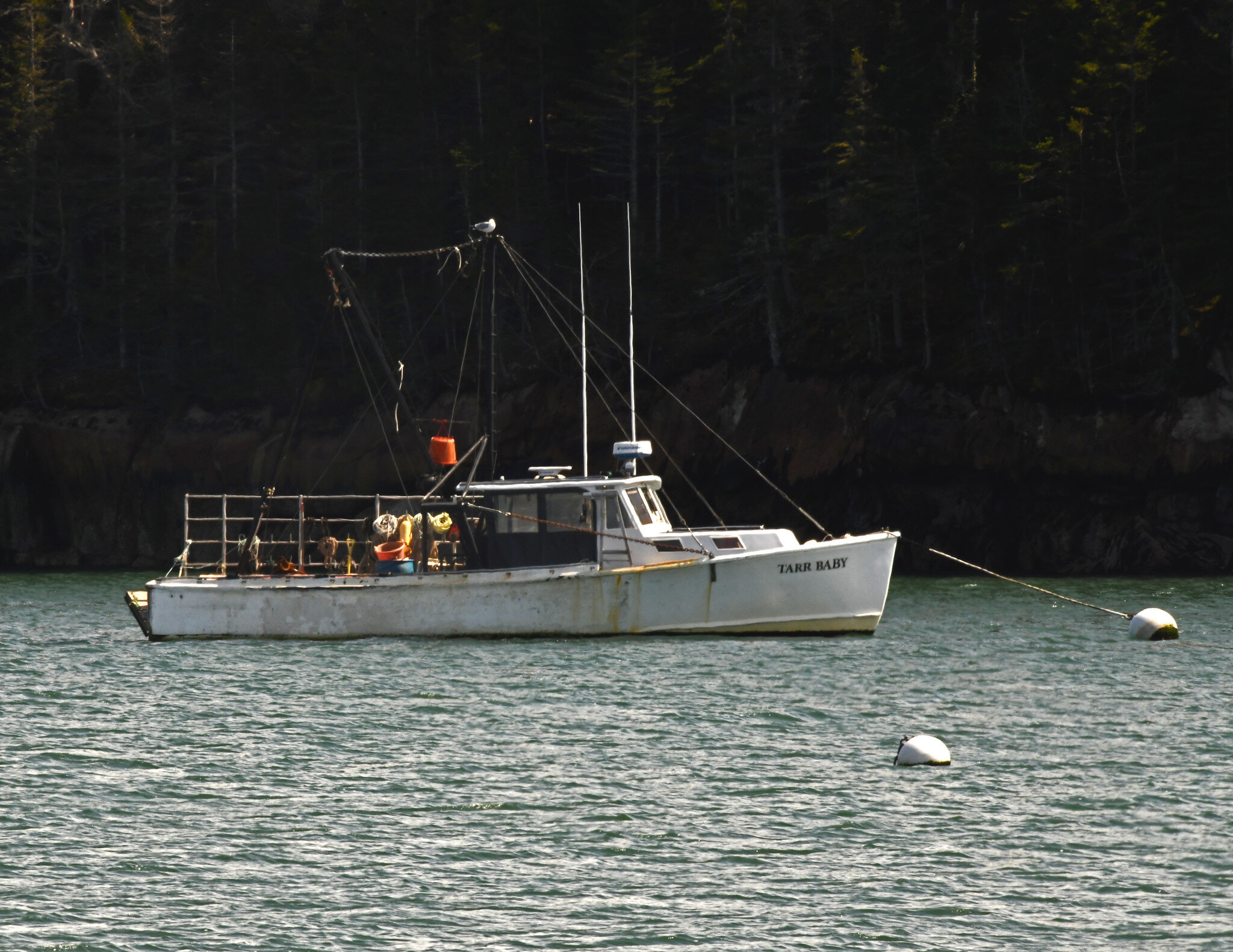
The scallop fishing season ended in April and the fishing vessels started dismantling their scalloping equipment, converting for the summer lobster season — if there is to be one. But the season for catching migrating elvers (glass eels) continued with Fyke nets at stream mouths being swept into graceful forms by the high tide currents.

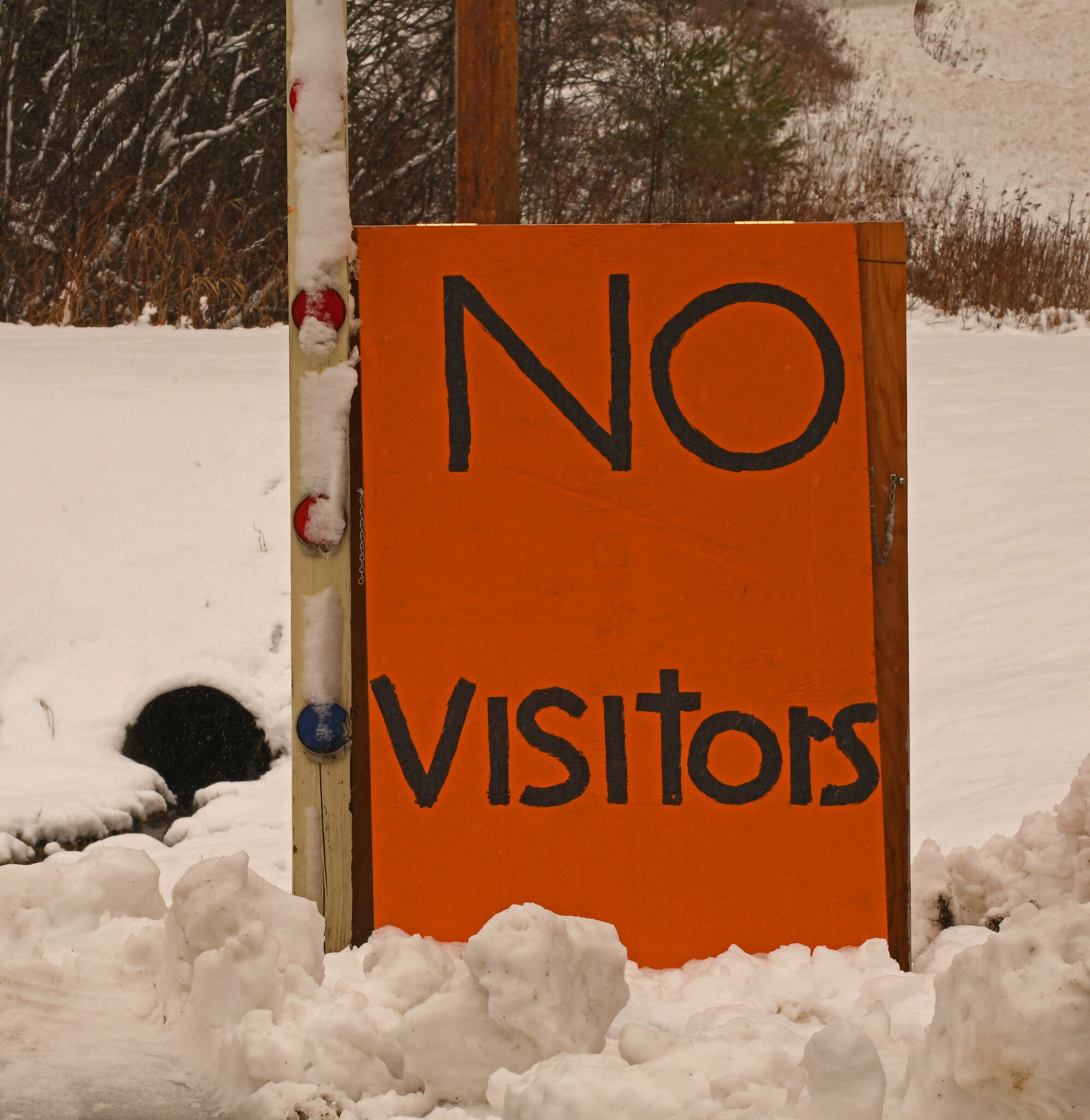
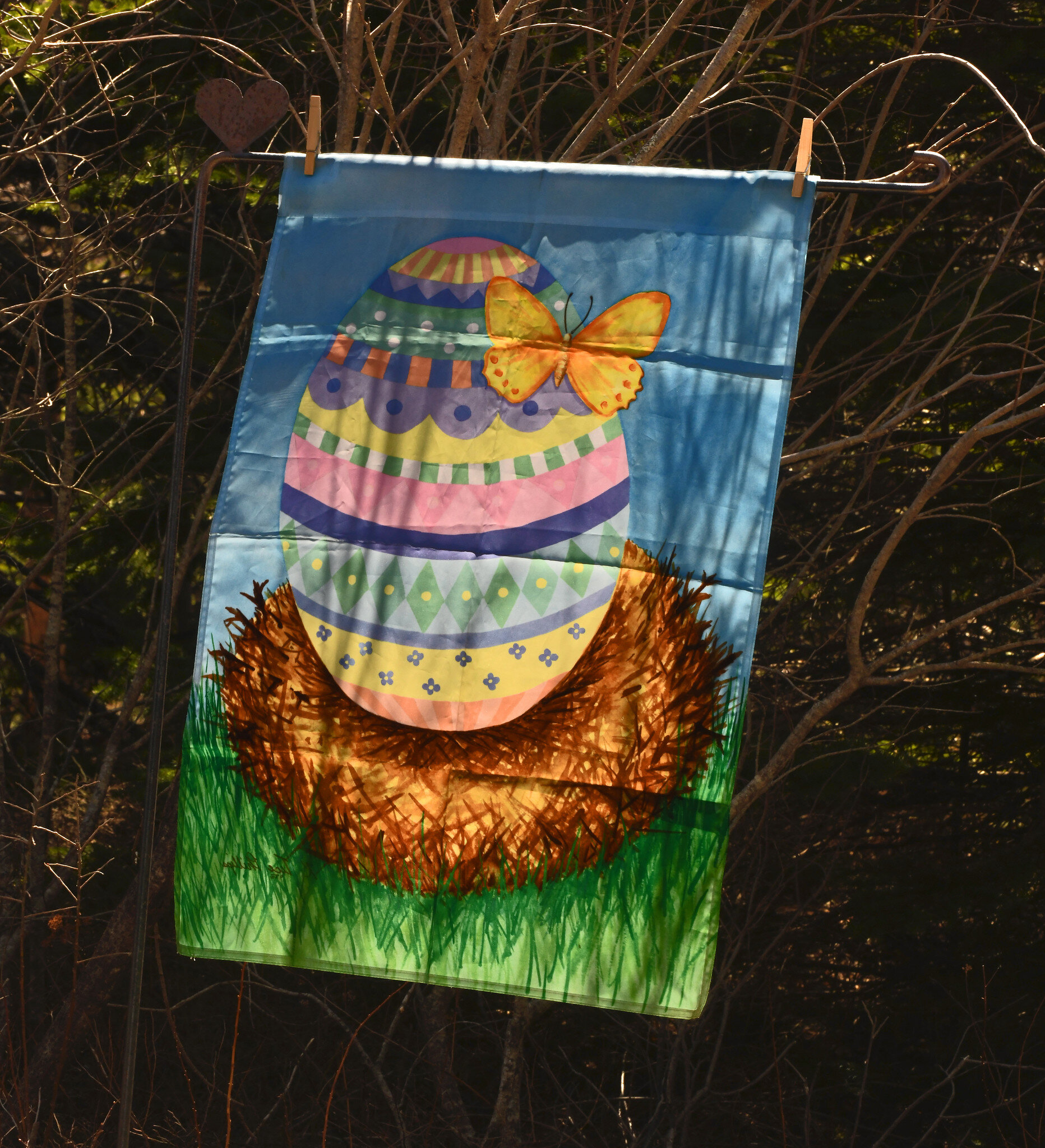
Of course, April is the Easter month, the month of renewal and hope. But, this year it also was the month of harm and fear, as the plague reached us.. The two road signs below tell a tale of two Aprils here — one is still in front of a long-term care facility in Blue Hill, the other was beside a driveway in Brooklin:
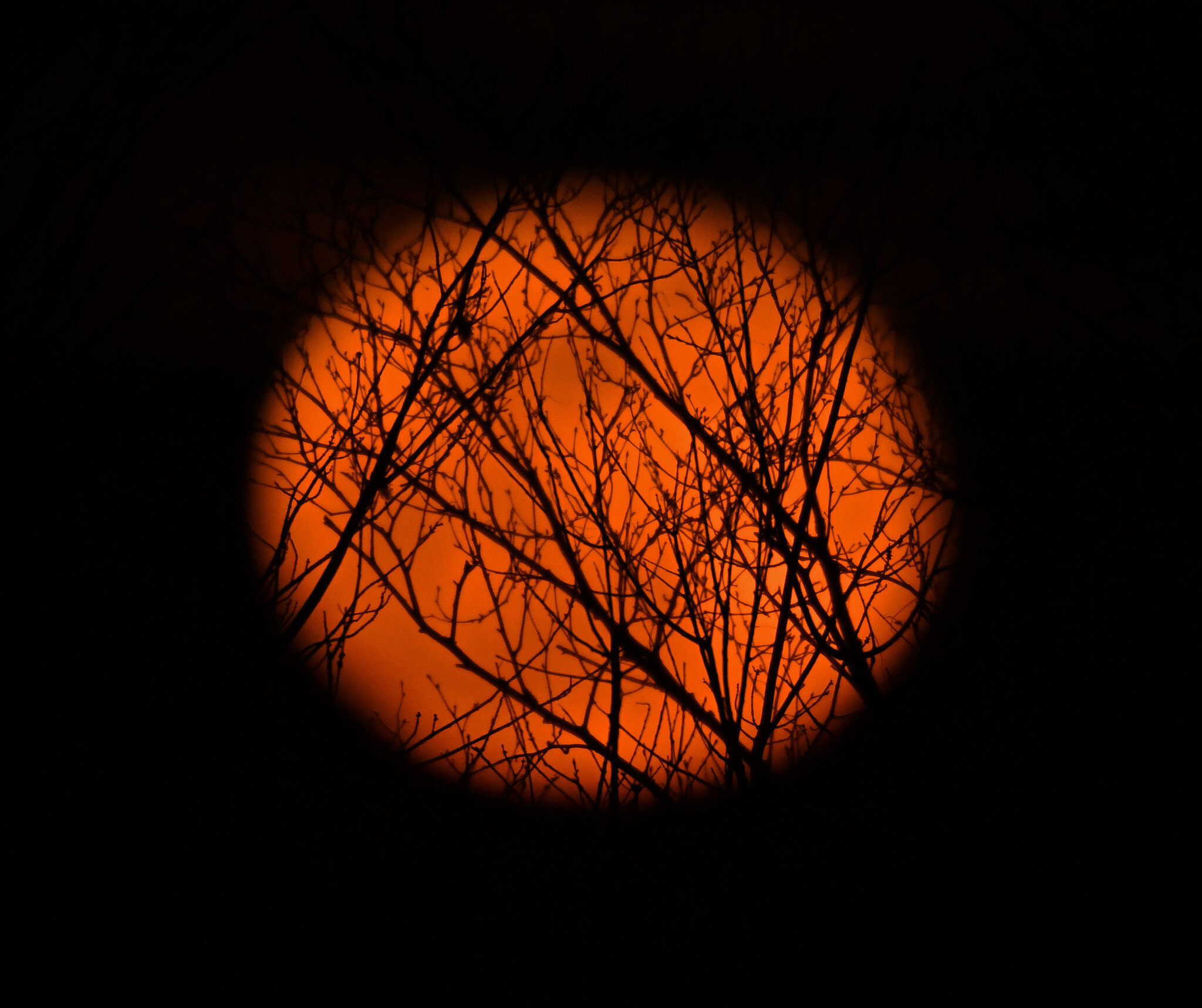
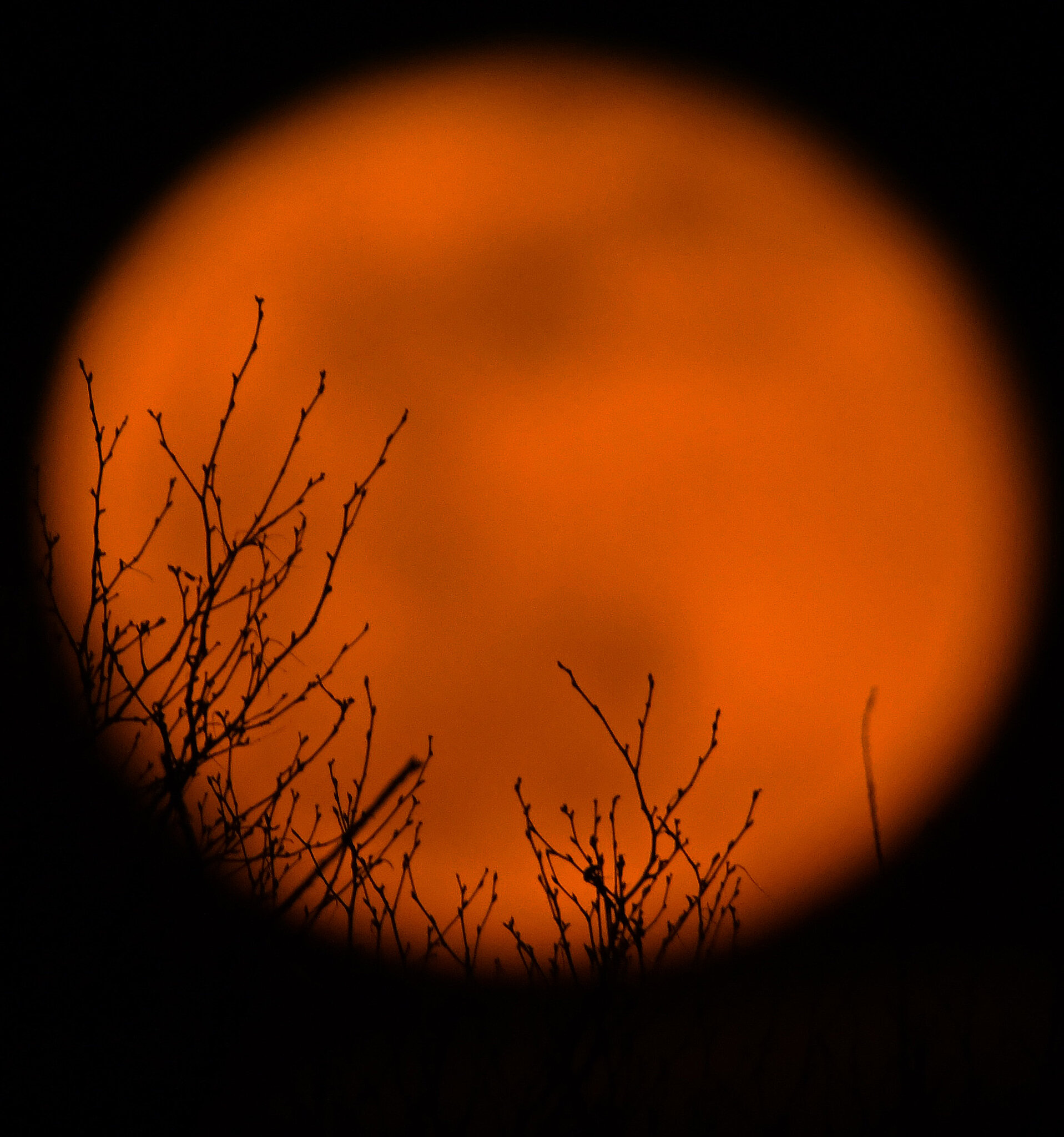
Finally, perhaps the most dramatic April moment was when the month’s full moon, a “super moon,” rose big and orange out of the horizon and shot into the sky like a molten cannon ball:

(Images taken in Brooklin, Blue Hill, and Surry, Maine, during April 2020)
Is that one of those famous birds? Let’s see: About seven inches long? Check. Gray-brown head and back with white belly? Check. No eye-ring? Check. Fly-catching whiskers? Check. White wing bars? Check. Bobbing tail? Check. Raspy voice that keeps repeating its last name? Check. On or near a man-made structure? Check!!!
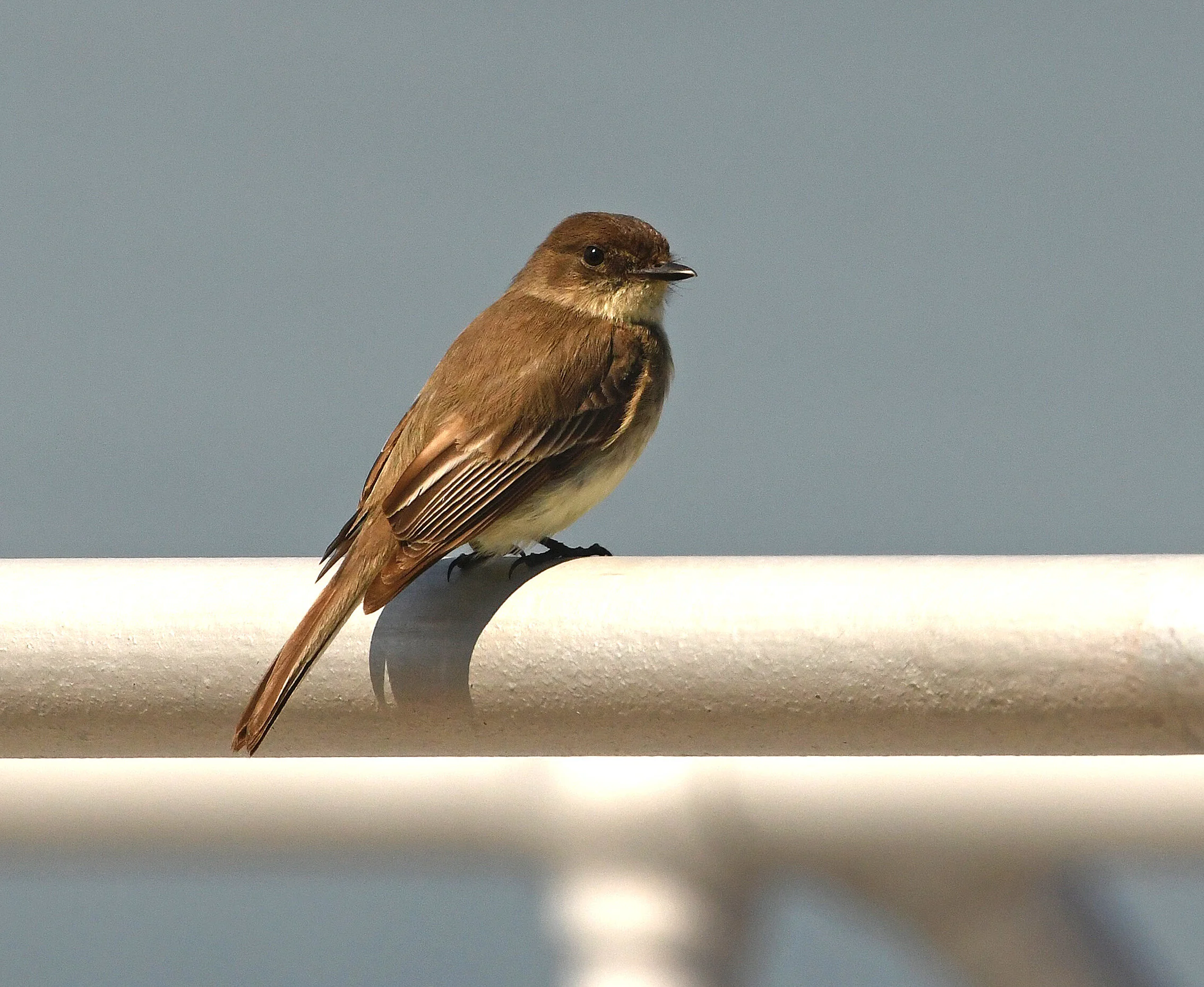
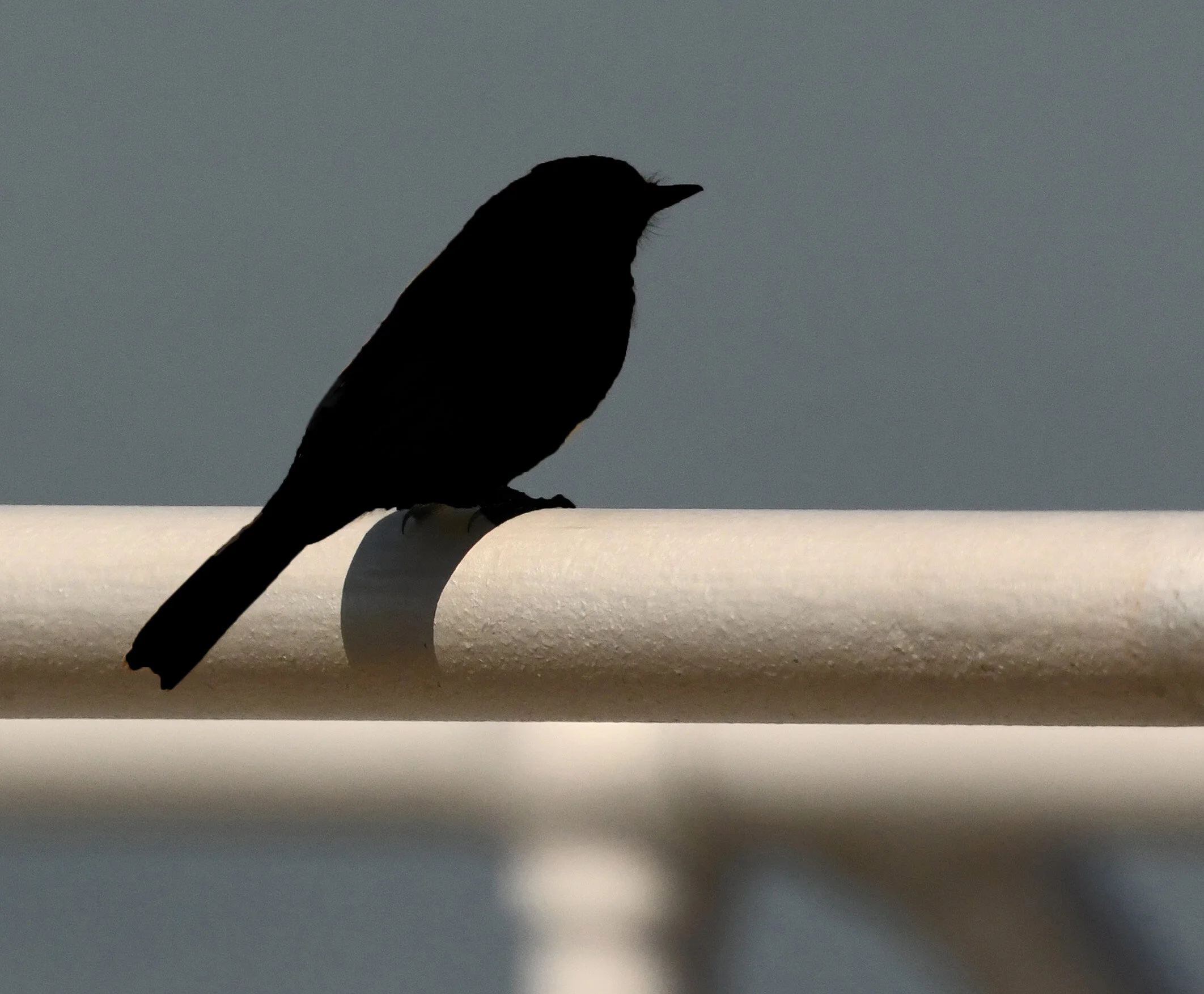
Yes, it’s an Eastern Phoebe, one of our earliest spring migrants and one that builds nests in man-made structures as well as in the woods. He or she (only Phoebes can distinguish a perched him from a her) was taking a rest yesterday on the railing of a pier in Great Cove. S/he and her/his mate had just finished inspecting the underside of that structure for a possible nest site. Here’s a silhouette that we created for identification:
Eastern Phoebes are famous for a 19th Century report on their being the first bird species banded in North America. The reporter and bander was an 18-year-old young man in Pennsylvania, but not just any young man. He was none other than the artist-ornithologist John James Audubon performing an experiment in 1804. According to Audubon’s account (which some dispute), he used silver thread to band young Eastern Phoebe nestlings and documented their return to the same area the following year. (Brooklin, Maine)
(Posted on FaceBook April 29, 2020)
The Maine scallop dredging season ended in March. But, the scallop diving season is still open until the end of April and a few vessels are in our coastal waters with divers aboard who hand-harvest the more expensive “divers scallops” from the sea bottom.
Some divers dive off the backs of the same vessels used for dredging during that season: lobster boats converted into dredgers with masts and booms and other bottom-sweeping gear for harvesting scallops. However, some divers prefer to use smaller, highly maneuverable boats that can be trailered around and operated with an outboard motor that sips gasoline, rather than a powerful engine that gulps more expensive diesel fuel.

The boat shown abiove is like those that some fishermen use for scallop diving, but we don’t know if it is one of them. We simply like the way it was powering down Eggemoggin Reach all alone on the sunny morning of April 25. Here’s Dayspring, which our neighbor has been using this month to dive for scallops:

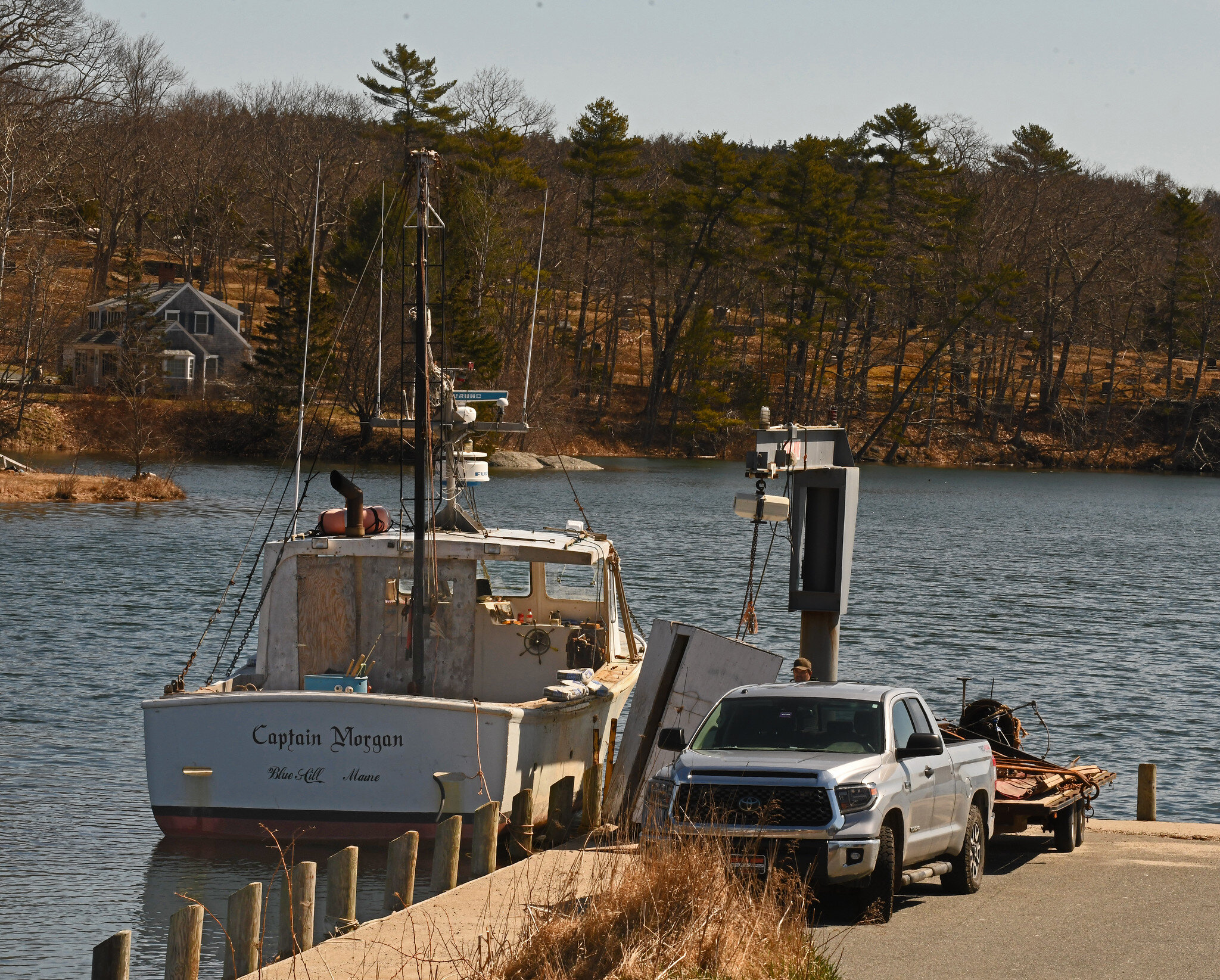
We do know that the Captain Morgan, shown below, was a full-fledged scallop dredger this winter. You’re seeing her here in Blue Hill Harbor on April 8, having her scalloping equipment removed; including her boxy “shelling house” that protected scallop shuckers from the winter cold.

We’ll likely see her again in the summer lobster season – if there is one. (Brooklin and Blue Hill, Maine)
There are two seasonal things happening now that you might find interesting. Both relate to the white-tail deer that regularly roam our fields in some unknown circadian schedule, all of which are females or yearlings in various sized sororities. (We have a buck or two on the property at times, but they usually remain hidden.)
First, our deer are being very frisky. They gambol and chase each other with a freedom, energy, and grace that makes an old man wistful. Lately, a few of these high-spirited white-tails have taken to jumping over our large double stone wall for the hell of it, rather than walk through one of its portals. That’s when wistful becomes envy.

04/23/20
Second, many of these deer are in one stage or another of their spring molt. If you look closely at the jumper, you’ll see that she’s molting along her neck and chest. The annual spring deer molt usually starts there and moves back to the rump and can be quite patchy:

Leighton Archive Image
The deer’s dark gray winter topcoat absorbs the sun’s heat; it also provides better camouflage in the winter landscape of gray trunks, dark evergreens, and white snow that resembles their tails and underbellies. In the spring, the darker hairs in the topcoat are replaced with lighter, reddish hairs, which reflect away the sun’s light and provide better camouflage in brighter, leafy terrain. (Brooklin, Maine)
Here we see branches of our Katsura Tree offering us its flowers in this morning’s rain. This wonderful tree has red flowers in the spring and lush blue-green leaves in the summer:


The tree gives off a “good woody fragrance,” which is what Katsura means for this tree in Japanese. In the fall, it turns bright yellow, then a combination of bronze and yellow:


In the winter, the Katsura is a many-veined fan that becomes the framework for intricate snow painting:

The Katsura (Cercidiphyllum japonicum ) is a native of Japan and China, but it does very well in our cold zone and is a featured specimen in Maine’s famous Asticou garden, a garden that was inspired by the plans of Beatrix Farrand. The tree grows in the 40-to-60-foot range and its many oval-shaped (ovate) leaves range from a little more than an inch to a little more than three inches in size. (Brooklin, Maine)
We’re regularly checking “our” Ospreys that have returned this month to their usual spring-summer nest nearby.

We’ll give you status reports from time to time, and perhaps an interesting fact or two gleaned from our research. As you can see from the images here, taken yesterday, our “Fish Eagles” are in great shape.

The Osprey’s wings are the bird’s most distinctive feature, we think. They’re very big compared to the bird’s body. Each of those wings can range in size from five to almost six feet in length; yet, their skinny body usually is less than two feet in length and the whole bird usually does not weigh more than four pounds.

Osprey wings are oil-coated to repel water, extraordinarily strong to soar and change directions in high winds, and unusually designed to power dive on prey. The wings are bent at the “wrist,” which gives them greater maneuverability than eagles and other large raptors. Ospreys are the only raptors than can fold their wings halfway and flutter in one place like a helicopter when targeting a fish below the surface.
They’re also the only raptor that tips over when “helicopting” and dives headfirst at amazing speed into the water to catch prey, which may be several feet below the surface. They then swim back up to the surface with those bent wings and rocket out of the water with a relatively heavy fish in a tight grasp.

(Brooklin, Maine)
