
This image appeared yesterday in our monthly column in the Ellsworth American.
To read the column, click here: http://www.5backroad.com/montly-column
JOURNAL
This image appeared yesterday in our monthly column in the Ellsworth American.

To read the column, click here: http://www.5backroad.com/montly-column
Our Horse Chestnut Trees (Aesculus hippocastanum) have been flaunting their flowering pyramids recently, as the images here from yesterday show.
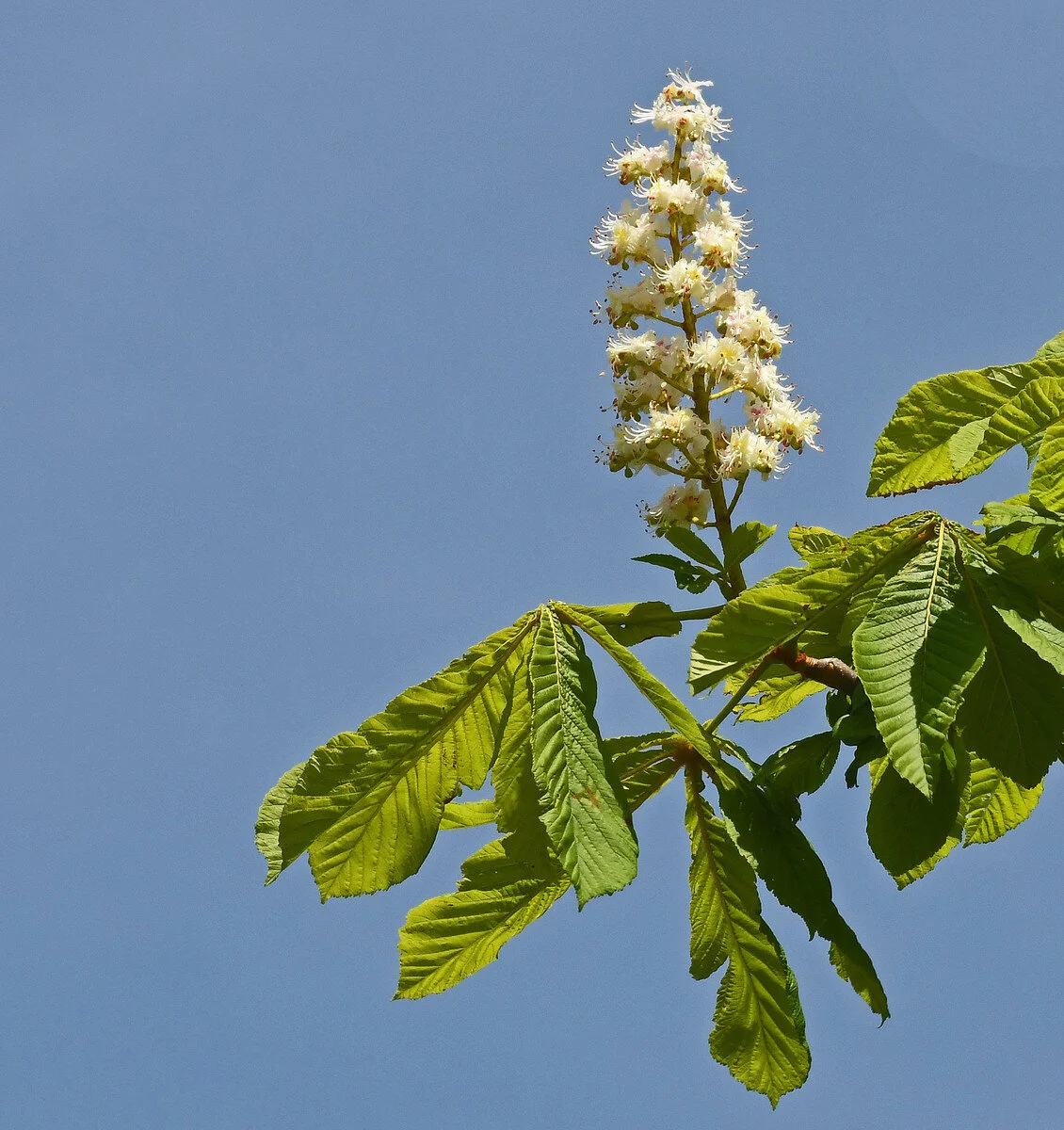
These unusual trees are native to the Balkans. They were imported into England in 1616, primarily for landscape use in towns and on private property. Soon after, they were being exported from England to Colonial America for the same uses.
The trees apparently were given the “Chestnut” name because of their similarities to the European Sweet Chestnut Tree (Castanea sativa), but these Horse varieties are not related to that tree. The European Sweet chestnuts are edible; the horse chestnuts are not.

As for that equine part of its name, there are two major stories. Most botanists reportedly say that the tree was called a “Horse” Chestnut because the Turks fed the tree’s seeds to cure coughing horses. Some people also say that they got that name because, when the trees’ leaves fall, they leave scars on their twigs that look like horseshoes with nail holes. (Brooklin, Maine)

We’ll call this fellow Satchmo and here’s his story. On Monday (June 8), we heard extremely loud, incessant, and strange screams that sounded like a crow being tortured by a laughing pterodactyl – a drawn out series of “GRReeeps.” The odd thing was that we were in the treeless parking lot of the Home Depo gardening center in Ellsworth, Maine. We scanned the sky and saw only two speechless herring gulls soaring.
As we walked to our car, we got to a point where it seemed that we were right under or over the sound. Then, suddenly, we saw him! (Sex assumed.) There, on the side of the gray bed of a Chevy pickup truck was this bundle of gray feathers screaming his fat-beaked head off.
This fledgling looked to be about six inches long and appeared more indignant than injured. Judging from his position, he could fly at least a little and seemed to be expecting to be fed. But, the only birds visible were those gulls, which would more likely eat him than feed him. He backed off and looked like he would fly when we got within 10 feet of him (200 mm lens used).

Now, a question for our good birders: What is he? He seems a bit like an American robin, but his feather and beak colors don’t seem right. His shape and shorter tail seem to rule out his being a common grackle, although he sort of sounded like an amped-up one. Help needed. (Ellsworth, Maine)
Here’s part of Sunday’s (June 7th’s) “birth” of the latest “child” (flower) of our prolific Hibiscus plant. After budding, the petals grow tightly together like a packed parachute. When they reach the right length, a mechanism of cell expansion and other factors makes the petals begin to twirl open, as you see here. You actually can watch the petals moving if you’re as patient as Job.

The flower at this stage gives us a tantalizing peek at her red-buttoned “stigma” (pollen catchers) atop the “stamen” (funneling stalk) containing protruding yellow-buttoned “anthers” (pollen producers).

Within hours, the flower is entirely open, as you see above. Her flamboyant colors are to attract pollinators quickly – she will close and drop within days. (Brooklin, Maine)
We were lucky last Wednesday (June 3) when we visited Brooklin’s Naskeag Point. Although it was foggy with intermittent rain, we got this image of three Great Black-Backed Gulls, each in a different position – it’s like a field guide illustration.

Great Black-Backs are the world’s largest gulls, attaining lengths of almost 2 ½ feet, with a black-topped wingspan of more than 5 feet. When they flash those huge wings, it can be very intimidating to the smaller gulls and other shore birds.

In fact, these birds are beach bullies. They openly steal their neighbors’ food and, as if that weren’t bad enough, they eat their neighbors’ eggs and young. Nonetheless, from what we’ve seen, eagles, ospreys, and great blue herons don’t seem to think that these black-backed bullies are so great and ignore them. (Brooklin, Maine)
Yesterday was another of the many days here that begin with fog coming in over a still sea. We went over to Brooklin’s Center Harbor to watch the moored boats disappear and reappear, a veiled dance by some beauties.

As you can see, from time to time, the sun would break through the fog and spill what seemed to be a stream of freshly purified light on the Harbor’s reflective waters, while the horizon remained a seemingly impenetrable gray wall.

Those short moments brought us a clarity that was so real, it was unreal – a visual paradox. (Brooklin Maine)
This Caruso is a male Yellow Warbler, a bird that we hear singing now. He’s usually much easier to hear than to see and therein lies the problem in identifying him.

My best guide, the Centennial Peterson Guide, says his song sounds like “tsee-tsee-tsee-tsee-titi-wee” or “weet weet weet tsee-tsee wew.” But, my Sibley Guide says it’s “sweet sweet sweet ti ti ti to soo” or “swee swee swee ti ti ti swee.”
That’s not to mention my old National Geographic Birds Guide and the current Cornell Lab of Ornithology on-line Guide, which have the gall to tell me that he’s actually bragging in English: “sweet sweet sweet I’m so sweet.” This is news to me. What’s a mediocre birder to do? None of those descriptions sounds exactly like what I’ve been hearing.

However, once we mediocre birders get a glimpse of him and see his male chestnut streaks, we’ll probably say: “It’s a male Yellow Warbler!” Even those who just like hearing and seeing birds likely will look and say something like: “It’s an almost all-yellow little bird singing his heart out!” Archive images used. (Brooklin Maine).
Here we have the footwear part of a Pink Lady’s Slipper plant (Cypripedium acaule). It was photographed among Star Flowers Wednesday, June 3.

These native orchids, which occasionally are white, are found hiding here and there in our mixed woods in June. They’re getting even more difficult to find on land open to the public due to predation by human collectors.

Lady’s Slippers have two unusual needs. First, they have to seduce insects for pollination. The insects are enticed into an entrance slit in the flower’s sweet-smelling pouch, which closes after they enter. To escape through the only exit, the insects have to squeeze through hairs and pollinate the flower’s stigma with pollen that the insects have picked up elsewhere.

Second, these orchids depend on threads of fungus from the Rhizoctonia genus for reproduction. The fungus has to be in the nearby soil to break open and pass on food to the Lady’s Slippers’ small seeds that are scattered by the wind. (Brooklin, Maine)
Yesterday, I was on one creaky knee admiring Lady’s Slippers blooms in the darker woods. Out of the corner of my eye, I saw a movement of a large thing about 25 feet to my side. This is not what an old man with a bad leg wants to see in these woods, where the possibilities are 50-50 for something of that size: either a deer (no problem) or a black bear (a potential significant problem if it or I panic).

It turned out to be this big-eyed doe who went into her “frozen” mode, in which she thinks I can’t see her if she doesn’t move. I “shot” her and she melted away. By the way, note that she’s wearing her summer coat, which is lighter in color and weight than her winter coat. She looks a little scrawny to me, but there seems to be plenty for her to eat around here. (Brooklin, Maine)
Green Arrow Arum (Peltandra virginica) plants in our local ponds and other freshwater wetlands are coming along well, as you can see from this image taken yesterday. Soon, many of these leaves will reach about 30 inches with about 8-inch wide “arrow heads” that are heavy enough to bend the stalks gracefully over the pond.

This plant, also known as Tuckahoe, produces fruits that ducks, muskrats, and other marsh creatures eat, but humans are advised not to taste any part of the plant. The family name “arum” is thought to derive from the Arab term for “fire” and reflects the sensation you’ll have in your mouth if you chew this plant. (Brooklin, Maine)
Waves of warblers are now flitting among the emerging leaves and, as usual, driving us crazy. Identifying these confusingly-named beauties is difficult for us. Here we have a Common Yellowthroat Warbler, which is not to be confused with the different Yellow-Throated Warbler.

In fact, this is a male Common Yellowthroat, which is not to be confused with the female of the species. The female does not wear a mask, but loves them – she reportedly chooses a mate based on the size of his mask. Here she is:

Common Yellowthroats are our only warblers that stay low and make their nests in reedy marshes, which is where the female’s drabness comes in handy. Except for the male’s constant singing, they’re easily missed by those who always look up in the treetops for warblers.

(Brooklin, Maine)
May here was a weather mixing bowl of sun, fog, rain, and even snow flurries, but mostly it was a month of glorious sun. Nonetheless, we didn’t see many leaves until near the end of the month.


Along the shore, some fishing vessels were coming back to the water from their winter vacations “on the hard,” while others were getting reconfigured from scalloping to lobstering and loading their traps. Here we see vessels from neighboring Blue Hill, our own Naskeag Harbor, and Stonington across Penobscot Bay.


While the covid-19 virus kept many human visitors away, we had plenty of returning visitors from other members of the animal kingdom. As for the feathered ones, we’re monitoring a returning pair of ospreys, which appear ready to hatch one or more eggs in June; tiny spring warblers, including the embarrassingly named yellow-rumped warblers, found their way back. They were among many winged returnees, including flocks of aggressive grackles that drove our recently-awakened painted turtles crazy.


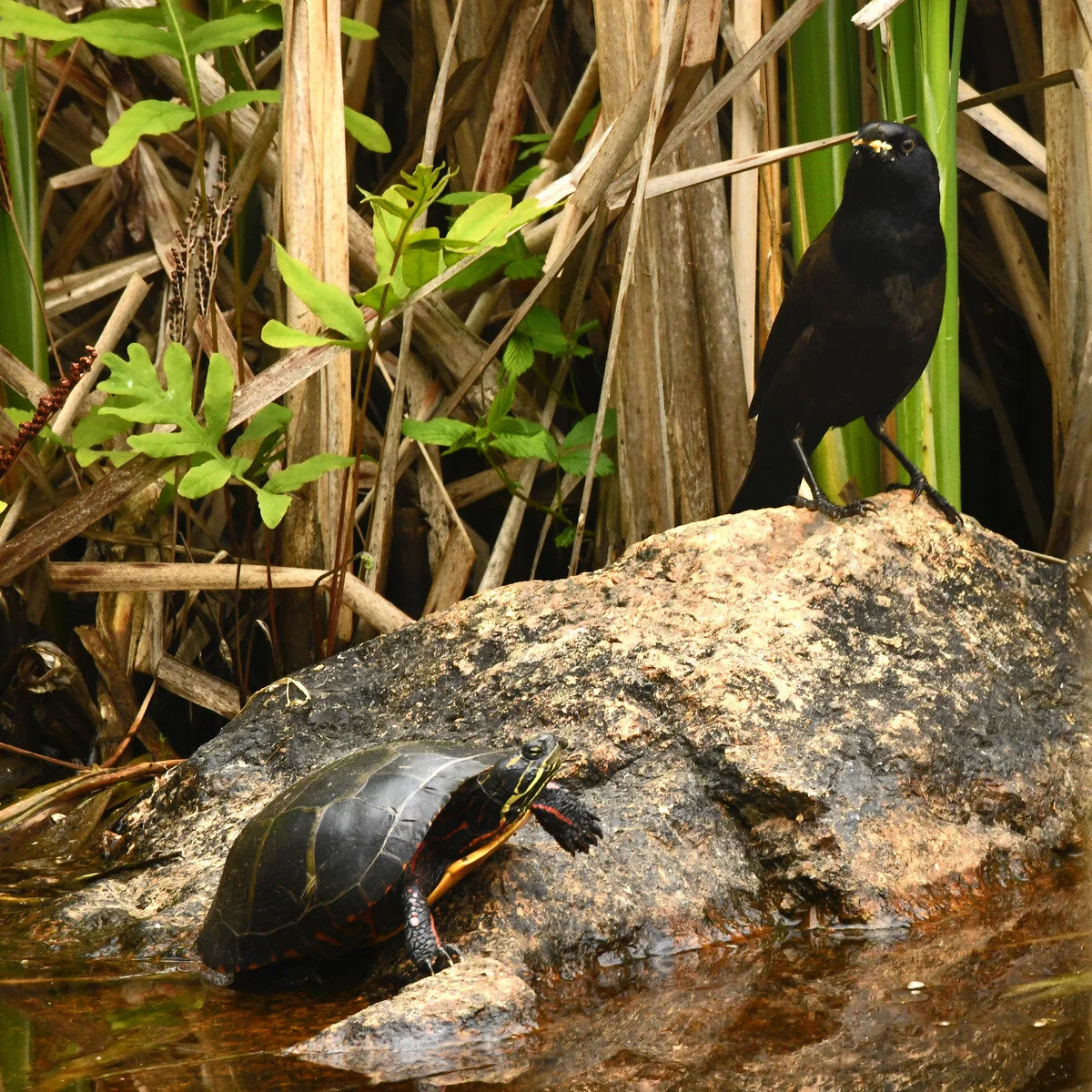
Of course, other residents awoke from their winter’s seclusions and hibernations, including our groundhogs, muskrats, and chipmunks.


In the woods and marsh ponds, wild plants grew exponentially: skunk cabbage at the beginning of the month consisted of purple spathes and leaves trying to emerge; at the end of the month, they were in almost full leaf. arrow arum and water lily pads were out by the end of the month, and ferns had progressed from being entombed to fiddleheads.


Of course, May also is about blossoming flowers. In terms of trees, among our most spectacular are flowering crabapple, apple, plum, shadblow and red maple.


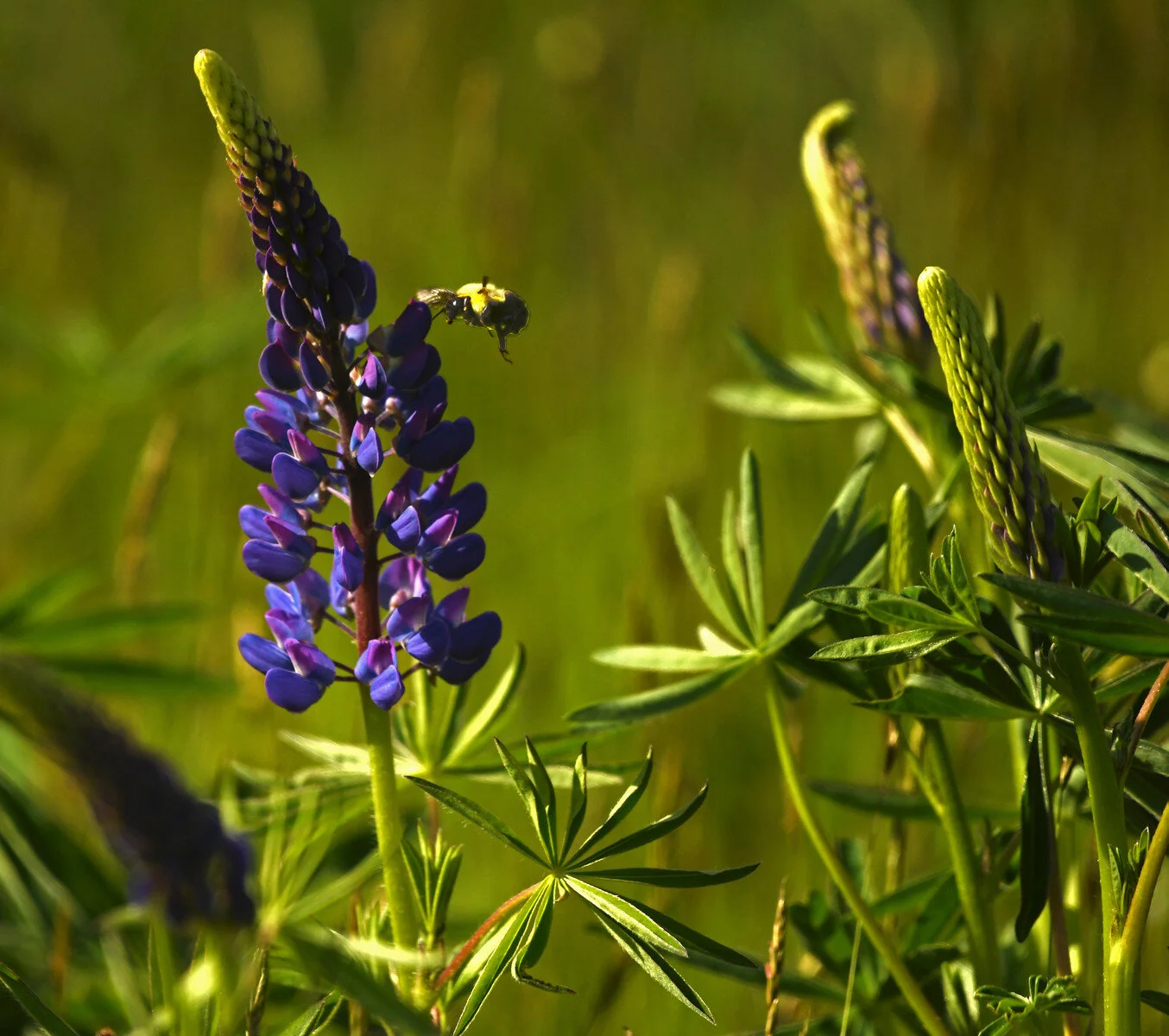
On the ground, lupine pods start to arise and bejewel themselves in May; dandelions blow their horns everywhere, quince helps early pollinators, and tulips appear initially as spears.


The two most famous days in May evoke differing senses: Mother’s Day love is celebrated with a banner on Brooklin’s Naskeag Road and Memorial Day is celebrated with the American Flag on veterans’ graves in our Town’s cemetery.


Finally, we leave you with May’s spectacular moon. The full May moon is known as the Flower Moon, because it arrives with the flowers. Just before it became full, it appeared during the day over our budding trees. The full May moon arose red, seemingly angry, and distorted in our atmosphere; it then transformed into platinum as it ascended into space.


(Brooklin, Maine. All images here were taken in Down East Maine during May 2020.)
On her first day of maturity, yesterday, this voluptuous Hibiscus blossom attracted the ardent attention of a sunbeam and we were fortunate to be there.

(Brooklin, Maine)
We were supposed to go Bald Eagle “shooting” at a friend’s “special place” early yesterday morning, now that these birds are doing a lot of diving on migrating alewives. But, the fog was so intense (as it is today) that the plan was abandoned. So, we’re posting images of diving eagles from the many in our archives.
Bald Eagles perform several distinctive dives. The most impressive to us is when they are soaring in circles high above a river or other water and spot their prey. They then bank severely, spiral down fast in smaller and smaller circles.

They then pull up to skim the surface of the last few feet of water, thrust their talons straight out at the last moment, and pluck the prey with a splashy “thwack”:

During such dives, they can reach 100 miles per hour and, if you’re close enough, you might hear their killing whistle – the wind whipping through wing and leg “chaps” feathers. (Brooklin, Maine)
Our woods are getting darker as the deciduous tree leaves fill in the canopy spaces between the spruce and balsam fir treetops. The stars of Starflower plants (Trientalis borealis Raf.) are now rising to light these late May shadows. They’re mostly white and tiny, about ¼- to ½- inch in diameter on slight stalks that usually are less than 2 inches long.

Yesterday, we saw this flowering Starflower plant with some others that had recently offered up flowers. Soon, the shadowed woods floor will become a vernal galaxy of their stars. By mid-summer, the stars will have accomplished their purpose of attracting pollinators and become shooting stars that wilt and disappear. Only the herbs' leaves and flowers’ stalks will remain for a while, then also disappear before the frost. (Brooklin, Maine)
In the Right Place: Dry
The morning fog here has not burned off yet and looks like it may not burn off until late in the day, if then. We’ve had morning fog since Tuesday (May 26), when these images of Naskeag Harbor were taken:


Fog is fine, especially for those of us who marvel over the lights and colors that change our perspectives of interesting places. However, we don’t need fog now; we need rain and plenty of it. We’re well below average in the precipitation charts. The woods and fields are dry and the few small showers predicted in the next 10 days won’t correct the situation. The last thing we need this summer is a drought on top of the plague. (Brooklin, Maine)
Common Flowering Quince (Chaenomeles japonica) is now in full bloom, providing needed nectar to early pollinators, as you may infer from this image taken yesterday:

It’s one of three species of flowering quince plants that originated in Asia and is highly regarded in Japan for bonsai culturing.

The flowering varieties are not to be confused with the fruit-bearing Quince Tree (Cydonia oblonga). (Brooklin, Maine) See another image in the first Comment space.
You’ve heard of Punxsutawney Phil, the shadow watcher; but, have you heard of Naskeag Nate, the tide watcher? This is Nate on Sunday (May 24):

Unusually for most of his kind, he was enjoying himself at the shore. He ate a large portion of vegetation there, then climbed up to the top of a 15-foot granite pier pylon to take a sunbath and scan Great Cove:


Most people would call Phil and Nate “Groundhogs,” a name that has nothing to do with their looks or genes; it reportedly was given to them because of their extraordinary burrowing ability. Many also would call them Woodchucks, a name that has nothing to do with wood or the chucking thereof. It was an attempt by our European settlers – who had never seen a Groundhog in Europe – to pronounce the Algonquin Tribe’s word for the animal, “Wuchak,” meaning digger.
That’s not all: some people call these rodents “Whistle-Pigs,” due to their high-pitched call; or “Land Beavers,” due to their looks (if you ignore their hairy little tails), or even “Mouse Bears,” because they sit up on their haunches like a tiny bear. But, in the end, Nate and Phil and their kind are just the largest ground squirrels in Maine; and, yes, they climb trees and swim.

However, as with all squirrels who have to live near humans, all is not furry fun with Groundhogs. They can gorge on crops and garden vegetables and dig massive tunnels that are not friendly to tractor axles. Our State allows hunters to shoot Groundhogs on sight anytime on non-posted land. (Brooklin, Maine) For a few more images, click here:
Today is Memorial Day, the most profound of our military recognition days. It’s the day that we’re supposed to come together in a national remembrance of those who died while serving in the United States Armed Services.
However, as our country evolves, it seems to get harder and harder to come together over any principle, no less one that requires putting patriotism above politics and risking personal safety. We suspect that having safe fun on the unofficial first day of summer is foremost in many people’s minds today. And so be it.
Nonetheless, we visit cemeteries on Memorial Day weekend. They’re good places for old people to ponder life, death, altruism, and the speed with which civilization changes right around you.

In our two local cemeteries, American flags dignify the graves of those who served in the military, whether or not they died in service. The image above is from the Brooklin Cemetery; the one below is from the Naskeag Cemetery.

(Brooklin, Maine; images taken yesterday)
Historically, a “landmark” is a conspicuous and recognizable object that guides and often pleases a traveler in the hard world, while a “seamark” is the same for travelers in the wet world, except it also often signals danger. In this context, consider Sun’s Up, the flashy little lobster boat with the big forward sheer:
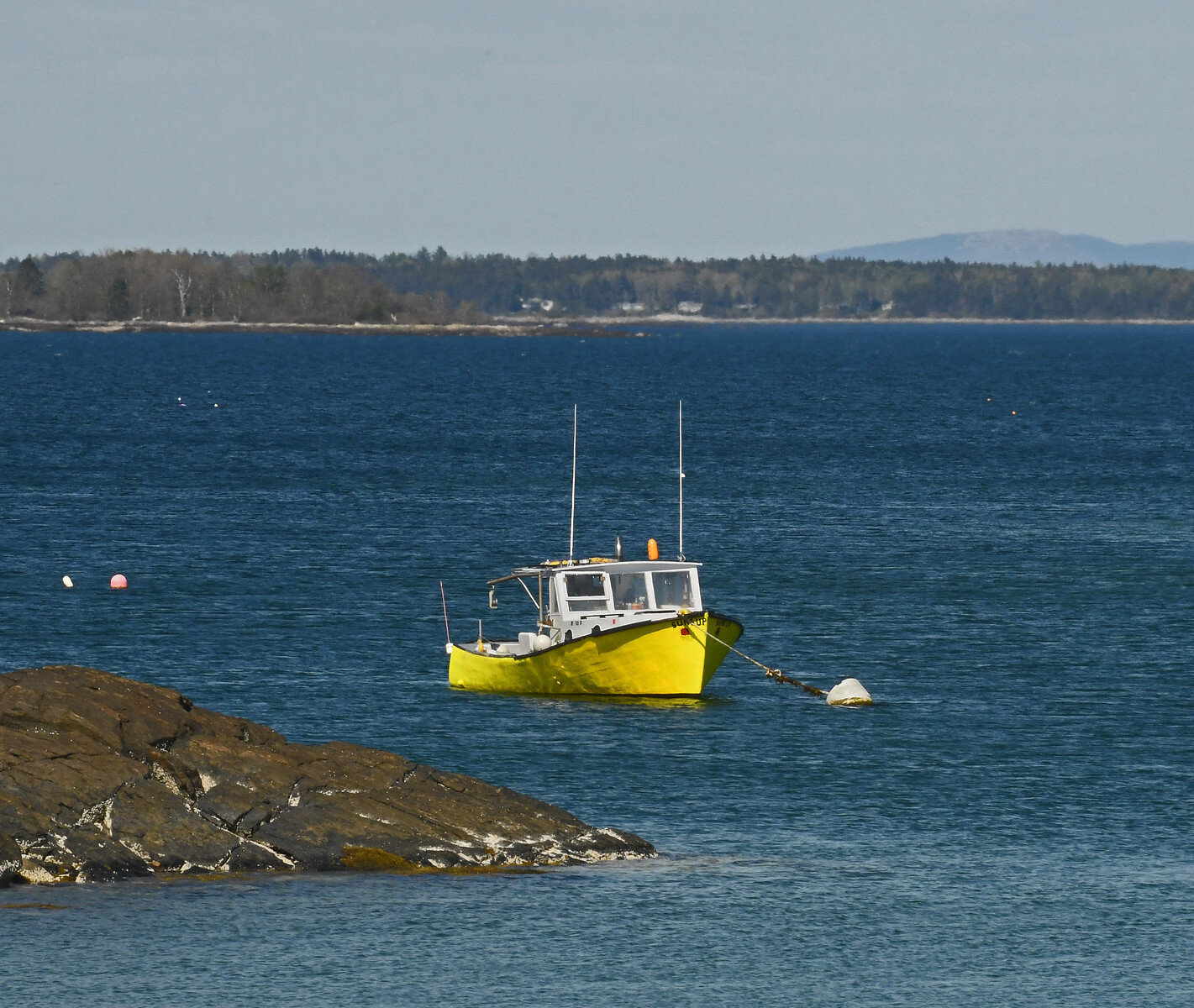
She’s part of the wet world, but also something that many drivers on the hard world's Route 175 eagerly look for when they come to Conary Cove in Blue Hill. (Blue Hill, Maine; image taken May 22)
