Comment

In the Right Place: The Eyes Have It

The young American crow (Corvus brachyrhynchos) that has recently fledged out of its nest can fly well and is almost the size of an adult. However, it’s still a baby that can’t feed itself well and demands – with outlandish vocal and bodily expressions – almost constant attention from its parents and relatives. If you see one and don’t look closely, you might think that this youngster is an adult sounding a crow alarm about a nearby owl or some similar threat. But, no; its all about himself or herself.

1.jpg

We were lucky to see the above youngster land on a dock railing about 50 yards from us on Monday (July 13). It screamed and moaned and swayed its body until an adult crow came and warned it to get away from that human. (That’s one of the things that many young crows don’t seem to understand instinctively.)

There are three significant things to look for in deciding whether a crow is immature or adult. First, the babes have cloudy blue eyes; the adults’ eyes are very black. Second, the black painting on the youngsters’ beaks is not finished – it’s still white and pink at the  bases; the adults’ beaks are all black. Third, and easiest to see, the youngsters seem to beg for food or other attention from adults almost all the time.

4.jpg

For comparison purposes, here’s an image from our archive of an adult crow:

6.jpg

(Brooklin, Maine)

Comment

1 Comment

In the Right Place: Eternal Life

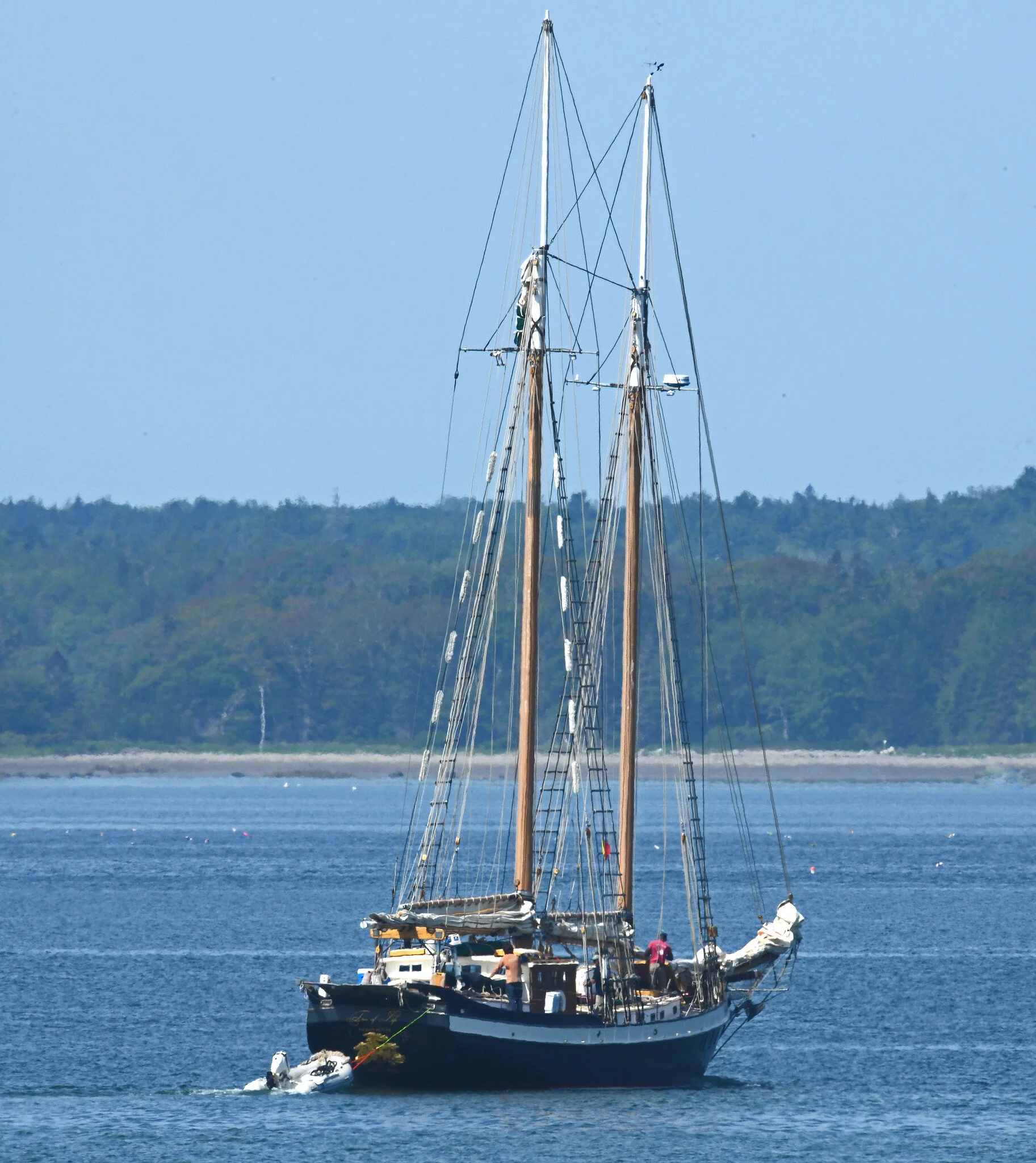
A small two-master slipped into Great Cove Sunday evening (July 12), but she didn’t go unnoticed by those of us whose windows face the Cove – she was our first schooner sighting of the year here. The local email tom-toms sounded and it was determined that she was the Tree of Life out of Newport, Rhode Island.

1.jpg

She stayed the night and motored out of the Cove yesterday on an almost windless morning, when the images here were taken. She seemed to be carrying only a five-person crew, no tourists. Once she got well into the haze of Eggemoggin Reach, she found some wind and put up her sails.

2.jpg
5.jpg

The Tree is a luxuriously appointed 71-foot cruiser with a composite wood-fiberglass hull. She was launched in 1991 and has sailed the world. However, these plague-ridden times are hard on such tourist-dependent ships; in fact, the Tree is being advertised for sale by a high-end broker.

Thus, her unusual name – Tree of Life – is now ironic. Such a Tree appears as the source of eternal life in the Genesis description of the Garden of Eden. Variations of that concept appear in many religions, mythologies, and works of art. According to one report, this schooner was christened Tree of Life because an Irish folk song of the same name was playing when its owners were looking for a name. (Brooklin, Maine)

1 Comment

Comment

In the Right Place: Ditched

Tawney-hued wild daylilies (Hemerocallis fulva) are starting to congregate along our roadsides and elsewhere. They soon will become cheering crowds that will wave at passing vehicles.

DL1.jpg

These emblems of high summer are called daylilies because most of them, when they reach the flowering stage, will be opened by the touch of the sun and wither overnight. However, if it is a dark, cloudy day, many day lilies will remain closed. (By the way, they also are commonly called ditch lilies due to their ability to live in roadside ditches and other sloping surfaces.)

DL2.jpg

Unlike true lilies that grow from delicate bulbs, these wild daylilies grow perennially from tough roots and runners. That means that they can be invasive. They’re native to Asia, but came here with our earliest European colonists. Since then, they have been cultivated by horticulturists into many colorful domestic varieties, such as this yellow variety:

DL3.jpg

(Brooklin, Maine; images taken July 5 and 7)

Comment

Comment

In the Right Place: Weather Report

The weather menu for July here has been fog appetizers with a choice of the following entrées: plain fog; fog with rain; fog with mist; fog with sun sauce; sun with fog on the side; cold with fog icing, and heat and humidity baked in fog.

The most enjoyable (at least for a photographer) is sun with fog on the side, when the fog continuously and quickly rolls in and over you to turn a clear, sunny day into a wet gauzey net and then rolls back to its original threatening position.

That’s what happened here on the morning of Thursday (July 9). One minute, we were trying to focus on this happy, wind-blown osprey posing atop a tall spruce with a brilliant blue sky background:

F1.jpg

The next moment, we were enveloped in a cloud that caused the disturbed bird to swoop away. But, not before we “shot” her and got this extraordinary image:

F2.jpg

Out in Great Cove, one moment, Lavera from Blue Hill was watching the fog come toward her; the next moment, she was lost and we had to use a big lens to find her (in closeup form):

The surrounding coast and islands tend to stand out on a day like this, when the fog rolls in and out and often becomes a background curtain:

F5.jpg
F7.jpg

Eventually, the fog won its battle of attrition and took over the day. This is how Naskeag Harbor looked in the afternoon:

f14.jpg

(Brooklin, Maine)

Comment

Comment

In the Right Place: Pogey Pursing

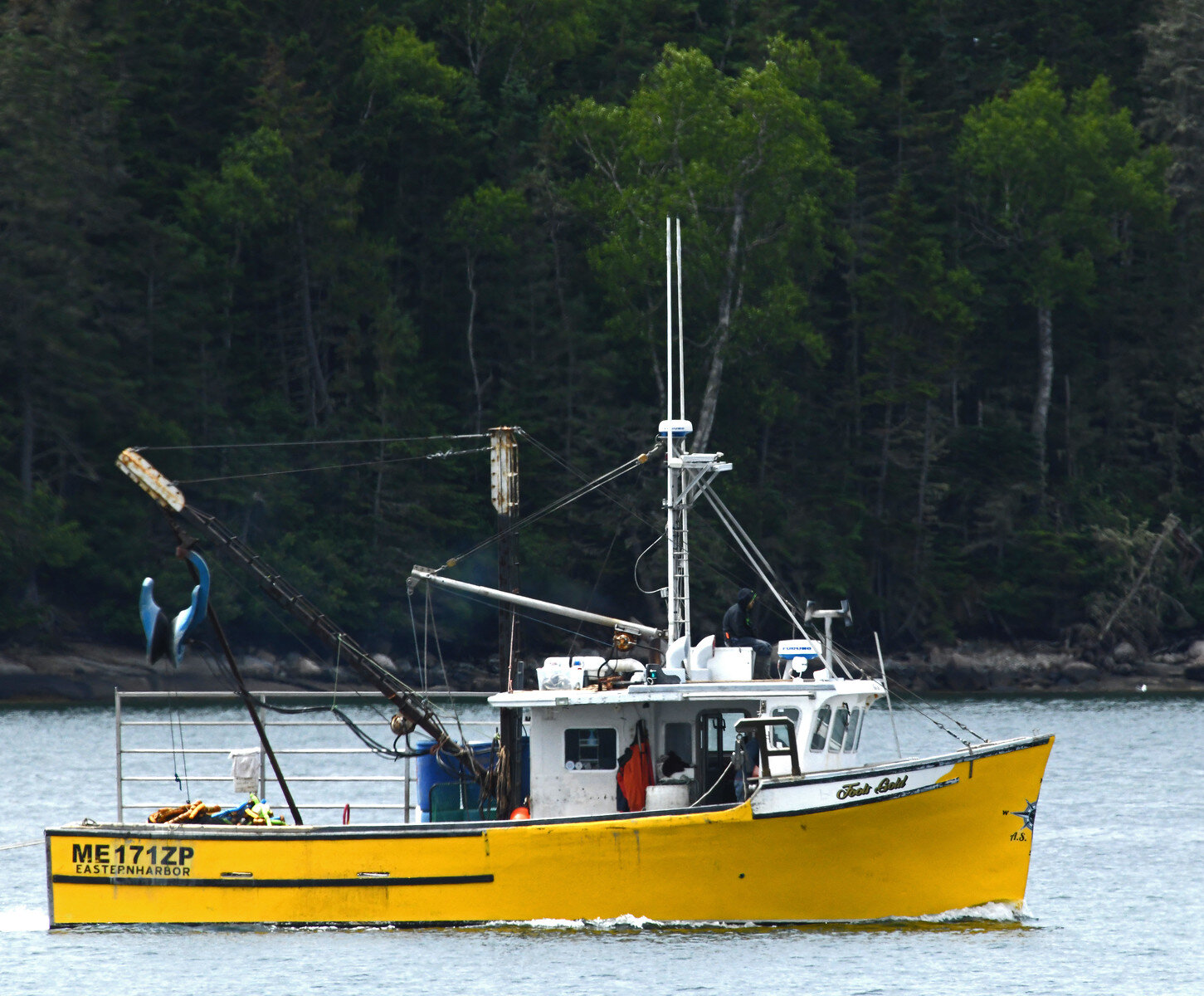
This is Fool’s Gold out of Eastern Harbor, Maine. She’s on the hunt in Great Cove on a misty July 6.

P1.jpg

Fool’s Gold is a “purse-seiner,” which is an unusual word worth considering for a few seconds because there’s a good New England part to this story.

In the 14th Century, before real pockets were invented, there were “purses” within which valuables were carried – usually cloth or leather pieces that could be “pursed” shut with an imbedded drawstring. There also were “segnes” (later spelled “seines” and pronounced “sanes”); they were and still are fish nets.

Here’s the good part, according to historical reports:  In 1826, one or more fishermen in the Rhode Island fishery put together the two concepts of a drawstring purse and a trawling net. The first “purse-seine” was created there to catch menhaden (pogeys), about 15-inch-long fish often used for lobster bait. The purse-seine type of net is now used worldwide to catch big and little fish.

A purse-seine is designed to capture all or most of a school of fish. When the school is found, the fishermen deploy a large seine (net) out of their vessel’s stern to descend like an underwater curtain that will encircle as much of the school as they can. Fishermen spread out their seine for encirclement nowadays by using an outboard motored skiff or the fishing vessel, itself. 

P2.jpg

The seine is held up by floats. Its bottom is open when deployed, but it is lined with rings through which a pursing or “lead” (as in leader) line is threaded. When the catch is within the encircling seine, the fishermen pull the pursing/lead line like a drawstring and close the bottom of the net, entrapping the fish above in a mesh swimming pool.

Then, the closed purse-seine and its contents are drawn back onto the vessel or brought alongside for bringing the catch on board. In the first Comment space, you’ll see Fool’s Gold deploying her purse-seine around a school of pogeys in Great Cove.

P8.jpg

(Brooklin, Maine)

Comment

Comment

In the Right Place: Float-It-All Express

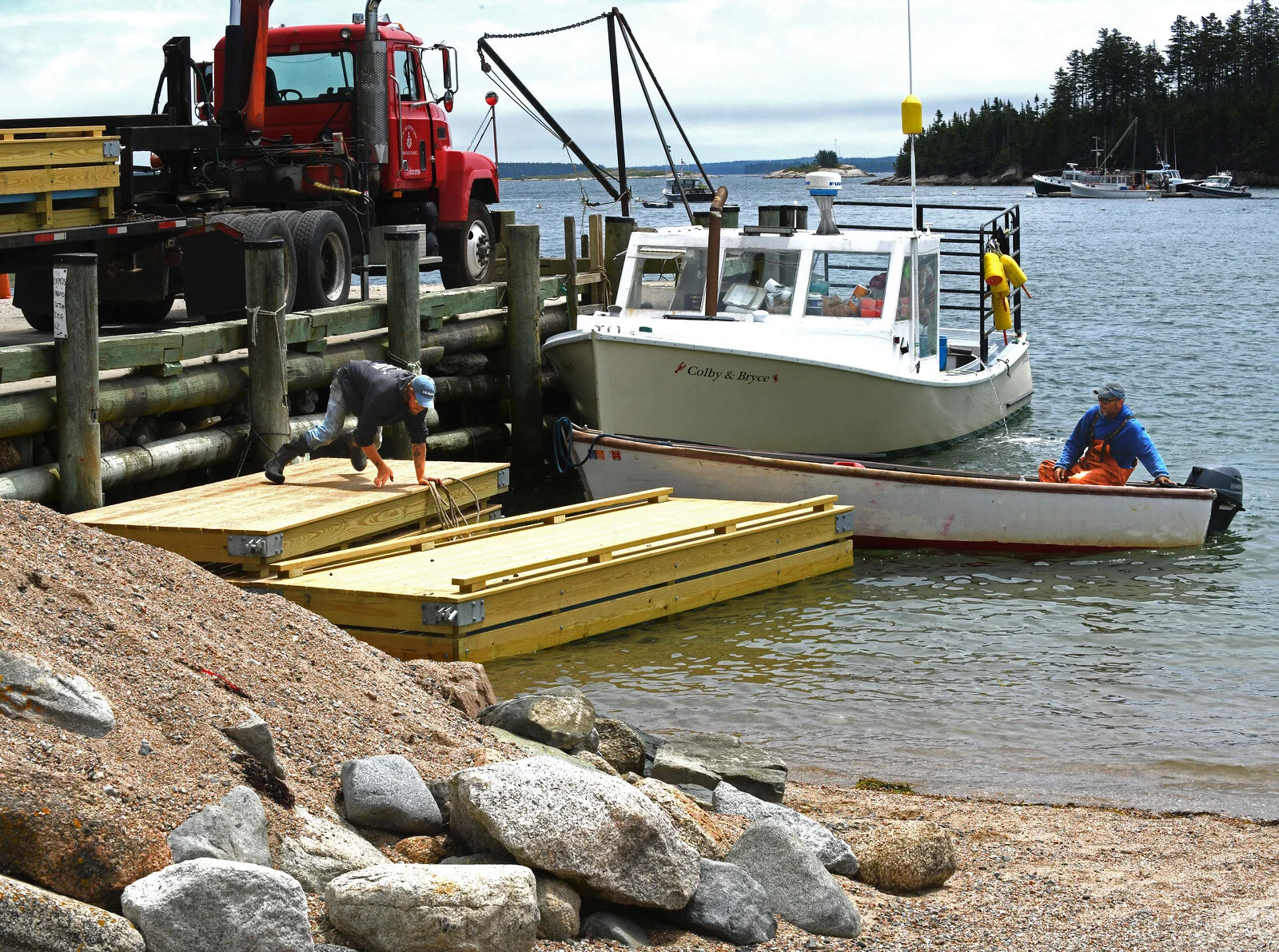
On Tuesday (July 7), the small Town Pier at Naskeag Harbor was more congested than we’ve seen it in a long time. Fishing vessels were tied up on either side and atop was a local pickup truck and trailer plus an enormous crane truck and trailer (18 wheels and 5 axles). The truck was offloading its massive cargo directly into the water.

1.jpg

That cargo turned out to be the prefabricated parts of a large float that was destined to be the docking end of a pier now being constructed. The off-loaded parts were roped and towed by a small outboard motor boat to the middle of our Harbor, where they were tied together.

7.jpg

According to the truck driver, arrangements had been made with the owner of a local fishing vessel to tow all of the lashed segments to Deer Isle, where they would be bolted together and connected to the new pier. Deer Isle is a fairly large island that, at its closest point, is about two miles across the waters of Eggemoggin Reach from Naskeag Harbor.

The famous Deer Isle - Sedgwick Bridge, below, serves Deer Isle and Little Deer Isle (where the bridge actually lands). But, that high suspension bridge has narrow lanes going and coming that apparently can’t accommodate a large vehicle with a load like this. So, the float-to-be will be floated to its home.

Leighton Archive Image

Leighton Archive Image

(Brooklin, Maine)

Comment

Comment

In the Right Place: Osprey Nest Report No. 7

There has been an important development in the saga of Ozzie and Harriet, the ospreys that we’ve been monitoring since April: We’ve actually seen the suspected third nestling in the family’s fine Brooklin waterfront home. We’re calling her Lucy for identification purposes. She seems as active as her apparently older siblings, David and Ricky (“the Boys”).

Now that the nestlings are about three weeks old, Harriet takes frequent short flights, leaving them home alone. She often comes back to the nest with part of a branch, to (sometimes literally) spruce up her home. In the image here, she’s returning on July 3; if you look closely, you’ll see the tops of the heads of Lucy and the Boys.

A.jpg

Ozzie is still delivering fish daily to the family and always is flying or perched close by. We’ve recently seen him take off screaming after a high-flying bald eagle that was not interested in ospreys or a fight with one.

Brutus, the spurned osprey that attacked Harriet several times while she was brooding, has not been seen for months.

Ozzie sometimes flies to the nest for no apparent reason other than visitation. When he does, things get crowded there. He has to step gently, picking his large taloned feet up high and placing them down carefully to avoid the tottering youngsters. Ozzie also collects hefty pieces of wood for Harriet’s home renovation, as he was doing here on July 6:

B.jpg

(Brooklin, Maine)

Comment

Comment

In the Right Place: Washing Regularly

Lavender is at its peak here now, its slim wands waving in the breezes, creating a fragrant blue mist. It’s part of the aromatic mint family. There are wild Lavenders, but most of the Lavender here appears to be English Lavender (Lavandula angustifolia), a cultivar shown below:

Y.jpg

Lavender has been used throughout the ages for its fragrance and reputed disinfection and antiseptic characteristics. It was part of the Egyptian mummification process and an additive to Roman baths. Perhaps that’s why its name originates from the Latin verb “to wash.” (Brooklin, Maine)

Comment

Comment

In the Right Place: Convenience

The bait and lobster hut in the middle of Naskeag Harbor is back, providing fishermen with a convenient place to get bait going out and sell their catches coming in. It’s operated by Billy Damon out of Stonington.

A.jpg

Above, we see the Lily Ann from nearby Benjamin River coming into that rafted hut on Friday (July 3), apparently after a day of fishing. Below, we see her tying up to it:

B.jpg

(Brooklin, Maine)

Comment

Comment

In the Right Place: Social Climbers

Traditional English Shrub Roses, such as this, seem to be out of fashion these days. But, we love them for their quintessential old rose scent, stunning appearance, climbing ability, and inspiration to artistic interpretation.

1.jpg

Besides, these roses love us back – they prosper in Maine’s climate and seem to murmur “wonderful, wonderful” all summer.

add 2.jpg

The Shrub Roses shown here are the award-winning Gertrude Jekyll hybrids, first introduced into the United Kingdom by David Austin in 1986. They’re aptly named after the famed English garden designer of the early 20th Century. (The original pronunciation of Gertrude’s Celtic last name was “JEE-kill,” but many now pronounce it “JECK-ill.) Ms. Jekyll was a horticulturist, garden designer, writer, photographer, and fine artist. She created over 400 major gardens before dying at the age of 89 in 1932. 

add 1.jpg

The GKs have climbing competitions with Clematis companions on one of our decks:

2.jpg

(Brooklin, Maine; images taken July 2 and 3)

Comment

Comment

In the Right Place: The Engines That Could

10.jpg

Not plague, nor rain, nor gloom of fog can stay Brooklinites from their celebration of Independence Day. This morning, the resourceful Brooklin Volunteer Fire Department hosted a “No-Contact Parade” of fire trucks and other emergency equipment (complete with blasting sirens and flashing lights), interspersed with some local vintage cars and trucks.

Of course, today’s celebration was not one of the lavish Fourth of July productions for which Brooklin is known. But, that’s not the point. We thank the Department and all participants; they made our Fourth happier. Here are a few more images taken during this damp morning:

1.jpg
9.jpg
6.jpg

Comment

Comment

In the Right Place: Snuffed

We seem to be having more than our usual share of fog – and it’s not just morning fog. Yesterday afternoon, a wall of fog came in from the sea and snuffed out our view of the sun and everything beyond 30 feet from us, as you can see in this image of the Town Pier. (There are fishing vessels moored not far from that pier that have disappeared.)

1.jpg

One of our most memorable fog experiences occurred at Great Cove several years ago, when our visibility was about four feet. We heard the “Whump, Whump, Whump” of big wings moving heavy air. The sound got closer and closer as we searched the sky unsuccessfully. Then, breaking through immediately above us, a Great Blue Heron appeared in silhouette form for about two seconds and was gone.  The camera was already pointed toward the sound and we got off one lucky shot:

4.jpg

(Brooklin, Maine)

Comment

Comment

In the Right Place: Bloody Good

Yarrow (Achillea millefolium) is beginning to bloom here, as this image from yesterday shows:

Y-1.jpg

While some yarrow is native to the United States, most of the plants in this area appear to be colorful cultivated varieties in gardens. Native Americans used Yarrow to stanch bleeding and it eventually achieved the common names of Nosebleed Plant and Woundwort. Several species of birds, including Starlings, use Yarrow to line their nests, where it is thought to inhibit parasites. (Brooklin, Maine)

Comment

June Postcards From Maine

5 Comments

June Postcards From Maine

Summer has arrived, but there have been far fewer visitors to our “Vacationland” this year due to the Covid 19 plague. Perhaps these Postcards will be able to give a few who couldn’t make the trip a virtual vacation.

June here was a month of many clear, summery days, showing to advantage our sun-spotted Acadia National Park across Blue Hill Bay; brightly-flowered window boxes; broken-windowed barn shells, seemingly standing by sheer determination; fields of perky wildflowers; winding country roads into the unknown; friendly streams, and secret granite-ledged inlets on the islands.

1.jpg
4.jpg
7.jpg

But, June was not a month of only clear skies. We had a significant number of foggy days that would transform one visual beauty into another.

10.jpg
14.jpg

Sailboat, motorboat, and even kayak traffic was diminished significantly this June compared to last year. But, many fishing vessels, including much of the Stonington fleet, worked through the winter and others returned to the water in June to set their lobster traps.

18.jpg
21.jpg

There’s a different watery view in the June bogs and marshlands where exotic plants hide among innumerable hues of green: Lady’s Slippers and Jack-in-the-Pulpits emerge within shadows; Water Lilies begin to bloom; Skunk Cabbage spreads its lettuce-like leaves, and Arrow Arum rises high out of the still ponds, soon to bend gracefully and dip its arrows into the water.

28.jpg

In terms of wildlife, June is a time when many animals give birth. We saw White-Tailed Deer does that froze and didn’t flee, indicating that their fawn was nesting nearby; Tree Swallows that dove endlessly for the thousands of insects that their little ones needed, and our yearly resident Ospreys did it again and produced two fine nestlings in June.

68.jpg
70.jpg

As the wildlife young grew fast in June, so did our trees, especially the Pine and Horse Chestnut trees.

32.jpg

But, it’s the flowers of June that get most attention after our cold winter and virtually nonexistent spring. Early in the month, the wild flowers in the fields were dominated by millions of Buttercups and Daisies, with Orange and Yellow Hawkweed and Wild (Blue Flag) Iris hidden within.

39.jpg
36.jpg

By mid-month, Maine’s iconic wild Lupines were grabbing the attention with their glowing purple, pink and white pyramids of pea pods; by end of June, the Lupines were beginning to lose their color and go into their “velvet” phase.

43.jpg

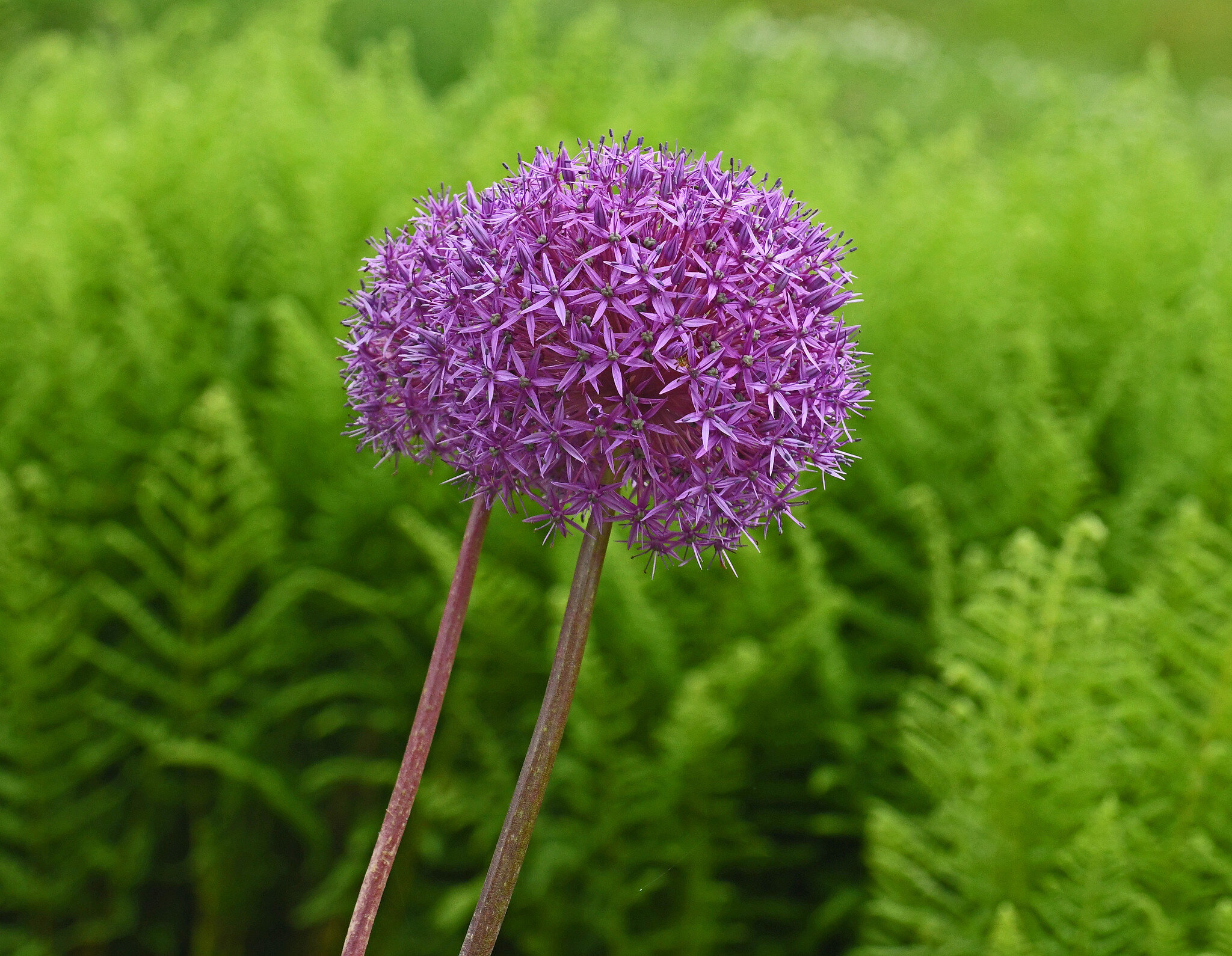
It’s not just the wild flowers that showed off in June. Lilacs came early to Maine gardens; then, Peonies of many different varieties began to open, as did Roses, Clematis, Iris, Poppies, Allium, and many more domestic flowers.

47.jpg
58.jpg
46.jpg

But, of course, we could not escape all of the pain of the plague and unrest that pervaded our Nation’s June. It was reflected in the Brooklin Inn’s cry of support for Black lives and nearby Leaf & Anna Gift Shop’s imaginative open air display with no shoppers browsing.

Nonetheless, we end with this sign of optimism: the Quarter Moon that rose here on the afternoon of June 28 signaled the coming of a Full Moon on July 5.

64.jpg

(All images here were taken in Down East Maine during June 2020.)


5 Comments

Comment

In the Right Place: Bombs Away

June is leaving us with the gift of several days of soaking showers and heavy fog to ease our dry landscapes. Surprisingly, our dry spring has been a good one for Peonies (“PEE-uh-knees”), but perhaps that’s because they are mostly domestic flowers that usually are watered by gardeners. The ones shown here are from our neighbors’ gardens.

Below, we seem to have an image of a Japanese form Peony, with its pollen-producing stamens waving like kelp, but it might be an Anemone Peony, which appears similar to our eyes:

i-ts3c8Wn-X3.jpg

There reportedly are about 30 species of Peonies, several of which are native to the United States, if not Maine. There apparently are at least six recognized Peony flower forms (the shape and content of the flowers): Single; Semi-Double; Double; Anemone; Bomb, and Japanese. Below, we apparently have a Double and/or Bomb Peony (find the ant):

i-QtFT9fv-X3.jpg

As you may have guessed, we have trouble distinguishing Peonies, since we haven’t found one that wasn’t beautiful to us and we inherently resist being analytical about beauty. (Brooklin, Maine)

Comment

Comment

In the Right Place: Erratic

Many cats love catnip and some of them are tigers – Eastern Tiger Swallowtail Butterflies (Papilio glaucus), that is. Here we see a female yellow tiger on blooming catnip (Nepeta cataria).

1.jpg

We know it’s a female by the blue dots on the edges of her hind wings (not easily seen in some of these images); if a butterfly of this shape were all black or virtually black, it would be a female tiger as well.

3.jpg

Tiger Swallowtails reportedly are not originally native to Maine, but have become naturalized in the eastern and southeastern United States. They are the state butterfly (or insect) of Alabama, Delaware, Georgia, North and South Carolina, and Virginia.

4.jpg

When they are flitting among flowers that they like, such as catnip, these tigers are great target practice for photographers who want to increase their eye-hand coordination to “shoot” erratically flying or moving things:

2.jpg

(Brooklin,  Maine)

Comment

Comment

In the Right Place: Osprey Nest Report No. 6 (Congratulations!)

Ozzie and Harriet, whom we’ve been monitoring since April 21, are the proud parents of two nestlings that you can see if you study this very long-distance image:

1.jpg

We’re calling them David and Ricky or “the boys,” which television viewers of a certain age will understand.

The eggs hatched earlier in the week, but, despite our best efforts, we were unable to see the chicks until yesterday when Harriet flew off the nest for about two minutes while Ozzie was guarding it. (Ozzie visits the nest frequently, but we’ve never seen him try to cover the chicks as Harriet does.)

Based on average egg sizes of 2.5 inches, the newborns were probably about 2 inches long when they emerged. Now the boys appear to be about 4 or 5 inches long. Compare the chick in the first Comment space image to Harriet as she returns to the nest after her break. She’s approximately 24 inches in length.

2.jpg

Ospreys are known for super-fast growth. The boys likely will be flying in August. We’ll keep you posted. (Brooklin, Maine)
Comment

Comment

In the Right Place: Priority Shipping

The delivery of toilet paper during the plague around here has been very slow. We discovered why yesterday, when we caught a glimpse of the latest shipment arriving at Naskeag Harbor:

i-wfFXprh-X3.jpg

Well, that may not be totally correct. This kayaker was an important part of a guided paddling tour of the coastal islands here. It is illegal to deposit human waste into U.S. waters and the Maine Island Trail Association protocols call for island visitors to carry solid waste and used toilet paper back to the mainland for proper disposal. (No digging “cat holes” on our islands!)

The protocols suggest using portable toilets designed for carrying in canoes or strapping onto kayaks, such as a small “Boom-Box,” which has a top that folds open as a seat. In fact, this paddler might even be carrying one behind him.

Such innovation has been a great response to the need to protect our environment, especially since kayaks seem to be getting slimmer and slimmer (and more graceful) each year, such as this beauty, also seen yesterday:

i-4fPKnzt-X3.jpg

(Brooklin, Maine)

Comment

Comment

In the Right Place: Favorites

A very slim silver lining in the Corvid 19 plague up here may be that full-time residents can enjoy their favorite summer “Vacationland” spots with fewer distractions from tourists and summer residents. On the other hand, we need our $6.5 billion tourist influx and, besides, many of our favorite summer spots are small, secret, or otherwise unknown to outsiders.

Here we see a family, complete with dog, recently enjoying one of their summer spots: where Surry’s Patten Stream empties into Patten Bay, a spot that is especially beautiful at high tide:

M-1.jpg

Here’s another local favorite photographed recently — the ledges around Sand Beach on Deer Isle:

i-LvC4LnR-X3.jpg

(Surry and Stonington, Maine)

Comment