Comment

In the Right Place: A Bit Rusty

Here, we’re looking at one of our favorite red barns yesterday. It’s a local barn well-sited high on the Flye Point peninsula overlooking Herrick Bay. It apparently is not a “working barn,” in the sense that it stores grain or shelters farm animals, but it’s a picturesque reminder of days gone by.

1.jpg

While red barns are considered picturesque now, that wasn’t why that color was favored by many farmers in past centuries. According to experts. farmers needed something to seal the barn wood and protect against things like fungus and rot, but they had to make their own sealers and paints.

They usually used linseed oil from flax seeds, which is an orange-like stain that will adhere to wood. They mixed that with ferrous oxide (rust), which was plentiful and turned the mixture red. When manufactured paints of various colors became available, many farmers chose red because that was the traditional barn color.

By the way, the word “barn” derives from the Old English word “bere,” which meant barley specifically, but also grain, generally. (Brooklin, Maine)

Comment

Comment

In the Right Place: Warm and Windy Gray

 Today has been one of those frequent gray January days during which the sun battles to get through the overcast and never makes it for long, while the wind messes with the sea by gusting up to 26 miles per hour. Nonetheless, there is something that has been unusual during the past few years: the temperatures have been too warm – in the 40’s (F) when the images here were taken.

1.jpg

Above, we see the gray-on-gray of this morning: the gray water of Center Harbor slapping the piers of the gray Brooklin Boatyard dock.

Below, , we see a little color on the ridge overlooking the gray northern waters of Great Cove.

2.jpg

(Brooklin, Maine)

Comment

Comment

In the Right Place: Bright-Eyed and Bushy-Tailed

January, historically, is our coldest and snowiest month. This January, however, is not living up to its uncomfortable reputation. For those who leave their filled bird feeders outside overnight, the unseasonably warm weather has been producing a risk around here this month: Our raccoons have been awakening and taking winter strolls. Unsubstantial bird feeders are being found in shambles.

1.jpg

Raccoons aren’t true hibernators like turtles that reach a near-death state all winter. Raccoons are more like their distant cousins, the bears. They put on fat in the fall and early winter, find a den, curl up, and go into a deep sleep that can last up to 30 days. But, they can be awakened from their dreams and, once awake, they think of food – the easiest to find, the better.

3.jpg

Brooklin, Maine; Leighton Archive images used)

Comment

Comment

In the Right Place: Flurry Redux

Yesterday’s post, about the picturesque snow flurry in Blue Hill on Monday morning, motivated requests for more images from the brief snowstorm. Here are two additional ones.

1.jpg

Above, you’ll have to peer through the heavy snow (as I did) to see the cause of the big moving arrow in Blue Hill Bay: a male Mallard Duck followed by a pair of Mallards on their way to an important appointment.

Below, you’ll see the beginning of the flurry’s light powdering of the small, tidal island just south of the Blue Hill golf course.

3.jpg

(Blue Hill, Maine)

Comment

Comment

In the Right Place: Bluster Buster

This snow flurry rode in on the back of high tide yesterday morning and blustered for about 45 minutes before the sun took control again.

1.jpg

Fortunately, I was riding beside the picturesque old red boathouse in Blue Hill’s Connery Cove at 9:22 a.m., when the flurry reached its peak and I took the above image.

When I came back south at 10:47 a.m., the sun was heating up the day, the Cove was still, and the snow on the boathouse’s roof had melted already. I took this image then:

2.jpg

(Brooklin, Maine)

Comment

Comment

In the Right Place: Stillness

Here, we’re looking southwest out of Great Cove yesterday afternoon. The day is steely gray, with virtually no wind to disturb the resting ebb tide. The horizon hides in the sky where there are no islands to break the plane.

a.jpg

Across the peninsula, the water in Naskeag Harbor is as still and dark as a garden pond, which is all the better for“Miss Millie” to show off her clean lines.

b.jpg

(Brooklin, Maine)

Comment

Comment

In the Right Place: Vacancy

This image of a local candidate for a Stephen King novel was taken from the road on January 7.

1.jpg

I’ve heard travelers assume that Maine was one of the country’s poorest states based on seeing a fair amount of “scenery” such as this here. But, they’re wrong.

Leighton Archive Image

Leighton Archive Image

Based on official state “poverty rates” (percentage of residents in poverty), Maine ranks 19th best among the states, with 11.6 percent of our residents in poverty. This is better than Pennsylvania (23rd), California (26th), and New York State (34th). Neighboring New Hampshire ranks first in having the fewest impoverished people (7.6%).

So, why are there so many rundown structures along our roads? One theory is that Maine is transitioning from a small farm economy to tourist and other significant economies.

Leighton Archive Image

Leighton Archive Image

Small farms are being abandoned and many of their structures (especially barns) can’t meet the modern mortgage, insurance, and safety standards necessary for selling them. The costs of reconstruction are higher than the loss of just leaving the property with the hope that someone from New York City or Los Angeles will buy it and clean things up for summer vacations. (Brooklin, Maine)

Comment

Comment

In the Right Place: State of the Union

Unlike some unions we know, the state of our local Common Eider union appears to be sound. For at least many decades, if not centuries, Eiders have been arriving locally for their winter vacations in late fall and leaving in early spring.

They collect into a group (a “paddling”) of hundreds in Blue Hill Bay near the mouth of the reversing falls there. Those unusual falls are between the Bay and Salt Pond, which is basically a small tidal lake.

At low tide, the Pond empties fast into the Bay through a narrow channel of whitewater. The Eiders stream into that channel to take advantage of its shallower water and dive for mollusks that are exposed by the surge and crustaceans that lose control in the fast water.

6.jpg

In the image above, we’re watching the Eiders beginning their parade into the channel yesterday at about 3;30 p.m. Here’s closer look at the brown female and white and black male Eiders:

Leighton Archive Image

Leighton Archive Image

(Brooklin, Maine)

Comment

Comment

In the Right Place: Perfection

Here, we see the perfect end to yesterday’s perfect winter day, weatherwise. It was sunny until this orange-skied moment, a few seconds after sundown at about 4:15 p.m.

C.jpg

We’re looking west-northwest from Naskeag Point. The temperature is 30 degrees (F) with no wind. All is silent and I’m alone for as far as I can see. I feel like I’ve been deeded the world for a few minutes.

Contrary to some popular belief, Maine is not Arctic-like in January, although it is cold and does have its frigid moments. According to historic Brooklin records, our average January temperature is 28 degrees. The maximum recorded is 52 degrees and the minimum is minus-8. (Brooklin, Maine) Click on the image to enlarge it.

Comment

Comment

In the Right Place: Frozen Beauty

A clear January morning in Down East Maine looks like this. This image was taken today at about 11:15 a.m.

i-gsGnjRt-X3.jpg

We’re looking southwest over the North Field, with its long rock wall; over Great Cove and Babson Island, the Cove’s biggest protector; over Eggemoggin Reach, the famous sailing channel, and out to Deer Isle, which obscures the Atlantic Ocean in this view.

It’s 30 degrees (F) on our ridge with a wind chill that makes it feel like 21 degrees. The wind is sweeping down from the northwest at a rate of 10 miles per hour with frequent gusts reaching 17. It’s cold and the rain chain is frozen:

i-rJxLxxJ-X3.jpg

(Brooklin, Maine)

Comment

Comment

In the Right Place: Smart Feet

In the Right Place: Smart Feet

We have many beautiful country roads, but some of the most beautiful are hidden, privately maintained "lanes" that wind sinuously through woods and along ridges.

1.jpg

They’re intersected every now and then by driveways that lead to houses deep within the trees or out on the shore.

3.jpg

It’s a joy to walk or drive along these roads after (or during) a snowstorm. The images here are from walk on a nearby lane this morning.

2.jpg

As James Taylor sang, “I guess my feet know where they want me to go / Walking on a country road.” (Brooklin, Maine)

Comment

Comment

In the Right Place: Staying Power

Here, we see a seasonal moment in Naskeag Harbor on Monday (January 4). Fine snow mixed with light rain is coming down slowly. Dear Abbie: and Miss Millie seem to be vigilant sentinels, squinting into the wind and current. They appear to be standing guard for the vacant summer residence on Harbor Island.

i-GDMv5bV-X3.jpg

Abbie has been rigged with a mast and boom for scallop dredging; she’s also wearing a temporary shelling hut to protect those shucking the mollusks from cold sea winds. Millie retains her lobster boat form; perhaps members of her crew have been diving for prime “divers’ scallops.”

There is no human in sight. An immense silence draws you into the moment and makes you want to stay. (Brooklin, Maine)

Comment

Comment

In the Right Place: Contrast

Here, we see yesterday morning arriving in more than 57 shades of gray on fallow fields, frozen ponds, empty seas, and low flying clouds:

i-QgdLc8b-X4.jpg

Here, we see yesterday’s sunlight finally reaching us as it sinks below cloud levels at sunset:

w.jpg

(Brooklin, Maine)

Comment

Comment

In the Right Place: Romping

Off and on for the past week, I’ve been hiding near a pond where we keep seeing fresh signs of North American River Otters. It’s been cold, boring, and unsuccessful, but the sight of otters playing is worth the nuisance. (The images here are from prior photographic hunts.)

10.jpg

It’s always reassuring to have these large weasels nearby, since they’re like the proverbial canary in the mine warning system – they avoid polluted areas. Although capable of traveling long distances on land, the otter (Lontra canadensis) is really at home in water.

11.jpg

It has all the latest equipment for hunting and playing in water: webbed feet; undulating tails; self-sealing ears and nostrils; special lungs that allow up to eight-minute underwater hunts; special eyes that increase vision in murky water, and whiskers that are sensitive to underwater vibrations caused by prey or playmates.

12.jpg

Otters often are seen in small, happy-go-lucky groups, which are known by numerous collective names, including bevy; family; lodge; raft, and – our favorite – “a romp of otters.” (Brooklin, Maine)

Comment

Comment

In the Right Place: Brevity

This Hibiscus flower, born on January 1, is our first flower of the new year. We watched her bud near Christmas; then, her petals grew longer into something like a packed parachute.

1.jpg

When her packed petals reached the right length, she unlocked her cell expansion mechanisms to make them swirl open, defiantly showing her entire self to the world.

2.jpg

Her red-buttoned “stigma” was ready to catch pollen atop her “stamen,” the funneling stalk containing yellow-buttoned “anthers” that were ready to produce pollen.

Yesterday, she reversed the dance and swirled herself back into that packed form:

3.jpg

This morning, we found her tightly self-mummified on the floor, never to open again. A brief, but flamboyant life.

i-fpLt2fP-X3.jpg

(Brooklin, Maine)

Comment

Comment

In the Right Place: Fluctuation

All morning here, it’s been raining, then snowing, then snowing with rain, then raining again. Looking out the window is like watching (and photographing) impressionistic images being created by fluctuating temperatures.

x.jpg

We suspect that it will get colder and we’ll have some snow to shovel.

w.jpg

A University of Illinois paper provided a concise description of what seems to be going on: “Most precipitation that reaches the ground actually begins as snow high in the atmosphere. These snow flakes develop somewhere above the freezing level where the air temperature is less than 32 F … and begin to fall toward the earth as snow. If ground temperature is above 32 F, the freezing level must be located somewhere above the ground. The falling snow passes through the freezing level into the warmer air, where it melts and changes to rain before reaching the ground.” (Brooklin, Maine)

Comment

December Postcards From Maine

7 Comments

December Postcards From Maine

December, the final month of a year that we all would like to forget, was mild by Maine standards. Below, you see the last of a December day’s sun touching the face of Cadillac Mountain in Acadia National Park. Also below are Patten Stream entering Patten Bay; Blue Hill overlooking Blue Hill Bay, and the Connery Cove boat house in the brief gray-blue light immediately after sundown.

1.jpg
29.jpg

The last of the in-shore lobster traps are pulled up in December for storage. Some of the fishing vessels also are stored for the winter in December, but others are refitted with booms and masts and the crews go out into the cold to dredge for scallops or dive with air tanks for prime “divers’ scallops.”

25.jpg
27.jpg

Snow was of little concern this December. We had only one plowable snow storm that produced more beauty than annoyance.

7.jpg
13.jpg

At night, the Brooklin General Store’s Christmas (or, for some, Holiday) lights have been visible almost all month. The number and types of decorative lights displayed in Brooklin vary from the minimal to the exuberant.

14.jpg
17.jpg

The decorations inside houses also vary from traditional Christian to modern festive . (We should note that the clever foldout/popup Christmas card below was given to us by our good friend and neighbor Sharron Ellis.)

20.jpg

Before Christmas, we spotted one of Santa’s helpers apparently delivering presents on his own. There also was a road banner showing Santa’s love for animals, which seemed to amaze our deer.

30.jpg

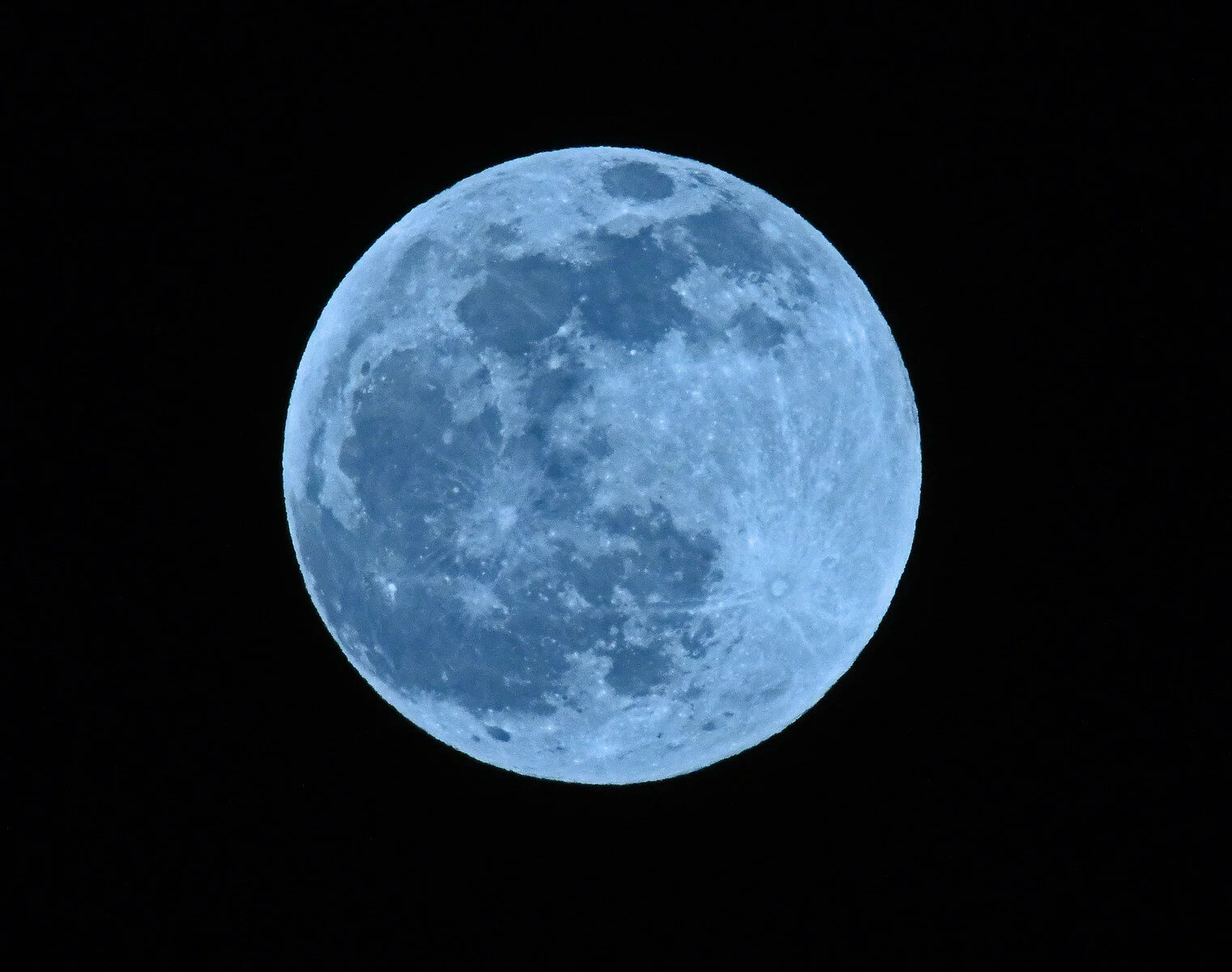
One of the highlights near the end of the month was the December full moon, commonly called The Cold Full Moon in recognition of its Native American name. Below, in the first image, we see it about to climb over Acadia National Park a few minutes after it rose above the horizon. The second image shows it entering its high trajectory.

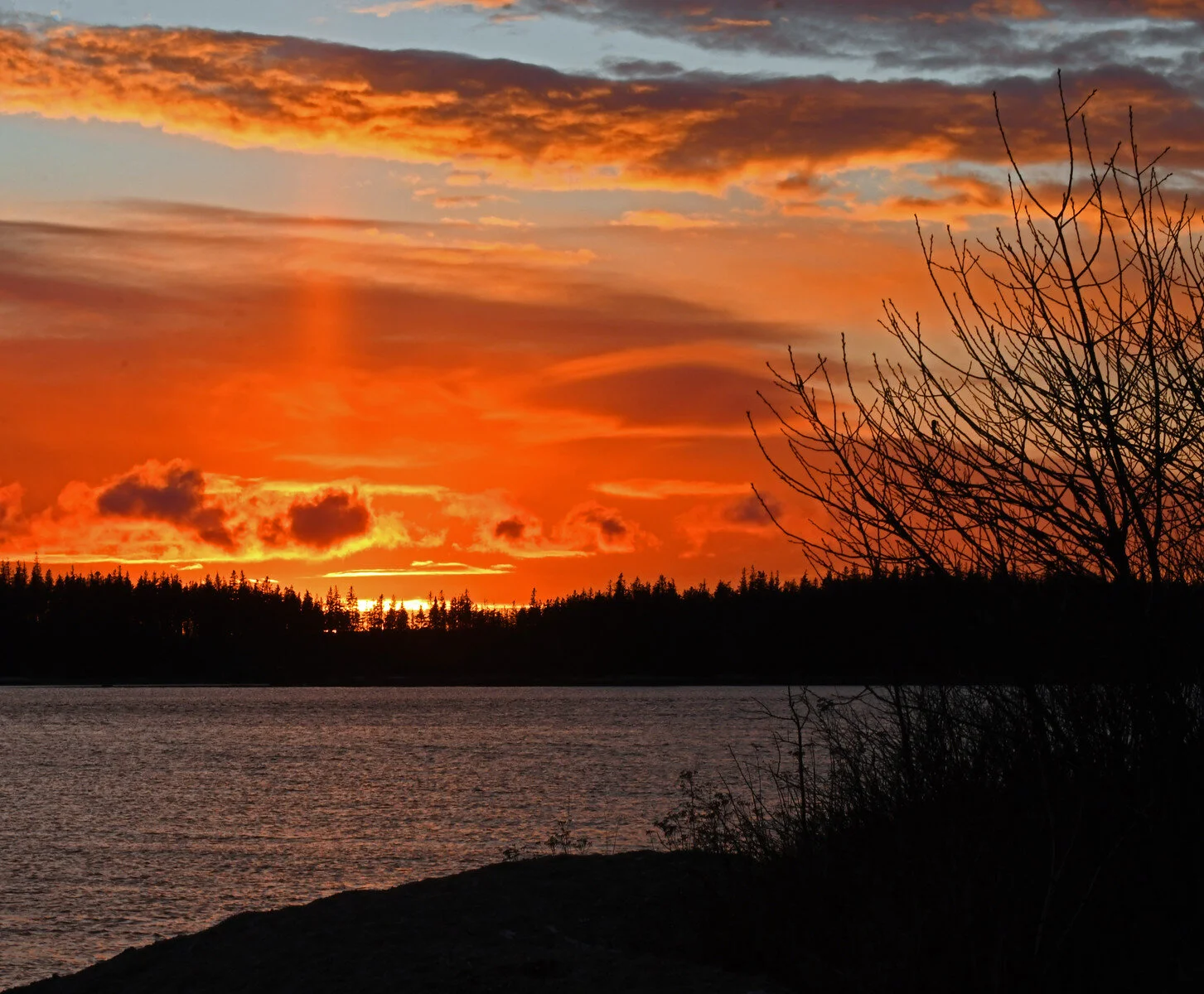
Because of its cold, clear (unpolluted) air, December produces some of the year’s best sunsets. We end this edition of Postcards with one of them:

12.jpg

HAPPY NEW YEAR!

(All images here were taken in Down East Maine during December 2020.)


7 Comments

Comment

In the Right Place: Very Cool

Here, we see the December full moon a few minutes after it rose over our horizon yesterday; it’s about to climb over Cadillac Mountain in Acadia National Park:

1.jpg

December’s full moon is known for its high trajectory, which makes it visible longer than most moons, but also smaller. It’s most common name is The Cold Full Moon, based upon the Mohawk Native American name for the month that real cold begins in their territory.

Here, we see (with a larger lens) that Cold Moon it raced above Great Cove in Brooklin last night:

Apropos of its name, we had 24-degree (F) temperatures and 22 mile-per-hour wind gusts at the time that these images were taken. Those combined for a painful wind chill and frigid camera. (Brooklin, Maine)

Comment