Comment

In the Right Place: Woodies!

Yesterday, the day before astronomical spring, I flushed a quartet of Wood Ducks (three males and a female). They were hidden under the nearby bank of a marsh pond that had lost half of its ice and they scared me more than I did them. They were my first Woodies of the year and they made my day.

I only had a 200 mm lens on the camera and, by the time I got my shutter set for their speedy wing beats (1/4000th of a second) and pointed it in their direction, I only “captured” this straggling male high above me.

WD-1.jpg

That’s alright; it’s good to know that they’re now here, which means that I’ll see them again in their favorite ponds or in an overlooking tree. (They’re taloned webbed feet enable this tree roosting from which they get their name.)

The next time, I’ll have a big lens strapped on the camera. and try to capture a male Wood Duck in full dress uniform and feathered helmet(, such as this fellow from a prior year:

WD-2.jpg

Brooklin, Maine)

Comment

Comment

In the Right Place: The Great Wet Hope

Here’s an abstract collage as it appeared on the WoodenBoat School Campus on March 17. It’s made of big boat white buoys; small boat and line-pickup yellow and red bullet buoys; heavy, rusty mushroom anchors, and chains and other mooring hardware, among other things.

i-k6drNn7-X4.jpg

This equipment never was put to use during the pandemic summer of 2020. However, barring unforeseen circumstances, the School’s famous building and sailing classes will be held this summer and this gear will become part of a functional art presentation in Great Cove.

One of the urgent hopes around here is to see, once again, Great Cove on a warm summer’s day, alive with sails on the WoodenBoat fleet, classic schooners, and other vessels. (Brooklin, Maine)

Comment

Comment

In the Right Place: The Paws That Refresh

The furry catkins of American Pussy Willow (Salix discolor) have been a welcome sight recently. They’re usually among the first signs that winter is losing its grip, although we’re never surprised by wintery March and April days. The images here were taken March 16:

P-1.jpg

Named after the soft cat paws that they resemble, the furry catkins protect the male plants’ “flowers” from the cold. (Those flowers have no petals or scent; they’re just stamens loaded with pollen.)

P-2.jpg

The cat paws soon will disappear. Then, the exposed stamens, like little firehoses, will spout massive amounts of dusty pollen into the air. The wind has the job of delivering the pollen to awaiting female flowers and sneezing hikers. (Brooklin, Maibe.

Comment

Comment

In the Right Place: Uncharitable

It’s St. Patrick’s Day, so we’re serving cabbage today. Unfortunately, our cabbage is inedible and foul-smelling at times, but it’s a very important plant.

We’re talking about Skunk Cabbage. Its flower-containing purple spathes are just now pushing their way up through the ice in the bogs., as you see from this image taken this morning:

S-1.jpg

The plant’s name is uncharitable, but descriptive; it has a foul breath when it flowers or is bruised. However, that’s why the plant has survived for centuries: that odor is very pleasant to bees and other pollinators and obnoxious to larger animals that might crush it. By summer, the Skunk Cabbage will be a regal, shade-producing canopy for smaller wildlife, as shown in this archive image:

S-2.jpg

(Brooklin, Maine)

Comment

Comment

In the Right Place: Sapped

We’re starting to see some of the older maple trees around here being bled for their sap to make maple syrup. The best sap comes with freezing nights and warm days. However, once the trees start using their energy to bud and leaf, the flavor diminishes significantly.

S-1.jpg

The historic sapping process involves driving a hollow spile into a tree and hanging a can or bucket from it to catch drips, as you see here. However, the more efficient (but ugly) modern process involves suction pumps connected to networks of plastic pipes and containers.

S-3.jpg

Not all maple trees produce good syrup sap. Sugar, red, and black maples are recommended, if they’re old enough. Only trees at least 40 years old (some say 45) will produce good sap and most will do so for over 100 years, according to reports.

(Brooklin, Maine; Leighton Archive images used)

Comment

Comment

In the Right Place: Considerate

Here, we see ice-ringed Pumpkin Island and its Light on Saturday, March 13. I’m at the tip of Little Deer Isle admiring the scene and wondering why this three-acre Maine Island is called Pumpkin.

P-1.jpg

It’s not shaped like a pumpkin; pumpkins weren’t grown there, as far as I can tell, and a review of six histories of the area was not illuminating on this subject. Perhaps one of you can help.

The Island and its Light are located at the northwest entrance to Eggemoggin Reach, a granite ledge- and island-clogged channel between the Penobscot Bay and the Atlantic Ocean. The Reach is some of the best sailing water in the world during a clear day, but can be perilous during a foul day or dark night, even to boats with radar.

P-2.jpg

The Pumpkin Island Light entered service in 1855, when there was no radar, but plenty of traffic there in the form of coastal cruisers carrying timber, granite, and other commercial cargo. (These vessels are now called schooners and their cargo is tourists.) It was said that the Light could be seen with the naked eye 20 nautical miles away.

The Light was operated until 1933. The Island and its buildings were then sold and have remained in considerate private hands since. (Little Deer Island, Maine)

Comment

Comment

In the Right Place: Reminder

Did you set your timepieces forward last night? We sympathize with those who are trying to do so with their sundials.

Palladio.jpg

They didn’t have to worry about the government messing with their time when this famous sundial was affixed in 1560 or 61 to Palladio’s magnificent Villa Barbaro in Maser, Italy. (Brooklin, Maine; Leighton Archive image taken in April 2013)

Comment

Comment

In the Right Place: Check It Out

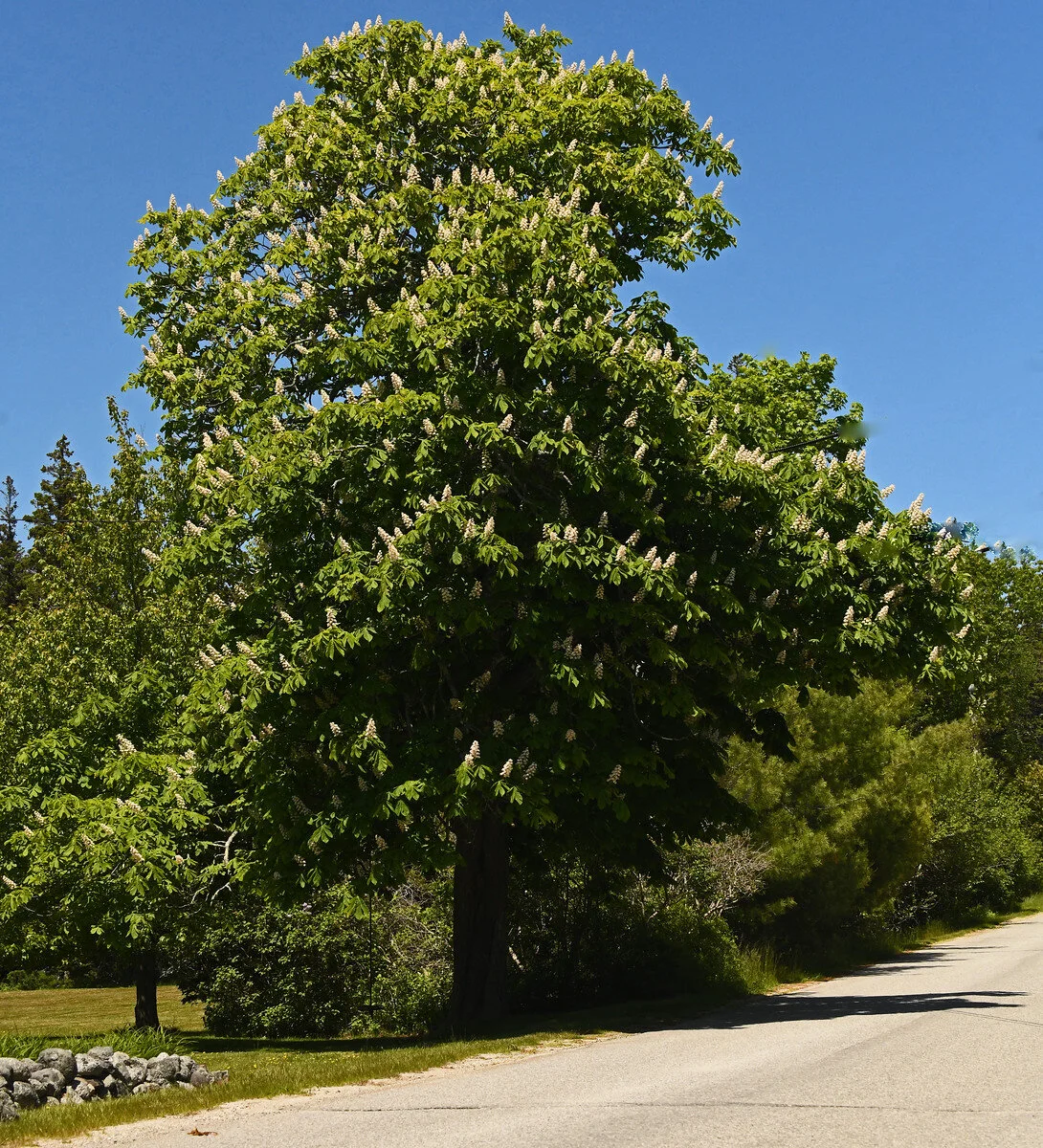
For those who like their winter trees gnarly and scary, here’s one of our favorite Brooklin Horse Chestnut Trees as it appeared yesterday. It apparently is ready to reach out and snatch a child.

C-1.jpg

In the summer, however, it’s an inviting temple of lush palmate leaves, flowered candelabras, and vibrant conker shells:

C-2.jpg

This unusual species of tree (Aesculus hippocastanum) is native to the Balkans. They were imported into England in 1616, primarily for landscape use, and then exported to the United States for similar purposes.

The tree was named a chestnut tree because of similarities to the European Sweet Chestnut Tree (Castanea sativa); but, it’s not related to that tree. It also was named a “Horse” Chestnut Tree, but it’s certainly not related to any horse. Why the “Horse” nom de bloom? There are two theories.

The primary theory is that, in days of yore, the Turks fed the tree’s conkers to their sick horses to cure the animals’ coughing. The other theory is that, when the tree’s leaves fall, they leave scars on their twigs that look exactly like little horseshoes, complete with nail holes. Check out your nearest Horse Chestnut Tree. (Brooklin, Maine)

Comment

Comment

In the Right Place: You Never Know

We’re having a heat wave. Yesterday’s high was 42 degrees (F); today’s is projected to be 47, and tomorrow’s 48. Put those ice skating plans on hold for a while. But, don’t pack the skates away yet.

RJL_2900_edited-1-X3.jpg

Winter dies a hard death here, especially in the field ponds. In March, they can stir in awareness with a little warmth and then revert into an ice-induced coma. (Brooklin, Maine)

Comment

Comment

In the Right Place: For the Record

Unfortunately for some of you, I never get tired of this view. I take a series of images of it each month for an historical archive and usually show at least one here. This was taken in yesterday’s slight haze.

i-3TSHWGm-X3.jpg

What you see in the foreground is a rocky field and a stand of trees and brush on the east coast of Brooklin’s Naskeag Peninsula, a place we call Amen Ridge because it is adjacent to Amen Farm. Next, you see Blue Hill Bay and several of its islands.

Then, a roughly estimated 11 miles away (as the crow flies) from the Ridge, is large Mount Desert Island. The southern face of its Cadillac Mountain is looming there and we note that its snow has mostly disappeared.

Mount Cadillac is part of the wonderful 42,000-acre Acadia National Park, all of which is open to the public now 24 hours a day. However, social distancing is required and the visitor centers and other buildings are closed until April 15. (Brooklin, Maine)

Comment

Comment

In the Right Place: Gullible

It was cold here Saturday afternoon, March 6. The Gulls were sopping up the sun on the Blue Hill Harbor Dock pylons, not inclined to move when a lens was pointed in their direction. It was a good time to try to work on identifying the plumage transitions from immature to adult Gulls.

Here, you have a four-year adult Herring Gull, our most common Gull. It’s notable by its white body, gray wings and back, red spotted lower bill, yellow eye, and pinkish legs.

G-1.jpg

Herring and some other larger Gulls have a four-year transition to mature plumage, with different phases each year.

These differing immature Herring Gull plumages often are difficult to identify as to year, especially since there is extensive variation in them due to interbreeding and other factors. However, my best guess for this Gull is that it’s a three-year Herring Gull:

G-2.jpg

But, as usual, I’m not sure. Some of you black-belt birders may know what it is with certainty. (Brooklin, Maine)

Comment

Comment

In the Right Place: Comings and Goings

Here, you see the mouth of Patten Stream flowing into Patten Bay in Surry, Maine. It’s 12:23 p.m. on March 6 and the tide is coming in:

P-1.jpg

Below, you’ll see the same location at 3:07 that day, with the tide still rising.:

P-2.jpg

Very high tides will cover most of the rocks at the mouth and make it easier for migrating fish to leave the Bay’s salt water and swim upstream to spawn or grow in fresh water. (They are “diadromous” fish that spend part of their lives in salt water and part in fresh.)

Among the fish found migrating up this stream are alewives (herring, to spawn) and young American eels (glass eels, which grow into adults in fresh water before returning to the sea to spawn in several years). (Brooklin, Maine)

Comment

Comment

In the Right Place: Bill and Coo

I saw a male Mourning Dove yesterday circling and chasing away other Doves, which usually means he’s staking out his nesting territory early. Although most Mourning Doves mate from spring to fall, they reportedly are capable of mating any time during the year.

D-1.jpg

If you haven’t already, you’ll soon hear cooing from the male Mourning Doves. (Females usually don’t coo.) Mourning Doves have two other cute traits that set them apart from most birds. First, they, usually sleep with their chins tucked into their breasts rather than with their heads under a wing:

D4.jpg

Second, they also use their thin beaks like straws when drinking, keeping their heads down and sucking the water up, rather than taking a beak-full of water and tossing their heads back to let gravity do the job.

D-2.jpg

(Brooklin, Maine; archive images shown)

Comment

Comment

In the Right Place: Royalty

When you get as old and as large as this Queen of the wild apple trees, you need at least three walkers to stand and take in the sun on a cold day.

i-r6GcJJK-XL.jpg

Thanks to the WoodenBoat School for taking good care of her. (Brooklin, Maine; image taken yesterday)

Comment

1 Comment

In the Right Place: Blimey!

Here, forming ranks in yesterday’s freezing weather, is a Maine native that only those with keen eyes have seen without help. It’s a tiny fungus called British Soldier Lichen (Cladonia cristellata) that seems to thrive in winter.

L2.jpg

Its common name derives from the British military uniform immortalized in the old New England alarm, “The Redcoats are coming!” The British Soldiers seen here are bivouacking in and on the wood of a decaying old farm wagon.

L1.jpg

The Soldier stalks grow to about ¼ an inch and their red jackets usually are smaller than match tops. Yet, this lichen is eaten by white-tailed deer, wild turkeys, and other wandering salad lovers.

As you may know, lichens are two symbiotic organisms in one entity: fungi and algae. Basically, most of the lichen body is a fungus that brings in necessary water and minerals; the algae make needed sugar from sunlight. Because their bodies are mostly fungi, lichens are classified as fungi. (Brooklin, Maine)

1 Comment

Comment

In the Right Place: Ouch!

Here, you see Great Cove and Eggemoggin Reach being wind-whisked to a froth yesterday morning.

1.jpg

Below, you’ll see switchback grasses motivated by that wind to show us their balletic capabilities.

2.jpg

The records show that it was 11 degrees (F) with a wind chill of minus 08 when these images were taken. The ambient wind was 23 miles per hour, but the gusts occasionally reached a high of 39.

The sun was shining boldly and the day was crinkly clear. Yet, the cold wind’s effect on a bare nose was to turn it into a frozen ice pick that penetrated to the brain. (Brooklin, Maine)

Comment

Comment

In the Right Place: Animalistic

According to poetic legend, March is supposed to come in roaring like a lion. Well, this March came here yesterday like a sea serpent, causing exceedingly high tides and spouting smoke-like fog, as you see here in Center Harbor:.

M3.jpg

That fog became torrential rain that created small lakes in the woods.

M2.jpg
M1.jpg

Today, March turned into a polar bear bellowing strong Arctic-Canadian winds that produced power outages here, wind chills well below zero, and whitecaps whipping up Great Cove:. It’s also sunny and clear, but I wouldn’t recommend hiking in it. (Brooklin, Maine)

Comment

February Postcards From Maine

6 Comments

February Postcards From Maine

It was an easy February here on the coast of Maine. Except for a short string of cold days, it was mild. We had about three snow storms and even those were timid and more decorative than disruptive.

1.jpg
i-WXphp2j-XL.jpg

The big municipal plows kept the streets plowed and the local home-based plows kept the driveways and country lanes clear.

We had many sunny days. The white fields were made even brighter and smoother-looking in full sunshine and clear blue skies. Wild blueberry plants peeked up through the white snow like spilled wine and children laughed and screamed as they went fast down slick hills on sleds and disks.

4.jpg
9.jpg

New England “connected” and early “four-square”-like houses stood proud in the snow and cold that they were designed to withstand.

14.jpg
17.jpg

That’s not to say that every day was perfect this February. We had a few hard rains and sleeting storms that were not pleasant if you were out-of-doors. However, the rains did help clear snow.

20.jpg

The rains did an especially good job of clearing off lobster traps that were stored for the winter. Most of the lobster boats that remained in the water were reconfigured for scallop fishing. Aft of the cabin, a mast and boom were added to drag and hoist a dredge net. Usually, a “shelling hut” was added there, as well. The delicious mollusks could be shucked in the hut with some protection from the cold winter sea winds.

25.jpg

The wildlife that enjoyed the mild month the most seemed to be the white-tailed deer, which picked over our garden with the expertise of gourmands; the wild turkeys, which loved to sprint across the icy road right in front of your car to see if you could skid, and the hundreds of common eider ducks that spend their winter vacations going for joy rides in the Blue Hill Falls fast water.

28.jpg

This February had its somber aspects. U.S. deaths from the Covid 19 plague exceeded 500,000 during the month. Per order of the Governor, the State and National flags in front of the Brooklin Town Offices were lowered to half mast in honor of the victims. Per order of President Biden, the flag at our Post Office also was lowered. On the other end of the emotional spectrum, February 14 was Valentine’s Day; a beautiful bouquet arrived at our house for a beautiful lady.

February’s full moon is named the Snow Moon for reasons that should not have to be explained. It was raining when the official full moon rose on February 27. However, February 25 was as clear as a day can be. A virtually full moon rose in the afternoon of that day and was illuminated by the low light of the setting sun.

33.jpg

(All images here were taken in Down East Maine during February of 2021.)


6 Comments

Comment

In the Right Place: On the Wild Side

Here, we’re looking at a layered scene along Flye Point Road on February 23. In the background, a storm is about to break its huddle over Acadia National Park. In the center, we get a peek of Blue Hill Bay (on the left) below a ridge of trees. We also see piles of rocks that remain from clearing and planting the wild (low-bush) blueberry field in the foreground. The winter wine color of blueberry plants is at its best when emerging from snow.

i-wDdk52j-X3.jpg

By the way, Maine reportedly is the largest producer in the world of those low-bush blueberries that are marketed as “wild.” But, these sweetest of all blueberries are commercially cultivated and harvested; in fact, they’re often pollinated by hard-working rented bees from mobile hives. (Brooklin, Maine)

Comment