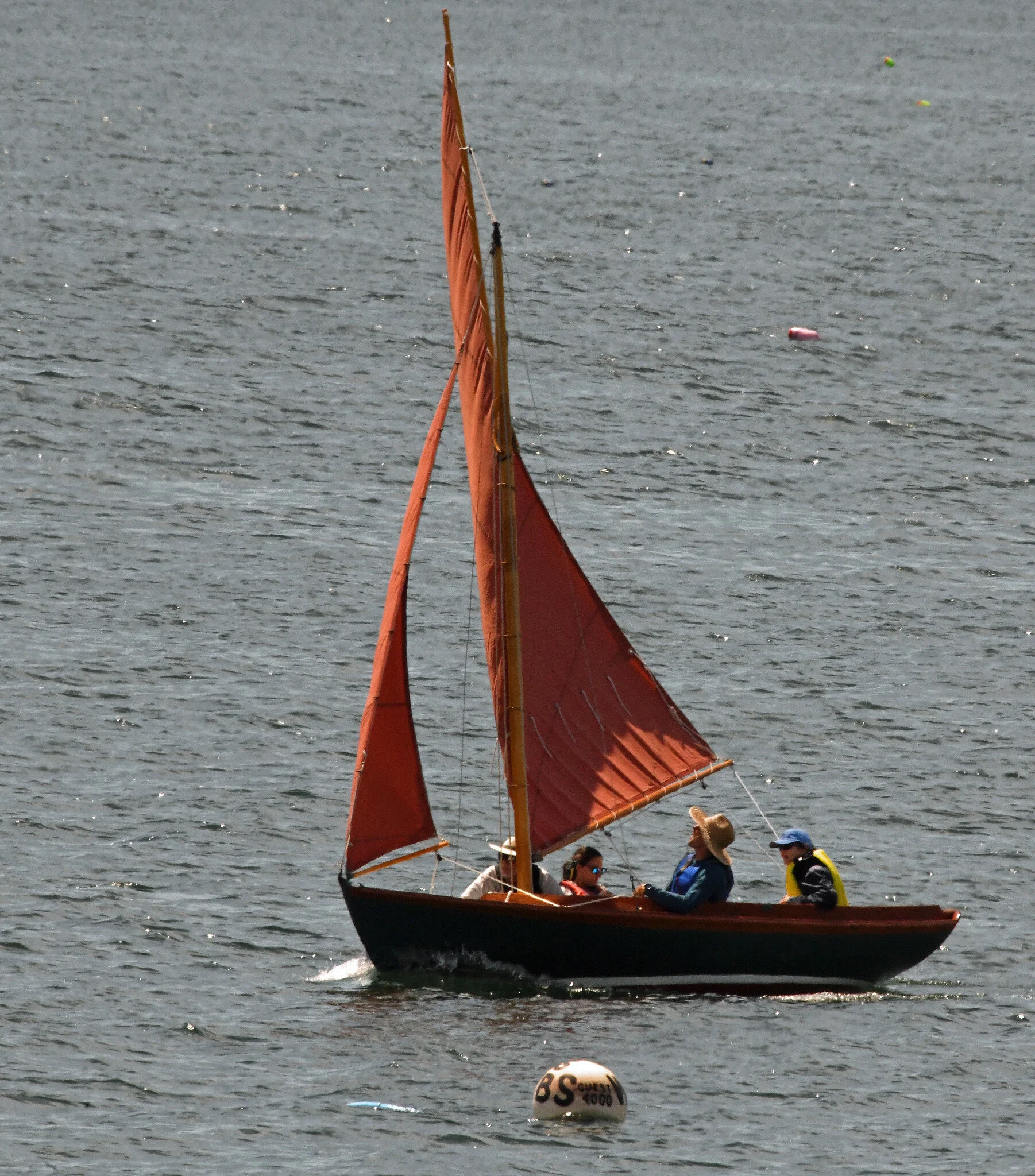
Fiona is a catboat. I could see that from her single mast set far forward into the bow and her broad beam (widest part of the hull). However, I realized that I knew little about this type of sailboat, including why it is called a “catboat” or a “cat.” So, I did a little curiosity research, some of which is shared here.
It turns out that, from the mid-1800s through the early 1900s, the majority of close-to-coast boats for fishing, transportation, and recreation in New England were catboats. Several sources, including Wikipedia, said that the origin of the name for the boat type was unknown. However, Catboat Charters in Massachusetts states that “the name ‘Catboat’ comes from the fishermen having to shoo all of the cats from the boat who were after the dead fish!”
Typically, in addition to the forward placement of its single mast, a catboat’s single sail is gaff-rigged, the boat has a shallow draft, and a beam that is half as wide as the boat is long at the waterline. It usually has a retractable keel (“centerboard”) for fishing or recreational sailing in shallow waters, but some have fixed keels. Traditionally, the Cape Cod cats were 20 to 30 feet long.
However, a small (usually 12-foot) version has been one of the most popular recreational and instructional sailboats for the past 100 years. It’s known generically as a Beetle Cat. Here’s an archive image of Elater, a WoodenBoat School Beetle Cat: