Comment

In the Right Place: Holy

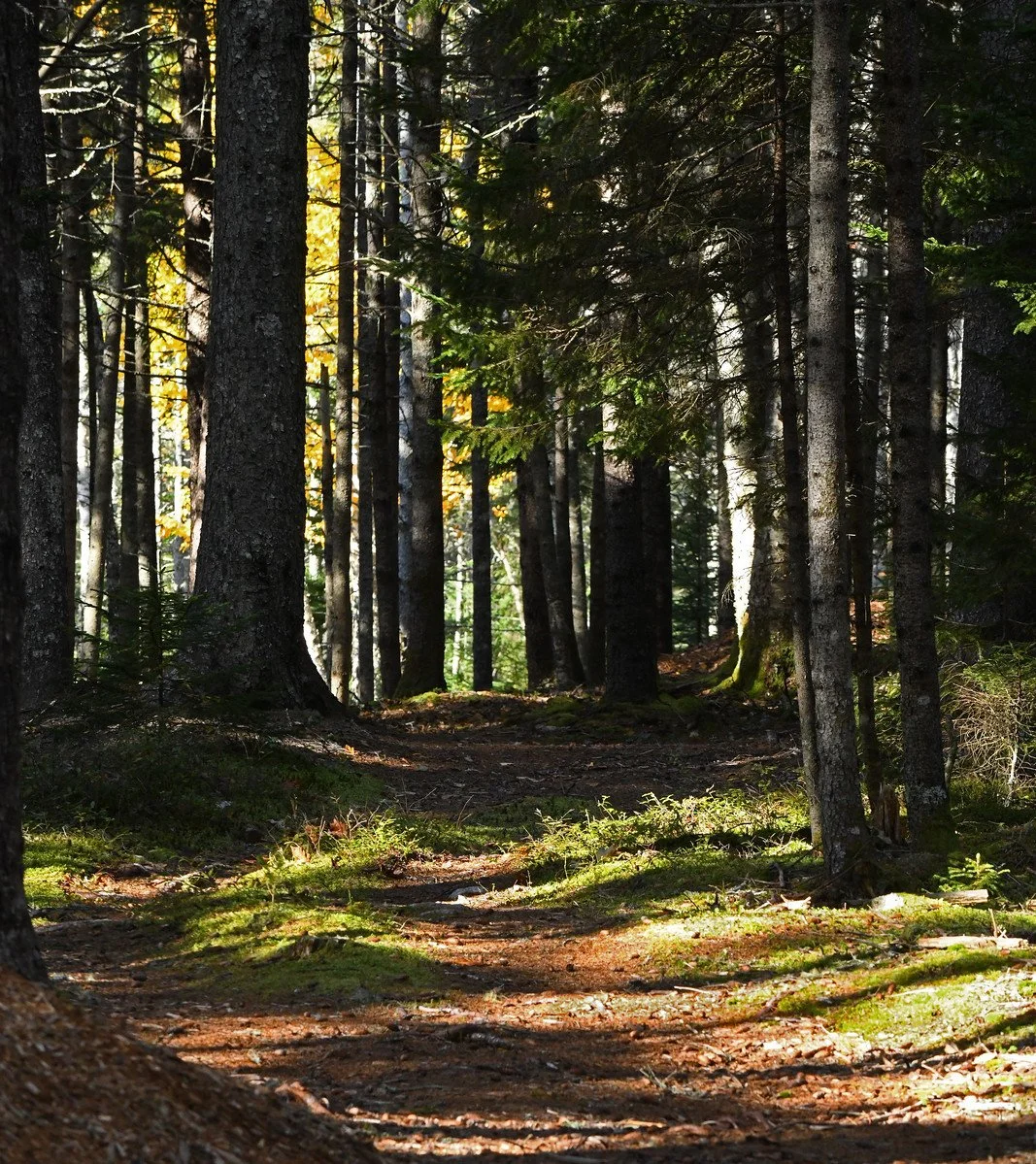
The fall of leaves has created side lights in the darker, columned parts of the woods. Memories of ancient Italian cathedrals lighted through stained glass can be aroused here.

Except, the holy water doesn’t stand still; it runs quickly through moss, giving the fallen one last joyous ride.

(Images taken in Brooklin, Maine, on October 28, 2021.)

Comment

Comment

In the Right Place: Eateries

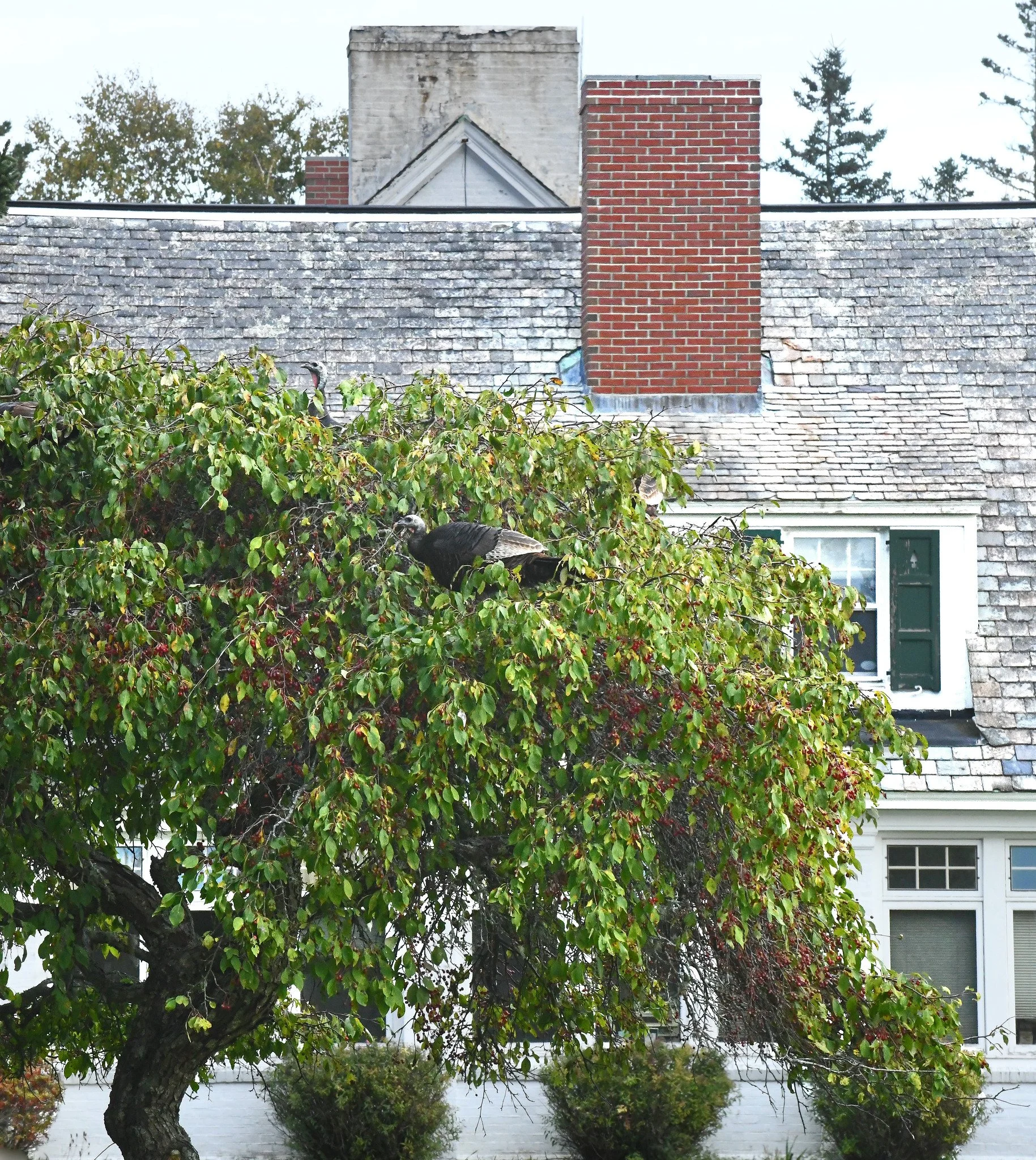
Choice crabapples seem to be featured on local wildlife menus recently. Here you see a favorite fast-food spot that caters to a furry and feathered clientele. It’s an ornamental Japanese crabapple tree on the WoodenBoat School campus.

It has at least four wild turkeys dining in its higher-priced terrace seats, although only two are visible in this image. Beneath the tree, there was ample evidence that white-tailed deer have been feeding from the cheaper standup-eating section below. Deer often stand on their hind legs and nibble apples off their branches.

(Image taken in Brooklin, Maine, on October 18, 2021.)

Comment

Comment

In the Right Place: Nor'easter Report

IWe’re under a wind advisory until noon today and it’s been raining steadily all morning. However, the first nor’easter of the season apparently has yet to do significant damage here on the Down East coast. Our local weather station in central Brooklin shows that our highest gusts never quite reached 50 miles per hour in the early morning hours and that the wind speed seems to be subsiding.

In the image above, you see the rain coming down this morning on our garden, fields, and in Great Cove. We’re still getting occasional rainy wind gusts in the 30s that are proving to be leaf-rippers:

We never lost power here on the Naskeag Peninsula and few trees apparently came down in all of Brooklin. But news reports indicate that there were some significant power outages in other parts of Maine and especially along the coastal areas in states south of us. (Images taken in Brooklin, Maine, on October 27, 2021.)

Comment

Comment

In the Right Place: "Pendulocity"

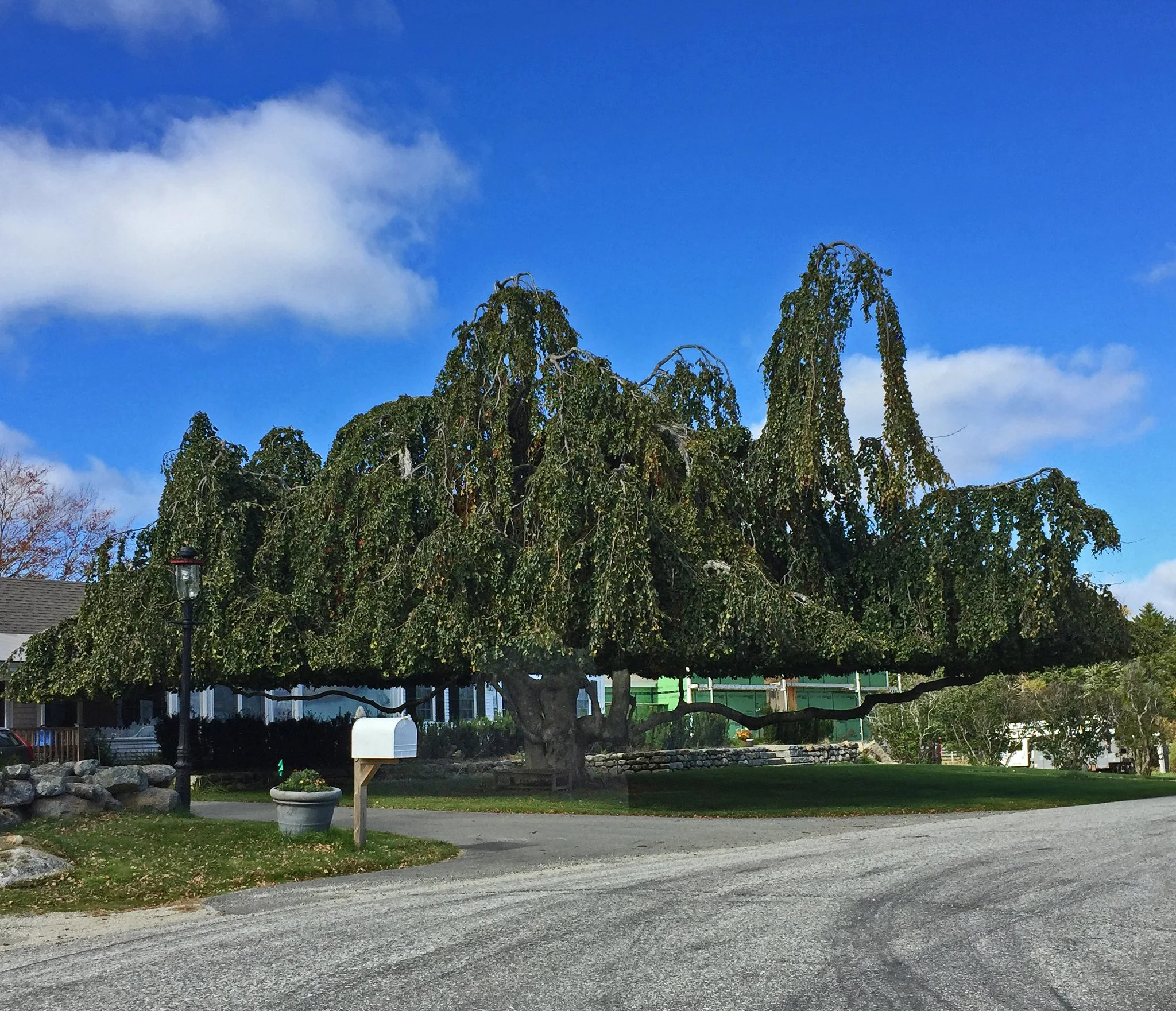
This Weeping Beech (Fagus sylvatica 'Pendula') at Amen Farm is one of the world’s more unusual types of tree. Its scientific name is derived from its most noticeable characteristic: pendulous branches.

These trees can grow to more than 80 feet in height and often are wider than they are high. They were selectively bred from European Beeches in England in 1836 and were introduced into the United States in 1847.

Beeches usually don’t lose all of their leaves in the fall or winter (a phenomenon called “marcescence”); many of the leaves dry out and hang on tightly to sing a rustling chorus to the winter winds. The remaining Beech leaves drop when new growth is ready to appear in the spring.

This one is more than 70 years old and is still growing and being specially pruned for an intriguing flat-bottom-branch effect. Most Weeping Beeches reportedly live between 150 and 200 years. (Image taken in Brooklin, Maine, on October 20, 2021.)

Comment

Comment

In the Right Place: Finding the Way

I’m beginning to think that there’s a relationship between winding wooded lanes and quality of rural life: the more wooded lanes that a community creates, the better its quality of life. Here you see a nearby lane with yesterday’s low sunlight filtering through the trees.

Brooklin has many wooded lanes, most of them hidden and privately maintained, but available for public walking.

Vehicular traffic on these lanes usually is minimal, often just people returning to homes that are further hidden in the woods or on the coast, with long driveways that intersect the lanes.

A typical dictionary definition for “lane” is “a narrow road, especially in a rural area.” The word derives from the Old English word “lanu,” meaning “narrow, hedged-in road.” In today’s conflicted world, a walk on a country lane is more about “hedging-out” than “hedging-in.” (Images taken in Brooklin, Maine, on October 24 [no people] and 18 [people], 2021.)

Comment

Comment

In the Right Place: Skinny, Dipping

This Great Blue Heron youngster apparently is trying to figure out what he was doing wrong after he failed to catch a fish in three unsuccessful – although grandly exuberant – tries.

Youth is an accelerated learning semester for Great Blues:

In recent years, many Great Blues apparently have been postponing their migration flights. In fact, an increasing number of GBHs, especially juveniles, have been reported to over-winter in Maine as that season gets milder. This is yet another Climate Change phenomenon that we need to ponder.

Although Great Blues are our largest (hence, “great”) Herons, they’re not built for the cold. They’re painfully skinny. They can reach almost five feet in length, but usually weigh much less than eight pounds. (Images taken in Surry, Maine, on October 22, 2021.)

Comment

Comment

In the Right Place: Waterfront Report

Fishermen here continue to pull their lobster traps from the water and take them to storage. All or virtually all local lobster fishing will be ended before December.

Some of the vessels will be converted into winter scallop trawlers with masts, booms, and nets; some will remain unchanged and be used as scuba diving platforms for “divers’ scallops,” and the rest will be hauled ashore for winter storage “on the hard.”

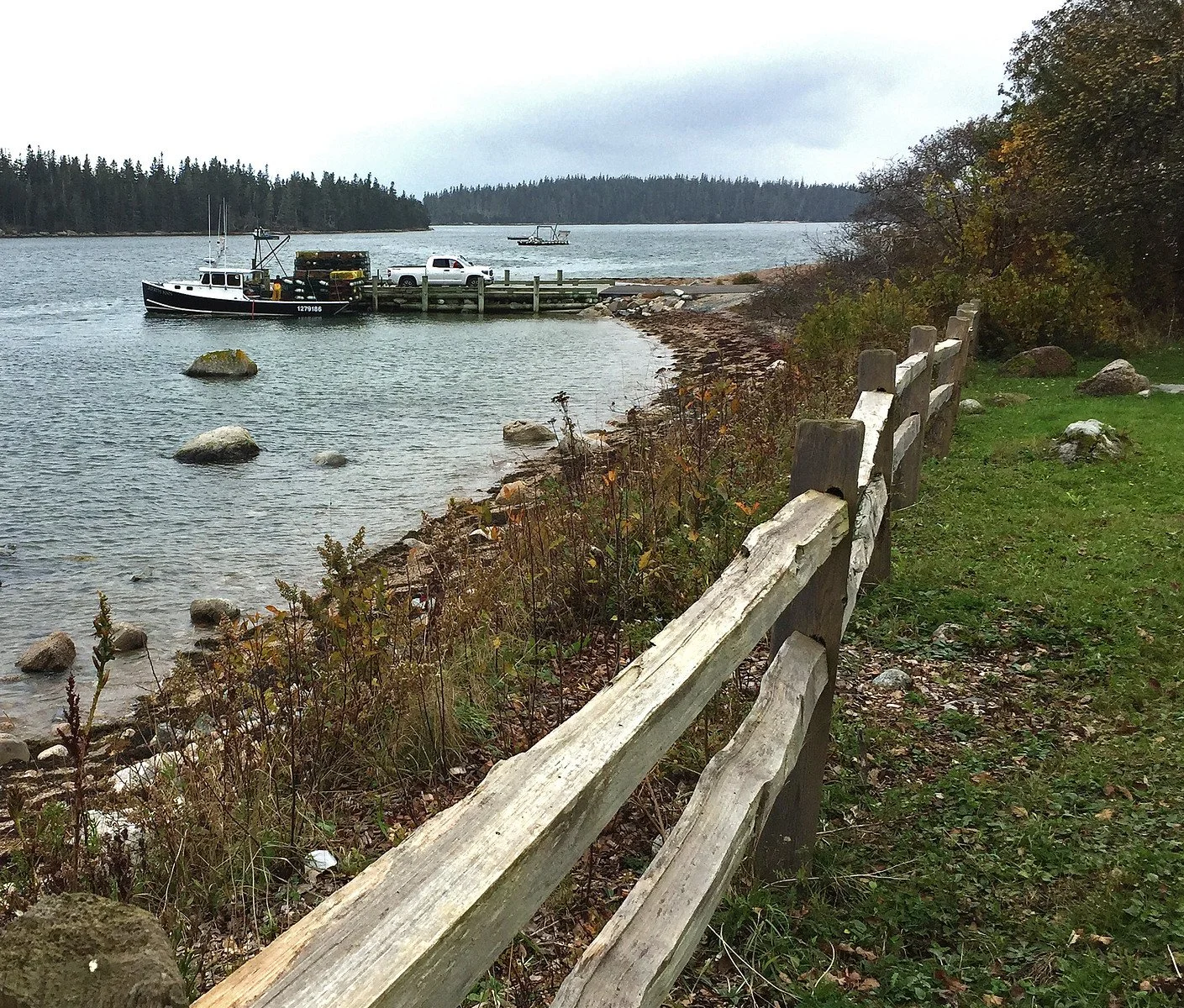
Here you see traps being off-loaded from Judith Ann in Naskeag Harbor during the misty aftermath of a severe thunder and lightning storm yesterday. (Images taken in Brooklin, Maine, on October 22, 2021.)

Comment

Comment

In the Right Place: Self-Defense

The paths through our woods now have a thick, crunchy carpet that, when dry, announces my strides to my furry fellow-mammals who also tread there. But, if I remain still long enough, it announces their strides to me. Fair enough.

This fall, it seems that the yellow leaves are holding on longer than the red leaves. These red leaves on trees along the path shown above are long-gone now:

As I understand it, the yellow leaf color is caused primarily by the natural loss of a chemical (chlorophyll), while the red is caused primarily by the energetic production of a new chemical (anthocyanin). But, why would a tree go to the trouble of producing a new chemical before it shuts down many operations for the winter?

A little (probably inadequate) online research indicates that there are two popular scientific theories that suggest it is a matter of self-protection, but in defense against different dangers. One theory suggests that red leaves help trees absorb damaging sunlight during their transition; that is, red is a “sunscreen.” The other theory suggests that red leaves keep away harmful insects, especially aphids. Some scientists think that both theories may be correct.

(Images taken in Brooklin, Maine, on October 20 [carpet] and 9 [branches], 2021.)

Comment

Comment

In the Right Place: Weaponizing

Here we see last night’s full Hunter’s Moon “rising” yellow from behind a wooded island in Blue Hill Bay.

It’s our dirty atmosphere that discolors and distorts the moon as we see it rise initially from a flatter perspective. Below, as you’ll see, it turns silver to us as it gets higher and we view it through less of the lower atmosphere. (That hump on the left is Acadia National Park.)

The October full moon reportedly was named by Native Americans to commemorate the period after the harvest when they would hunt deer and other animals scavenging in the newly cleared fields.

Curiously, this Hunter’s Moon occurred during Maine’s bow- hunting season for deer (October 2-29). Guess what was the weapon of choice for many Native Americans when hunting deer before the Europeans arrived? (Images taken from Flye Point in Brooklin, Maine, on October 20, 2021.)

Comment

Comment

In the Right Place: Above It All

Yesterday we had an exceptionally large herd of clouds migrate over and around our little peninsula, mostly of the cumulus and stratocumulus breeds, I think. They created one of those days of now-you-see-sun; now-you-don’t.

Above you see them galloping northeast (to the left) over Acadia National Park’s Cadillac Mountain. They were more crowded in the southwest over Great Cove and Eggemoggin Reach:

(Images taken in Brooklin, Maine, on October 19, 2021.)

Comment

Comment

In the Right Place: Cozy

You might think that this is not an architectural masterpiece that you’re seeing here, soaking up yesterday’s sun.

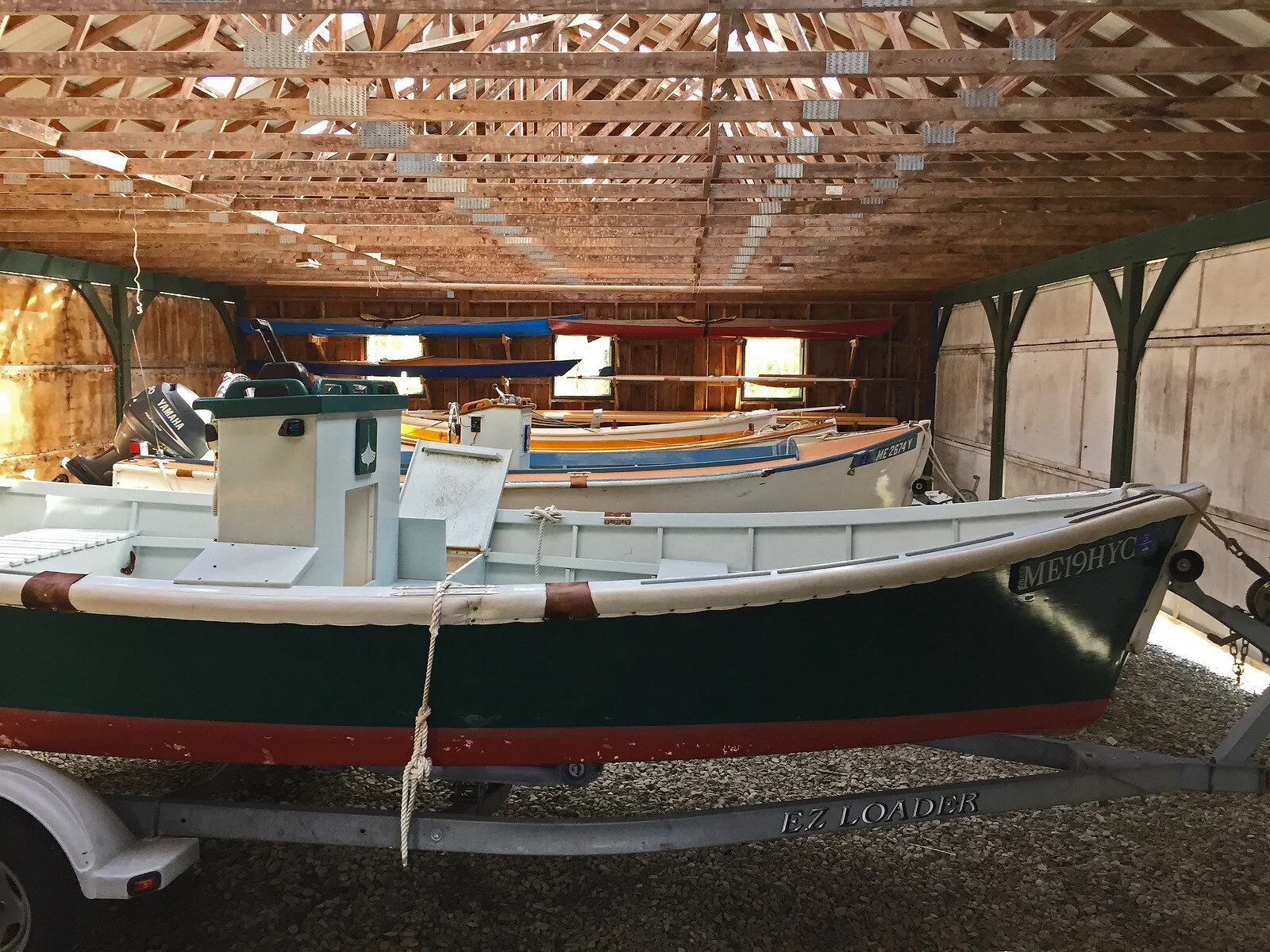
But, architects will tell you that “form follows function.” And, the function of this shed is to protect some of the WoodenBoat School’s fleet of small boats during the winter. Stated another way, you’re looking at a jewel box.

On days like yesterday, the summer-frisky boats inside the cozy boatshed bask in the sunlight streaming through the skylights.

(Images taken in Brooklin, Maine, on October 18, 2021.)

Comment

Comment

In the Right Place: First Light

After a weekend of rain, the weather gods favored us this morning with a glorious October dawn. Here, the first light has just risen above the wooded ridge to the southeast, on your left, and is spreading slowly over the North Field. It already has found Babson Island, which protects Great Cove.

i-NDdMjZN-XL.jpg

We’re just getting used to seeing the Cove without moored sailboats swaying in its tides and winds. The boats are being replaced by waterfowl convoys, which provide a different kind of visual pleasure through a spotting scope. (Image taken in Brooklin, Maine, on October 18, 2021.)

Comment

Comment

In the Right Place: Hanging Around

October rains and winds have blown down the leaves on many old “wild” apple trees here, but many trees continue to hold tightly onto all or some of their apples. The curious result is that we see gnarly gray trunks and branches decorated with green and red fruit like Christmas lights.

i-tfZQhZV-X3.jpg

The dropping of an apple apparently is not a simple matter. As we understand it, apples usually are dropped twice a year. Some are shed in the summer when the tree decides to drop (“abcises”) a number of its immature apples to preserve energy that will be used to help the rest of the fruit mature. As the days get colder in the fall or early winter, the tree eventually will drop its mature fruit.

i-H7bzRv2-X4.jpg

The process apparently involves the apple stem cells secreting enzymes that eat away their cellular walls. This weakens the stems’ grips and, eventually, gravity causes the fruit to fall, perhaps on a physicist’s head as the story goes. Warm and wet weather here may have slowed the process. (Images taken in Brooklin, Maine, on October 14 [full tree] and 5 [branches], 2021.)

Comment

Comment

In the Right Place: Hold Ups

Here you see the woods bordering a not-quite-red-yet blueberry field on Thursday.

1.jpg

It’s been a strange fall for deciduous tree and bush leaves. Some have turned and dropped en masse like panicked crowds, others are just turning and dropping a leaf here and there, and still many others remain vibrantly green and appear to be holding onto their branches for dear life.

4.jpg

Last night, it rained here in Brooklin and has continued to rain hard and steadily as we speak. Red, orange, and yellow leaves are being pelted to the ground in sodden clumps, yet those feisty green holdouts remain steadfastly aloft. (Images taken in North Sedgwick, Maine, on October 14, 2021.)

Comment

Comment

In the Right Place: Waterfront Report

Here you see the end of a day’s fishing at the convenience raft in Naskeag Harbor, where freshly caught lobsters are sold by fishermen (male and female) and fuel and lobster bait for the next trip out are bought by them.

L3.jpg

We hear that the overall lobster harvest this year continues to be lower than expected, but at least the market continues to react by raising lobster prices. However, the fishermen’s lives have been further complicated by the 2020-2021 State and regional protective restrictions (quotas) on harvesting Atlantic Herring.

Herring are the fishermen’s favorite lobster bait. Alternative bait must be used now and, we hear, it has become harder to get; which means more expensive for fishermen to buy; which means they keep less of those higher prices. Some of the fishermen are taking traps out of the water early to put an end to this strange season.

L4.jpg

Nonetheless, many seem to be carrying on and having great weather to do so. We wish them the best of luck. (Images taken in Brooklin, Maine, on October 12, 2021.)

Comment

Comment

In the Right Place: Handy Things

Our wet but mild (some would say hot) summer and early fall seem to have produced record numbers of mushrooms in our woods. Some of them can be characterized by how they feel on the fingers. At the extremes, we have pleasurable Touchy-Feelies and unpleasant “Ugh”-Producers.

1.jpg

Above, you see two in the unpleasant category. They have very sticky caps that will make you want to wash your hands or rub them on your pants immediately after touching. (I often touch mushrooms to see to see if they have gills. These don’t.) With the help of our local Mushroom Maven, David Porter, we think that these may be dark-capped varieties of the wonderfully named Slippery Jack Mushrooms (Suilliu luteus).

Below, you’ll see a member of the touchy-feely category. It can arouse the sense of stroking very good velvet or suede when touched lightly. It also has a wonderful common name based on its color and its milk-like oozes: It’s a Chocolate Milky Mushroom (Lactarius lignyotus):

2.jpg

(Images taken in Brooklin, Maine, on October 7 [Slippery] and 9 [Milky], 2021.)

Comment

Comment

In the Right Place: Dee-Lightful

This feisty fellow came over to give me a real sassing yesterday while I was taking a morning walk and minding my own business. (Sex assumed.) Of course, he has that right, being The State Bird and all.

1.jpg

He doesn’t understand that he’s only a piece of mostly colorless fluff that weighs about half an ounce. He seems to think that he and his kind deserve special recognition because they’re native, all-year residents that live outside in the harsh winter. He’s proud to come from a tough, local family known as Black-Capped Chickadees.

i-DKxZKnQ-X3.jpg

He gets his first name from the cap that he likes to wear pulled down over his eyes and ears. His family name mimics his favorite call, which sounds like a kazoo playing “chick-a-dee-dee-dee.” The more “dees” at the end, the more alarmed or annoyed the bird is. Five or more “dees” at the end usually means that there is an imminent danger, such as a crouched barn cat, nearby. (Images taken in Brooklin, Maine, on October 11, 2021.)

Comment

Comment

In the Right Place: Speaking of the Devil

There are only a few small, but tough, dragonflies around our ponds now, virtually all of them red autumn Meadowhawks, as far as I’ve seen recently. My guess is that this one is either a Cherry-Faced Meadowhawk (Sympetrum internum) or a Ruby Meadowhawk (S. rubicundulum).

i-FnN2GqW-X3.jpg

Dragonflies historically have been revered in Eastern cultures. However, they were feared in earlier Western cultures that believed they were the devil’s insects. (Their English name reportedly is derived from the Romanian “drac,” meaning both devil and dragon.) Perhaps the fear was in recognition of the insect’s voraciousness in capturing prey and viciousness in dealing with its captured victims.

Most of their kind hunt in the air where their remarkable eyes can lock onto a chosen smaller insect, even if it’s within a swarm of other insects. Then, their even more remarkable flying capability – using each of their four wings together and/or independently – allows them to out-fly their prey in both speed and maneuverability.

The dragonflies can grab another insect with their legs, tear off its wings to prevent distraction and further flight, and rip and chew the victim to pieces with strong jaws and serrated mandibles – all in mid-air, where they eat and eat and eat voraciously.

We should be glad that they evolved into much smaller species than their primordial ancestors, which had wingspans of two and one-half feet. (Image taken in Brooklin, Maine, on October 7, 2021.) C

Comment

Comment

In the Right Place: Somewhat Spiritual

We’re beginning to see trees change color and skeletons riding motorcycles. Both are, in their own way, celebrations of death and an expected life thereafter. These also are signs that we’re approaching one of humankind’s more bizarre celebrations, Halloween.

i-T6cj8H6-X3.jpg

We apparently can thank the Celts for Halloween, which reportedly originated thousands of years ago with their festival of Samhain (pronounced “SOW-in”). It occurred in October at the end of harvest and the onset of the cold, dark winter.

That was the beginning of the season in which human deaths increased and when the dead were thought to briefly return to life in desiccated form. The “spirits” – a word derived from the Latin “to breathe” – were welcomed or warned away (depending on what you’re reading) by huge, artificial bone fires, now called “bonfires.”

i-nrJdGW3-X3.jpg

Human skeletons have been symbols of death and the risking of life since time immemorial. Crusaders, Nazi SS troops, and pirates, among others, used skull and crossbone flags and decorations to scare others and warn of their bloodthirstiness. (Images taken in Surry, Maine, on October 9, 2021.)

Comment