Comment

In the Right Place: O’ Nest Report VIII

There was joy this week at the Osprey Nest, the summer home of our local fish hawk couple, Ozzie and Harriet. The joy was mostly mine: It is now certain that our feathered neighbors have once again produced those red-eyed, big-beaked, reptilian-ugly creatures known as osprey nestlings. Yet, these little monsters are beauties-to-be.

Above you see the two chicks that I’ve seen so far. Judging from Harriet’s behavior, there may be one or two more chicks hidden in the nest hollow. Of course, there will be no milk and pablum for these babies; as with all raptors, they’ll eat bloody prey from the get-go.

In this case, Ozzie will dive under the waters of Great Cove; grasp an unsuspecting fish in his sharp talons; swim up to the surface and fly away to a nearby tree or rock; tear off pieces of the fish’s head and gulp them down with gusto, then home-deliver the bleeding torso for a nice home meal by the family. Usually, Harriet will eat first, then carefully feed the chicks small pieces. (Ospreys have a limited sense of paternal generosity.)

Per our Report Protocol (and O&H sitcom history), nestling sexes will be assumed and the first-born (largest) chick will be named David, while the second-born will be named Ricky. If there is a third nestling, she will be named June due to the month of her birth. If there is a fourth nestling, it will be named Quartus, the Latin baby name meaning “fourth born.” (Images taken in Brooklin, Maine, on June 19 and 21, 2024.)

Comment

Comment

In the Right Place: Windjammer Watch VI

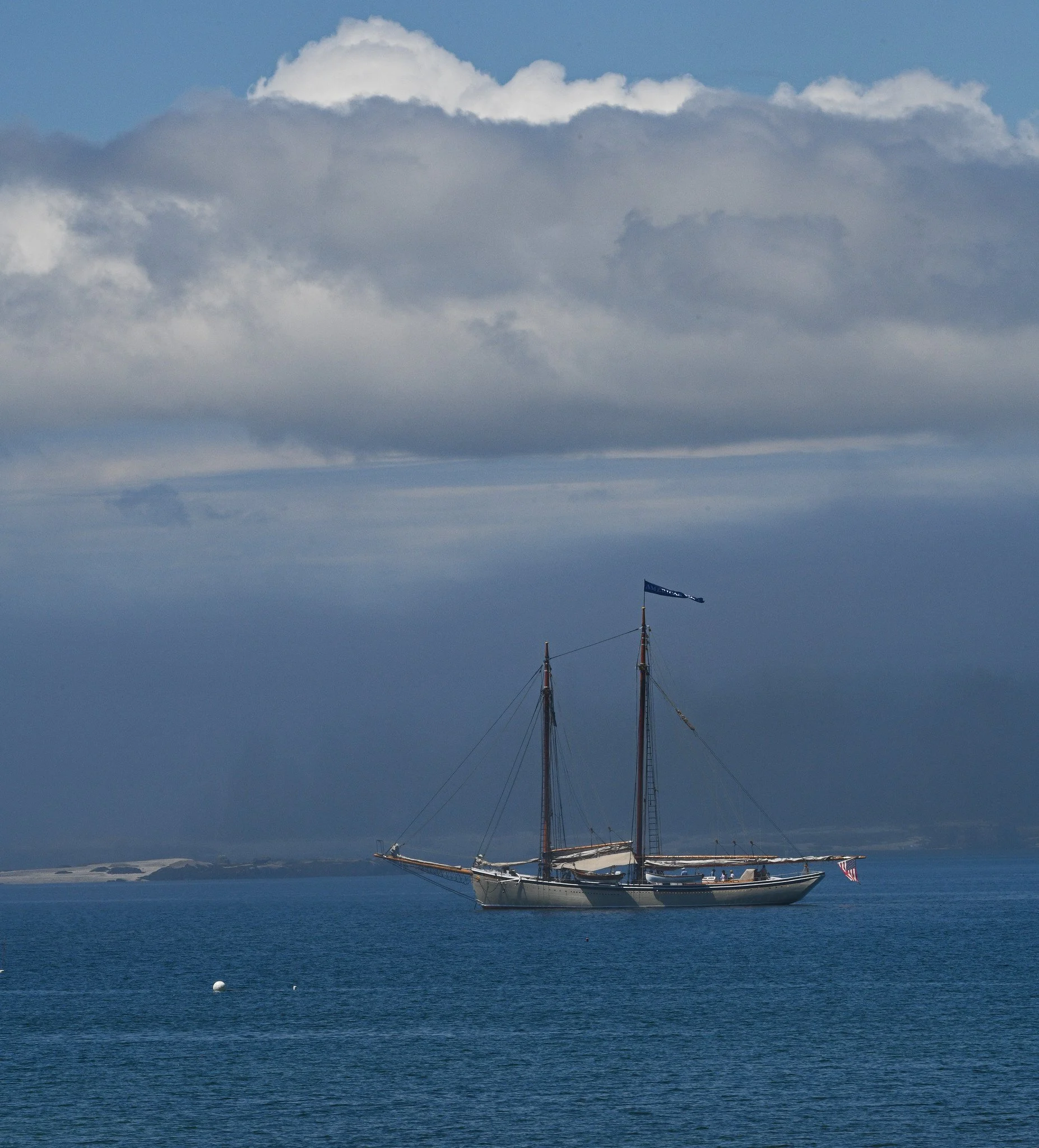
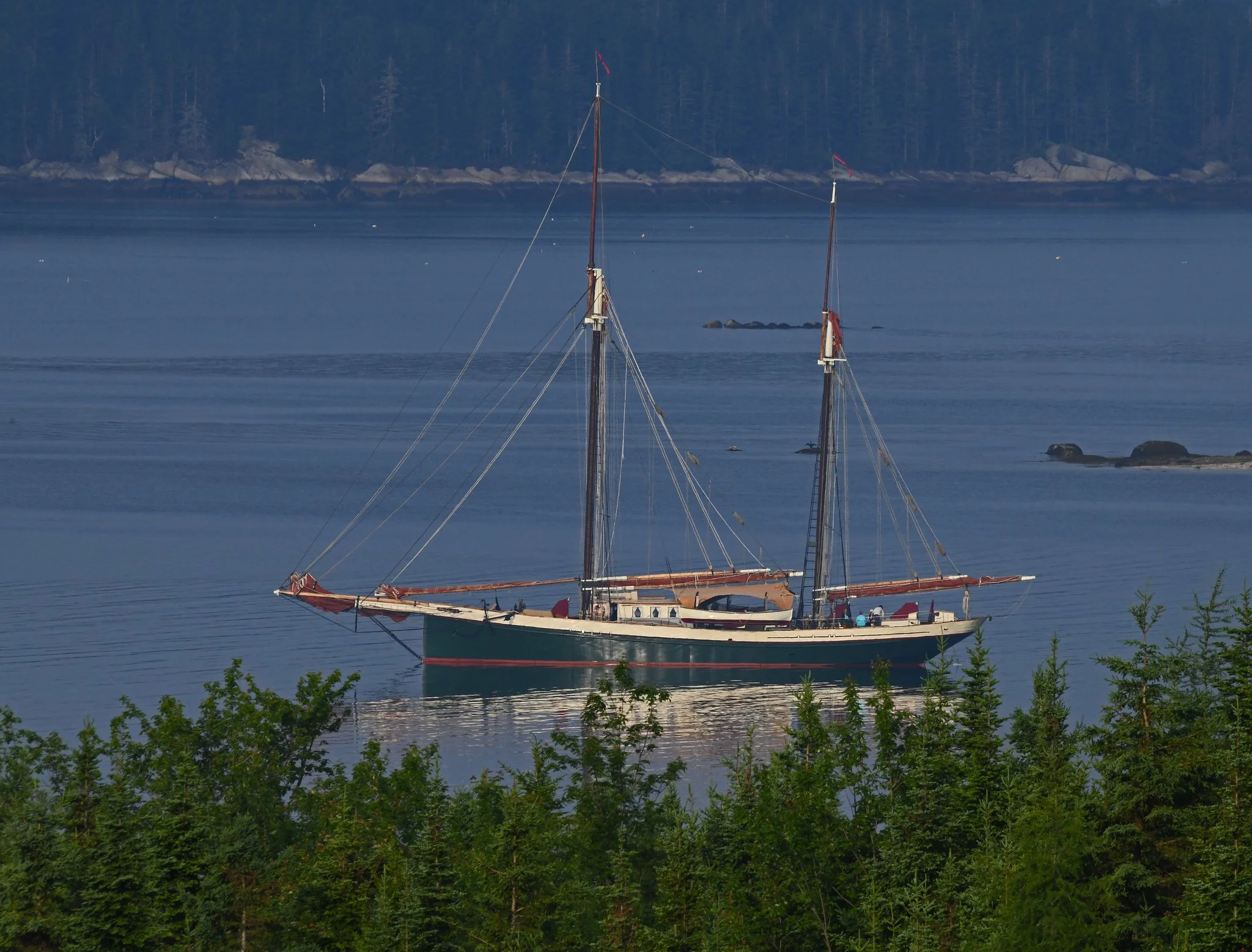
A quartet of Maine windjammers overnighted in Great Cove on Wednesday. They departed in Thursday’s intense hazy heat during a wind doldrum that thwarted their major reason for being.   But, judging from the apparently happy passengers, it was cooler on board the vessels than ashore, where the reported high in Brooklin was a steamy 91 degrees. The four high-masted visitors were “Angelique” (third June visit), “Ladona,” “Mary Day,” and “Stephen Taber” (second June visit).

The visits started Wednesday evening (also hot and hazy), with “Angelique” mooring first and the “Taber” coming in from the south shortly afterward:

The other two vessels apparently came in from the north and moored where we usually can’t see them from our deck. Only "Angelique” was visible to us as dawn’s first light came into the Cove:

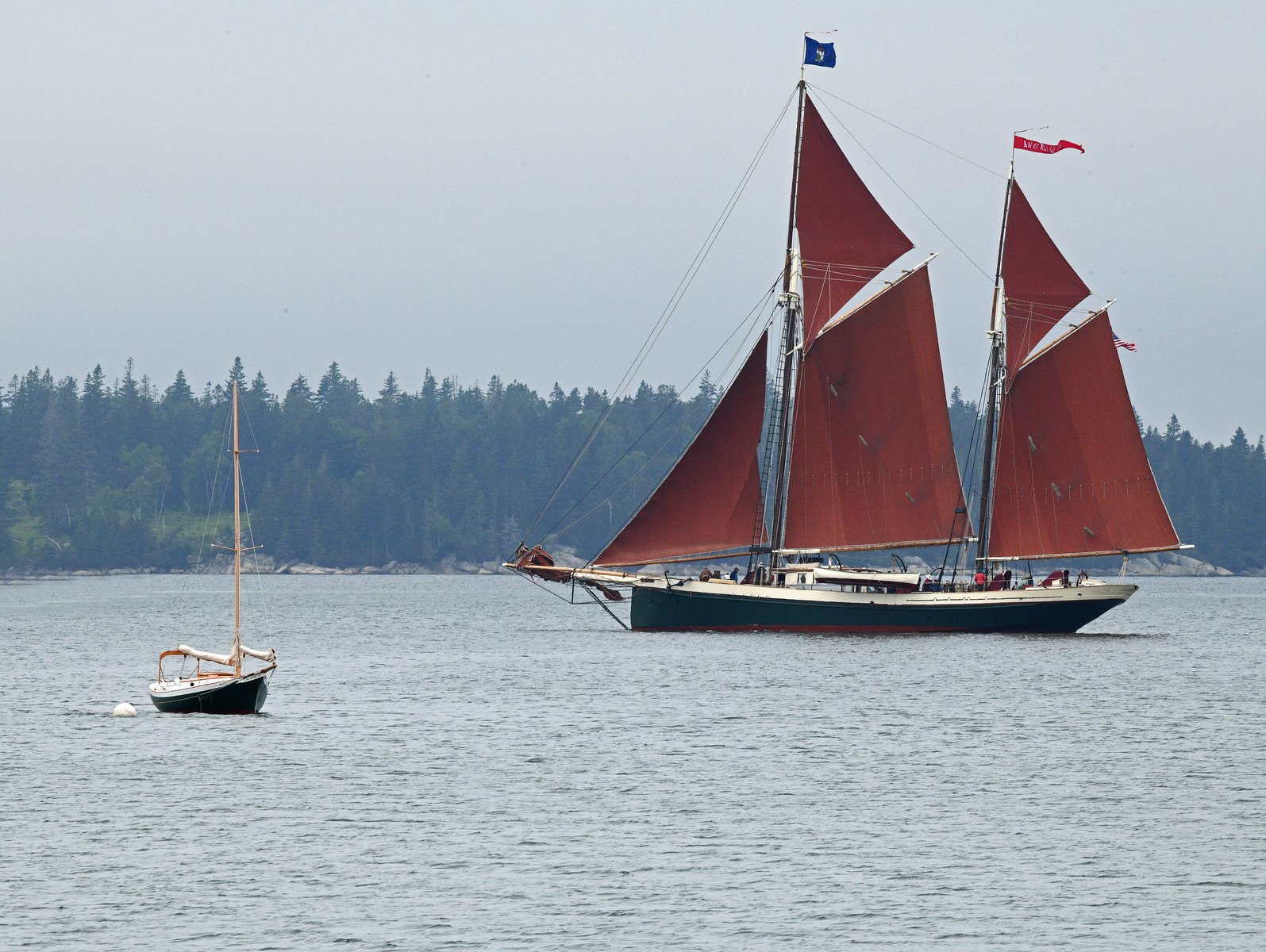
Angelique” is a 130-foot gaff-rigged ketch out of Camden, Maine, that was launched in 1980. She never raised a sail on this torpid day and was the first to motor away:

Ladona” (usually pronounced locally as “lah-DOE-nah”) is a 105-foot schooner out of Rockland, Maine, that was launched in 1922 as a racing yacht . She went through various interesting lives before being restored as a coastal cruiser. On Wednesday evening, she rafted up with the “Taber” for some partying and sailed off under power Thursday, using her mainsail as a stabilizer :

As usual, the stately and graceful “Mary Day,” a frequent visitor to the Cove, received plenty of attention . She’s a 125-foot schooner out of Camden, Maine, that has classic mercantile coastal cruiser lines, but was built in 1962 just for passenger cruises:

Mary” motored several hundred feet to Babson Island, where she raised her mainsails for stabilization and hosted a beach luncheon that lasted hours:

Although “Stephen Taber” hooked up with the racy “Ladona,” the “Taber” is one of the oldest windjammers in the Maine fleet. The vessel is a 110-foot schooner out of Rockland, Maine, that was launched in 1871. She doesn’t have a motor and was pushed out of the airless Cove by her trusty yawl boat, “Babe”:

(Images taken in Brooklin, Maine, on June 20, 2024.)

Comment

Comment

In the Right Place: Magic

Here are the June images of one of the local landmarks that I keep photographic tabs on. It’s the iconic red boathouse in Conary Cove on one of those magical summer mornings when everything stands still as the early light releases them from dusk.

(Images taken in Blue Hill, Maine, on June 18, 2024.)

Comment

Comment

In the Right Place: Windjammer Watch V

We awakened Tuesday morning to see that the “Capt. Frank Swift” apparently had spent the prior night in Great Cove. I only had time to take a few images of this compact coastal cruiser at her anchorage. (See also the image in the first Comment space.) As best I can tell, she’s the former brigantine “Actress” that was out of Belfast, Maine.

The Swift” is a 75-foot vessel that is now apparently out of Camden, Maine. She originally was designed by famed naval architect Murry Peterson in 1937, but not built until 1983. In recent years, this cruiser was rigged as a brigantine with schooner-proportioned masts, but now she appears to be rigged as a traditional schooner.

(A brigantine is a two-masted vessel carrying square-rigged sails on spars on the foremast and gaff-rigged, triangulated sails on the second mast. Many call a schooner-proportioned ship rigged like that a “hermaphrodite brigantine” due to the combination of key components.)

Images taken in Brooklin, Maine, on June 18, 2024.

Comment

Comment

In the Right Place: A Piece of Work

We see a lot of good craftsmanship in Great Cove during the summer. If this canoe is hand-made, as it appears to be, it’s quite a piece of work

If that vessel was hand-made, as it appears to be, it’s quite a piece of work. (Images taken in Brooklin, Maine, on June 16 and 19, 2024.)

Comment

Comment

In the Right Place: O’ Nest Report VII

I got lucky yesterday at the Osprey Nest, the summer home of our local fish hawk couple, Ozzie and Harriet. It was a chilly, gray day for photography, but an illuminating one for biologic verification: There now is no doubt in my mind that Harriet is brooding youngsters, probably three or four, even though I have not seen one yet.

Harriet has all the moves of a sheltering mother – outspread wings to protect nestlings below; sometimes (as above) quickly raising her wings due to apparent movement under her; sometimes leaving the nest for a few minutes of wing-stretching, and being careful when she returns, and – yesterday – appearing to be delicately feeding bits of fresh fish to youngsters deep in the nest.

Of course, Ozzie reliably delivers the fish daily, usually after eating the first third for his own lunch. Harriet then usually eats her fill and then feeds the youngsters.

(Images taken in Brooklin, Maine, on June 17, 2024.)

Comment

Comment

In the Right Place: Summer Fashions

The sleek reddish summer coats of many of our younger white-tailed deer are virtually all in, replacing their heavy, brown-gray winter jackets. On some deer, such as this young doe, you still can see slight variations in color that soon will disappear.

On the other hand, the coats of many of the does that recently have given birth still are in transition and a little shaggy:

Motherhood can trump beauty, at least temporarily. Nonetheless, all the fawns that I’ve seen so far have had healthy, glossy coats. (Images taken in Brooklin, Maine, on June 14 and 10, 2024.)

Comment

Comment

In the Right Place: Viewpoints

The eastward view of “cloud alley” from Amen Ridge was spectacular yesterday, as you see here. The mountains on Mount Desert Island and the waters of Blue and Jericho Bays were again producing their own special weather, while crowds of lupines seemed to be pressing to watch the show.

The westward view on the ridge is not too shabby either, especially if you like barns that are bright red on the outside and upholstered on the inside:

(Images taken in Brooklin, Maine, On June 15 and 10, 2024.

Comment

Comment

In the Right Place: Windjammer Watch IV

“Angelique” arrived in fog Wednesday evening for her second overnight visit to Great Cove this month.

The next morning, the dawn light found her early and started burning off the fog, apparently before her passengers arose.

She was anchored off Little Babson Island, which was fogged in at dawn, but appeared in full sunlight by 9 a.m. (That shed on the island reportedly is a terminus for a power cable from the mainland.)

As lunchtime neared, “Angelique” weighed anchor and moved about 200 yards south in front of the lovely beach on Babson (aka Big Babson) Island. The passengers were given an opportunity to explore the island, take a swim, and (apparently) have a delicious lunch on the beach. By about 2 p.m., she was gone; I never saw her depart.

“Angelique” is a 130-foot ketch out of Camden that was built for tourism in 1980. She’s still on this six-night cruise that was scheduled to feature a “windjammer gam,” in which multiple windjammers tie up in a raft to provide passengers an opportunity to walk from boat to boat, sample food and drink, and listen to live music. (For wordsmiths: Originally, the term “gam” meant a pod of whales, but whaling crews adopted it to describe social visits when one whaler met another at sea. Now it’s applied broadly to vessel raftings.)

(Images taken in Brooklin, Maine, on June 12 and 13, 2024.)

Comment

Comment

Windjammer Watch III

Here you see the Schooner American Eagle in Great Cove yesterday morning with her sails down, her weather tarp up, and her passengers ashore exploring the WoodenBoat School Campus on a fine sunny day:

Soon the passengers descended the WoodenBoat pier and rowed themselves back to the Eagle, two boatfulls of them:

Almost as soon as the Eagle’s passengers re-boarded her, a massive rogue fog wave lurched in from the southwest and engulfed everything before it, including the schooner and her passengers. Sometimes, a little sunlight was able to leak into the fog; sometimes a swirl of air would reveal parts of the schooner.

Nonetheless, the Eagle had a schedule to keep. Her crew and passengers raised her mainsail and foresail in the fog, sometimes disappearing from view from the shore:

Then, she sounded her fog horn and headed off into Eggemoggin Reach, disappearing and reappearing as the sun slipped through gaps in the fog. For awhile during her departure, the only trace of her was the sound of her fog horn every few minutes. Then, nothing but silence and shifting fog.

The Eagle is a 90-foot, high-riding schooner out of Rockland, Maine. She was launched in 1930 as the Andrew & Rosalie, the last fishing schooner built in Gloucester, Massachusetts. In 1941, during World War II, she was renamed American Eagle. She fished until 1983 and then went through difficult times until she was totally renovated in 1986 as a tourist schooner. She has since become a National Historic Landmark.

As she was departing Great Cove yesterday, the Eagle passed behind another historic vessel, the 20-foot pocket cruiser Martha, once owned by New York- and Brooklin-based author E.B. White:

(Images taken in Brooklin, Maine, on June 12, 2024.)

Comment

Comment

In the Right Place: Flashing Yellow Caution

This and other yellow flag iris plants (Iris pseudacorus) have started their short blooming period here in our damper areas. They’re reportedly the only completely yellow, large wild iris now growing naturally in North America.

They’re not native to North America; they’re the progeny of garden escapees that are not on anyone’s Most Wanted List. They’ve naturalized themselves into perennial wildflowers that are spreading rapidly in Maine and elsewhere, according to the reports. That’s not good; these handsome little devils are extremely invasive.

The Maine Department of Agriculture, Conservation & Forestry states that they may be controlled with chemicals or by digging them up (wear gloves to protect against their sharp leaves). It’s best to bag and dispose of them with the garbage. Note, however, that special rules apply to using herbicides to control plants in or near wetlands and water bodies in Maine. (Images taken in Brooklin, Maine, on June 10, 2024.)

Comment

Comment

In the Right Place: Windjammer Watch II

Here you see the schooner “Stephen Taber” in Great Cove near sundown on Sunday. She overnighted and departed early yesterday in still air. Her schedule indicates that she is on a five-night trip that features live band music.

She has no motor, so her yawlboat was attached to the stern as an outboard motor and she left the Cove with her mainsail up to increase steering stability.

The 110-foot “Taber” was built in 1871 and is a National Historic Landmark that hails from Rockland, Maine. Curiously, she was named after a once-famed, but now forgotten,19th Century New York politician. As with many coastal cargo cruisers in the 1800s, the “Taber” was built with a flat bottom to “ground out” and discharge her cargo without the need for a pier. She has a centerboard to lower as a keel during cruising. (Images taken in Brooklin, Maine, on June 10 and 11, 2024.)

Comment

Comment

In the Right Place: A Cautionary Tale

Here you see high tide at the mouth of Patten Stream in the rain on Saturday. However, while editing this image, I discovered that I apparently had photographed a very rare species – the illusive Maine Alligator. (Let your imagination off its leash, look closely, and see if you can find it.)

Well …. Maybe I at least captured what I aimed at: apparent examples of common orange lichen (Xanthoria parietina) growing along the rocky shoreline. The growth also is known as maritime sunburst lichen. It often grows on walls, hence it has the scientific epithet “parietina,” which means “on walls.” This lichen was chosen as a model organism for genomic sequencing.

(Image taken in Surry, Maine, on June 8, 2024.)

Comment

Comment

In the Right Place: The Year of the Blues

It’s been a very good year for Blue Flag Iris (Iris versicolor), such as this one and those in its colony:

It’s also been a good year for versicolor’s wild and wiry cousin, Slender Blue Flag (Iris prismatica), shown below,. Perhaps the abundance of these wild beauties is a result of our very wet spring.

The distribution of the slim cousin (prismatica) in Maine is described online by our Department of Agriculture, Conservation & Forestry as follows: “This rare plant has been documented from a total of 6 town(s) in the following county(ies): Sagadahoc, York.” I”ll have to report that slim usually is an annual sight here in Hancock County, if I can figure out how you make such reports.

(Images taken in Brooklin, Maine, on June 4 (versicolor) and 6 (prismatica), 2024.)

Comment

Comment

In the Right Place: Trying to Be Great

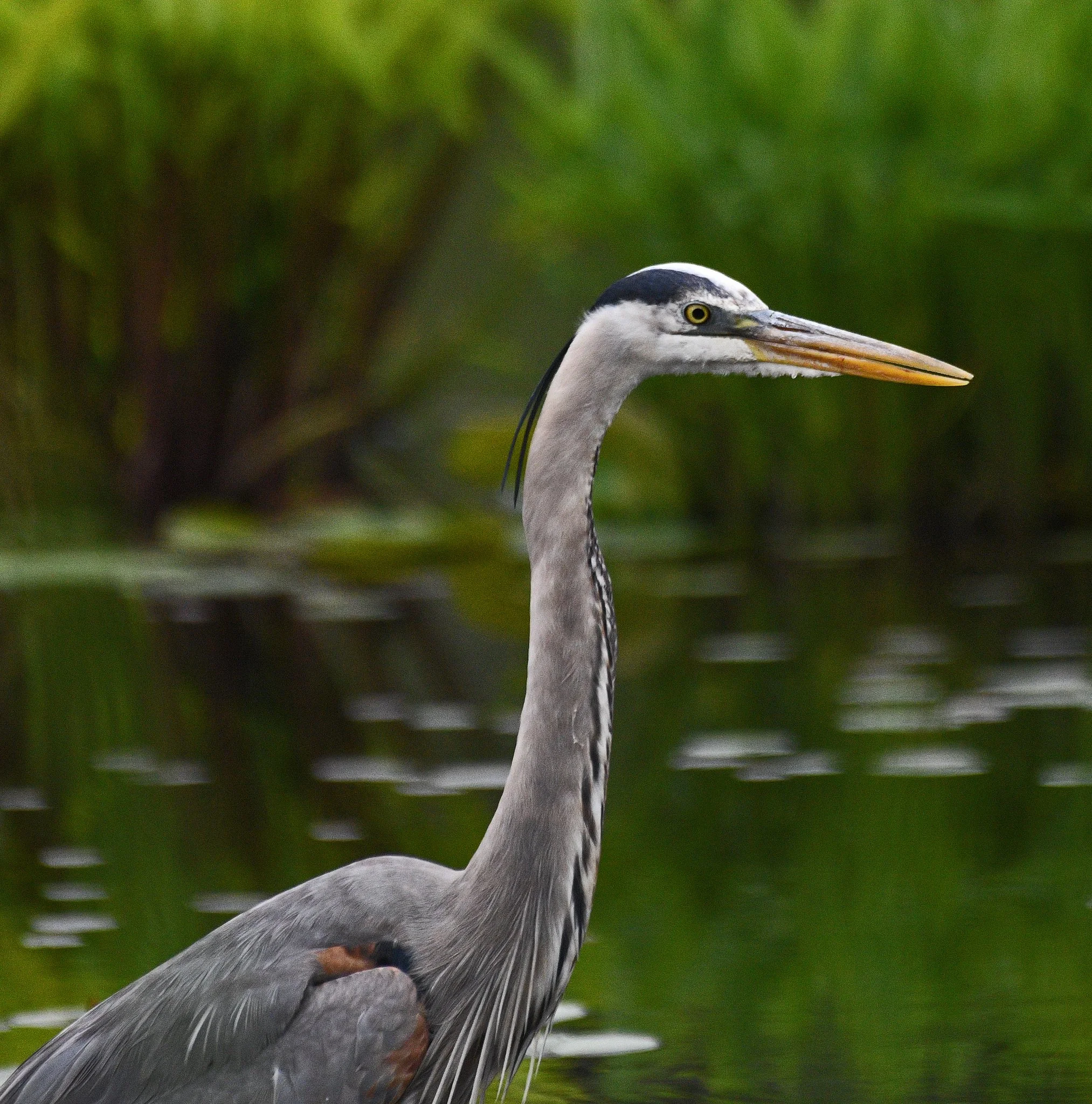
It took patience and determination to get close and stay there as this apparently young great blue heron hunted for about 30 minutes without snagging a fish.

But, I had to feel admiration for him as I realized that it took MORE patience and determination to BE that young heron and keep trying to snag a fish.

Great Blues are our largest herons (they’re “great”), but they’re considered to be a “Species of Special Concern” by Maine wildlife officials. That’s primarily because their coastal breeding populations have shown significant declines in recent years.

This loss appears to be at least partly due to a significant increase in predatory Bald Eagles and proprietary human beings deciding to reside along the coast.

(Images taken in Brooklin, Maine, on June 6, 2024; sex and age estimated.)

Comment

Comment

In the Right Place: Windjammer Watch I

Here’s a pleasant surprise that was anchored in foggy Great Cove yesterday morning and that many of you will recognize immediately:

It’s our old flame “Angelique” and she gets the prize for being the first windjammer to visit the Cove in 2024. Her schedule says that she’s on a six-night cruise that will focus on Acadia National Park and other sights on nearby Mount Desert Island.

Angelique” is a 130-foot topsail ketch that’s easy to recognize by her unique dark red (“tanbark”-like) sails and large overhanging fantail. Her size is more apparent when she passes by conventional sailboats, such as “Martha,” a pocket cruiser that’s almost 20 feet (19’9”) long:

(Images taken in Brooklin, Maine, on June 6, 2024.)

Comment

Comment

In the Right Place: Nest Reports

June is the peak of bird nest activity here. Here are reports on two nests that I’m monitoring from a distance.

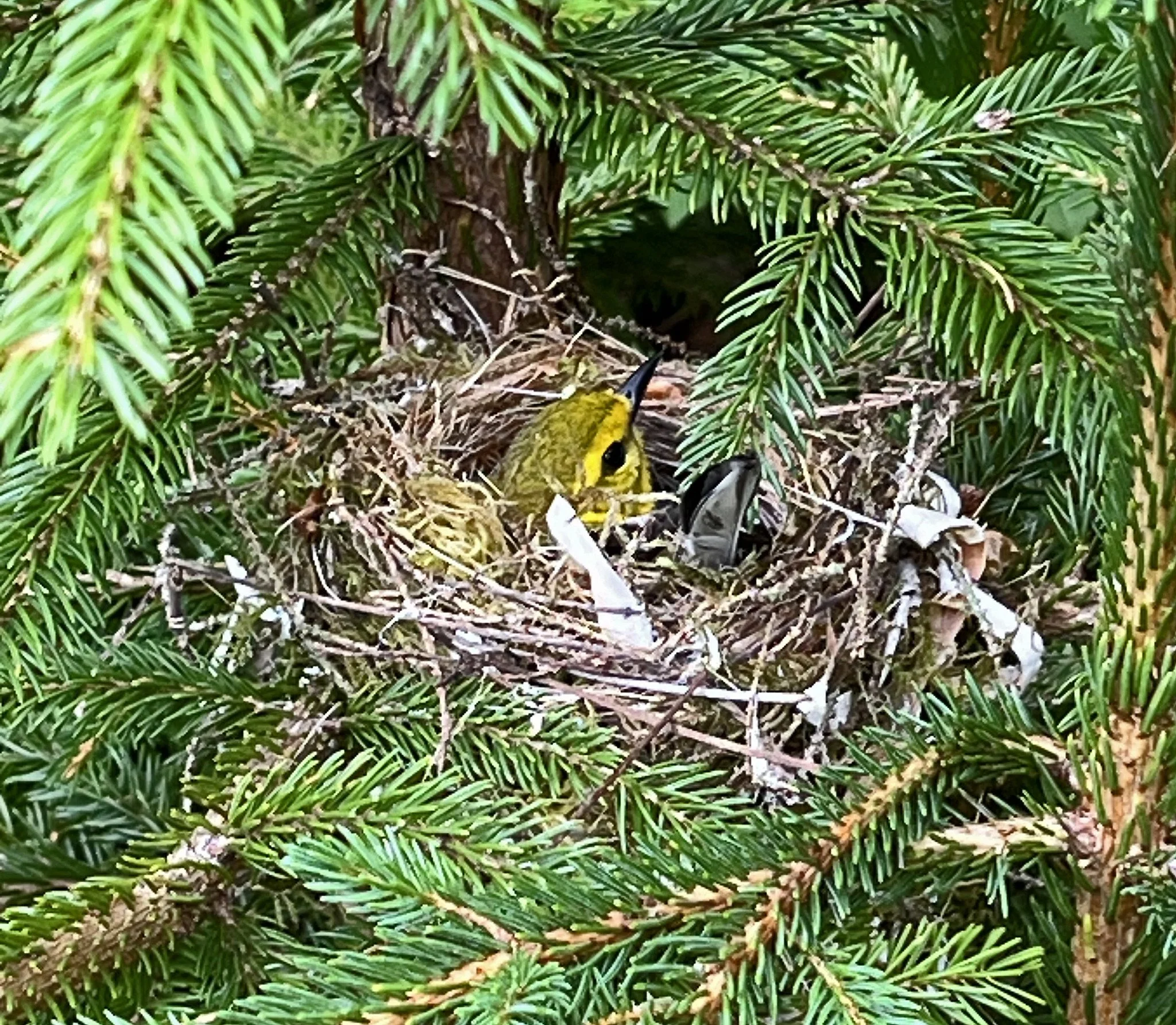
First, meet Wendy, the black-throated green warbler, via an enlarged image. Her cupped nest appears to be between 2 and 3 inches in diameter and she has decorated it with strips of white birch hung here and there. She snuggles down low in her nest with head and tail protruding up and appears to be incubating eggs.

Second, it’s been a frustrating 10 days for me at The Osprey Nest, the summer home of Ozzie and Harriet. Every now and then I’ve seen parts of Harriet’s back while she was lying low in the nest. Sometimes, I’ve just heard her calls from there. I think (and hope) that she is incubating eggs or brooding over chicks.

I can’t figure out Ozzie’s schedule for feeding her; I haven’t seen him for weeks. For those who are having trouble remembering him, here’s a Leighton Archive image of Ozzie at his finest:

(Primary image taken in Brooklin, Maine, on June 5, 2024.)

Comment

Comment

In the Right Place: Purity Plus

Wild water lily pads are rising and collecting into jostling crowds, seemingly  waiting for the parade of the plant’s own beautiful flowers, fragrant water lilies (Nymphaea odorata).

Only a few of those water lilies are in bloom now, looking like candle-offerings to Astraea, the goddess of purity. Soon there will be hundreds of such offerings.

Although stunning in appearance, our native water lilies perform critically important functions in ponds, lakes, and slow-moving streams. Among other things, they’re a source of nectar for many unusual pollinators, provide shade and shelter for fish and other freshwater denizens, and prevent or retard high water temperatures that would encourage smothering layers of gooey algae. (Images taken at the WoodenBoat School campus in Brooklin, Maine, on June 4, 2024.)

Comment