Comment

In the Right Place: Classics Department

The classic sleekness of Luders 16s can’t be denied.  They always look ready to pounce into action, even when just moored in fog at low tide or riding a high tide under the sun.

These sloop-rigged racers have been described as “two-man boats needing the work of three men.” I hasten to correct the record and point out that you’re looking at “Frolic,” a local L-16 that’s owned and sailed by a woman and moored in Great Cove.

The L-16s were designed by the renowned naval Architect Alfred E. (Bill) Luders for the Fishers Island Yacht Club in New York. Hence, they originally were called Fishers Island L-Class boats, with the “L” indicating their designer.  According to the published specifications, they’re 16’4’ long at the waterline and 26’4” overall, with a beam (widest part) of 5’9”.

The first L-16s were designed and built by Bill at Luders Marine Construction, his Connecticut boatyard that was founded by his father. Bill spent most of his career working out of Luders Marine. During World War II, that company built more than 100 military ships under Bill’s direction, including minesweepers, patrol craft, and submarine chasers.

Bill Luders died at the age of 90 in 1999. (Images taken in Brooklin, Maine, on June 19 and 21, 2025.)

Comment

Comment

In the Right Place: Major Contributors

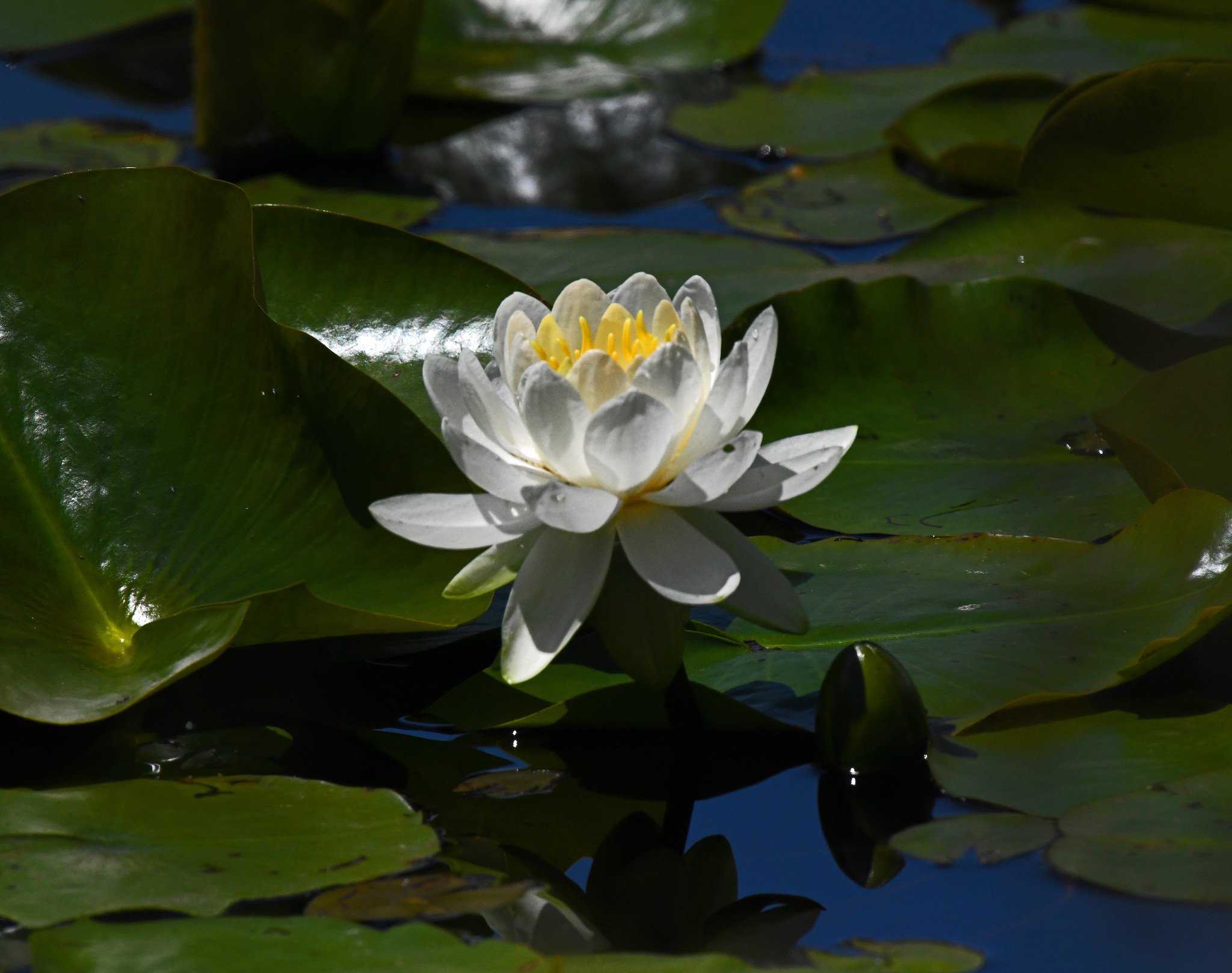
Our fragrant water lilies (Nymphaea odorata) have been appearing in ponds for about two weeks, but the flowers are just starting to become numerous amid the floating carpets of their lily pads. The best time to see the full beauty of these native flowers is early in the day when they first open up and the yellow pollen-producing stamens at the centers are more obvious. (See also the image in the first Comment space.) Their floating lily pads contain pores (“stomata”) through which the plants breathe. After pollination, the flowers will sink, and their seeds will mature in the flowers’ fruits.

Water lilies are major contributors to wildlife. Their pads provide hunting and resting platforms for birds, frogs, dragonflies, damselflies, and other insects; they also provide shade for fish and insects below, while keeping the water cool. Their fleshy stems are eaten by beavers, muskrats, moose, deer, and porcupines, and their seeds are loved by ducks.

(Images taken in Brooklin, Maine, on June 20, 2025.)

Comment

Comment

In the Right Place: Thrilling

If “pea soup” is an accurate description of our usual dense fogs, Thursday’s fog was haddock chowder. It was so thick, it appeared chunky in places. It occasionally would lift slowly about 100 feet, and then seemingly crumble down again into an impenetrable gray wall.

Every now and then, the schooner “Heritage” could be seen for several minutes hunkered down off Babson Island. The large, mostly yellow-hulled “Heritage” is hard to hide. Here you see her waiting for her passengers to come back from a foggy visit to the renowned Wooden Boat School whose pier is on the Cove:

Since “Victory Chimes” was retired, the “Heritage” apparently is our largest coastal cruiser at 145 feet overall. She hails from Rockland, Maine, and was on a June 16-21 cruise visiting lighthouses and making trips ashore to interesting places, according to her schedule.

On Thursday, when it became obvious that the fog was not going to go away, the motorless “Heritage” did something unexpected: She raised her two mainsails and a topsail and slowly eased out into the fog-clogged Eggemoggin Reach with additional help from her powerful yawlboat:

I have a feeling that few lighthouses were seen that day, but that the sailing was thrilling in one sense at least. (Images taken June 19, 2025.)

Comment

Comment

In the Right Place: For Summer-Lovers

It’s officially the first day of summer and we’re having our third consecutive day of fog here as I write to you. Nonetheless, here’s a June image of Blue Hill and Blue Hill Bay that will stir the souls of some summer-lovers. It’s one of the pleasing sights that we collect for our monthly records. As a bonus, here’s a slightly different view of the small, no-name (I think) island:

(Images taken in Blue Hill, Maine, on June 11, 2025.)

Comment

Comment

In the Right Place: Amazing Grace

Here you see the “Grace Bailey,” one of the grand old ladies of the Maine coastal cruiser fleet. She’s coming into hazy Great Cove late Tuesday afternoon to anchor off Babson Island for a nice dinner and some merry folk music. According to her schedule, she’s on a six-night “music + sailing” cruise.

She overnighted in the Cove and got trapped there yesterday in soupy fog and steady rain that caused her to coverup and hunker down:

Grace” is 118 feet overall and now hails from Camden, Maine. She’s named after the daughter of the original owner, Edwin Bailey, who had her built in 1882 in New York. She was fastened by wooden treenails, as was the custom then, but has gone through several restorations during which her hardware has been updated. But she still has no motor. “Grace” reportedly is one of only four surviving wooden-hulled, two-masted schooners that engaged in the historic northeastern coasting trade.

She served in the coasting trade until 1939, working many of those years under the name “Mattie.” From 1919 to 1939, she did her coastal trading along the Maine coastline, one of the many vessels carrying goods to areas where road access was difficult or impossible. She was rechristened with her original name after restoration for tourist cruising. (Images taken in Brooklin, Maine, on June 17, 2025.

Comment

Comment

In the Right Place: Maine Lullaby


Here’s a June record image of the iconic old red boat house that we monitor in all seasons. The image could be the backdrop for Clara to sing her lullaby to her child in a Maine version of Gershwin’s “Porgy and Bess” -- “Summertime and the living is easy….”

An oak tree’s leaves and shadows frame your view horizontally. You can glimpse the Cove’s northeast passage to the beautiful sailing waters of Blue Hill Bay where – maybe – “the fish are jumpin’ and the sailing is dry.”. (Image taken in Blue Hill, Maine, on June 14, 2025.)

Comment

Comment

In the Right Place: Name Game Department

Here’s “Jack” conducting Sunday services in his Church of the Holy Bog. Yes, this is the Jack-in-the-Pulpit plant that usually is difficult to find due to its wet and shady habitat and competing “churchgoers.” The plant (Arisaema triphyllum) is native here and toxic in the raw state to humans.

The literature is unanimous that this plant was given the common name Jack-In-the-Pulpit because – to whomever named it – it looked like a preacher in a covered and striped pulpit who is further covered by a three-leaflet flower structure. It takes a lot of imagination to see that, but there remains a mystery: Why is the preacher named Jack? Why not just call the plant “Preacher [or Priest] in the Pulpit?”

The best answer that I’ve seen is that there was an old English custom of calling unknown males “Jack.” There also was the age-old toy named Jack-in-the-Box that might have reflected that colloquialism. Nonetheless, the Jack-in-the-Pulpit descriptor is more interesting than a technical one, which would be “Spadix-in-the-Spathe.” Botanically, the spadix is the flowering stemlike growth and the spathe is its hooded protective leaf. (Image taken in Brooklin, Maine, on June 15, 2025.)

Comment

Comment

In the Right Place: A Hare-Raising Tale

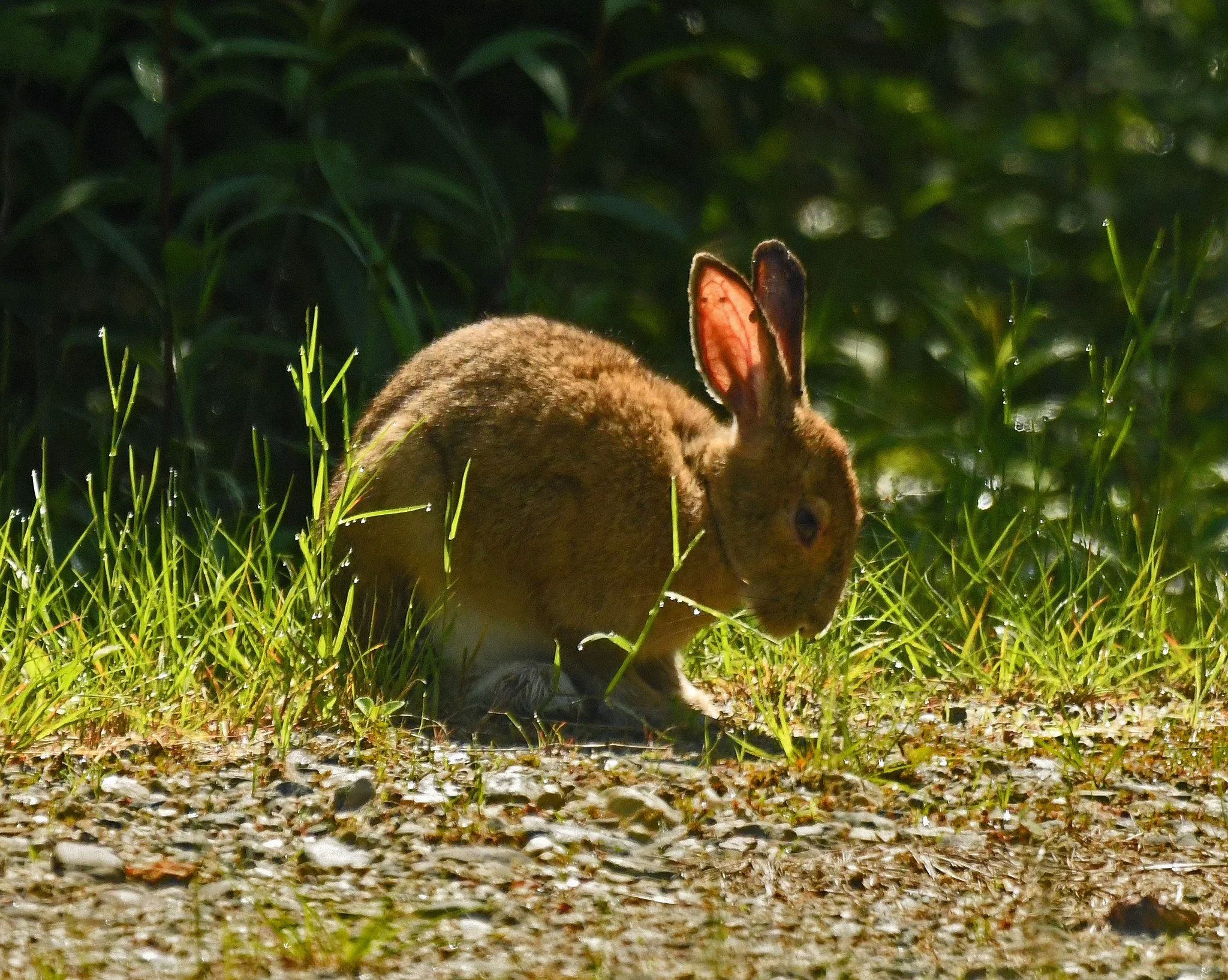
This youngster is not a rabbit. He’s a snowshoe hare at the shadowed edge of the woods, where he sometimes ventures out and nods off under the warm sun:

He’s got a lot to learn about hiding and he doesn’t have much time to do it. He probably won’t learn quickly enough, as you’ll see below.

Although related, hares are usually larger and faster than rabbits, with bigger feet (especially rear feet), longer ears, and longer legs. Unlike rabbits, which are born blind, naked, and helpless, hares are born with working eyes, fur, and can already hop a bit virtually immediately. Unlike that of rabbits, the fur of snowshoe hares also changes to white in winter to provide camouflage in snow.

However, both hares and rabbits have high mortality rates. Both hoppers are targets for just about every larger carnivore that has a beak, fangs, or bullets, including larger owls and hawks, large domestic cats, bobcats, lynx, dogs, coyotes, foxes, weasels, mink, fisher, marten, and human hunters in season (fall>spring).

Maine wildlife officials estimate the mortality rates of snowshoe hares in New England at 75 to 95 percent for juveniles such as this one, while the surviving adults’ mortality is thought to range from 66 to 81 percent. Stated another way: Hares usually don’t live much more than a year here and it is believed that rabbits have similar, if not worse, chances.

Nonetheless, although they are in decline here due to predation and habitat loss, hares still are considered to be abundant due to their high birth rates, while our native cottontail rabbits are listed as Endangered in Maine. (Images taken in Brooklin, Maine, on June 11, 2025. Sex assumed.)

Comment

Comment

In the Right Place: Yellow Is for Caution

Wild Yellow Flag Irises such as this are unfurling around our pond now, which gives us mixed feelings. These beautiful plants (Iris pseudacorus) are listed as “Severely Invasive” in Maine and many other jurisdictions due to their aggressive displacement of native plants. All parts of these plants also are poisonous to humans and other animals. Yet, they and their bladed leaves are exotically attractive.

Yellow Flag has many other common names, including these: Daggers, European Yellow Iris, False Acorus, Flagon, Fleur-de-lis, Jacob's Sword, Pale Yellow Iris, Water Flag, Water Iris, Water Skegs, and Yellow Iris. It thrives in wetlands, along shorelines, and in shallow water, preferring full sun and boggy conditions:

If you want to remove small colonies of them, Maine officials recommend digging them out and discarding them in the trash while using gloves. (The leaves are sharp and the sap can irritate skin.) A combination of mechanical and chemical treatment also is recommended online by Maine officials, especially for large colonies. But remember that special rules apply in Maine to herbicide use in or near wetlands and water bodies.

(Images taken in Brooklin, Maine, on June 9, 11, and 13, 2025.)

Comment

Comment

In the Right Place: Better Than Being Bugged

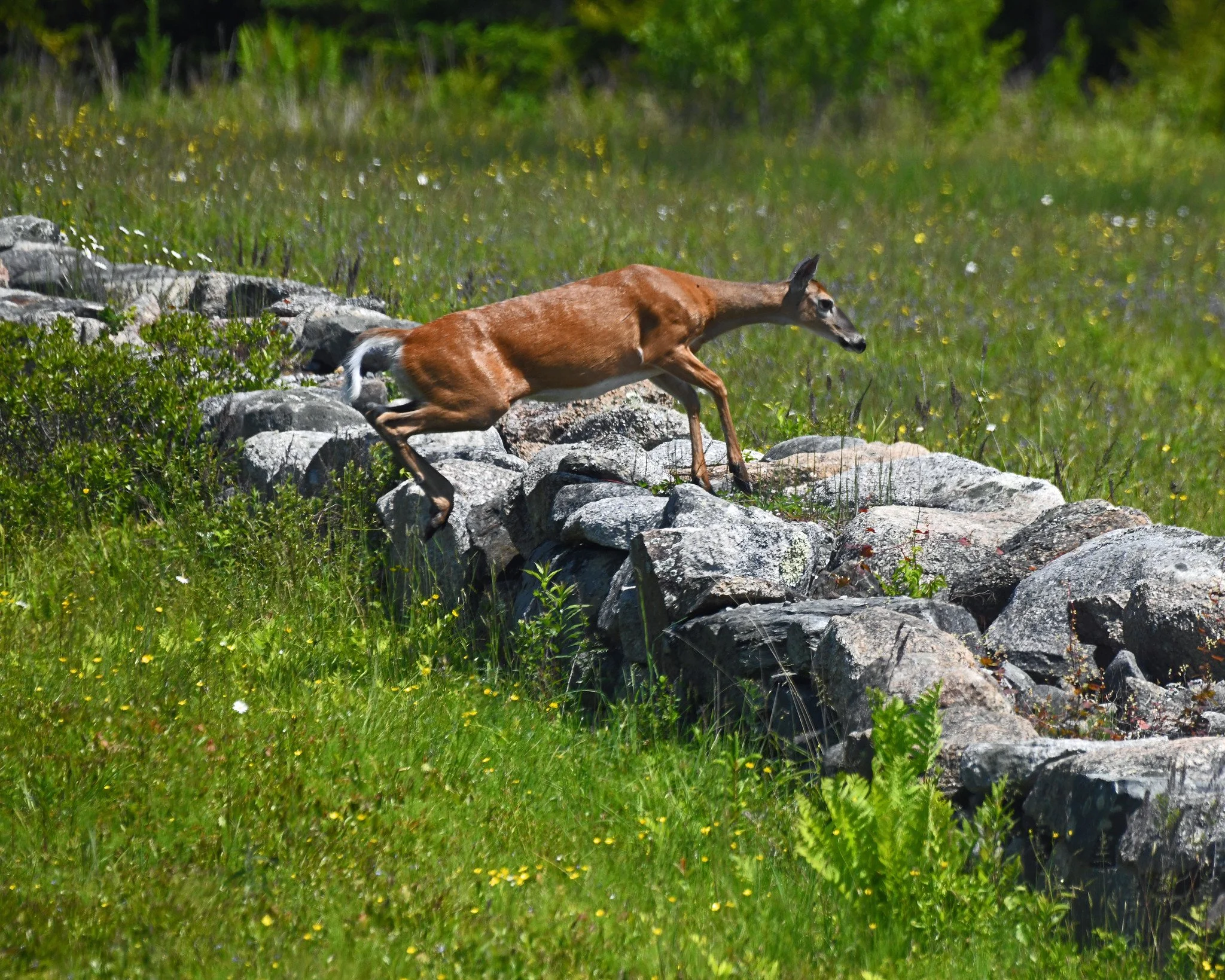
Many of our white-tailed deer are magnificent now. Their tawny summer coats glisten with newness, their muscles ripple with potential speed, and they roam their domain with grace and majesty. They also are spirited. For example, they never walk around our double field wall if they have a chance to leap over it:

Of course, there are too many of them here – almost a horde instead of almost a herd – and they do damage farms and gardens and cause traffic accidents. However, that’s a different story that need not be addressed now. Now, I’m just thinking that our white-tails are much more pleasing to watch on a fine summer morning than locusts. (Images taken in Brooklin, Maine, on June 11,2025.)

Comment

Comment

In the Right Place: Flag Days

Native wild blue flag iris are up and waving. (So are the nonnative wild yellow flag iris, which will be the subject of a future post.)

The wild blue (Iris versicolor) also is called the harlequin blue flag, northern blue flag, northern iris, and poison iris. They appear more frequently in the northeastern states. Blue flags grow and fly on pole-like stems in small colonies in fields, especially those where they can get their “feet” wet:

Those blue flag feet are plant stems (rhizomes) that are systems of roots and shoots, which have been implicated in the poisoning of humans and other animals, especially calves. The plant’s sap also reportedly has been a problem for people who are susceptible to dermatitis.

However, there are reports of blue flag rhizomes being used by some Native Americans in small amounts to treat liver and kidney problems, burns, wounds, and swellings.

(Images taken in Brooklin, Maine, on June 9 and 11, 2025.)

Comment

Comment

In the Right Place: Working Waterfront Report

I hear that local Captains are getting their lobster traps and vessels ready to start the coastal trapping season later this month or in early July. Here you see “Captain Morgan” with some of her scalloping gear that will have to be detached and a lot of paraphernalia on deck. “Judith Ann” apparently is all cleaned up and ready to go:

These images reflect two interesting aspects of coastal seafaring. First, note how tidy everything is on board “Morgan.” Some would call that being “ship-shape,” part of an old saying that reflects the nautical need to keep things in good order at sea for safety and economic reasons. In days of yore, it was a complement to people of any vocation to be told that their workplace was "ship-shape and Bristol fashion." (The English port of Bristol was famous for its very efficient shipbuilding and cargo handling.)

Second, notice how relatively small these vessels’ steering wheels are compared to those used many years ago or even today on large sailboats. Smaller wheels require less room at the helm and often provide more visibility and more reactive steering for quicker turns. Modern hydraulic and power steering systems reduce the need for muscular efforts to turn the wheel or keep it steady, making the physical leverage offered by a larger wheel less important. (Images taken in Brooklin, Maine, on June 8, 2025.)

Comment

Comment

In the Right Place: Golden Globe Reward

Here you see the visually full moon as massive clouds swirl in the sky at a little after 1 a.m. today. The slightly golden or reddish hue is caused by the orb’s unusually low position as viewed through our atmosphere. Gaps in the clouds allowed a clear sight of the golden globe this morning:

The June 2025 full moon technically will occur (be at its fullest) after most sane people go to bed here tonight (3:44 a.m. June 11, to be precise). It is the lowest full moon that we’ve experienced since 2006 due to a “lunar standstill,” which is a complex phenomenon involving views of the moon’s tilted orbit relative to the celestial equator.

The June full moon traditionally is called the Strawberry Moon because it coincided with the Algonquin strawberry harvest season in the northeastern United States. (Images taken in Brooklin, Maine, June 10, 2025.)

Comment

Comment

In the Right Place: Almost Time to Howl

Our wild lupines are nearing peak, when their pea-like flowers will have fully crested the plants’ mountainish flowerhead:

The perennial wild plant’s scientific name is Lupinus perennis. Lupinus means “of the wolf,” an indication that the lovely plants tend to run in packs that ravage the areas where they grow. They’re also known as quaker bonnets and bluebonnets for those who want to be sedate.

Lupins are members of the legume/pea family, as their flowers indicate. However, they also have large, spectacular radiating leaves at the end of long stalks. The leaflets and stems initially are hairy and can become smooth with age.

(Images taken in Brooklin, Maine, on June 8, 2025.)

Comment

Comment

In the Right Place: How Dry I Am – Not

Here you see cascades of freshwater flowing from Patten Stream into salty Patten Bay at low tide yesterday. Sprinkling light rain is bringing out a damp lushness to the surrounding green leaves and orangey rockweed and rock lichens there. However, within minutes, everything turned much darker, and a monsoon-like shower strafed the area, drenching Yours Truly:

But all was well. Here in Down East Maine, we’ve recovered from last year’s moderate drought and abnormally dry conditions. Only a small area in the southeast part of the state remains abnormally dry as of last week’s report. A little drenching now and then is better than wells going dry now and then. (Images taken in Surry, Maine, on June 7, 2025.)

Comment

Comment

In the Right Place: Thanks a Bunch

As you see, the bunchberries have been collecting at a rate that soon will make them into “multitudeberries.” The plant’s scientific name reflects its abundance north of us, Cornus canadensus, but it’s also commonly called dwarf dogwood, rabbit berry, and pudding berry. It’s early summer flowers boost the species chances of survival by spraying pollen out when insects land on them.

The plant, itself, is a unique organism, not a shrub or tree. The pectin-rich red berries that will replace the flowers later in summer can be eaten by humans raw or cooked and are often made into puddings, jellies and sauces. Birds, bears, deer, hares and rabbits are known to snack on the berries when they come. (Images taken in Brooklin, Maine, on June 4 and 6, 2025.)

Comment

Comment

In the Right Place: Distinctive

Here you see the windjammer “Angelique” tucked into Great Cove as her passengers were awakening to a hazy day yesterday. Her passengers visited the renowned WoodenBoat School there. She’s still on a six-night cruise that includes exploration of nearby Acadia National Park. Here she is a bit later when her passengers were returning from WBS and helping to raise the longboats and sails:

Angelique” is a 130-footer out of Camden, Maine, that was launched in 1980. Although all the coastal cruisers have their distinct characteristics, she is perhaps the most distinctive. She’s the only gaff-rigged ketch (primarily meaning, mainmast forward) in the Maine fleet, which is mostly schooner-rigged (primarily, mainmast aft).

She also is the only one with “tanbark”-colored sails. In days of yore when sails were cotton, they were dipped in vats of tannic acid, tallow, and red ocher, which turned them reddish and protected against mildew. (In yesterday’s haze, sun, and shade, they sometimes appeared brick- red, then burgundy-purple, and even black.)

Her original owner and designer revealed two secrets about “Angelique” in an interview: First, although it is true that the vessel was named after a long-limbed beauty, those limbs weren’t female legs. She was named after one of the purple/brown hardwoods imported from French Guiana and Suriname that are used in boat and ship construction: “Angelique wood” (Dicornya quianensis). There is some in “Angelique’s” cabin. A significant irony here is that the vessel has a steel compartmentalized hull.

Second, although she resembles a 19th Century North Atlantic fishing trawler, her design was inspired by early pilot sailboats and early large sailing yachts. She was designed specifically for passenger traffic, not for fishing or commercial hauling along the coast.

(Images taken in Brooklin, Maine, on June 5, 2025.)

Comment

Comment

In the Right Place: Coughing It Up

Horse chestnut tree candles are now blooming and attracting many pollinators. The trees are not true chestnut trees and they’re not native. They originally came to North America from Greece and Albania. But they are attractive and their compound leaves are unique palmate formations:

These trees reportedly live up to 300 years, but their “buckeye” nuts are inedible to humans. In days of yore, however, those nuts were fed to horses to treat coughs and congestion, which is why many researchers think that the tree is called a horse chestnut tree. Or, is that horsechest nut tree? (Images taken in Brookin, Maine on June 3, 2025.)

Comment

Comment

In the Right Place: Good Vibrations

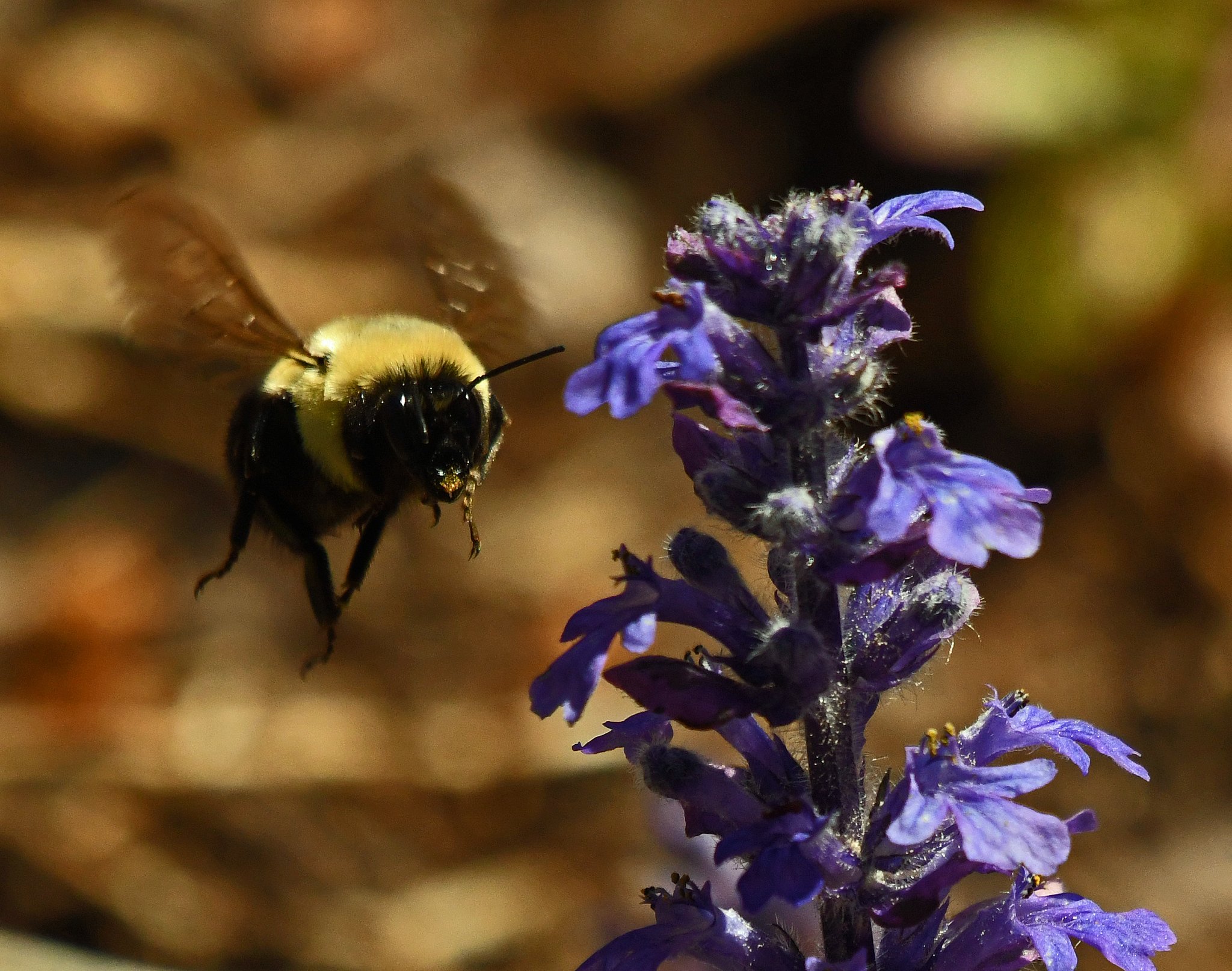
It seems appropriate for American bumblebees to play their kind of music on this bugleweed (ajuga). Unlike other insects, bumblebees perform “buzz pollinations” – they grab the flower anther with their jaws (mandibles) and buzz by vibrating at the right frequency until the pollen floats free.

They probably play mostly “Taps” on these bugles because the typical pollinating bumble bee reportedly lives only about a month, while their queens live much longer to start next year’s colony, usually underground. They’re good pollinators, but (unlike honeybees) they don’t produce and store honey.

(Images taken in Brooklin, Maine, on June 3, 2025.) Apologies to the Beach Boys, creators of the hit ‘60’s song “Good Vibrations,” which had nothing to do with insects.

Comment