
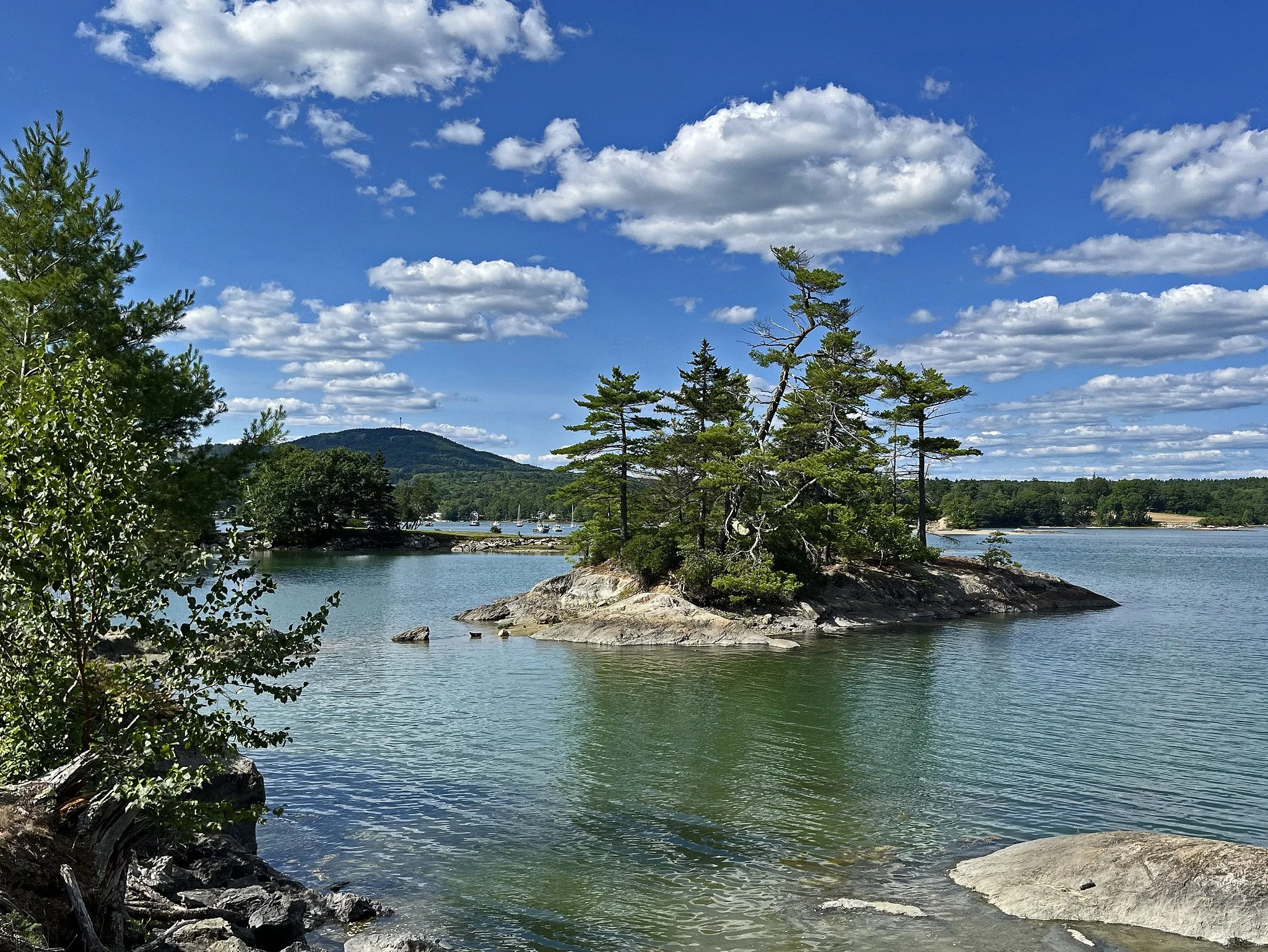
August arrived yesterday and made a wonderful impression on us. Here you see her tenderly treating our favorite view of the near-mountain called Blue Hill as it overlooked the green and blue waters of Blue Hill Bay. This morning, she bathed the boats in Great Cove with sun and cool breezes. It’s a great start. (Image taken in Blue Hill, Maine, on August 1, 2025.)

July in Down East Maine is the first month of the two-month high summer. As you will see here, this is when our coast is most stunning, our natural landscapes and gardens most lush, our wildlife most vibrant, and our sense of community most evident in the local celebrations of Independence Day and mutual enjoyment of “The Way Life Should Be.”
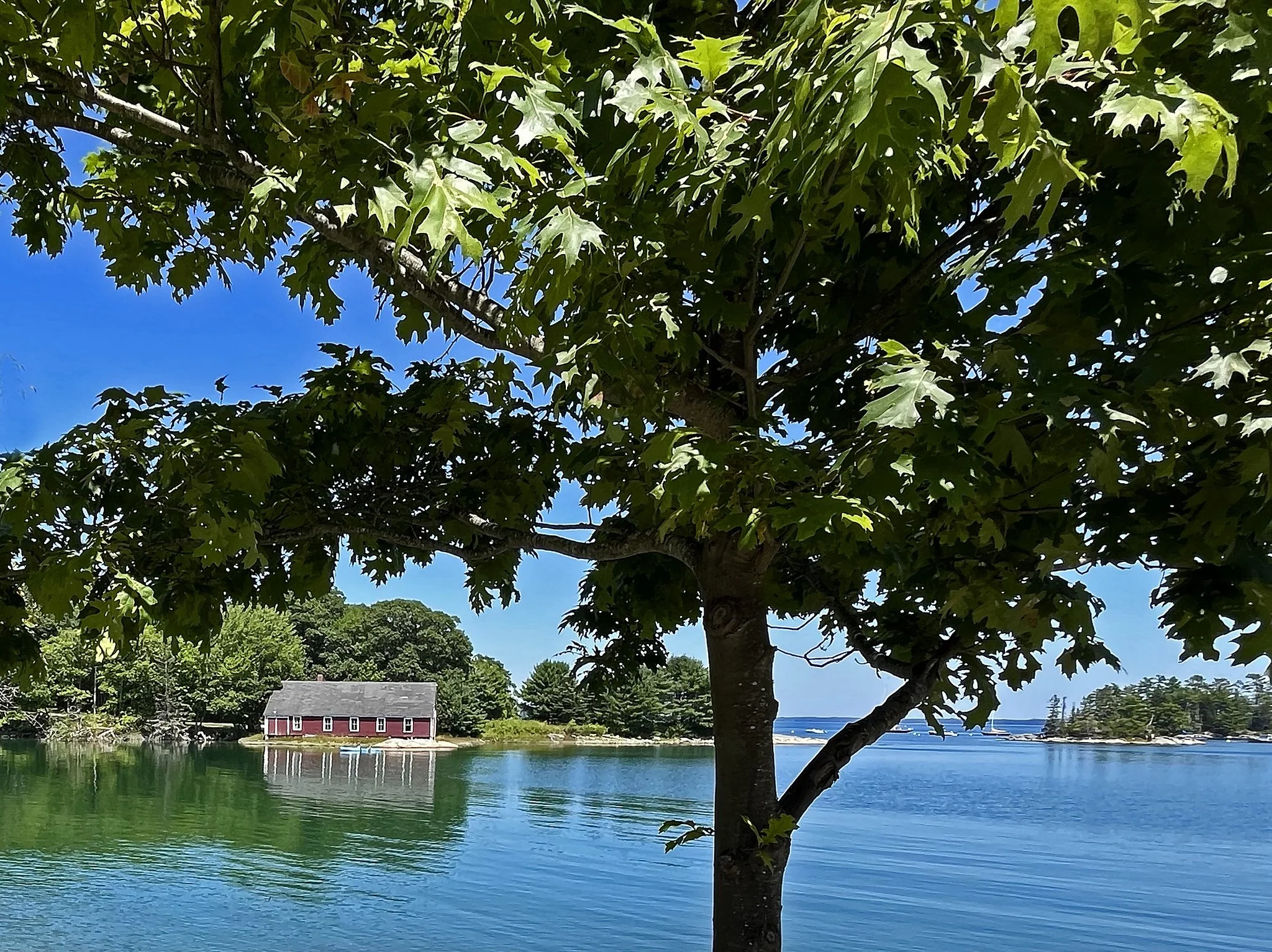
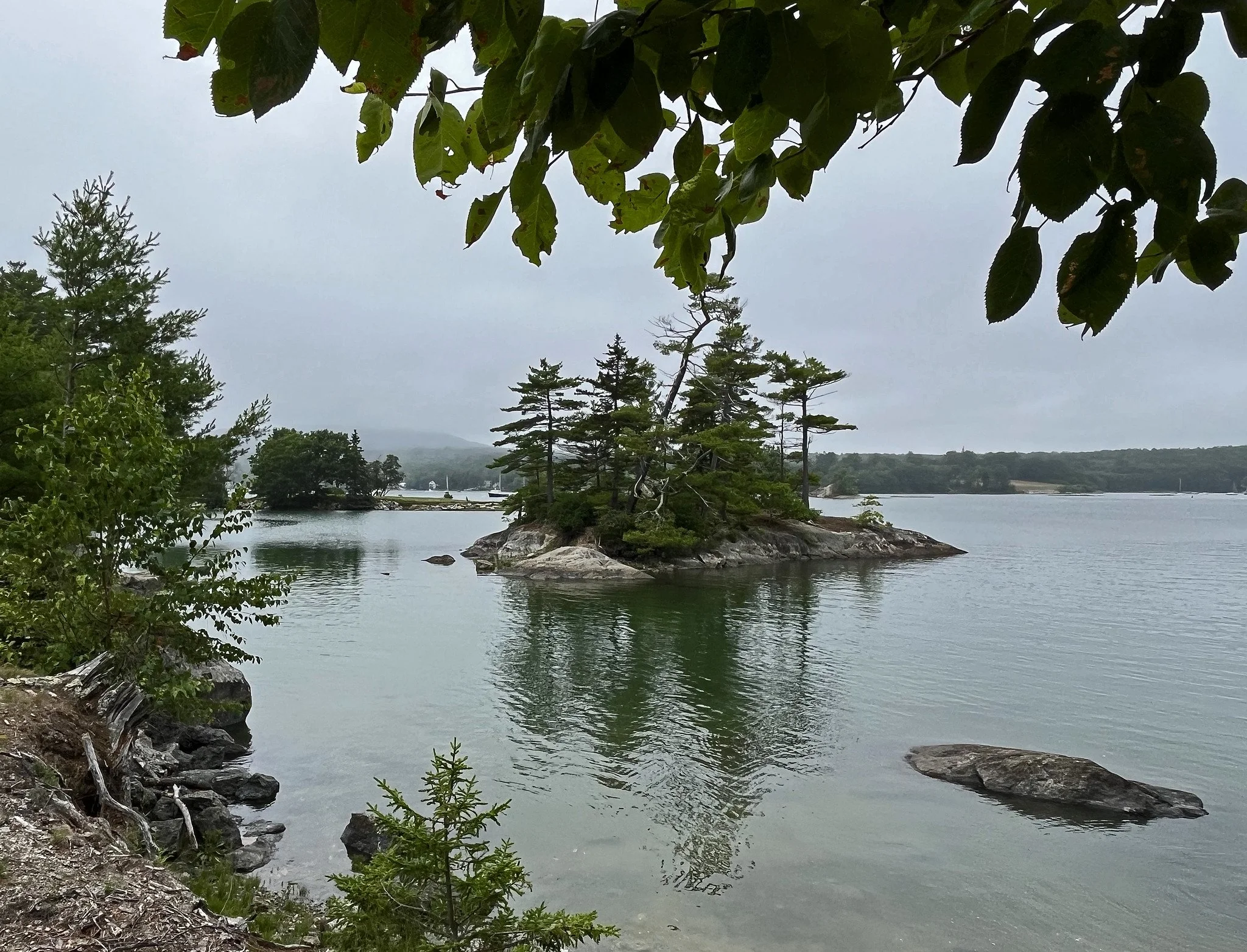
As usual, we’ll begin these “Wish You Were Here” Postcards with the four vistas that we monitor for the record: Mount Desert Island from Brooklin’s Amen Ridge; the “Island House” in Brooklin’s Naskeag Harbor; the old boathouse in Blue Hill’s Conary Cove, and the view of Blue Hill, itself, at the end of Blue Hill Bay. As for that last vista, I should say “befogged view” of the near-mountain, since I’ve decided to show what it looked like on one of our foggy July days.

As for our larger wildlife, July is when all of our white-tailed deer get new reddish coats and our bucks get new velvet-covered “hats.” (The new antlers at first are covered by a protective and nourishing membrane often called of “velvet.”) Old and young, does and bucks, looked to be in excellent health:


On the ornithological front, there was good and tragic news. The bad news relates to Ozzie and Harriet, the ospreys that nest annually in their penthouse over Great Cove. Ozzie disappeared after a vicious fight with an invading osprey during which both appeared to be seriously injured. Harriet repeatedly returned to the empty nest and eventually abandoned it. This is my last image of her:

However, we have many happy summer residents of the feathered kind, including nesting common yellow throat warblers, song sparrows, and great blue herons:


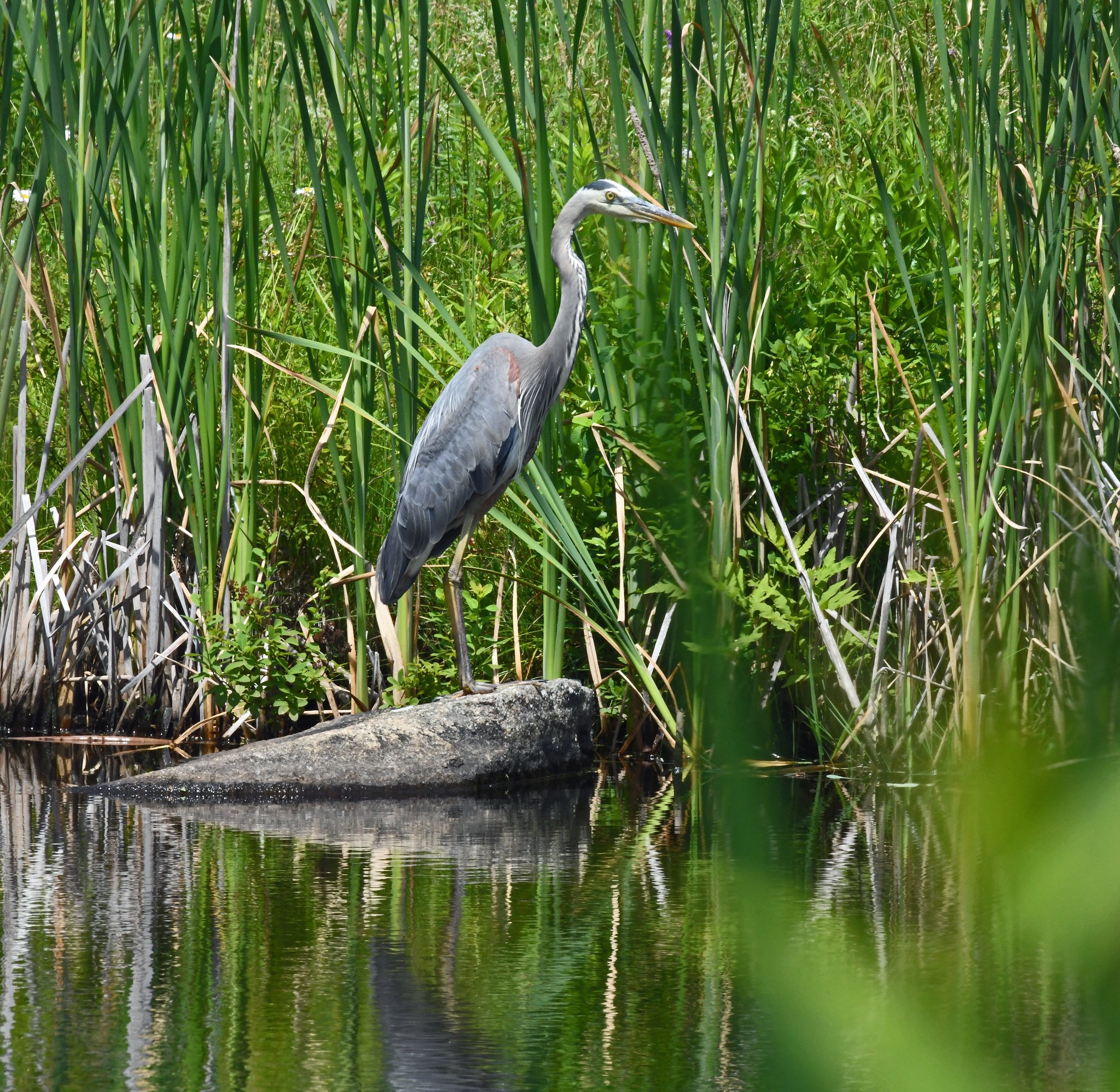
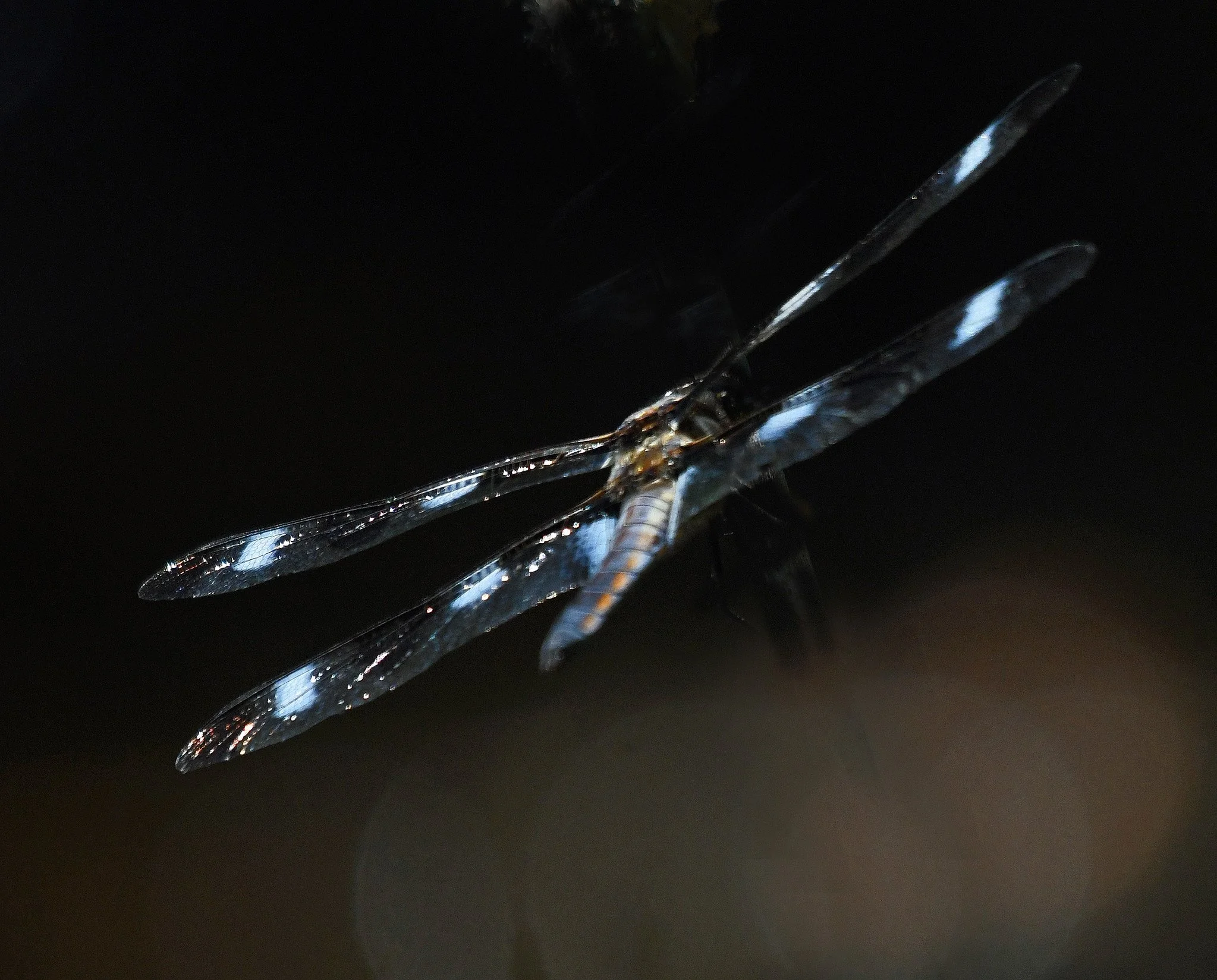
Among the smaller winged wildlife, our returning monarch butterflies always are a concern in July. This year, they seemed to come late and in fewer numbers by my records. On the other hand, we had plenty of spangled fritillary butterflies and bees to help with the pollination of the flora. The dragonflies were increasing at a good pace in July and doing a good job of debugging the landscapes.




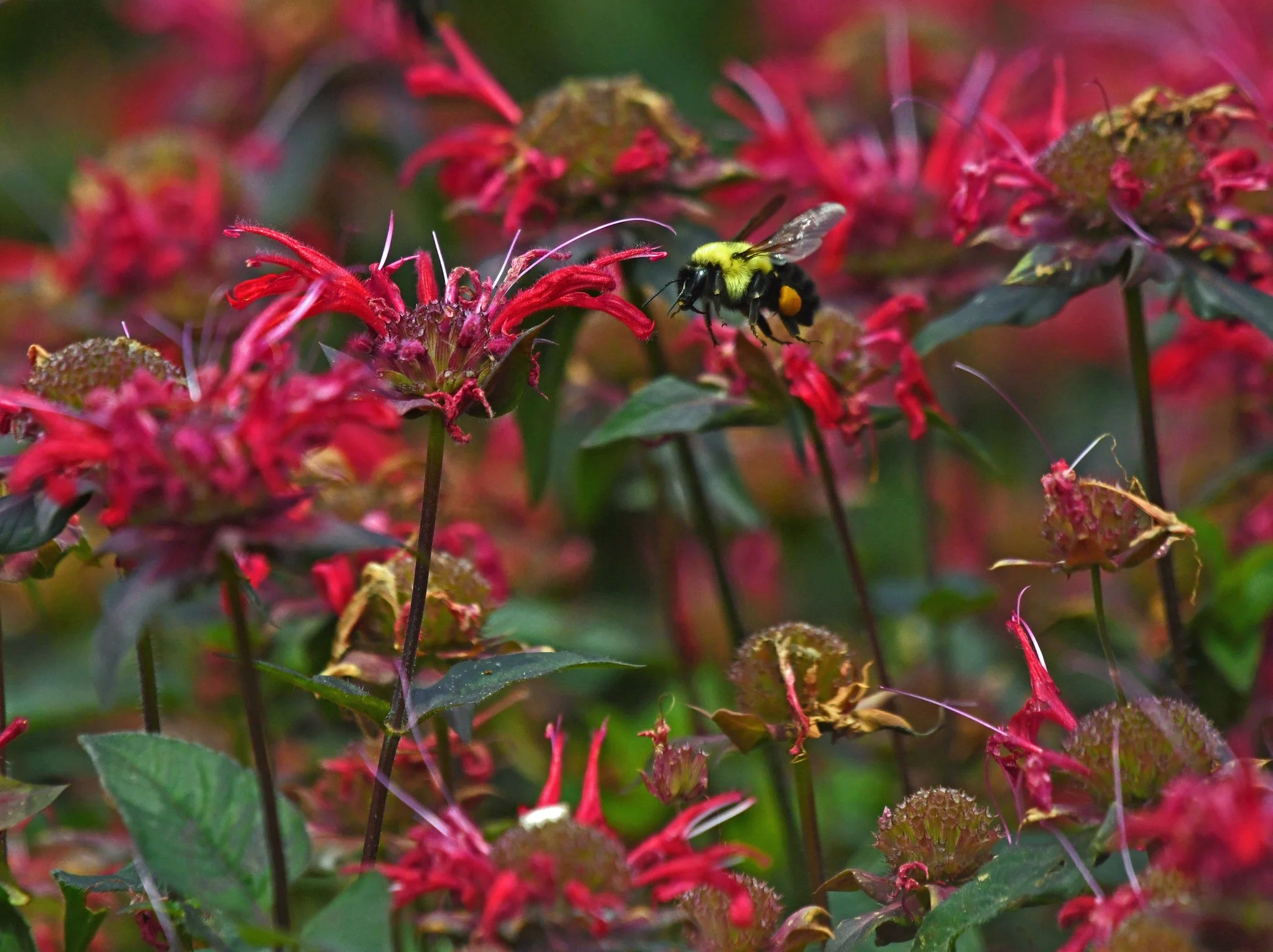
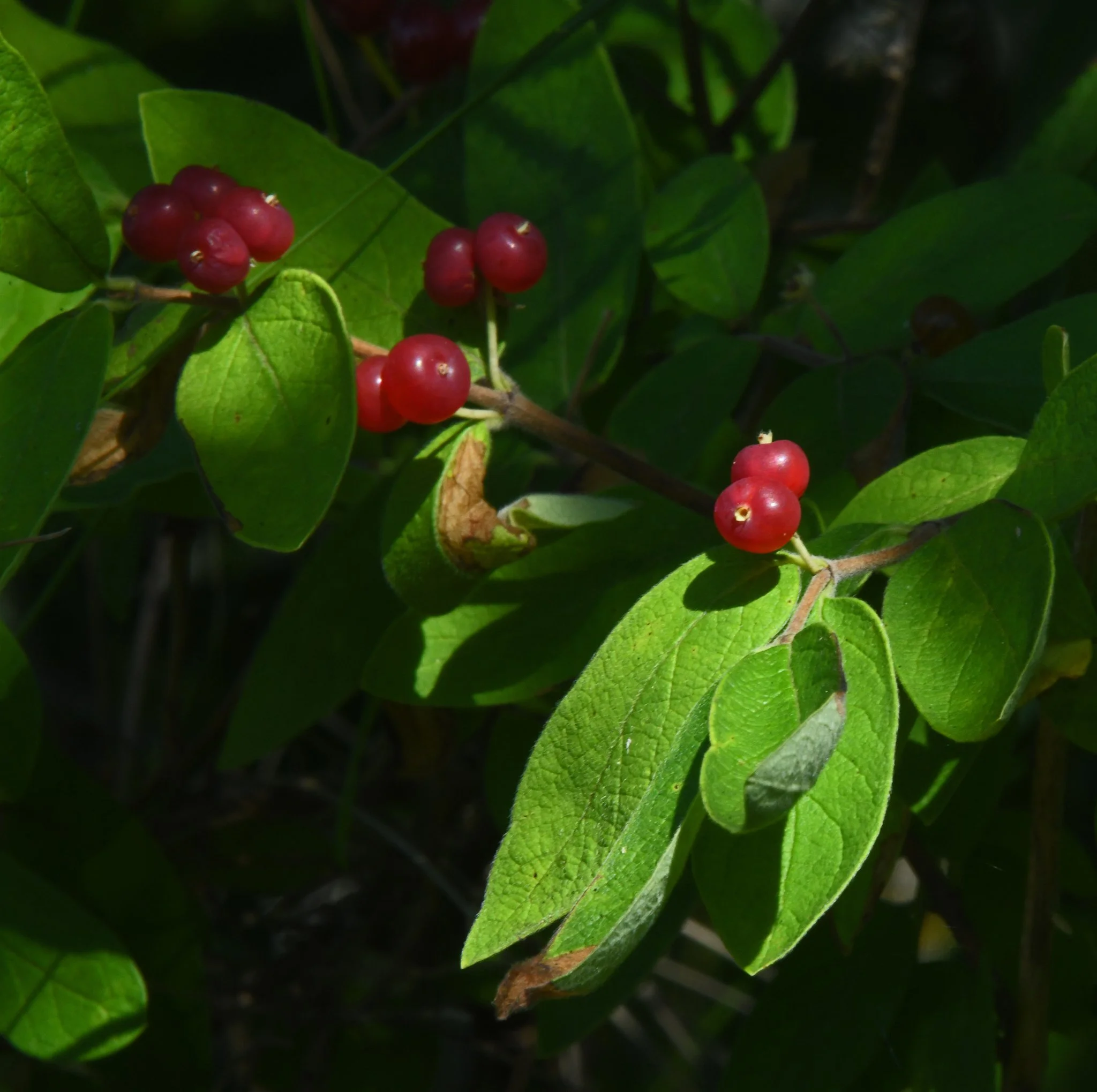
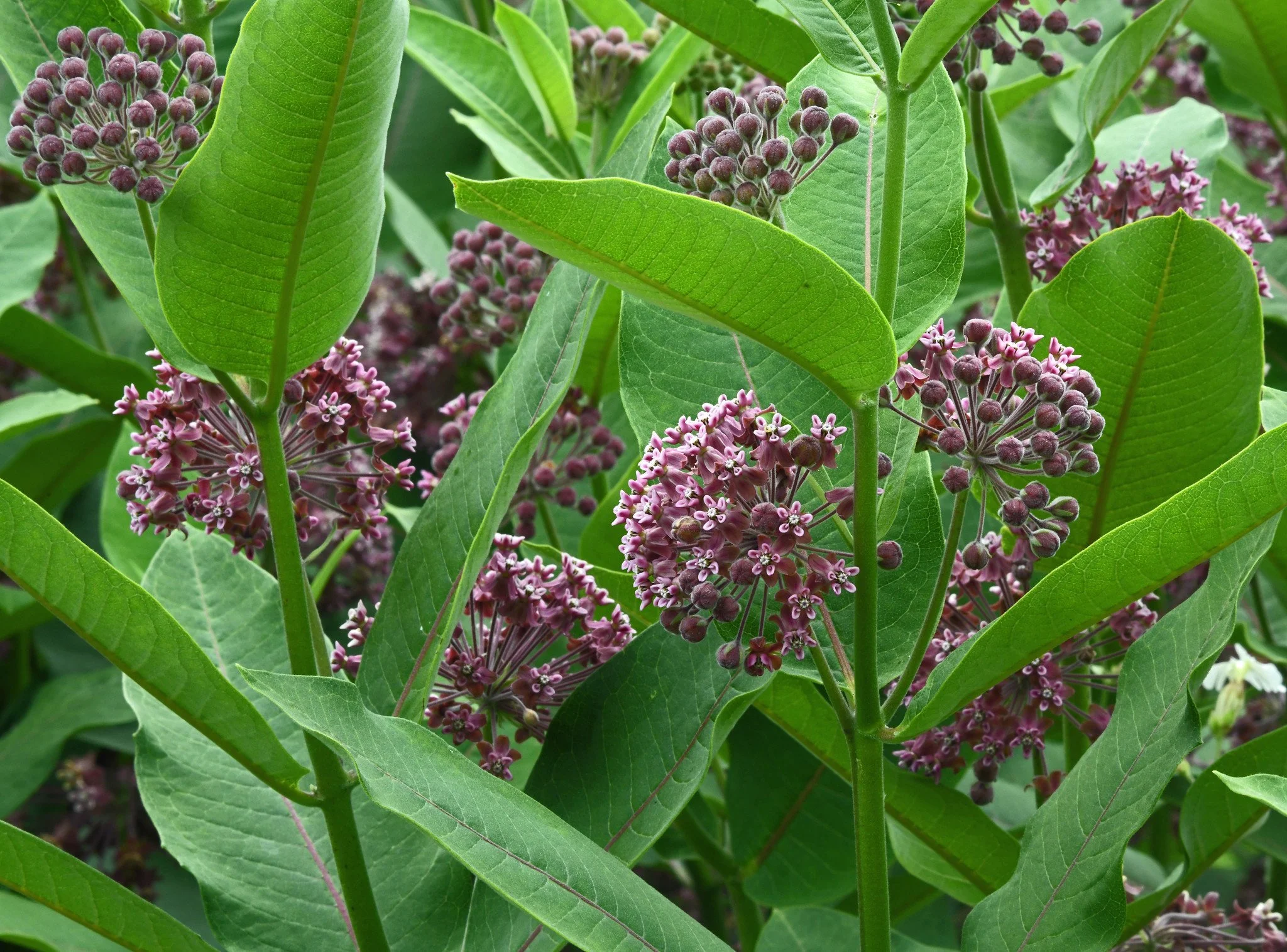
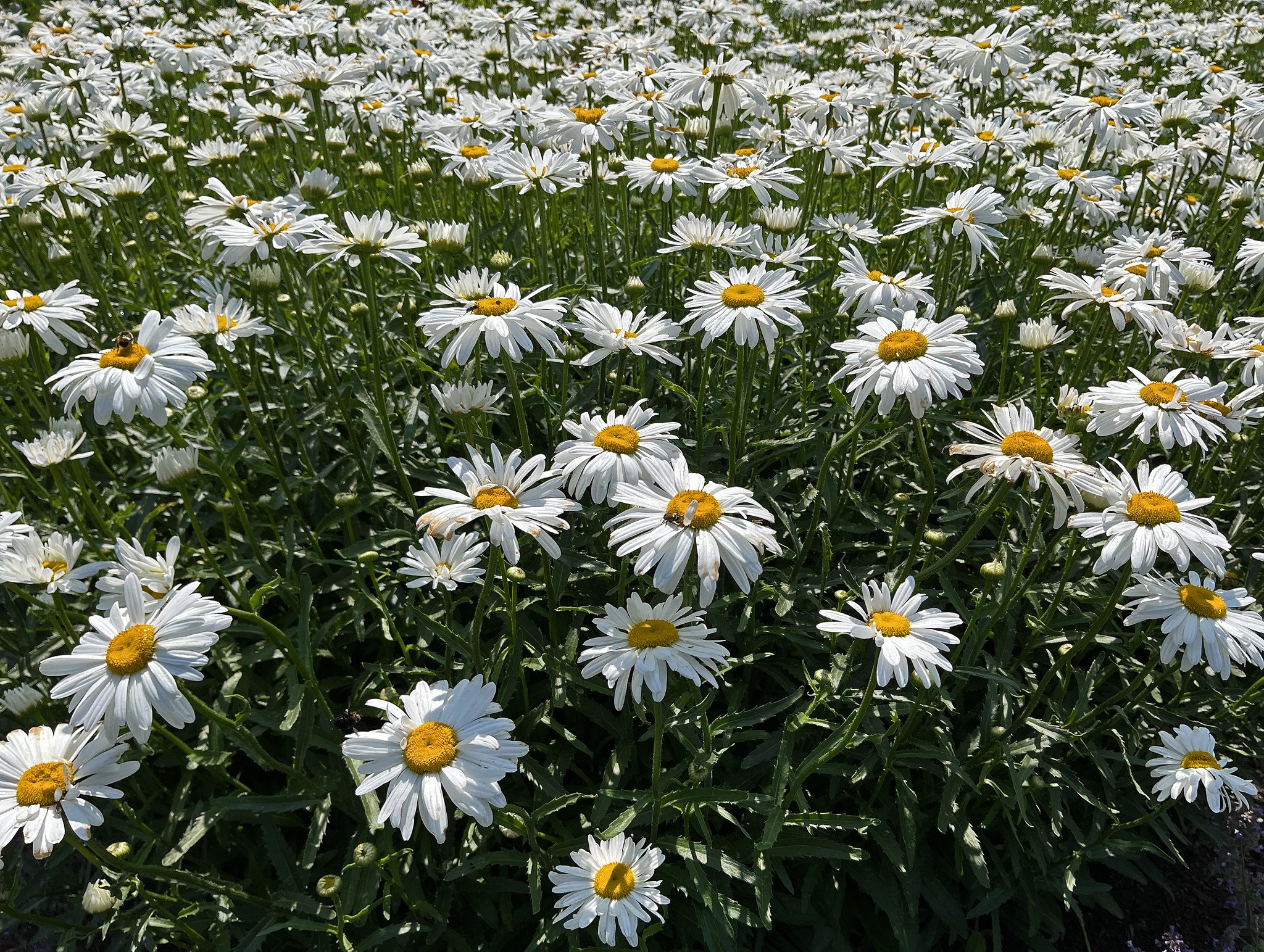
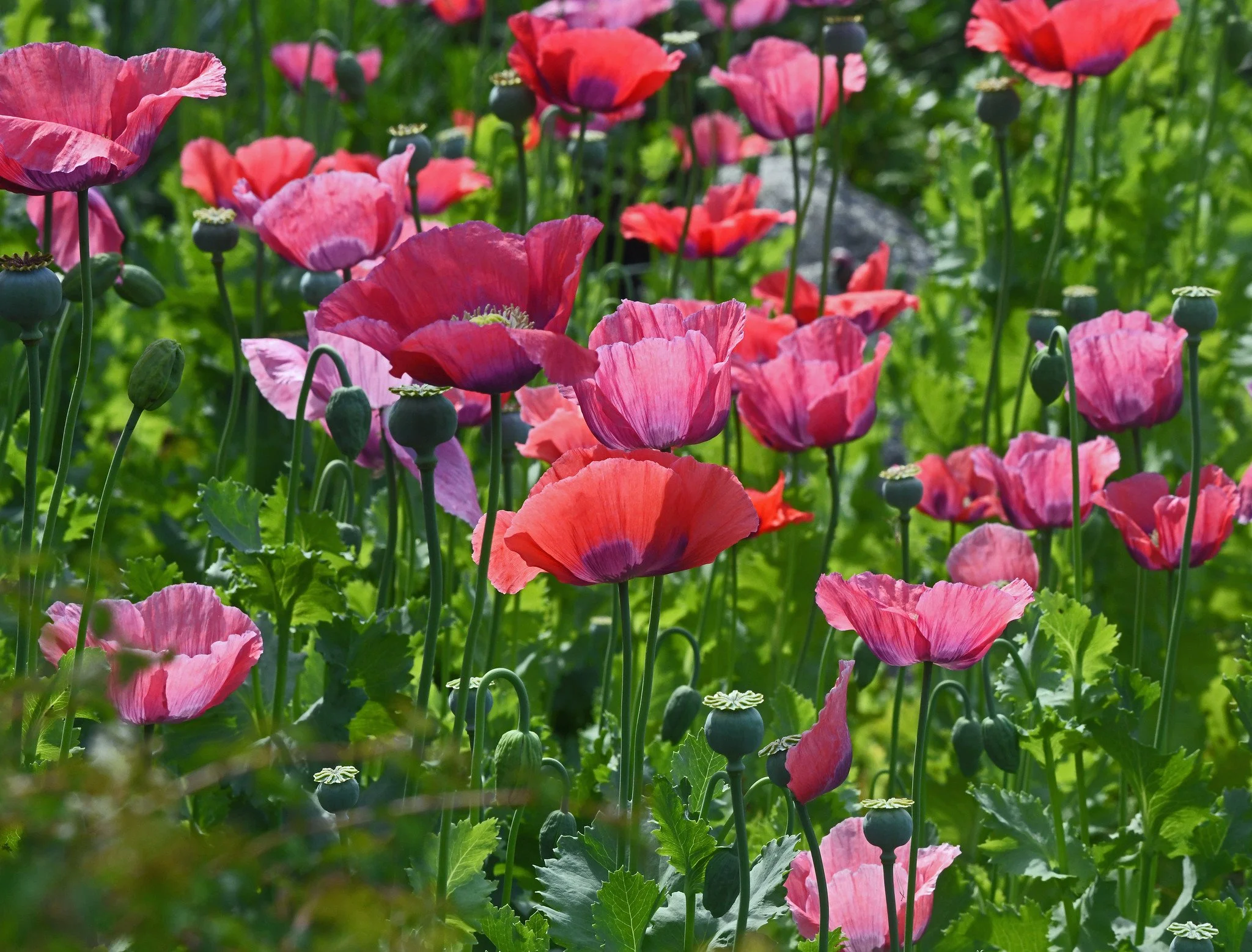
On the flora front, there was enough precipitation in July to keep the woods and ponds vibrant and produce vast multitudes of wild and cultivated flowers and berries, only a few of which can be shown here:















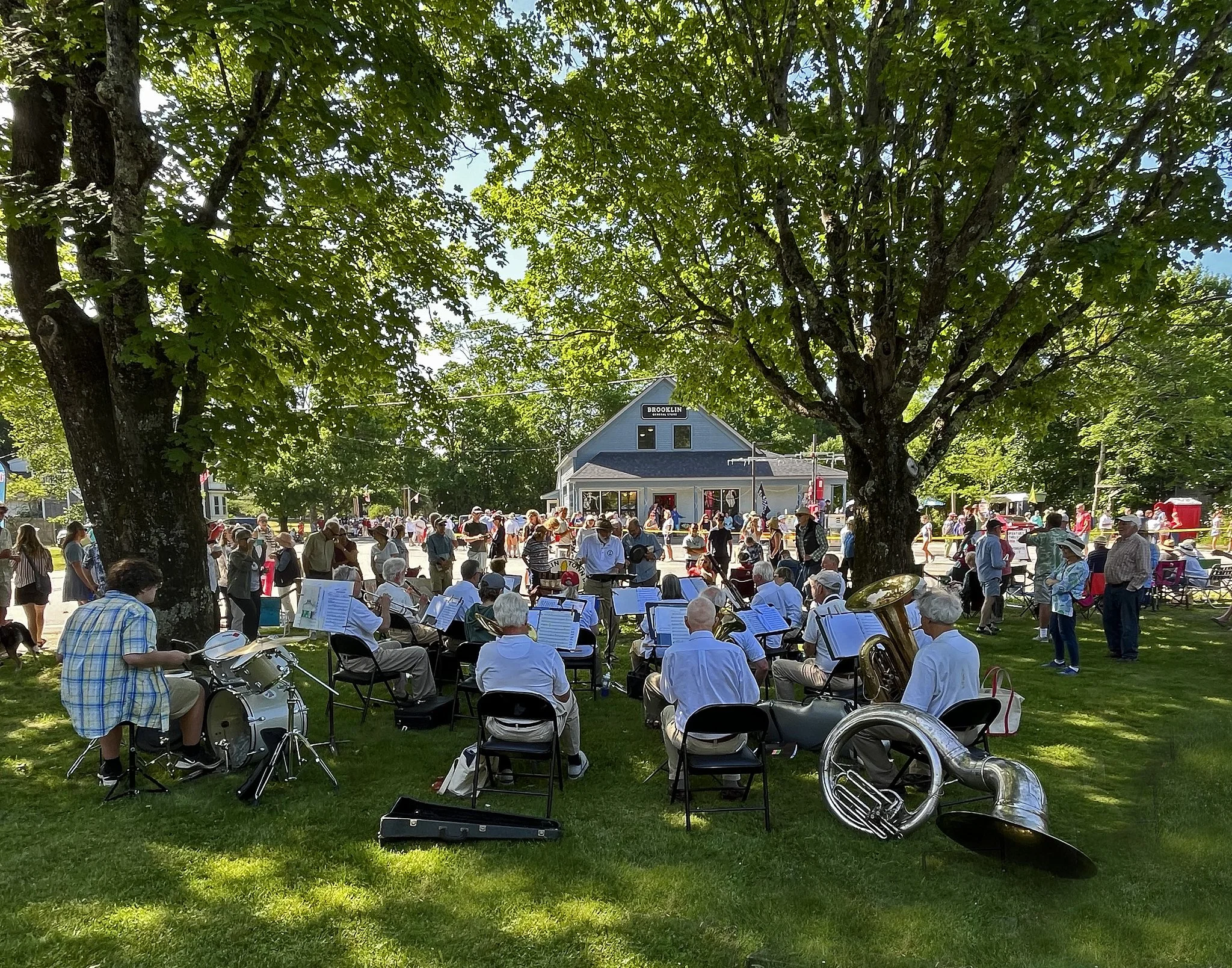
In addition to summer flora and fauna there is this thing in coastal Maine simply called “summer fun.” This includes, among many things, community celebrations of Independence Day on July 4. Brooklin is well known for its celebration, which begins with rousing music by the Town Band in the shade of the maples in front of the library:


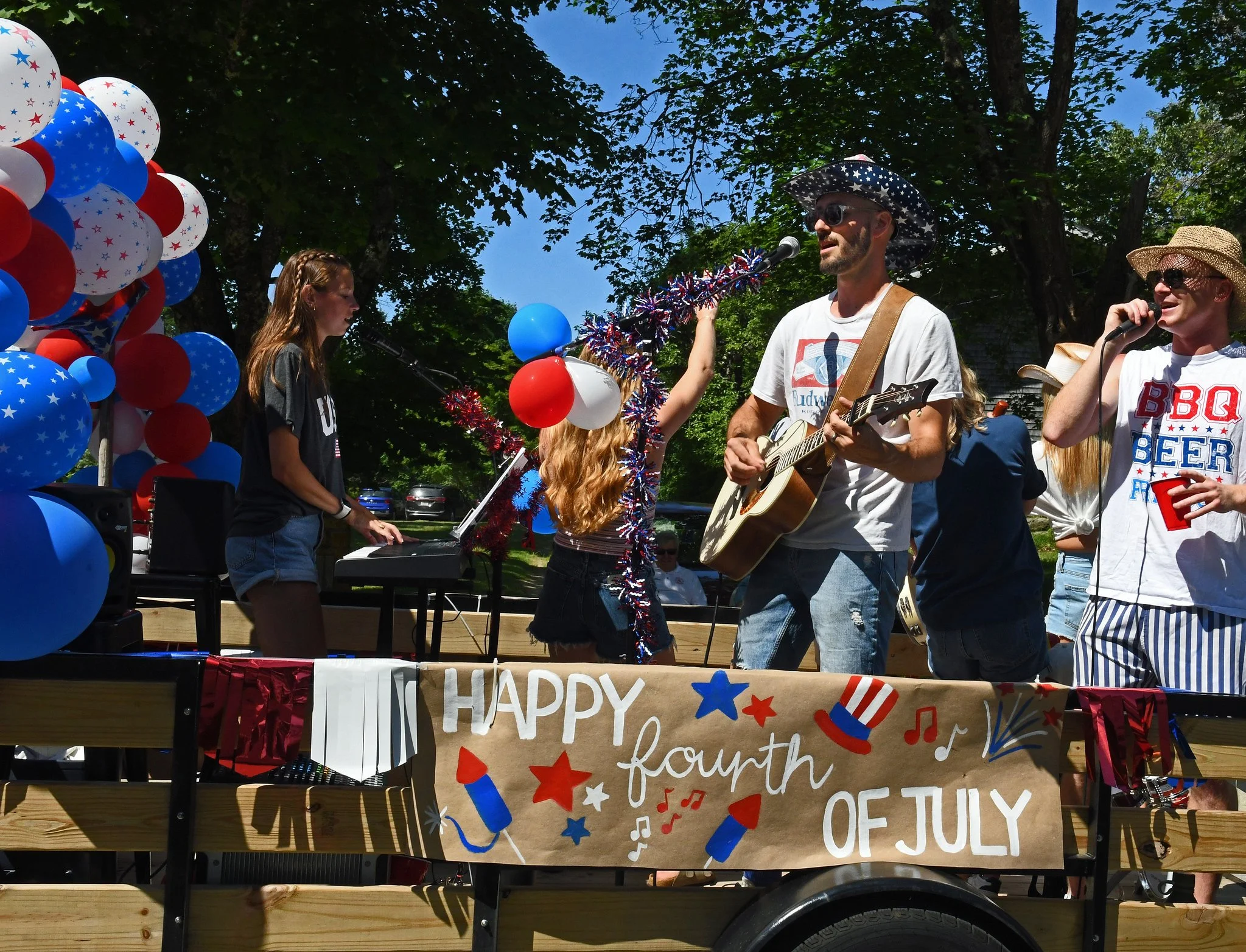
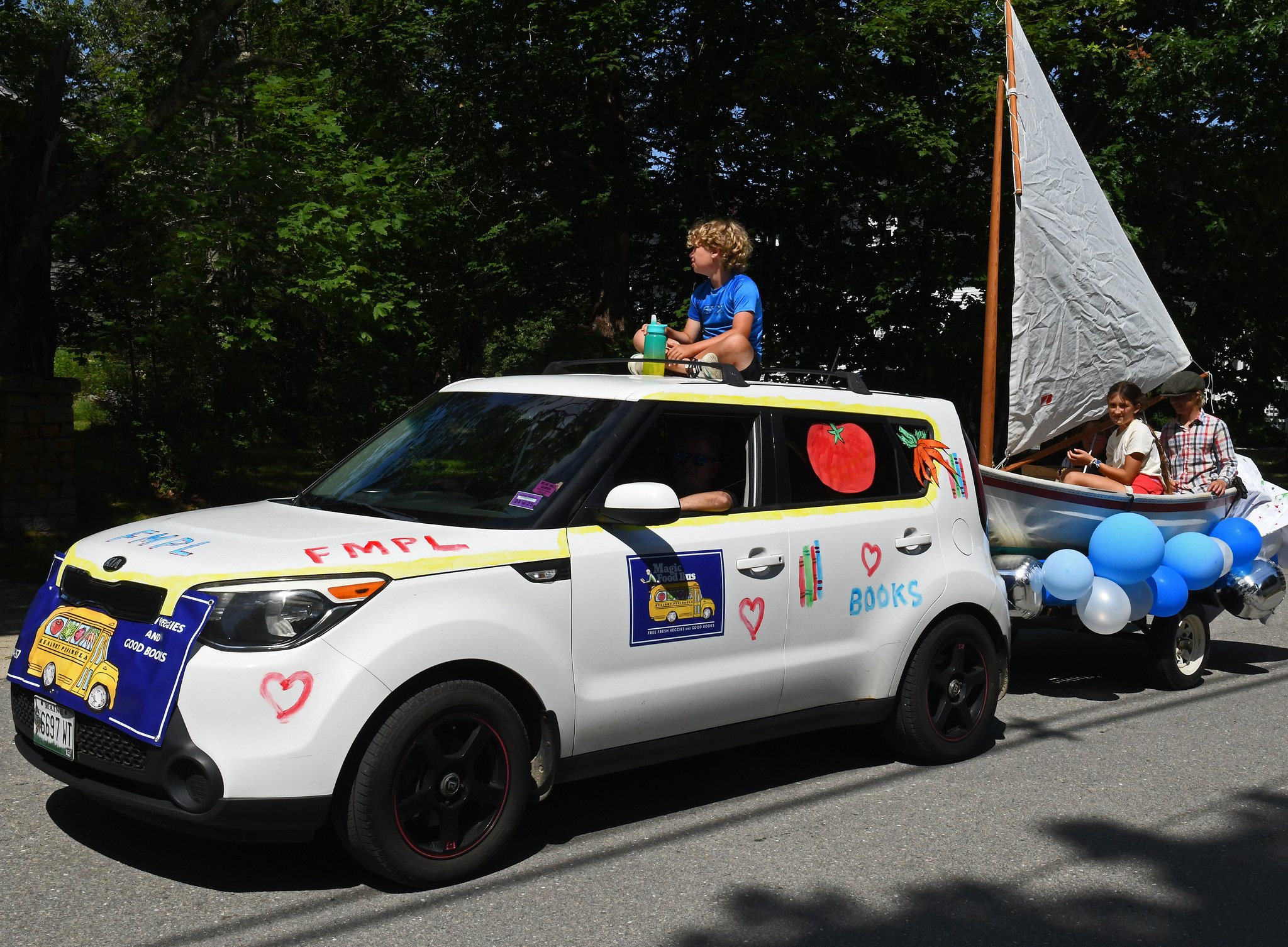
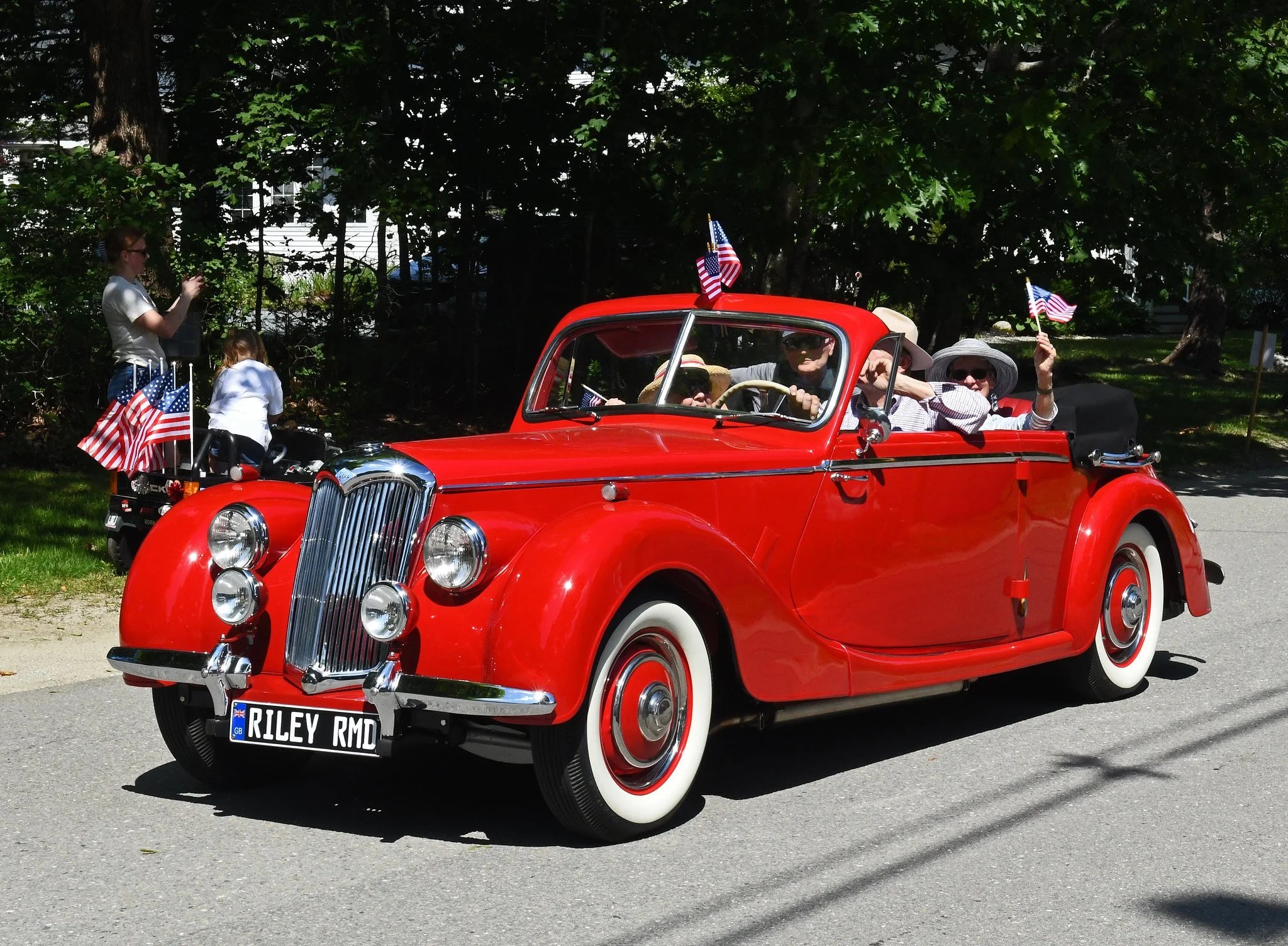
At about 10 or 10:30 a.m., the annual July 4th Parade winds its way through Town. It’s an eclectic event that includes fire department trucks from the region, imaginative floats, vehicles of all kinds (including classic cars), and ordinary people who suddenly feel like marching down the middle of the road. Here’s some of it:






![5].jpg](https://images.squarespace-cdn.com/content/v1/55c0efcfe4b0a318ebdf786b/1753999623941-WZD3XYJQTA78JHBXY348/5%5D.jpg)


After the Parade, everyone walks to the nearby Town Green. That’s where the adults can gossip, the children can engage in games and contests, and everyone can eat a delicious lunch. Among the children’s games, you’ll see toddlers trying to throw a “dead chicken” into a hole for a prize, friends trying to hit each other in the face with a wet sponge, and large numbers of fit children seeing who can climb the highest on a slippery pole:


Of course, summer water activities predominate here. Among the most popular tourist activities are multi-day cruises along the coast on classic windjammers that are joys to sail on and to see. Here are a few of the jammers that were seen in Brooklin’s Great Cove during July:
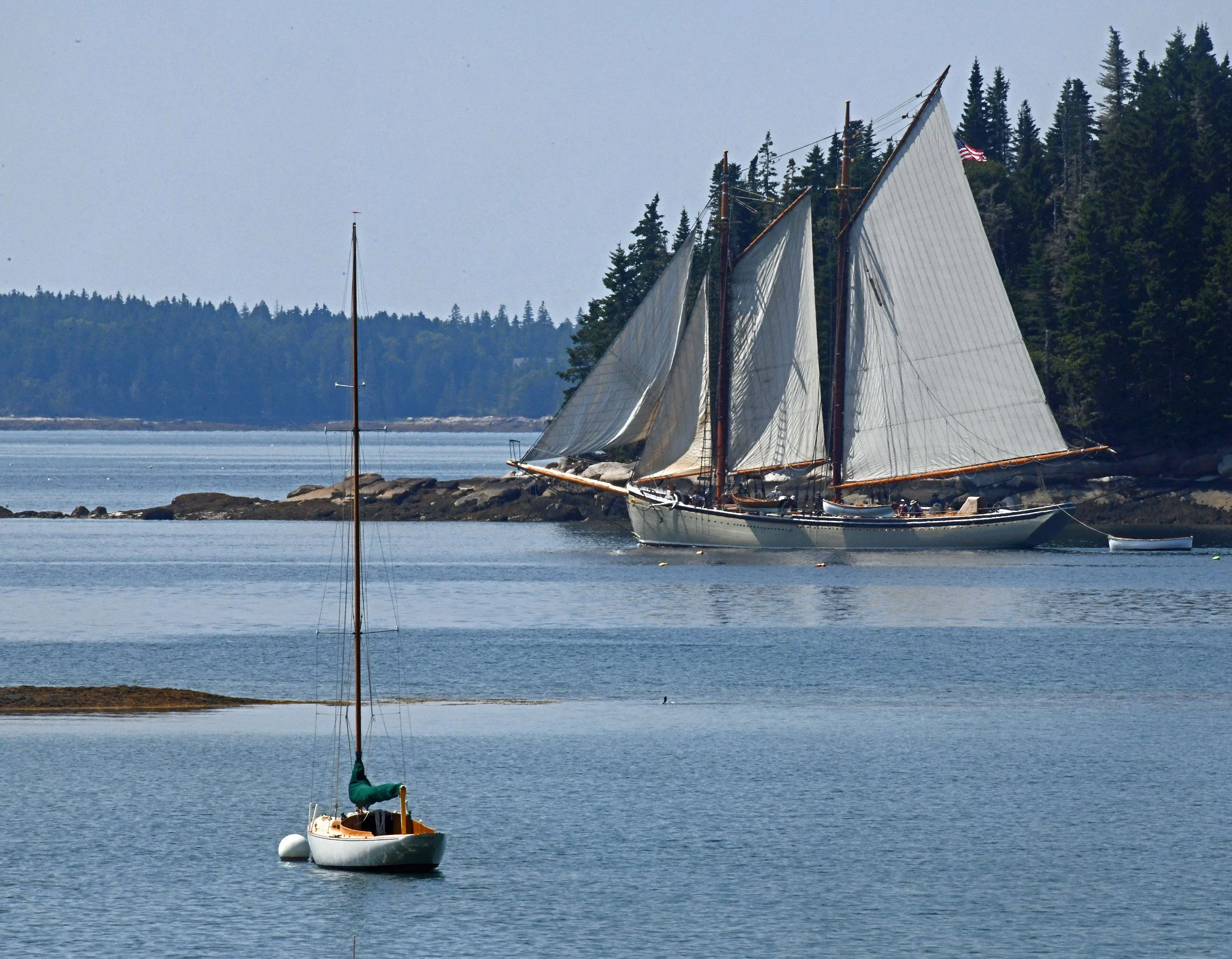
American Eagle (Passing by Frolic)
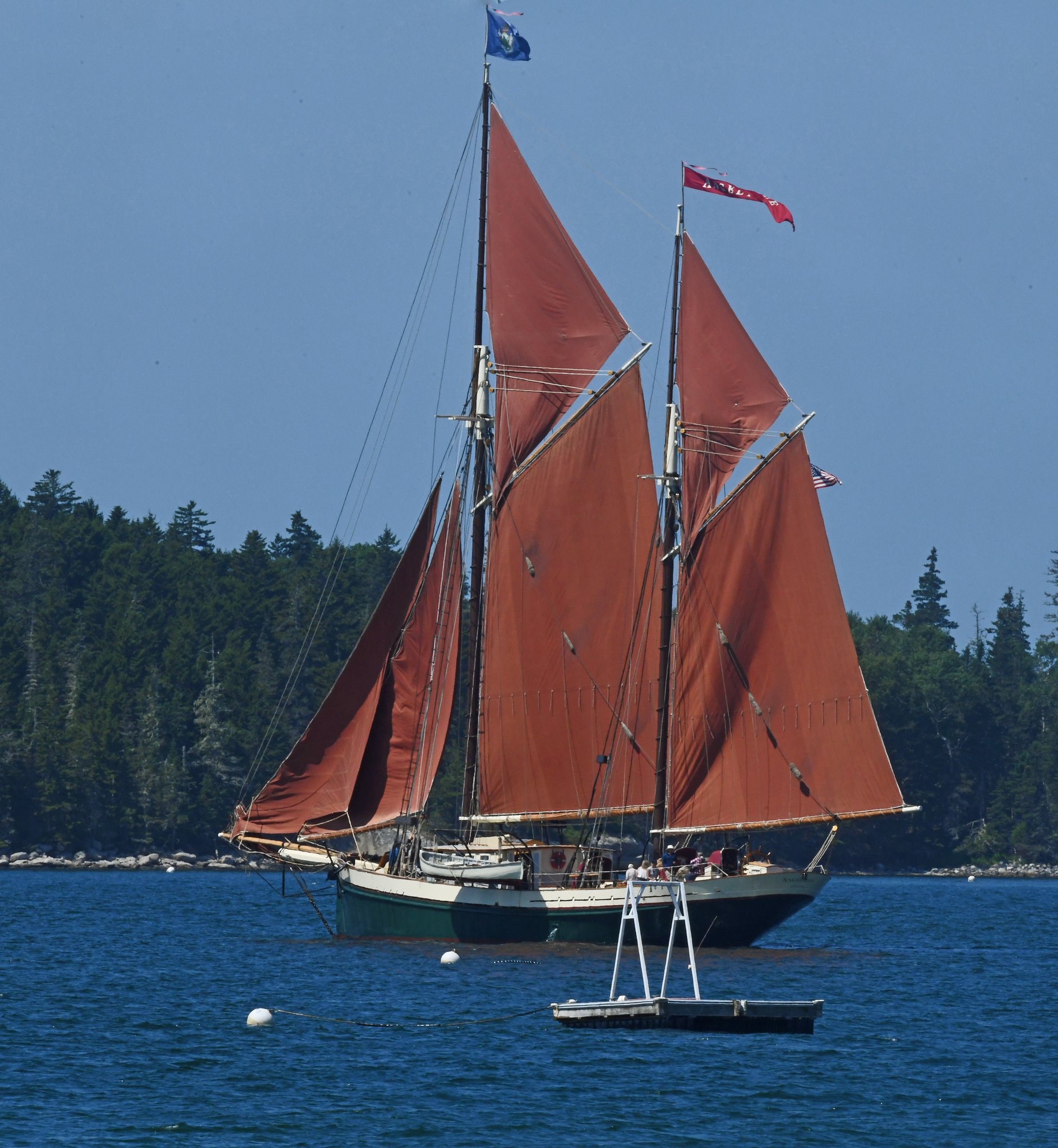
Angelique (Passing By a Mooring Raft)

Grace Bailey
Heritage I

Heritage II
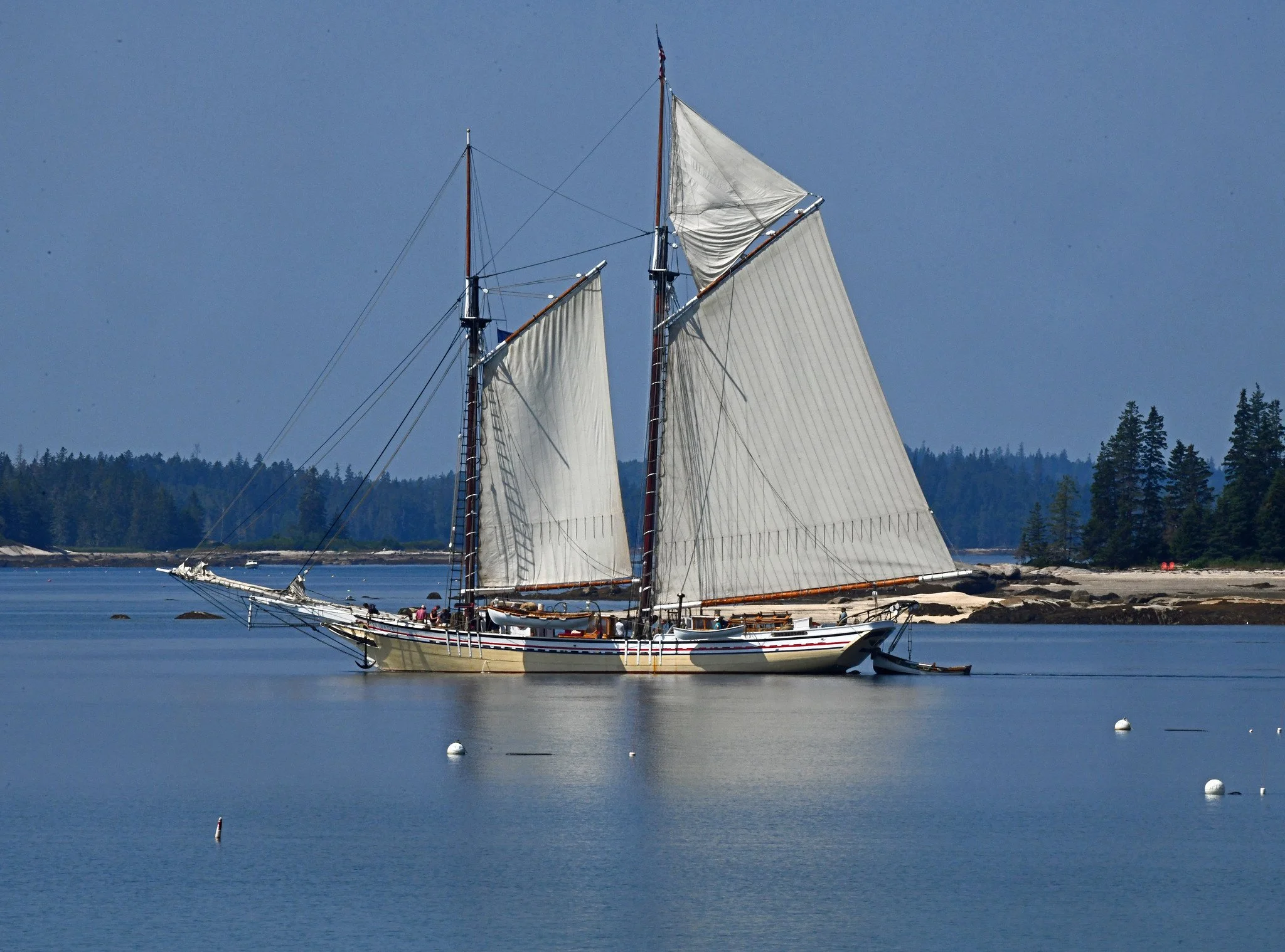
Heritage III

Lewis R. French (In Light Rain)
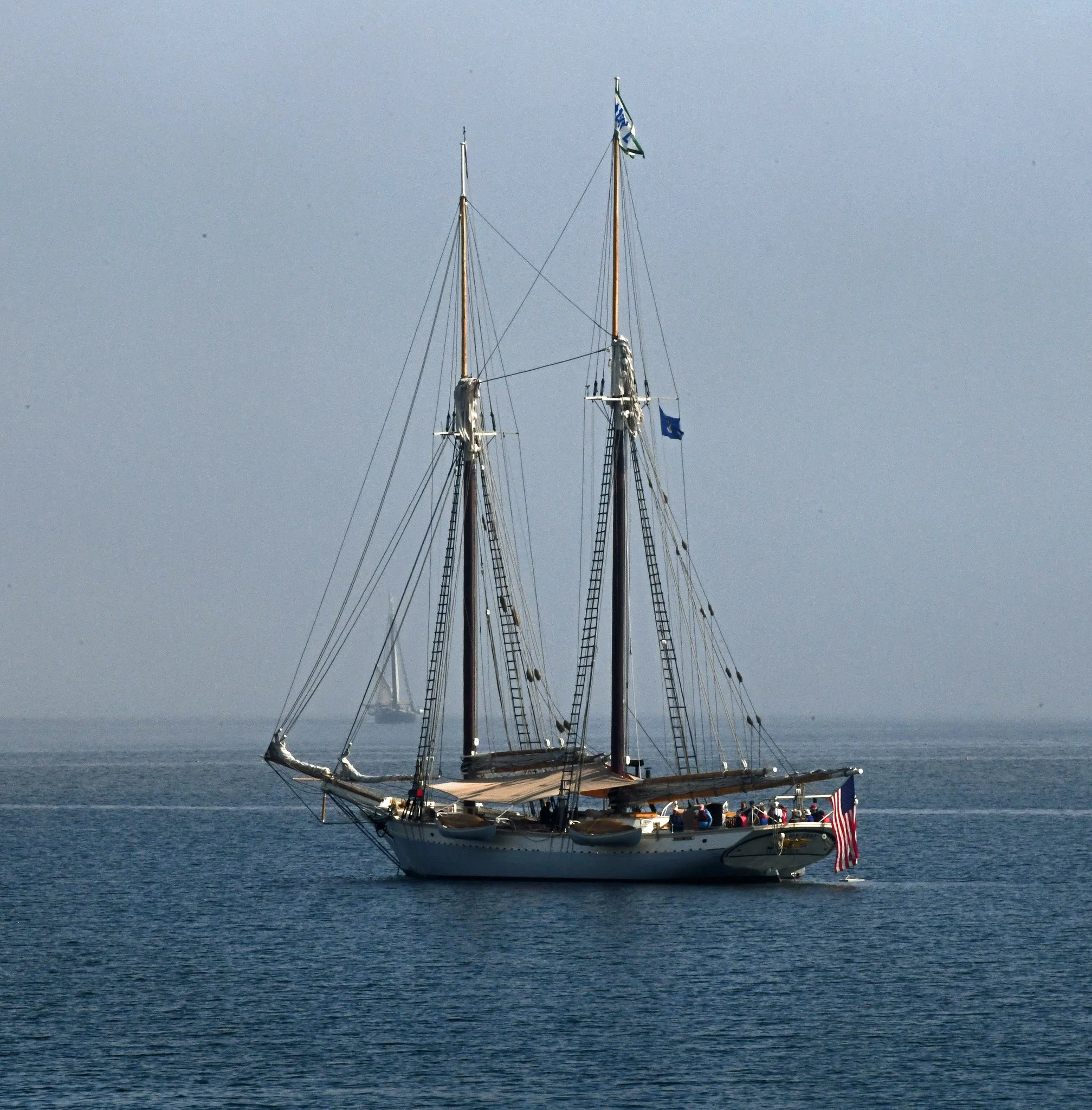
Mary Day (In Fog) with J&E Riggin Coming In
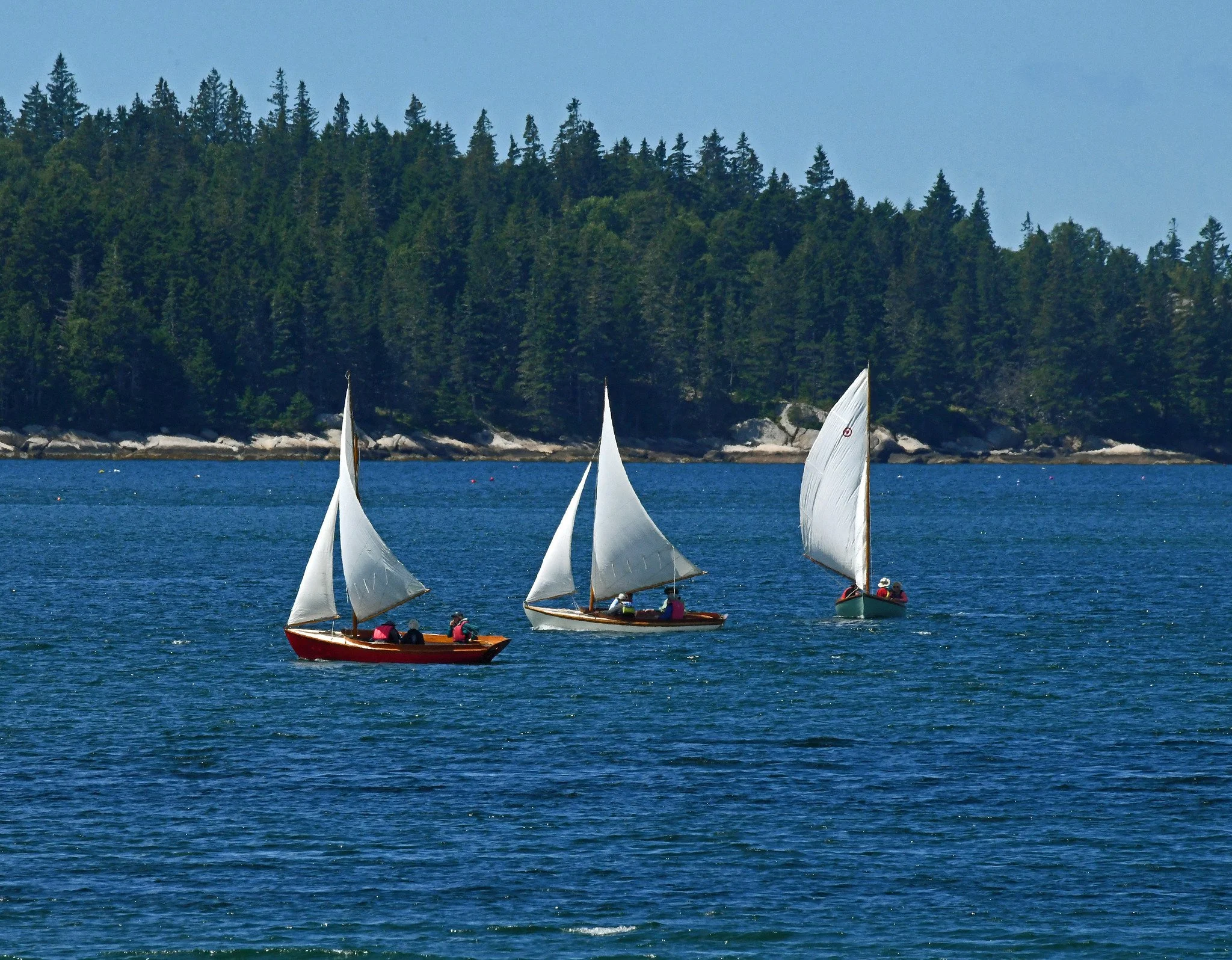
Private boats powered by engines, sails, and muscle abound in the July waters in all sorts of weather:
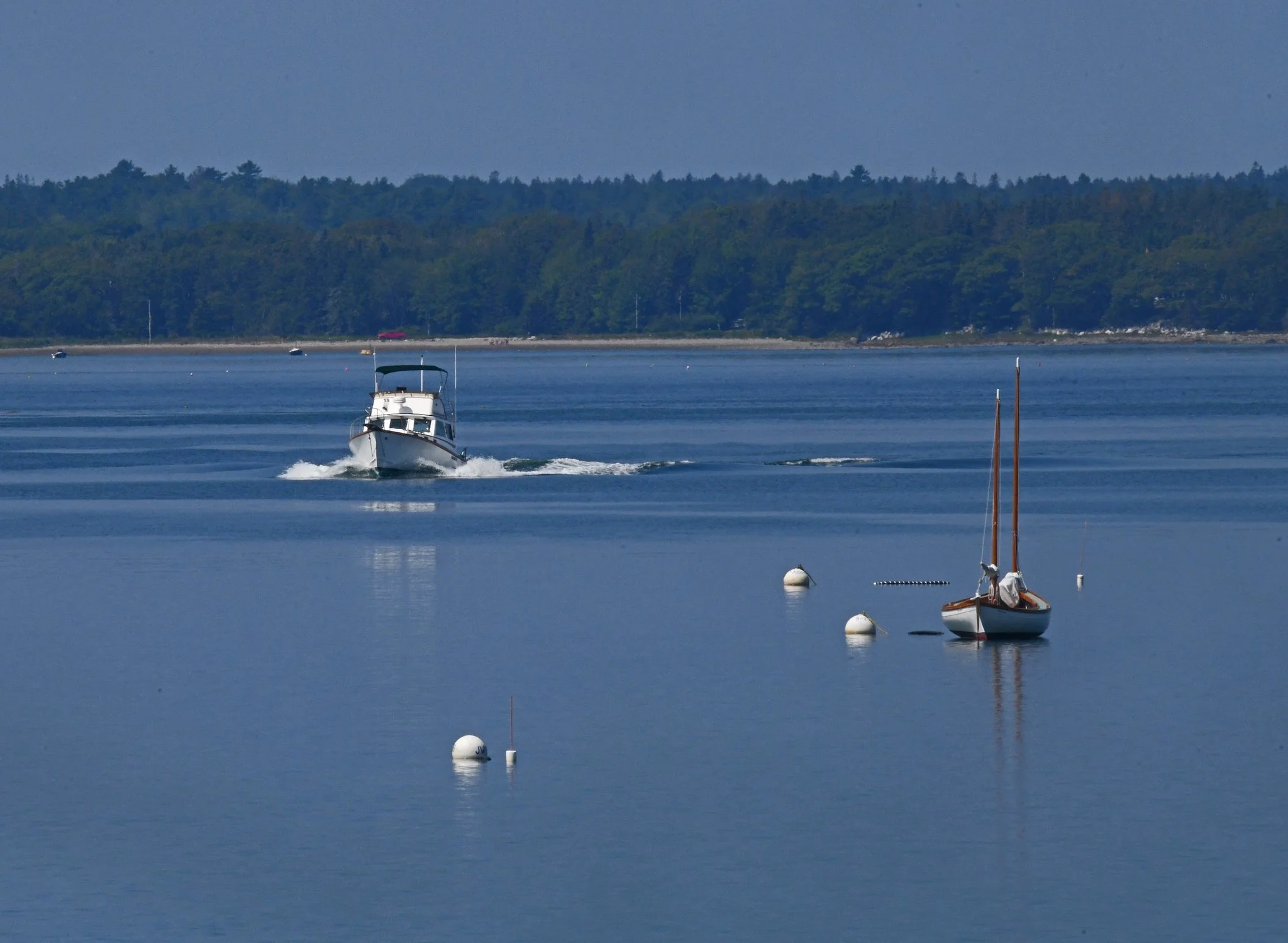


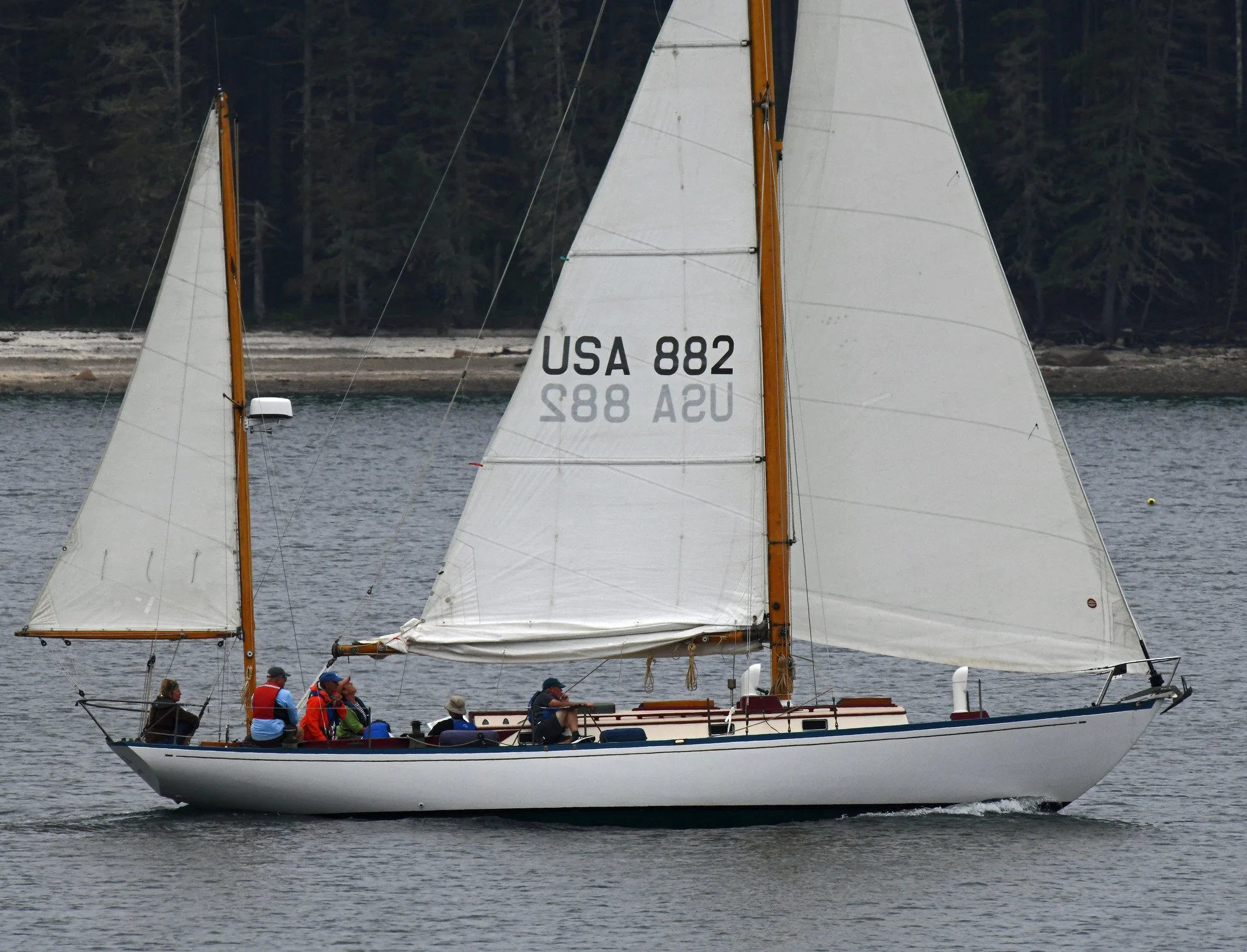


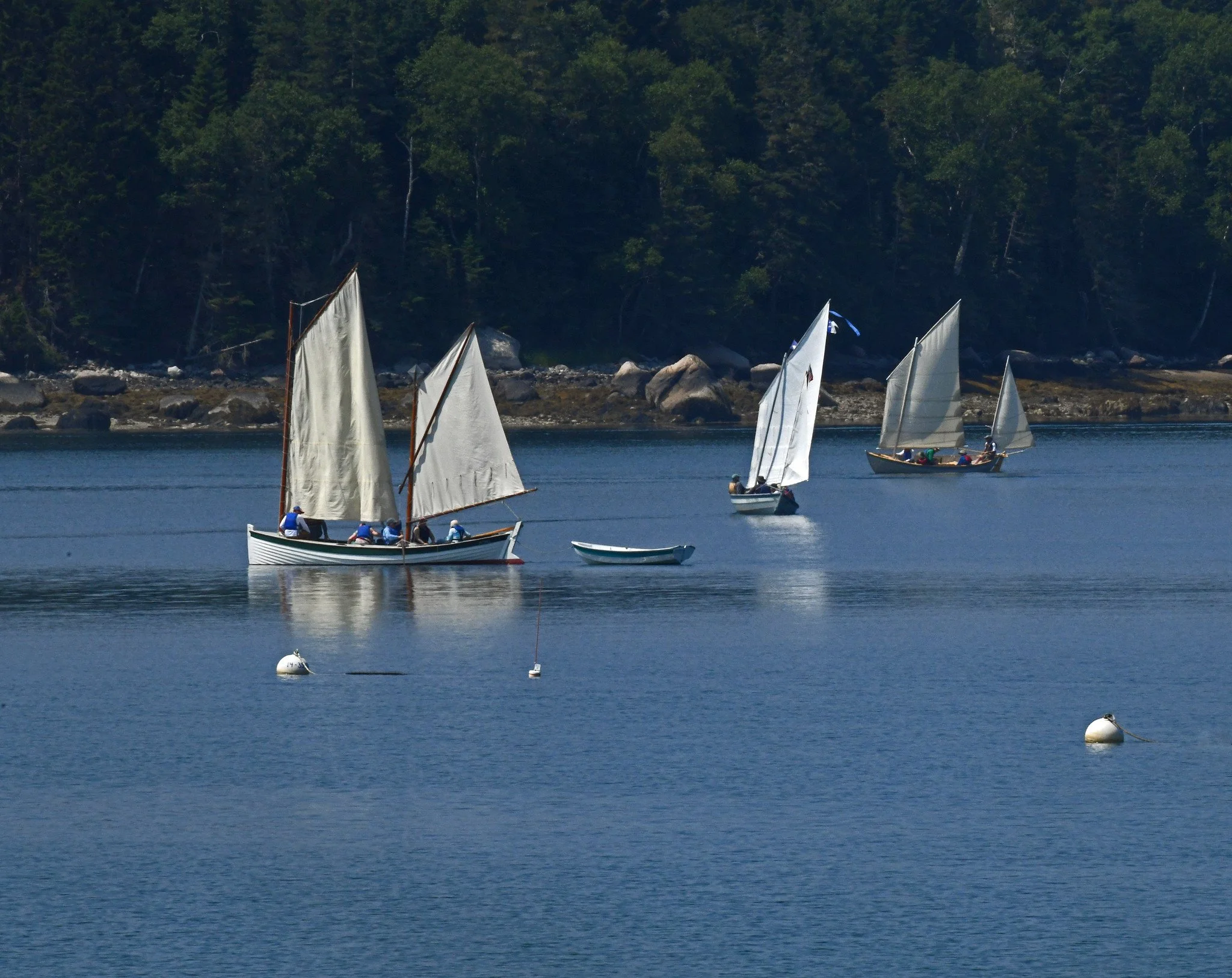
There also are educational activities in Great Cove, where the Wooden Boat School has floating classrooms for novice and seasoned sailors:
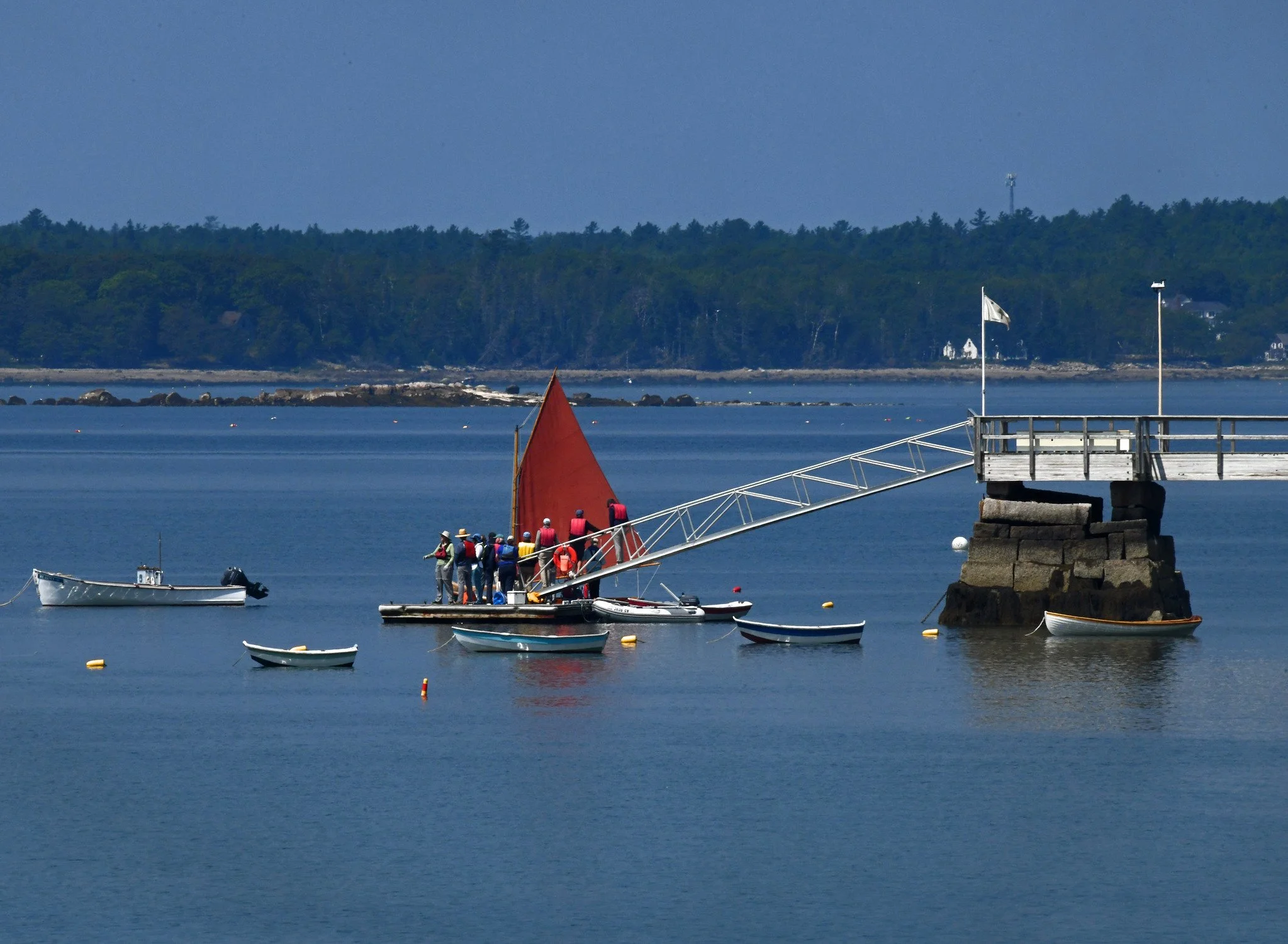


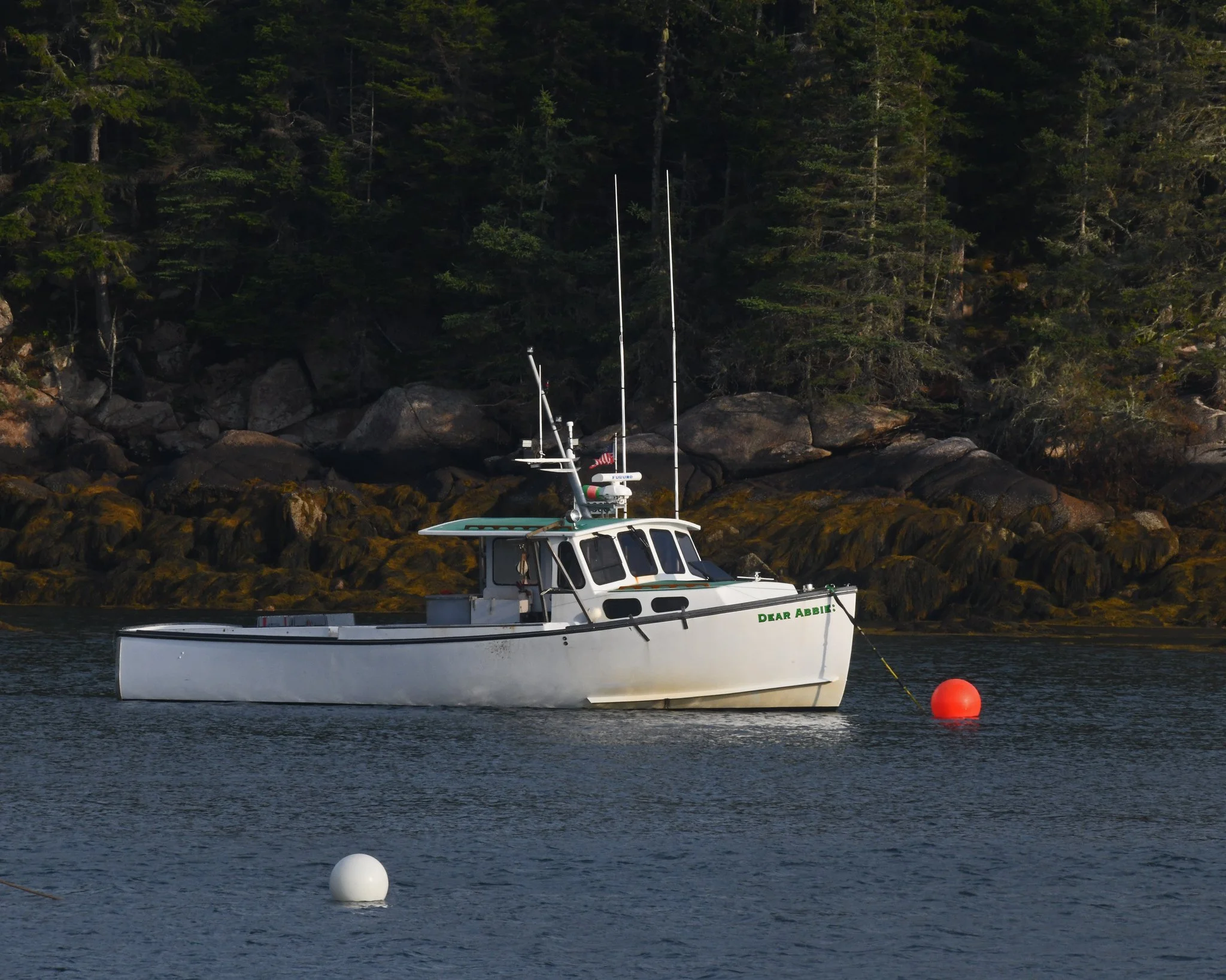
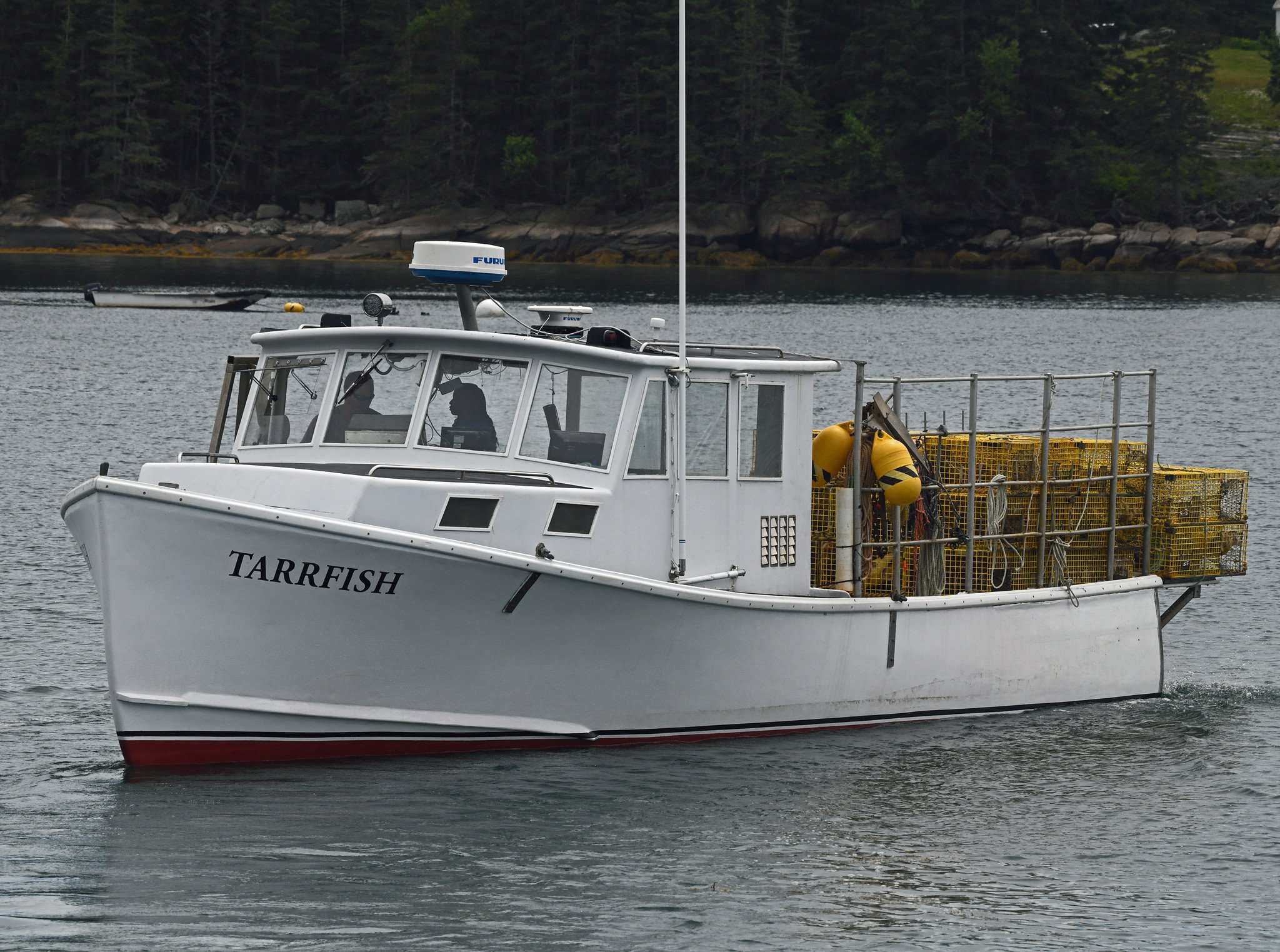
It’s not just fun and games on the July waterfront. That’s when many lobster fishermen begin their season by loading traps onto their distinctive vessels and setting the traps in the coastal waters:





We now come to the July full moon. It’s traditionally called “The Buck Moon” because it appears when male deer regrow their annual antlers. Below you’ll see the July moon growing from its gibbous phase to a full moon, and fading to a crescent in a misty sky. You’ll also see a final merged image to remind you of the July moon’s traditional name.


(All images in this post were taken in Down East Maine during July of 2025.)
Yesterday was a two-jammer day in Great Cove, but I didn’t find that out until the massive HERITAGE raised sails and moved out, disclosing the smaller AMERICAN EAGLE anchored directly behind her from my perspective. The two schooners apparently did some overnight rafting.
The 145-foot HERITAGE home-ports in Rockland, Maine, and her schedule says that she was on a five-night cruise along the Maine coast. (She has a habit of sleeping with her mainsail and one topsail up.) Here see her at her overnight anchorage off Babson Island and eventually putting up sails during the morning’s low tide:

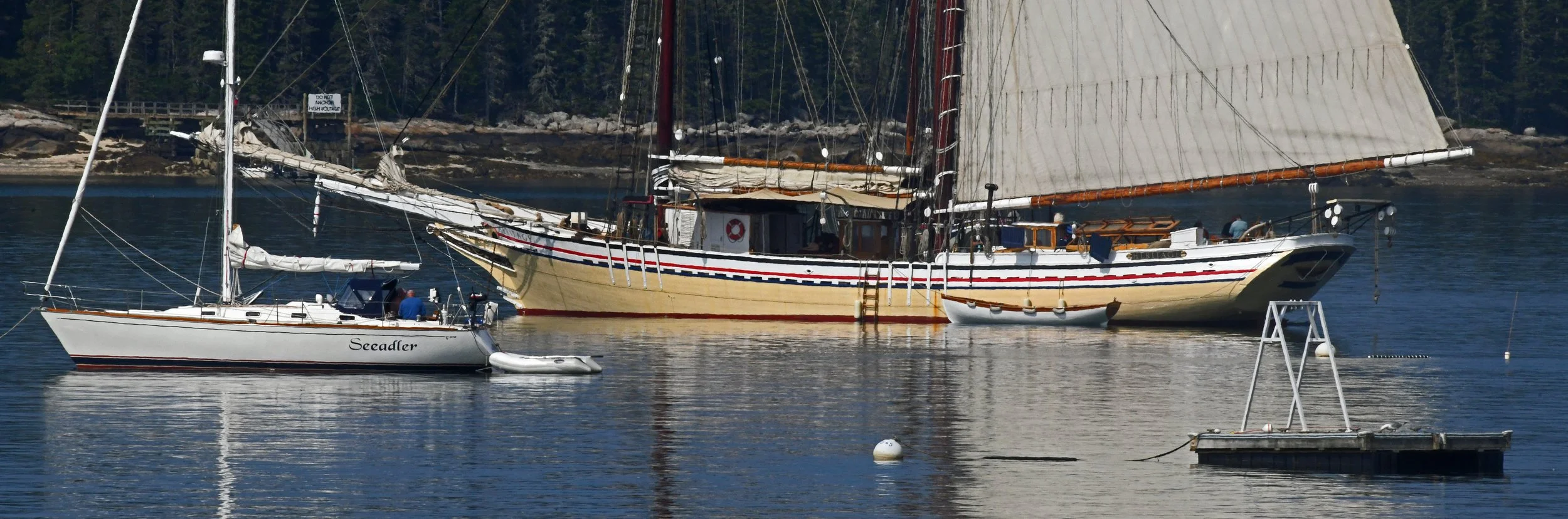
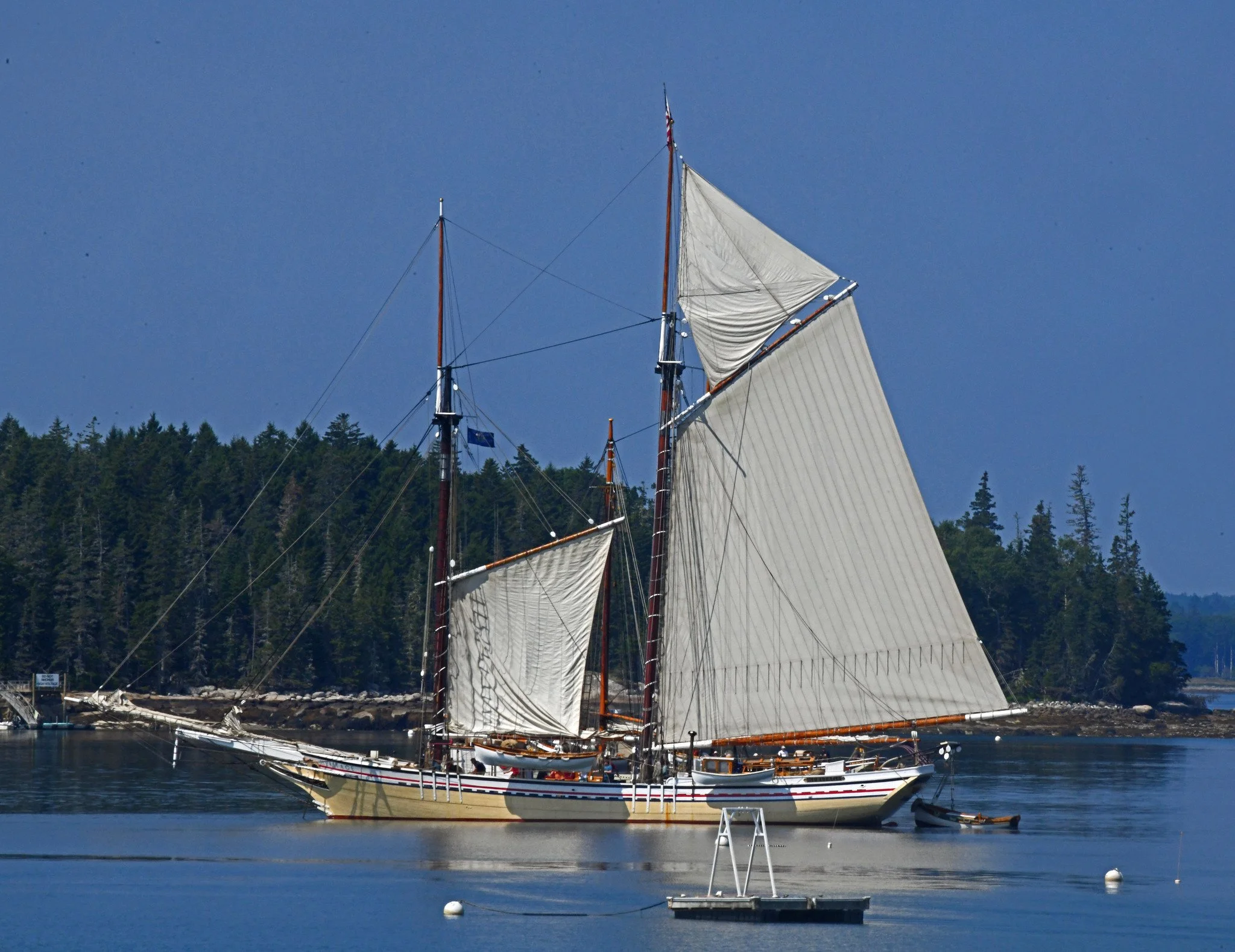
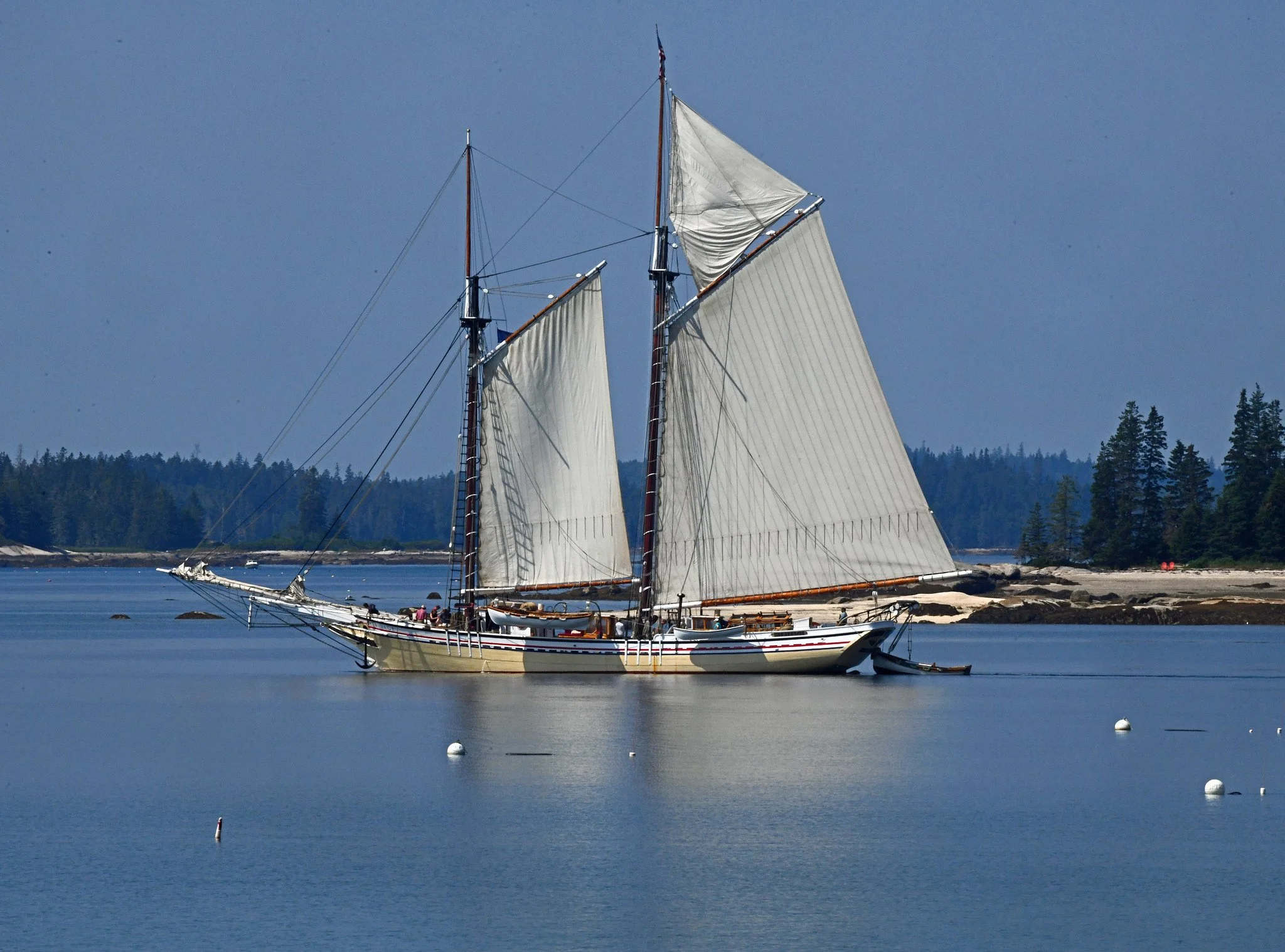
She left the Cove in light wind yesterday morning without putting up any staysail or jib:
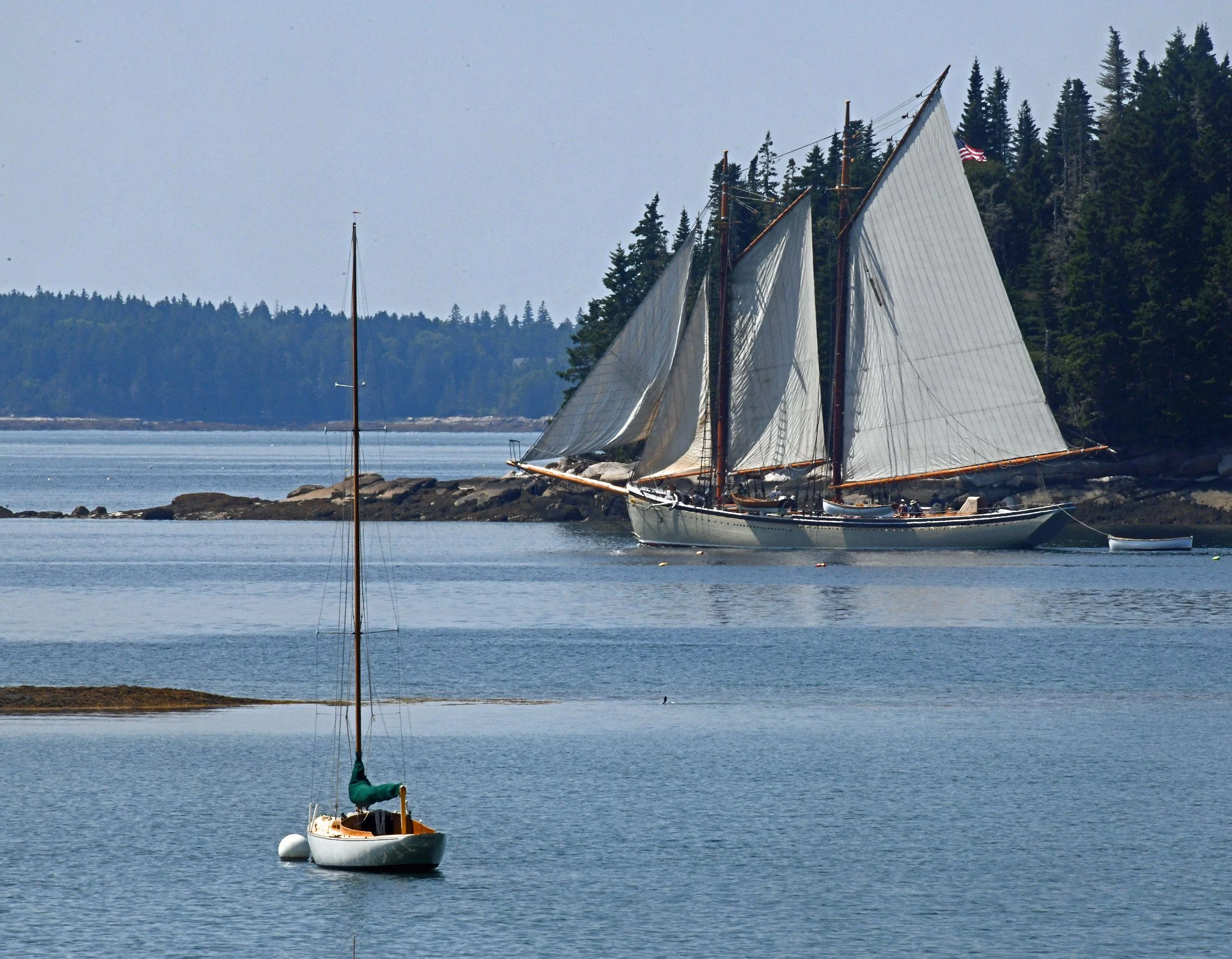
When the HERTITAGE left, there was her neighbor, the 123-foot AMERICAN EAGLE! (She sleeps with no sails on, so was hard to see.) She’s also from Rockland, and her schedule says that she’s on a six-night “Unscripted Adventure.” She soon raised sails and left the Cove with with staysail and jib up in the light and erratic wind:



As far as I can tell, yesterday’s visit to the Cove was the HERITAGE’S fourth and AMERICAN EAGLE’S second, since the cruising season opened in late spring. (Images taken in Brooklin, Maine, on July 30, 2025.)
Here’s another look at a WoodenBoat School sailing “classroom” that recently had several of us guessing – incorrectly – as to what kind of boat she was. WBS descriptions and some on-line research have revealed a few of her wonderful secrets.

She’s named “Petrel,” apparently after the seabird of the same name. Many of you probably know a lot about those fascinating birds that like to stay far out in rough seas. But I bet that only a few of you know a lot about a “Crotch Island Pinky” – which is the kind of bird that “Petrel” actually is.
Here’s part of the informative WBS description of “Petrel”:
“The Crotch Island Pinky is a 26’ double-ended open boat with a ‘cat-ketch’ rig and internal ballast. The type was developed in [Maine’s] Casco Bay in the 1880s and built in Yarmouth, Freeport, and Harpswell, as well as on Crotch (now Cliff) Island, just a few miles east of Portland. These boats were the pick-up trucks of their day, used for fishing and freight during the late 19th and early 20th century. Fast and powerful, their “easily driven hulls” and ample sail area made for safe, efficient work and travel among the rocky shores of Maine and beyond.”
Other sources reveal that large and small wooden “pinky vessels” or “pinky ships” were popular in the Gulf of Maine in days of yore due to their seaworthiness in rough seas and, especially, their ability to sail well to windward.

The “pinky” design called for bluff (almost rounded) bows and very sharply tapered-down sterns. The boats reportedly got their strange nickname from those narrow sterns, which some thought looked like pinkies. (Images taken in Brooklin, Maine, on July 28, 2025.)
Here you see Conary Cove in one of its better looks on Saturday. A flood tide is just about to ebb on a brilliant, high-summer day, while a cooling breeze helps the surrounding lush leaves to cast undulating green shadows onto the smooth water:
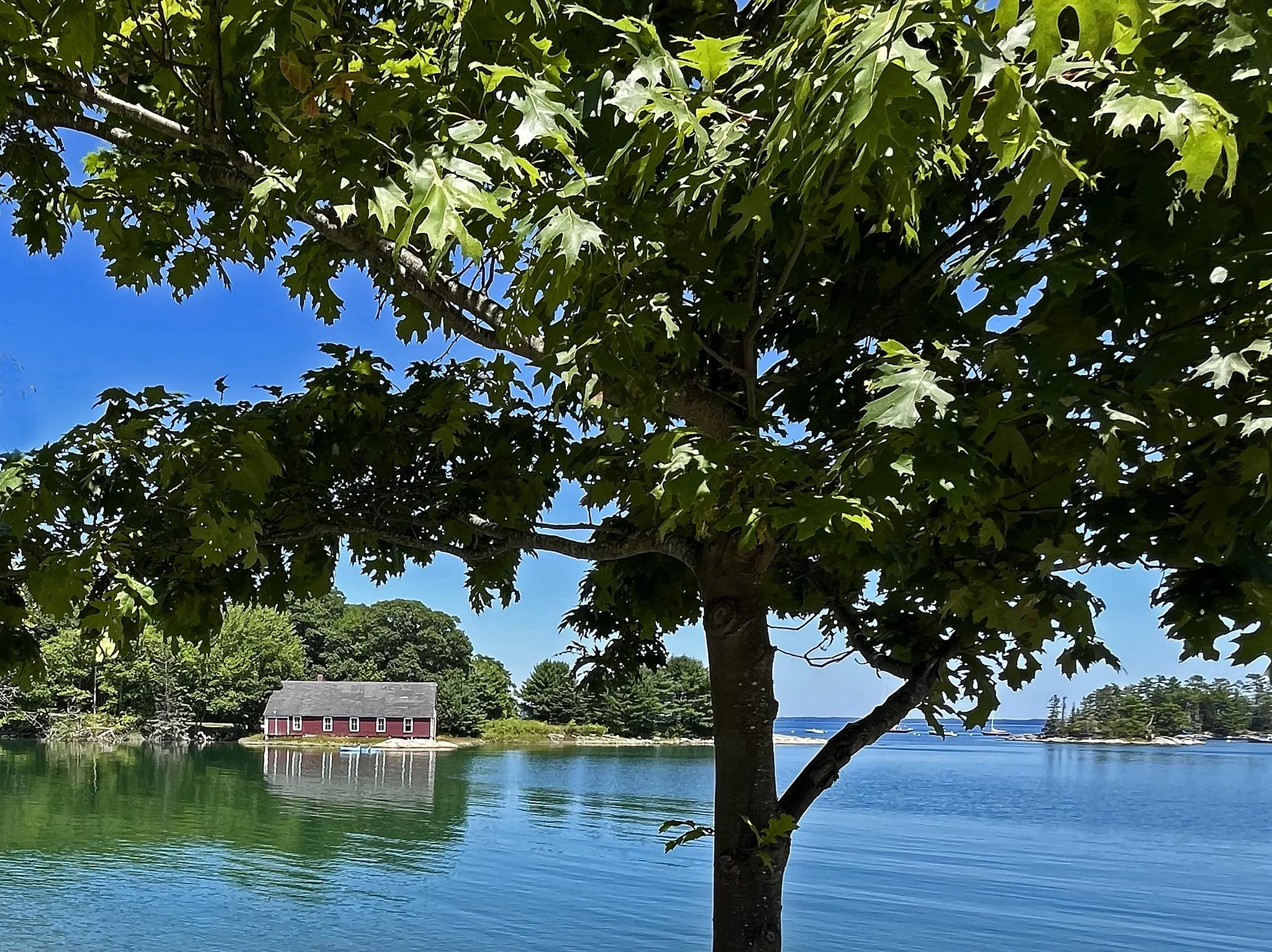
If you look closely at this telephoto image, you’ll see that a pair of paddling adventurers had entered the Cove in a flashy vessel to take a close look at the old red boathouse.:

(Images taken in Blue Hill, Maine, on July 26, 2025.)
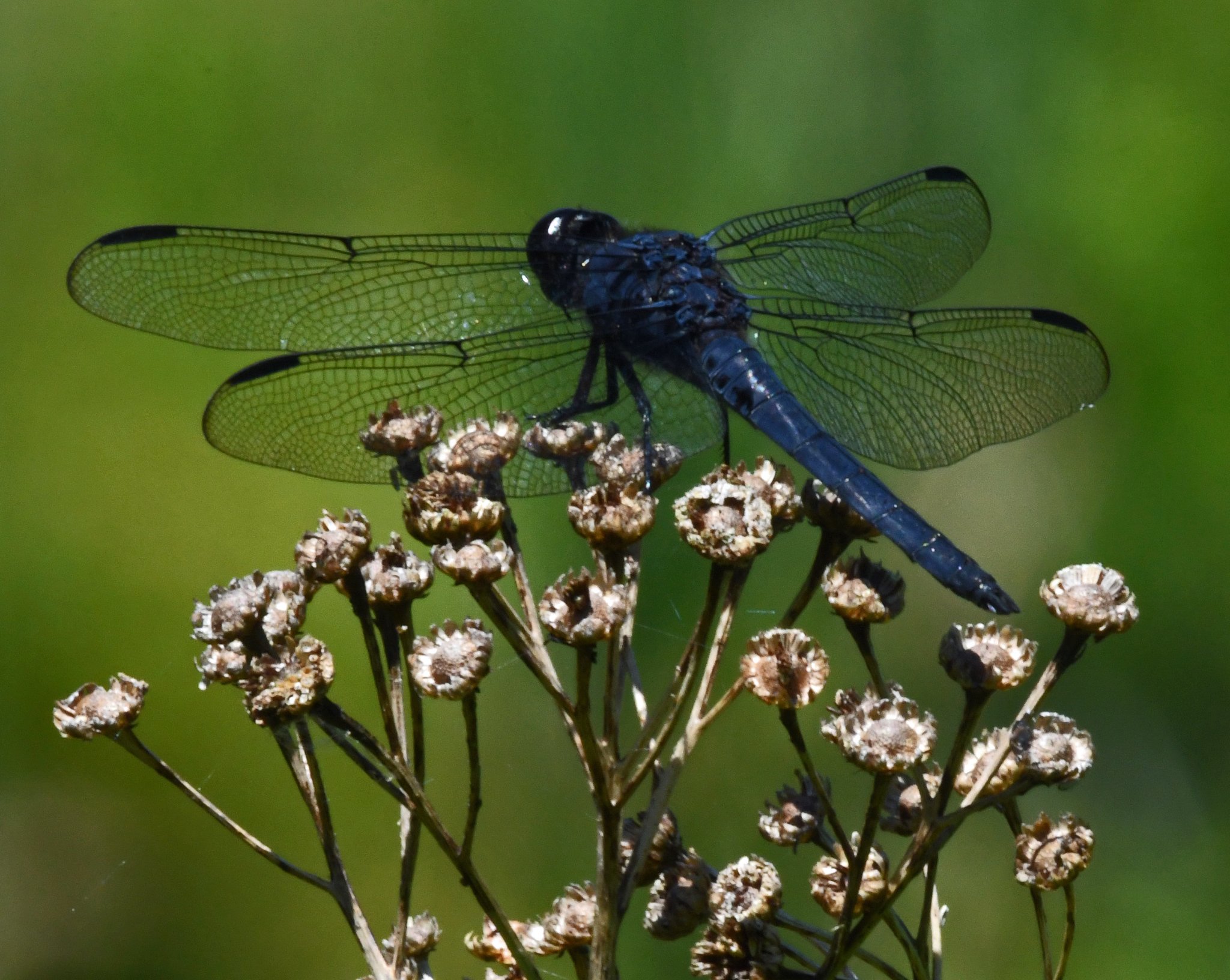
It’s getting to be prime time for dragonflies, always fascinating and frustrating subjects for photographers. Here you see what I think is a male slaty skimmer (Libellula incesta), which is native to the northeast U.S. and some of southern Canada.

I’ll probably be doing a major article on dragonflies in August, after I do further research on their amazing flying maneuvers. Speaking of flying maneuvers, here you’ll see this fellow leaving those desiccated flowers in a hurry, with his head apparently swiveled 90 degrees to look at me with both eyes, while his wings are positioned oddly to launch himself straight up:

(Images taken in Brooklin, Maine, on July 24, 2025.)
Here’s the iconic, high-summer view of Mount Desert Island (MDI) from Amen Ridge in Brooklin. You’ll have to imagine the capricious breezes that carried hints of salt and balsam fir toward the camera. The lupine flowers in the field have dried up in their fuzzy way, but the grasses and sedges there are still green and munchy for our white-tailed residents. A sea haze has turned the placid Blue Hill and Jericho Bays slate blue, while restless cumulus clouds roam northeast (to the left) over MDI’s hunched western mountains.

MDI is Maine’s largest island and is accessible by bridge. Most of Acadia National Park is on the island, which is otherwise ornamented with Down East towns and villages that are popular with tourists, including Bar Harbor, Bass Harbor/Tremont, Mount Desert/Somesville, Northeast Harbor, Seal Harbor, and Southwest Harbor. (Image taken in Brooklin, Maine, on July 21, 2025.)
It hasn’t been a great year for monarch butterflies here yet, if my experience is typical. I’ve seen a few of them sipping from local milkweed and bee balm – usually one or two butterflies at a time; not large numbers. I’ve seen no eggs or caterpillars on the milkweed yet. Yet, the monarchs that I’ve seen seem to be in good shape.

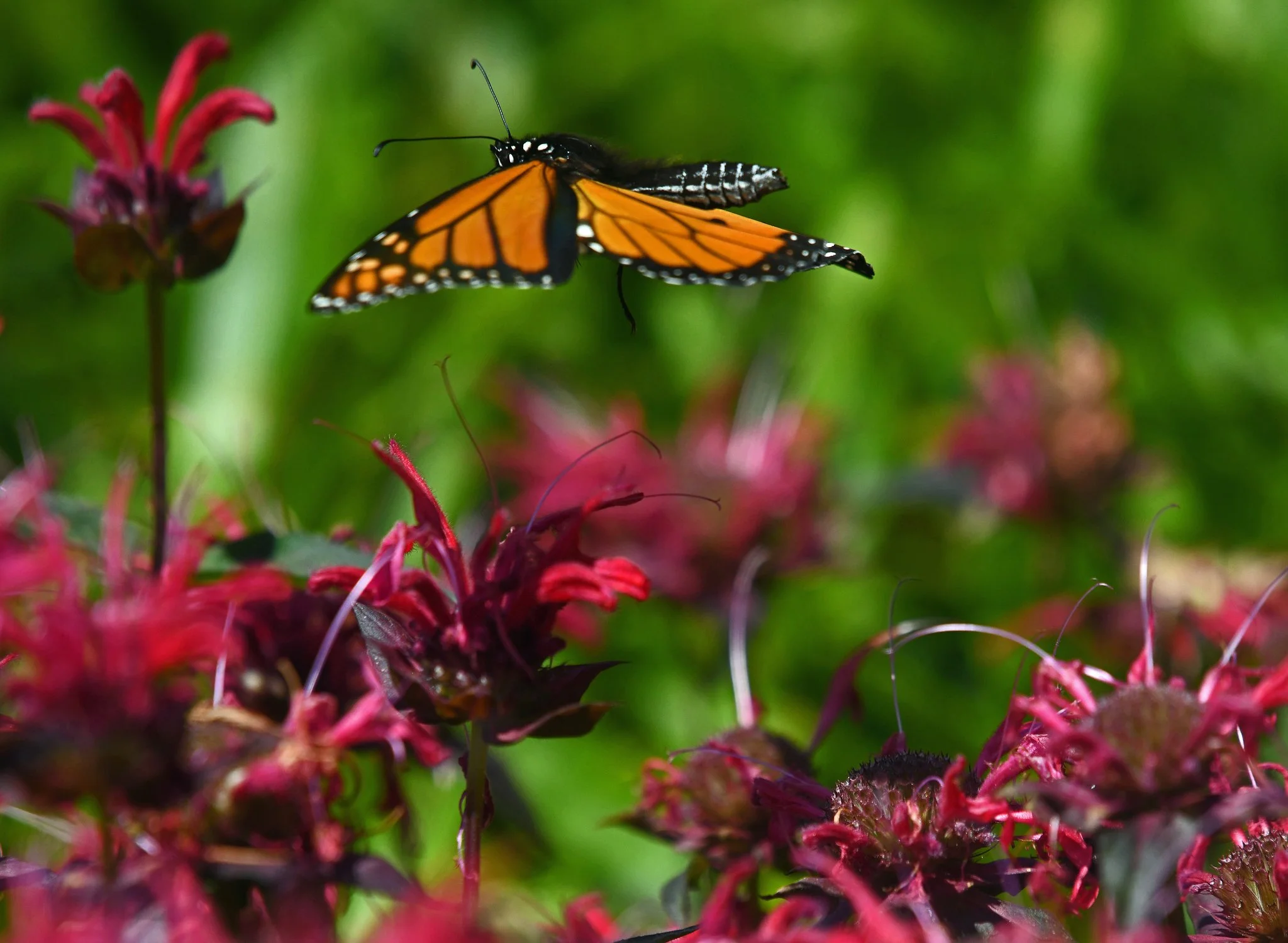
Here you see a male monarch flitting among our pollinator-picked-over bee balm. Only the male monarchs have those matching, dark elliptical spots on their hind wings. The spots are thought to be scent glands that exude pheromones to attract females. (Hope this works better than aftershave lotion on human males.) The male monarchs also tend to have thinner black wing veins than the females.

I’m trying to “shoot” butterflies in flight with a hand-held camera and long lens. It can be painful and frustrating, but I think I’m noticing that many butterflies seem to fly with their bodies flexed horizontally when they undertake a long flight; it may be the best aerodynamic position for their unusual configurations:
(Images taken in Brooklin, Maine, on July 23, 2025.)
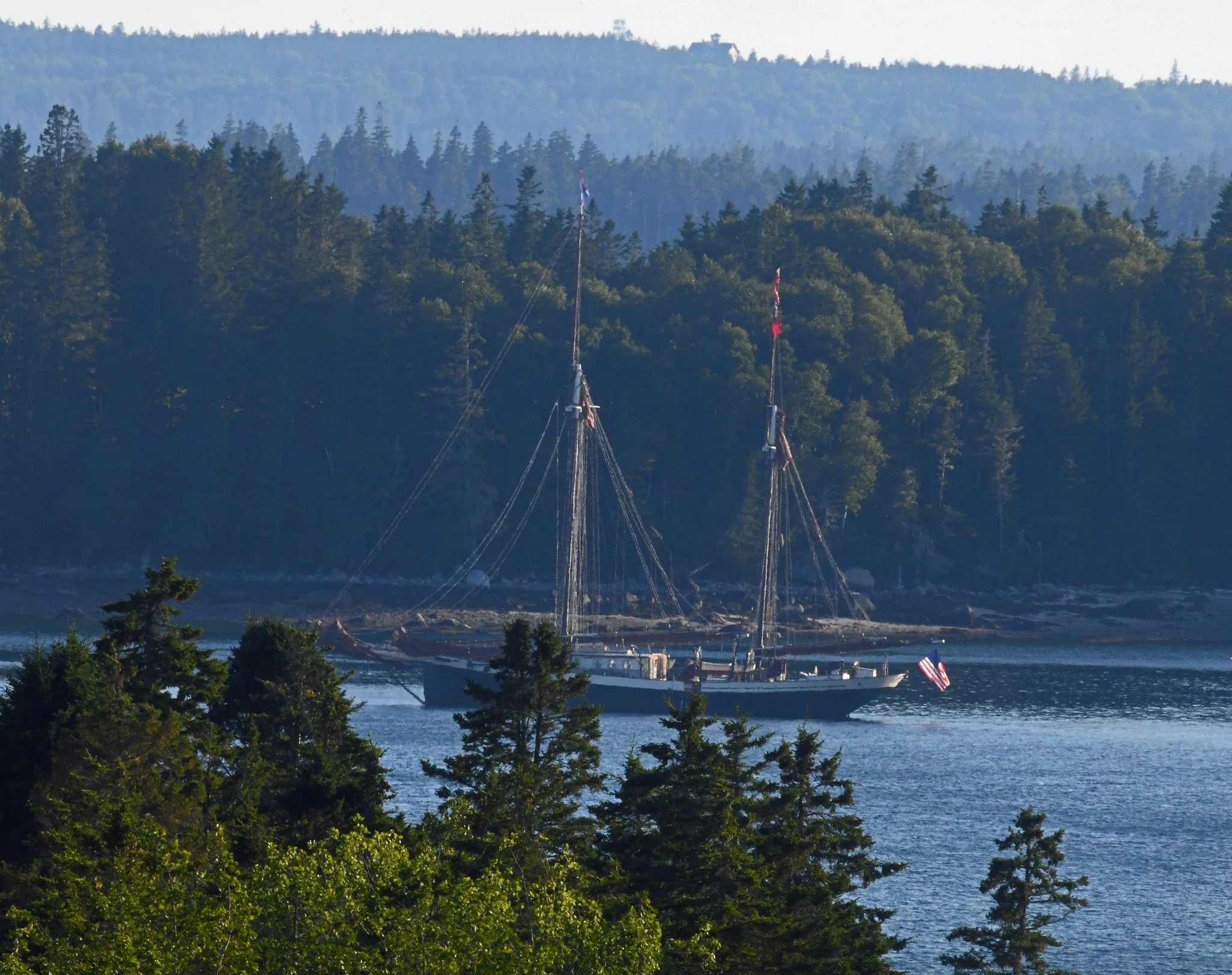
Above, you see Angelique anchored off Babson Island at sunset on Wednesday evening. This was her fourth visit this year. She overnighted there and was on a five-night cruise that is scheduled to culminate today with participation in the always-fabulous Camden [Maine] Classic Cup Regatta. She’s a 130-foot ketch and Camden happens to be her home port.
Yesterday morning, Angelique moved to the middle of Great Cove where she got a lot of attention from the WoodenBoat School sailing classes and other traffic there:


Angelique finally raised her famous tanbark-colored sails and pivoted out of the northern Cove exit:


(Images taken in Brooklin, Maine, on July 24, 2025.)
For some of us, there seems to be nothing that captures the spirit of summer better than sailing a small boat and sensing your life coming into harmony with sunshine, wind, and blue water, and – for the moment – being unable to think of anything else.

Here, you see the lucky novice students in the WoodenBoat School’s “Elements of Sailing I” class apparently doing just that Tuesday.


They’re learning to sail in the School’s 12 ½-foot Herreshoffs (with keels) and Havens (with centerboards), some of the most joyful vessels that ever got their bottoms wet.
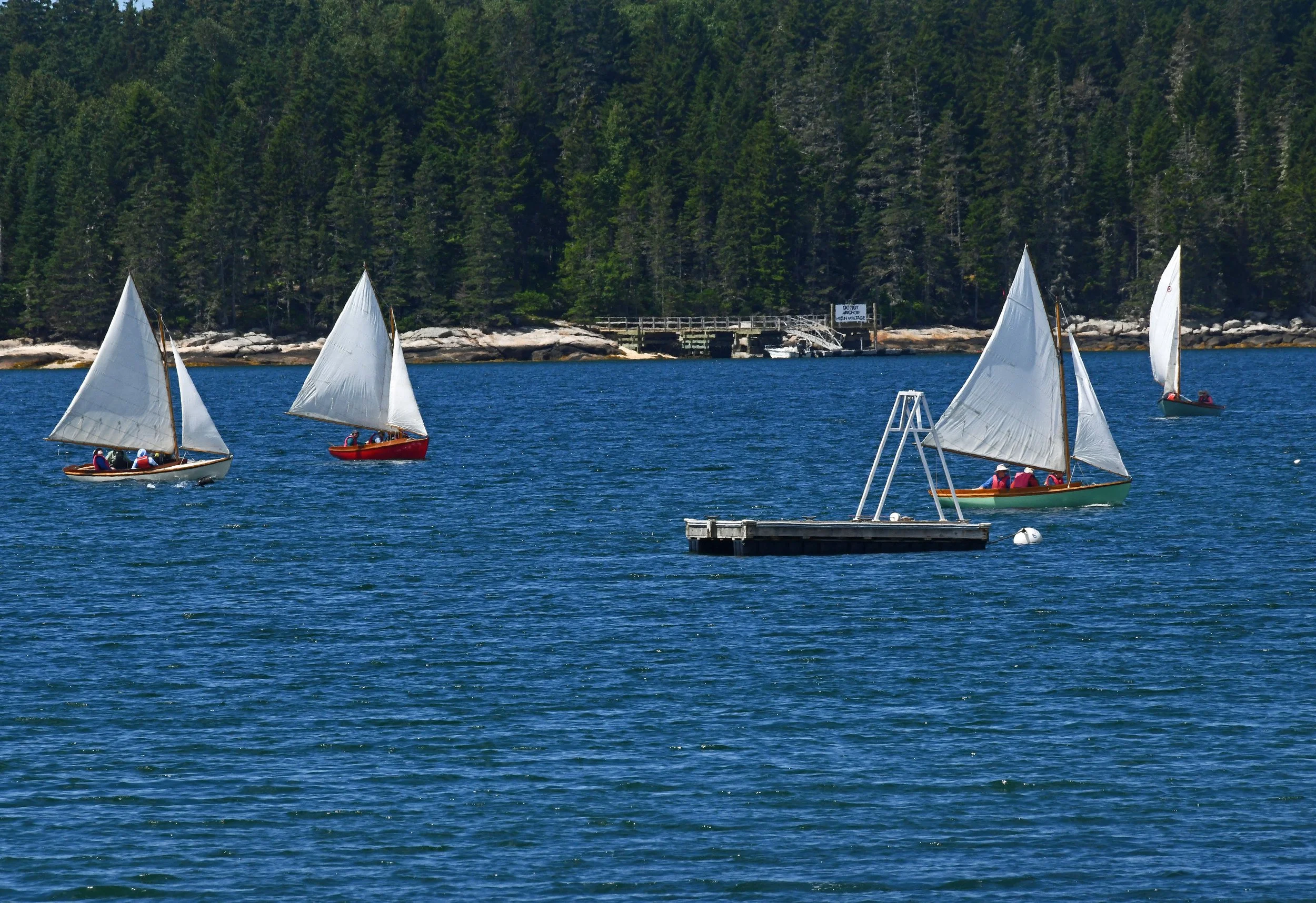

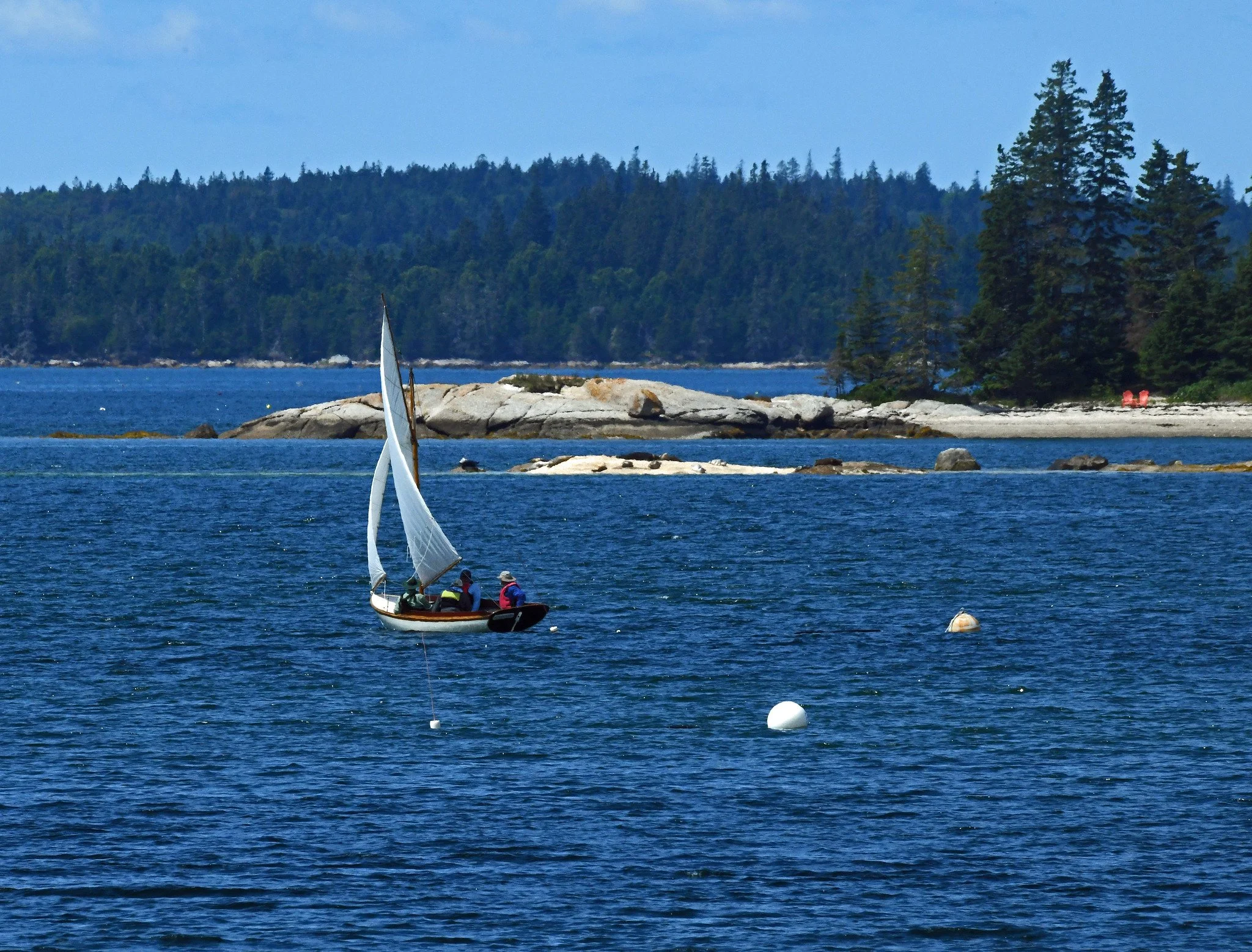
(Images taken in Brooklin, Maine, on July 22, 2025.)
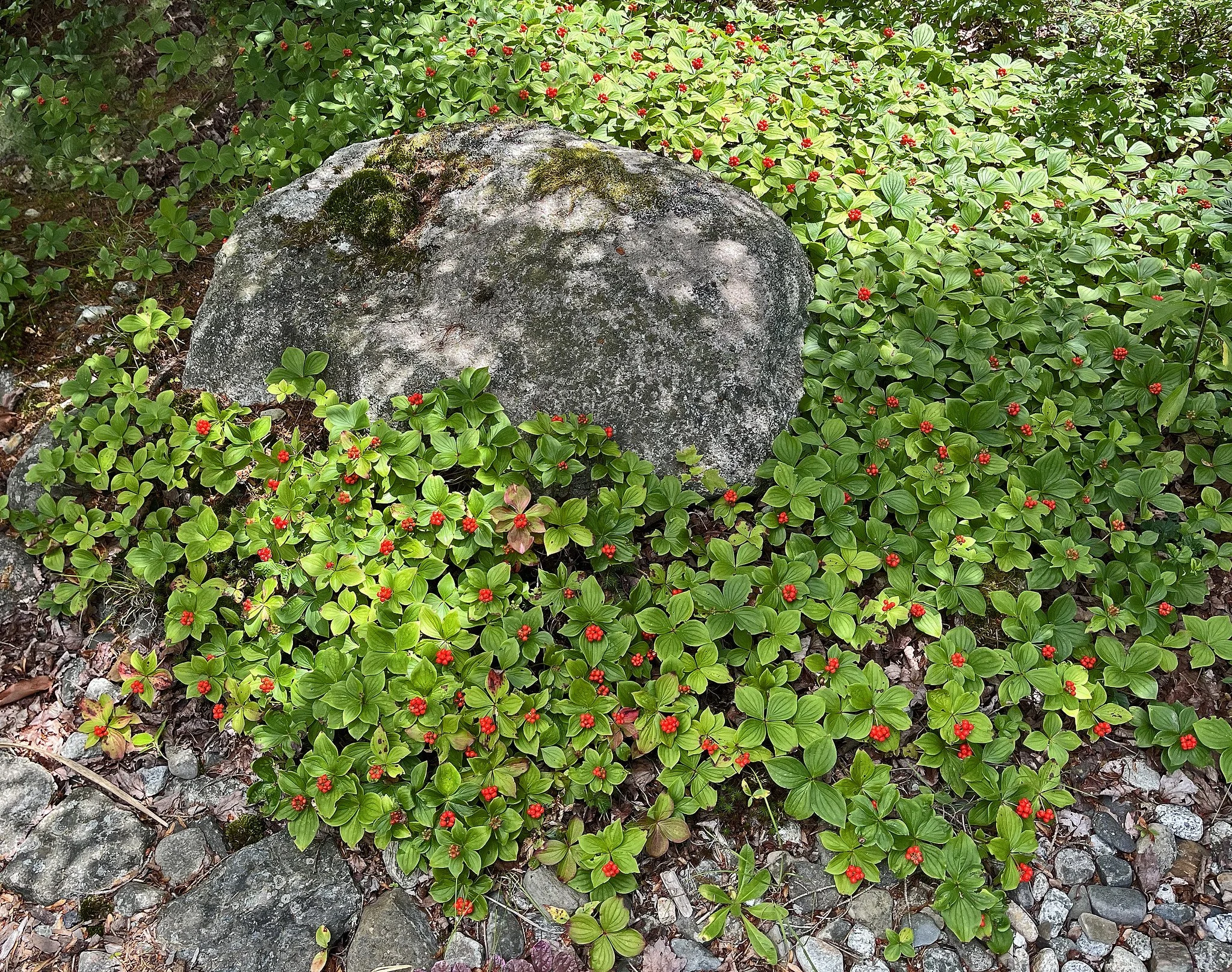
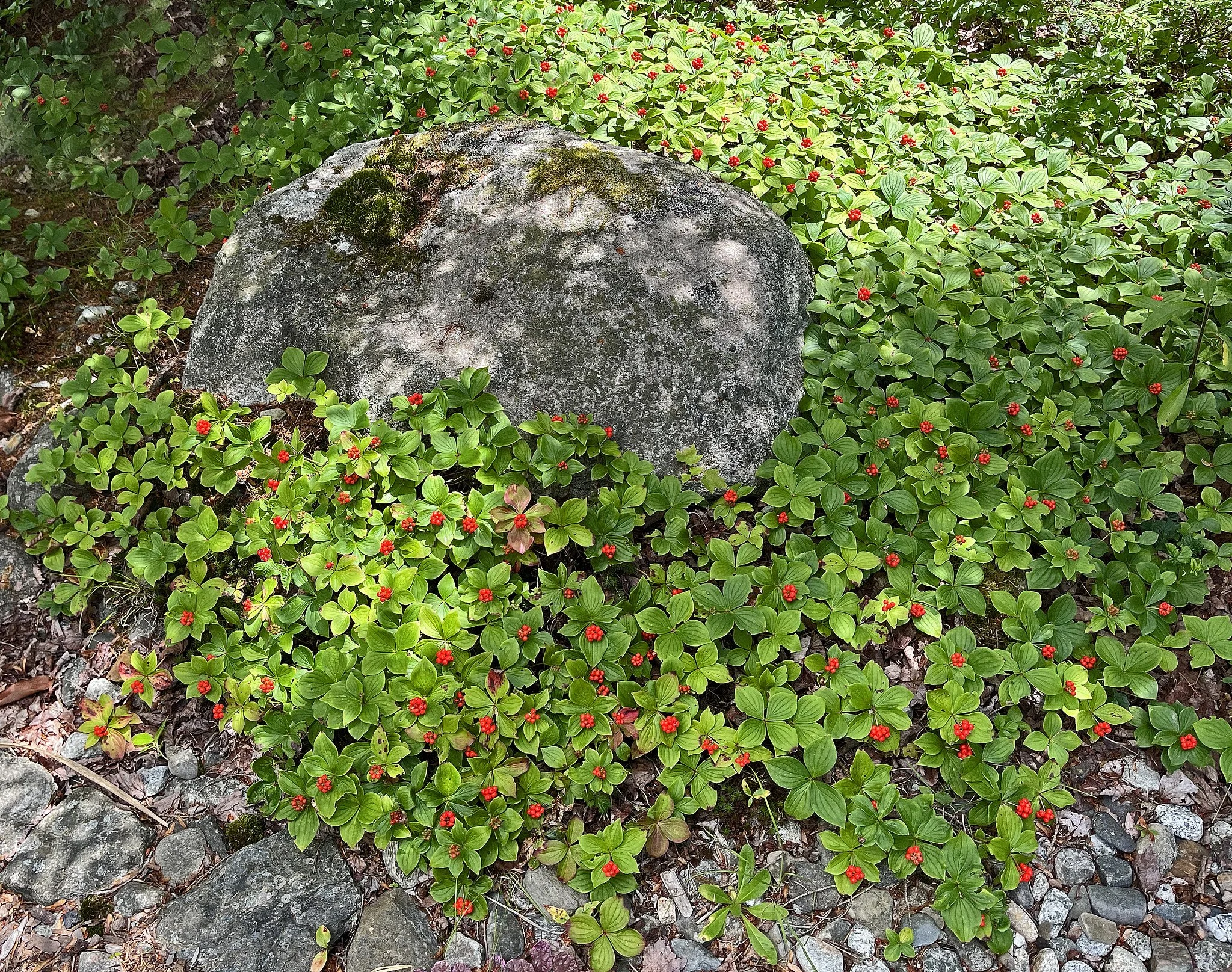
Red bunchberries are emerging in bunches, from bunchberry plants, which have been bunching up since spring, when white flowers and bracts emerged from the plants in bunches. This wonderful wild groundcover is a member of the dogwood family.

Bunchberry’s high summer red berries were used by Native Americans for food and treatment of coughs, colic, fever, and stomach aches. They’re full of pectin and can make a passable jelly or jam, I hear. Birds, squirrels, deer, moose, and bears prefer these fruits fresh and raw.
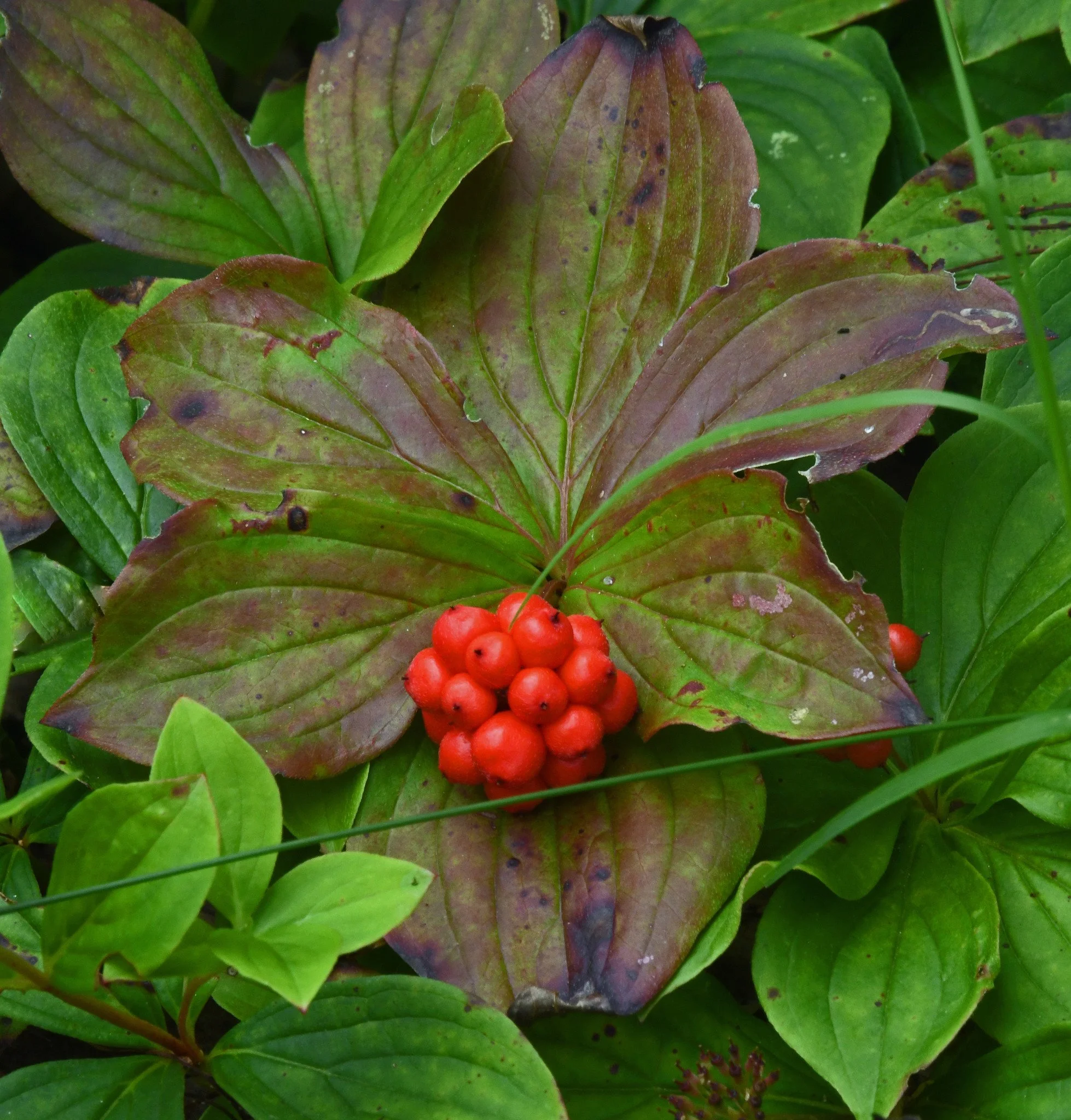
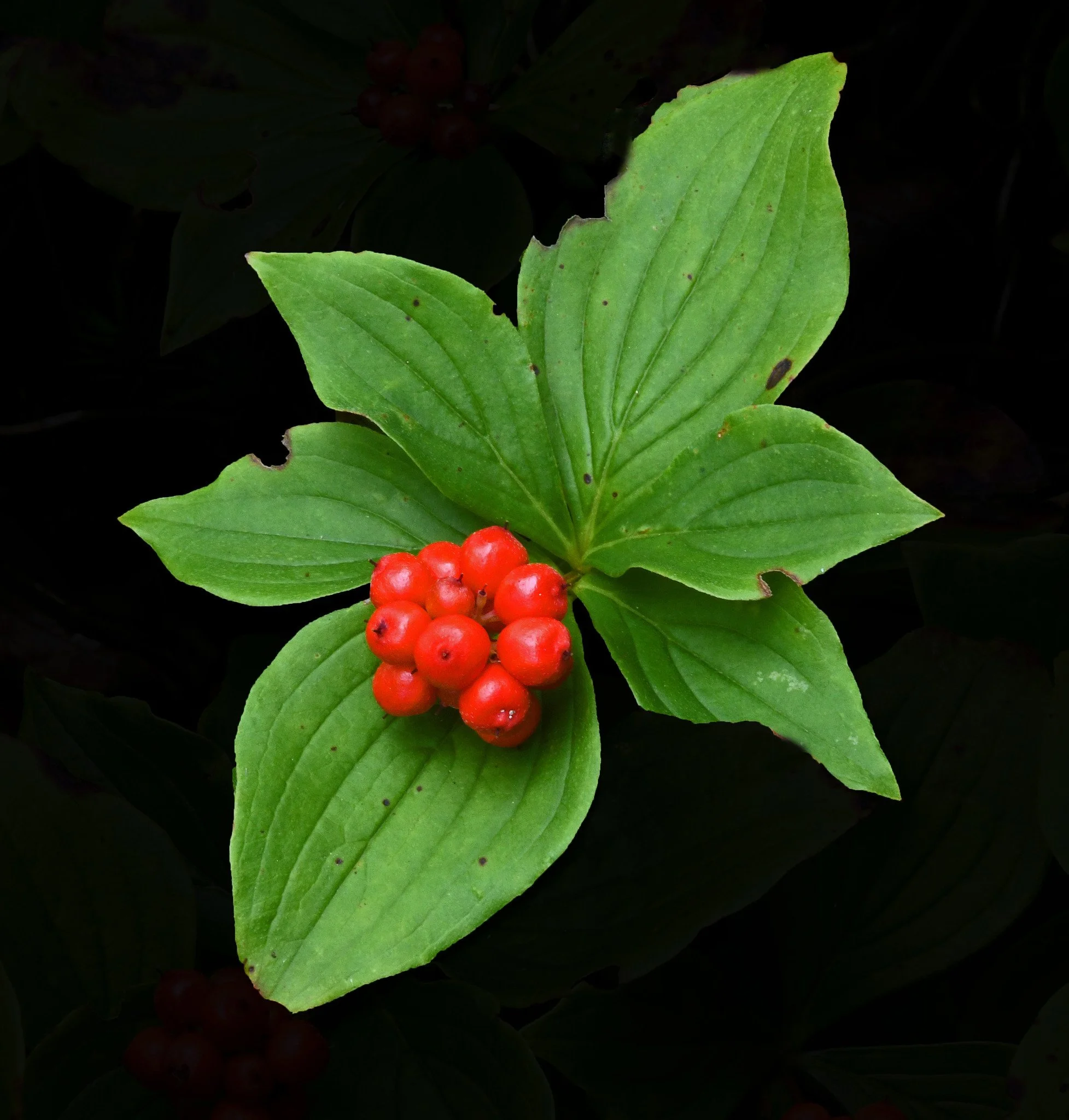
The plant (Cornus canadensis) also is known as crackerberry, dwarf dogwood, creeping dogwood, ground dogwood, and Canadian dwarf cornel. (Images taken in Brooklin, Maine, on July 22, 2025.)
“Our” white-tail deer herd appears happy and healthy this year, albeit perhaps a bit too numerous for their own and our good. The seemingly boundless joy of the yearlings – not too old, not too young for the browsing life – is infectious. Here are images of what I’m fairly sure are yearling white-tails, a male (buck) and a female (doe):


A “yearling” actually is in the second year of life (about 1.5 years old). They’re slim and gangly, with disproportionately long legs and thin necks, compared to mature deer.

The young bucks, especially, look a little odd: like does that have had beginners’ antlers screwed into their heads:

At this time of year here, all deer antlers are new bone (not horn) that is covered by a nurturing “velvet” membrane that contains blood vessels, nerves, and skin tissue. Antlers covered by velvet reportedly are the fastest-growing tissue in the animal kingdom.
(Images taken in Brooklin, Maine, on July 13 and 20, 2025.)
Versant Power, the electricity utility in northern and eastern Maine, is replacing miles of bare wire strung from utility poles here. The new lines are “covered conductors,” which are transmission wires wrapped in insulated material. Judging from what I’ve seen on the poles, the new wire apparently is color-coded:
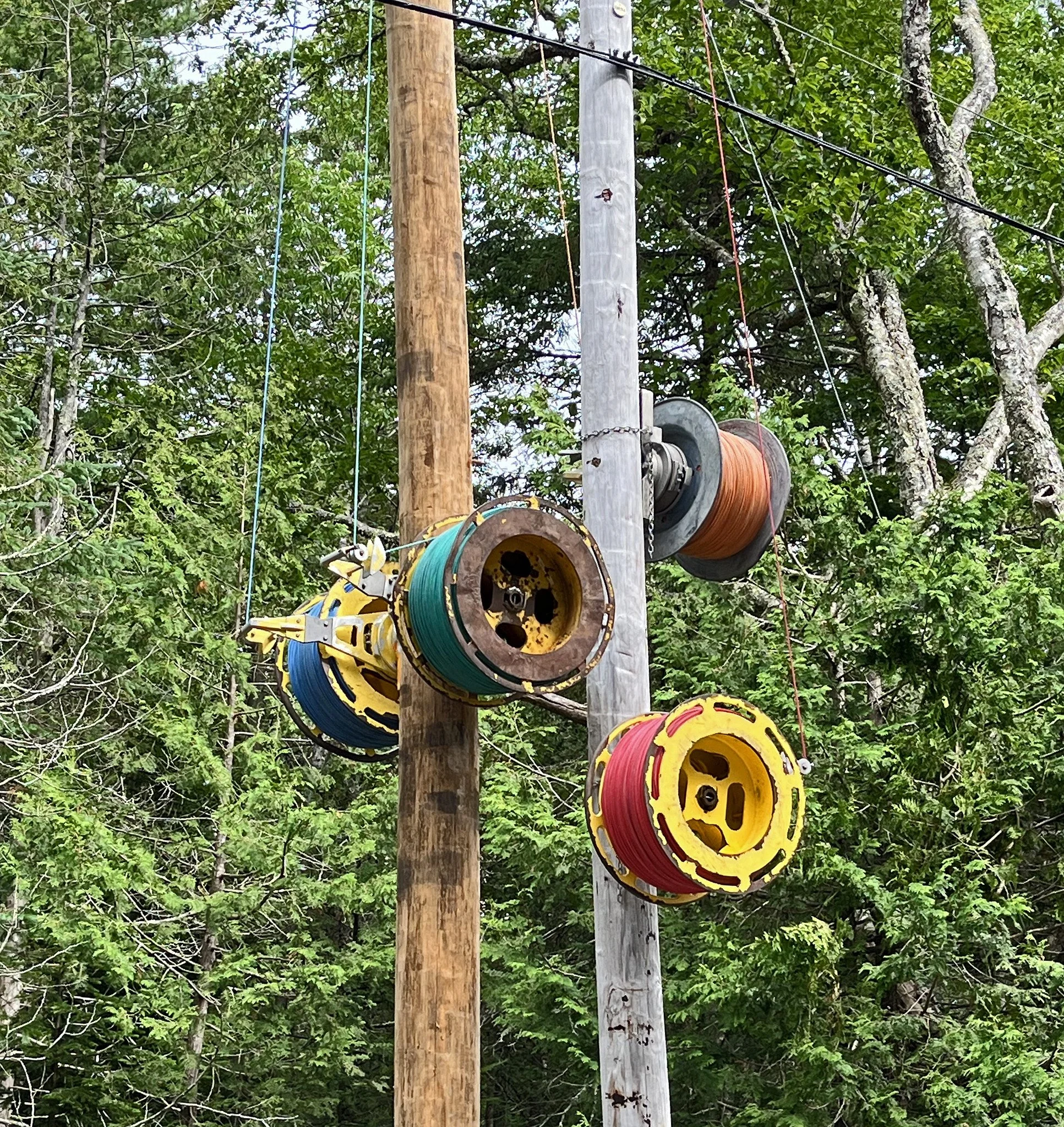
Covered conductors make the wire more resistant to damage that can be caused by falling trees and branches, thereby reducing electricity faults and outages. (Maine is the most forested state in the U.S., based on percentage of forested land.) “The number one cause of outages in our service territory is trees and branches,” according to a statement on the Versant website.
(Image taken in Brooklin, Maine, on July 14, 2025.)
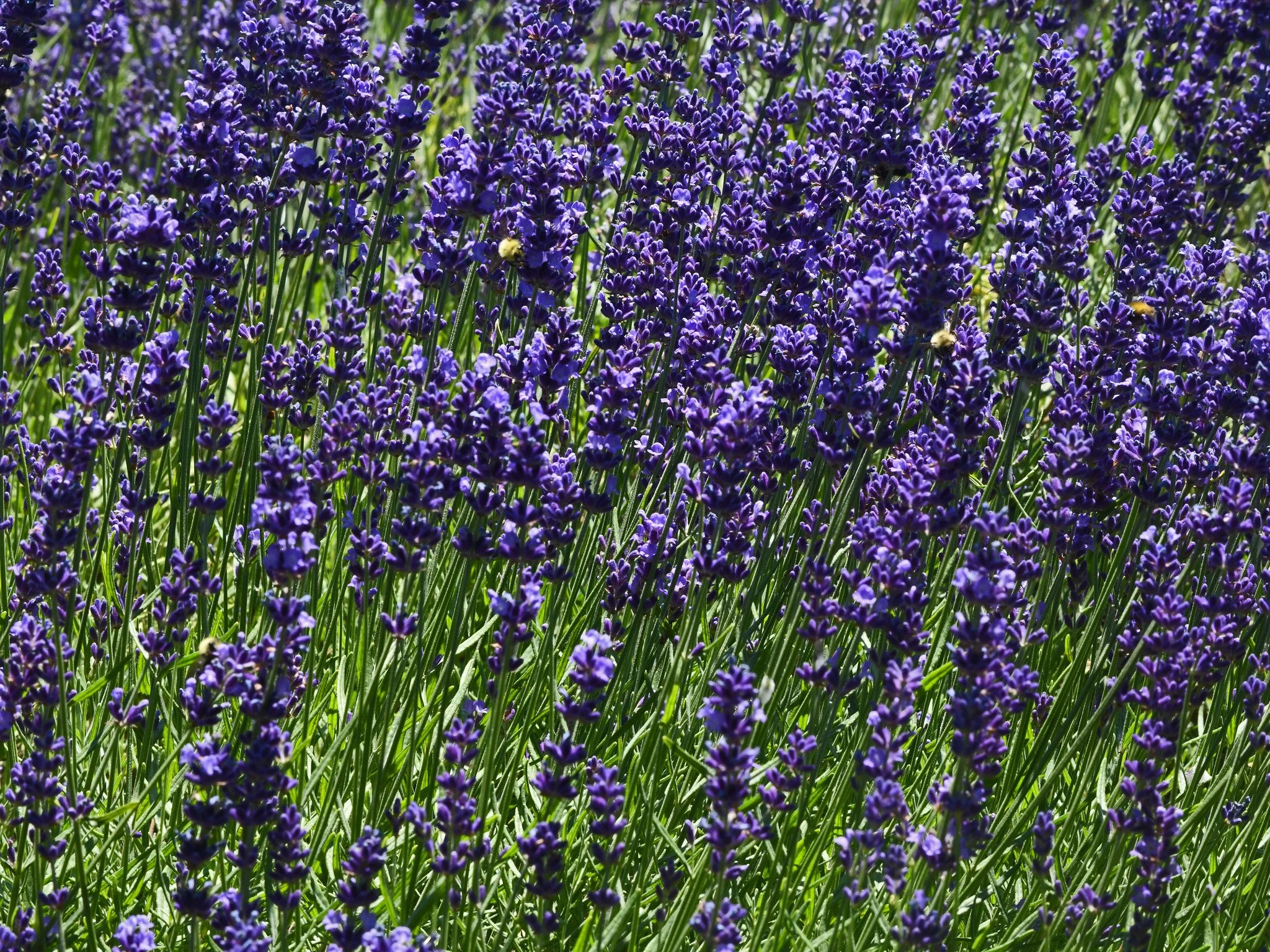
This has been a good year for our lavender, as you see. It has come up lush and full of nectar that has been attracting record numbers of pollinators. Curiously, this herb’s intriguing fragrances seem to repel mosquitoes, flies, and other annoying insects, as well as deer. (After a rain, it sometimes smells of berry-scented soap to me.)
On the other hand, lavender has been attracting humans for many centuries. Its rich history includes use in ancient Egyptian embalming, Greek and Roman bath scenting, and modern aromatherapy to promote relaxation and improve sleep. It’s native to the Mediterranean region, Middle East, and parts of India.
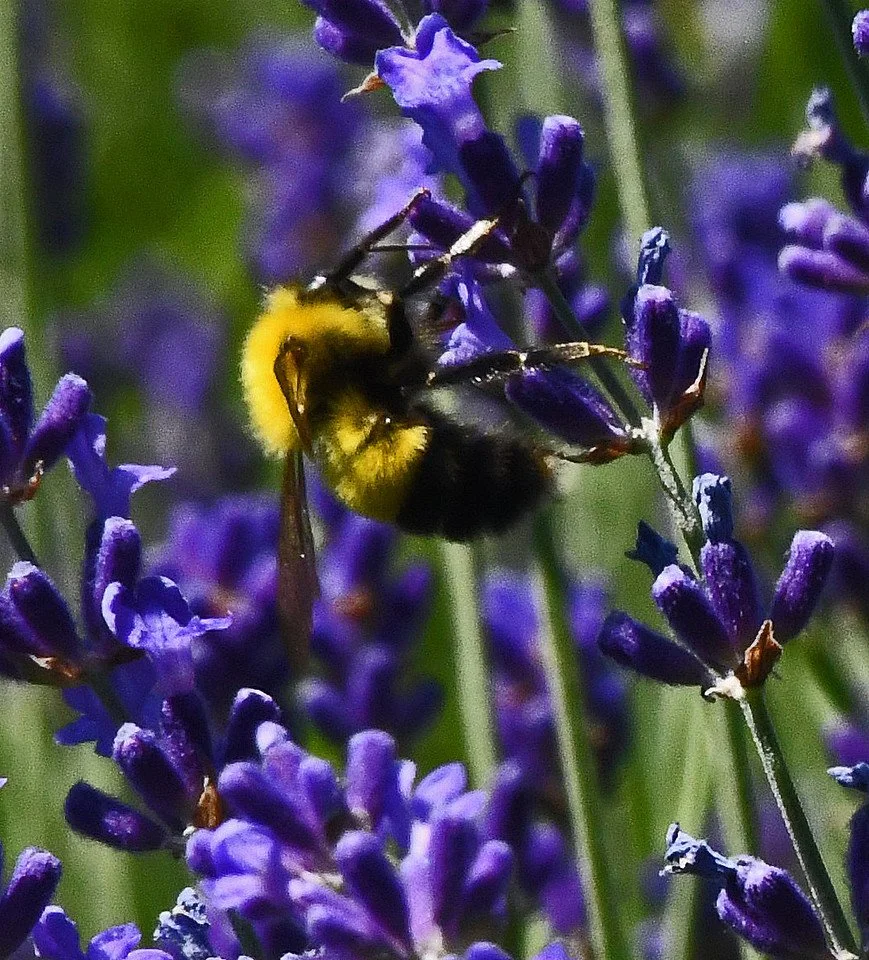
The name "lavender" comes from the Latin word "lavare," meaning "to wash," an apparent reference to its historical use in bathwater. It’s a member of the mint family and reports indicate that there are over 45 species of the plant and 450 varieties cultivated in various colors. (Images taken in Brooklin, Maine, on July 19, 2025.)
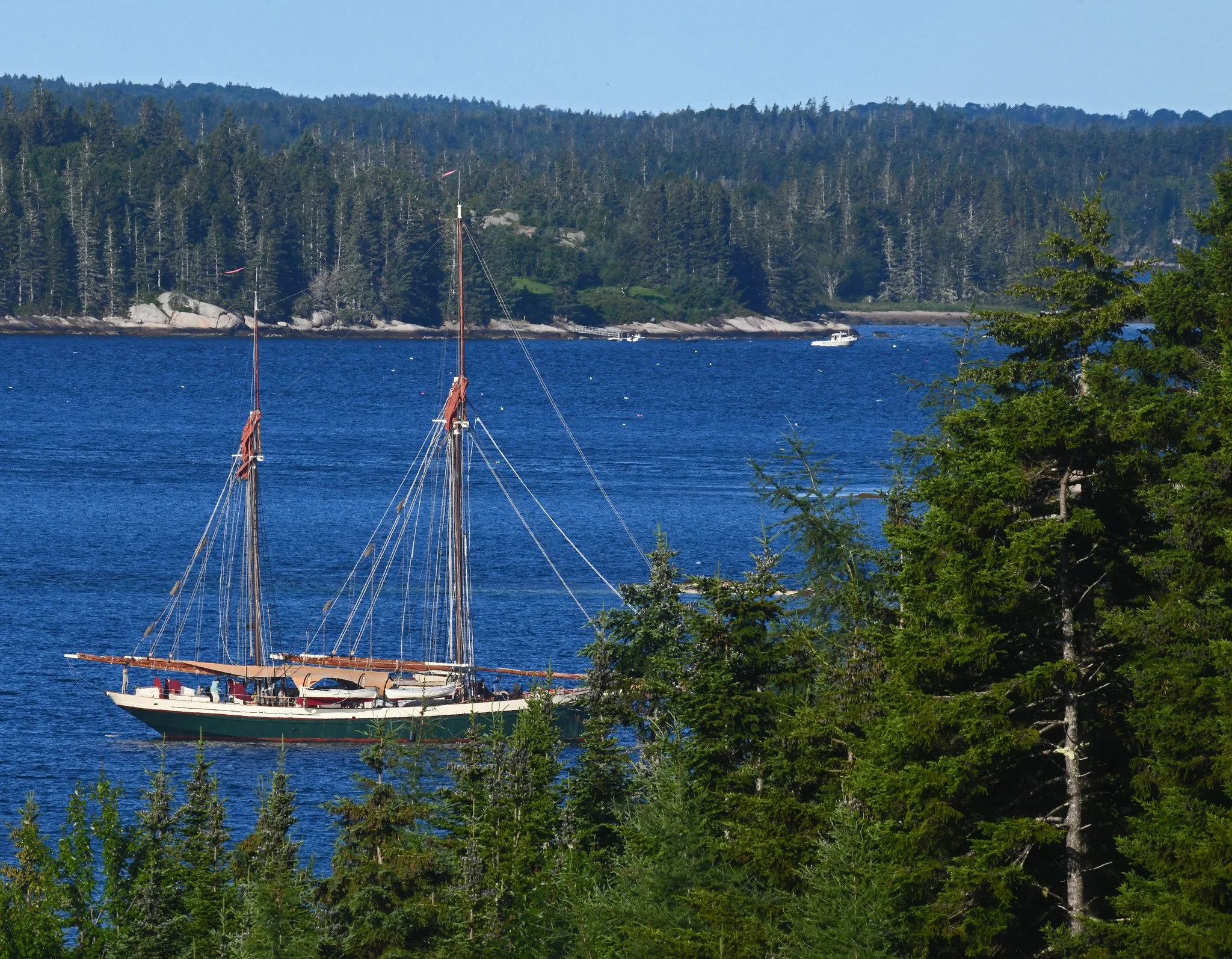
The gaff-rigged ketch “Angelique” was moored off of Little Babson Island in Great Cove when we awoke yesterday morning. She overnighted there and put her passengers ashore to tour the WoodenBoat School campus. Here you see her passengers returning from that tour yesterday.:
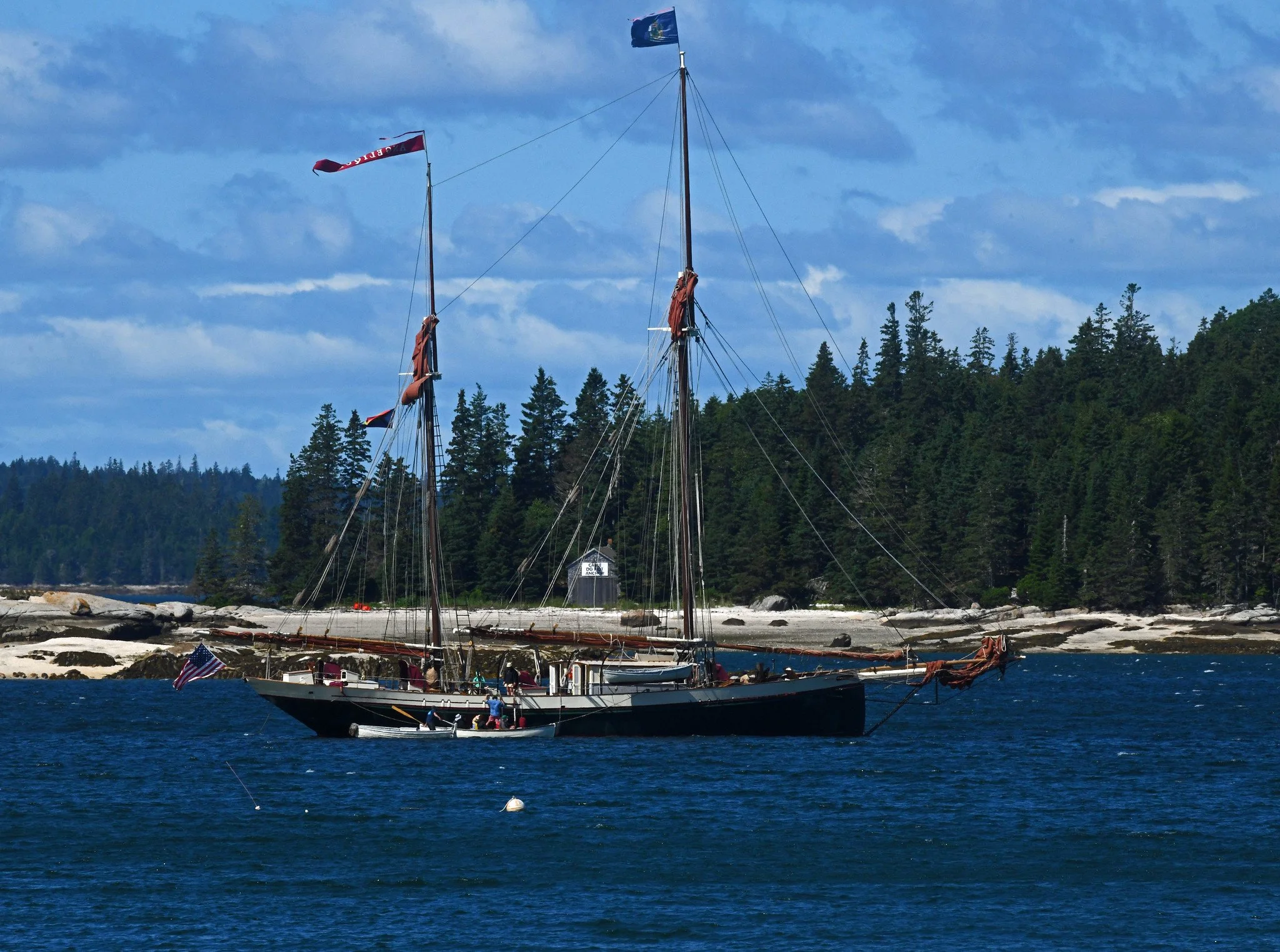
As you can see from the vessel’s flags, there were somewhat significant wind gusts then, perhaps 10-to-15-mile MPH, which apparently influenced her Captain to motor out of the Cove instead of raising the windjammer’s beautiful reddish tanbark-like sails. That was a disappointment.
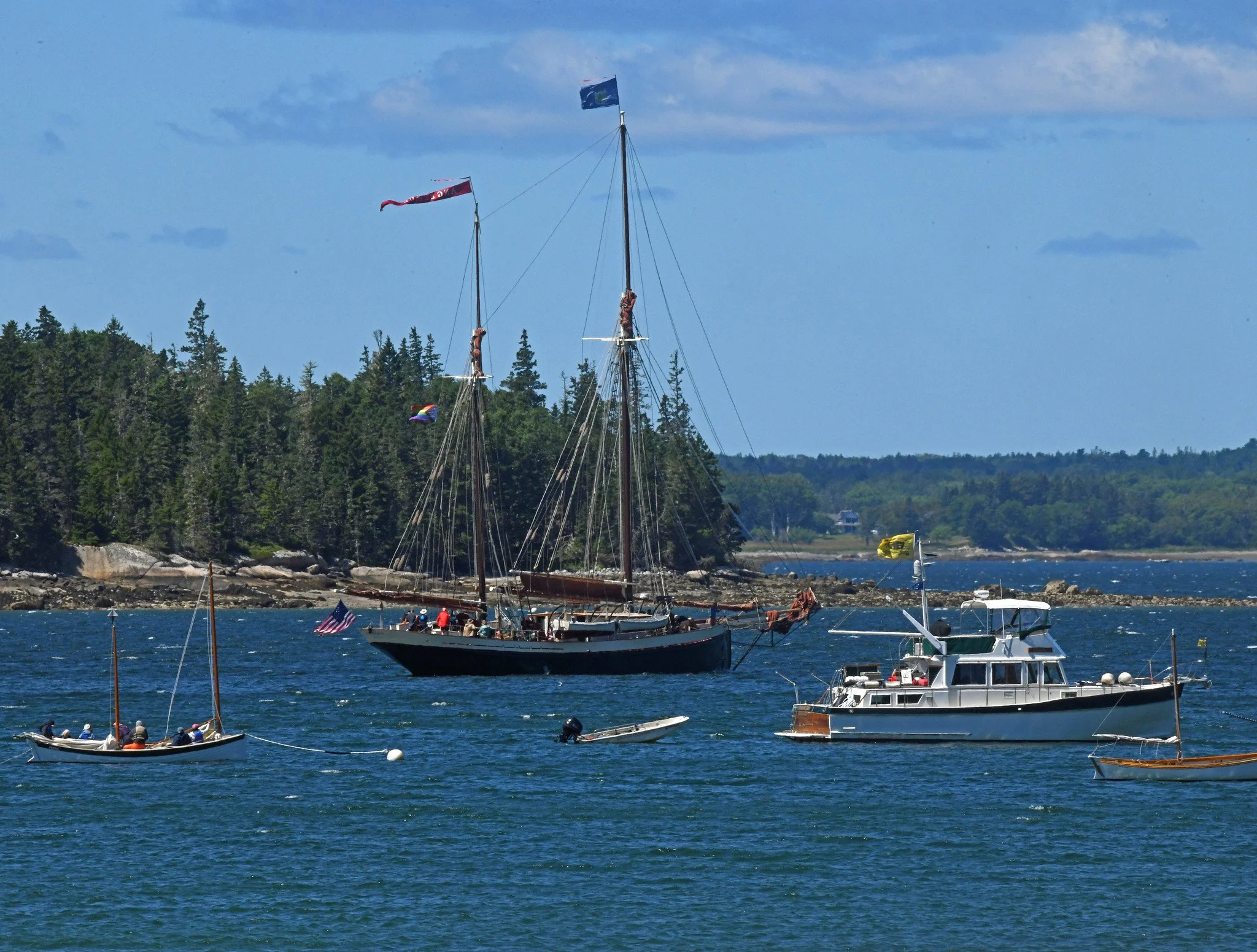
“Angelique” is one of the few vessels in the windjammer fleet that have inboard motors. She’s young by fleet standards, having been designed for tourist cruising and been launched in 1980. She hails from Camden, Maine, and was on a four-night tour of Down East lighthouses, according to her schedule. This was her third visit to the Cove this season.
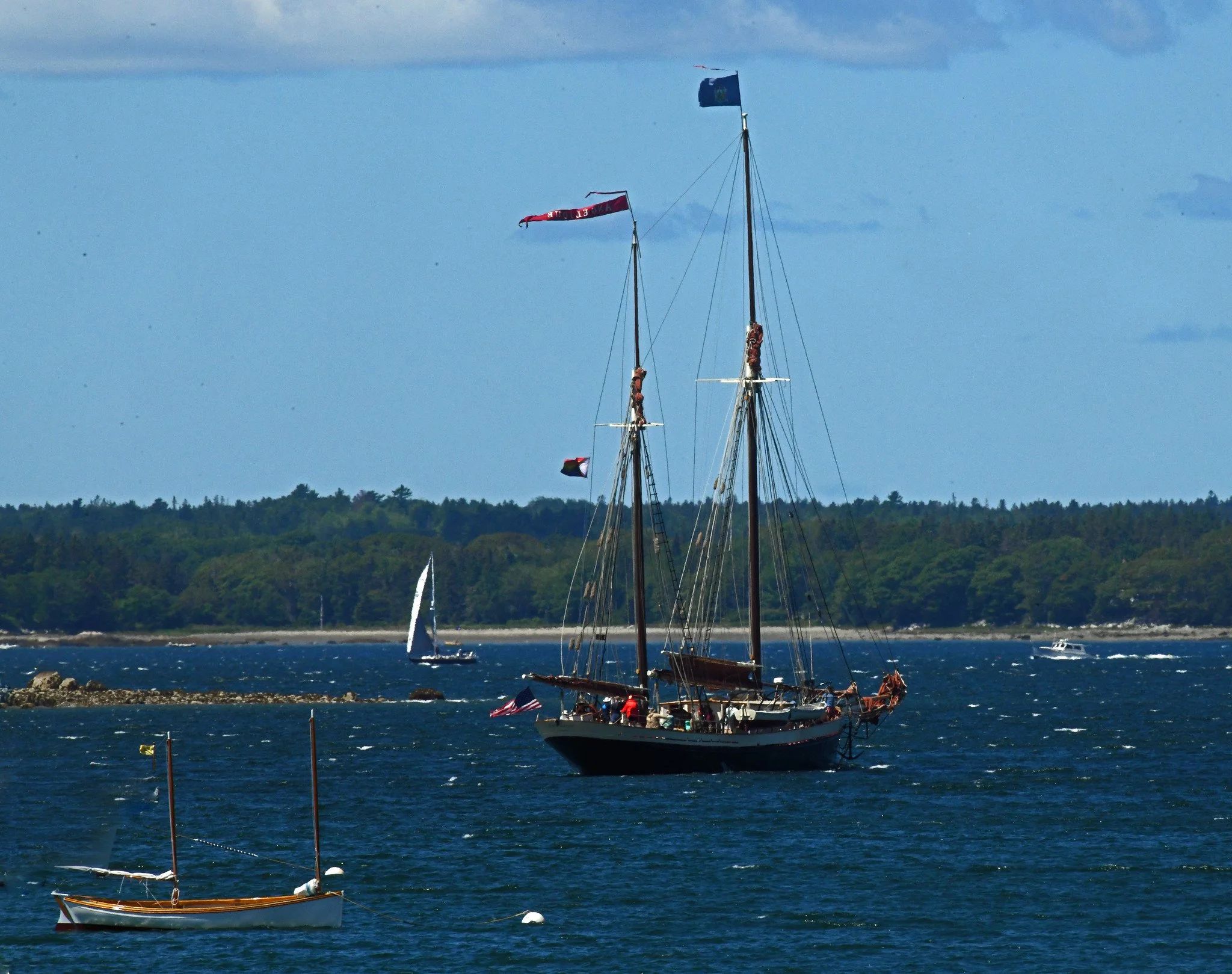
(Images taken in Brooklin, Maine, on July 18, 2025.)
You know it’s high summer when crowds of tawny daylilies line the streets and byways to wave hello at passersby.
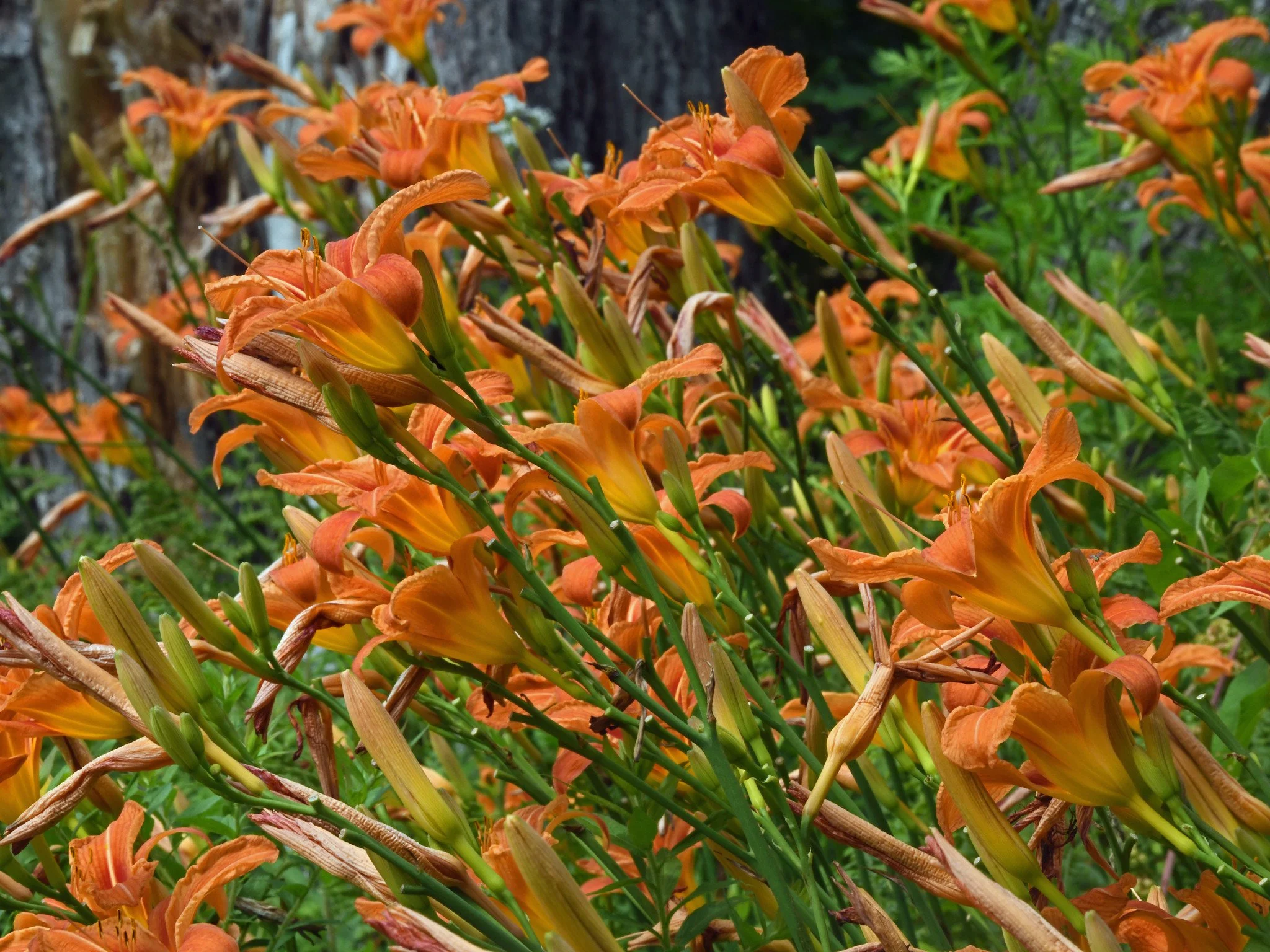
These lovely rabble, despite their name, are not true lilies, genetically speaking. But who cares? They get their name from the fact that each flower usually lasts for only one day and looks lily-like. Fortunately, each plant has many buds, which usually insures a long-lasting greeting.
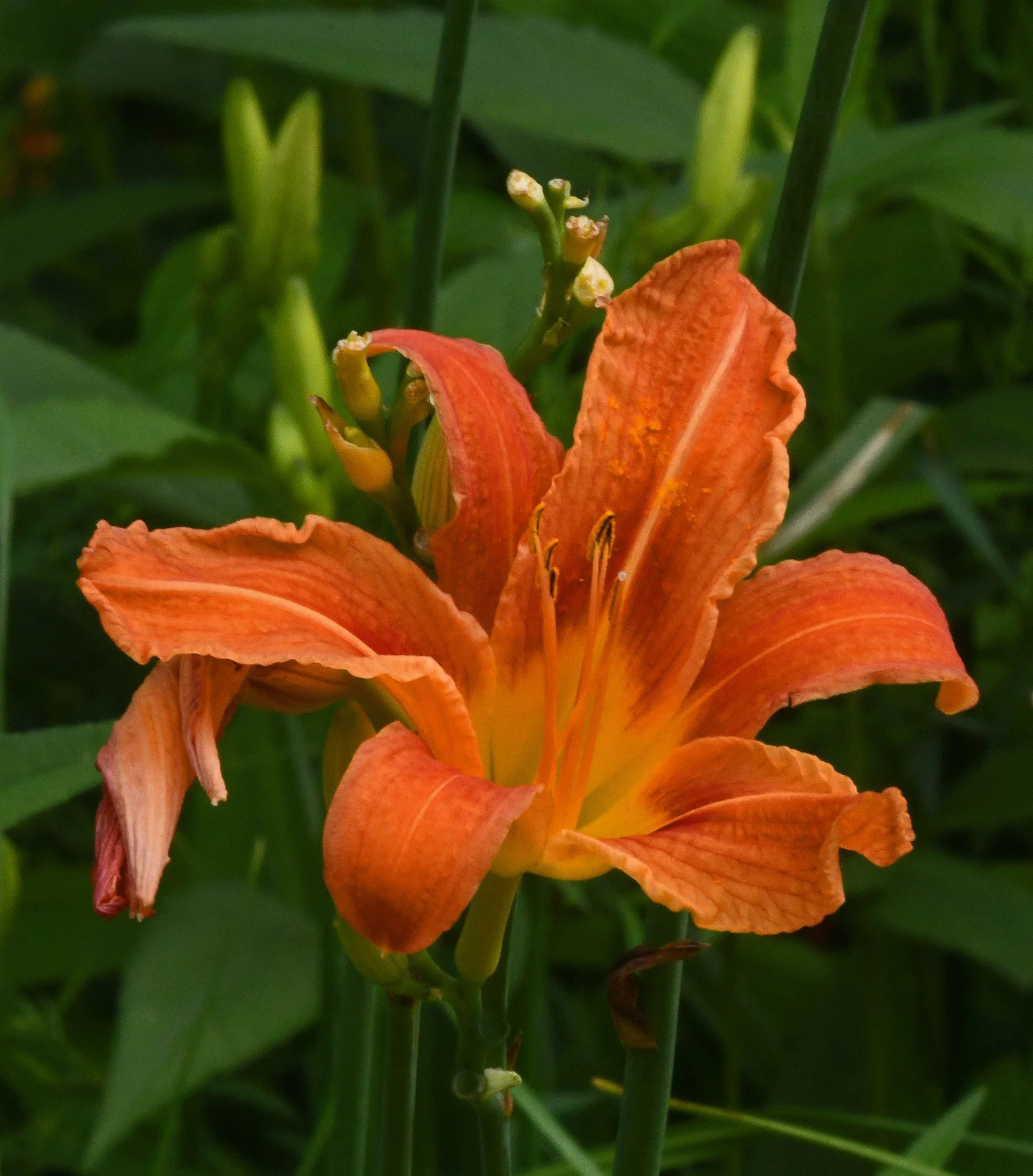
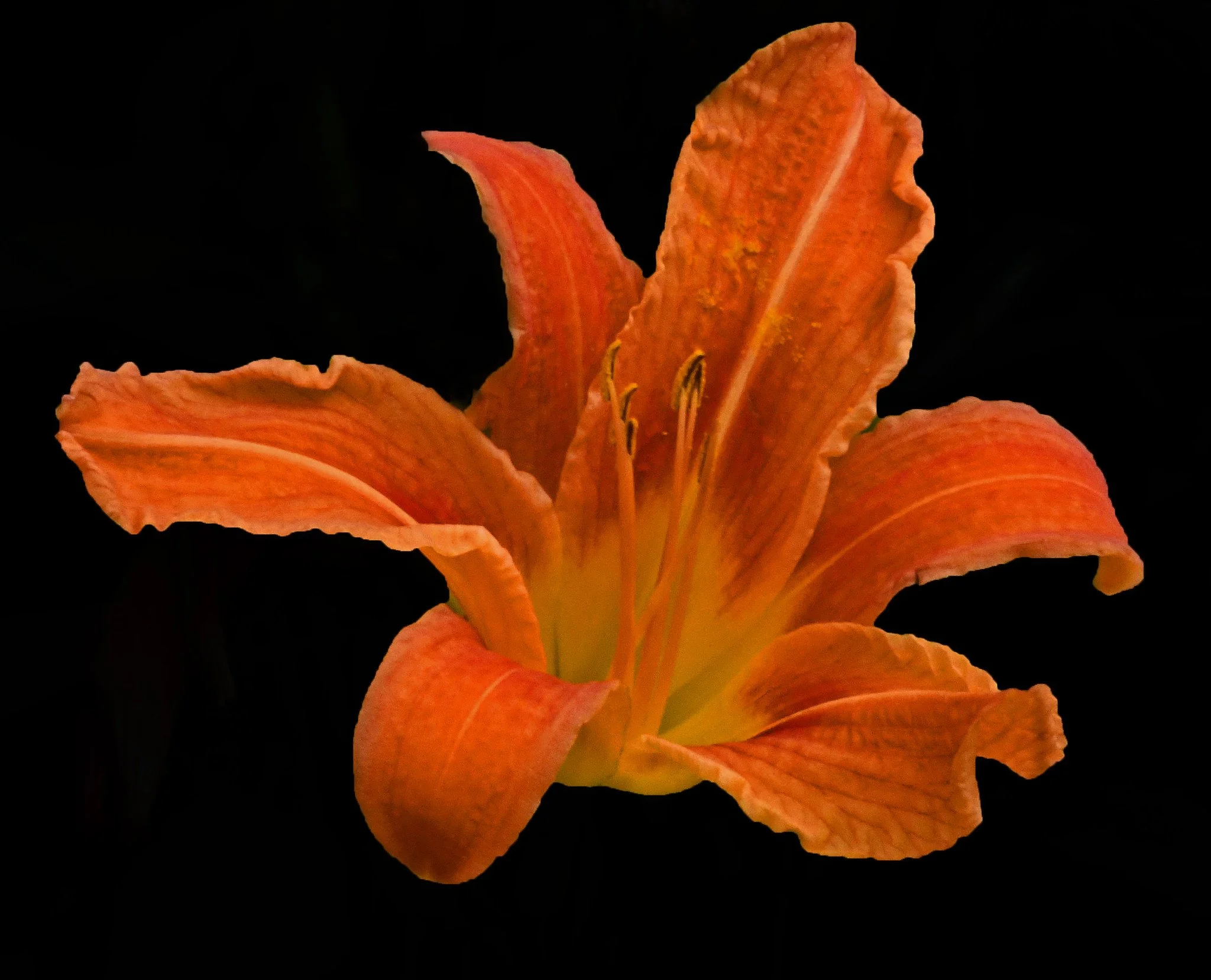
They’ll thrive almost everywhere and are bright spots in drought and on land needing erosion control. (In days of yore, they sometimes were called what amounted to “outhouse lilies,” with the word “outhouse” pronounced “sh__house.”) Nonetheless, they’re welcome here.
(Images taken in Brooklin, Maine, on July 14, 2025.)
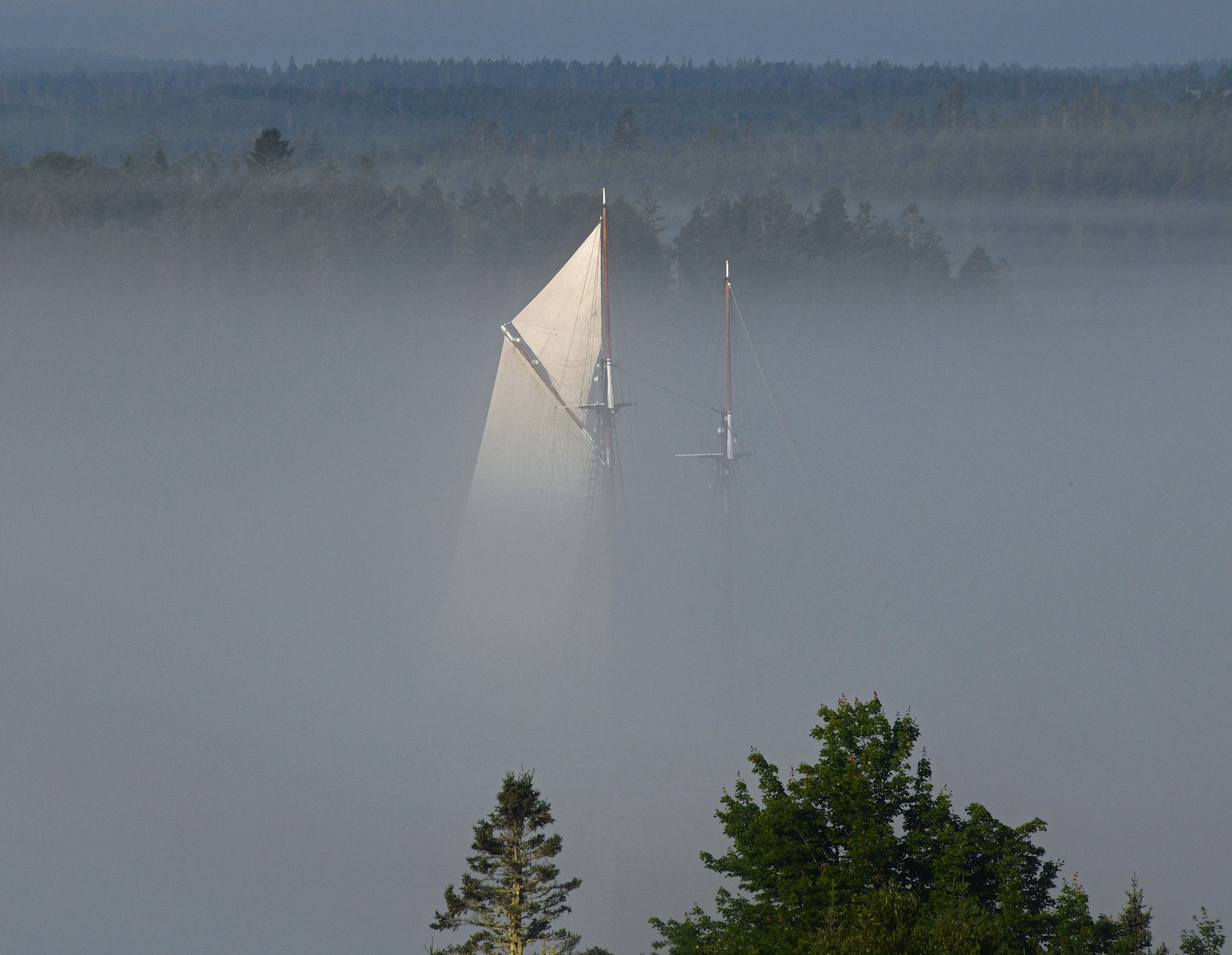
It’s foggy as I write and it’s been foggy every other early morning this week. This gives us all a chance to play that popular game known as “Name That Windjammer!” For example, can you name this windjammer that was in Great Cove yesterday morning just by looking at what the fog has let us see of her:

Here are some of the hints that are exposed: she’s large; she’s got two masts and they’re schooner-configured; her Captain keeps her mainsail up as a stay sail overnight; she flies a topsail, and her sails are white (which eliminates “Angelique”).
If you guessed the 145-foot Heritage out of Rockland, Maine, you would have been correct. As the fog lifted, her unique yellow hull with red, white and blue bands were revealed:
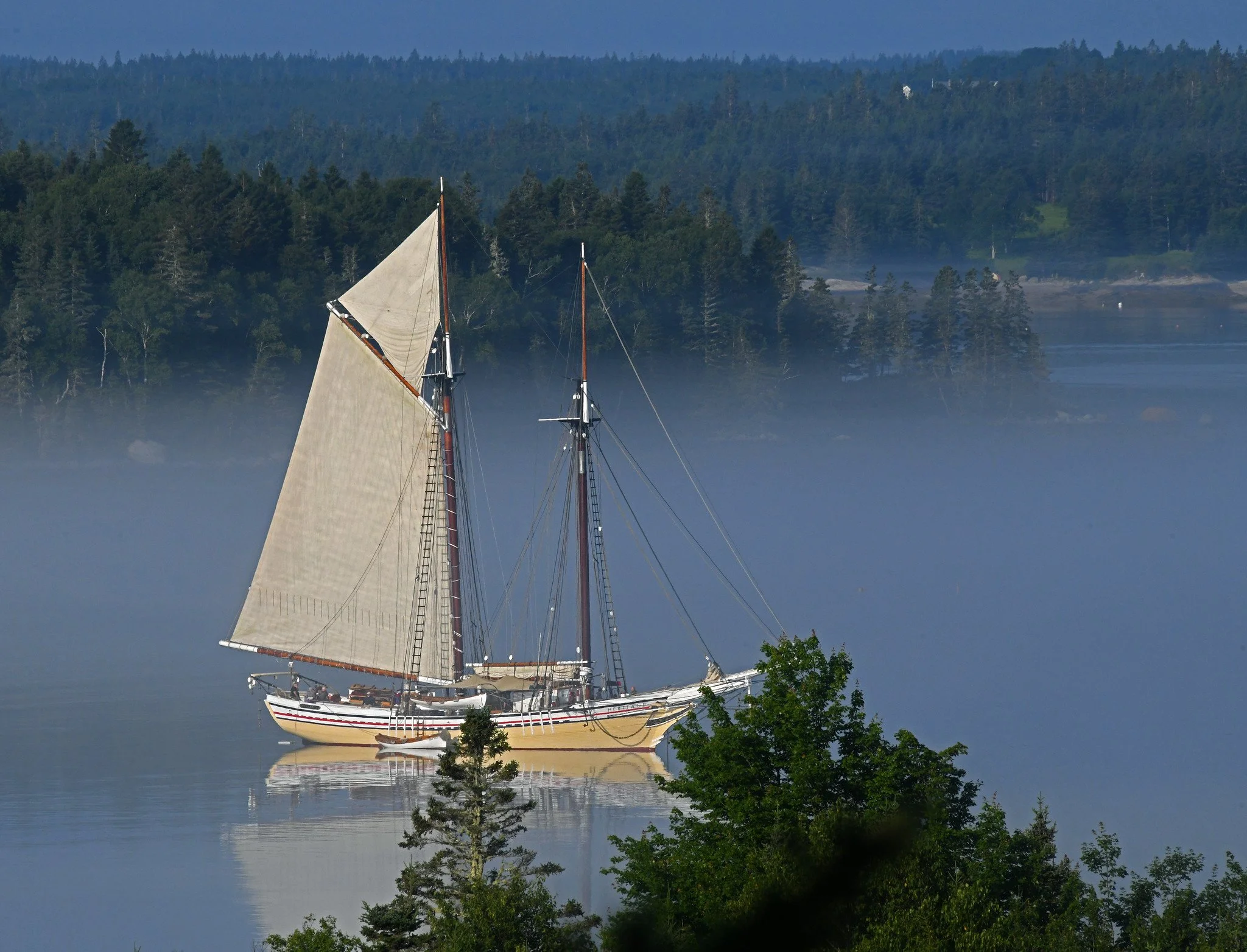
This is her third visit to the Cove this cruising season. She’s on a six-night “Full Moon” cruise, according to her sailing schedule. (Images taken in Brooklin, Maine, on June 16, 2025.)

Our red bee balm river is cresting in scented waves and it has attracted the first monarch butterfly that we’ve seen this year. I haven’t seen any monarchs or monarch eggs on milkweed yet, but now I have some confidence that they will come like late baseball players.
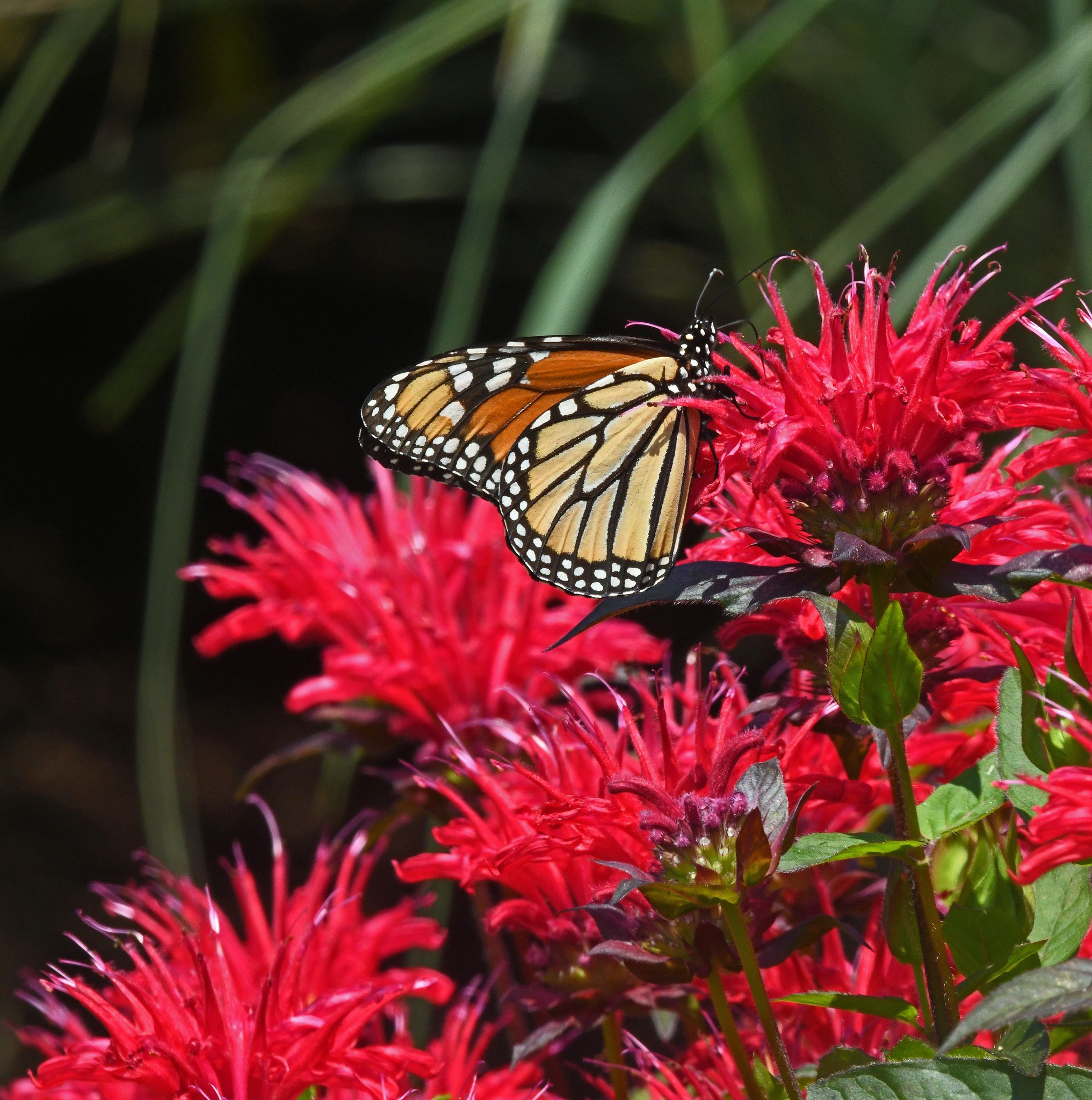
Bee balm, also called monarda, is a native North American plant. It looks good, smells good, attracts all sorts of pollinaters (including hummingbirds) and is generally deer-resistant.
The plant is part of the mint family and many people consume its flowers and leaves as salads and garnishes or in tea. After the Boston Tea Party, many rebelling colonists switched to “Oswego Tea” made of bee balm by Native Americans to avoid the imported and taxed British tea.
(Images taken in Brooklin, Maine, on July 15, 2025.)

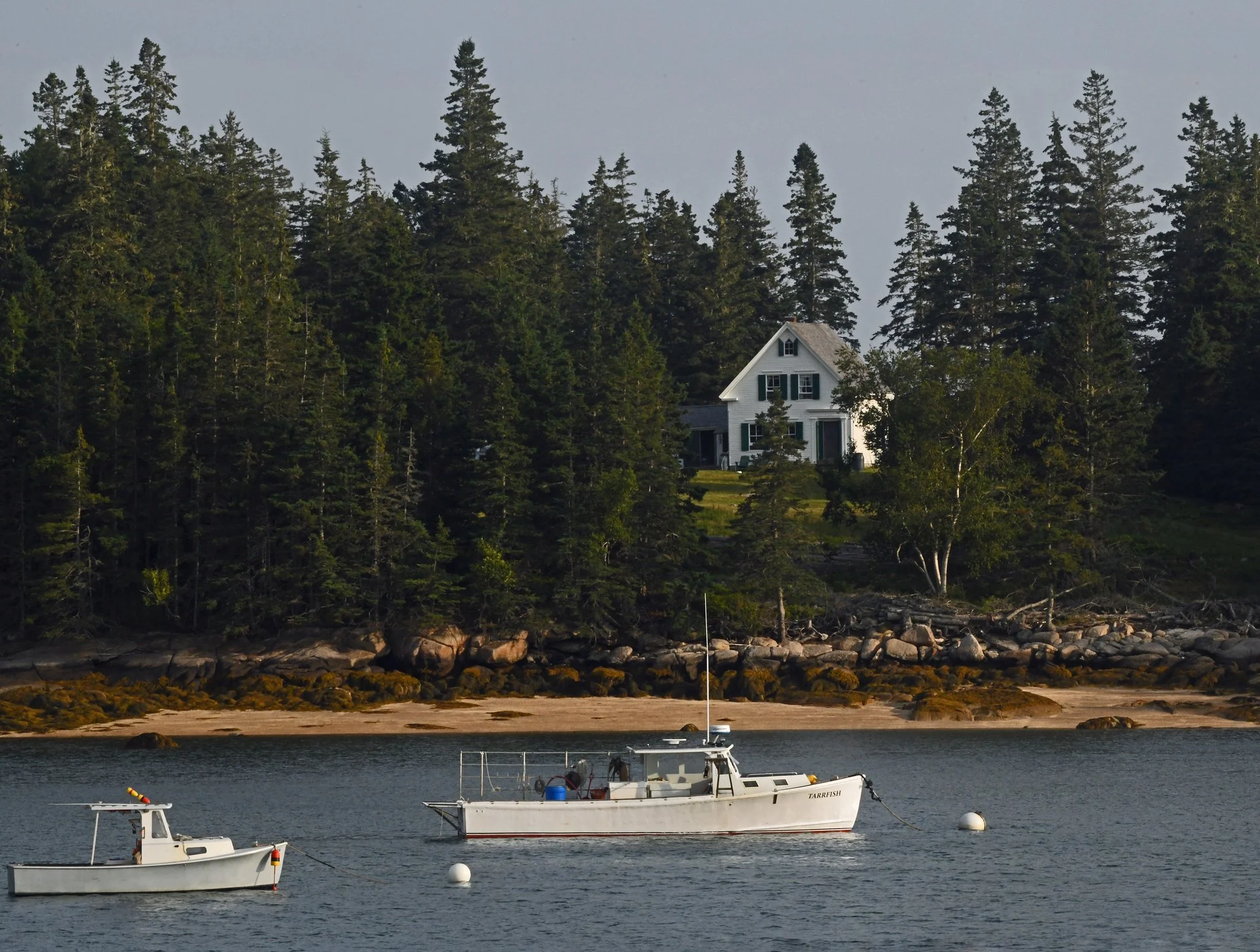
Above, you see David Tarr’s Fishing Vessel “Tarrfish,” all cleaned up from the scalloping season and waiting at the Naskeag Harbor docking float for David to bring a load of lobster traps down to the Harbor. He soon came down with a trailer load of traps and took them to the adjacent beach on Naskeag Point.


“Tarrfish” soon came around and was beached beside the trailer. The traps were then handed up to David and his daughter on the boat. When all of the traps were stored on board, “Tarrfish” pulled back and returned to the docking float, probably waiting for another load.


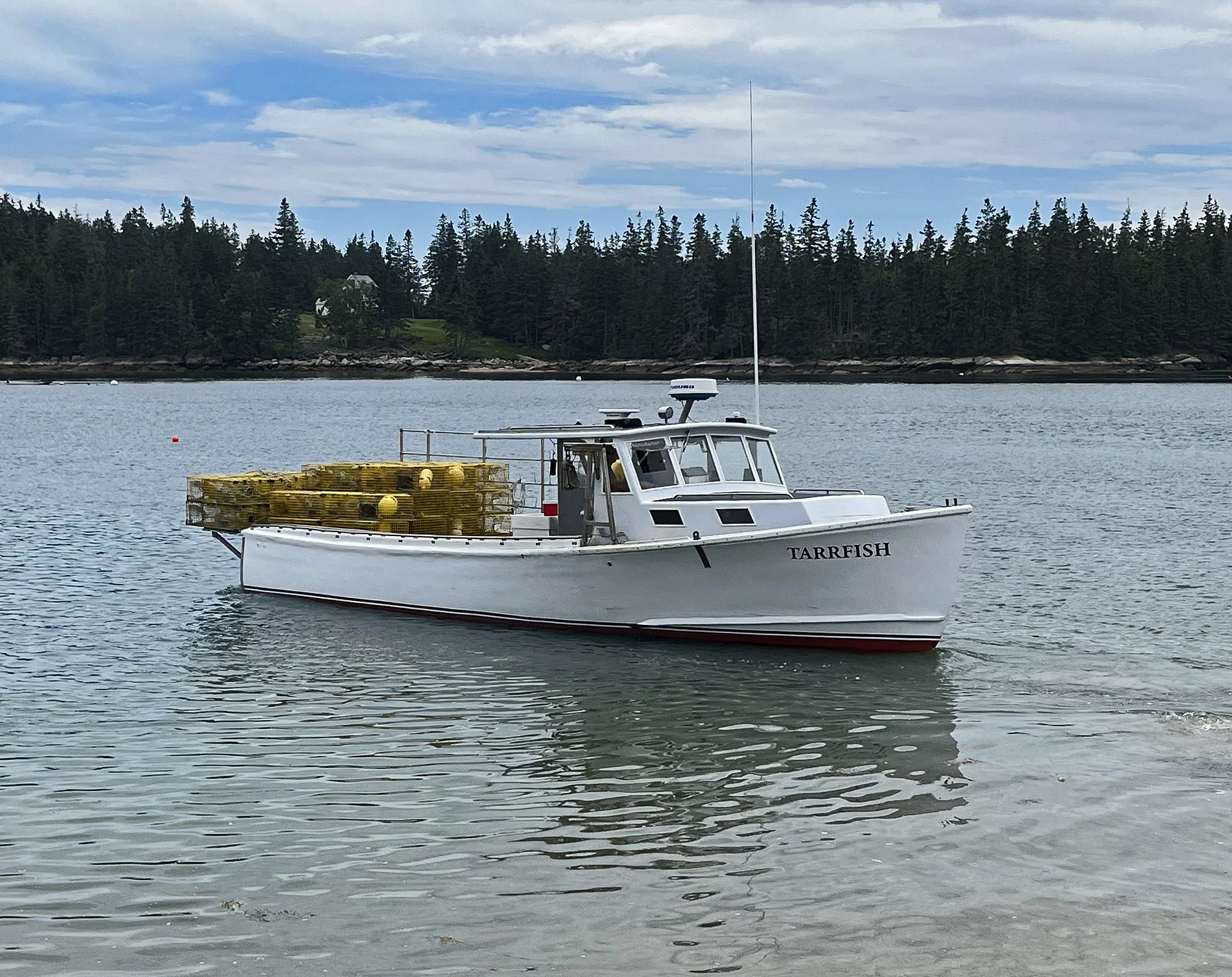
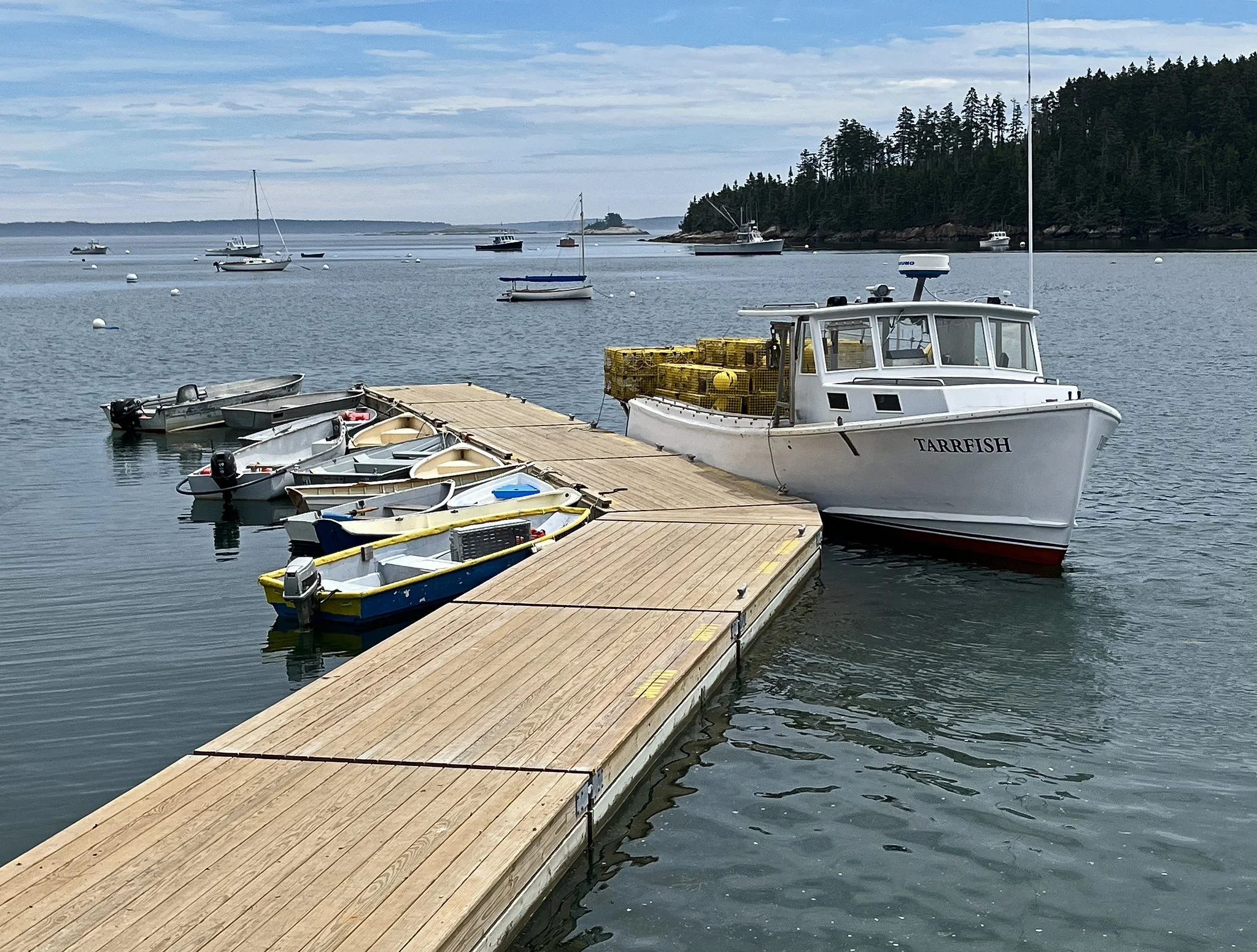
The traps will be taken out into local sea waters, baited and set, and submerged in trap lines to capture the tasty little critters that are on the move now. (Images taken in Brooklin, Maine, on July 9, 2025.)

Barbara and I went to Bar Harbor’s Criterion Theatre Saturday night to catch David Sedaris’s performance and see how the historic Art Deco Theatre’s restoration was going. (There also was the calamari and wine at Testa’s around the corner, but I digress.) Short report: Both David’s sardonic raconteuring and the Theatre’s historic facelifting were deserving of a standing ovation. It’s great to have that live performance venue nearby.
By the way, for Jimmy (“Margaritaville”) Buffet fans who have studied the accompanying image of the entrance to the Criterion: That’s not a typo on the marquee, “Jammy Buffet” is the name of an unrelated tribute band that played at the Theatre yesterday night.
The Theatre was opened in 1932 by a well-off resident who had served a jail term for bootlegging. Its smartly-decorated premises reportedly included a then-modern floating balcony, a state-of-the-art “Inter-Phone” system, and a basement “speakeasy.” It apparently is one of only two extant Art Deco theaters in Maine.


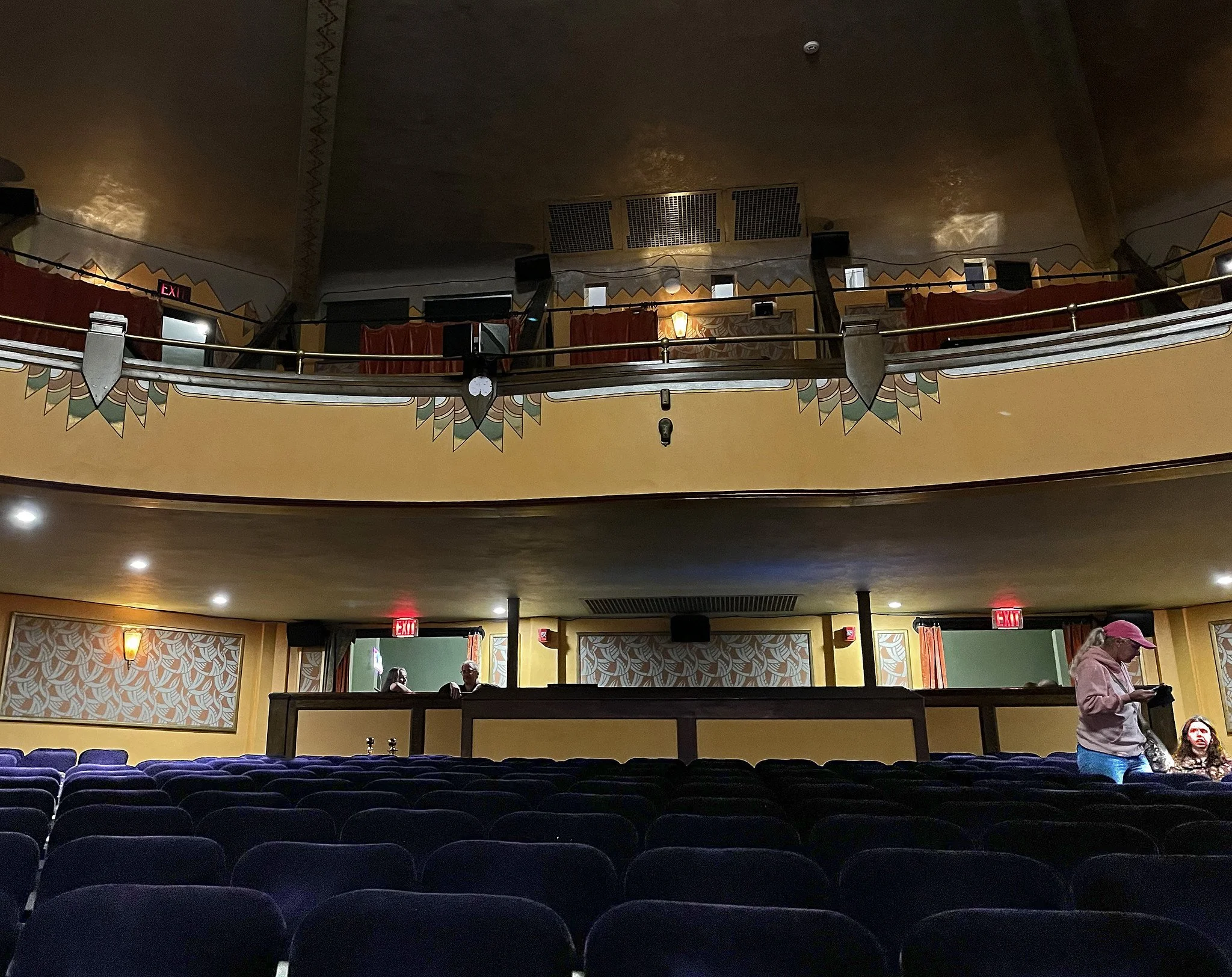
The Criterion’s restoration is a courageous undertaking and still a work in progress, as well as a learning process. (Saturday’s sound and lights had to be corrected early in David’s talk.) And, of course, David was courageously hilarious in his unique takes on life and his ridiculous dress – he wore a white imprinted sport coat and bright red, knee-length “balloon pants.”


(Images taken in Bar Harbor, Maine, on July 12, 2025.)