
This is a female ruby-throated hummingbird about to feed on bee balm. These females are “ruby-throated” only because their species name says that they are; only the males wear those spectacular iridescent red and purple necklaces called “gorgets.”
Here in Down East Maine, the males impregnate the females and usually start their migration back south in July, leaving the females to build nests and raise the progeny as single parents. That means that these mothers need plenty of energizing nectar.
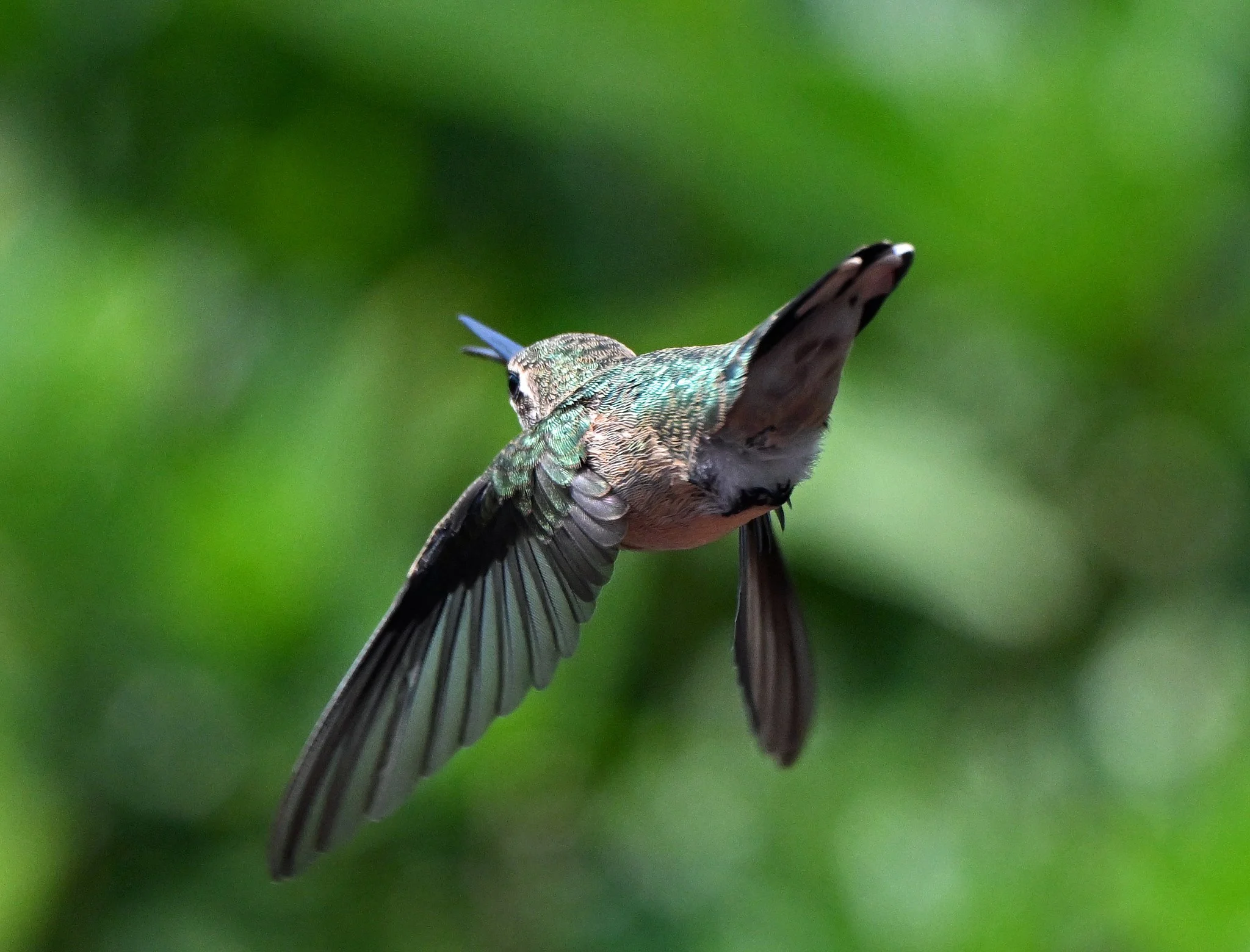
Ruby-throats are among wildlife’s best fliers. They reportedly beat their wings between 50 and 80 times per second depending on activity – too fast for the human eye to see more than a blur. They can fly forward, backward and even upside down, and can reach forward speeds of up to 60 mph during courtship dives, according to researchers.
Most adult ruby-throats weigh about three grams and are about three inches long overall, but their bodies (not counting long beak and stubby tail) are only about 1.5 to 2.0 inches long, according to taxonomist measurements.

Stated another way, these birds have the weight of a ping-pong ball and the body length of a roasted peanut pod. Yet, on their migrations from and to Central America and southern Mexico, they can fly nonstop 500 or so miles across the Gulf of Mexico.
(Images taken in Brooklin, Maine, on July19, 2026.)