Outdoor photography is in significant part about luck, good and bad, at least for me. The more you try, the more luck you have, good and bad. You can learn from both.
For example, hurrying home late for lunch recently, I noticed a red flashing in the bushes. I focused a long lens on it and discovered this male Northern Cardinal. I instinctively took this quick, somewhat unusual shot of the handsome guy. I was lucky, good lucky.
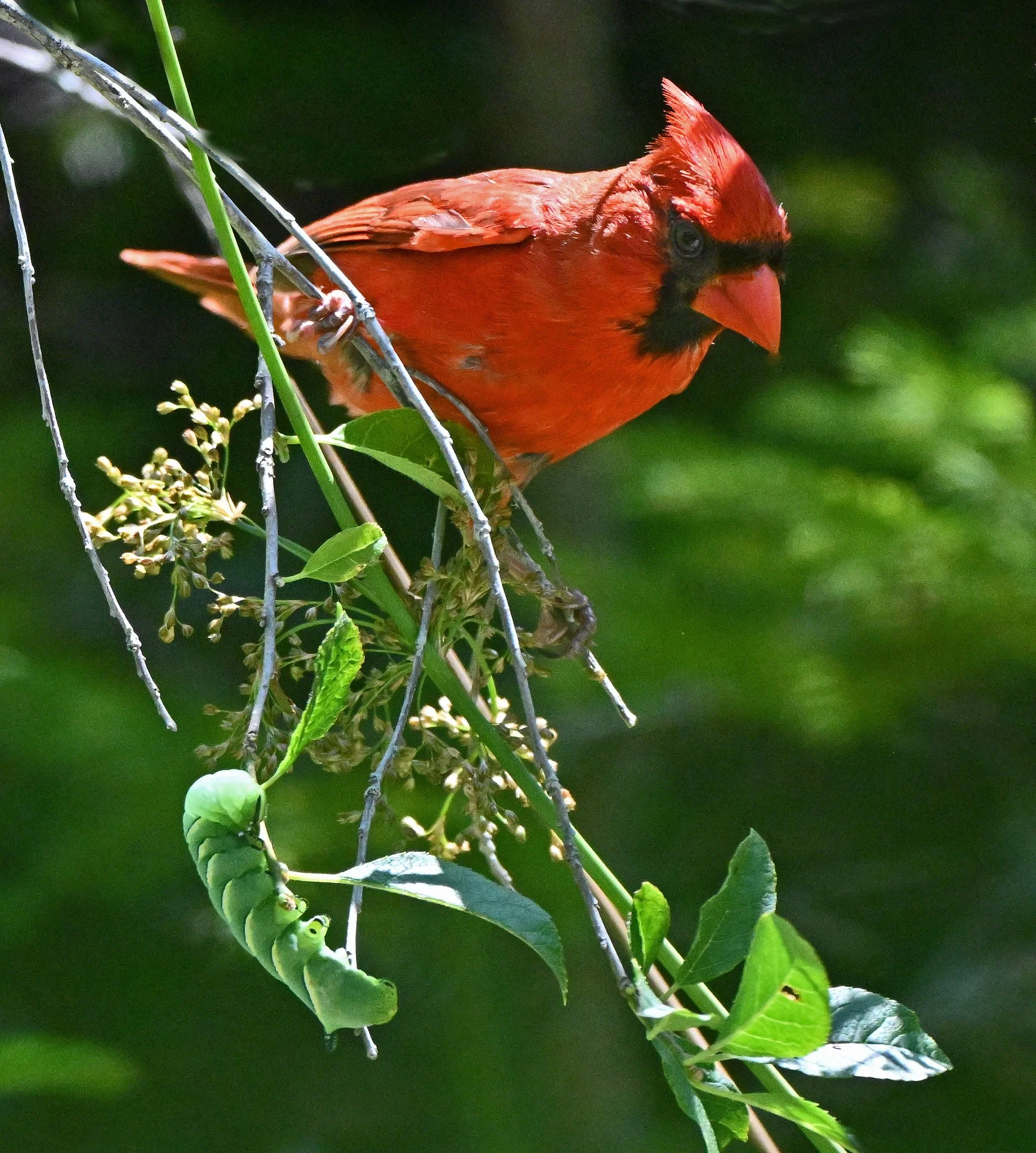
A second after shooting, as I was re-slinging the camera, he pounced on something in a great flurry and flew back into the dark woods. I missed that shot due to bad luck compounded by the sin of impatience. I should have stayed focused on him to see what he was up to.
When I was cropping his image, I noticed for the first time what appears to be a well-camouflaged hornworm caterpillar that the cardinal apparently was about to prey upon in the fast swirl of action that I failed to capture. It would have been a dramatic and satisfying photo. (Satisfying because I’m not a fan of hornworms.)
Hornworm caterpillars are garden pests that turn into sphinx or hawk moths. They especially love to munch on tomato, eggplant and pepper plants. Many birds eat these caterpillars, including mockingbirds, wrens, bluebirds, robins and, of course, cardinals.
Gardeners often pick hornworms off plants and place them on feeders for wild birds; I hear that some gardeners who keep chickens hand-feed the caterpillars to their fowls as squishy treats. (Image taken in Brooklin, Maine, on July 26, 2026.)