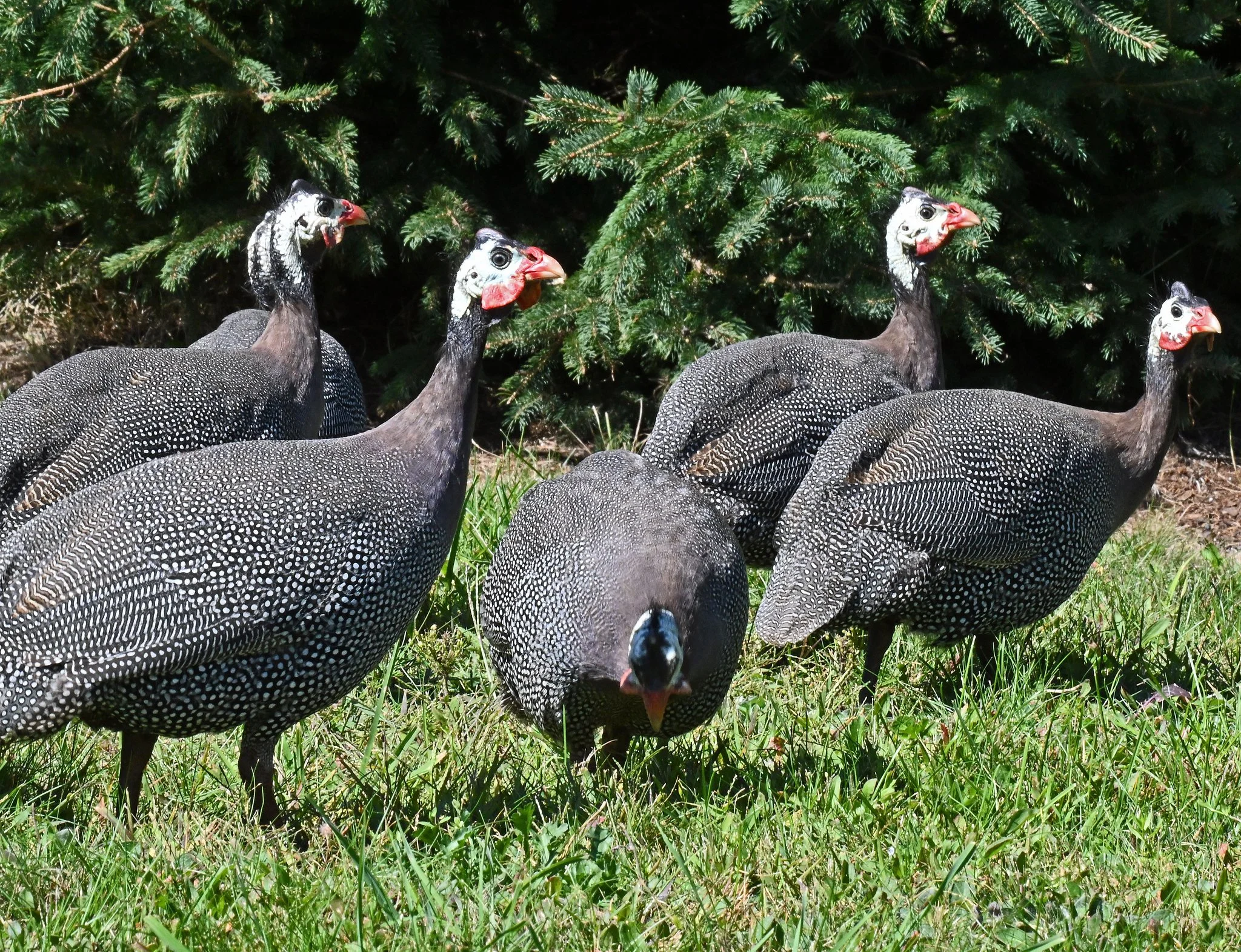
Barbara and I watched a real-life cartoon in yesterday’s rain. It involved this “confusion,” which is the name for a group of helmeted guinea fowls. These birds are like wild turkeys; they prefer to walk everywhere rather than fly (which they can do well). The fowl belong to a neighbor, and they frequently roam the local roads and our property under an apparently expansive interpretation of being “free range.” This image was taken last week when they were together.
The other character in the cartoon was “Wile E.,” the name we’ve given to an alpha eastern coyote who believes he owns our property (and maybe does in some sense). We hardly ever see him and, when we do, it’s usually a ghostly glimpse at dusk. On the over hand, we hear him often at night celebrating a kill or calling his pack. But yesterday he was stalking the roadrunners in the daylight, albeit in rain on a dark day.
The birds caught sight of him, ran up close to the house, and then flew up into our nearby maple trees. Wile E. came into the garden area, but wouldn’t get as close to the house as the birds did. (He’s as cautious as he is wily.) He then saw me on the deck. (Yes, in the rain; I’m crazy.) He spun around and loped off into our north meadow, occasionally looking back to give me the evil eye.
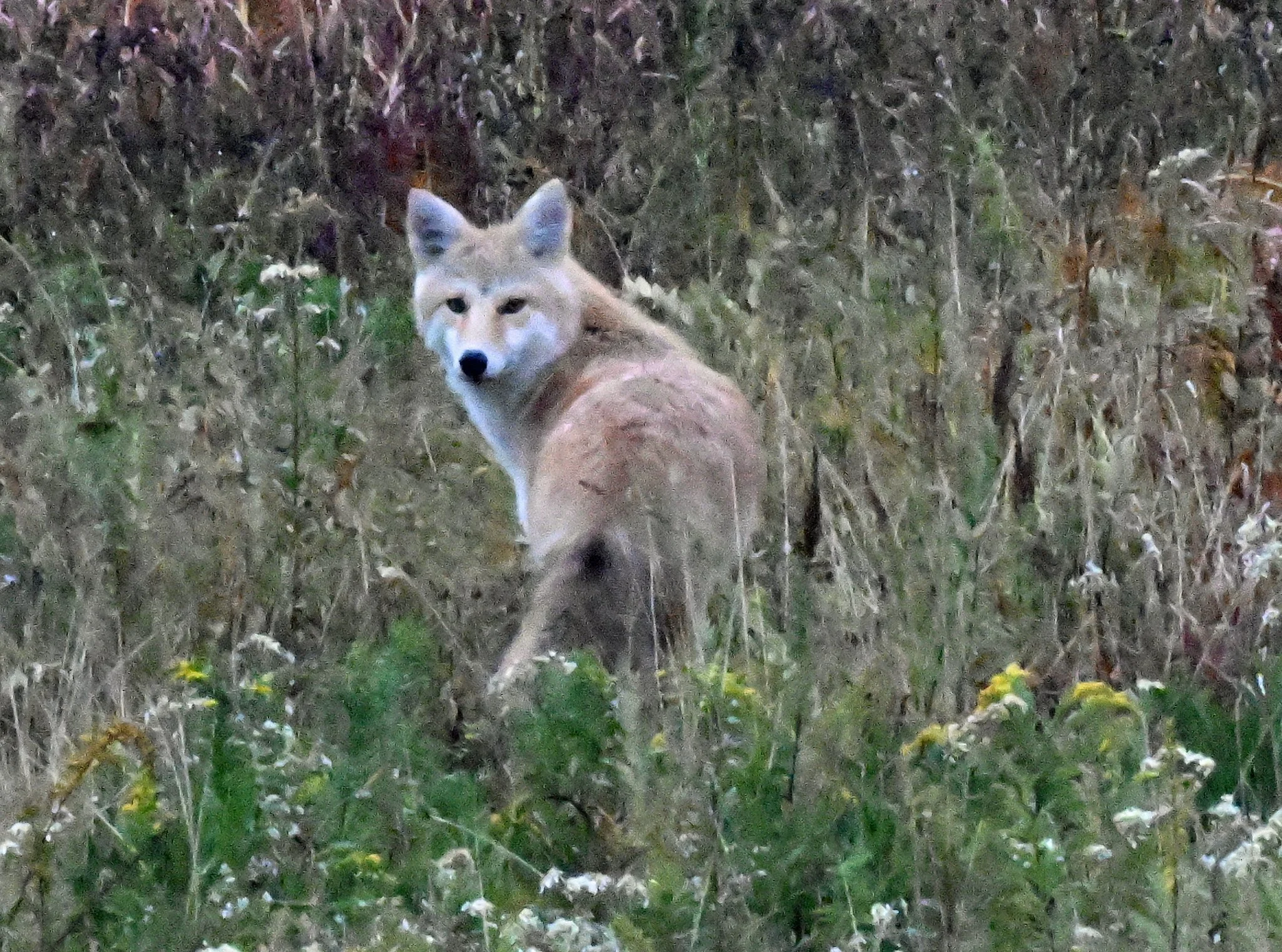
The roadrunners won the confrontation again. But Wile E. knows that they come into his territory and there likely will be a chase in the future that won’t be funny for them. But there always are fun facts.
Guinea fowl are native to Africa, but they often are kept on American farms for their eggs, meat, extraordinarily active tick and small insect foraging and/or their habit of acting like guard dogs and squawking loudly when a stranger comes near.
Eastern coyotes often are called “coywolves” because they’re hybrids containing 25-30% wolf DNA. They’re heavier and broader than western coyotes, with wider jaws, larger skulls, and longer legs that make it easier to hunt in deep snow.
(Images taken in Brooklin Maine on September 24 and 28. 2026.)