
Today is gray, the snow has melted, and the tree spirits are doing a dance that Native American ancestors would understand.
(Brooklin, Maine)
JOURNAL
Today is gray, the snow has melted, and the tree spirits are doing a dance that Native American ancestors would understand.

(Brooklin, Maine)
Before reading further, you should know two things. First, if you’re not interested in scallop fishing equipment, stop reading this esoteric and overly-long post now. Second, I’m far from being an expert on that subject, but I keep getting questions about it and we have here an opportunity to try to identify a few things.

Above, is the fishing vessel (“F/V”) Tarr Baby, which is owned by neighbor David Tarr. She’s now “trawler” rigged with metal “mast” and “boom” (aka “outrigger”) and “winched” for “dredge” scalloping.

The dredge is a steel-framed, chain mesh “net” that has a twine top for unloading; it’s dragged along the sea bottom. (See below.)

As you can see in the first image, Tarr Baby also has a drop-down diving/boarding platform on the stern that David can use when he’s hand-harvesting “divers scallops” in SCUBA gear. Just above that platform is a stack of perforated plastic “fish baskets” (mostly orange) in which the harvested scallops can be collected before their muscles (what we eat) are shucked out and possibly for temporary onboard storage of those shucked muscles.
Behind the baskets in the first image is a metal “trap rack,” which can be used to secure stacks of lobster traps when Tarr Baby is transporting them at the beginning and end of her lobstering season. Here's an image of her during the early summer with stacked traps that soon will be taken out to sea and submerged:

(Brooklin, Maine) If I made any mistakes, I welcome corrections.
In the Right Place: Super
We, of course, prefer real Maine fish-hunting Eagles, such as this one, to the faux Philadelphia footballing variety that will be flapping this evening.

In fact, we’d go so far as to say that we would have no objection to those Philly birds being shot down tonight. Even with a Tommygun. Our neighbor Judith Fuller apparently has similar feelings; that’s her Naskeag Road banner below.

Go Pats! (Brooklin, Maine)
Yesterday, Punxsutawney Phil predicted a long winter. We don’t have our own Town Rodent to confirm this for Brooklin, but we don’t need one: we always have a long winter. Whether that’s bad depends on your attitude. For example, it snowed a pretty snow here most of Thursday and yesterday morning, then turned beautifully sunny yesterday afternoon and today.

Yesterday morning, while annoying for some, was beautiful for others: Mostly fine snow arrived in rippling white veils; toward noon, the sun tried to break the snow’s will with piercing beams of soft light that silverized the landscape. As the snow valiantly fought a losing battle with the sun, the tide came home strong and very high. The image above is of the steadfast Town Dock during all that. Below, we see several feet of water submerging the nearby beach and rocks as it snowed.

(Brooklin, Maine)
If you see a piece of bark tumbling from a tree trunk and then defying gravity just before it hits the ground, you’ve probably found a Brown Creeper. This is an all-season bird here that’s about five inches of good camouflage. It’s difficult to spot and best observed at an angle, as shown below.

The Brown Creeper is a cruelly-named little bird that doesn’t creep. It quickly spirals up a furrowed tree trunk by hopping spritely with both long-nailed feet together. It uses its curved bill to pry insects and larvae out of crevices.

When it gets near the tree’s top, it flutters to the base of another (or the same) tree and repeats its spiraling, barberpole search. (Brooklin, Maine)
It was sunny yesterday and we spotted a Bull Moose heading north near Naskeag Road. Shot it:

As we speak, our first February snowfall is happening:

(Brooklin, Maine)

Historically, January is our coldest, snowiest month and the one in which the sunsets and their afterglows are the most dramatic. This January was among the best that we’ve had and, thus, a good beginning toward fulfilling neighbor Judith Fuller’s colorful roadside banner wish for us, to the left.
January had three very good snowstorms and some of the best sunsets that we’ve seen. One of the snowstorms was of the fat-flake, slow-falling variety that was especially beautiful during the storm and after the snow carpeted our area.


The sunsets and their afterglows were spectacular contrasts at times, especially in the context of periodic thaws that melted the snow, followed by more snow.


Did we mention that January’s sunsets and afterglows were spectacular, especially when followed by sparkling mornings?


Did we mention that January’s sunset afterglows were spectacular, especially when cirrostratus clouds streaked furiously 30 thousand of feet above us, auguring wind-whipped snow and rain to come?


Conditions got a bit difficult for wildlife at times, especially the smaller, late-born fawns. But this January was not especially harsh.


January also is prime scallop fishing time around here, whether by hand-harvesting “divers scallops” after diving off drop-down stern platforms or dredging for them with nets.


January also is the time when the Amaryllis flowers on the inside window ledge explode while the snow outside provides a perfect background.

Finally, this January contained a second ("blue") full moon that also was a super moon and a "blood" (eclipsed) moon. Here's everything but the eclipse, which we couldn't see:


For larger versions of the above images, as well as many additional images of special moments in this January, click on the link below. (We recommend that your initial viewing be in full-screen mode, which can be achieved by clicking on the Slideshow [>] icon above the featured image in the gallery to which the link will take you.) Here’s the link for more:
https://leightons.smugmug.com/US-States/Maine/Out/2018-in-Maine/January/i-JhvPPHV
(Brooklin, Maine)
Until today, we’ve been in a relative thaw during which virtually all of our snow disappeared.

This scene of two days ago, showing a staring contest between the Brooklin fishing vessel Long Set and the shuttered summer home on Harbor Island, is typical of last week; but, it would not be a popular “Maine Winter” postcard.

As we speak today, however, there’s a serious snow shower transforming our world back into a proper white winter one. (Brooklin, Maine)
It’s hard to imagine the volume of water in the 10- to-13-foot tides that we regularly have in Naskeag Harbor, but here’s a way to try: Find the dark high tide band on the granite ledge in this image and cover that band and everything below it with a piece of paper (preferably green or blue), which represents water.

Theoretically, you have just replicated the Harbor’s high tide and drowned this photographer and the innocent sea glass hunter on the sand bar. Your next exercise is to use this image to try to imagine the volume in the world’s biggest tides, up the coast in Canada’s Bay of Fundy, where they’re about four times higher than ours – beyond 53 feet (16.3 meters). (Brooklin, Maine)
We like to imagine Andrew Wyeth smiling knowingly at the basic, almost austere, beauty of Back Road on a winter day when everything is eye-wincingly sharp and there’s a bite to the air.

(Brooklin, Maine)
Northern Cardinals are always a pleasure to see, especially in winter when most of the red-coated things that we see are people and trucks. These birds are called Cardinals because the male’s plumage is the color of the characteristic vestment of Catholic Cardinals, as you can see below.
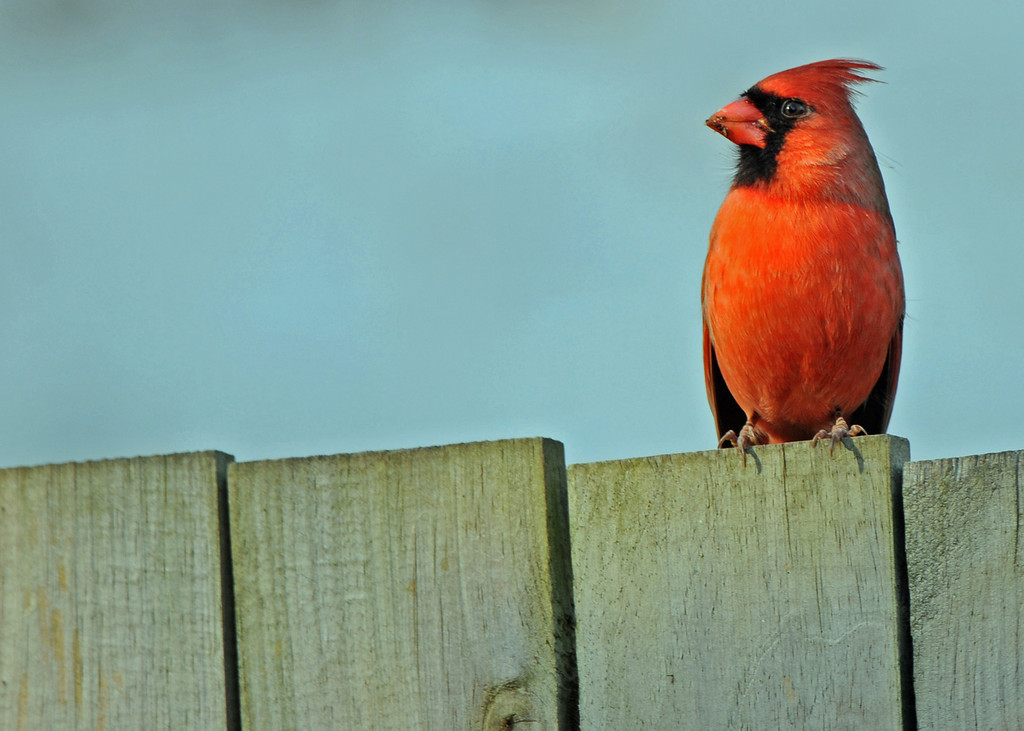
The feathered male Cardinal, however, is not very priest-like when it comes to defending his territory from other males – he’ll even hurt himself by viciously attacking his own reflection for hours. There is a sweet side: unlike many bird species in which only males sing, male and female Cardinals sing to each other. Here's a female Northern Cardinal:

(Brooklin, Maine)
We like to imagine scenes such as this as being the ending of a movie in which life is about to take a predictable turn. Will there be happiness, sadness, or sameness? Ah, that depends on our own mood when we play Rural Rorschach.

(Brooklin, Maine)
Here, the Cirrostratus Clouds are sweeping swiftly through last night’s sunset afterglow, somewhere between 20 and 40 thousand feet above Great Cove and Eggemoggin Reach.

The Latin scientific name for these clouds is straight-forward: “cirrus” meaning “wisp-like” and “stratus” meaning “layered.” The appearance of these high-flyers often signals an incoming warm front, which hasn’t arrived as we speak; it’s now 14 degrees (F) and sunny. (Brooklin, Maine)
The Mallards that decided to spend their winter with us seem to know that our duck hunting season is, for all practical purposes, over. (Licensed falconers, of which there are few here, still may hunt ducks with their birds of prey.) The ducks are coming back into ponds and closer to shore, and not always paying enough attention to their runways during our present thaw-freeze-snow-thaw cycles.

The Mallards come barreling in, sometimes with a splash (see the image above) and sometimes with a comical fluttering skid past their mate (see the image below).

Mallards’ legs are set back farther than those of many belly flopping birds, which gives them a tipsiness when erect on ice, as well as that distinctive Mallard waddle when on land. (Brooklin, Maine)
You never know what you’ll find on the shore when the snow starts to melt. Here’s a classic clam hod that could use a little work.

Professional clammers who dig with short-handled rakes often lean with one hand on the hod handle while the other digs up their prey, which are then chucked into the hod basket; the four-point bending position can lessen back strain during the hard work. The slats in the basket allow the clams to be rinsed off by dipping the hod into the sea or by spraying. (Brooklin, Maine)
The woods and fields have been getting the kind of soakings that are good investments toward a bountiful spring and the streams are running cold, clear, and wild. Here's Patten Stream in Surry emptying into Patten Bay last week:

We’ve been fortunate precipitation-wise this winter – so far. We’ve gotten nice day-long snows followed by good thaws, not week-long snows that produce dirty 14-foot piles in plowed parking lots. Here's a closer look at Patten Stream’s churning waters:

(Brooklin, Maine) Way-to-go, Pats! (Phew!!)
The Dark-Eyed Junco (Junco hyemalis) is a confusing bird. Most birders consider it a sparrow, but some think it’s a finch. No one knows what its name means in English, Latin, or any other language except Spanish, in which “junco” is a rush plant.

Many casual observers call it “The Snowbird,” based on its legendary sudden appearance with the first snow or – in some older yarns – causing that snow. Our theory is that the bird is not easy to see where there are no bird feeders and no snow-covered ground.

They’re small, neutrally-colored, and mostly feed on the ground in the absence of feeders. When the snow comes, their hopping and flitting become obvious. (Brooklin, Maine) Go Pats!
This is small part of a familiar sight around here, which many from away will not recognize.

Yes, it's a scallop dredge and its twine net that were being repaired yesterday at the Town Dock. The dredge is an ingenious contraption that allows scraping the bottom and harvesting scallops and other mollusks there, with escape routes for fish and openings for removing the scallops by fishermen (including women). Here's most of it:

The equipment’s exotic terminology includes an apron, skirt, clubstick, shoes, rock chains, sweep chain, ring bag, and chaffing gear. (Brooklin, Maine)
Yesterday was a splendid gift throughout: blue dawn on fields of fluffy, fresh snow; shining, crispy morning and afternoon of azure skies and slow-moving clouds; orange setting sun captured in a tangled net of bare branches, and sharp, clear night in which Polaris brightly points the way. Yesterday’s sunset, shown here, was especially transporting.

It even could be African with a little imagination – think of the pure snow as sand, the twisting trees as Acacias, and the sweaty heat from wearing three layers of clothes while stalking a fawn through calf-high snow. (Brooklin, Maine)
Yesterday's snow storm was the fluffy fat flake kind that dares you to come out and play.


We did come back for lunch and a warm-up.

But, mostly, we roamed around on foot and in the car.


At Naskeag Harbor and along Back Road:


The Brooklin Cemetery with its Camperdown Elm:

The Brooklin Inn and Town Office:


"The Red House" on Back Road:

The General Store and Library:


On Naskeag and Back Roads:


As dawn breaks today, one of Jerry Gray's crew comes to plow us out; soon, the sun finds our North Field and Great Cove:


(Brooklin, Maine)

