Comment

In the Right Place: Stinkers

Posted March 22, 2020

The purple spathes of skunk cabbage plants (Symplocarpus foetidus) have been emerging all week. The image here, taken yesterday, is of a cluster in our bog that we’ve been monitoring and cataloging photographically for several years.

1.jpg

Skunk cabbages are the first wild plants to flower during our spring. However, they flower inside the spathe from a fleshy geodesic-dome-like bulb called a spadix. Sometimes, the spadix becomes visible due to the spathe being trampled or bitten::

04/14/20 Image Inserted Later

04/14/20 Image Inserted Later

These flowers produce a gagging odor that smells like rotting meat to us, but they apparently smell delicious to pollinating insects.

The large, beautiful skunk cabbage leaves usually start to come in May here. You should be careful not to barge through them, unless you like being confronted with an odor similar to skunk spray. By mid-summer, the plants are in regal form. Here’s a July 1, 2019, image of the above spathe cluster:

2.jpg

(Brooklin, Maine)

Comment

Comment

In the Right Place: Peace

Maybe it’s time for the government to recommend that the general public practice Shinrin-Yoku, the Japanese therapeutic practice that translates roughly as “taking in the forest atmosphere.” It’s been promoted as “forest bathing” by many enthusiasts and the Association of Nature and Forest Therapy Guides and Programs.

These enthusiasts are advocating forest bathing to reduce stress, depression, and blood pressure; to enhance memory, and even as a potential cancer preventative.  Scientific tests of varying reliability are being cited.

A.jpg

But those of us who regularly walk the woods alone don’t need catchy names and scientific tests for motivation. We know, as Wendell Berry said, that’s where we can “come into the peace of wild things who do not tax their lives with forethought of grief ….” Peace of mind is in short supply these days. (Brooklin, Maine) The image was taken Wednesday, March 18; click on it to make it bigger.

Comment

Comment

In the Right Place: Getty Loony

Common loons such as this were wailing loudly and frequently in the grayness of Great Cove yesterday morning as the rain clouds moved in. It was eerie, but good-eerie.

Leighton archive image

Leighton archive image

It’s the beginning of breeding season for them here. The males are looking for females, perhaps the same mates that they’ve been meeting for several years.

Leighton archive image

Leighton archive image

Loon parents reportedly abandon their offspring in the late summer and take separate winter vacations. However, many then return to their breeding grounds and reunite (or try to) to start another family. By the way, male and female loons are indistinguishable to non-Loons. (Brooklin, Maine)

Comment

Comment

In the Right Place: Congestion

The spring equinox occurs at 11:49 p.m. today. We’ll be greeting the fertile season in self-isolation for our own protection, while some of our evergreen neighbors will continue congregating in crowds for theirs. Our spruce trees, in particular, have so many seed cones this year that their tops look like they were attacked by a manic decorator. The image below of one of our tall (about 70-foot) Black Spruces was taken Tuesday, March 17:

A.jpg

The seed cones usually occur in the top third of spruces, while their pollen buds usually appear in the lower third, which is good social distancing – it reduces the chances of self-pollination that might weaken progeny.

Spruces produce cones in a two-year cycle, which means that these almost mature cones are the result of buds formed in 2019. It was wetter and warmer than average here then, with a spring that was the wettest in Maine since 1973. That may be the cause of today’s cone congestion. (Brooklin, Maine)

Comment

Comment

In the Right Place: Flamboyant Flotsam

This battered lobster trap buoy was trying desperately to get ashore in Great Cove on Sunday (March 15). It created rolling reflections like spilt paint on the rising tide as it tried to avoid the grasps of rockweed. Part of its problem was that it had lost its “buoy stick,” which would have kept its “bullet” vertical and allowed it to bob. There also was no sign of the line to which it apparently was attached.

C.jpg

Most lost buoys reportedly are slashed from their lines by the propellers of vessels. But, some may be result from recent wildlife protections designed to reduce the number of whale and other marine deaths due to entanglement in fishing gear. One of these protections is to attach the buoys to lobster traps with lines that have “weak links,” which have a breaking strength of no greater than 600 pounds. (Brooklin, Maine) Click on image to enlarge it.

Comment

Comment

In the Right Place: Now Is the Time

Most of our ancient apple trees have been abandoned and must fend for themselves in their old age. But, some are cared for and these mostly are pruned in late February through mid-March. Here, you see arborists pruning some of the old apple trees at the WoodenBoat campus on March 12 (Thursday).

A.jpg

Tree surgeons tell us that the ideal time to cut the apple trees is now, just before they come out of their winter sleep. Dead, diseased and broken branches are removed and sometimes the tree height is lowered by cutting back large vertical growths to encourage them to branch outward.

A1.jpg

Fall or early winter pruning is not recommended because it can create wounds that can’t heal before the severe weather arrives; summer pruning can result in excessive leaves that retard fruit growth. (Brooklin, Maine)

Comment

Comment

In the Right Place: Happy Birthday!

The Great State of Maine, also known as The Pine Tree State, is 200 years old today.

Pine.jpg

Our statehood arose out of a bitterly divided nation headed for war. When the Massachusetts District of Maine filed for statehood in 1819, there were 22 states, equally divided between those that were “free” (that prohibited slavery) and those that were “slave” (in which slavery was legal).

Maine’s requested entrance as a free state would destroy the political balance as it related to the country’s gravest problem, slavery. The Missouri Compromise of 1820 was the Congressional solution: free Maine would enter the Union on March 15, 1820, as the 23rd state and slave-permitting Missouri would enter as the 24th on August 10, 1821.

Pine 2.jpg

Maine was a fervent abolitionist state. It was the first state to support creation of the Republican Party to oppose slavery and the birthplace of President Abraham Lincoln’s first Vice President, Hannibal Hamlin. When the Civil War arose, Maine contributed a higher percentage of its population to the Union military than any other state. (Brooklin, Maine)

Comment

Comment

In the Right Place: Moon Pi to Maine Pi

Most people won’t know this: today is International Pi Day. It’s a day on which mathematicians celebrate that formula, which is an amazingly useful tool for many things, from equipment for the space program to forestry management in Maine.

C.jpg

Pi, symbolized by the Greek letter “π,” is a way to measure things involving circles, such as parachutes for slowing landings and the insides of living trees. More specifically, Pi is the ratio (comparative size) of a circle’s circumference (length around) to that circle’s diameter (length through the middle). That ratio, numerically, is recognized as 3.14159 for most uses, but it has been calculated out to over a trillion digits.

B.jpg

Thus, if you want to know the diameter of any part of that big spruce trunk behind your house, measure the part’s circumference and divide that number by Pi. Or, use a forester’s diameter tape, which has circumference measurements on one side and Pi-derived diameter measurements on the other.

D.jpg

(Brooklin, Maine)

Comment

Comment

In the Right Place: Spring Unsprung

“The significant snowstorm shown in the accompanying photograph was taken on April 10 of last year, at the beginning of the Easter weekend in Brooklin, Maine. Stated another way, it’s time that we had a candid talk about Spring here in Down East Maine.”

EA 031220.jpg

That’s the first paragraph of our monthly column that appeared yesterday in the Ellsworth American. Click on image to enlarge it. (Brooklin, Maine) To read the column, click here: http://www.5backroad.com/montly-column

Comment

Comment

In the Right Place: On Thin Ice

Here we see Matthew and Martha Mallard, testing the fast-disappearing ice in the WoodenBoat campus marsh pond yesterday.;

1.jpg

A few days ago, ice covered the pond and was thick enough to support a man:

2.jpg

If we get one of our famous spring freezes, the pond will refreeze. If we don’t, it soon will host considerable wildlife, including red-winged blackbirds, mergansers, wood ducks, and, of course, mallards like Matthew and Martha, who may decide to nest there. (Brooklin, Maine)

Comment

Comment

In the Right Place: Bulging

Monday night’s full supermoon had plenty of pull with yesterday’s high tide. That tide was a 12 ½ -footer, our highest predicted tide for March, according to Center Harbor data. We also had fog coming in with the tide yesterday, making the effect more dramatic.

2.jpg

As you can see above, the tide reached high onto the banks of Great Cove. On the other side of our peninsula, it climbed the Town Dock to about two feet from the top:

3.jpg

Tides actually are very long waves that are pulled back and forth and made to bulge by the gravitational effects of the moon and sun on the Earth. When the sun, Earth, and moon are in alignment, the moon not only appears “full” (of light), the pull of the sun on the tides is added to the pull of the moon. This makes the oceans bulge deeper than at other times. (Brooklin, Maine)

Comment

Comment

In the Right Place: Worming

We were on Mount Desert Island yesterday evening when March’s molten full moon arose out of Frenchman’s Bay into the low-lying clouds. At first, it was a massive, planet-like presence.

1.jpg

But, it was rising fast and resolved itself when it got above the clouds:

2.jpg

By the time that we got home, it was a silver cannon ball hurtling over Blue Hill Bay.:

3.jpg

This is our last winter full moon, at least for those who believe spring won’t arrive until the March 19 equinox. It also was a supermoon, since it was at its closest monthly point to us last night. Because the March full moon usually comes when worms in the soil are stirring, this lunar spectacle traditionally is called the Full Worm Moon. But, maple tree sap also often starts to run in March, so some call it the Full Sap Moon.

4.jpg

(Mount Desert Island and Brooklin, Maine)

Comment

Comment

In the Right Place: Inspirations

In the spring of 1804, William Wordsworth was wandering “lonely as a cloud” around Glencoyne Bay in the Lake District of England, when he saw something that inspired his most famous poem: “all at once I saw a crowd / A host of golden daffodils / Beside the lake, beneath the trees / Fluttering  and dancing in the breeze. ****”

1.jpg

Well, it’s technically spring here and we’ve been wandering a lot in the woods, fields and beside ponds and the sea; yet, it wasn’t until we wandered into the supermarket that we found a host of golden daffodils.

3.jpg

Nonetheless, daffodils will be growing out of the ground here soon. In the meantime, daffodils picked in the supermarket can help us pretend that it’s spring and inspire us photographically. (Brooklin, Maine)

Comment

Comment

In the Right Place: Passing Through

Yesterday morning, we had a good sign: a flight of 42 Canada Geese were resting and eating in Great Cove and on its shore.

1.jpg

They’re gone now, possibly continuing north to the country for which they’re named. They’re magnificent birds, especially when they rise and circle high, honking and forming a V-shaped formation.

Leighton Archive Image

Leighton Archive Image

Even better, when a mating pair of them flies low in close-order drill to strafe you, you don’t know whether to dive to the ground or stand and marvel.

Leighton Archive Image

Leighton Archive Image

An increasing number of Canada Geese born in Maine are not migrating, which has created issues. Geese don’t migrate by instinct, they learn the pathways from older leaders when they’re young. If they mature where they’re born, they and their following generations become non-migratory residents and have to survive our winters. If the winter survival drives them to urbanized areas, they often are considered to be aggressive (and messy) pests.

Leighton Archive Image

Leighton Archive Image

(Brooklin, Maine)

Comment

Comment

In the Right Place: Ruffles and Snuggles

It’s Thursday, March 5. We first go to feel the 30-something-mile-per-hour gusts that are blowing down and across Eggemoggin Reach and into Great Cove. The winds are whistling through the Cove’s north entrance; ruffling the lowering tide into greens, blues, and whites, then escaping out of the Cove’s south entrance back into the Reach and out to the nearby Atlantic.

B.jpg

A short time later, we drive a few miles down to the point of our Peninsula to check Naskeag Harbor, which snuggles within larger and more numerous protective islands. The difference is remarkable: Captain Morgan, a local fishing vessel, is calmly pointing into the wind; her line is taut, but she’s not bucking or wallowing. She might even be smiling.

A.jpg

(Brooklin, Maine)

Comment

Comment

In the Right Place: Caring

One of our better old folks’ homes for wild (non-harvested) apple trees is the WoodenBoat campus, where those aged trees that are not buried in the woods are cared for tenderly and loved by visitors.

1.jpg

The queen of long-term care there is an extraordinary centenarian that likes to take the sun in her walkers:

2.jpg

(Brooklin, Maine), images taken March 3 and 5, 2020)

Comment

Comment

In the Right Place: Wind Watching

It doesn’t feel like spring, no matter what the calendars say, but early March is trying to live up to its windy reputation. Here,we see the usually placid Great Cove early this morning being whipped up a bit by 33-mile-per-hour gusts:

1.jpg

Here, we get a little closer yesterday at low tide in similar winds:

2.jpg

(Brooklin, Maine)
Comment

Comment

In the Right Place: False Signals

It’s a tropical 43 degrees (F) as we speak this morning. We’ve been in a freeze-thaw-refreeze cycle lately in which the wooded streams continually form ice and then sculpt it away. Compare the first image of our favorite two-foot waterfall, taken yesterday afternoon, with the one below it, taken Monday (March 2):

1.jpg
2.jpg

The streams seem to enjoy the process, but trees and smaller plants can be endangered when their root systems keep getting confused by false signals of spring. (Brooklin, Maine)

Comment

Comment

In the Right Place: Death Vigil

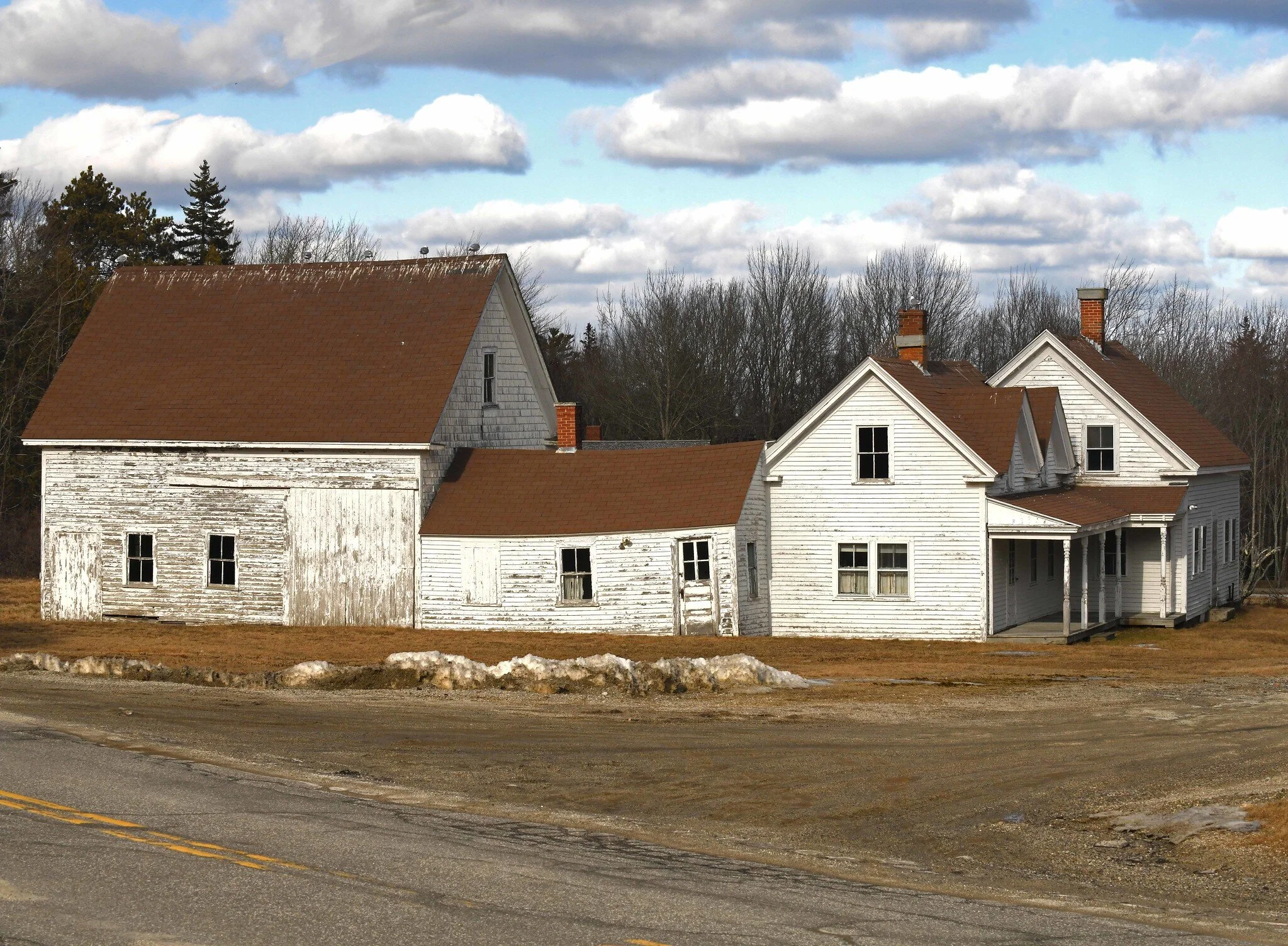
We’re watching this connected farmhouse on Bay Road die a little bit each day. She seemingly is straining to maintain some of the dignity that she had when a large family and a cow, horse, and chickens called her home.

A.jpg

At one time, this house also acted as an important local Post Office. Now she’s a place visited mostly by seagulls that befoul her roof.

B.jpg

She’s a symbol of the times: small farms declining fast, Maine land values increasing exponentially, insurers refusing to insure old houses without extraordinarily expensive safety renovations, mortgage institutions refusing to fund houses that don’t have adequate insurance, and many older owners not having the heart or money to tear down their former homes.

There is a movement here in Maine to use land trusts to try to conserve some of these farmhouses by subsidizing organic and other small farmers to inhabit them, but it may be too little too late.  The inhabitants of reconstructed connected barns now often are not milking cows; they’re fancy cars.

C.jpg

(Brooklin, Maine; images here taken March 1, 2020)

Comment

Comment

In the Right Place: This Is Slick

Our temperatures in February and early March have been above average. But, they still have been mostly below freezing with some short daily highs that reach above the 32-degree mark (F). This confuses the sea ice that has been accumulating in the shadowed nooks of our coves and the pond ice in our marshes and field ponds.

As the days heat up, the edges of scalloped sea ice have been getting pulverized by the incoming tides, only to refreeze again later.

3.jpg

Our pond ice has been frozen thicker and more uniformly because it has less movement and salinity compared to its salty cousin. But, the ponds are not happy. They’ve been moaning a lot lately, with occasional ice cracks that open with a sound louder than a rifle shot.

2.jpg

(Brooklin, Maine; images taken yesterday)

Comment