Comment

In the Right Place: Nymphs

Many of the ponds here are now filled with native Fragrant Water Lilies (Nymphaea odorata), such as this one, which appeared last week.

L-10.jpg

Their genus name, Nymphaea (“nim-FYE-ah”), is derived from the Greek and Roman name for “water lily,” which, in turn, originated as a reference to mythological water nymphs. The local plants’ species name, odorata (“o-dor-RAH-ta”), means “fragrant,” as you probably guessed.

The sweet-smelling flowers of these Fragrant Water Lilies open early on clear mornings and close about noon or whenever the day gets darkly cloudy. Their flowers and water lily pad leaves attract insects and become floating al fresco cafes for smaller frogs (especially green frogs) and birds (especially red-winged blackbirds. Underneath the lily pads, fish and aquatic invertebrates, such as dragonfly nymphs, enjoy the shade.

L-8.jpg

The plant’s seeds are a favorite food for waterfowl and their stems (rhizomes) are consumed by many animals, including muskrats, beaver, deer, moose, and even porcupines.

L-4.jpg

(Brooklin, Maine)

Comment

Comment

In the Right Place: Generation Gaps

Here we see several Monarch Caterpillars on milkweed plant leaves yesterday. (Special thanks are due to neighbor Sherry Streeter whose excellent milkweed plot welcomes this sometimes-troubled species and is the locus of the images here.)

M-7.jpg

This caterpillar and its larval siblings recently emerged from eggs attached to milkweed leaves by female Monarch Butterflies that may now be dead or dying. These caterpillars soon will pull hooded chrysalises over themselves, do a quick-change trick while hidden in their tombs, and climb out as our second generation of Monarch Butterflies (Danaus plexippus), the royalty of their kind (Leighton Archive images):

M-4.jpg

Monarchs produce four generations here during the warm months, three of which die after their Maine vacation. The fourth generation butterflies, born in September or October, are the special ones that migrate south to start the cycle again. (Brooklin, Maine)

Comment

Comment

In the Right Place: Comb Job

With a little help from our more knowledgeable friends, this insect on an Ox Eye Daisy has been identified as a Virginia Ctenucha (Ctenucha virginica). The friends are Marnie Reed Crowell and Kenneth William Shellenberger. It’s reportedly the largest and most broad-winged wasp moth in North America.

i-wx67JkH-X3.jpg

The name for the moth genus Ctenucha (“ten-OOCH-ah”) was derived from the Greek words meaning “having a comb,” an obvious reference to insect antennae. (Brooklin, Maine) Click on image to enlarge it.

Comment

Comment

In the Right Place: Secrets

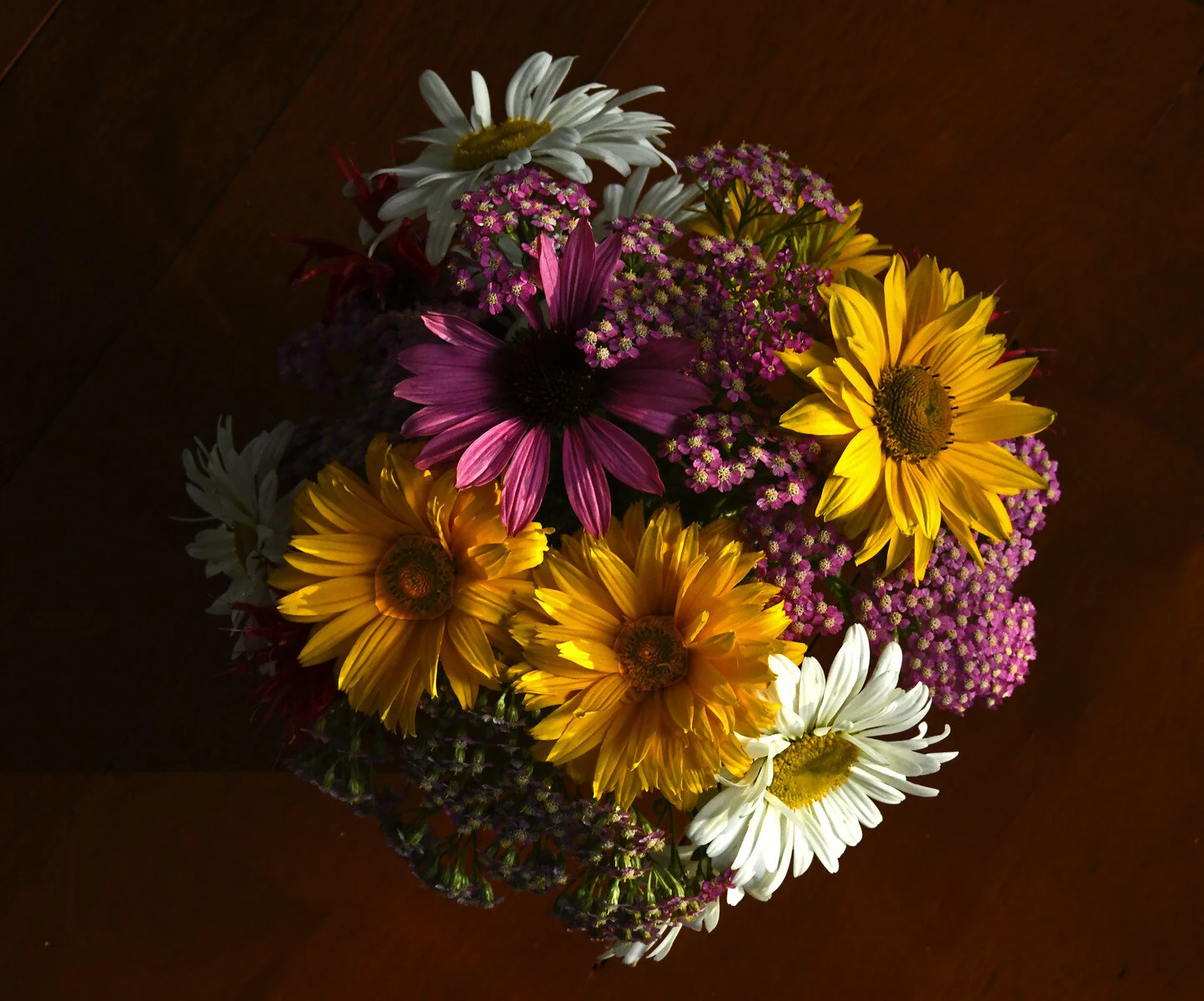
It’s one of those foggy-rainy-gray days as we speak. But, we have a secret remedy to prevent an attack of the blahs. Barbara goes into her garden, picks a bucketful of fresh summer flowers, returns to the house, towels off, and quickly and confidently creates a work of floral art such as this. She puts it on the dinner table and the blahs dare not enter the house.

6.jpg

An old photographer also lives in that house and he steals the arrangement. (Don’t tell Barbara.) He takes the flowers to various types of window light to see how they like the differing luminosity. This not only makes him immune from the blahs, it makes him feel younger. After he has taken the maximum dosage, he returns the flowers to the dinner table and the house remains blahs-free. (Brooklin, Maine) Click on the image to enlarge it.

Comment

Comment

In the Right Place: Entanglements

This is busy Naskeag Harbor yesterday, as fishing vessels wait in line to sell their catches at the rafted lobster hut. Serene as this looks, it’s a confusing time for the lobster industry and, especially, for those of us who are just interested onlookers.

5.jpg

Early in the summer, prices were low and there was an apparent fear of a glut on the market that would drive them lower. There also are the extra costs that would be imposed by the proposed regulations to further protect right whales from entanglement in commercial fishing gear, the need for which as to lobster fishing is strenuously disputed.

Speaking of entanglement, let’s not forget China, customarily a major U.S. lobster customer. The Chinese government restricted U.S. lobster purchases in retaliation to President Trump’s protective tariff on other goods.

This was followed by the President’s recent surprise direction that lobster fishermen should receive subsidies due to China’s action. How and when such subsidies would reach here is unclear.

In the meantime, it appears that our fishermen continue to do what they do well – catch lobsters. (Brooklin, Maine)

Comment

Comment

In the Right Place: Osprey Nest Report No. 8

All is well as of yesterday with Ozzie and Harriet and their three nestlings, David, Ricky, and Lucy. Most of the images here were taken yesterday; a few were taken Monday (July 13).

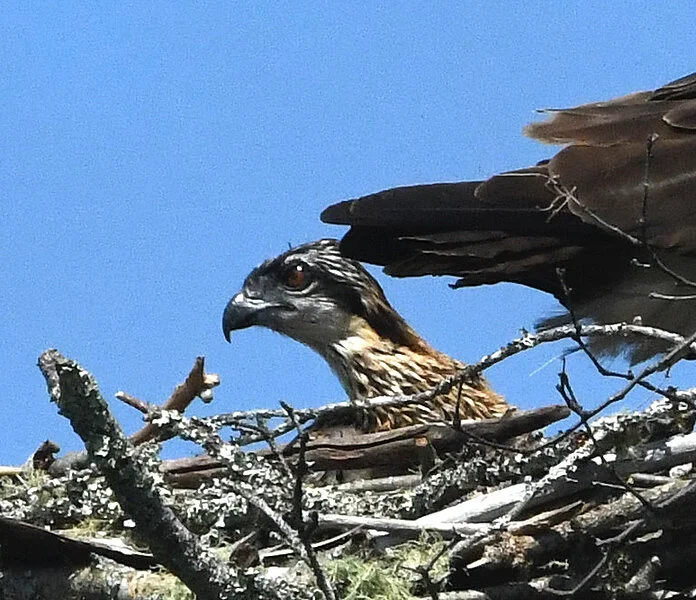
The nestlings are growing quickly. Here, we see that Ricky, the second born, is starting to lose his reptilian look, but is still “all eyes,” brown ones at that:

O-4.jpg

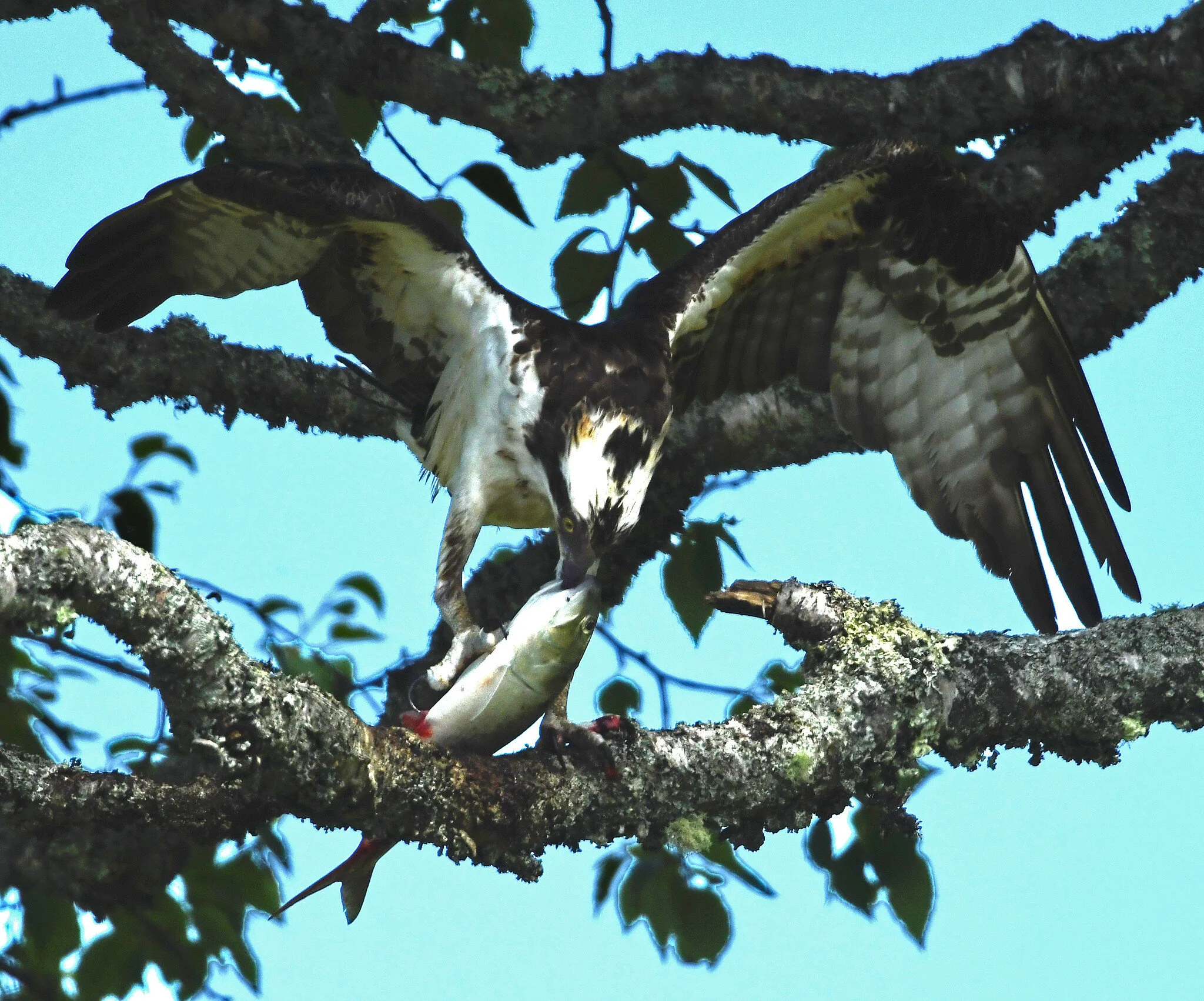
Both parents have been attentive. Below, we see Ozzie decapitating a freshly-caught fish for his breakfast, then leaving the rest of it at the nest rim for his family. After a few minutes on the nest, he leaves, but stays withing calling range.

O-3.jpg

Staying within calling range is important. Ozzie and Harriet (especially Harriet) seen to have a concept of protected airspace near and over their nest, where intruding raptors will be attacked by them.

Yesterday, a lone female osprey got curious and came too close to the nest. Harriet screamed her special intruder call and the nestlings dove for cover as they always do when she screams like that. She even left the nest to intercept the intruder before Ozzie could come and drive the complaining female off . As he did, it was easy to see the difference in size between mature males and larger mature females.

O-11.jpg

The decibel level caused by three ospreys screaming during this episode was amazing. But, in the end, the intruder flew away and Harriet checked us out as she returned to watch over the still-hiding youngsters. She and Ozzie seem to have gotten comfortable with us.

O-1.jpg
O-14.jpg

(Brooklin, Maine)

Comment

Comment

In the Right Place: The Eyes Have It

The young American crow (Corvus brachyrhynchos) that has recently fledged out of its nest can fly well and is almost the size of an adult. However, it’s still a baby that can’t feed itself well and demands – with outlandish vocal and bodily expressions – almost constant attention from its parents and relatives. If you see one and don’t look closely, you might think that this youngster is an adult sounding a crow alarm about a nearby owl or some similar threat. But, no; its all about himself or herself.

1.jpg

We were lucky to see the above youngster land on a dock railing about 50 yards from us on Monday (July 13). It screamed and moaned and swayed its body until an adult crow came and warned it to get away from that human. (That’s one of the things that many young crows don’t seem to understand instinctively.)

There are three significant things to look for in deciding whether a crow is immature or adult. First, the babes have cloudy blue eyes; the adults’ eyes are very black. Second, the black painting on the youngsters’ beaks is not finished – it’s still white and pink at the  bases; the adults’ beaks are all black. Third, and easiest to see, the youngsters seem to beg for food or other attention from adults almost all the time.

4.jpg

For comparison purposes, here’s an image from our archive of an adult crow:

6.jpg

(Brooklin, Maine)

Comment

1 Comment

In the Right Place: Eternal Life

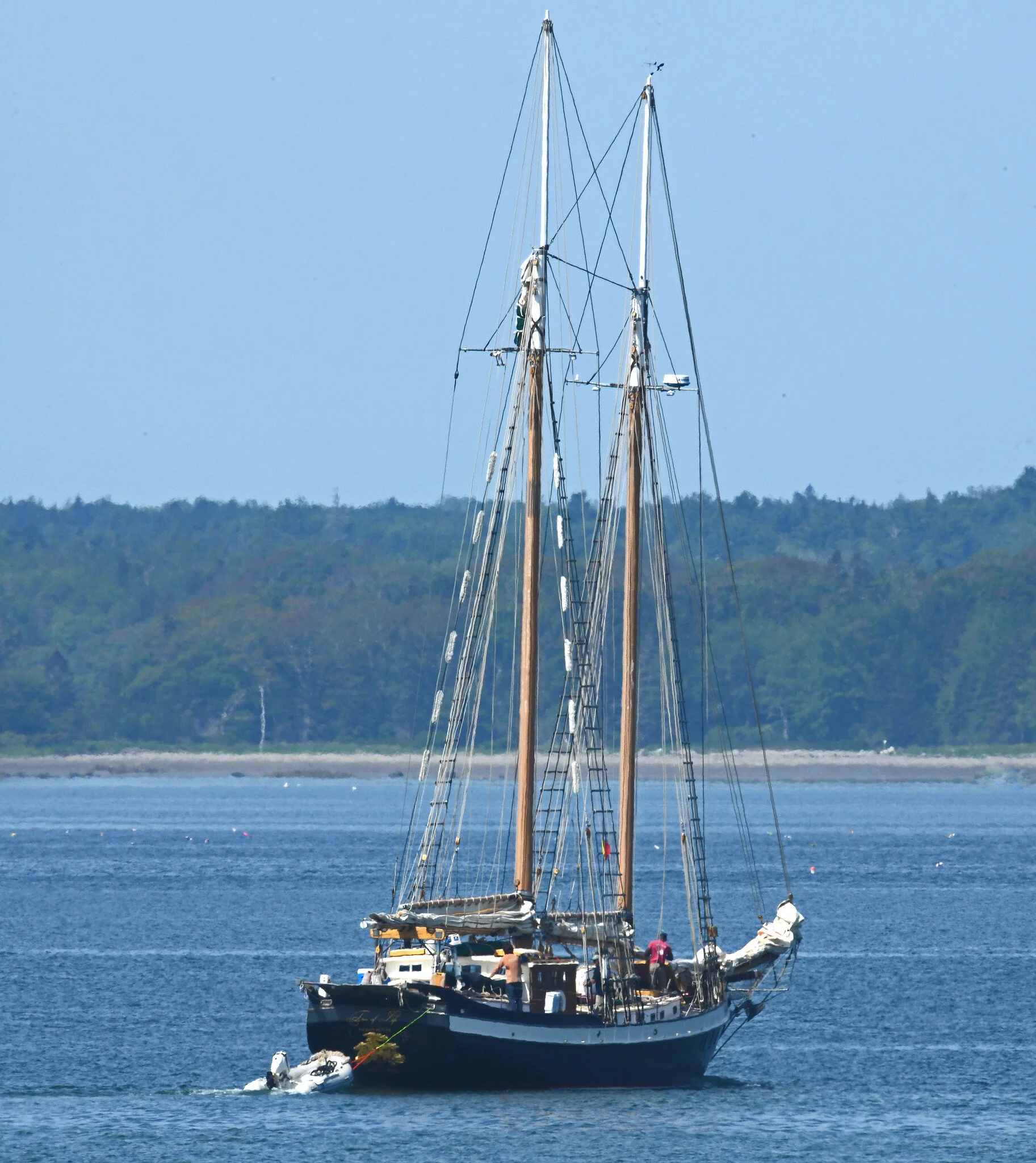
A small two-master slipped into Great Cove Sunday evening (July 12), but she didn’t go unnoticed by those of us whose windows face the Cove – she was our first schooner sighting of the year here. The local email tom-toms sounded and it was determined that she was the Tree of Life out of Newport, Rhode Island.

1.jpg

She stayed the night and motored out of the Cove yesterday on an almost windless morning, when the images here were taken. She seemed to be carrying only a five-person crew, no tourists. Once she got well into the haze of Eggemoggin Reach, she found some wind and put up her sails.

2.jpg
5.jpg

The Tree is a luxuriously appointed 71-foot cruiser with a composite wood-fiberglass hull. She was launched in 1991 and has sailed the world. However, these plague-ridden times are hard on such tourist-dependent ships; in fact, the Tree is being advertised for sale by a high-end broker.

Thus, her unusual name – Tree of Life – is now ironic. Such a Tree appears as the source of eternal life in the Genesis description of the Garden of Eden. Variations of that concept appear in many religions, mythologies, and works of art. According to one report, this schooner was christened Tree of Life because an Irish folk song of the same name was playing when its owners were looking for a name. (Brooklin, Maine)

1 Comment

Comment

In the Right Place: Ditched

Tawney-hued wild daylilies (Hemerocallis fulva) are starting to congregate along our roadsides and elsewhere. They soon will become cheering crowds that will wave at passing vehicles.

DL1.jpg

These emblems of high summer are called daylilies because most of them, when they reach the flowering stage, will be opened by the touch of the sun and wither overnight. However, if it is a dark, cloudy day, many day lilies will remain closed. (By the way, they also are commonly called ditch lilies due to their ability to live in roadside ditches and other sloping surfaces.)

DL2.jpg

Unlike true lilies that grow from delicate bulbs, these wild daylilies grow perennially from tough roots and runners. That means that they can be invasive. They’re native to Asia, but came here with our earliest European colonists. Since then, they have been cultivated by horticulturists into many colorful domestic varieties, such as this yellow variety:

DL3.jpg

(Brooklin, Maine; images taken July 5 and 7)

Comment

Comment

In the Right Place: Weather Report

The weather menu for July here has been fog appetizers with a choice of the following entrées: plain fog; fog with rain; fog with mist; fog with sun sauce; sun with fog on the side; cold with fog icing, and heat and humidity baked in fog.

The most enjoyable (at least for a photographer) is sun with fog on the side, when the fog continuously and quickly rolls in and over you to turn a clear, sunny day into a wet gauzey net and then rolls back to its original threatening position.

That’s what happened here on the morning of Thursday (July 9). One minute, we were trying to focus on this happy, wind-blown osprey posing atop a tall spruce with a brilliant blue sky background:

F1.jpg

The next moment, we were enveloped in a cloud that caused the disturbed bird to swoop away. But, not before we “shot” her and got this extraordinary image:

F2.jpg

Out in Great Cove, one moment, Lavera from Blue Hill was watching the fog come toward her; the next moment, she was lost and we had to use a big lens to find her (in closeup form):

The surrounding coast and islands tend to stand out on a day like this, when the fog rolls in and out and often becomes a background curtain:

F5.jpg
F7.jpg

Eventually, the fog won its battle of attrition and took over the day. This is how Naskeag Harbor looked in the afternoon:

f14.jpg

(Brooklin, Maine)

Comment

Comment

In the Right Place: Pogey Pursing

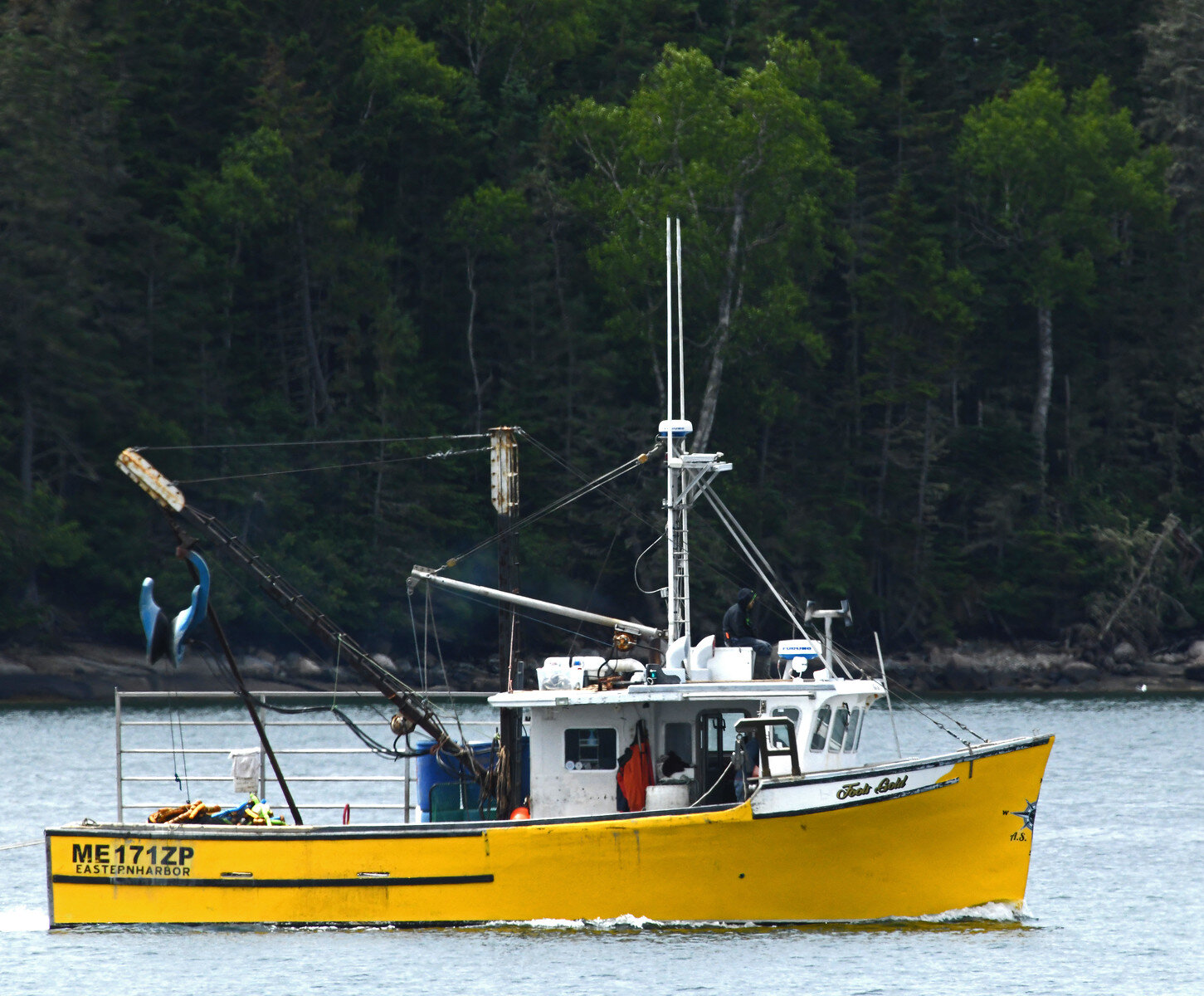
This is Fool’s Gold out of Eastern Harbor, Maine. She’s on the hunt in Great Cove on a misty July 6.

P1.jpg

Fool’s Gold is a “purse-seiner,” which is an unusual word worth considering for a few seconds because there’s a good New England part to this story.

In the 14th Century, before real pockets were invented, there were “purses” within which valuables were carried – usually cloth or leather pieces that could be “pursed” shut with an imbedded drawstring. There also were “segnes” (later spelled “seines” and pronounced “sanes”); they were and still are fish nets.

Here’s the good part, according to historical reports:  In 1826, one or more fishermen in the Rhode Island fishery put together the two concepts of a drawstring purse and a trawling net. The first “purse-seine” was created there to catch menhaden (pogeys), about 15-inch-long fish often used for lobster bait. The purse-seine type of net is now used worldwide to catch big and little fish.

A purse-seine is designed to capture all or most of a school of fish. When the school is found, the fishermen deploy a large seine (net) out of their vessel’s stern to descend like an underwater curtain that will encircle as much of the school as they can. Fishermen spread out their seine for encirclement nowadays by using an outboard motored skiff or the fishing vessel, itself. 

P2.jpg

The seine is held up by floats. Its bottom is open when deployed, but it is lined with rings through which a pursing or “lead” (as in leader) line is threaded. When the catch is within the encircling seine, the fishermen pull the pursing/lead line like a drawstring and close the bottom of the net, entrapping the fish above in a mesh swimming pool.

Then, the closed purse-seine and its contents are drawn back onto the vessel or brought alongside for bringing the catch on board. In the first Comment space, you’ll see Fool’s Gold deploying her purse-seine around a school of pogeys in Great Cove.

P8.jpg

(Brooklin, Maine)

Comment

Comment

In the Right Place: Float-It-All Express

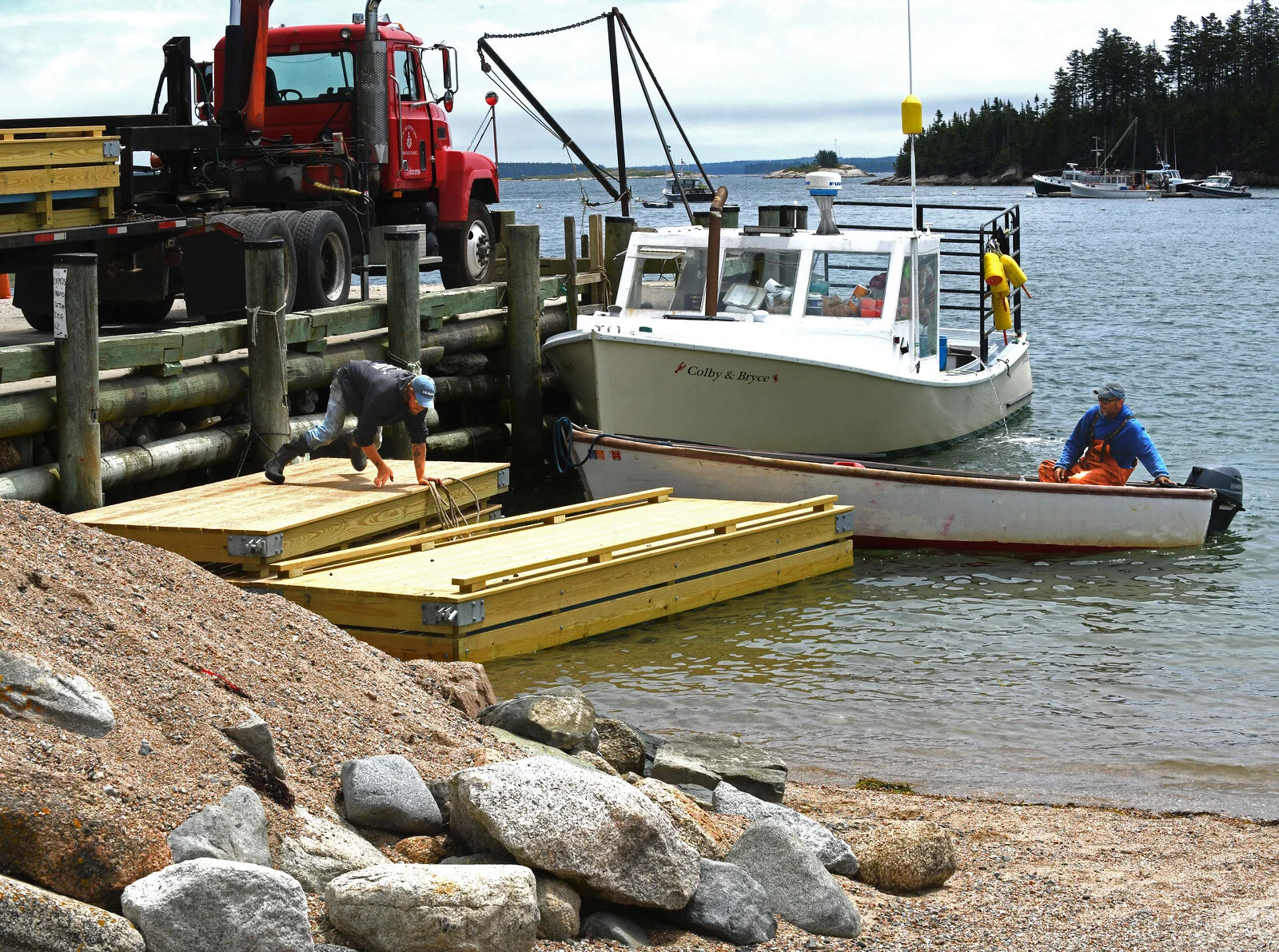
On Tuesday (July 7), the small Town Pier at Naskeag Harbor was more congested than we’ve seen it in a long time. Fishing vessels were tied up on either side and atop was a local pickup truck and trailer plus an enormous crane truck and trailer (18 wheels and 5 axles). The truck was offloading its massive cargo directly into the water.

1.jpg

That cargo turned out to be the prefabricated parts of a large float that was destined to be the docking end of a pier now being constructed. The off-loaded parts were roped and towed by a small outboard motor boat to the middle of our Harbor, where they were tied together.

7.jpg

According to the truck driver, arrangements had been made with the owner of a local fishing vessel to tow all of the lashed segments to Deer Isle, where they would be bolted together and connected to the new pier. Deer Isle is a fairly large island that, at its closest point, is about two miles across the waters of Eggemoggin Reach from Naskeag Harbor.

The famous Deer Isle - Sedgwick Bridge, below, serves Deer Isle and Little Deer Isle (where the bridge actually lands). But, that high suspension bridge has narrow lanes going and coming that apparently can’t accommodate a large vehicle with a load like this. So, the float-to-be will be floated to its home.

Leighton Archive Image

Leighton Archive Image

(Brooklin, Maine)

Comment

Comment

In the Right Place: Osprey Nest Report No. 7

There has been an important development in the saga of Ozzie and Harriet, the ospreys that we’ve been monitoring since April: We’ve actually seen the suspected third nestling in the family’s fine Brooklin waterfront home. We’re calling her Lucy for identification purposes. She seems as active as her apparently older siblings, David and Ricky (“the Boys”).

Now that the nestlings are about three weeks old, Harriet takes frequent short flights, leaving them home alone. She often comes back to the nest with part of a branch, to (sometimes literally) spruce up her home. In the image here, she’s returning on July 3; if you look closely, you’ll see the tops of the heads of Lucy and the Boys.

A.jpg

Ozzie is still delivering fish daily to the family and always is flying or perched close by. We’ve recently seen him take off screaming after a high-flying bald eagle that was not interested in ospreys or a fight with one.

Brutus, the spurned osprey that attacked Harriet several times while she was brooding, has not been seen for months.

Ozzie sometimes flies to the nest for no apparent reason other than visitation. When he does, things get crowded there. He has to step gently, picking his large taloned feet up high and placing them down carefully to avoid the tottering youngsters. Ozzie also collects hefty pieces of wood for Harriet’s home renovation, as he was doing here on July 6:

B.jpg

(Brooklin, Maine)

Comment

Comment

In the Right Place: Washing Regularly

Lavender is at its peak here now, its slim wands waving in the breezes, creating a fragrant blue mist. It’s part of the aromatic mint family. There are wild Lavenders, but most of the Lavender here appears to be English Lavender (Lavandula angustifolia), a cultivar shown below:

Y.jpg

Lavender has been used throughout the ages for its fragrance and reputed disinfection and antiseptic characteristics. It was part of the Egyptian mummification process and an additive to Roman baths. Perhaps that’s why its name originates from the Latin verb “to wash.” (Brooklin, Maine)

Comment

Comment

In the Right Place: Convenience

The bait and lobster hut in the middle of Naskeag Harbor is back, providing fishermen with a convenient place to get bait going out and sell their catches coming in. It’s operated by Billy Damon out of Stonington.

A.jpg

Above, we see the Lily Ann from nearby Benjamin River coming into that rafted hut on Friday (July 3), apparently after a day of fishing. Below, we see her tying up to it:

B.jpg

(Brooklin, Maine)

Comment

Comment

In the Right Place: Social Climbers

Traditional English Shrub Roses, such as this, seem to be out of fashion these days. But, we love them for their quintessential old rose scent, stunning appearance, climbing ability, and inspiration to artistic interpretation.

1.jpg

Besides, these roses love us back – they prosper in Maine’s climate and seem to murmur “wonderful, wonderful” all summer.

add 2.jpg

The Shrub Roses shown here are the award-winning Gertrude Jekyll hybrids, first introduced into the United Kingdom by David Austin in 1986. They’re aptly named after the famed English garden designer of the early 20th Century. (The original pronunciation of Gertrude’s Celtic last name was “JEE-kill,” but many now pronounce it “JECK-ill.) Ms. Jekyll was a horticulturist, garden designer, writer, photographer, and fine artist. She created over 400 major gardens before dying at the age of 89 in 1932. 

add 1.jpg

The GKs have climbing competitions with Clematis companions on one of our decks:

2.jpg

(Brooklin, Maine; images taken July 2 and 3)

Comment

Comment

In the Right Place: The Engines That Could

10.jpg

Not plague, nor rain, nor gloom of fog can stay Brooklinites from their celebration of Independence Day. This morning, the resourceful Brooklin Volunteer Fire Department hosted a “No-Contact Parade” of fire trucks and other emergency equipment (complete with blasting sirens and flashing lights), interspersed with some local vintage cars and trucks.

Of course, today’s celebration was not one of the lavish Fourth of July productions for which Brooklin is known. But, that’s not the point. We thank the Department and all participants; they made our Fourth happier. Here are a few more images taken during this damp morning:

1.jpg
9.jpg
6.jpg

Comment

Comment

In the Right Place: Snuffed

We seem to be having more than our usual share of fog – and it’s not just morning fog. Yesterday afternoon, a wall of fog came in from the sea and snuffed out our view of the sun and everything beyond 30 feet from us, as you can see in this image of the Town Pier. (There are fishing vessels moored not far from that pier that have disappeared.)

1.jpg

One of our most memorable fog experiences occurred at Great Cove several years ago, when our visibility was about four feet. We heard the “Whump, Whump, Whump” of big wings moving heavy air. The sound got closer and closer as we searched the sky unsuccessfully. Then, breaking through immediately above us, a Great Blue Heron appeared in silhouette form for about two seconds and was gone.  The camera was already pointed toward the sound and we got off one lucky shot:

4.jpg

(Brooklin, Maine)

Comment

Comment

In the Right Place: Bloody Good

Yarrow (Achillea millefolium) is beginning to bloom here, as this image from yesterday shows:

Y-1.jpg

While some yarrow is native to the United States, most of the plants in this area appear to be colorful cultivated varieties in gardens. Native Americans used Yarrow to stanch bleeding and it eventually achieved the common names of Nosebleed Plant and Woundwort. Several species of birds, including Starlings, use Yarrow to line their nests, where it is thought to inhibit parasites. (Brooklin, Maine)

Comment