Comment

In the Right Place: Seeing Spots

We saw this flying jewel at a local pond on Sunday, August 2. He belongs to a somewhat confusing species, which is known officially as 12-Spotted Skimmer Dragonflies (Libellula pulchella).

1.jpg

We can see that he is a mature male because he has 10 pale blue spots: two on each wing and two at the bases of his hind wings. But males, females and juveniles of his species all have 12 dark spots: three on each of their four wings.Thus, all of the species has 12 spots and only its adult males have 10 additional blue spots. Here’s a mature female:

Leighton Archive Image

Leighton Archive Image

From the reports that we’ve read, there seems to be a bit of a debate as to whether these 12-Spots are among the migrating dragonflies or whether they are residents that lay fertilized eggs for the following year before they die in the cold of autumn. It appears that most experts think that they (or some of them) migrate, but we haven’t found any definitive confirmation. Perhaps you know of some. (Brooklin, Maine)

Comment

1 Comment

In the Right Place: ERR Revisited

This is Great Cove at dawn on Saturday, August 1, and these are some of the boats that over-nighted there. They soon will be going to the starting line of the annual Eggemoggin Reach Regatta or getting ready to watch the racers go by and come back in the afternoon. The 15-mile Regatta ends here at the Cove.

1.jpg

This race was over the same route it usually has traveled since its beginning in 1985. The racers started at Torrey Island and sailed south in the Reach outside Babson Island that protects the Cove. Here, you see them on their way south in the Reach; that’s the two-masted schooner LaDona way out there in the haze:

They turn about near Halibut Rocks and sail north to finish at the Cove in low tide, where they receive a congratulatory horn blast and cheers. The weather was mostly clear, but large clouds sometimes darkened the Reach.

8.jpg

There reportedly were about 100 racers that finished this year after hours of shifting and dying winds. They can come in any color, but must be sailboats made of wood and be at least 24 feet in overall length. Here’s a sampling of some as they came near and crossed the finish line:

9.jpg
X.jpg
18.jpg
6.jpg
30.jpg

The next morning, there was fog in the Cove and many of the visiting boats waited it out, singly or rafted with friends with whom they’ve partied.

13.jpg

We caught a glimpse of this schooner leaving that morning (yesterday) , but couldn’t identify her. We could use some help on that:

12.jpg

(Brooklin, Maine)

1 Comment

Comment

In the Right Place: Going Crazy

It takes more than a plague to cancel the annual Eggemoggin Reach Regatta for wooden sailboats. It finished in light wind and at low tide in Great Cove yesterday afternoon. The same 15-mile route has been used since the beginning of the race in 1985.

1.jpg

Nonetheless, this plague did prevent the usual ERR partying on the WoodenBoat Campus after the race. Only once in its history was the race cancelled, and that was due to pea soup fog – but, the party was held then, when only good cheer was contagious.

2.jpg

The images here are of the boats approaching the finish line at one pf the entrances to Great Cove. We may do a special on this Regatta, if and when we cull and edit our more than 200 images of the race. (It’s easy for a photographer to go crazy when he sees this beautiful sight.)

3.jpg

(Brooklin, Maine)

Comment

July Postcards From Maine

5 Comments

July Postcards From Maine

July here was alternatively sunny, wet, chilly, and foggy — sometimes on the same day. Nonetheless, the month often was beautiful no matter what the weather. That wasn’t unusual. What was unusual about this July was that it was plague-infested., which meant that many who wanted to be in our fair state at the height of summer were prevented from coming. And, the enjoyment of those who have the good fortune to live here was limited in strange ways.

Yet, there was much to enjoy in July, the month of picturesque fast change here. In these latitudes, July is a time to feel and see both high summer as well as the end of that season and the beginning of autumn. For example, here are two views of Acadia National Perk across Blue Hill Bay at about the same time of day. The first was taken on a clear July 6, the second on a hazy July 31:

2.jpg
1.jpg

There are other ways to look at July’s changing beauty. For example, here’s the mouth of Patten Stream in Surry, Maine, with and without exploring tourists. (Yes, tourists came here in July, but not as many as in the past.)

3.jpg
4.jpg

Many Maine towns that traditionally celebrate the Fourth of July in a big way had to abandon the celebration or think out of the box this year. The resourceful Brooklin Volunteer Fire Department sponsored a “No Contact” parade of emergency vehicles and classic cars and trucks for socially-distant Town residents to wave at on that foggy and rainy Independence Day:

5.jpg

Speaking of fog, July fog can be some of the densest and most acrobatic, due to the seemingly random temperature shifts in the month.

13.jpg
10.jpg

While it may be fun to watch fog, it’s no fun to fish for lobster during it. Or during a pandemic. Or during a trade war with China, one of the biggest lobster customers. Or when the the market is questionable due to these factors. It seemed that, because of those reasons and others, many fishermen (male and female) hesitated this year and waited until July to get their traps in and to sell their catches at the lobster hut in Naskeag Harbor.

17.jpg

While we had fewer human tourists, we seemed to have our usual number of feathered ones. We have been spending some time monitoring the return of Ozzie and Harriet, our neighboring summer resident osprey pair, and their three youngsters, born in June. We’ve named the nestlings, in order of birth, David, Ricky, and Lucy. These youngsters also are part of the fast-change-phenomenon of July. Here, you see them on July 9 and July 28:

Below, Harriet takes an occasional break and then comes back, helicoptering down to the nest. Ozzie drops takeout orders of fish into the nest. Lucy tries to continue to shelter under her mother’s wing, even though she has become too big for such pampering. And, Ozzie takes off from his spruce-top watch tower to chase away a foreign osprey that invaded his family’s air space.

24.jpg
26.jpg

Bee balm blooms in the middle of July and the little (3-4”) female ruby-throated humming birds that nest in the area appear in the garden to sip the flowers’ abundant nectar. (Females don’t have ruby throats.)

30.jpg

Milkweed flowers also bloom in July and the monarch butterflies return to sip the nectar and lay eggs on the plants’ leaves. The eggs become caterpillars that eat the leaves on which they were born; they’ll become our first home-grown generation of monarchs in August.

31.jpg

Clear-winged hummingbird moths and eastern swallowtail butterflies are among the many insects that also invade the milkweed flowers:

Queen Anne’s lace, July’s signature wildflower, is everywhere by the end of the month. Native fragrant waterlilies arise in July and bunchberry plants shed their flowers and offer their red berries. Black-eyed Susans, wild daisies, day lilies, tansy, and the first goldenrod also appear.

36.jpg
38.jpg

Among the many July garden flower favorites here are roses, lavender, heliopsis, peony, echinacea, and clematis:

41.jpg
46.jpg

We end with an image, taken in July, of the wonderfully complicated, but Maine-like, entrance to a local home. It seems to say. “Welcome, come on in!”

50.jpg

(All images here were taken in Down East Maine in July of 2020.)


5 Comments

Comment

In the Right Place: Baleful

It’s summer and the basking is easy. It has been warm here lately, but our ponds have remained reasonably full and our Painted Turtles don’t seem to mind the humidity. This young PT seemed disdainful of us and the bee (or fly?) on his back yesterday:

T-1.jpg

There are indications that turtles need to bask in the sun’s rays to help regulate their temperature, obtain vitamin D, and to kill their parasites.

© Richard Leighton Archive

© Richard Leighton Archive

Nonetheless, they also have a seemingly counterproductive summer habit: they often pile on top of each other while basking.

© Richard Leighton Archive

© Richard Leighton Archive

The main scientific theories about this piling behavior seem to be that it is a form of competition for the best spot, a turtle social trait, and/or a defensive strategy (more eyes and ears). Such a grouping. is called a “bale of turtles.” This, reportedly, is because a collection of these compacted and plated reptiles is thought by some to look like a bale of bound things. To us, one turtle may look like it’s carrying a bale, but a group of them usually looks like a bale of bales that has come undone.

© Richard Leighton Archive

© Richard Leighton Archive

(Brooklin, Maine)

Comment

Comment

In the Right Place: Osprey Report No. 10

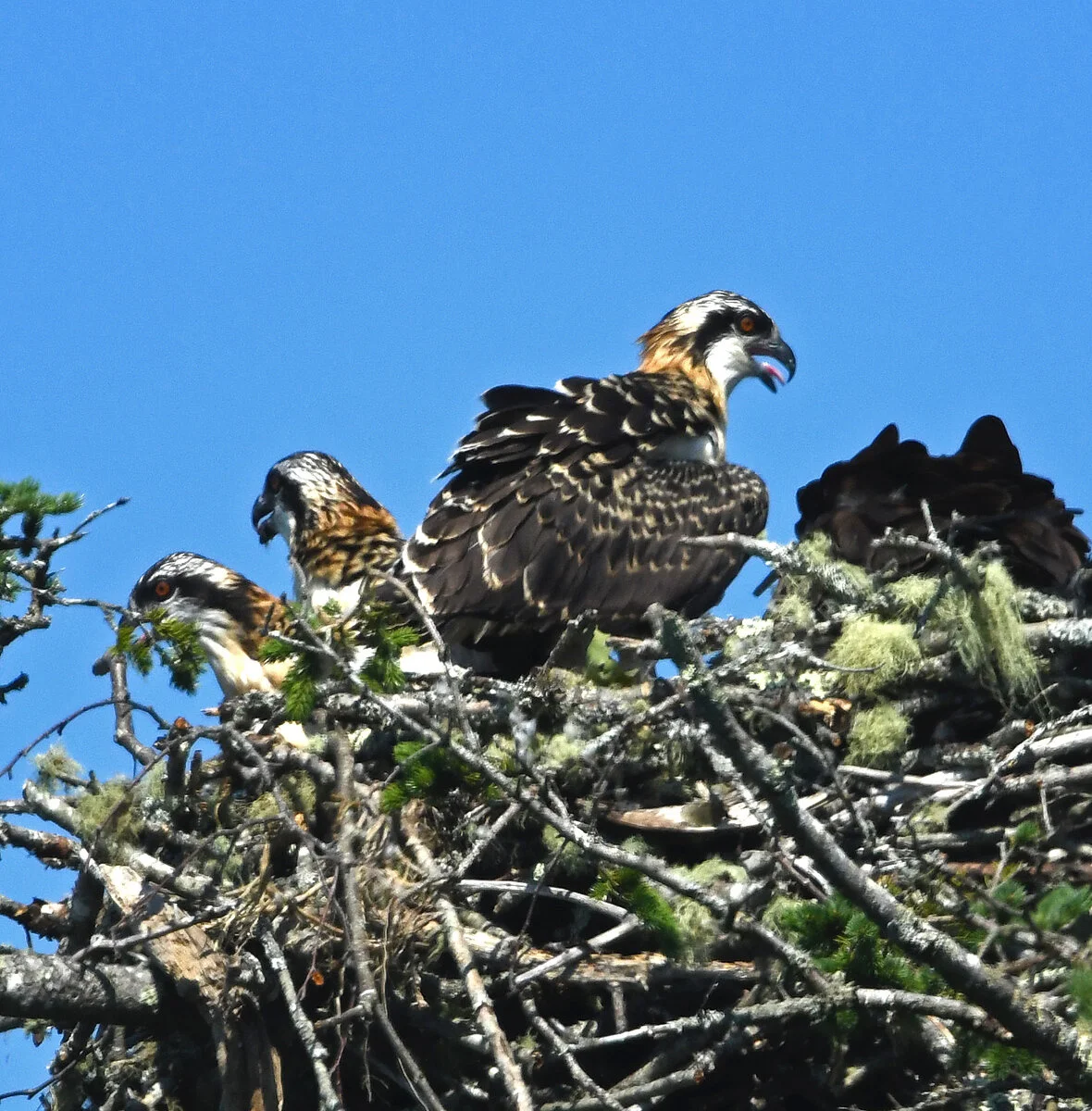
Ozzie and Harriet continued to be near-perfect parents and their youngsters continued to grow very quickly since last week’s report. Below, you see (left to right) Harriet, Lucy, and David. (Ricky was at the bottom of the nest doing what he does best – sleeping.)

O-10.jpg

Shortly thereafter, all three siblings were up and jabbering, while Mom turned her back on them. From front to back, David, Lucy, and Ricky:

O-1.jpg

Nonetheless, there is a problem in Eden: the nest that we once thought was so large, now appears a bit too small for the full family to be comfortable, especially while the youngsters walk off their energy and flap their wings. Ozzie still delivers fish there, but he often can’t find a comfortable space and flies back to a nearby spruce top.

O-8.jpg

Ozzie is a courageous (and handsome) guardian. He comes to scream and attack whenever Harriet gives her danger call (usually when another osprey is near and always when humans and dogs are). He also acts on his own and threatens anything that gets too near:

O-5.jpg
O-6.jpg

All three youngsters now have learned to rip apart and eat the fish that Ozzie slaps down into the nest. But, Harriet is still feeding them choice pieces with delicate movements involving sharp beaks on the delivering and receiving ends. Harriet often has to turn her head perpendicular to the sky and place the scrap into the nestling’s open mouth.

O-3.jpg

Harriet still opens her wings for the nestlings to snuggle and hide under and to shade them from the sun. But, the youngsters don’t fit under her now, even though they try – most of their bodies stick out like an ostrich with its head in the sand:

O-2.jpg

From time to time, Harriet will fly off the nest for a break, leaving it unattended. Once, on a hot day this week, when she was gone a long time, Ozzie appeared at the nest and opened his wings as a partial sunshade for the sleeping nestlings.

O-121.jpg

When Harriet returned, Ozzie flew off and she opened her wings. (Brooklin, Maine)

Comment

Comment

In the Right Place: Whiz Kids

We were at one of our favorite field ponds yesterday. Here’s one of its calming sights. Are your eyes good enough to see the cute insect at rest? (It’s about a one-inch young male Common Blue Damselfly [Enallagma cyathigerum], we think.)

D-2.jpg

One of the non-calming experiences there is trying to get lucky at “shooting” Dragonflies and Damselflies as they whiz by. Here’s an image of what we think is a young (only two-inch) whizzing male Common Green Darner Dragonfly (Anax junius):

D-1.jpg

(Brooklin, Maine)

Comment

Comment

In the Right Place: Rarity

This coastal schooner spent Sunday night in Great Cove; you see her here leaving early yesterday morning being pushed by her motorized yawlboat lashed to the stern.

S-1.jpg

She’s a rare sight this year. Maine’s Covid 19 guidelines were eased recently to allow vessels to offer chartered cruises starting in July. The number of passengers has been limited among other behavior safety guides.

There are only two schooners in our area now offering over-night cruises, according to the Ellsworth American, and this is one of them. She’s the Stephen Taber and she’s on a five-night cruise that costs $1,128 per person, according to the ship’s website. (That’s a bargain for the ship’s renowned food, lodging, and get-away-from-it-all cruises along our beautiful coast.)

The Taber is a 110-foot windjammer that was launched in 1871 and still does not have an engine (except for that powerful yawlboat). When there’s a good wind and she’s flying everything she has, however, the Taber is breath-taking:

S-2.jpg

(Brooklin, Maine)

Comment

Comment

In the Right Place: Frenzied

Yesterday’s ITRP focused on the Ruby-Throated Hummingbirds in our Bee Balm. Today, we’ll focus on the Bee Balm, itself, based on some quick research.

3.jpg

The common name of the plant is a misnomer; the plant is not a balm that calms the many pollinaters it attracts; it frenzies them – especially bees of all sorts, hummingbird moths, and hummingbirds. Here, you see what appear to be two American Bumblebees (Bombus pennsylvanicus) approaching the plant yesterday:

1.jpg

Here, a Clear-Winged Hummingbird Moth (Hemaris thysbe) buries its face in one of the plant spikes yesterday:

2.jpg

The scientific binomial for the plant is Monarda didyma, the first part (its mint plant genus) is named after the 16th Century Spanish botanist Nicolás Monardes. The second part is derived from the Greek words for twin temples or temples of the twins (usually referring to the god Apollo and goddess Artemis). Many of the flowering heads of the plant do seem to be divided in two:

5.jpg

The plant leaves were used by Native Americans for medicinal purposes and its flowers were steeped by them as tea. When English tea was boycotted by Colonists, many Bostonians switched to this Native American tea, which they called Oswego Tea.

4.jpg

(Brooklin, Maine)

Comment

Comment

In the Right Place: Balmy

Our Bee Balm (Monarda didyma) is flowering, which means that female Ruby-Throated Hummingbirds and other pollinaters are in feeding frenzy mode here. We took these images yesterday.

H-1.jpg

Female Ruby-Throats (Archilochus colubris), which don’t have ruby throats, reportedly are the only full-time summer resident hummers in Maine. The chauvinistic males of their species are the ones with the red throats; they mate here in the spring and apparently most keep moving on to Canada to hang out with the boys and avoid nesting chores.

H-5.jpg

Ruby-Throats are less than four inches long. But, they can fly horizontally up to 25 miles per hour and dive up to 40. Their wingbeats average 53 per second and, when in passing gear, the beats can reach 200 a second – at which point the ones in our garden become iridescent green blurs to the unaided eye. See also the image in the first Comment space.

(Brooklin, Maine)

Comment

Comment

In the Right Place: Trapped Art

July has been a good month for abstract art here, especially mobile masterpieces of the lobstering kind.

T-1.jpg

Neat stacks of colorful lobster traps and gear are going out to fish late this year due to the confusing health and market situations.

T-3.jpg

With a little selective focusing, they can be viewed as utilitarian works of art and unintended decoration.

T-5.jpg

(Brooklin, Maine)

Comment

Comment

In the Right Place: Soaked

Double-Crested Cormorants seem to be enjoying the summer here with fewer boats to disturb their fishing and sunbathing. Many despise these birds due to their fondness for defecating on manmade objects and their competition with fishermen.

1.jpg

Nonetheless, they are perhaps our most skilled fishing bird. They can dive deeply, stay down long, use their crackling blue eyes to pierce the murkiness, and pump their powerful legs simultaneously to obtain significant underwater propulsion.

K-4.jpg

However, Cormorants (Phalacrocorax auritus) are not good fliers compared to other feathered fishermen, especially air divers (e.g., kingfishers, ospreys, eagles). And, they seem to take forever to take off from the water. That, according to the literature, seems to be due to the fact that the primary feathers of Cormorants are morphically adapted to absorb water and repel air bubbles when the birds dive. This reduces their buoyancy under water, which gives them a great advantage as a below-water hunter. Those soaked wings are why Cormorants spend a lot of their spare time preening and holding their wings out to get a blow-dry. (Brooklin, Maine)

Comment

Comment

In the Right Place: Questionable Royal Blood

Queen Anne’s Lace plants, such as this beauty, have been flowering all week and soon will look like waves of snow rolling on our fields.

Q-1.jpg

These wild celery-carrot plants are native to Europe and their scientific binomial is Daucus carota, which seems to translate into “carrot family carrot.”.

Q-2.jpg

There’s a debated legend involving the plants’ name and the red or purple spot that sometimes appears in the center of their flowers. Queen Anne supposedly was tatting lace and pricked her finger; one drop of her royal blood fell and spoiled the lace; however, the royal blood made it a valuable heirloom after which the plant was named.

The debate is as to which of two Queen Annes supposedly yelled “Ouch!” – Queen Anne of England, Scotland, and Ireland (1574-1619) or Queen Anne of Denmark (1665-1714). (Brooklin, Maine).

Comment

Comment

In the Right Place: Osprey Report No. 9

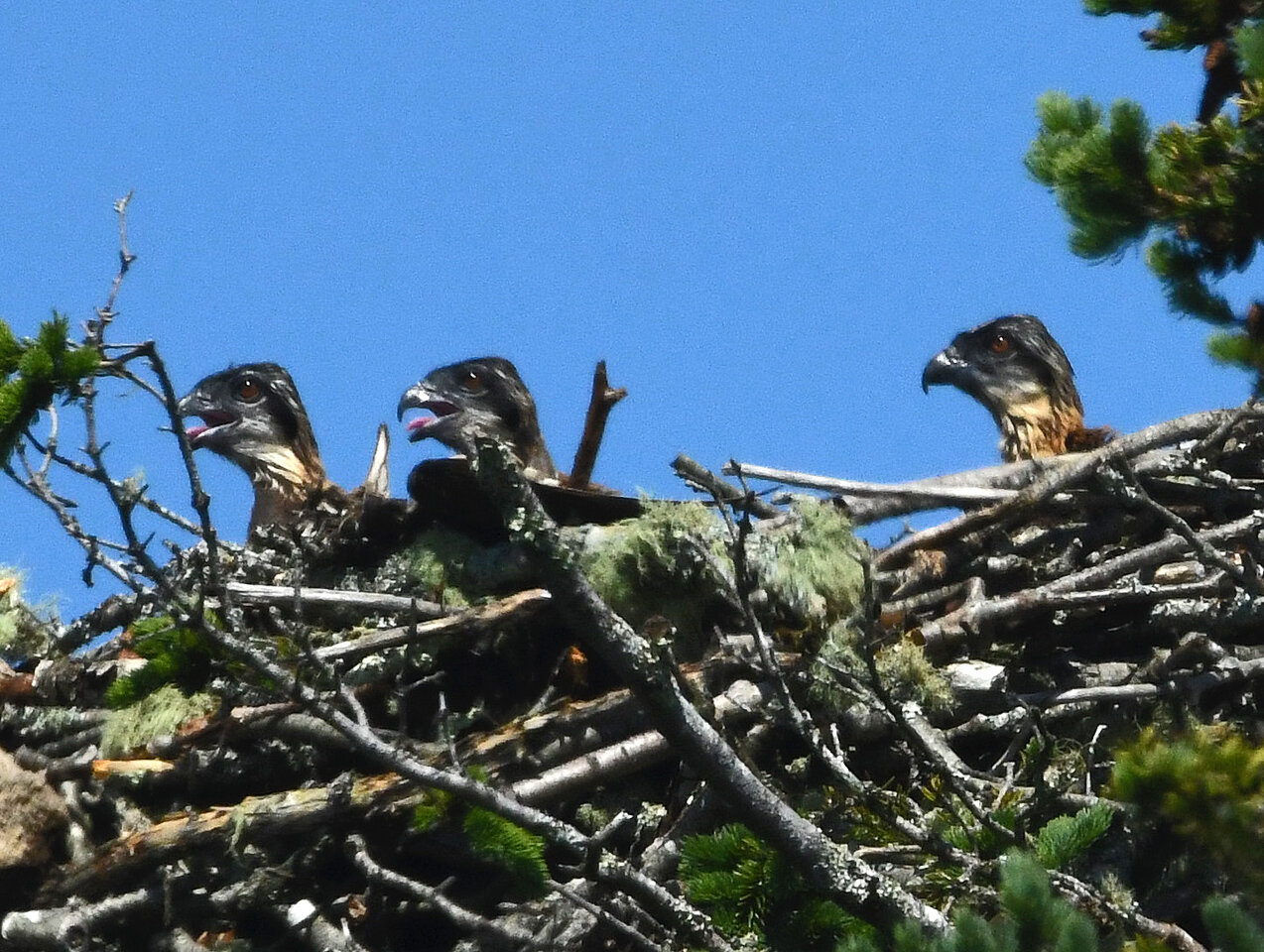
This week’s report finds that Ozzie and Harriet and their three nestlings (David, Ricky and Lucy) remain well. We visited them yesterday and took these images then. The nestlings seem to be growing a quarter of an inch a day and they’ve instinctively developed that osprey head-shifting move (like a bobble doll) to get focus and depth perception. Here’s Harriett and Ricky, the second-born, having a conversation about when Dad will bring lunch:

O-4.jpg

David, the first-born, has been trying his large (but not fully-feathered) wings – flapping away for minutes without getting any lift and often whacking his mother or nest mates.. Maybe, he’s grabbing the bottom of the nest to avoid lift.

O-3.jpg

Harriet occasionally leaves the nest for short flights to stretch her own wings and to check out the neighborhood:

O-7.jpg

The ospreys recognize me. When I arrive, Harriet calmly watches me set up my tripod and put out my chair, as do the nestlings, if they’re up, and Ozzie if he’s around. Then, the raptors go back to what they’ve been doing.

It’s rare, but sometimes a stranger comes by my shaded vantage point and asks what I’m doing, as one did yesterday — with a tail-wagging dog on a leash. As usual in such a situation, Harriet went bonkers. She sounded the osprey Code Red alert and flew off the nest; Ozzie appeared out of nowhere; the nestlings disappeared into the bottom of the nest, and Ozzie and Harriet circled loudly shouting “Go Away!” in osprey-speak, often giving us the evil eye.

O-1.jpg

When the stranger and his amazed dog left, Harriet returned to the nest and calmly preened; Ozzie disappeared again, and the youngsters sat up, seemingly relieved that the drill was over. Soon, Ozzie returned with lunch for Harriet and the kids, usually a fish that Ozzie has decapitated for his own lunch. Here we see Mom and the kids waiting for their take-out meal to be brought home by Dad (left to right: Harriet, Lucy in shadow, Ricky, and David, all watching Ozzie in landing mode):

O-2.jpg

Ozzie usually stays on the nest only for a few minutes, then leaves. But he seems to be always within hearing distance of Harriet’s calls, often perched atop a nearby spruce scanning the sky for intruders (especially bald eagles and other ospreys) for him to drive out of his protected airspace:

O-8.jpg

(Brooklin, Maine)


Comment

Comment

In the Right Place: Nymphs

Many of the ponds here are now filled with native Fragrant Water Lilies (Nymphaea odorata), such as this one, which appeared last week.

L-10.jpg

Their genus name, Nymphaea (“nim-FYE-ah”), is derived from the Greek and Roman name for “water lily,” which, in turn, originated as a reference to mythological water nymphs. The local plants’ species name, odorata (“o-dor-RAH-ta”), means “fragrant,” as you probably guessed.

The sweet-smelling flowers of these Fragrant Water Lilies open early on clear mornings and close about noon or whenever the day gets darkly cloudy. Their flowers and water lily pad leaves attract insects and become floating al fresco cafes for smaller frogs (especially green frogs) and birds (especially red-winged blackbirds. Underneath the lily pads, fish and aquatic invertebrates, such as dragonfly nymphs, enjoy the shade.

L-8.jpg

The plant’s seeds are a favorite food for waterfowl and their stems (rhizomes) are consumed by many animals, including muskrats, beaver, deer, moose, and even porcupines.

L-4.jpg

(Brooklin, Maine)

Comment

Comment

In the Right Place: Generation Gaps

Here we see several Monarch Caterpillars on milkweed plant leaves yesterday. (Special thanks are due to neighbor Sherry Streeter whose excellent milkweed plot welcomes this sometimes-troubled species and is the locus of the images here.)

M-7.jpg

This caterpillar and its larval siblings recently emerged from eggs attached to milkweed leaves by female Monarch Butterflies that may now be dead or dying. These caterpillars soon will pull hooded chrysalises over themselves, do a quick-change trick while hidden in their tombs, and climb out as our second generation of Monarch Butterflies (Danaus plexippus), the royalty of their kind (Leighton Archive images):

M-4.jpg

Monarchs produce four generations here during the warm months, three of which die after their Maine vacation. The fourth generation butterflies, born in September or October, are the special ones that migrate south to start the cycle again. (Brooklin, Maine)

Comment

Comment

In the Right Place: Comb Job

With a little help from our more knowledgeable friends, this insect on an Ox Eye Daisy has been identified as a Virginia Ctenucha (Ctenucha virginica). The friends are Marnie Reed Crowell and Kenneth William Shellenberger. It’s reportedly the largest and most broad-winged wasp moth in North America.

i-wx67JkH-X3.jpg

The name for the moth genus Ctenucha (“ten-OOCH-ah”) was derived from the Greek words meaning “having a comb,” an obvious reference to insect antennae. (Brooklin, Maine) Click on image to enlarge it.

Comment

Comment

In the Right Place: Secrets

It’s one of those foggy-rainy-gray days as we speak. But, we have a secret remedy to prevent an attack of the blahs. Barbara goes into her garden, picks a bucketful of fresh summer flowers, returns to the house, towels off, and quickly and confidently creates a work of floral art such as this. She puts it on the dinner table and the blahs dare not enter the house.

6.jpg

An old photographer also lives in that house and he steals the arrangement. (Don’t tell Barbara.) He takes the flowers to various types of window light to see how they like the differing luminosity. This not only makes him immune from the blahs, it makes him feel younger. After he has taken the maximum dosage, he returns the flowers to the dinner table and the house remains blahs-free. (Brooklin, Maine) Click on the image to enlarge it.

Comment

Comment

In the Right Place: Entanglements

This is busy Naskeag Harbor yesterday, as fishing vessels wait in line to sell their catches at the rafted lobster hut. Serene as this looks, it’s a confusing time for the lobster industry and, especially, for those of us who are just interested onlookers.

5.jpg

Early in the summer, prices were low and there was an apparent fear of a glut on the market that would drive them lower. There also are the extra costs that would be imposed by the proposed regulations to further protect right whales from entanglement in commercial fishing gear, the need for which as to lobster fishing is strenuously disputed.

Speaking of entanglement, let’s not forget China, customarily a major U.S. lobster customer. The Chinese government restricted U.S. lobster purchases in retaliation to President Trump’s protective tariff on other goods.

This was followed by the President’s recent surprise direction that lobster fishermen should receive subsidies due to China’s action. How and when such subsidies would reach here is unclear.

In the meantime, it appears that our fishermen continue to do what they do well – catch lobsters. (Brooklin, Maine)

Comment

Comment

In the Right Place: Osprey Nest Report No. 8

All is well as of yesterday with Ozzie and Harriet and their three nestlings, David, Ricky, and Lucy. Most of the images here were taken yesterday; a few were taken Monday (July 13).

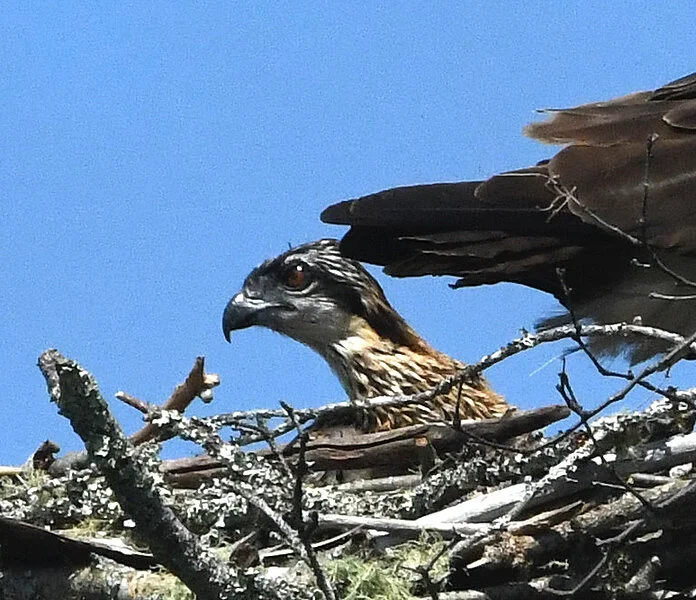
The nestlings are growing quickly. Here, we see that Ricky, the second born, is starting to lose his reptilian look, but is still “all eyes,” brown ones at that:

O-4.jpg

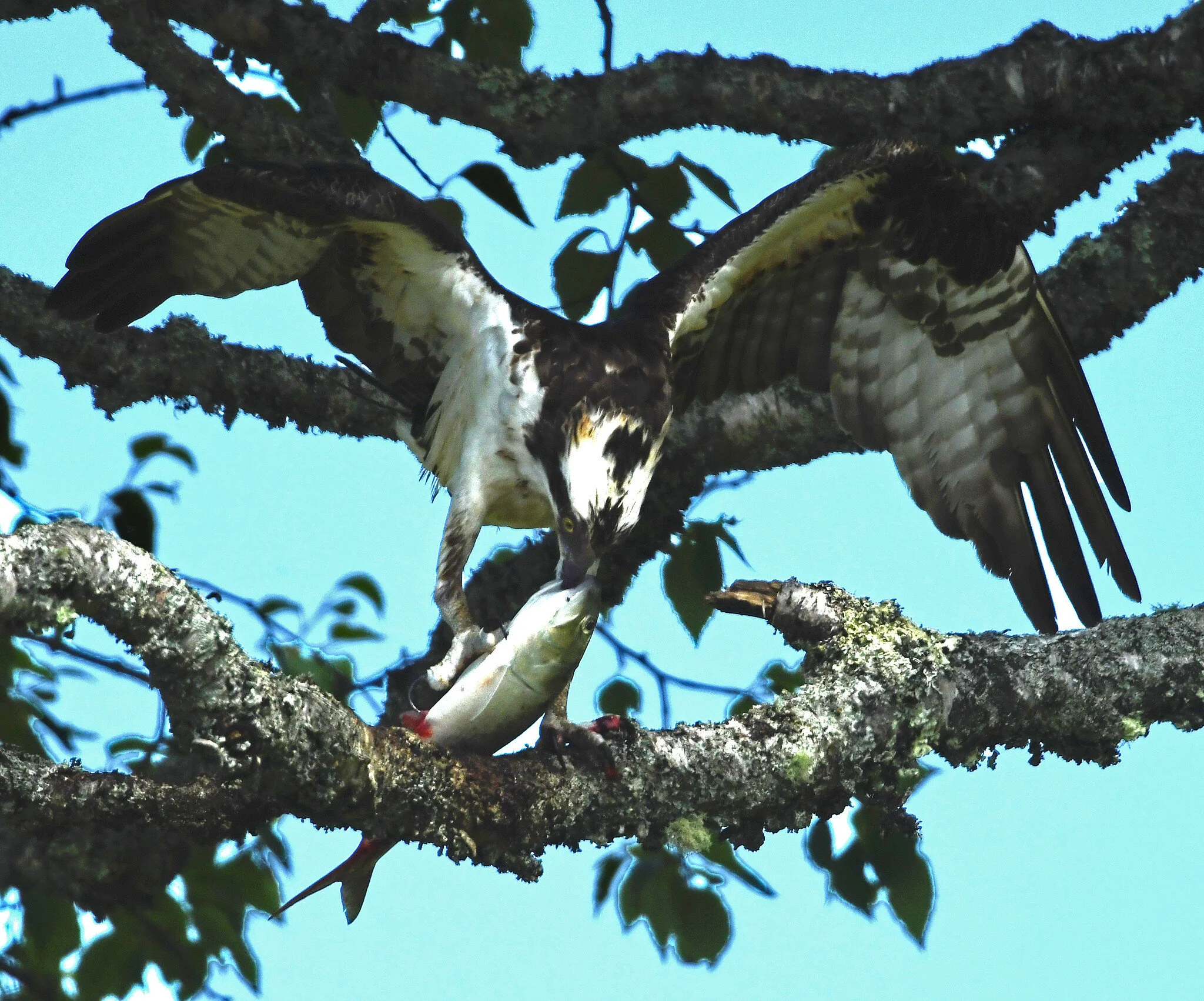
Both parents have been attentive. Below, we see Ozzie decapitating a freshly-caught fish for his breakfast, then leaving the rest of it at the nest rim for his family. After a few minutes on the nest, he leaves, but stays withing calling range.

O-3.jpg

Staying within calling range is important. Ozzie and Harriet (especially Harriet) seen to have a concept of protected airspace near and over their nest, where intruding raptors will be attacked by them.

Yesterday, a lone female osprey got curious and came too close to the nest. Harriet screamed her special intruder call and the nestlings dove for cover as they always do when she screams like that. She even left the nest to intercept the intruder before Ozzie could come and drive the complaining female off . As he did, it was easy to see the difference in size between mature males and larger mature females.

O-11.jpg

The decibel level caused by three ospreys screaming during this episode was amazing. But, in the end, the intruder flew away and Harriet checked us out as she returned to watch over the still-hiding youngsters. She and Ozzie seem to have gotten comfortable with us.

O-1.jpg
O-14.jpg

(Brooklin, Maine)

Comment