Comment

In the Right Place: Brash New World

It’s easy to ignore common things. For example, many people seem not to pay attention to seagulls or even know that there are various seagull species that look different from each other and, depending on age, look different within the same species. Here, we see the most common of our gulls flying in Naskeag Harbor on October 24.

G-2.jpg

This is an American Herring Gull. It’s sometimes called a Smithsonian Gull due to the fact that its scientific species name, “smithsonianus,” honors the English chemist James Smithson, whose financial bequest enabled the Smithsonian Institution to become successful. Here’s the same bird after it alighted on the Town Pier nd eyes us suspiciously:

G-1.jpg

We can tell from this bird’s gray-mottled head and pink legs that it’s a nonbreeding adult that is four or more years old. We can’t tell whether it will migrate south, which most of our gulls do. But, we always have a few true Mainer gulls that hunker through the winter. In fact, the number of fulltime gull residents seems to have increased in the past few years along with our ambient and water temperatures. This one seems comfortable now, however.

G-3.jpg

These birds can be brash when it comes to getting the food that they need, especially in winter. But they’re also smart and don’t waste their time on useless acts. This was proved by a British experiment during World War II.

One of the birds’ traits is to flock around food sources, be they schools of fish or discarded food. The Brits decided to train Herring Gulls by feeding them fish from partially submerged periscopes. The hope was that the trained birds would automatically swarm German U-Boat periscopes to find fish and give notice of the presence of a subs. The gulls swarmed the training periscopes that had been supplied with fish; they ignored the same periscopes when they had no fish. (Brooklin, Maine)

Comment

Comment

In the Right Place: Trappings

There are many ways to take lobster traps ashore at the end of the season. The crew of the Fishing Vessel Cassie Marie seemed to like to make a game of it on Saturday (October 24). They seemed to be playing a fishermen’s version of Blind Man’s Buff.

C-1.jpg

They loaded the traps in the front of their outboard motored utility boat until the driver was, in effect, blindfolded by them. The boat was pointed toward the shore and driven until it beached itself with a crunch. (We think we saw the driver peek and swerve several times.)

C-2.jpg

The traps were stacked on the beach until there were enough of them to make a trailer load to carry them off to storage:

C-3.jpg

By the way, the origins of the game Blind Man’s Buff (often called Bluff) date back to ancient Greece, according to historians. Versions of it were popular in Henry VIII’s court, Colonial America, and, especially, in Victorian England. (Brooklin, Maine)

Comment

Comment

In the Right Place: Rest in Peace

Here, you see one of our Viburnum bushes on October 19 and, below that, you’ll see the same bush as it was yesterday in a decimated state.

A.jpg
A-1.jpg

Within a day or so, there will be virtually no Viburnum leaves to admire. The plants deserve a rest. From spring to fall, they put on a spectacular performance involving white flowers and green leaves, red and black berries, and bright red leaves that become wine-purple in color.

v-3.jpg

There are between 150 and 175 native and imported species in the Viburnum genus, according to what we’ve read. Our plants are Mariesii Viburnums, named after19th Century English Botanist Charles Maries. (For the scientifically oriented: our plants apparently are the tomentosum form of Viburnum plicatum.) They do well in Down East Maine. (Brooklin, Maine)

Comment

Comment

In the Right Place: Shhhh

On Saturday (October 24), we thought that we heard some snoring and peeked into the WoodenBoat School Boat Shed and saw this:

WB-1.jpg

Some of the WBS small boat fleet have been sleeping there since the summer of 2019. The School cancelled its 2020 sailing and building classes due to the Covid plague.

To give you a better idea of the size of these boats, look at “Swifty.” She’s the double-ended Caledonia yawl in the left of this image. She’s 19’6” long and has a beam (greatest width) of 6’2”. As with all of these boats, “Swifty” looks much better in the water, which we can show you. Here’s our archive image of her being expertly sailed in pre-plague days:

Leighton Archive Image

Leighton Archive Image

(Brooklin, Maine)

Comment

Comment

In the Right Place: Tenacity and Tenderness

This tall, but relatively young, White Oak (Quercus alba) is one of our more famous trees for reasons that will become clear. But, the point that we want to make first is that Oaks hold onto some of their leaves longer than most deciduous trees and some Oaks will keep a few (sometimes almost all) of their leaves through the winter.

eb-1.jpg

This tenacity, called marcescence, is not fully understood, but usually occurs in younger trees. (Keep in mind that Oaks have been known to live longer than 400 years – “younger” is a relative term.) Apparently, in most other trees, a layer of cells forms around the base of leaves as the weather gets colder and seals the leaves off from water and nutrients. This “abscission layer” does not completely form in Oaks and a few other trees. Many of their leaves don’t completely die; their diet is severely diminished and they turn dry and brown, but they hang on. The leaves on some Oaks also take longer to change color:

eb-2.jpg

We know that you’ve patiently been reading about science, but really wanting to know why this particular Oak is famous. Well, it was planted in the back of the Brooklin Cemetery by one of Brooklin’s most famous residents, the writer E.B. (“Andy”) White. He planted it when his beloved wife died and was buried there in 1977. His wife, Katherine Sergeant Angell White, also was a famous author and editor. When Andy died in 1985, he was buried next to her under the Oak and their plain gravestones receive a scattering of its leaves every Fall.

eb-3.jpg

(Brooklin, Maine; images taken October 24, 2020)

Comment

Comment

In the Right Place: Diminished Dignity

Here, we see one of our favorite places, as it was Thursday (October 22). We keep a visual record of this iconic connected farmhouse on Bay Road (Route 175).

10/22/2020

10/22/2020

But, it’s sad to watch it die a little each day while seemingly trying hard to maintain some of the dignity that it had when a large family called her home. At one time, part of this house also acted as a local Post Office. Now, she’s a place visited mostly by seagulls that befoul her roof:

Leighton Archive Image

Leighton Archive Image

Small farms – real working ones – are declining fast here due to changing times. Maine land values are increasing exponentially; insurers are refusing to insure old houses without extraordinarily expensive safety renovations; mortgage institutions are refusing to fund houses that don’t have adequate insurance, and many older owners do not have the heart or money to tear down their former homes.

Leighton Archive Image

Leighton Archive Image

There is a movement in Maine to use land trusts to try to conserve some of these farmhouses by subsidizing organic and other small farmers to inhabit them. However, it may be too little too late.  The inhabitants of decently reconstructed connected houses and barns now often are not farmers, cows, goats, or horses; they’re business people or retirees who use the barns for cars, snowmobiles, and (in the winter) boats. (Brooklin, Maine)

Comment

Comment

In the Right Place: Delighting the Dead

There are two trees in the Brooklin Cemetery that are spectacular now, one because of its leaves, the other because it has dropped its leaves. This is how the leafy one appeared on Thursday afternoon (October 22):

It’s a mature Japanese Maple cultivar (probably Acer palmatum, sub. palmatum) in the southwestern corner of the Cemetery. This tree, which has Asian family origins, apparently has reached its maximum height of about 35-plus feet and, therefore, is old for its type. These trees grow about one foot a year until they reach maturity and have been known to live more than 100 years. We have been unable to find the history of its planting.

T-1.jpg

The other spectacular tree in the Cemetery also is a cultivar that has family origins in Scotland. It’s a Camperdown Elm (Ulmus glabra “Camperdownii”) that commands the middle of the Cemetery. Unlike the Japanese Maple, this Elm loses its small leaves early and extends its sinuous branches as if in a blessing. Here’s an image of it taken yesterday:

T-2.jpg

We also have been unable to find the history of this beauty’s planting. Any help on the history of these trees would be appreciated. (Brooklin, Maine)

Comment

Comment

In the Right Place: Sweet Sorrow

Here, we see the Fishing Vessel Christopher Devin II at the Town Dock in Naskeag Harbor on misty Wednesday (October 21). Her traps are being unloaded for winter storage. Her lobster season apparently is over. It can be a poignant moment for fishermen, sort of sad relief, we hear.

1c.jpg

However, Christopher Devin is one of the FVs that usually has a winter season for dredging Atlantic scallops. She gets refitted with a mast and boom for the dredging net and a temporary shelling hut is fitted behind the cabin to shelter crew members who shuck the delicious mollusks on cold, windy days. Here’s an image of Christopher Devin last year in her scalloping rig is in the first Comment space:

1d.jpg

This year, the announced scalloping season here is from November to April, with most areas limited to 15 gallons of shucked scallops a day. There are different times and rules for boat dredging and SCUBA diving for “Divers’ Scallops.” (Brooklin, Maine)

Comment

Comment

In the Right Place: Just Pigmenting in the Rain

Posted on FaceBook October 22, 2020

Here, we’re on Flye Point yesterday in a soft rain. We’re looking across a wild (“low-bush”) blueberry field; and, in the distance, we see cloudy Cadillac Mountain in Acadia National Park across Blue Hill Bay.

X.jpg

Below, we see one of our country lanes soaking up yesterday’s rain.

Y.jpg

The yellows and reds of autumn bush and tree leaves seem subtler in the rain, as if they were new brush strokes that need working. The yellows in fall leaves come when their dominant green chlorophyll pigments are lost due to seasonal weather, allowing their yellow carotenoid pigments to be seen. The reds in leaves come from a pigment called anthocyanin, which some plants produce in the cool autumn temperatures. (Brooklin, Maine)

Comment

Comment

In the Right Place: Stanley

We met this straw man on Monday (October 19) in the back acres of Mainescape in Blue Hill. He was quarrelsome and refused to tell us his name, so we baptized him Stanley. He kept arguing with us by stating a fallacy and then easily refuting it.

1.jpg

For example, when we doubted that he could survive heavy rainstorms, Stanley retorted: “Everyone says it rains heavily every day here, but the official records show that’s untrue.” We told him that form of false response has been called a “straw man argument” or “toppling a man of straw argument” since at least 1620. He replied that we were not alive in 1620 to hear that. (Brooklin, Maine)

Comment

Comment

In the Right Place: Rarity

We looked out the window yesterday evening and saw this beautiful sunset afterglow over Great Cove, with a cameo performance of the moon in crescent form. It was like a Christmas card without wishes for Peace on Earth, Good Will to All, or Joy to the World. Perhaps that’s appropriate these days.

1.jpg

The moon soon will be performing a complicated role in October’s play. As you see it here, it’s in its “waxing crescent” phase (waxing meaning its illuminated part is getting larger). On October 31, it will be full. That is, we’ll have a full moon on Halloween to delight witches and goblins.

It also will be the second full moon in the month, so that will make it a rare “Blue Moon” on Halloween. (The next time that will happen is in 2039.) But wait, there’s more: By a quirk in our calendar, it also will be the year’s “Harvest Moon,” bright enough to bring in crops. (Brooklin, Maine)

Comment

Comment

In the Right Place: Proud Smiles

Last year, we had a bumper crop of Winterberries and, so far, it looks like this year will be as good or better than last year. (The images here were taken this morning.)

1.jpg

According to New England folklore, a profusion of Fall Winterberries means that a tough winter is coming. That didn’t happen last winter and our bet is that it won’t happen this year.

2.jpg

When the Winterberry plants’ leaves fall, the berries stand out in the winter landscape and last a long time if there are other foods for wildlife. The red fruits are not very nutritious, but are the default survival food for a reported 49 species of birds, deer, raccoons, and mice. Those berries only appear on the females of these deciduous holly bushes; the nearby Winterberry plants without berries (but with proud smiles on their faces) are the males. (Brooklin, Maine)

Comment

Comment

In the Right Place: Flying Lessons

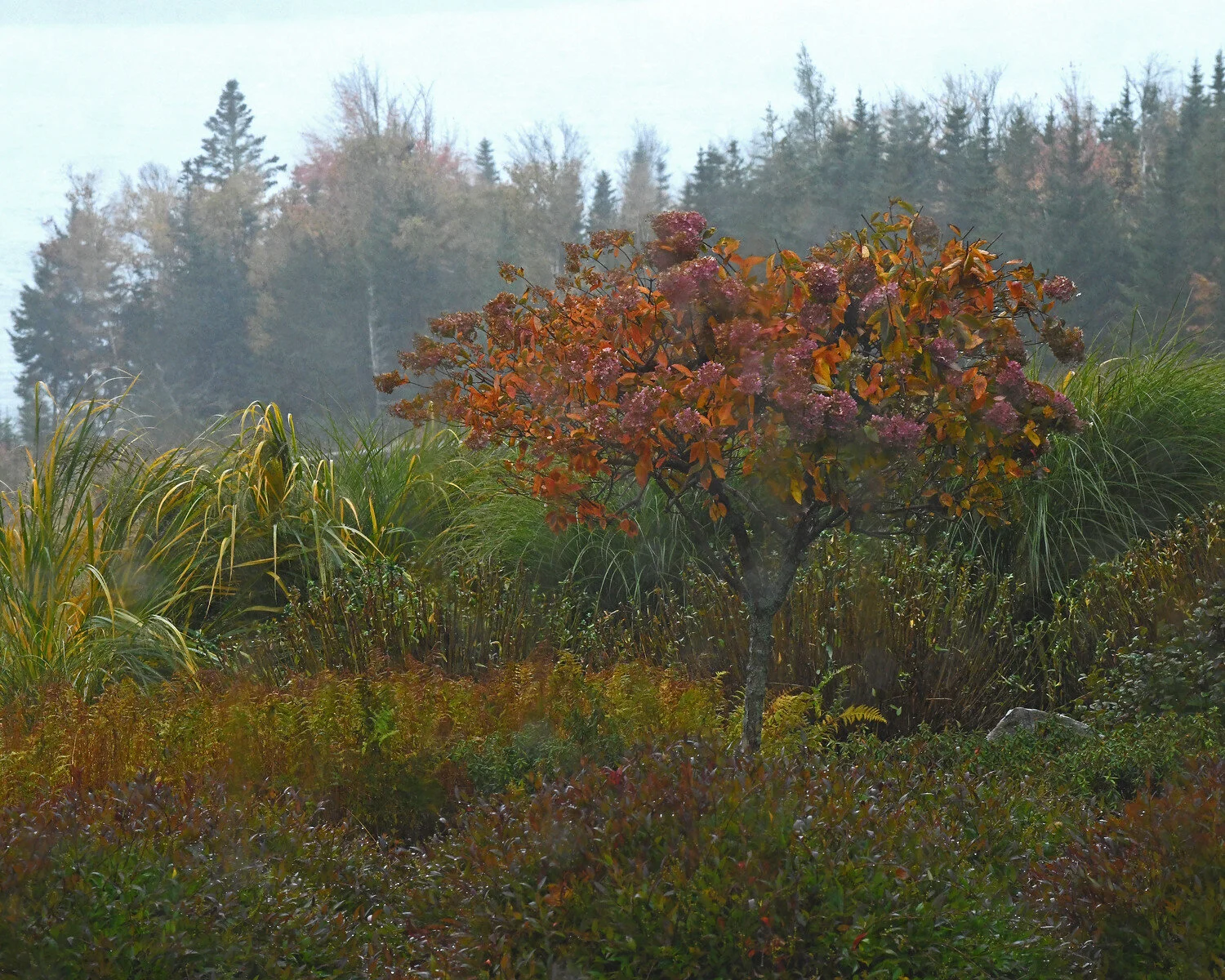
Yesterday morning, sheets of rain came in over the sea, sometimes riding wind gusts of over 40 miles per hour. Our rain chain became a real swinger.

7.jpg

We, of course, went outside, camera in hand. Not because we’re crazy, although a case could be made there. We did it because many of our brightest fall-colored leaves were being given involuntary flying lessons. We wanted to document some of them on the branch before they became compost.

1.jpg

Above, you see our Stewartia Tree in the rain before some of her leaves were ripped from her. Below, you’ll see images of Redvein Enkianthus bushes in yesterday’s deluge, still with most of their leaves and fruit intact.

5.jpg

Our Viburnum turns brilliant red and, sometimes, burgandy purple before the leaves fall, while the similarly-shaped Clethra leaves turn yellow:

The Winterberry seems to be doing well this year, as it did last year. Soon, its leaves will be gone, but the berries will remain as winter bird food.

10.jpg

(Brooklin, Maine)
Comment

Comment

In the Right Place: Bearing Signs

Here we see the Fishing Vessel Time Out II and two of her seagull admirers.

X.jpg

She was coming and going in Great Cove on Wednesday, October 14.

Y.jpg

We couldn’t tell whether she was trapping lobsters or taking up her traps to end the season. In any case, she proudly bears the signs of a busy 2020 lobster fishing season and always is good to see in the Cove.

Z.jpg

(Brooklin, Maine)

Comment

Comment

In the Right Place: Pallid

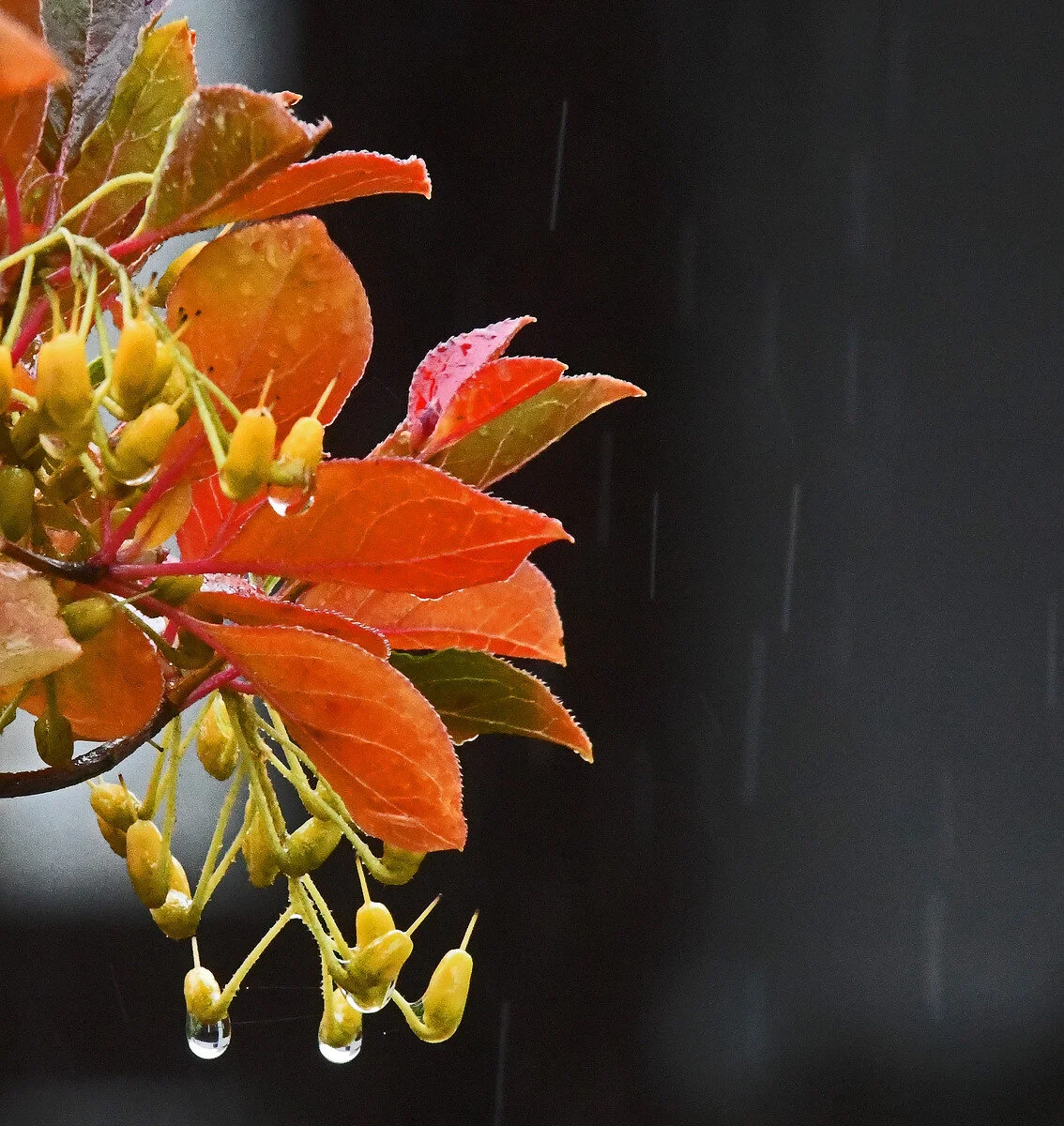
We went out yesterday to record local leaf performances. Mid-October here is supposed to be our fall color peak. Well, with a few exceptions, our peak has been pallid. Some of the early-turning trees have been blown nude by severe wind and rainstorms. Others are late turning, probably due to the drought that we had most of the summer.

i-8qv7kkw-X3.jpg

Some trees, such as the above local sugar maples, made a good effort, but got scalped by recent winds. Nonetheless, even pallid leaves sailing in blue water can be a remarkable reminder of fall:

i-2Pq8p2C-X3.jpg

(Brooklin, Maine)
Comment

Comment

In the Right Place: Great Legs

This Greater Yellowlegs Sandpiper (Tringa melanoleuca) was working the waterline in Great Cove yesterday morning at high tide.

1.jpg

Her name begs the question: Greater than what? (Sex assumed.) Well, she’s greater (that is, about four inches longer) than her cousin the Lesser Yellowlegs Sandpiper (Tringa flavipes). Today’s visitor does have a great set of legs that allow her to resist small waves and stand in deeper water than her cousin:

2.jpg

The thin, yellow-streaming legs attached to Greater and Lesser Yellowlegs Sandpipers earned them the most disgusting collective name in bird terminology – a group is called an “Incontinence of Yellowlegs.” (Brooklin, Maine)

Comment

Comment

In the Right Place: A Play with No Words

Act One. It’s October 8. We’re driving down Naskeag Road and a hawk – looks like it’s a broadwing – flies low across the road and into a deserted country lane. We follow and get out of the car near the beginning of the lane to search the trees. It’s sunny with breezes that chill the face just a little. Rustling leaves, most still green, arch over the lane in many places. They catch the light on one side of the lane and, on the other, create shadows that reach across it. We’re alone, except for a well-hidden hawk. But, we’re enjoying our solitude without the need wonder why.

i-hFvdnFL-X4.jpg

Act Two. There’s movement on the lane about a quarter of a mile away, coming slowly toward us. We can’t make out what it is. It soon becomes a man of a certain age hunched-over his cane. He’s walking slowly, seemingly with difficulty. He comes on relentlessly, wading through pools of light and shade. His head is down; he apparently sees only the ground a few feet in front of him. He doesn’t see us.

Act Three. We worry about the proper thing to say when the hunched-over man reaches us. Then, we realize that he seems to be enjoying his solitude in his own way. We decide not to intrude. We get into the car, close the door softly, back up, and drive away. He never saw us. We regret not having talked to him. The hawk wins again.

(Brooklin, Maine)

Comment

Comment

In the Right Place: Hot and Cold

This is last night’s afterglow following sunset over Great Cove.

i-4vfkPFb-X3.jpg

As the months get colder, the sundown colors get warmer. By November, some of our afterglows will be blood red. For example , here’s a November 17, 2019, image of part of the same area:

i-CWg75k7-X3.jpg


The warmer light apparently is due to the changing rotational angle from which the sunlight passes through the sky’s color spectrum to get to us. (Brooklin, Maine)

Comment

Comment

In the Right Place: Seeing Red

We were in the mood to see some fall colors today. Most of our trees are not at their color peak yet, but wind and rain already have taken a toll on leaves and we’re never sure that we shall have a peak.

1.jpg

As usual, we visited this majestic red maple that has outgrown the North Sedgwick Baptist Church; it has been a favorite fall sight for a long time.  (We haven’t been able to find reliable information about the tree’s age. Perhaps one of you knows its age. We do know that the Church was built in 1843 and red maples (Acer rubrum) have been known to live more than 300 years.)

Among other places, we also visited the blueberry fields down the road from the Church.:

2.jpg

(North Sedgwick, Maine)

Comment

Comment

In the Right Place: Really Rocking

This is low tide in Great Cove’s intertidal zone on Friday (October 9). The “Rockweed” is living up to its name by clinging to its steadfast best friends.

S-1.jpg

There are several types of rock-anchored seaweed commonly called Rockweed. The one that you see here is our most abundant one, Knotted Wrack (Ascophyllum nodosum). Its “knots” are little air bladders that float its “blades” up to the surface to become waving fans in the rising tide.

Leighton Archive Image

Leighton Archive Image

Knotted Wrack and other Rockweeds are boarding houses for a variety of marine life at low and higher tides. They attach themselves to rocks with their “holdfasts,” toe-like growths that can paste themselves securely to hard surfaces. They are neither weeds nor true plants; they’re marine algae that host other lives and are, themselves, foods and ingredients for manufactured products, including fertilizer. Whether and how Rockweed should be commercially harvested is a controversial issue here. (Brooklin, Maine)

Comment