Comment

In the Right Place: Higher Learning

This is Torrey woofing yesterday. She’s poignantly trying to learn the subtleties of her job as the Town Greeter.

1.jpg

The poignancy comes from Torrey’s being the replacement of Digby, a legend and a landmark who went to Dog Heaven about two and a half years ago. Here he is:

4.jpg

In many small towns, there’s a dog that virtually every resident knows or recognizes. Ours was Digby, who had moves that Torrey is still learning. The Town Greeter usually lies on the Larkin family’s open porch about 50 feet from Bay Road, the main northbound road out of “downtown” Brooklin.

As was Digby, Torrey often is the first or last living personality for miles that drivers will see as they wind around turns into or out of the heart of Brooklin. Now, residents look to see if Torrey is “out” as we drive by, but also think of Digby as we do.

2.jpg

The cold or snow usually has been no problem for these dogs; they’re both mixtures of Bernese Mountain and Great Pyrenees dogs that seem to prefer the cold. Torrey is a somewhat uncommon red version of this popular mixture. (Brooklin, Maine)
Comment

Comment

In the Right Place: Cleanliness Is Next to Godliness

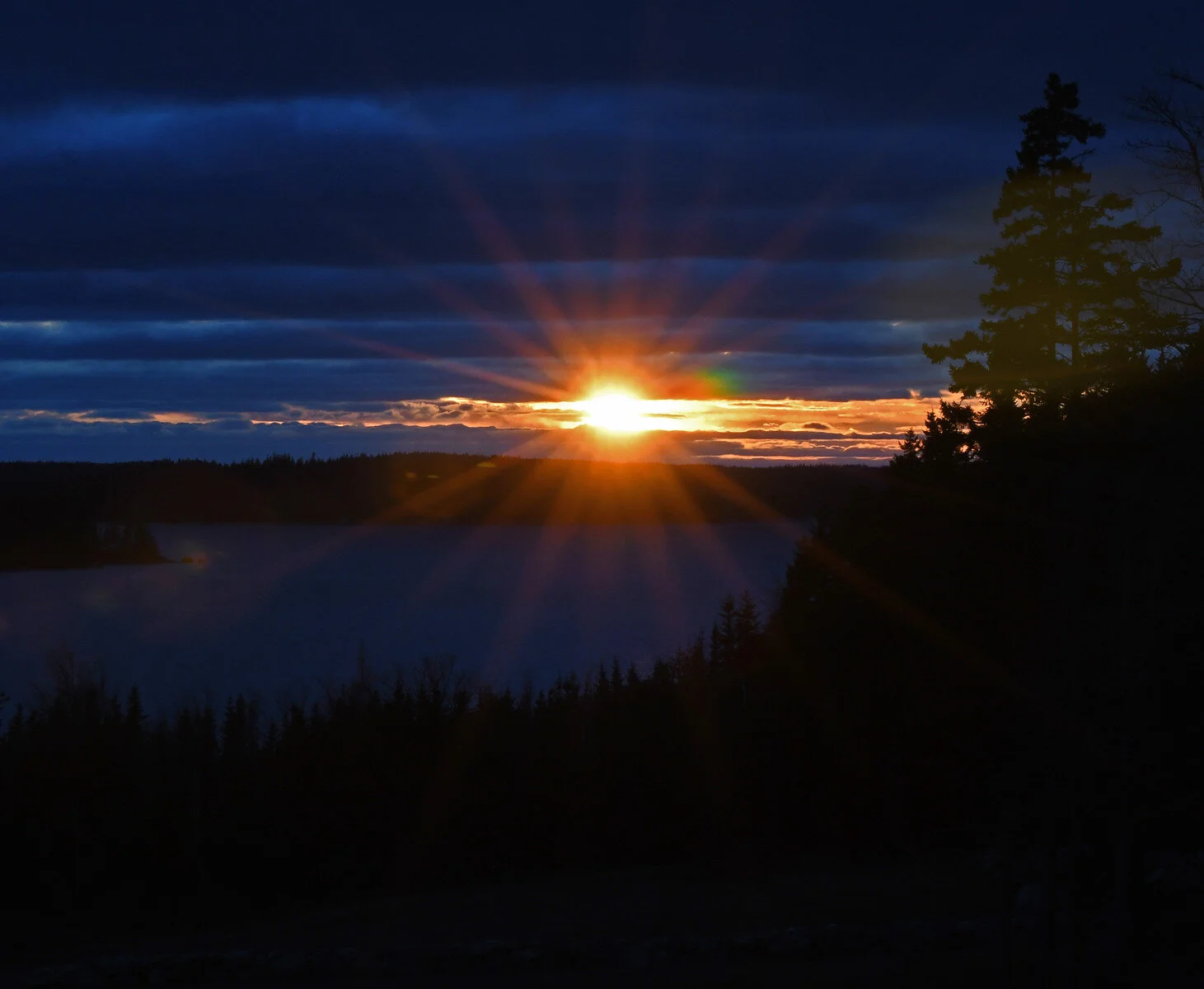
The sunsets here are much better than the evening news. This is last night’s sunset over Great Cove, Eggemoggin Reach, and Deer Isle.

i-Bf7PTjd-X3.jpg

As usual, winter’s lower sun rays, and clean air allow us to see farther and more of the red in our color spectrum. (Brooklin, Maine)

Comment

Comment

In the Right Place: A Glimpse

Yesterday, we got this glimpse of one of one of Santa’s Helpers on Back Road. This year, they’re coming in by boat to avoid state Covid 19 quarantine requirements and restrictions on sled flights.

i-HwDPxWq-X3.jpg

(Brooklin, Maine)

Comment

Comment

In the Right Place: Tricked Out

Here, we see Long Set this morning in Naskeag Harbor after surviving a significant storm last night and this morning. There was torrential rain and wind gusts of 40 miles per hour.

i-x8zZ99w-X3.jpg

Much of Brooklin was without central power from late yesterday afternoon to about 11 a.m. today. (Many residences here have electricity generators for such times.) Note that Long Set is tricked out as a scalloper now, with mast, boom, and winter shedding hut. (Brooklin, Maine)

Comment

Comment

In the Right Place: Dee-Lights

Posted December 5, 2020

It’s still warm here and we’ve had steady, almost pleasant, rain all morning. Yet, lately, our Black-Capped Chickadees seem to be starting to store seeds. Some old-timers say that this means that things are going to start to get cold and nasty soon.

1.jpg

These birds get their family name from their complaints, which the one shown here is doing. They sound like a kazoo playing “chick-a-dee-dee-dee.” The more “dees” at the end, the more alarmed or annoyed the bird is. A frantic and repeated five-dee complaint might mean that a hawk is nearby.

3.jpg

Of course. this species of Chickadee, the state bird of Maine and Massachusetts, gets its first name from the black cap that it likes to wear pulled down over the ears.

2.jpg

(Brooklin, Maine; Leighton Archive images used)

Comment

Comment

In the Right Place: Roiling

This is the mouth of Patten Stream in Surry yesterday, spewing roiling waters into Patten Bay.

1.jpg

Our streams are mostly full now, thanks to several deluges in November. However, we still need more precipitation before the ground freezes deeply.

2.jpg

(Surry, Maine)

Comment

Comment

In the Right Place: Screaming

We’re seeing Blue Jays congregate in groups here, probably for protection (more eyes and ears) from raptors that can see them better now that the leaves are down.

1.jpg

These bright birds have their own trick to take advantage of other birds, especially near feeders. They first try to swarm competitors. If that doesn’t work (and it usually doesn’t with Northern Cardinals), they do a very good imitation of a Broad Wing Hawk scream.

2.jpg

That usually clears the area, even though Broad Wings have migrated south. (Brooklin, Maine; Leighton Archive images)

Comment

Comment

In the Right Place: Clapped Traps

These lobster traps were stacked in Naskeag Harbor's shallows before yesterday’s storm here, ready to be piled on a trailer at low tide and carried away for winter storage.

1.jpg

Then, the storm came with 43-mile-per-hour gustsand produced this sight yesterday afternoon:

(The storm-scattered traps had been picked up by this morning.)

Usually, there is no problem with leaving traps on the beach; they should stay in place due to their weight, which ranges from about 45 pounds to 65 pounds depending on size. You don’t want to lose one – new ones cost about $55 to $70, according to current advertisements. (Brooklin, Maine)

3.jpg

Comment

November Postcards From Maine

6 Comments

November Postcards From Maine

This November was milder than usual here in Brooklin, Maine. Our average temperature in Fahrenheit degrees was 56 with a high of 70 on one day and a low of 20 on two days. Our one and only snow storm was just a duster on November 3. Below, you see Acadia National Park across Blue Hill Bay on a sunny day. You also see the snow-dusted woods during the storm and two local ponds, one after the snow and one in sun.

1.jpg
4.jpg

We did have quite a few days of blustery winds that whipped up the coves and grasses. The highest November gust recorded here was 53 miles per hour, which occurred yesterday.

7.jpg

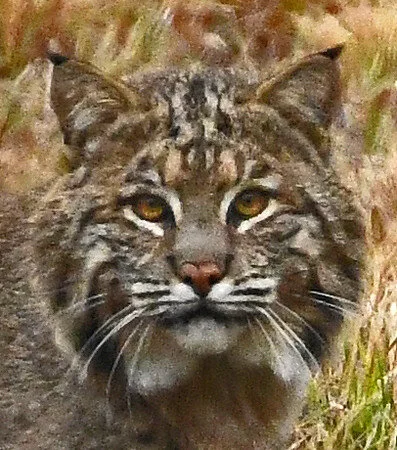
In terms of wildlife, November was the best month of the year for one reason: I finally “caught” the big male bobcat that I’ve been trying to “shoot” for years. He usually travels at dusk or later in the night, but, on November 6, he was slinking across our field while I was hidden near there with a big lens. He heard the clicks, looked my way, and slinked off into the woods.

15.jpg
16.jpg

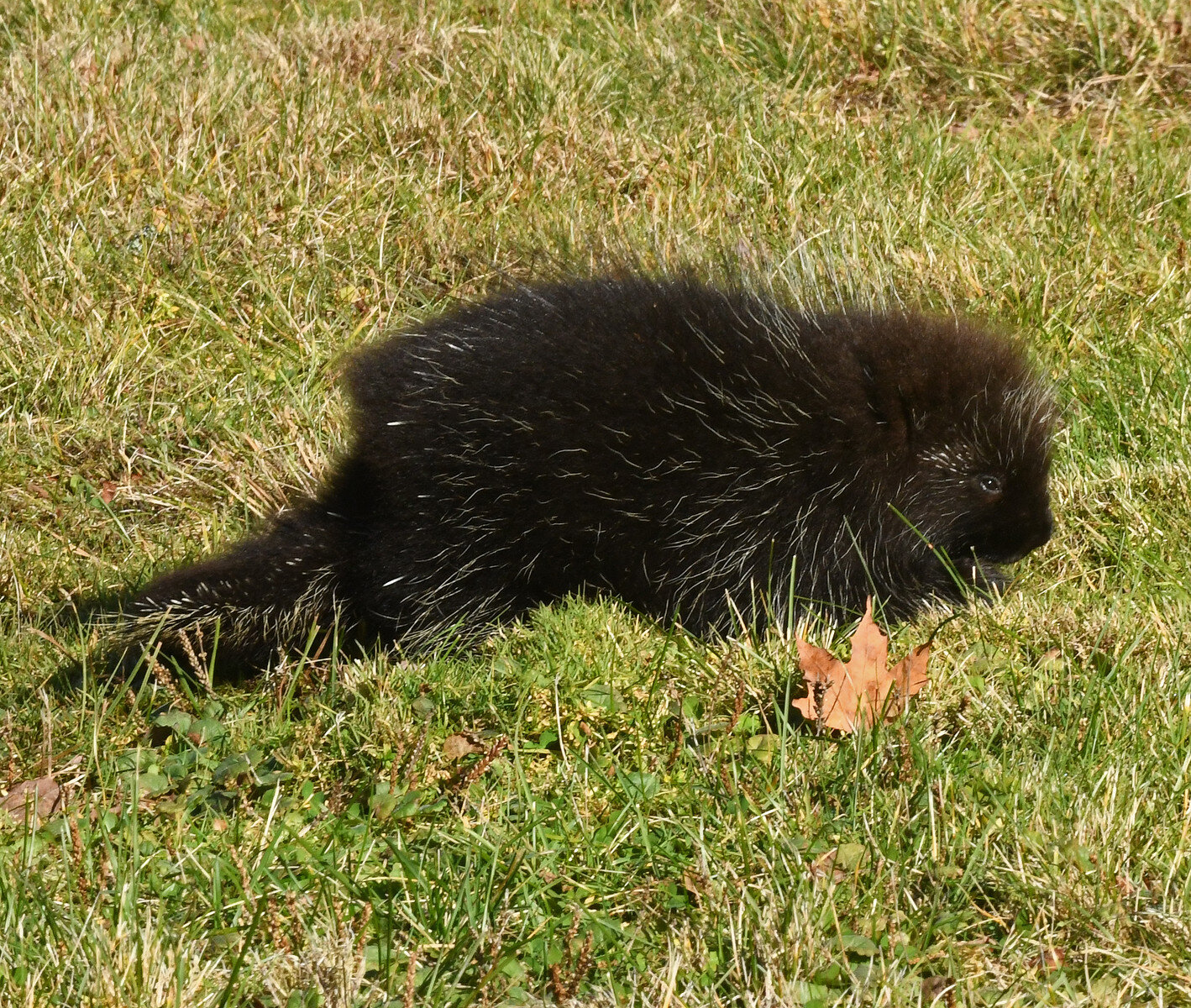
The snow shower didn’t slow down any of the White-Tailed Deer that consider Barbara’s garden to be a charity kitchen, nor did it bother our resident porcupine pup that refuses to leave our property despite multiple incentives.

Due to our mild October and November, many trees had not turned color when the snow storm came early in the month. The leaves on the sugar maple below were green when the snow came. They soon turned yellow and dropped. Our famous Camperdown elm in Brooklin Cemetery, however, dropped its leaves in October and was ready for the snow in November. The leaves on Amen Farm’s signature weeping beech also turned and dropped during November.

20.jpg
11.jpg

Winterberry and vibernum bushes also got caught with some of their leaves on when the snow came.

29.jpg

Among the most colorful inhabitants of our woods has been, unfortunately, invasive Asian bittersweet, which kills native trees and bushes.

30.jpg

November on the waterfront is when many of our fishermen pull their lobster traps and store them for the winter.

34.jpg

Some fishermen will also store their boats and pursue other goals during the winter. Others refit their lobster boats with a mast and boom and the rest of the equipment to dredge for delicious scallops in November, when that season starts in earnest.

37.jpg

November is a voting month and this one was special: a Presidential election during a pandemic. Below, you see Brooklinites wearing masks and practicing extra-large social distancing as they line up to vote at the Town Office. (We’re aware of no Covid 19 cases in Brooklin, as of this writing.)

44.jpg

The prime of deer hunting season is in November (bucks and does with the right permit). The harvested animals have to be weighed and tagged at an authorized inspection station.

Of course, Thanksgiving occurs in November, plague or not. Many here decided to stay isolated and send Thanksgiving cards, rather than have their family members try to come in from out of state. There also is November’s Beaver Full Moon, which occurred last night, but was not visible due to wild storms. However, we have the next best thing — the virtually full moon that flew over through a clear November sky two days ago.

Speaking of clear skies, the winter skies in Maine, starting in November, are among the cleanest there are. That absence of haze, dust, and other pollution helps create the most colorful sunsets of the year here.

i-QdkvRBK-X4.jpg

(All images here were taken in Brooklin, Maine, in November 2020.)


6 Comments

Comment

In the Right Place: Seeing Red

Here, we see yesterday’s sunset over Great Cove and Eggemoggin Reach, with the sun disappearing from view behind Deer Isle. Sunsets here are among the best in the colder clear air of winter. Clear air is one of the keys to beautiful sunsets. Dust and other pollution, as well as haze, dull air colors.

i-QdkvRBK-X4.jpg

Clear air is not the whole story behind a good sunset, however. Basically, when the sun is low on the horizon in our eyes, its light is traveling to us through more air than during the day when the sun is high and closer. The longer the sunlight’s journey to us, the more air molecules it has to scatter. It scatters more violet and blue light out of the illumination that reaches us from far away, leaving more yellow, orange, and, especially, the longer red light waves for us to see. (Brooklin, Maine)

Comment

Comment

In the Right Place: Workout

Here, you see this morning’s low and late November sun light finally illuminating an important patch of woods at 8:30 a.m. The mossy patch is the end of at least three White-Tailed Deer trails. Their paths wind under 60- and 70- foot Balsam Firs and Black Spruce that have outgrown their original branches.

i-VvqHLqD-X3.jpg

This also is the edge of the woods, where the deer stop, look around, and emerge into the open where the grazing is better. For several days, I’ve watched this spot for at least an hour, not moving when does and their yearlings come by without seeing me. I’m waiting for a big buck to appear before I click the shutter. I’m also giving my patience its much-needed morning workout. (Brooklin, Maine)

Comment

Comment

In the Right Place: Wakeup Calls

Here, you see a waterfowl hunting boat being positioned onto its trailer in Naskeag Harbor yesterday. Apparently, the men were returning from a morning hunt while hidden off one of the islands in Eggemoggin Reach.

1.jpg

Waterfowl hunting is highly regulated in Maine. The allowable seasons vary by species and state hunting zones, but November and December seem to be the months when much of that shooting takes place in the waters around here. We often wake up to “boom-boom-booms” from the Reach then. (Hunting hours begin at 30 minutes before sunrise.) (Brooklin, Maine)

Comment

Comment

In the Right Place: Fine Dining

Our White-Tailed Deer are doing some serious grazing now that the days are getting colder and the greens are getting scarcer; a few are already starting to eat woody fodder. Whitetails need to consume food almost constantly when roaming their home range. (Defensive instincts keep most deer moving, albeit slowly when they find good fodder and no potential predators are sensed.)

1.jpg

The National Deer Association reports that, on average, Whitetails need to eat 6 to 8 percent of their body weight daily. That’s about 9 to 12 pounds a day for a 150-pound doe or buck! Above, you see a well-groomed doe browsing in our South Field on Wednesday (November 25). Here she is when she first noticed us:

2.jpg

(Brooklin, Maine)

Comment

Comment

In the Right Place: Bag Lady

These are some of our Thanksgiving table flowers for a dinner for two (and a zoom family get-together). It’s just amazing what Barbara can do with a $9.99 bag of supermarket flowers.

i-vtBm8j4-X4.jpg

(Brooklin, Maine)

Comment

Comment

In the Right Place: Whippings

This was Great Cove a few minutes ago on this clear November day.

1.jpg

The temperature was 34 degrees (F) and a northwest wind was gusting at 29 miles per hour, whipping the water and grasses (common reed).

2.jpg

(Brooklin, Maine.)

Comment

Comment

In the Right Place: Crowded Freedom

Here, you see a patch of nearby woods that even the skinniest deer would agree is tough going.

1.jpg

We’re surprised at how much it resembles the crowded freedom in some paintings by abstract expressionists (e.g., Jackson Pollack). Unfortunately, the only color in this part of the woods comes from Asian Bittersweet, the serial killer that steals the life-giving sunlight from its neighbors, then chokes them to death.

Unfortunately, the only color in this part of the woods comes from Asian Bittersweet, the serial killer that steals the life-giving sunlight from its neighbors, then chokes them to death.

2.jpg

(Brooklin, Maine; images taken November 19, 2020).

Comment

Comment

In the Right Place: Department of Defense

Here, you see American crows starting to collect Friday (November 20) on one of their favorite roosting trees, a weeping beech.

z.jpg

The crows that have decided not to migrate are starting to form their winter communities here. In the spring, summer, and early fall, they maintain extended family territories that they defend against other crows.

As it gets cold and the leaves disappear, however, many nonmigrating crows from inland will come to the coast, somehow knowing that food-rich tidal zones usually are not buried in snow.

Leighton Archive Image

Leighton Archive Image

The formerly unneighborly resident crow families will create roosting areas with these inland birds and other “foreign” crows. They huddle through the winter nights with them. Why?

x.jpg

The leading theory is that crows sense their increased visibility (hence, vulnerability) in leafless trees. Their primary predators (other than humans) are great horned owls and other large raptors. Owls can see and attack crows better during clear winter twilight nights. The more crow eyes, ears, and sharp beaks available, the better that the birds can warn and defend themselves in winter. (Brooklin, Maine)
Comment

Comment

In the Right Place: Mmmm-MMMM

Here, we see the Fishing Vessel Tarr Baby becoming one of the first (if not the first) of our lobster boats being refitted yesterday with a mast and boom for winter Atlantic Scallop dredging.

1.jpg

The scallop season here runs from later this month through March of 2021, depending on the type of scalloping (dragging a dredge or human diving) and the Maine zone in which it is done.

3.jpg

For those lucky enough to live on the Down East coast of Maine, it’s time to place your order for fresh scallops with your favorite fisherman. David Tarr, the owner of Tarr Baby, is one of several fishermen already advertising with signs and on FaceBook.

2.jpg

There’s nothing better for dinner than very fresh scallops, except perhaps very fresh lobster. But, soon we’ll have both here! Time to get out that recipe for lobster and scallop bouillabaisse. (Brooklin, Maine)

Comment

Comment

In the Right Place: Change

Here, you see part of the marsh pond on the WoodenBoat School campus yesterday. It’s mostly iced up after a cold night and morning. If your eyes are very good, you’ll be able to discern a few Canada geese crammed in an area that has not yet frozen, probably because of their activity.

1.jpg

Below, you can see the pond the day before yesterday, prior to its icing:

2.jpg

Historically, the pond has been totally covered with thick ice by December, except (sometimes) for one or two river otter portals. The variable Climate Change weather has been changing that. For instance, this morning’s warm spell (47[F] at 9:45 a.m.) has been melting the ice and giving the thankful geese some paddling room. (Brooklin, Maine)

Comment