Comment

In the Right Place: Reminders

After a morning of dispirited snow flurries yesterday, the afternoon northwest winds whipped the overcast into cumulous cream pastries, giving the sun enough space to create a bright winter’s day.

Here, we’re looking southwest from Great Cove Ridge, down a fallow field, over a small firepond, and through the south entrance to the Cove. We can imagine that we see infinity beyond. It’s a place that attracts many sailboats during a normal summer and many shore and water birds now.

A.jpg

Below, we’re at the other side of Naskeag Peninsula on Amen Ridge. We’re gazing northeastish over another fallow field, across Blue Hill Bay and some of its islands, to the face of Cadillac Mountain. Cadillac is in Acadia National Park, which breaches out of Mount Desert Island like a dark whale.

B.jpg

These are everyday sights for some of us lucky people. But, we have to remind ourselves constantly how precious they are. (Brooklin, Maine)

Comment

Comment

In the Right Place: Cheap Thrill

Today’s morning weather was strange here on the Maine coast. It started off February-gray; then, snowed a little; then, the sun poked through the overcast while it was snowing; then it stopped snowing, and now, from time to time, the sun leaks through thin spots in the clouds as they sweep by. If it gets stronger, it will melt all the snow we have covering the ground.

i-RCv9kqq-X3.jpg

And, oh yes: we have daffodils blooming. Well, in the spirit of full disclosure, the flowers are “mini-daffodils” that sell for $3.99 a pot at the supermarket. You should also know that they’re misleadingly labeled “From America,” which probably indicates Central or South America. (Brooklin, Maine)

Comment

Comment

In the Right Place: Purity

Here, we’re looking at sea ice during low tide in Blue Hill Bay. As the tide rises, the ice will rise on top of it like a tattered silk robe. Then, most of its tears will heal themselves and there will be a layer of fairly (but not completely) uniform white ice atop the water.

i-mKNWTRB-X4.jpg

For the past decade, it seems, we’ve been getting less and less sea ice, which corresponds to the increases in our ambient and water temperatures. This winter, so far, the sea ice seems to have appeared only in nooks and crannies in the coves and harbors, if it appeared at all. Oldtimers will tell you about the miles of thick sea ice that used to appear on open water and support carriages and trucks driving to the islands.

Due to its salt content, sea water doesn’t freeze until the temperature drops to 28.4 degrees (F) and stays there or below for some time. During the process, the ice is purified and can be melted into drinkable water. (Blue Hill; image taken January 25, 2021)

Comment

Comment

In the Right Place: Now You See it, Now You Don't

Funny thing about Snowy Owls: When I get out a big heavy lens on its big heavy tripod and put on my big fluffy winter clothes with my big-treaded climbing boots and go huffing up some small trail on a big windy mountain where several Snowies have been reported … I hardly ever see one.

However, I can be in my car at Trenton (Maine) airport; notice a deformed power line pole; then, notice that the pole really isn’t deformed; then, nearly kill myself getting camera equipment out of the back of the car and put together, while audibly praying that the big white bird atop the pole will act the way it should and not fly away.

7.jpg

That’s what happened here – several years ago in February – when this apparent female or juvenile Owl went back to sleep after determining I was going to stay at a safe distance. I’m still trying for a 2021 Snowy.

8.jpg

Snowies usually hunt at night and rest during the day. When resting, they don’t move much to avoid being noticed, especially by a Bald Eagle, which probably won’t stay at a safe distance.

They come from Arctic areas where there often are no trees to perch on, so they tend not to differentiate a power pole, roof, or large rock, so long as it gives them a panoramic view. Many of the young ones probably have never seen a human until they get to the right latitudes; so, they may let people get too close for the Owls’ own good. Give them plenty of room. (Brooklin, Maine)

Comment

Comment

In the Right Place: All's Well That Ends Well

POSTED FEBRUARY 3, 2021

We drove around a bit today to see if yesterday’s well-hyped Nor’Easter snowstorm did any damage on Naskeag Peninsula. It didn’t, as far as we could see. It did leave a little snow on this mobile Christmas (aka Holiday) wreath that is still expressing good cheer.

1.jpg

It also left a bit on the immobile sailboat that apparently is a dormant garden now:

But, there weren’t any toppled trees or power lines down, as far as we could see. (Brooklin, Maine)

Comment

Comment

In the Right Place: To Pull or to Push?

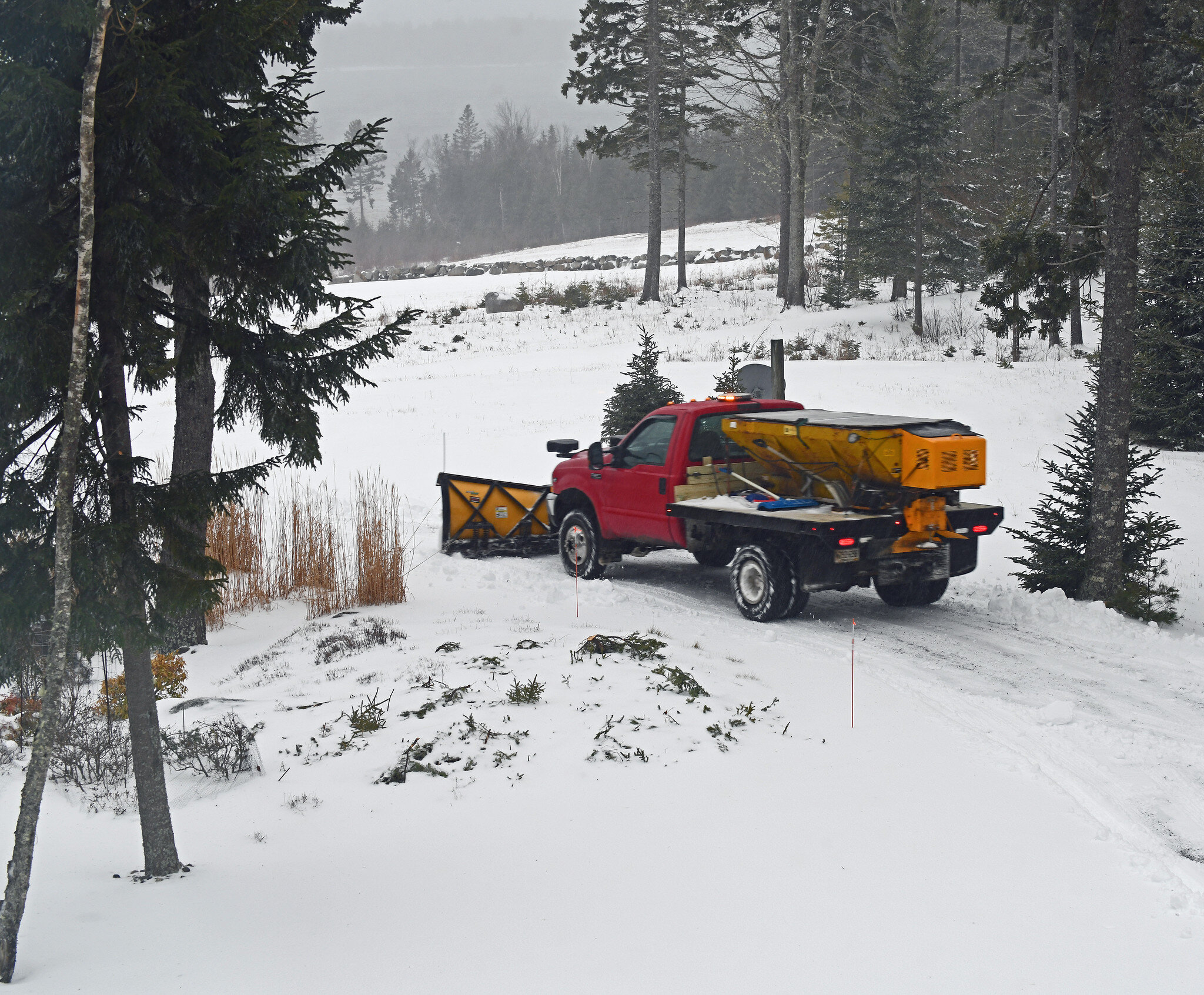
The much- trumpeted Nor’Easter that swept into New England last night and this morning was an ugly storm at its strongest and still remains an ugly dribbler of rain, sleet, and soft snow. Here, we see Jerry Gray’s truck plowing our driveway this morning.

1.jpg

Did you ever wonder what snow-swept Mainers did before snowplows? It turns out that Maine was a leader in developing ways to get rid of snow. Initially, communities recruited armies of shovelers.

This was followed by two contradictory methods. One was to pack the snow down so that traffic could travel on it. Teams of horses or oxen (and tractors later) would pull heavy logs or heavy wooden rollers over the snow to make it as hard as rock.

The other was for the animals or tractors to pull a “snowplane,” a contraption that looked like a huge carpenter’s plane made of wood and a blade with side funnels; it would shave the snow off roads and dump it onto the roadsides.

As trucks with strong engines developed in the 1900s, a conceptual breakthrough happened: Why not push a plow rather than pull it? The credit for inventing, patenting, and building large truck and tractor plows with internal controls goes to Don A. Sargent of Bangor, Maine.

2.jpg

In 1948, Dean Fisher of Rockland, Maine, began making smaller plows that could be attached to jeeps and, later, pickup trucks. They were operated by more sophisticated hydraulic lift controls. These became the model for improvements that continue to this day in Fisher and other plows (Brooklin, Maine)

Comment

January Postcards From Maine

4 Comments

January Postcards From Maine

January in our part of Maine is a time for many to remember Christmas. Mostly, they do so by leaving their Christmas (aka Holiday) wreaths up all month and, sometimes, in unusual paces. Actually, a good number of Mainers remember Christmas that way until the end of March.

32.jpg

January, historically, also is our snowiest and coldest month. However, in the past few years, the month has not been nearly as cold or snowy as in past years. This year, we only had two plowable snow storms, both of which were lovely and short, but enough to decorate the scenery when the sun came back.

1.jpg
2.jpg

Part of the scenery that looks good decorated in snow is our country lanes that wind through the srpuce and fir woods and almost always end at the sea.

8.jpg

The winter waters here are especially intriguing in their various January forms. The full and fast streams have snow garlands. The coves and bays into which the streams flow, sometimes are a study in gray or blue contemplation; at other times they’re places tormented by rain and wind-whipped waves. There also are the ice-filled ponds, which weren’t safe enough to skate on until very late in the month.

46.jpg
3.jpg
i-3BDbtgf-XL.jpg

Speaking of water, many of our fishing vessels remained in the cold January waters, some looking just as they did in summer, but used by oxygen-tank-equipped divers to hand harvest high-priced “Divers’ Scallops.” Others have been rigged with a mast, boom, and dredge to drag for scallops. On the other hand, a good number of vessels go “on the hard” and rest in the winter like wooden bears..

19.jpg
18.jpg

Our wild turkeys, white-tailed deer, and mallard ducks don’t rest during January. The deer fawns are especially interesting as they encounter their first winter with plenty of perkiness.

16.jpg

As with December, The cold, dry clarity of January skies often produces stunning sunsets and afterglows. January also is the month of the full Wolf Moon, which American Colonists thought (incorrectly) attracted the attention of wolves and made them howl. This year, the Wolf Moon was behind clouds here; however, the next night was clear and the moon then was virtually indistinguishable from a full moon, as you can see below.

40.jpg

As January left us last night, there was news that February will arrive on the winds and snow of a major storm. We’ll see.

(All images here were taken in Down East Maine during January 2021.)

4 Comments

Comment

In the Right Place: Steaming Plus

Common Eiders have a design problem, which they try to overcome with two distinctive defensive moves. Their problem is that their bodies are too heavy and broad to overcome their “bow” waves and get enough “hull” speed to fly up quickly when they sense a predator in the water (e.g., a seal), air (e.g., bald eagle), or land (e.g., human).

Rather than try to fly up, they collect closer in their group (a “paddling” of Eiders) to make it difficult for a predator to isolate on a single target, as do zebras.

X.jpg

Then, as you see here with these Eiders in Blue Hill Bay, they perform their first distinctive maneuver, what researchers call “steaming”: they increase speed by using their wings as oars that both propel them and lift them up a bit.

If need be, they convert their steaming into what has been called by researchers “paddle-assisted flying.” (See them beginning this in the image in the first Comment space.) In this maneuver, they lift off the water, but stay low and use their powerful legs to assist their air-beating wings in giving them more speed to skim over the water. (Brooklin Maine; Leighton Archive images used)

For more on this subject, see: Gough, et al., “Aquatic burst locomotion by hydroplaning and paddling in common eiders (Somateria mollissima),” Journal of Experimental Biology 2015 218: 1632-1638; doi: 10.1242/jeb.114140

Comment

Comment

In the Right Place: Sky Performers

Here, we see last night’s spectacular moon sailing over Naskeag Peninsula at about 10 p.m. in 14-degree weather with a wind chill of 4 degrees. It was a virtually full moon. The actual January full Wolf Moon was the night before last night, but it was hidden behind mounds of clouds here.

X.jpg

Below, you’ll see last night’s sunset, which did a credible warm-up act for the moon:

Y.jpg

The Old Farmer’s Almanac reported that the American Colonists named this month’s full moon the Full Wolf Moon, which still is the most common name for it. The name reportedly was based on the Colonists hearing wolves howl around their settlements when there was a full moon in January. Their basic concept, apparently, was that the full moon drives wolves a bit crazy in the harshest month of winter and the wild canines instinctively howl at the glowing orb then.

This, of course, is nonsense. Wolves howl anytime that they have a need to, day or night, and seem to pay no attention to the moon, itself. They howl to contact other members of the pack, to warn other packs to stay away, to call their pack for a hunt, and for other reasons. They are motivated by the moon’s light, which gives them an opportunity to see better and to call together their pack for a hunt then. (Brooklin, Maine)

Comment

Comment

In the Right Place: Form Follows Function

Frequent visitors to Naskeag Harbor will recognize this abstract artform.

1.jpg

It’s also functional art – part of the hoist for lifting and loading lobster traps and other things off or on to the fishing vessels when the tide is too low to pass them over by hand:

2.jpg

Brooklin, Main, images taken January 19 1nd 21)

Comment

Comment

In the Right Place: History Is Not Prologue

It’s finally acting a little like January in Maine around here – but nothing like historical Maine Januarys. It snowed a few inches overnight into the morning yesterday, a nice, sticky little coating that you can see in the images here.

F.jpg

Today it has been snowing since early morning – fine, dandruff-like flakes that are having trouble hanging onto spruce and fir needles, probably because the temperature has been hovering at or above 32 degrees (F). The forecast is for the snow to continue all day into the night.

Historically, January has been Maine’s snowiest month. Overall, during this month, we have had about 50 to 70 inches along the coast and 60 to 110 inches inland. According to National Oceanic and Atmospheric Administration location-based records for 1983 through 2010, nearby Acadia National Park averaged 23 days of snow in January, which accumulated to 72 (71.8) inches for the month on average. We’ve had nothing like that since climate warming has arrived. (Brooklin, Maine)

Comment

Comment

In the Right Place: Fetus

Here, we see one of “our” White-Tailed Deer fawns prancing in our North Field yesterday. She’s one of a pair of twins born last summer who doggedly follow their mother on her rounds in the neighborhood. (Fawn sex assumed.)

A.jpg

These youngsters are experiencing their first winter and seem to be enjoying it. It snowed a few inches here overnight and continues to do so intermittently this morning; but, the twins are large enough now to navigate in the snow. Which brings us to a nomenclature question.

B.jpg

There apparently is a bit of a debate as to whether our twins are too large to be “fawns” and, therefore, must be “yearlings.” As far as I can tell from the biological reports, a White-Tail has to be between one and two years old to be a yearling; hence, their name, “yearling.”

Deer younger than a year, such as the twins, are still “fawns” and fawns do not have to be tiny with spots. (However, they’re cuter and more memorable when they’re tiny and spotted. Here’s an archive image of a spotted fawn taken last August in the same field:

D.jpg

By the way, the noun “fawn” is derived from the Old French word “faon,” which is based on the Latin “fetus,” meaning offspring. (Brooklin, Maine)

Comment

Comment

In the Right Place: Tipping

As we speak, these and many other Christmas (aka Holiday) wreaths still are being displayed around here on public buildings, homes, barns, and in the most unusual places.

X.jpg

In fact, quite a few wreaths will remain displayed until at least Easter. Why are they displayed so long? The most frequent answer goes something like this: “Well, my great-grandparents, grandparents, and parents did and, besides, I like them and they smell better than plastic.”

Y.jpg

Mainers also should be proud of them. The State reportedly is the leading producer of balsam fir wreaths and greens in the United States and probably in the world. It’s a commercial and cottage industry here that is perhaps best known for donating all of the wreaths on the veterans’ markers in Arlington Cemetery. And, it’s a sustainable industry – only one to two feet of branch tips are cut (by “tippers”) without killing the trees. (Brooklin, Maine)

Comment

Comment

In the Right Place: Twinkle, Twinkle Little Aperture

RJL_7148-Edit.JPG

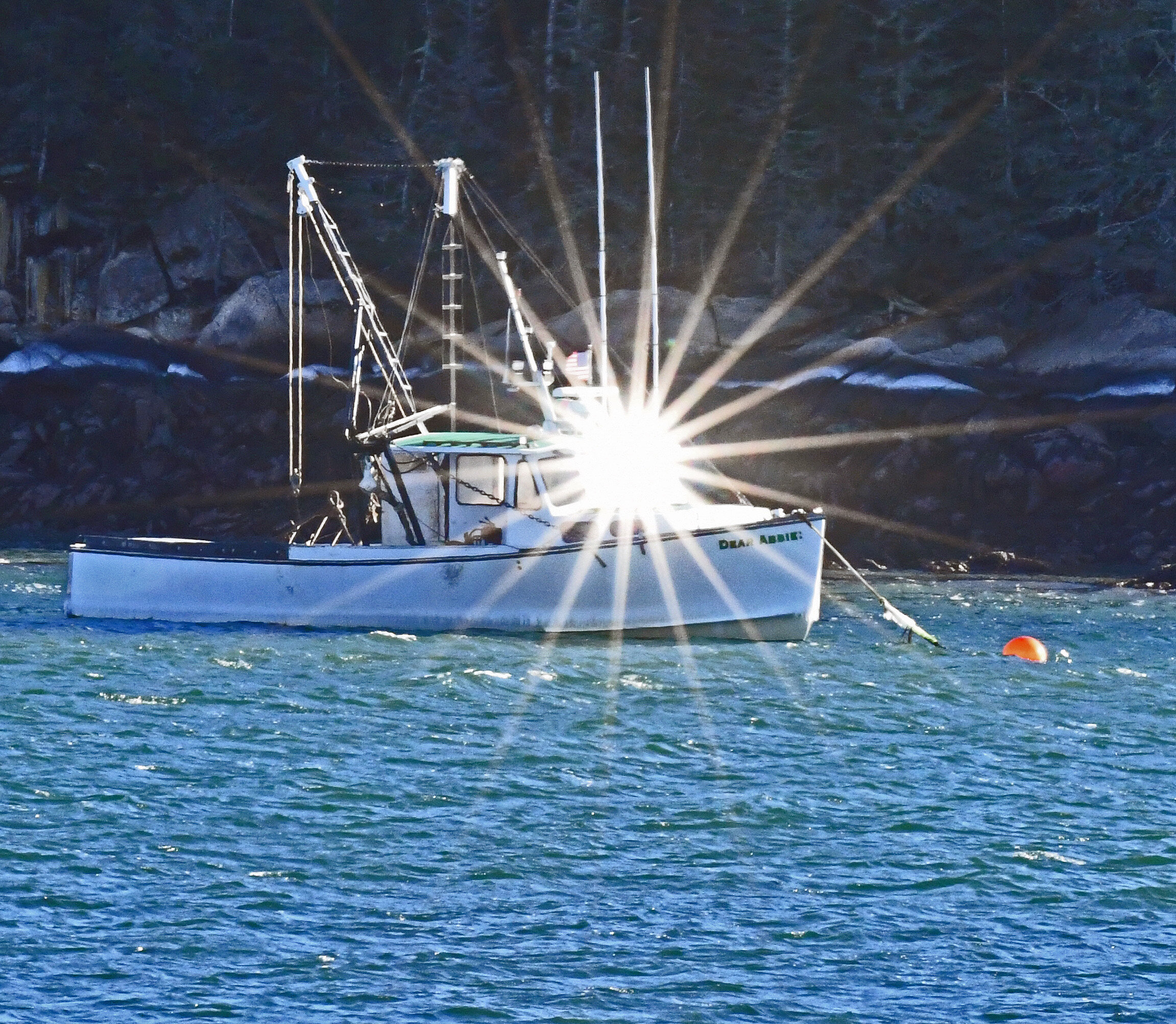
Yesterday, the conditions were right for shooting sun stars off the cabin windows of “Dear Abbie:” She was facing generally toward the low sun and swinging slowly on her mooring in Naskeag Harbor. At intervals, she would come around and face directly into the sun rays and her windows would become a huge glaring ball that would block out everything from cabin to bow and make watchers’ eyes wince closed.

Sun stars are created by the aperture that lets light into the camera when its blades whirl open. They’re not created by the sun or the reflecting glass. When intense light passes through a small aperture and is diffused across the opening aperture blades, the blades will create the points of a star on your image.

RJL_7149-Edit.JPG

The more blades, the more star points; the straighter the blades’ edges, the sharper the star points; the smaller the aperture, the clearer the star. This image was taken with an aperture of f22 and an aperture opening speed (“shutter speed”) of 1/200th of a second. (Brooklin, Maine) Click on image to enlarge it.

Comment

Comment

In the Right Place: Branding

Here, we see snow-bordered Patten Stream chortling south from Lower Patten Pond toward its mouth, where it empties into Patten Bay in the town that used to be called Pattensborough. The town is now Surry, Maine.

3.jpg

Two things are illustrated here. First, there’s plenty of water in this wooded stream (and others) in our area. Curiously, we’ve been getting more precipitation than average; yet, in much of Maine, this January (so far) has been one of the 10 warmest we’ve had.

2a.jpg

Second, somebody named Patten once lived around Surry and he wasn’t modest about people knowing it. That would have been Captain Mathew Patten, Surry’s (Pattensborough’s) first settler and an apparent believer in self-branding.

The Captain arrived in the unsettled area in his coastal schooner sometime in the 1760s. He bought his first 100 wild acres there in 1767 for very little money. Thus began his life as a successful land speculator and a supplier of goods for the settlers. He would use his schooner (later schooners) to deliver timber cut by the settlers to Boston and points in between and return with goods not available in the wilds of Down East Maine.

2b.jpg

(Surry, Maine; images taken Friday [January 22])

Comment

Comment

In the Right Place: Gambles

Here, we see one of several local ponds yesterday with ice skaters trying their skates for the first time this year – and, for the first time ever, mostly wearing plague masks.

x.jpg

Skating (thick) ice has been late coming this year due to temperature fluctuations. However, yesterday was one of those beautiful winter days when even Herring Gulls wanted to the on the ice:

y.jpg

Nonetheless, we’ve had at least two reported near-fatalities with people falling through thin ice last week, according to Game Warden reports in the Bangor Daily News. The Wardens say that ice that is two inches or less thick is definitely not safe to skate on, but four or more inches is safe. They don’t say whether three inches is worth the gamble. (Brooklin, Maine)

Comment

Comment

In the Right Place: Watch Out

We had a dusting of snow very early this morning that already has melted away in many places – except places like this with tempting untrammeled snow that you don’t want to walk on. Why? Because there is slippery ice below it; and, below that, very cold water. This bog is part of Maine’s many wetlands.

x.jpg

The State government reports that 25 percent of Maine's land area is wetlands, four times the wetland area of the other five New England States combined. Over five million acres of Maine's wetlands are freshwater wetlands, which are defined as wooded swamps, shrub swamps, bogs, freshwater meadows, freshwater marshes, and floodplains. Only 157,500 acres are tidal or coastal wetlands, which are defined as tidal flats, salt marsh, freshwater/brackish marsh, aquatic beds, beaches, and reefs. Among the many benefits of wetlands is that they are home to myriads of wildlife, including endangered and threatened species. (Brooklin, Maine; image taken January 20) Click on image to enlarge it.

Comment

Comment

In the Right Place: Treasure Hunt

Many boats are in winter storage buildings or shrink-wrapped now and you don’t get a chance to see them. We were lucky Sunday, January 17, to get a peek at this green-hulled jewel in storage at the Atlantic Boat Company.

011721.jpg

Her name is “Kismet” and she’s 27 feet in overall length with a beam (widest part) of about 8 feet, according to her owner, Bruce Fowler. She hails out of Brooklin now, but she was built in 1995 on the west coast and designed by Bill Garden, based on the designs of fishing trawlers there. (Brooklin, Maine)

Comment