
This image of a Spotted Salamander appeared yesterday in our monthly column in the Ellsworth American.
To read the column, click here: http://www.5backroad.com/montly-column
JOURNAL
This image of a Spotted Salamander appeared yesterday in our monthly column in the Ellsworth American.

To read the column, click here: http://www.5backroad.com/montly-column
As we speak, the overcast here is thick and the horizon is gray, except for momentary flashes of sun trying to leak in through a weak seal. We’ve had a lot of days like this recently, including April 5, when the images here were taken.
In Naskeag Harbor, we see an empty summer house on Harbor Island, empty fishing vessel, and empty Town Pier:

In Great Cove, we see an empty WoodenBoat School pier and Eggemoggin Reach:

I’ve been searching for the right adjective that describes such a day beyond the one-dimensional “gray.” “Gloomy” or “Dreary” come to mind. Gloomy originates from the Scottish for “a sullen look.”
“Dreary” has a much more interesting history. It derives from the Old English for “sad” and “sorrowful.” However, “dreary” originally meant “cruel, bloody,” or “blood-stained.” It was used first in the sense of “lonesome, dismal, gloomy” by John Milton in his 1667 publication of Paradise Lost. (Brooklin, Maine; Online Entymology Dictionary used)
Here, we see a small part of a highspeed aerial fight on April 3 between a non-resident Common Raven who wandered into our area and some of our local American Crows who nest here. (Note that the Raven, lower right, is larger, has a stouter beak, and has a fan tail that is much more rounded than the Crows’.)

Within about 10 seconds of the stranger’s landing atop a high spruce here, one of our local Crows was attacking it and calling for help. The bigger Raven did a credible job defending itself, even when a second and third Crow joined the fight. But, the advantage tipped to the Crows when the fourth Crow screamed in. By the time the seventh Crow was strafing the stranger, the Raven’s tail had lost a feather and there was a loose primary feather in its right wing. It fled followed by a ridiculing mob of our crows warning it never to return.
These are large birds. A Raven will usually be about two feet long and a Crow almost a foot and a half. Here’s an image of a mature Crow:

Leighton Archive Image
Crows and Ravens regard each other as enemies, even though they are cousins in the same Corvid family. The primary reason, according to recent research, is that they both have been reared to rob the other’s nest of eggs or chicks and to otherwise compete for food and territory. That is, they know each others’ harmful habits. Most of their fights are initiated and won by the smaller Crows, who are better (indeed, magnificent) fliers and have learned to fight in larger numbers than the less communal Ravens. However, when the Ravens outnumber the Crows, it can be a bad day for the smaller cousins. (Brooklin, Maine)
Here, we see a stand of local woods playing with the light on April 2. They’re a mixture of evergreen balsam fir, spruce, and other conifer trees interspersed with gray- and white-barked maples, birch, and other deciduous trees and bushes that are not yet in-leaf.

April sunlight tumbles through the leafless branches onto the mosses and lichens, while at the same time creating darkness in the form of shadows streaking from the backs of trunks and treetops.
These woods can be wonderfully silent now, with no or few bird songs or people noises. It’s the kind of silence that comes when standing still and alone among the trees and a tingling comes from being touched by something primeval and invisible that is made of nothing that “lives.” (Brooklin, Maine)
This courting pair of Hooded Mergansers appeared in our field pond in April of 2017, the last time that we saw Hoodies there -- until last week. The 18-inch adults of this species are the smallest and oddest of the three types of American Merganser, but they’re the most handsome of the Mergansers in my opinion.

When excited, or just when they feel like it, Hooded Mergansers erect their proportionately massive hoods (crests, really), which contort their heads into tomahawk-shaped structures. This is particularly spectacular on the orange-eyed, black-faced male Hoodie.

When his crest is down, he sports a white racing stripe on each side of his head; when his crest is up, he wears a cresting moon in a black sky.

(Brooklin, Maine; Leighton Archive images used)
Happy Easter to all those who celebrate it religiously and/or secularly. Here, we see the Fuller Family driveway banner featuring an Easter egg in a nest, an old and interesting practice.

Although Easter is revered by Christians as a celebration of the resurrection of Jesus, it also historically has been celebrated as a time for exchanging decorated eggs and, later, building nests for the magic rabbit that lays Easter eggs, usually called the Easter Bunny in this country.
The custom of exchanging eggs at Eastertime has been traced to the early Christians of Mesopotamia, where eggs were symbols of fertility and new life. Western Christians would not eat eggs during Lent, but would exchange decorated ones and then eat them on Easter day. The concept of decorating the eggs was extended to the extreme in the 1800s by Russian nobility, which exchanged jewel- and gold-encrusted eggs on Easter.
As for the Easter Bunny, the leading theory is that the origin of that tradition was the pagan festival honoring Eostre, the fertility goddess whose animal symbol appropriately was a rabbit. The imaginative idea of exchanging “rabbit eggs” at Easter reportedly came from Germanic peoples.
They developed the custom for young children to enjoy Easter by making nests for the “Osterhase” (Easter Hare), which would come by while they were sleeping and lay decorated eggs in their nests. Apparently, in 18th Century German settlements in Pennsylvania, the Easter Hare was translated into English as the Easter Bunny for the children. (Brooklin, Maine)
In the Right Place: Becalming
Yesterday and today (so far) have been beautiful days, albeit chilly ones. Here, you see Great Cove yesterday, swirling its spring sea sequins to mesmerize onlookers. The “sequins” are millions of small water mirrors refracting the sky and scenery in different ways due to the sea’s movement. The calming effect on humans is real, according to a number of studies.

At a basic level, hues of the color blue are associated with producing calmness in many people. Further, staring at the moving ocean changes the frequency of the brain waves of many of us into a mild meditative (and often creative) state.
It also appears that the smell of ocean breezes contributes to our calmness, possibly by the inhalation of many negative oxygen ions. An overriding factor is that we’re conditioned to expect that watching the sea is calming; therefore, there’s a certain amount of culturally imposed influence, according to the reports.

(Brooklin, Maine)
This is the beautiful state of our bog yesterday, filled with an estimated 10 inches of water on average.

We’ve been having powerful rainstorms lately, but yesterday’s report of the U.S. Drought Monitor for Maine shows our Down East coast and parts of western Maine to be still “Abnormally Dry.” The hope is that additional rain will come and prevent us from slipping into the next stage, “Moderate Drought,” or worse in summer. (Brooklin, Maine)
March here on the coast of Maine is part winter, part spring, and part something indefinable. This March, we had beautiful clear days during which we could study Acadia National Park across Blue Hill Bay; plenty of rain that collected in the bogs and rippled down rain chains; intense fogs that washed our vision with a gray brush; light snow that soon disappeared, and freezing ice in the ponds and bogs that would melt and refreeze.


Great Cove was calm at times and agitated at others. The streams, full of rain water and melted ice and snow, rushed about their business, and our low tides provided opportunities for children to play pirates. (Two of the pictured children are from the same family and the third is their neighbor who is in the same anti-virus “bubble,” according to the mother or the brothers.)


Most of the exotic wildlife has not arrived here in March, but Red Squirrels and Herring Gulls are year-round neighbors and Common Eiders always take their winter vacations here.


Speaking of Herring Gulls, they take their wintry sun on the angles of New England Architecture in March and that architecture often can be seen best before the leaves come.


Cattail fences around iced-in ponds and Skunk Cabbage spathes rising out of bog water provide interesting contrasts, while Speckled Alder and Pussy Willow catkins provide plenty of promise. of big changes in April.


Around the waterfront, mooring gear patiently awaits late May or early June when it will be attached to the WoodenBoat School’s fleet of small boats in Great Cove. Lost lobster trap buoys, however, will remain part of a colorful collage created around a tree trunk. Most lobster boats that remain in the water during the winter have been converted to scallop boats, with added masts, booms, and shelling huts. There were some unusual vessels in the water during March, as well.


Among the traditional March events here are St. Patrick’s Day and the opening of Glass Eel season. Here we see an unusual pink flamingo St. Patty’s Day roadside banner that captures the eye and of the fine mesh of Fyke nets that capture the eels when the tide comes in.


Finally, we were lucky to have a fairly clear night to see the March full moon. It’s most commonly called the Full Worm Moon because it appears when worms are starting to wriggle in the ground. However, some call it the Full Sap Moon because Maple Tree sap also is starting to run and drip into containers to make syrup.

March was a good month here, all things considered.
(All images above were taken in Down East Maine during Marchl 2021.)
This is the full moon rising high over Great Cove at 1:11 a.m. this chilly morning. (Yes, I’m crazy.) It was approximately 224,777 miles above the Cove and at an angle that made it look a bit oblong.

The March full moon traditionally is considered the last winter moon. However, this one is the first spring full moon for those who believe spring arrived with the March 20 astronomical vernal equinox.
This moon is perhaps better known as the Full Worm Moon, based on the Native American seasonal names collected by The Farmers’ Almanac. It shines when worms (and grubs) are stirring in the soil and attracting robins. But, maple tree sap also often starts to run in March, so some call it the Full Sap Moon. (Brooklin, Maine)
Real estate signs promote a “water view” when they can. In Maine, that can be tricky. There are views of the Atlantic Ocean, bays, reaches, lakes, rivers, and “other” waters, not to mention coves and harbors withing those waters.
Here, as it appeared this morning, you see a view of a cove (Great Cove) protected by an island (Babson Island), within a reach (Eggemoggin Reach) – all of them as calm as a curled-up house cat in the sun.

However, below, you’ll see Great Cove yesterday being ruffled by 24-mile-per-hour wind gusts. Therein lies a joy of people who like to watch weather and are lucky enough to live on a reach.

A “reach,” geographically speaking, is a length or arm of an ocean, river, or other large body of water that extends up into the land. It often experiences complex winds that sailors love. Eggemoggin Reach is an island-congested channel extending from the Atlantic Ocean up and into Penobscot Bay. It has some of the best sailing winds in the world and some of the most interesting weather in Maine.

(Brooklin, Maine)
We’ve been monitoring this colony of Eastern Skunk Cabbage (Symplocarpus foetidus) spathes and buds at least once a week, as you may know. They appear to be doing very well in the bog. (Image taken March 27, 2021)

The wine-colored spathes protect a fleshy spike (“spadix”) of tiny flowers that attract pollinators, but usually are never seen by others. However, sometimes the spathes are trampled or eaten and the innards are revealed. See below:.

Leighton Archive Image
The pale, spear-like buds next to the spathes will start to unfold into bright green leaves late next month or in early May, as you see in these archive images:


Slowly, a three- or four-foot rosette of large, oblong leaves will be formed by late May or early June to provide shade and hiding places for the bog’s smaller creatures:.

Leighton Archive Image
(Brooklin, Maine)
Yesterday morning, this clever rowing platform was the only vessel in Great Cove. It’s a shame that more people didn’t see its interesting features.

In addition to its long sliding seat for more rowing power, it has an oar gear system that enables the rower to row looking forward without the awkwardness and slowness when trying that with standard oars and oarlocks. The gearing also enables the rower to see whether his oar blades are entering the water correctly on the power/pulling stroke.

(Brooklin, Maine)
This morning is one of those cool, clear Maine mornings that pulls at your eyes as you try to see more and more. So it also was on March 23, when this image of Connery Cove and its iconic boathouse was taken.

Here, the tide is rising and the granite coast ledges are beginning their twice-daily disappearance act, slowly transforming from being interesting to the eager sightseer into being dangerous to the unfamiliar mariner.
By the way, in the 1950s at least, this boathouse was white and had a large pier extending straight from its two side doors into the waters of the Cove. (Blue Hill, Maine)
Here, we see three male Common Eiders escorting four females at Blue Hill Falls on March 20. The number of these visiting Eiders seems to have dwindled down to less than 50 birds.

They’re leaving for their breeding and nesting grounds, which usually are on sparsely populated or uninhabited sea islands. Maine supports the largest breeding population of Common Eiders in the eastern United States and Canadian Maritimes.

Leighton Archive Image
The birds that we see here are American Common Eiders (Somateria mollissima dresseri), one of three Common Eider varieties in the Atlantic Flyway. The other two are the Northern Common Eider (Somateria mollissima borealis), which nests on the coast of Greenland and other northern latitudes, and the Hudson Bay Common Eider (Somateria mollissima sedentaria), which seems to be mostly confined to the Hudson and James Bay areas in Canada.

Some recent bird counts have indicated that Maine Eider numbers are down in the usual sighting places. One theory for this is that they are still at good numbers, but have shifted congregation and nesting areas due to human and other predator population shifts. (Female Eiders tend to be philopathic; that is, they return to breed on the island on which they were hatched unless there is a significant disruption.)
Another theory is that actual Eider losses have occurred because of reductions in Atlantic Blue Mussels, their favorite food, and/or increases in birds that prey on Eiders (especially Bald Eagles), and/or that prey on their eggs (especially Black-Backed and Herring Gulls). (Brooklin, Maine)
Naskeag Harbor at low tide is a good place to practice mountain climbing and to reach the summit on mountains that have barnacles to help footholds.

I’m not sure whether these boys are from one family (they were being supervised by one couple) or what Covid 19 guidelines (if any) might apply. Nonetheless, it was a pleasure to see them enjoying rigorous exercise in the outside air, rather than being hunched over video games at home. (Brooklin, Maine)
Pound for pound, Maine’s most valuable fish is an energetic baby eel known as a glass eel or elver. The price of these babies is controlled by market ups and downs, but they’ve been known to reach over $2,000 per pound of squirming infants in a great year. They’re sold to Asian importers who raise them and resell the mature eels for delicacies.
They’re American Eels (Anguilla rostrata) thought to be migrating from their parents’ salt water breeding ground in and around the Sargasso Sea to their parents’ fresh water maturing streams and ponds in Continental America. At some time after maturity (usually years), they’ll migrate back to the breeding grounds and die there after breeding. Thus, they are “catadromous” fish that have life cycles in fresh and salt waters.
Their Maine fishing season opened Monday, March 22, and will end June 7. The season is timed for the eels’ arrival here from their long trip. Methods for harvesting them are limited to hand-dipping nets and “Fyke” nets (usually pronounced “Fick” nets). Most fishermen use Fyke nets placed in the historic paths of the incoming eels. These are large, thin-meshed funnel nets with a trap and capture bag at the end.

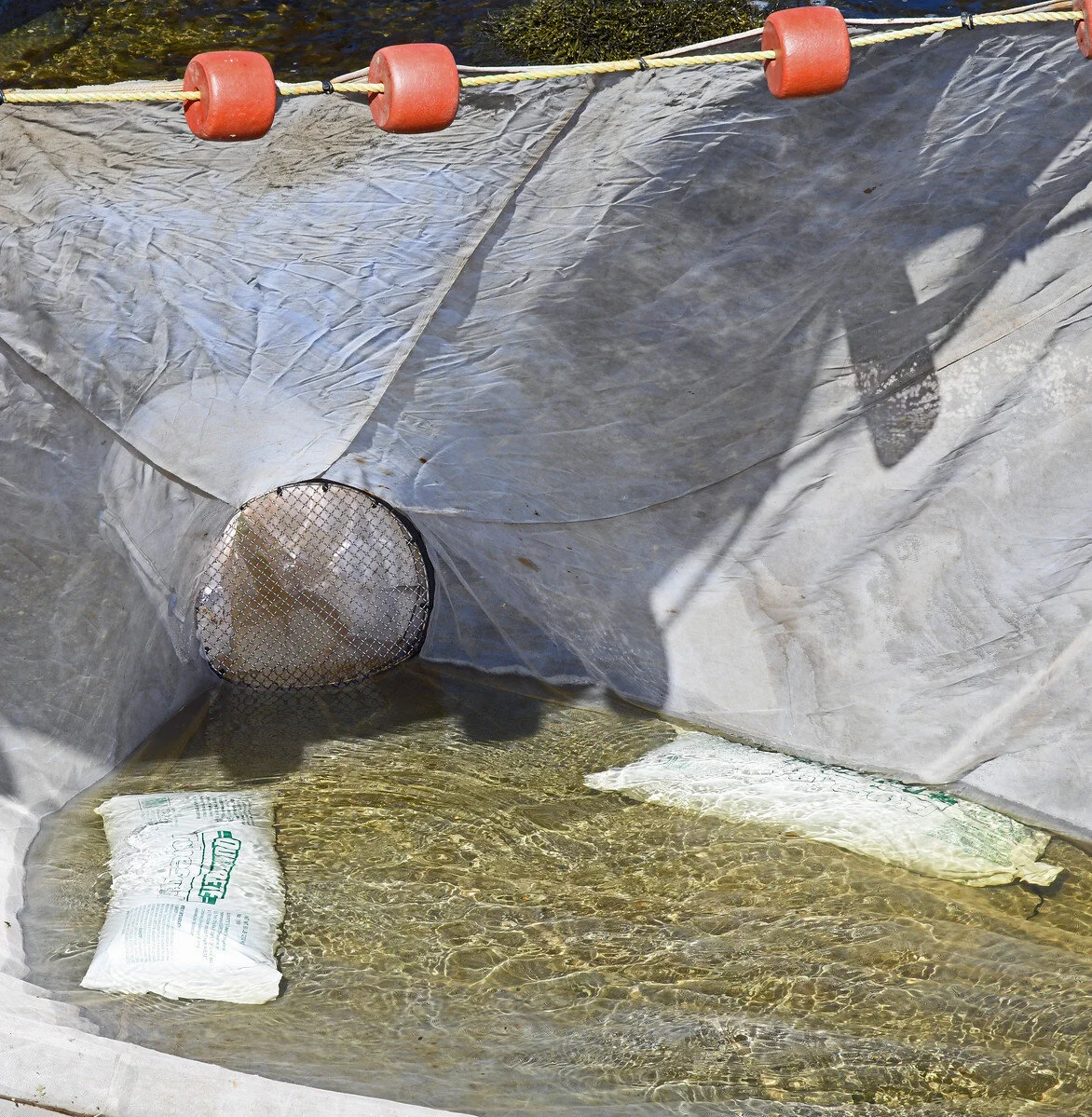

Above, you see eel fishermen setting up and tending to their nets yesterday at low tide in the mouth of Patten Stream in Surry, Maine. By high tide, the nets will be mostly under water. Below, you’ll see an archive image that shows why these fish are called glass eels – they’re transparent except for their eyes and backbone.

Leighton Archive Image


(Surry, Maine)
It’s cool outside, but not shivery. We seem to be able to smell spring starting to disturb the winter fields with spurts of fresh, aromatic growth here and there. Or, maybe it’s a bit of early pollen that we’re sniffing. Nonetheless, things definitely are happening in and around the fields, woods, streams, and ponds.

The growth around the base of this maple is not one of those signs of spring, although it may look like a hallucinated fungus to some. It’s an ever-growing collection of lost and discarded lobster trap and other buoys photographed yesterday on the WoodenBoat School Campus.

(Brooklin, Maine)
Let’s face it, sea gulls can be pests, especially when they claim squatters’ rights on empty or little-used structures. Nobody knows for sure how the birds know that a structure is vacated, but common sense indicates that the birds can perceive prolonged inactivity where there should be some and the absence of humans yelling and throwing things at them when the squat.

Even though they have webbed feet, the Gulls seem to prefer angled resting places where they don’t have to sit in their own mess while taking in the sun. See these Herring Gulls on the roof of the barn attached to the above house.

(Brooklin, Maine; images taken March 20, 2021)
This is Mill Stream yesterday, running quickly under elevated Main Street in the Town of Blue Hill. The stream spills over a small dam, and empties into Blue Hill Bay.

The red building on Main Street was built in 1880 and is known historically as the Wescott Blacksmith Shop. Charles Wescott bought the building in 1910 for his blacksmith forge, which produced iron art works as well as providing utilitarian iron services. The building has contained a series of restaurants since about 1978.
In the 1700s until about 1939, the nearby small mountain also named Blue Hill and its surrounding area were known for good timber trees for ships and building construction. Early on, saw mills were constructed beside the stream’s mouth and run with its water power. In the later years, a gasoline engine provided power until the mills succumbed to “progress.” Information courtesy of the Blue Hill Historical Society. (Blue Hill, Maine)
