Comment

In the Right Place: The Other Jack and Jill

This Jack-in-the-Pulpit plant (Arisaema triphyllum) was one of only two complete plants of its kind that we found yesterday in a boggy area where we usually find more.

j5.jpg

By “complete” we mean having a three-part leaf (“church”), which shelters a striped protective spathe (“pulpit”), within which there is a flower spadix (“Jack”). The scarcity of the plants probably is because our woods are in a semi-drought condition despite some recent rain.

jj6.jpg

Much about this native plant is strange, beginning with its name. It has a “pulpit” that hides the “preacher” rather than making him more visible and he’s disrespectfully called by his nickname alone. (“Minister-in-the-Pulpit” or “Priest-in-the-Pulpit” might be more inspiring.) Here’s one having trouble getting started:

J2.jpg

Who is Jack supposed to be? Perhaps the Jack-in-the-Pulpit name is a play on Jack-in-the-Box, where we also can’t see Jack most of the time. Does anyone know the history of this plant’s name?

j1.jpg

Moreover, the odds are about even that Jack is a Jill. This plant can change from male to female before its yearly appearance, as energy needs require. However, whether the plant hides a Jack or a Jill, you better not taste it raw – it’s toxic to humans. (Brooklin, Maine)

Comment

Comment

In the Right Place: Sheer Delight

Here we see the Belford Gray sailing out of Great Cove on Wednesday morning, June 16. She’s a small Friendship Sloop, the iconic type of Maine fishing boat used primarily in the late 19th and early 20th Centuries.

b1.jpg

These highly maneuverable sloops were conceived and built in and around the Maine Town of Friendship in the Muscongus Bay area; they then were evolved by boatbuilders along the entire Maine coast.

The boats typically have sharp clipper bows with breathtaking sheer swoops back to low deck areas and overhanging transoms (stern ends). The low aft portions are designed to make it easier for one or two fishermen to haul nets and traps out of the water. Here’s an archive image that will give you a better idea of her lines:

Leighton Archive Image

Leighton Archive Image

Nonetheless, the Belford was created by WoodenBoat School students and launched in 1992 to serve mostly as a wonderful sailing classroom. She’s a little more than 28 feet long; her beam (widest part) is nine and one-half feet, and she’s built with northern white cedar on white oak frames. Her name honors Belford Gray, a WBS instructor who was a highly regarded wooden boatbuilder.

b2.jpg

(Brooklin, Maine)

Comment

Comment

In the Right Place: Osprey Nest Report 7

The saga of Ozzie and Harriet Osprey continues and I think that they’re trying to drive me crazy. I’ve still not caught a glimpse of any hatchlings, although there are promising signs (that I may be reading too much into).

o1.jpg

Ozzie is spending much more time on and near the nest. Above, you see him bringing home yesterday’s breakfast. (If you have great eyes, you might see the tips of that breakfast’s tail under Ozzie’s tail.)

Both he and Harriet made numerous trips earlier in the week to get moss and bark strips to supplement the nest bottom. Harriet also has been making bobbing movements reaching deeply into that bottom that are consistent with feeding one or more hatchlings:

o3.jpg

(From day one, baby Ospreys are tediously but carefully fed minute pieces of fish from Mom’s [or, sometimes, Dad’s] big and sharp beak. No spoons allowed.)

o2.jpg

Above, you see the pair sitting together in their penthouse after breakfast, just seemingly chatting and enjoying yesterday’s lovely breeze:

Research indicates that there usually are three to four eggs and that these usually hatch serially – one a day. This is a tremendous advantage for the fast-growing first born. (Brooklin, Maine)

061721 – Maine Naturalists Only -- In the Right Place: I.D. Request

Saw these insects swarming this nearby raft of water lily pads today and yesterday, moving from pad to pad and skimming over the water.

n3.jpg

Are they water lily beetles of the Donacia kind? Were they laying eggs in the pads? Any help would be appreciated.

See also the enlargement below:

n2.jpg

(Brooklin, Maine)

Comment

Comment

In the Right Place: 'Tis the Season

It’s the beginning of the summer lobster fishing season. Each day, more fishing vessels are entering the water and being loaded with traps that will be set in lines in nearby waters. Below, we see Cool Change being loaded at the Town Dock in Naskeag Harbor. The cabin top of Judith Ann, docked behind, is barely visible, too.

June 16, 2021

June 16, 2021

Trucks with full loads of traps have been waiting their turn near the Dock all week.

June 16, 2021

June 16, 2021

Below, we see Cassie Marie leaving the Harbor and Jack Black at her usual station beside the bait and fuel float a few days ago, and Sea Princess steaming through Great Cove yesterday:

June 16, 2021

June 16, 2021

A few miles up the coast in Blue Hill, Sun’s Up was at her mooring yesterday, brightening Connery Cove:

June 16, 2021

June 16, 2021

(Brooklin, Maine)


Comment

Comment

In the Right Place: Through the Lens Darkly

Yesterday, fog and rain let us view a dark summer morning in in many ways. Here are a few. The First Baptist Church leaving the scene while the spirits in the Brooklin Cemetery are soothed:

r-1.jpg

Water lily plants, seemingly holding out their palms to see if the much-needed rain is real:

r2.jpg

Small vessels doing what most small vessels do — wait:

r3.jpg

A field in its summer whites and yellows: daisies, buttercups, and hawkweed:

r6.jpg

Naskeag Harbor, gone:

r4.jpg

Beach Roses as sipping cups:

The wet path not taken:

r11.jpg

The far-away doe at the edge, thinking that she is unseen:

r7.jpg

(Brooklin, Maine)

Comment

Comment

In the Right Place: A Good Yarn

This is the Coastal Schooner J&E Riggin reflecting the morning light in Great Cove on Sunday, June 13.

s1.jpg

Although there was hardly a breeze, she weighed anchor and slowly sailed out of the Cove:

The Riggin is changing the way people think about sailors’ “yarns.” In fact, according to her schedule, she’s in the Cove on another of her popular “Maine Knitting Retreats” for the needling crowd – knit one, purl two, smell the air three …. Clever niche marketing.

s4.jpg

She was built in 1927 as a Delaware Bay oyster dredger by Charles Riggin and named after his two sons, Jacob and Edward. She was rebuilt and rigged as a Maine coastal schooner passenger vessel in the 1970s and designated as a National Historic Landmark in 1991.

s6.jpg

The Riggin is 120 feet long overall. In cruiser crowd vernacular, she’s a two-masted, “bald-headed,” “spoon-bowed” schooner. That is, the Riggin is bald because she doesn’t fly topsails and her bow bulges slightly outward between the water and the bowsprit and deck, like the convex back of a spoon. (A “cutter bow” angles sharply inward from the bowsprit back down to the water.)

Leighton Archive Image

Leighton Archive Image

(Brooklin, Maine)

Comment

Comment

In the Right Place: Wake-Up Call

Here, we see the morning light reach the Coastal Schooner Stephen Taber in Great Cove yesterday. She spent the night there in the shelter of Babson Island. Some of the passengers were still eating a sumptuous breakfast, others were preparing to try the cool water before the vessel moved out.

t1.jpg

A few passengers climbed high into the rigging and leapt into the cool water, others chose paddle-boarding. before anchor was weighed:

t-6.jpg

Unfortunately, there was virtually no wind early yesterday, so the Taber was pushed out of the Cove by her powerful yawl boat Babe without raising sail.

t7.jpg

The 110-foot Taber was built in 1871 and is a National Historic Landmark that now hails from Rockland, Maine. As with many 19th Century cargo cruisers, she was built with a flat bottom to “ground out” and discharge her cargo without the need for a pier. She does have a centerboard to lower during cruising but has no motor.

t8.jpg

We cannot leave without remembering how spectacular she is under full sail, so we show you an archive image of the Taber coming into the Cove “with everything up” at a prior time:

Leighton Archive Image

Leighton Archive Image

The Schooner J&E Riggin also overnighted and likely will be the subject of a separate post tomorrow. (Brooklin, Maine)

Comment

Comment

In the Right Place: Osprey Nest Report 6

As of yesterday morning, Ozzie and Harriet appeared well, perhaps even more active than usual. Harriet continues to assume an incubation position, huddled low in the nest. Every now and then, she’ll lift her head and check her surroundings:

o1.jpg

However, she stretched her wings with short trips twice in 30 minutes yesterday. Here she is returning from one of those flights:

02.jpg

Ozzie remains attentive. He visited the nest briefly in the morning while Harriet was hunkered down. In the first Comment space, you can see him taking off over Harriet, who is virtually invisible; the tips of her primary feathers are visible in the image to those who have great eyes.

o4.jpg

Harriet’s incubation period has seemed longer than usual. There has been no cooing or feeding behavior at the nest to indicate the hatching of any young. It’s possible, I suppose, that the original clutch of eggs was damaged in a severe storm that we had in May and that Harriet is incubating her second clutch. But, that’s just speculation. (Brooklin, Maine)

Comment

Comment

In the Right Place: Aromatic Nymphs

Many of our quiet marsh ponds here are now filling with Fragrant Water Lilies. Those shown below were caught sunbathing nearby Tuesday morning, June 8.

l4.jpg

The white crown flowers on these native plants are like strings of solar-powered lights that turn themselves off and close when it clouds over and when the afternoon light turns dusky. The next morning, with the arrival of the early morning sun, the Water Lily flowers slowly turn themselves on by opening wide, seemingly with big yawns.

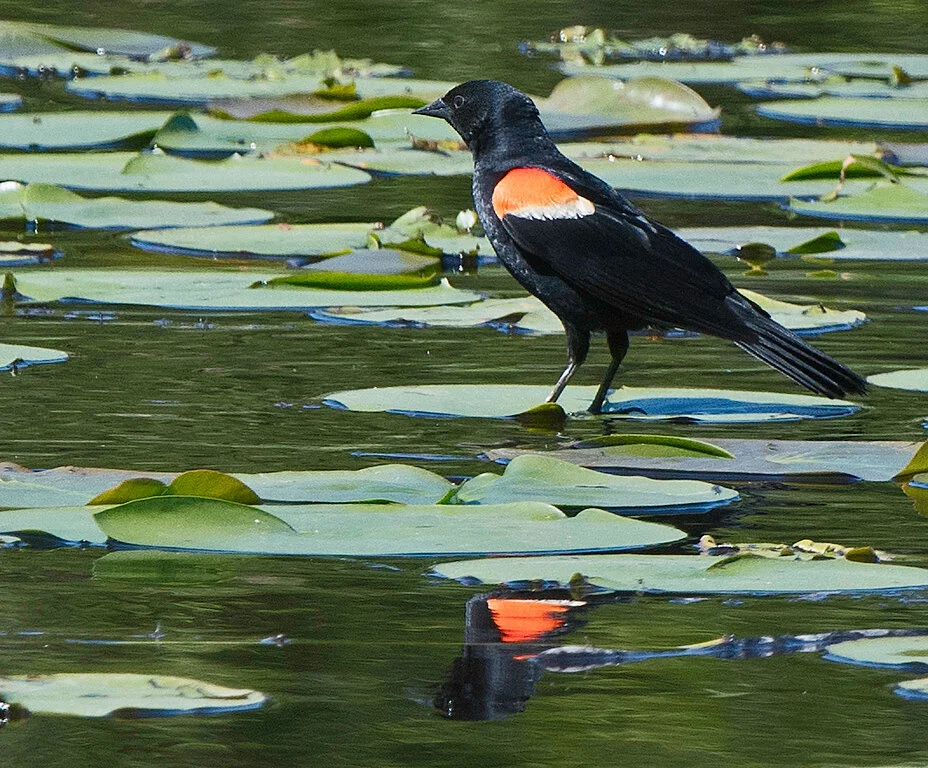
While perhaps not as exotic, the Water Lily leaves (“pads”) also are attractive and perform important local summer services.  They protect fish and aquatic invertebrates (e.g., dragonfly nymphs) in the shade below. Above, the pads collect insects while frogs and birds perch on them, waiting for their meals to be brought to the table. Here are archive images of a pair of Red-Winged Blackbirds waiting for service:

More broadly, the plants’ seeds are a favorite food for waterfowl and their stems (rhizomes) are consumed by many animals, including muskrats, beaver, deer, moose, and even porcupines.

l3.jpg

Unsurprisingly, the genus name of our native Water Lily is, Nymphaea, which is derived from the Greek and Roman name for “water lily”; that, in turn, originated as a reference to mythological water nymphs. The species name for our plant, odorata, means “fragrant,” as you probably guessed. That sweet scent attracts pollinators. (Brooklin, Maine)

Comment

Comment

In the Right Place: Oldie but Goodie

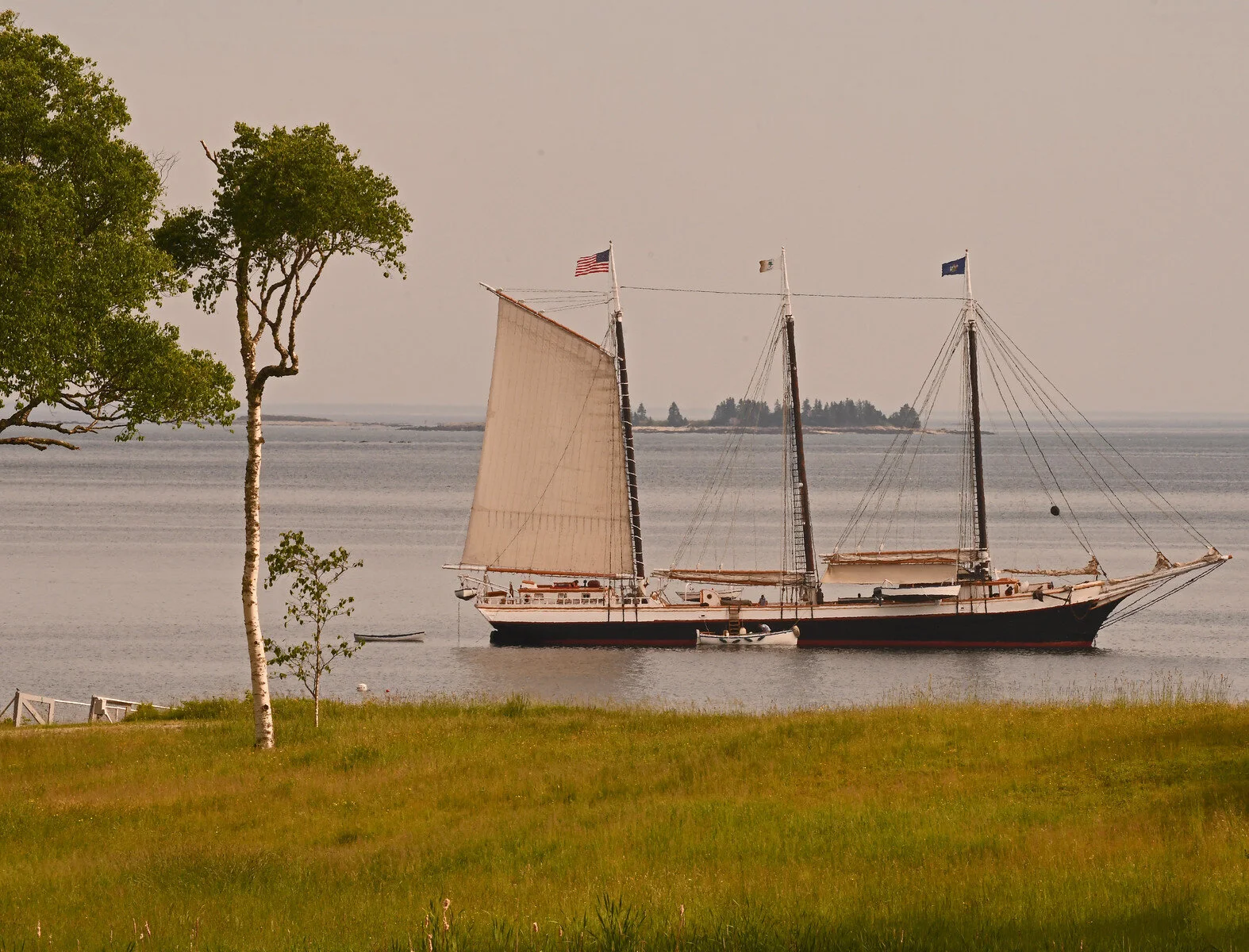
This is the coastal schooner Victory Chimes entering Great Cove in the heat and haze of Tuesday afternoon, June 8. She’s lowering her fore and mainsails after already having dropped her jibs.

v3.jpg

She left her mizzen sail up for the stability of pointing into the wind while anchored overnight in the Cove.

v5.jpg
v4.jpg

The Chimes then departed the Cove early yesterday morning in hard-driving rain, without raising sail. Here’s an archive image of her under full sail for reference purposes:

Leighton Archive Image

Leighton Archive Image

The 170-foot Chimes, out of Rockland, Maine, was launched in 1900 in Delaware as the commercial cargo vessel Edwin and Maud. When she relocated to coastal Maine as a passenger ship in the 1950s, her name was changed to Victory Chimes in honor of a Canadian schooner of that name that had been launched on Armistice Day in 1918. 

The Chimes now reportedly is the largest all-sail passenger ship in the United States, which means that she’s big and has no inboard engine. She’s also the only three-masted schooner in the Maine schooner fleet, a National Historic Landmark, and the last of the flat-bottomed, shallow-water schooners known as Chesapeake Rams. (She worked the Chesapeake Bay area for many years.)

Leighton Archive Image

Leighton Archive Image

Curiously, credit for much of her restoration must go to pizza. Thomas Monaghan, the owner of Domino’s Pizza, bought and restored her in 1988-1989. He named her Domino Effect and used her for employee incentive cruises. She was renamed Victory Chimes in 1990 when purchased from Monaghan to return to Maine cruising. (Brooklin, Maine)

Comment

Comment

In the Right Place: A Wolf in Bean Clothing

Common Lupines are starting to arrive like an invading army of beautiful troops. Pronounced LEW-pin, the wild legume derives its name from the Latin word “Lupinus,” meaning “wolfish” or “of the wolf.” That’s because Lupines (Lupinus polyphyllus) ravenously consume soil nutrients, usually to the detriment of other plants.

f-4.jpg

Lupines also are known more peacefully as Quaker Bonnet Plants, due to the shape of their flower pods. Inside those pods are beans that are edible after brining to remove toxins.

F-1.jpg

Maine’s native Lupines (Lupinus perennis L.) apparently have been extirpated or are extremely rare. The hordes that we see in our fields and along our roads were originally imported from western states and Europe. Much of the credit for their existence goes to Hilda Edwards, “The Lupine Lady,” who apparently was to these plants what Johnny Appleseed was to apples.

F-2.jpg

Hilda reportedly scattered Lupine seeds fanatically in Maine – including throwing seeds out of moving cars – during her extensive summer residencies here during the early7 20th Century. A popular and award-winning children’s fictional book called Miss Rumphius was based on her seed-sowing.

F-5.jpg

(Brooklin, Maine)

Comment

Comment

In the Right Place: Real Estate Values

Here, we see a male Red-Winged Blackbird smugly surveying his beautiful estate on Saturday, June 5. This year, he and his mate own a lovely corner of our pond.

B-1.jpg

He has even more reason to be proud. It looks like he’s about to become a Dad – again; probably before Father’s Day.

Leighton Archive Image

Leighton Archive Image

Mom is quite different from Dad. She’s much smaller and looks like a Hollywood version of a sparrow. But, she can flash her usually covered red-orange epaulets in a very beguiling way.

b-6.jpg

Mom has been sitting in the reeds unusually long lately. At this rate, these Red-Wings might even have a third brood this year. Unfortunately for me – but certainly not her family – she has placed her nest where I can’t get a straight shot at it without invading the entire family’s comfort zone. So, I have no nest shots of her and the youngsters this year.

However, I do have this image from a prior year:

Leighton Archive Image

Leighton Archive Image


(Brooklin, Maine).

Comment

Comment

In the Right Place: Hope

Here, we see the Coastal Schooner Lewis R. French traveling south out of Great Cove yesterday morning, a hot and still time with no sailing wind up yet.  

M1.jpg

She spent the night in the protection of the Cove as she often has in pre-plague years. Seeing her yesterday was an injection of hope. Maybe we shall have a normal, glorious summer.

The 101-foot French was launched in 1871 out of Christmas Cove, Maine. She was built there by the French brothers and named after their father. In her youth, her life was varied and hard: Among other things, she freighted bricks, granite, fish, lime, firewood, and Christmas trees. She has no internal engine. If you look closely, you might see that she was being pushed out of the Cove yesterday by her powerful yawl boat. 

But, who needs diesel power when – most of the time – the winds in our area easily fill your sails? Heere’s an archive image of her sailing in the Cove:

Leighton Archive Image

Leighton Archive Image

(Brooklin, Maine)

Comment

Comment

In the Right Place: Royal Flush

Iris Season is beginning in gardens here. There are almost 300 species of these domestic perennials and more being “designed” as we speak.

2.jpg

Reportedly, the most popular of the cultivated multitude are Bearded Irises, such as the above white ghost, photographed yesterday, and Siberian Irises, such as those shown below, photographed Friday, June 4.

2b.jpg

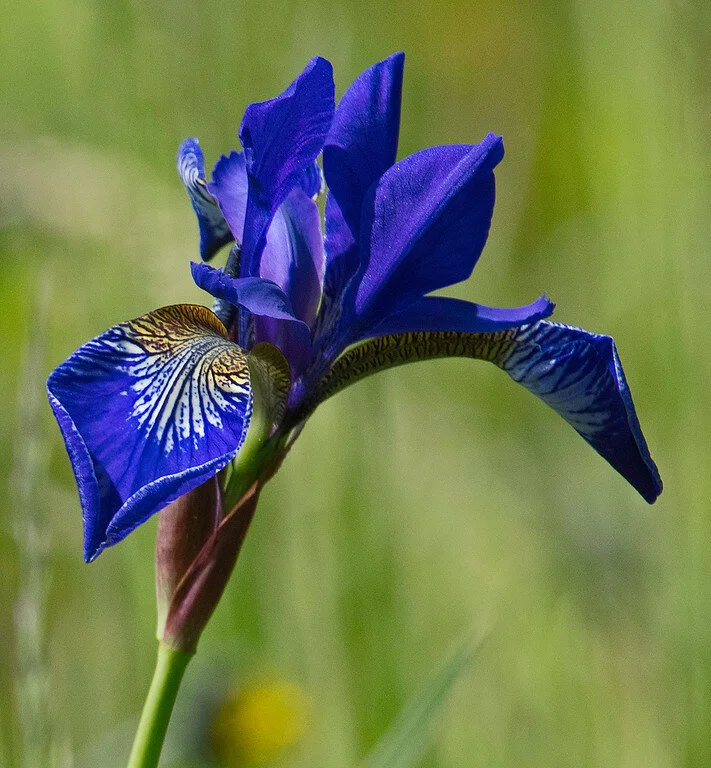
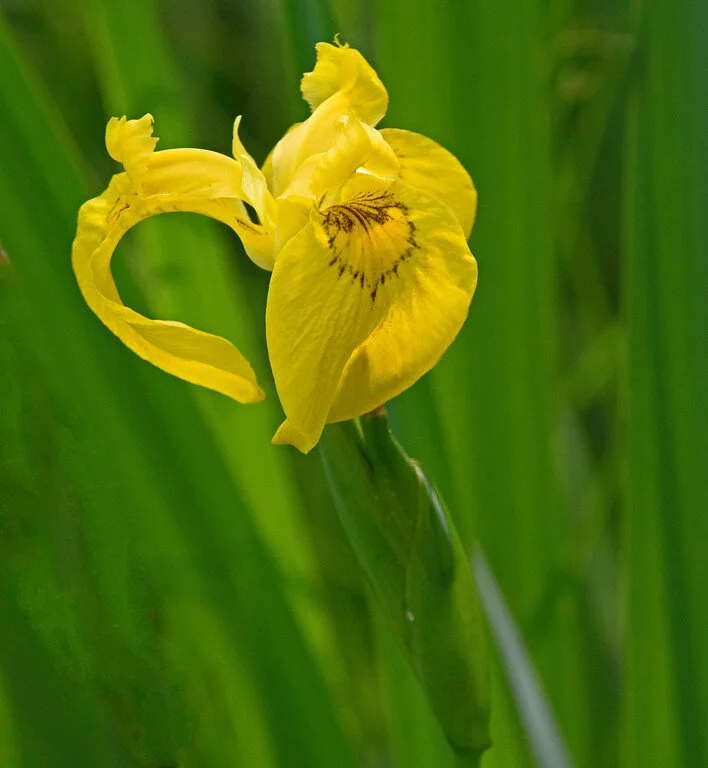
There also are 28 wild, native Irises in the United States, according to the U.S. Forest Service. The most common of these natives here are the Blue Flag and Yellow Flag Irises, which have not yet flowered in our fields and meadows, as far as I’ve seen. Here are archive images of each:

Iris flowers usually have three upward-thrusting “standards” (petals, really) and three downward-drooping “falls” or “sepals.” The supporting sepals look like petals, but are landing platforms that direct pollinators to where they have to go. Some sepals are “bearded” with what looks like an escaping caterpillar.

Aptly, all of the many plants in this family are named Irises after the Greek goddess of the rainbow, whose name also means rainbow. In France, the Iris was recognized as the symbol of royalty and stylized as the fleur-de-lis. (Brooklin, Maine)

Comment

Comment

In the Right Place: It's Not Easy Being Green

We have eight species of native frogs in Maine. With one exception, all of them have memorable names that are helpful for description: Spring Peeper, Gray Treefrog, Pickerel Frog, Northern Leopard Frog, Mink Frog, Wood Frog, and, of course, Bull Frog.

i-6PFf28x-X3.jpg

The exception is this little fellow here who greeted us yesterday. He’s the “Green Frog.” Why someone would give one of our several species of green frogs the common name of the Green Frog is beyond me. It would be like naming the Northern Cardinal The Red Bird.

Nonetheless, we have here a fine Green Frog and we wish him well. (We can tell that he’s an adult male because his eardrum [“tympanum “] is larger than his eye.) Green frogs can grow to about four inches in length, with the females usually larger than their mates. But, the males have more memorable calling voices: they sound like someone plucking the same loose banjo string incessantly, unfortunately.

Speaking of naming frogs, the scientific name of the Green Frog is Rana clamitans, which means “frog that cries loudly.” It’s thought that this refers to the loud squeal that Green Frogs make when trying to leap away from danger.

More interesting facts are in Maine Amphibians and Reptiles (The University of Maine Press, 1999), which is highly recommended. (Brooklin, Maine) Click on image to enlarge it.

Comment

Comment

In the Right Place: The King and I

It was raining lightly when I got down to Naskeag Harbor yesterday and saw a happy Herring Gull there who wasn’t bothered at all by the drizzle. He had found a treasure in the form of the front half of a boiled lobster, apparently the jetsam from a recent maritime lobster bake.

The bird was as joyous as a puppy with a new bone, sticking his head and beak inside the red carapace, pulling out strings of meat, and gulping them down voraciously. Other Herring Gulls approached and screamed, but our lucky bird would drag the lobster body 10 or 20 feet away and resume his feast. His feathered brethren never got any. But, that’s hardly the end of the story.

1.jpg

The commotion attracted the above Great Black-Backed Gull – the largest species of seagull in the world, often called “the king of gulls.” The wing spans of these kings can reach five-and-one-half feet. They’re infamous for feeding on the eggs and live young of other gulls and ducks and stealing food from any smaller animal. They’re bullies, but sometimes sophisticated bullies.

2.jpg

The technique used yesterday by this Greater Black-Back was patient intimidation. He swooped down and landed in the shallow water about four feet from our happy Herring Gull. (Sexes assumed.) He floated there a minute and then stood up imperiously and silently, perhaps to show his size advantage.

2a.jpg

Then, he slowly took a step or two toward his gulping cousin, stopped, and repeated the move after a pause. Soon, the Herring Gull got rattled and just stood above his lucky find without eating, all the while watching the king silently edging closer and closer.

Soon, the Herring Gull got the message, bowed to the king, and flew off without his treasure. The king took his cousin’s place at the feast and no one bothered him. We hear that the Herring Gull is still suffering from indigestion. (Brooklin, Maine)

Comment

Comment

In the Right Place: Osprey Nest Report 5

Ozzie and Harriet both seem to be physically well. However, they’ve been very agitated lately. I’m wondering whether something has happened to the eggs that they have been incubating – and still seem to be incubating. We had several terrible storms that deluged us at the end of May. The nest is exposed to all of the elements; if its drainage doesn’t work, it might flood.

1.jpg

Above, you see Ozzie arriving with a fish yesterday, trying not to land on Harriet who is in an incubating position with only her tail showing. This made her get to her feet and ruffle her feathers:

2.jpg

Soon, Ozzie took off again:

3a.jpg

. (Brooklin, Maine)

Comment

Comment

In the Right Place: The Blues

This lovely wildflower tangle, found in a Brooklin field yesterday, appears to be Lewis Flax (Linum lewisii), also known as Wild Blue Flax and Prairie Flax. It’s native to most of western North America, but unusual here in Maine. The plant was “discovered” on the western prairies by North American explorer Merriweather Lewis and named after him.

Lewis.jpg

Although this and many other non-Maine-native “wildflowers” are unusual here, they’re becoming less and less unusual thanks to the availability of American wildflower seed mixes that can be delivered to our doors for immediate sowing in our “foreign” fields. A similar cultivated Eurasian flax plant, simply called Blue Flax (Linum perenne), also apparently is available here for gardeners. (Brooklin, Maine)

Comment

May Postcards From Maine

1 Comment

May Postcards From Maine

May is our month for condensed springtime. During the month, our plants experience a phenomenal growth surge and the weather is even more volatile. This year, May brought beautiful clouds, dense fogs, high winds, plenty of sunshine, and driving rain showers that turned the new summer coats of our White-Tailed Deer into shag.

1.jpg
12.jpg

One of the highlights of many Mays has been the domestic bliss of a pair of Osprey that repeatedly have returned to a large nearby nest to honeymoon and raise nestlings. We call the parents Ozzie and Harriet and report on them regularly. Below, you see Harriet incubating her eggs in her queen-sized nest, Ozzie joining her, and Ozzie fishing for Harriet’s lunch. (Severe over-night storms during the last few days of this May have us worried about the viability of her eggs. We’re watching.)

13.jpg

This May often was cold and windy. We saw only one tightly-tucked Painted Turtle basking in our pond during the month, and then even this tough guy disappeared back into the bottom muck and has not returned since. We expect him and several other shelled sunbathers in June.

18.jpg

On the commercial waterfront, some of the fishing vessels that have been dredging for scallops this winter still had their masts, booms, and other dragging gear attached at the end of the May. However, many others in Naskeag harbor and Stonington were using May to load up for June lobster fishing during the month.

22.jpg

On the recreational and educational waterfront, sailboats and other small craft were cleaned up and moored along the coast in May. Here, you see some of the WoodenBoat School’s small fleet, all of which were put into Great Cove during the month for classes in June.

24.jpg

May is the month that our flowering trees wake up and try to outperform each other. Below, we start with the white flowers of Shadblow and Chestnut trees. Following them are the blossoms and flowers of wild Apple Tree, Plum, and Crabapple trees.

29.jpg

The Crabapple Trees were stunning in sun and rain this year, as was the specimen Japanese Maple in the Brooklin Cemetery.

32.jpg

Lilac Bushes are always a May favorite around here. Their beauty and scent are the essence of the month.

35.jpg

In the woods and fields, other favorite May performances were given as usual during the month. Starflowers and Bunchberry began to cover the darkening woods’ floors and Lupines, Bluets, and Blue Flax appeared in the fields out of nowhere, an annual magic act that no one tires of.

49.jpg
56.jpg

May’s volatile growth is perhaps easiest seen in the bogs and ponds. Below are images near the beginning and end of the month: Fern, Arrow Arum, and Skunk Cabbage

Of course, May has its serious side. The month ends with Memorial Day and so will our report. Below, we see the Town’s historic Camperdown Elm proudly guarding fallen veterans and others in the Brooklin Cemetery.

67.jpg

(All images taken in Down East Maine during May 2021.)

1 Comment