
This image of a Monarch Butterfly on Common Milkweed flowers appeared yesterday in our monthly column in the Ellsworth American.
Click on the image to enlarge it. To read the column, click here: http://www.5backroad.com/montly-column
JOURNAL
This image of a Monarch Butterfly on Common Milkweed flowers appeared yesterday in our monthly column in the Ellsworth American.

Click on the image to enlarge it. To read the column, click here: http://www.5backroad.com/montly-column
Yesterday was hot and hazy here, but there was a good breeze in Great Cove where an enjoyable spectacle was going on: The WoodenBoat School Elements of Sailing classes were catching those breezes and scooting all over the Cove like water bugs.

Above, you see We 3 performing yesterday for a languid audience of harbor seals. (I think I heard one or two flipper claps for some especially good come-abouts.) Here’s another of the boats out yesterday, Crackerjack, flaunting her tanbark red sails":
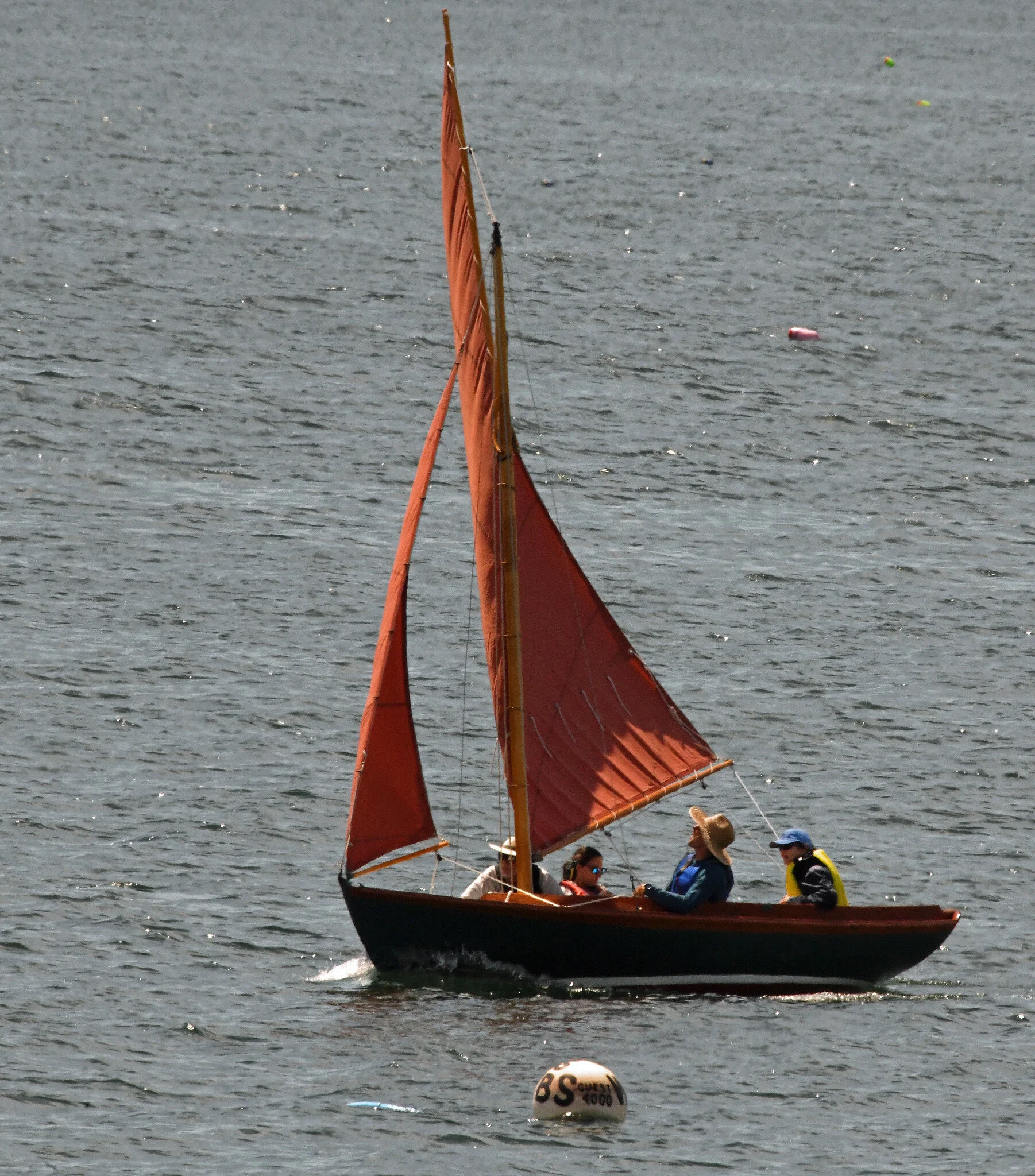
Both sailboats are part of the School’s fleet of 12 ½-foot (at waterline) sailboats. Some, such as the We 3, are “Herreshoffs.” These were designed by the famous naval architect Nat Herreshoff in 1914 and have been in constant production since then. They are considered by many to be the best small sailboat ever built.
Others, such as the Crackerjack, are “Havens.” These were designed by our locally famous naval architect Joel White in 1984 as a modified Herreshoff 12 ½. The principal difference between the two designs is that the Haven has a retractable centerboard and the Herreshoff has a fixed keel. Thus, the Haven has an advantage in shallow water, but both sail beautifully.
The rigging can be different. Here’s Fox, a Haven with a gaff rig like the Crackerjack’s:

Here’s Dovekie, a Herreshoff rigged as a Marconi Sloop, like We 3:

(Brooklin, Maine)
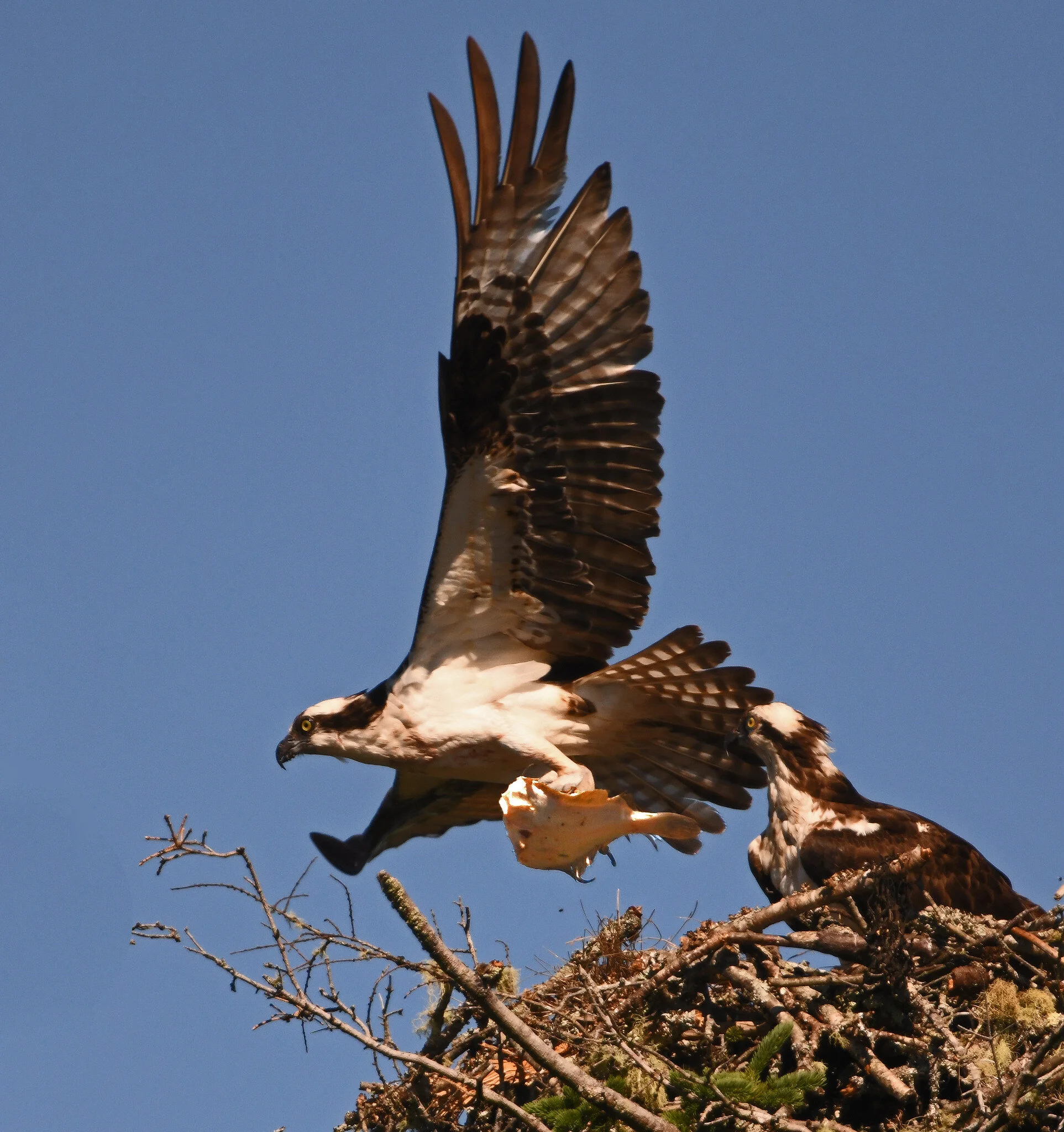
Here you see Harriet feeding a chick on Monday, July 5. – a very delicate process involving two sharp, hooked beaks.

Ozzie and Harriet remain in good health, but I’ve seen only that one chick recently. You’ll remember that we’ve seen three originally. There could be a benign reason for seeing only one now. The nest is deep and the dominant (first born) chick may be commanding the high ground to be fed first, while the other chicks huddle below where I can’t see them from my great distance. Harriet has been making moves that could be interpreted as feeding other, hidden chicks.
Of course, we need to remind ourselves that nests of big raptors will never pass an Occupational Safety and Health Agency inspection. Chicks fall out, try to fly too early, and get attacked by their more dominant siblings, not to mention being stomped accidently by incoming parents with talons.
The tyke that I saw Monday seemed healthy, inquisitively staring at the world with his red eyes that will turn to gold when it matures (sex assumed):
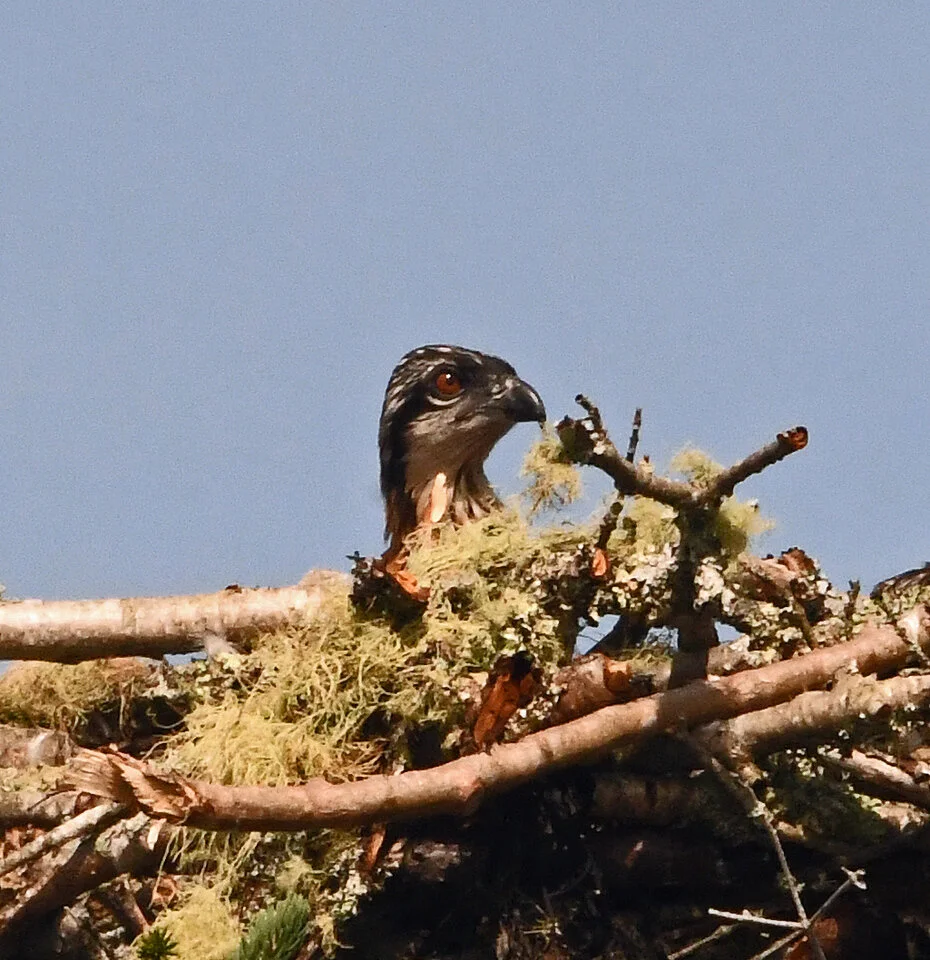
He is growing dark primary feathers and still has a lot of down on its wings:

Ospreys usually have few problems with predators; they are extraordinarily protective and will viciously attack intruders. However, sometimes a raccoon will get to the eggs or a rogue osprey, bald eagle, or great horned owl may get a chick by slipping under the radar while the female takes a short break from the nest. Here’s Harriet returning to the nest from a short pond-water-sipping break last week on a foggy day:

(Brooklin, Maine)
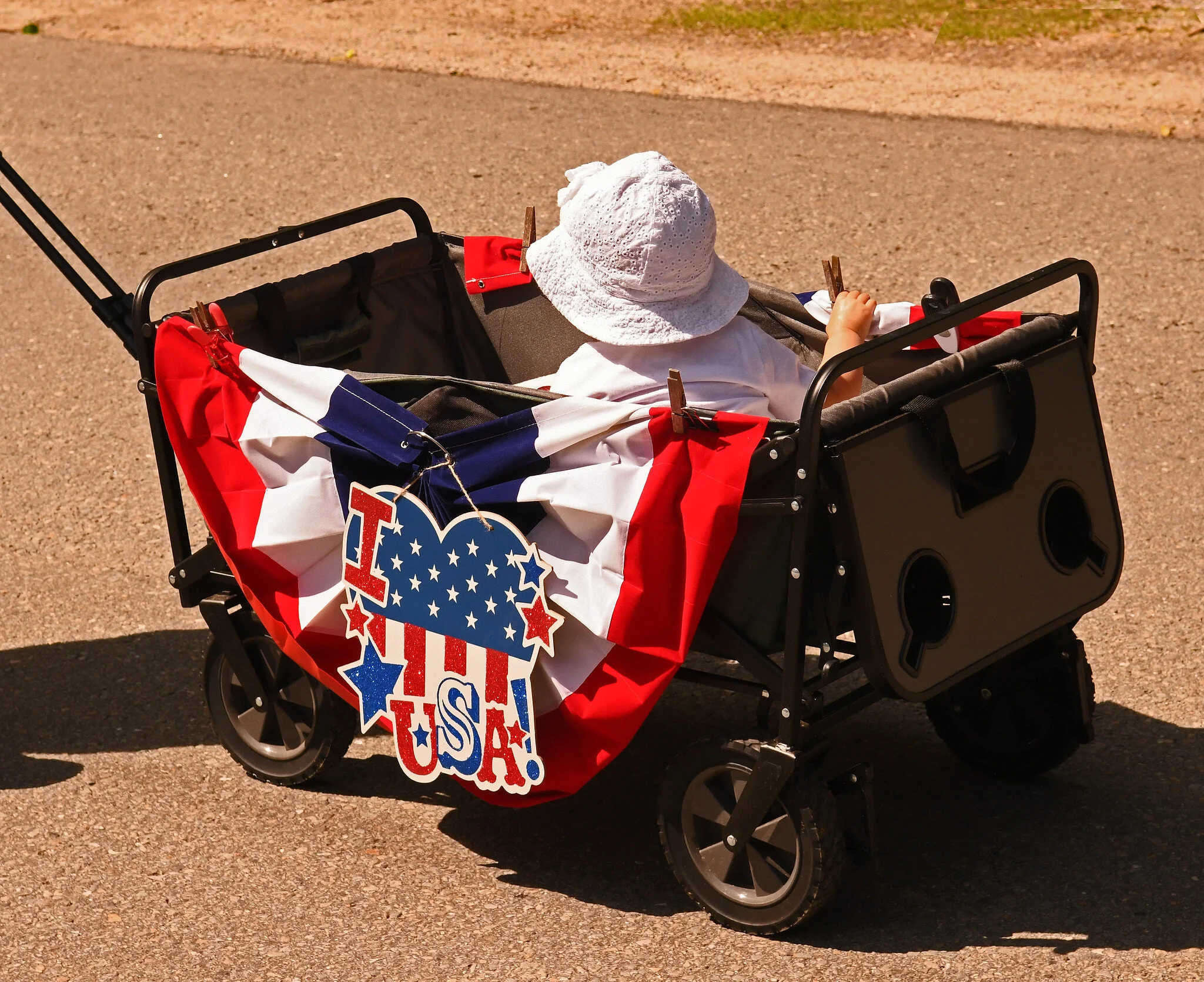
The weather was perfect, the time was over-ripe, and it looked like everyone had a great time at the Annual Brooklin Independence Day Celebration, held yesterday. The contrast between last year’s plague-dictated cold and rainy whizz-by of a couple of trucks and a few cars was stark.
As usual. the day began with the Brooklin Town Band on the Library lawn warming up the crowd with a wide variety of music, from John Philip Sousa marches to Leonard Cohen’s “Hallelujah.”


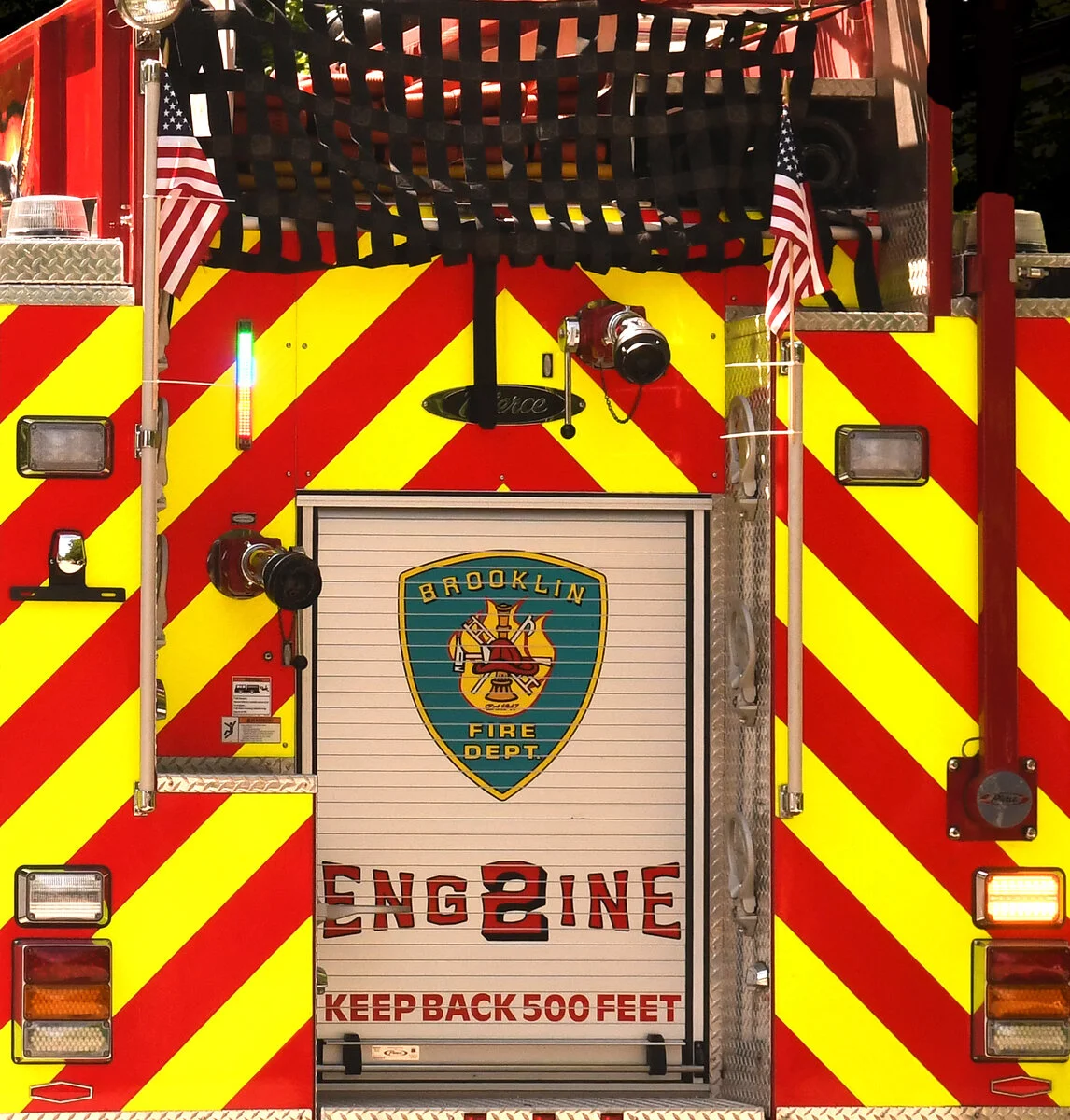
The parade started at about 10 a.m., led by some of our veterans carrying Old Glory and an Missing in Action Flag. Following that were modern and historic fire engines from Brooklin and the area.




There were two significant floats created by our neighbors. The first was a space-oriented presentation, complete with a black hole and a kidnapping alien. The other, titled BEe HAPPY celebrated bee keeping. Interspersed in the Parade were individual creations.



As usual, antique and classic cars ere featured and drew quite a bit of attention during the parade and when displayed in the Town Green afterward.


After the parade, the celebration continued at the Town Green. The usual children’s games — The Dead Chicken Toss, Golf Putting, and Wet Sponge Throw — were popular, as always.


And, finally, the usual delicious lunch of barbequed chicken or hot dogs, corn on the cob, cole slaw, and potato salad, with cold watermelon or ice cream as a desert


(Brooklin, Maine)
It’s sunny here as I write, but we’ve had soaking rains during the past several days. They’ve been a boon to thirsty farmlands and gardens and a curse to sailors and sightseeing passengers on coastal cruisers. Yet, a few of the latter have been determined that discomfort will not deter their plans. Here we see a small schooner’s crew and its complement of young and adult passengers sailing – above deck – through a downpour in Great Cove on June 25.

This is the Alamar out of Castine, Maine. (I’m told that Alamar is a Spanish name that means “to the sea” or “get closer to the sea.”) She’s only 45 feet long and her beam (widest part) is 13 feet. She’s a keeled wooden schooner like some of her large cousins; that is, she has a permanent keel, not a retractable centerboard as a keel. She also has an inboard diesel engine.

Alamar was bult in 1947 in Machiasport, Maine. A bit unusually, the craftsmen who built her worked by eye from a half-model designed by Dan Stuart and Nathaniel French; non-linear lines were not “lofted” from carefully cut wooden or plastic strip forms that would have allowed full scale scribing of her curves.

(Brooklin, Maine)
Here you see the Pride of Baltimore in 2012, celebrating the 200th anniversary of the war of 1812 by sailing past and saluting Fort McHenry.

Leighton Archive Images

The Fort is where Francis Scott Key penned his patriotic poem “The Star Spangled Banner.” Key was inspired by the unexpected American defeat of the British invaders, which prevented them from capturing Baltimore, Maryland, late in the War.
His poem became the lyrics to our national anthem, which will be heard countless times throughout our land today and tomorrow.
There were other significant American victories in that War to keep our independence, especially by the emerging Navy and citizen privateers who were licensed to harass and capture British ships. This is where the Pride of Baltimore fits in.
The 100-foot Pride is a reproduction of a typical 19th Century Baltimore Clipper Topsail Schooner of the type used as privateers in the four-year War. Those clippers were small but agile warships that were remarkably successful in capturing and harassing enemy merchant and war ships.
The clipper shown here actually is Pride of Baltimore II. She was launched in 1988 as a replacement for another reproduced clipper of the same name that was sunk in a squall in 1986. However, both Prides were named indirectly in honor of the Baltimore Clipper Chasseur, one of the most famous of the American privateers.
The Chasseur (meaning hunter in French) sank or captured at least 17 enemy vessels before returning to her hometown at War’s end. Upon seeing Chasseur’s victorious return up the Chesapeake Bay, the city’s largest newspaper dubbed her “the pride of Baltimore.” (From Brooklin, Maine)
Here you see some roadside flowers turning wet dreariness into smiling delight yesterday.

I think that the flowers are Rainyday Lilies, botanically known as Smileon ranidaes.

(Brooklin, Maine)
It’s chilly and raining hard as we speak – much-needed rain after several scorching days and months of inadequate precipitation. Unfortunately, the joy of rain seems not to register on tourists who have paid a fair sum to sail our coastal waters. They huddle under tarpaulins on the decks of coastal cruisers in jackets worn over sweaters. They peer and peer and get a distorted view of the beauty that benefits by their discomfort:

The tourists shown above are in Great Cove on the 125-foot schooner Mary Day during the rainy morning of June 25. Fortunately for them, they have heat in their cabins because Mary was built in 1962 just for vacationers. The passengers were not completely without luck, however. The previous day was a bright one and they arrived in the Cove during a lovely dusk:

Of course, during a sunny day with a good breeze brewing, the Mary Day can be a dazzling beauty in her own right, as our archive images show:


Leighton Archive Image
(Brooklin, Maine)
June here is when it seems like summer and we wonder whether we missed spring. Acadia National Park, across Blue Hill Bay, entices us to come; the wooded paths are lush, and clear streams emerge from trees into bays.


We had our share of fog and rain, but the summer residents came, eager to be part of the pastoral scene and enjoy views that are unique to Maine.


June is when ospreys incubate and hatch their eggs and we watch expectantly from a distance. “Our” nearby pair, which we call Ozzie and Harriet, were successful again this month. After days of Ozzie bringing Harriet her lunch and both of them taking turns patching their nest, Harriet hatched three red-eyed chicks, which are growing fast.


The black male and brown female red-winged blackbirds also raise chicks around our field ponds in June and stand guard like sentries or walk on water lily pads to collect insects for their young. The month also is when we finally get a good look and the green frogs and painted turtles in the ponds.


In deeper waters, numerous coastal cruisers begin to bring their tourist passengers into our Great Cove in June. They shelter overnight and visit the famous WoodenBoat School campus here.


June is when most of our lobster fishermen (a term that includes females) haul their traps to Naskeag Harbor, load them on their vessels, and set them into the surrounding waters.


This also is sailing country. June is the month that most of the boats are put back into the water for summer and fall sailing. Even when not sailing, the beautiful boats seem to complete the picture of a Maine summer.


Three summer signature flowers play a big part in June. Lupins peak and then wither into seed pods; day lilies begin to flower, and fragrant water lilies suddenly appear.


Finally, June is when tourists reach us by any means they can and residents enjoy picnics on the beach.


(All images taken in Brooklin, Maine, during June 2021)
While monitoring the activities of our new osprey nestlings yesterday, I kept getting distracted by my fair neighbor, Fiona, whom I have come to covet sinfully. Here she is yesterday, resting just offshore of the spruce that is topped by the ospreys’ nest:

Fiona is a catboat. I could see that from her single mast set far forward into the bow and her broad beam (widest part of the hull). However, I realized that I knew little about this type of sailboat, including why it is called a “catboat” or a “cat.” So, I did a little curiosity research, some of which is shared here.
It turns out that, from the mid-1800s through the early 1900s, the majority of close-to-coast boats for fishing, transportation, and recreation in New England were catboats. Several sources, including Wikipedia, said that the origin of the name for the boat type was unknown. However, Catboat Charters in Massachusetts states that “the name ‘Catboat’ comes from the fishermen having to shoo all of the cats from the boat who were after the dead fish!”
Typically, in addition to the forward placement of its single mast, a catboat’s single sail is gaff-rigged, the boat has a shallow draft, and a beam that is half as wide as the boat is long at the waterline. It usually has a retractable keel (“centerboard”) for fishing or recreational sailing in shallow waters, but some have fixed keels. Traditionally, the Cape Cod cats were 20 to 30 feet long.
However, a small (usually 12-foot) version has been one of the most popular recreational and instructional sailboats for the past 100 years. It’s known generically as a Beetle Cat. Here’s an archive image of Elater, a WoodenBoat School Beetle Cat:

Leighton Archive Image
Beetle Cats are not named after bugs or bug-eating felines. They reportedly were designed and first produced in 1921 by John Beetle of New Bedford, Massachusetts. His design has been copied and produced throughout the world under various tradenames. Beetle Cats, which are easy to sail and maintain, are especially popular for teaching youngsters the basics of sailing, racing competitively, and sailboat maintenance. (Brooklin, Maine)
We caught sight of the coastal schooner Ladona (“la-DOE-na”) for the first time this year at a distance on June 24. As you see here, she was racing downwind into the setting sun out in Eggemoggin Reach. It turned out that the 83-foot beauty out of Rockland, Maine, was headed for our Great Cove to shelter for the night.

The following morning, however, was not sunny; it was cold and rainy. Here you see her hunkered down there as it began to rain and pucker the water then:


Despite the rain, she raised some sail and continued her cruise:


Ladona was launched as a racing yacht in 1922 in East Boothbay, Maine. She reportedly took first in her class in the Bermuda Cup in 1933 and still remains one of the fastest windjammers in the Maine fleet.
She was named after a Union Civil War gunship on which her original owner’s father had served. Ladona, herself, performed Navy duty as a coastal submarine patrol vessel during World War II. After the War, she reportedly trawled for fish out of Stonington, Connecticut, under the name Jane Doré.
She was renovated in 1971 as a training vessel and renamed Nathaniel Bowditch, after the founder of modern sea navigation. She kept that name when she moved to Maine in the 1980s and became a coastal passenger cruiser. In 2014-2015, she was extensively restored again, given luxury appointments, and rechristened with her original name, Ladona.
Here’s an image of Ladona visiting Great Cove on a prior sunny day .

Leighton Archive Image
(Brooklin, Maine)
In the Right Place: Nest Report 9
I can confirm – and you can see – Ozzie and Harriet have done it again! They’re now raising three healthy osprey nestlings as they have done for at least the past four years. Here’s the proud Mom:

This morning was the first time that I could get a clear shot of them, perhaps because today’s unusual humidity forced them to get high enough in the nest to feel the sea breeze.
I don’t think that there is a specific bird name for osprey chicks, unlike eagles (eaglets), falcons and hawks (eyas), and owls (owlets). We’ll just call them David, Ricky, and June (from largest to smallest) to distinguish them. Here’s David:

(Brooklin, Maine).
Ozzie and Harriet appear well. He continues to be attentive, she seems to be feeding young at the bottom of her deep nest, and I’m still going crazy with frustration! I haven’t seen any nestlings. It seems that I should have spotted at least one little red-eyed osprey trying to peer out of the nest by now. Let’s continue to hope that nothing is awry.

In any case, the parents seem to be in magnificent shape. Above, you see Ozzie on Thursday, June 24, circling the nest with Harriet’s breakfast. (It looks to me like he’s about to serve an Atlantic halibut without its head, which Ozzie usually eats before serving.)

Below, you see Harriet taking one of her short breaks yesterday, literally stretching her wings.

(Brooklin, Maine)
Here we see the Coastal Schooner Mercantile on Thursday, June 24. The morning sun is just reaching her in Great Cove, where she sheltered overnight. She hails from Camden, Maine, and reportedly is one of only four of the traditional Maine schooners left.

The Mercantile is a 115-foot, two-masted schooner that was launched from nearby Little Deer Isle, Maine, in 1916 and was restored in 1989. When originally built, her design was common for the American vessels that toted goods and materials from one East Coast port to another, as trucks now do.

She’s 115 feet long overall with two masts on which sails are raised on wooden gaffs; that is, she’s “gaff-rigged.” Her foremast is shorter than her aft one, making her a typical “schooner.” The difference between a schooner and a ketch was evident the morning the Mercantile was in because the Angelique was also sheltering in the Cove at the time. Note the that foremast of a schooner usually is shorter than the other mast and the situation is reversed on the ketch:
The Mercantile is considered a “shoal draft schooner” because she has a flat bottom that will allow her to draw only five feet of water or beach herself and offload without the aid of a pier. She does have a retractable keel (centerboard) for sailing, which increases her draw to 10 feet 7 inches when it is down.

The Mercantile did not leave the Cove while we while we were ther. However, here are archiove images of her raising sail and leaving the Cove on previous visits:

Leighton Archive Image

Although common for her cargo-carrying time, the Mercantile reportedly now is only one of four such coastal cruisers still sailing. The other survivors are all in Maine waters: the Lewis R. French (launched in 1871), Stephen Taber (1871), and Grace Bailey (1882).
A fifth of her type, the Governor Stone (1877) out of Panama City, Florida, sailed the Gulf of Mexico until sunk during Hurricane Michael in 1918. I understand that repairs to her are being made and paid for mostly by volunteer contributions. (Brooklin, Maine)
These lovely sunworshippers caught our eye as they swayed and bobbed in the sea breezes above Naskeag Harbor on Wednesday, June 23. We’re told that they’re Frostweed, a native field plant also known botanically as Helianthemum canadense.

Frostweed produces flowers only where there is sunlight, and those flowers turn to face the sun, itself; that is, the flowers are “heliotropic.” Thus, the plant’s scientific genus name is based on the Greek words for sun (“helios”) and flower (“anthemon”).
You might reasonably ask: How can a plant that loves the sun be called Frostweed? Well, sap drips from parts of the stem and often turns into sparkling tiny ice crystals after a fall cold snap. (Brooklin, Maine)
Angelique, one of our more dramatic windjammers, slipped into Great Cove at low tide Wednesday, June 23, to take overnight shelter here:

She sailed out yesterday on what her schedule shows to be a photography and nature cruise. Below, you see images of her moored in the Cove yesterday morning with her mizzen and aft topsail up for stabilization.


Out of Camden, Maine, Angelique is a 130-foot topsail ketch. She’s easy to distinguish from other windjammers by her sharp-angled gaff-rigged topsails and the tanbark color of all her sails. In days of yore, when sails were made of cotton, their cloth often was dipped in a vat of tree bark tannins to protect from rot. The resulting red color was (and is) called tanbark.

She was built in 1980 for the tourist trade and designed to look like a 19th Century English North Sea fishing trawler. However, Angelique has unseen modern aspects, including a metal hull, full (not retractable) keel, and two powerful diesel engines.
Yesterday, passengers and crew raised her sails, she picked up a slight south wind, and sailed north to photograph nature:


(Brooklin, Maine)
Wild Daylilies (Hemerocallis fulva) are starting to appear and open a bit early here, as these tawny beauties were doing yesterday.

However, these floral emblems of high summer may be not what many people think they are. In the first place, Daylilies are not really lilies. They belong to the genus Hemerocallis, from the Greek words “beautiful” and “day” because each bloom lasts only about a day. The genus of true Lilies is Lilium, from the Greek name for white lily flowers.

Second, although many are wild, Daylilies are not native. They originated in Asia and were introduced here by our European colonists. Third, their flowers are tasty vegetables that can be eaten raw or cooked, as many in Asia do.

Nonetheless, there’s no doubt that the sight of swaying Daylilies while driving along a Maine rural road is a typical summer delight here. (Brooklin, Maine)
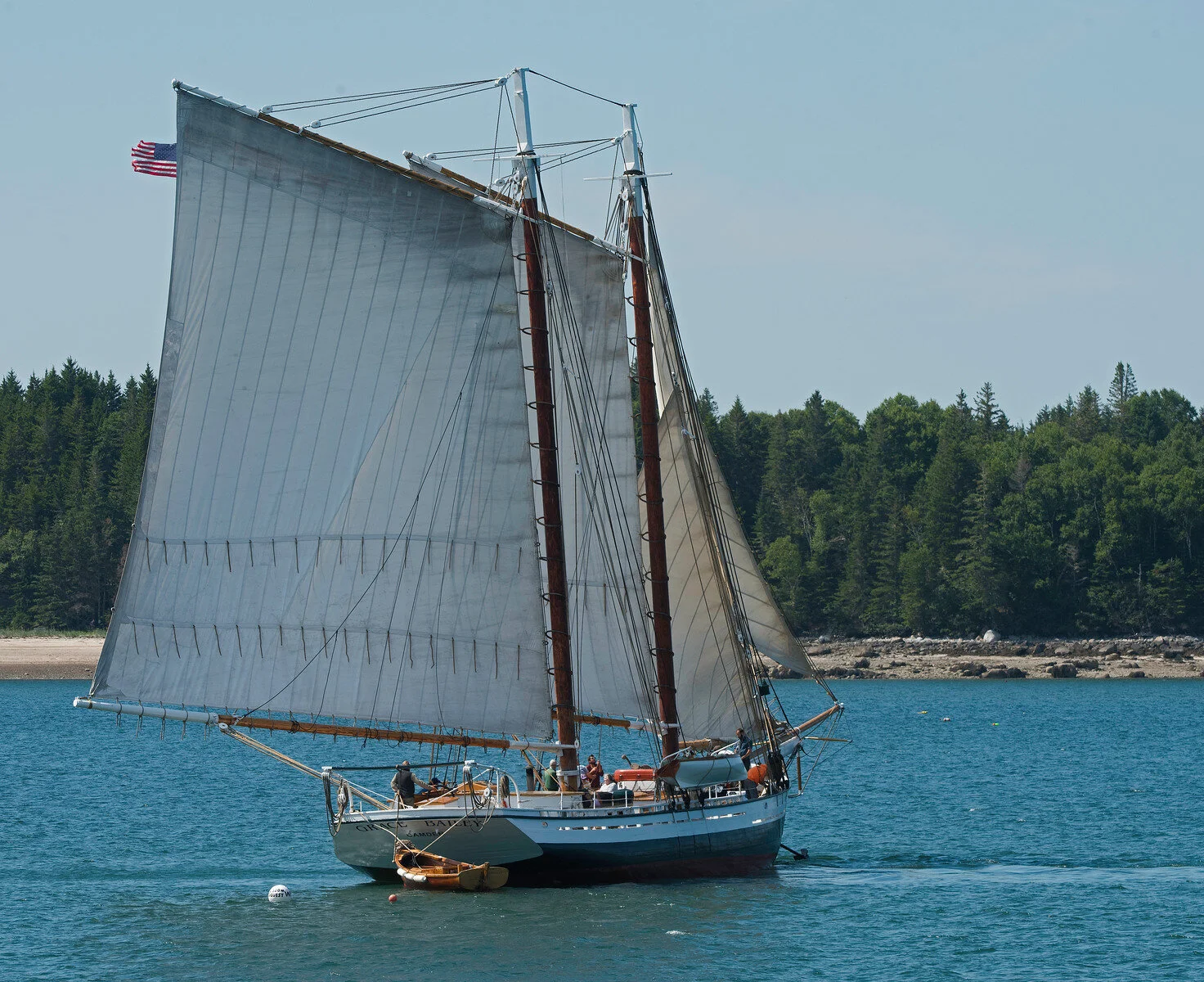
Yesterday, the 118-foot Coastal Schooner Grace Bailey sailed into Great Cove to shelter for the night. As you see, she was pointing into the northwesterly wind as the dying sun gave us a good idea of what coasting cruisers looked like when they hauled goods and materials to New England ports in the 19th and early 20th Centuries:

As with most of her kind, Grace has two “bald” masts (devoid of top masts) and a low-slung hull sheering up to a long cutter bow. She is flat bottomed for shallow waters, but has a retractable keel (“centerboard”) for hard sailing. She has no internal engine.

Leighton Archive Image
These “coasters” were the 18-wheel trucks during their commercial times of primitive roads. The vessels stayed close to the shore and were not built to withstand major open sea storms the way the much bigger square-sailed merchants were. (Those deep-water sailors looked down on coastal sailors, dismissing them as sailors who set their courses “by the bark of a dog,” according to Polly Burroughs’ A Celebrated Schooner Life.)
Leighton Archive Image
Grace was built in 1882 in Long Island, New York. She was named after the just-born daughter of her owner, Edwin Bailey. She was rebuilt in 1906 and renamed Mattie, the nickname of Edwin’s granddaughter Martha. In 1990, after being restored and reconfigured as a passenger ship, she was rechristened with her original name. (Brooklin, Maine)
Eastern Tiger Swallowtail Butterflies (Papilio glaucas) here are frantic to get to their favorite source of nectar before the flowers whither. Beauty Bush (Kolkwitzia amabilis) blooms are peaking here and, yesterday, this gorgeous female Tiger seemed to spend all morning trying to drink this one bush dry.
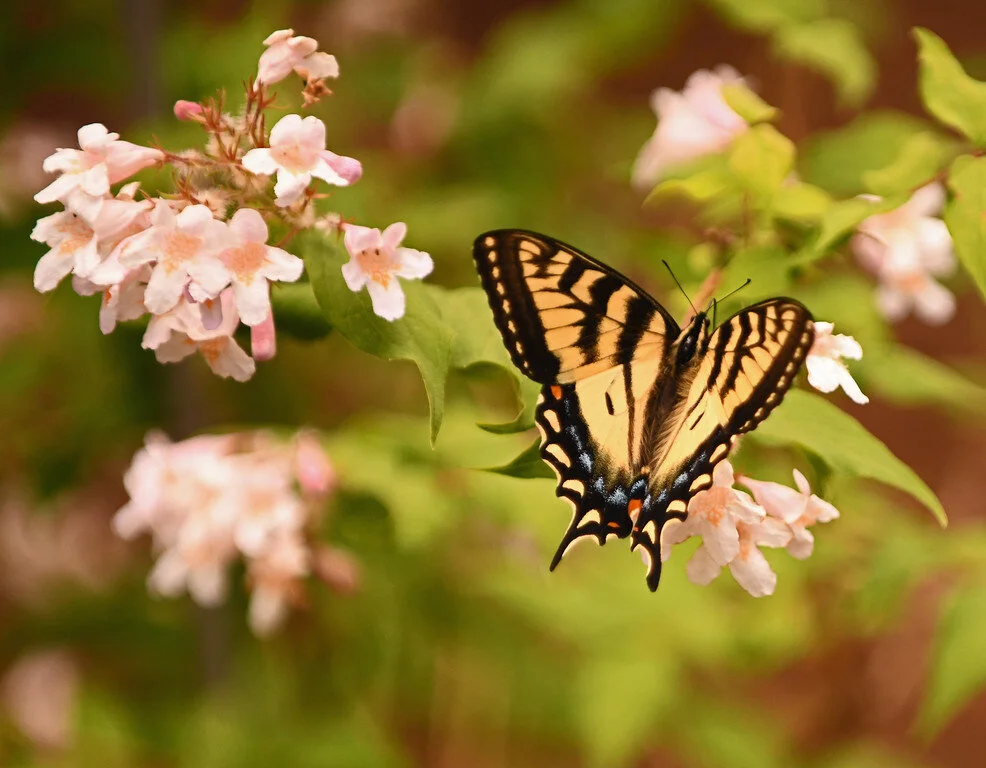
The male Tiger always is yellow with black “tiger stripes" on each fore wing. The female yellow morph is similar, but with a necklace of blue jewels along the hind wing. The female also can be almost completely black.
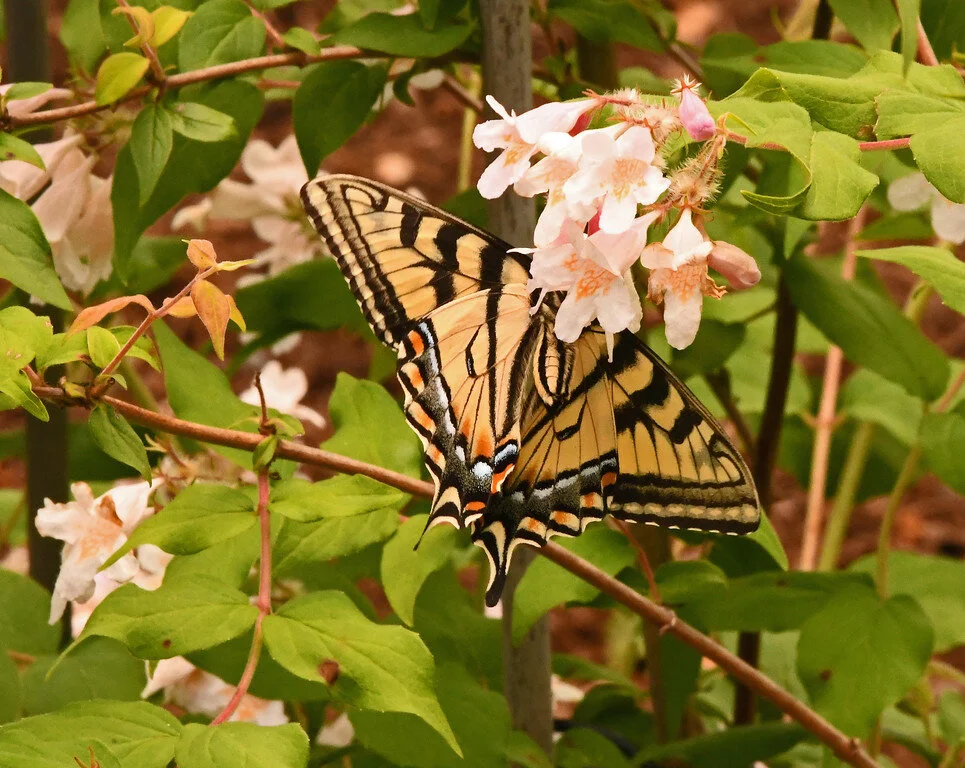
Tigers sometimes do an excited dance as they land on the blooms, especially the small Beauty Bush flowers. This activity apparently is because, as with all butterflies, Tigers smell and taste with chemical sensors on their antennae and feet.


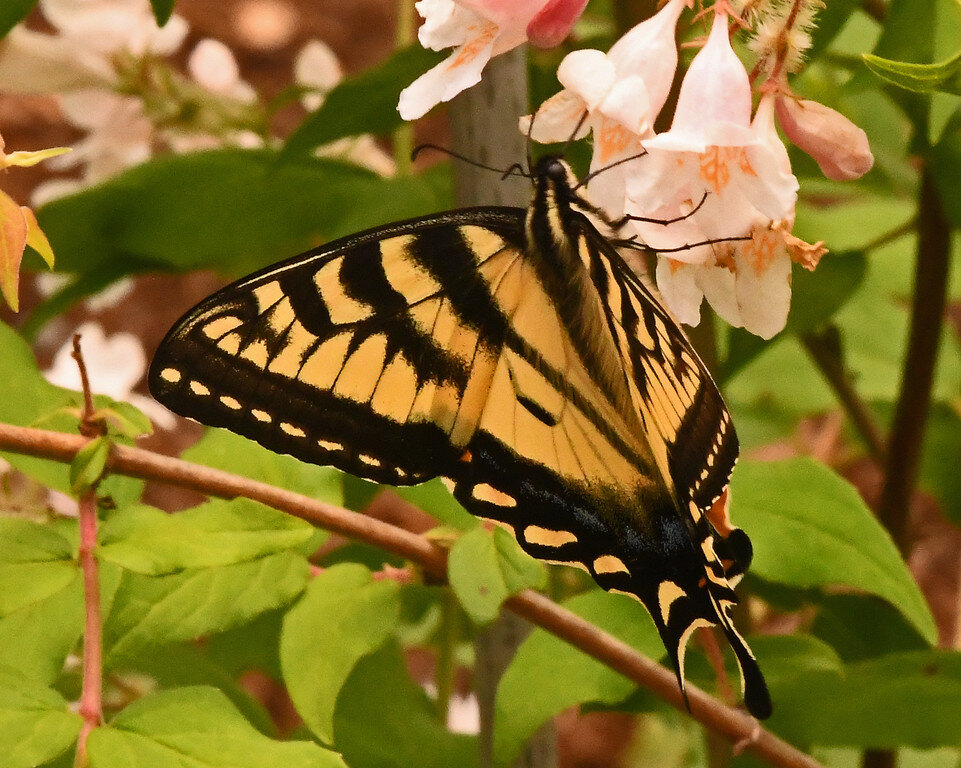
During its brief passage as a butterfly, the individual insect will mate and subsist on nectar and water. This existence as a winged insect will last only three or four weeks, but it already will have led an interesting and dangerous life as an egg, caterpillar, and larva. (Brooklin, Maine)
Here we see Mount Cadillac in Acadia National Park, as viewed yesterday afternoon from Amen Farm Ridge in Brooklin.

The Park has suffered serious storm damage this month. Yesterday’s official Acadia Conditions Report shows many historic carriage roads and popular trails closed for repairs, as well as a beach hazard warning that was in operation all day.
Most of the damage was done by a June 9 hurricane-like storm that bombarded the Park with almost five inches of rain in a few hours. Saturday (June 19), a tornado cell hailstorm in our area added insult to the injuries, but it did leave behind a glorious rainbow.
The Park Report warns: “Be prepared for quick weather changes from warm and sunny to cold and rainy. Weather on Cadillac Mountain and Acadia's other mountain peaks can be drastically different from temperatures in Bar Harbor or elsewhere on the island.” The Park and Bar Harbor are on Mount Desert Island, across Blue Hill Bay to the Northeast of us. (Brooklin, Maine)

