Comment

In the Right Place: Schooner Surprise

The beautiful sunrise in Great Cove today, shown here, revealed that three of Maine’s Coastal Cruisers had sheltered there overnight: Lewis R. French (launched in 1871) is on the left with its mostly gray hull and aft sails up for stability; Angelique (1980) is in the center with its mostly dark green hull and no sails up, and Victory Chimes (1900), the only three-masted vessel, is on the right with its mostly black hull and aft sail up.

4.jpg

It looks like today is going to be our second day in a row without fog, rain, or significant overcast. Yesterday was an iconic Maine summer day. We had a clear view from Amen Ridge of Mount Cadillac in Acadia National Park, across Blue Hill Bay:

1.jpg

(Brooklin, Maine)

Comment

Comment

In the Right Place: Vigilance

Once again, male Red-Winged Blackbirds are standing guard over their territories in our marshes, as this one was on Monday, July 26. Apparently, their second brood of the season is now here. (Some Red-Wings reportedly will have three broods a year, but two seems to be the usual number.)

X.jpg

These male Red-Wings are not only extraordinarily vigilant, they are among our most polygamous birds, according to ornithological reports. They may “keep” up to 15 females in 15 nests in their territory, which they defend angrily against any other intruder, including other birds and humans who get too close.

Z.jpg

But, male Red-Wings do have their moments of contentment, when there is peace in their kingdoms and they can just groom:

Y.jpg

(Brooklin, Maine)

Comment

Comment

In the Right Place: From Here to Eternity

Here you see the schooner Tree of Life leaving Great Cove yesterday morning in mist and fog and the vanguard of thin smoke that is reaching us from the raging western state wildfires.

1.jpg

(As this is written, today’s sunny morning is being made hazy by the drifting smoke, according to the weather tellers.)

2.jpg

The Tree, out of Newport, Rhode Island, is a 72-foot tourist cruiser that was launched in 1991 and has sailed worldwide. She is luxuriously appointed with airconditioned cabins, hot and cold water, DVD and large screen TV, and stereo in each cabin. Her pilot house is enclosed, which helps in weather such as yesterday’s.

3.jpg

Her name – Tree of Life – appears in Genesis as the source of eternal life in the Garden of Eden. However, according to one report, this schooner was christened Tree of Life because an Irish folk song of the same name was playing when its owners were looking for a name. (Brooklin, Maine)

Comment

Comment

In the Right Place: Rejection

This is the 26th day of July and the 20th day of the month that we’ve awakened to rain, fog, and/or an overcast day. Nonetheless, fog and rain make a summer garden lush with a subtle beauty that can sooth the disappointment from the sun’s rude rejection. Here are a few images from this morning:

3.jpg
1.jpg

(Brooklin, Maine)

Comment

Comment

In the Right Place: A Sad Tale

The wild Black-Eyed Susans are starting to peek from (but not yet peak in) in our fallow fields, where they’ll flourish until September. The proud group shown below was staring into the sun yesterday amid other emerging field flora.

1.jpg

There are at least 30 species of North American Black-Eyed Susans, all apparently sunflowers of the Rudbecki genus; these are R. hirta, I think. However, the common name of these natives seems inapt. They don’t have black eyes; their center discs are dark brown. Furthermore, no Susan ever had black eyes; human eyes come with colored “irises,” a word derived from the Greek words colorful and rainbow.

Leighton Archive Image

Leighton Archive Image

These flowers’ common name apparently was inspired by the early 18th Century English ballad “Sweet William’s Farewell to Black-Eyed Susan.” Sweet William was departing for war and tearful Susan appeared by surprise on his ship to say goodbye. I guess that she had dark brown eyes and the light wasn’t too good; how she got on a warship is a mystery. (Brooklin, Maine)

Comment

Comment

In the Right Place: The Buck Stops Here

Last night’s July full moon did not disappoint. It’s historically called the Buck Full Moon because it arrives at about the time when male deer are sprouting the velvety antlers that the bucks hope will grow into spiky displays that turn the heads of grazing does.

1.jpg

Above, you see the Buck Full Moon as it’s rising above Amen Ridge last night. Below, it’s sailing southeast above Naskeag Harbor, partially illuminating a fishing vessel.

2.jpg

At lower angles relative to us, the moon was turned yellow-orange by the sun’s light; as it gained height, it turned silver:

3.jpg
7.jpg

The most cited full Moon names, including this Buck Moon, come from The Old Farmer’s Almanac. They are based on historic sources, including Native American, Colonial American, and European sources.

Traditionally, each full Moon name was applied to the entire lunar month in which it occurred, not solely to the full Moon. (Brooklin, Maine)
Comment

Comment

In the Right Place: The Coast Is Clear

In the Right Place: The Coast Is Clear

Yesterday, for the first time in a long time, the federally supported U.S. Drought Monitor reported that, as of July 20, the entire seacoast of Maine was no longer abnormally dry or in drought:

U.S. Drought Monitor, July 22, 2021

U.S. Drought Monitor, July 22, 2021

Nonetheless, most of the rest of the State remained abnormally dry or in moderate drought and there is a pocket of severe drought in the upper southwest corner adjoining New Hampshire, according to the weekly report.

1.jpg

We’ve been getting above average fog, rain, and/or mist here on the Down East coast all month. This has kept our wooded streams flowing and our bogs lush, as you’ll see from the images above and below.

2.jpg

These images were taken on July 20, the day on which this week’s Drought Monitor is based. (Brooklin, Maine)

Comment

Comment

In the Right Place: Cool Customer

f1.jpg

This little masked marvel was hopping joyfully in our woods on Monday, July 19. He’s a Wood Frog (Lithobates sylvaticus), one of the most studied amphibians due to its mysterious ability to survive severe cold. (Sex assumed from his being less than two inches long; females usually are slightly larger than two inches.)

As with other amphibians, the Wood Frog is an animal with a metabolic rate that is too low to produce the heat necessary to keep its organs working. That is, the Wood Frog’s operational body heat must be obtained from the environment; it is ectothermic or “cold-blooded.”

Even so, Wood Frogs are remarkably adapted to the cold for reasons not yet fully understood. They usually are the first amphibians to appear in early spring, even when there is still ice in the vernal pools and the northern limit of their range is thought to be the tree line of the Arctic tundra.  (Brooklin, Maine) Click on image to enlarge it.

Comment

Comment

In the Right Place: Thick and Thin

The sun is trying to break through the morning’s thick fog again as this is written. This has been the foggiest and rainiest July in recent history here on the Down East coast. Yesterday, the sun eventually established a foothold and fought off the fog until the afternoon, when the fog started rolling large again.

1.jpg

This created the above interesting effect in Blue Hill’s Connery Cove that we were lucky enough to witness yesterday. Before the fog engulfed the Cove, the small fishing vessel Sun’s Up was brightly lit by its namesake for a few minutes. However, the fog continued to advance and soon snuffed the sunlight as you would a candle flame.

About 20 minutes later and a few miles to the south, we also were lucky enough to watch the 145-foot-long schooner Heritage being pushed by its yawl boat through the incoming fog and fading dusk light:

2.jpg

It was coming into our Great Cove to shelter for the night as the fog continued to thicken. (Brooklin, Maine)

Comment

Comment

In the Right Place: Beleaguered

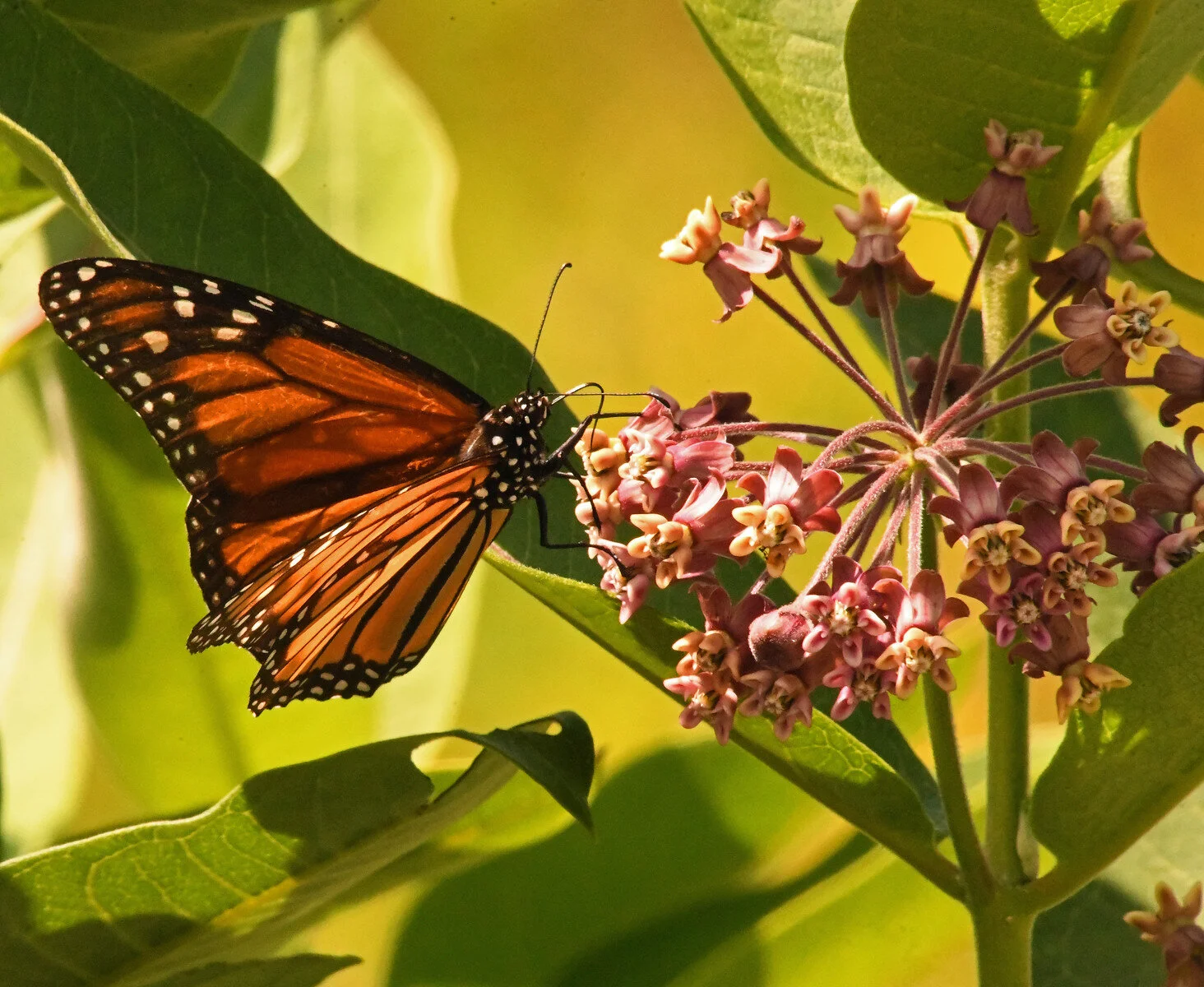
 Here you see a Monarch Butterfly sipping from a common milkweed floret on July 7:

m6.jpg

Below, you’ll see two newly hatched Monarch Caterpillars chewing milkweed leaves on July 13:

In our neighborhood, we seem to have fewer Monarch Butterflies and Monarch Caterpillars this year than in other recent years of diminished sightings. It may be coincidental, but this year there has been an apparent influx of American Robins and Bluebirds near the milkweed patches that I monitor. Leighton Archive images of each:

Robins are among the birds that eat the butterflies. Bluebirds eat the caterpillars I learned recently from Sherry Streeter, our neighboring Monarch hostess and protector. These insects are supposed to be toxic and their bright colors are meant to warn predators away from them. However, that’s not always the case, research indicates.

Some birds that are Monarch predators have adapted by eating only parts of the regal butterflies; Bluebirds, before eating the caterpillars, reportedly squeeze them against a hard surface until most of their toxic content is exuded from both ends of the insect; then, they gobble them up with a crunch. Predatory insects and the occasional mouse also will attack the otherwise-beleaguered Monarchs at various stages of their development. These beautiful creatures just can’t catch a break, it seems. (Brooklin, Maine)

Comment

Comment

In the Right Place: Questionable Practices

As you see below, those of us who visit Naskeag Harbor are now being asked an ultimate question: “What else is there to do?”

i-wfDCTJX-X3.jpg

A possible answer for fishermen floats in the background: the Harbor’s summer convenience raft, which sells fuel and bait to lobster fishermen and buys their catches. (Brooklin, Maine; image taken on July 16, but sign remained as of yesterday.)

Comment

Comment

In the Right Place: Osprey Nest Report 12

The saga of Ozzie and Harriet continues to unfold pleasantly, as you may infer from Thursday’s and Friday’s (July 15-16) images here.

o1.jpg

During our last episode, we were worried about June, the youngest and smallest of the family, whom we hadn’t seen for a while. Well, she’s getting bolder now and rising regularly from the depths of her home, as you see her above, to the right of her brothers David and Ricky. (The sexes of the youngsters are assumed for descriptive purposes.)

Harriet spends more time away from the nest now that her nestlings are too large for any predator. Below, you’ll see Ozzie and Harriet (golden eyes) with fast-growing and curious David (red eyes in the middle). If you look closely, you’ll see Ricky’s back as he rests in the nest.

o2.jpg

Answering questions from people who apparently are of a certain age, as I am: Yes, we’ve named these happy ospreys after the characters in “The Adventures of Ozzie and Harriet,” a television situation comedy of the 1950’s and ‘60s. It involved the problems of the Nelson family, especially those of the family’s two youngsters, David and Ricky. We named the third of “our” ospreys “June,” the month of her birth. (Brooklin, Maine)

Comment

Comment

In the Right Place: Great Expectations

g3.jpg

The mouth of Patten Stream was churning with alewives on Wednesday afternoon (July13) as the tide from Patten Bay rose high. It was raining, which cast the scene darkly and made it difficult for this young Great Blue Heron to cross the slippery rocks and get into a good fishing position.

Great Blues are our largest and most regal Herons (that is, they’re “Great”), but they’re considered to be a “Species of Special Concern” by Maine wildlife officials. That’s primarily because their coastal breeding populations have shown significant declines in recent years. This loss appears to be at least partly due to an increase in predatory Bald Eagles and proprietary human beings along the coast.

g2.jpg
g1.jpg
g6.jpg

Although they may be Great, GBHs are among our skinniest birds, as you can see here. They can reach almost five feet in length, but usually weigh much less than eight pounds. While slow and awkward on their feet, they can achieve a respectable air speed of about 30 miles per hour.

Leighton Archive Image

Leighton Archive Image

(Images taken on July 13 in Surry, Maine, except for the in-flight Archive one.)

Comment

Comment

In the Right Place: Dog Days

It’s mid-July – prime summertime – but the weather gods have not been good to us here on Maine’s Down East coast. All week, it’s been foggy and/or rainy at least in the morning and sometimes most of the day.

f1.jpg

Yesterday’s fog was gruel-thick at times, as you can tell from these images of the 125-foot-long schooner Mary Day leaving Great Cove in the morning, with tourists at the bow being unable to recognize tourists at the stern.

f2.jpg

Naskeag Harbor was no better, as you can see from the image of the Town Dock:

f3.jpg

Yet, our usually fertile soil remains dangerously dry. The weekly U.S. Drought Monitor, issued yesterday, showed that, as of July 13, most of Maine’s coastal counties continued to be “Abnormally Dry” and some in the State’s southwest corner actually were in “Severe Drought.” A good part of central Maine was reported to be in “Moderate Drought.” The Monitor is a federally supported report.

The temperatures in the first two weeks of July here often have ranged from uncomfortably chilly to uncomfortably clammy; the rain at times has hammered so hard that the deprived ground cannot absorb it well. If the trend continues, August could be a brutal disappointment.

This is not good for the “Vacationland” state that is famous for its grand summers and the nature lovers who come here to enjoy them, not to mention the fishermen and other outdoor workers who depend on them. It gives no solace to realize that it’s worse elsewhere. The Nation’s environment seems to be turning on its handlers like a dog that has been beaten so long it has nothing to lose. (Brooklin, Maine)

Comment

Comment

In the Right Place: Yellow Bird Road

It took about 15 minutes to find this male Common Yellowthroat Warbler Tuesday, July 13. He would sing from within a large bush; I would go near the bush; he would stop singing; I would stick my head into the bush and “phish” for him, and I would hear him singing from a different bush.

y1.jpg

He eventually tired of the game and stayed put for about three seconds. (Repeatedly making a “phish, phish” or similar sound sometimes attracts curious birds.)

y2.jpg

Common Yellowthroats are our only warblers that nest low and stay low most of the time. They’re easily missed by those who always look up in the treetops for warblers. Common Yellowthroats are not to be confused with Yellow-Throated Warblers, which mostly inhabit leafy treetops in summer. Why such similar names were chosen is beyond me.

However, as far as descriptive names go, the two Yellow Throats seem to have fared better than their cousin, the Yellow-Rumped Warbler:

Leighton Archive Image

Leighton Archive Image

Leighton Archive Image

Leighton Archive Image

It seems to me that the Yellow-Rumped just as easily could have been called a Yellow-Sided or a Yellow-Crowned Warbler.

(Brooklin, Maine)

Comment

Comment

In the Right Place: Organic Farming

Queen Anne’s Lace flowers are icons of high summer, but they’re already out in full force here. If you look closely at the images below, you’ll see that this plant, also known as Wild Carrot (Daucus carota), has not only attracted pollinating flies or bees, but also ants that apparently are herding aphids.

q2.jpg

As you may know, aphids are miniscule insects that suck the sap from plants. Ants are known to “farm” aphids and stroke them so that they exude “honeydew,” a sweet milk-like substance that the ants drink insatiably.

q1.jpg

I’m not sure what species these pollinators and ants are. If you can identify them for me, it would be appreciated. (Brooklin, Maine)

Comment

Comment

In the Right Place: A Start

Here, in Nakeag Harbor yesterday morning, we see indications that some of our fishermen haven’t gotten all of their lobster traps in the water yet. However, we hear that most of the fisherman are “all in.” We’ve also been told but that, so far, it’s been a “slow start” for lobster catches.

1.jpg

Below, you’ll see the water creeping up yesterday on a favored parking space for some fishermen – on the beach point, which is used only by those who know the tides well.

2.jpg

Fisherman here trailer their outboard-motored skiffs to the Harbor to ride out to their moored boats and to return from them. (Brooklin, Maine.)

Comment

Comment

In the Right Place: The Drain in Maine

Local ponds are brimming after Tropical Storm Elsa’s brief kiss on July 9, but analysis of the data indicates that the drought continues to plague much of Maine.

W1.jpg

Above you see a local Fragrant (Scented) Water Lily (Nymphaea odorata) apparently unaffected by the conditions. However, below you’ll see that nearby Common Cattails (Typha latifolia) have been slow to put out new growth:

w2.jpg

“It rained and drained for the most part,” according National Weather Service meteorologist Chris Kimble in Gray, Maine, as quoted in the Portland Press Herald. Rainfall this year is still about five inches below normal in total, notwithstanding Elsa’s exuberance. (Brooklin, Maine)

Comment

Comment

In the Right Place: Osprey Nest Report 11

Summary: Harriet put on quite an aerial show yesterday morning when a bald eagle appeared about half a mile away. After that, two chicks showed themselves; whether there still is a third chick is yet to be determined. Ozzie did not make an appearance while I was there.

Harriet’s defensive strategy seems to be based on the theory that it is better to challenge the enemy at a distance from the nest, rather than stay near or on it. On seeing the eagle, she began screaming and scrambled immediately up and off the nest, as you see here.

She began flying in wide circles above the nest like an aircraft carrier fighter that provides cover for the flat top. The eagle paid absolutely no attention to her antics and continued on its way, slowly flapping its huge wings to cross Great Cove.

o3.jpg

All the while, Harriet circled and screamed, the chicks huddled unseen at the bottom of the nest, and I did contortions trying to keep Harriet in focus. (It seems that the chicks go to the bottom of the nest when Harriet screams in attack mode, but not when she calls differently at the sight of Ozzie.)

As the eagle disappeared, Harriet returned and calmly preened herself as if nothing had happened. That’s when two chicks stuck their heads up and peered over the side of their nest. I waited for 30 minutes, but neither the third chick nor Ozzie appeared.

o11.jpg

(Brooklin, Maine)

Comment

Comment

In the Right Place: Weather or Not

Tropical Storm Elsa said her tearful goodbyes here yesterday with almost two inches of rain and wind gusts that reached almost 40 miles per hour, according the Brooklin School’s weather station.

Although the rain at times was slashing and the County was under flash flood and high surf warnings, no significant harm appears to have been done here. Besides, we needed the rain to bring our ground water levels up before August.

X.jpg

Above, you see Fiona, defenseless in the rain at her lonely mooring in Great Cove yesterday. She’ll probably have to be bailed out soon. Below, you see a nearby field pond being topped off at about the same time. No frogs were complaining.

Y.jpg

(Brooklin, Maine)

Comment