Comment

In the Right Place: Hail to the Chieftain

You never know what you’re going to see around here. This is a replica of the small Gislinge Boat excavated in 1993 near the town of that name in Denmark, which is pronounced “Jiss-ling,” I’m told.

x.jpg

Archaeologists reportedly think that the vessel might have been built for a Danish Chieftain in or about the year 1130, soon after the Viking Age.

y.jpg

This replica, on the other hand, was built by WoodenBoat School students in this year’s Stitch-and-Glue Boatbuilding Class. They used computer-cut marine plywood with wire stitches and epoxy, among other things.

z.jpg

The students used plans, based on the original vessel’s measurements, that were developed by Class Instructor John Harris’s Chesapeake Light Craft Company, which markets boat kits and plans. (Brooklin, Maine; images taken August 14, 2021) See also the image in the first Comment space.

Comment

Comment

In the Right Place: A Moment of Silence

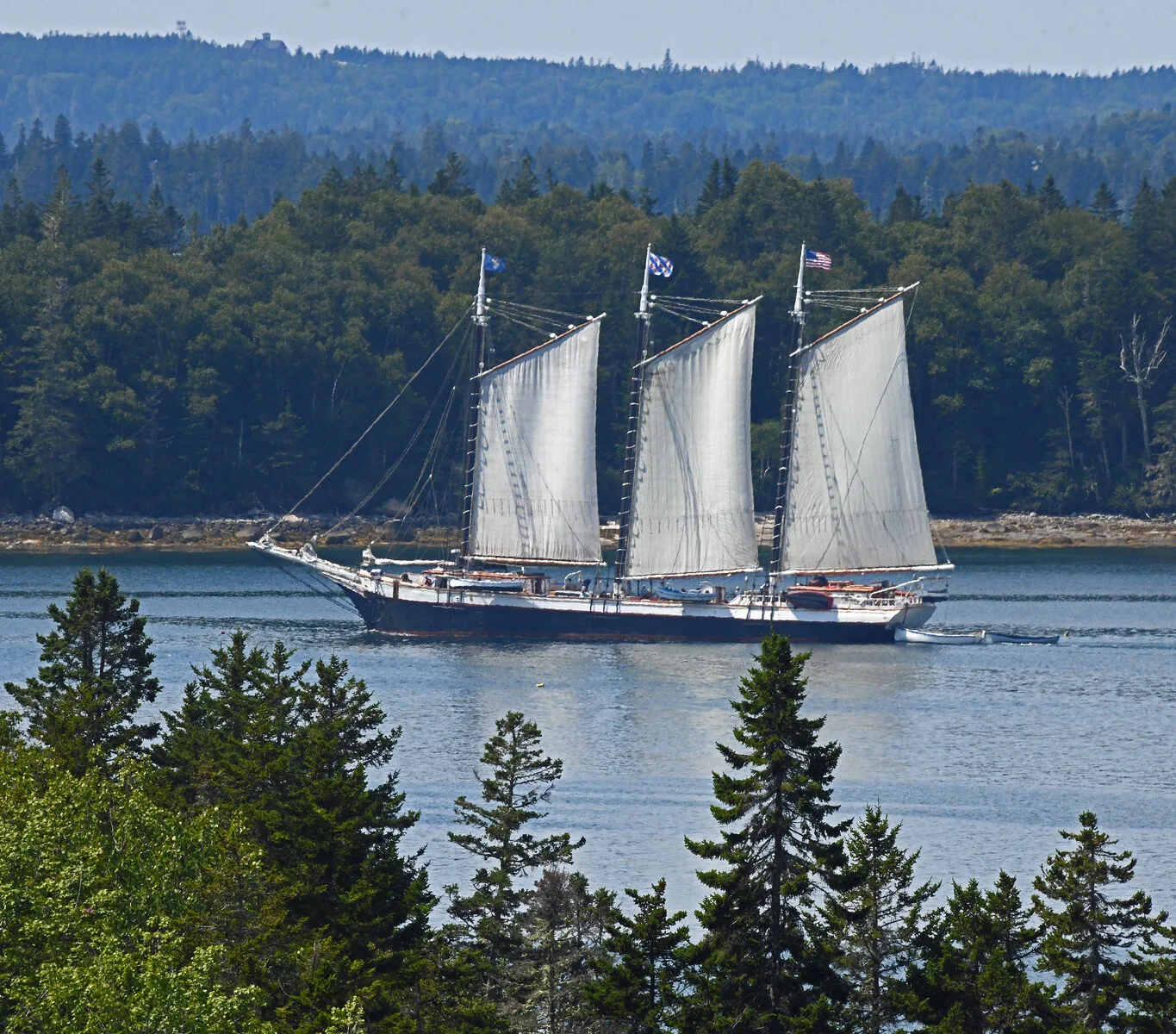
On Saturday morning, I was watching the sun battling the fog in Great Cove and saw no living creatures except seagulls and a lone cormorant. Then, a moving speck among the islands out in Eggemoggin Reach caught my eye. It slowly became a large schooner under full sail, coming silently toward the Cove’s southern entry, apparently trying to escape the Reach’s heavier fog and haze for a while.

v1.jpg

She passed through the Cove with no sound and returned to the foggy Reach through the Cove’s northern entry. (See the image in the first Comment space.)

v2.jpg

It was a moment out of the 19th and early 20th Centuries. The schooner was an old friend, the 170-foot Victory Chimes, launched in 1900 as the Edwin and Maud to freight fertilizer, coal, and lumber. As with the other coastal cruisers that have come to see the Cove this summer, the Chimes seemed to have fewer passengers than in prior (non-Covid) years. (Brooklin, Maine, image taken August 14)

Comment

Comment

In the Right Place: Hippies


Many Beach Rose (Rosa rugosa) hips are now cherry-tomato-sized and providing our deer a crunchy alternative to unripe apples. Humans also consume these hips for their vitamin C, antioxidant, and flavonoid content. Beach Rose plants are popular here, despite the plants’ highly invasive nature.

i-b2MbXJM-XL.jpg

The plants originated in Asia and were imported into New England for ornamental use as well as to stabilize shifting shorelines, hence their common name. Their flowers, usually white or a shade of pink/purple, are attractive:

i-LKk7ghw-XL.jpg

Since this hardy species had a high tolerance for sea salt, it was tried along New England roads that got plenty of salt and other chemicals in the winter. It prospered; some would say too much.

Firmly established Beach Rose plants create dense barriers of thorns and spines that can be painful, if not impenetrable, to walkers and dogs. They also are almost impossible to remove without heavy digging equipment. (Brooklin, Maine, images taken August 13)

Comment

Comment

In the Right Place: A Tale of Two Ladies

Here you see yesterday’s dawn sunlight touching little Martha and big Angelique as they sleep in Great Cove. It was a wonderful sight, especially since we haven’t been able to see the Cove on many mornings lately, due to heavy fog.

1.jpg

Martha is a local legend. She was built in 1967 by the famed Brooklin naval architect Joel White for his even more famous father, the New York- and Brooklin-based author E.B. White. Martha was named after Joel’s daughter, E.B.’s granddaughter.

She’s a sloop-rigged Crocker Pocket Cruiser that is almost 20 feet long overall (19’ 9”). After E.B.’s death, Martha was sold by the White family to Rich Hilsinger, Director of the WoodenBoat School here, who promised to keep her in Brooklin. Here’s an archive image of Rich sailing her in the Cove:

Leighton Archive Image

Leighton Archive Image

Angelique is a 130-foot topsail ketch. She was built in 1980 for the tourist trade and is designed to look like a 19th Century English North Sea trawler. Nonetheless, Angelique has unseen modern touches, including a metal hull, full (not retractable) keel, and two powerful diesel engines. Here’s a close-up of her yesterday:

2.jpg

(Brooklin, Maine)

Comment

Comment

In the Right Place: Maine Drought Report

The above-average rain and fog of July on the Maine coast is now the above average rain and fog of August here. The moisture has increased our ground water and is relieving the coast from the State’s significant dryness problem. (See the drought report below.)

P-2.jpg

In the image above, you see Patten Stream in Surry, Maine, tumbling fresh water into salty Patten Bay at very low tide on August 6. The image shows an interesting mixture of life that is below water at high tide.

The bright green strands on the rocks appear to be the algae known as Green Rope Seaweed (Acrosiphonia spp.). In the upper background are fields of seaweed that appear to be Knotted Wrack (Ascophyllum nodosum), the brown algae that is our most common form of Rockweed.

About 10 feet upstream, you’ll see that some of the rocks are spotted with what appears to be Common Orange Lichen (Xanthoria parietina), also known as Maritime Sunburst Lichen:

P-1.jpg

Despite the precipitation here on the coast, today’s federal “U.S. Drought Monitor” reports that Maine still has a significant dryness problem, as of August 10.

0812212 Release.jpg

This week’s Monitor map, above, shows that the majority of the State remains “abnormally dry” (yellow), in “moderate drought” (tan), or in “severe drought” (burnt orange). See the image in the first Comment space. (Brooklin, Maine)

Comment

Comment

In the Right Place: Recent Coastal Cruiser Sightings

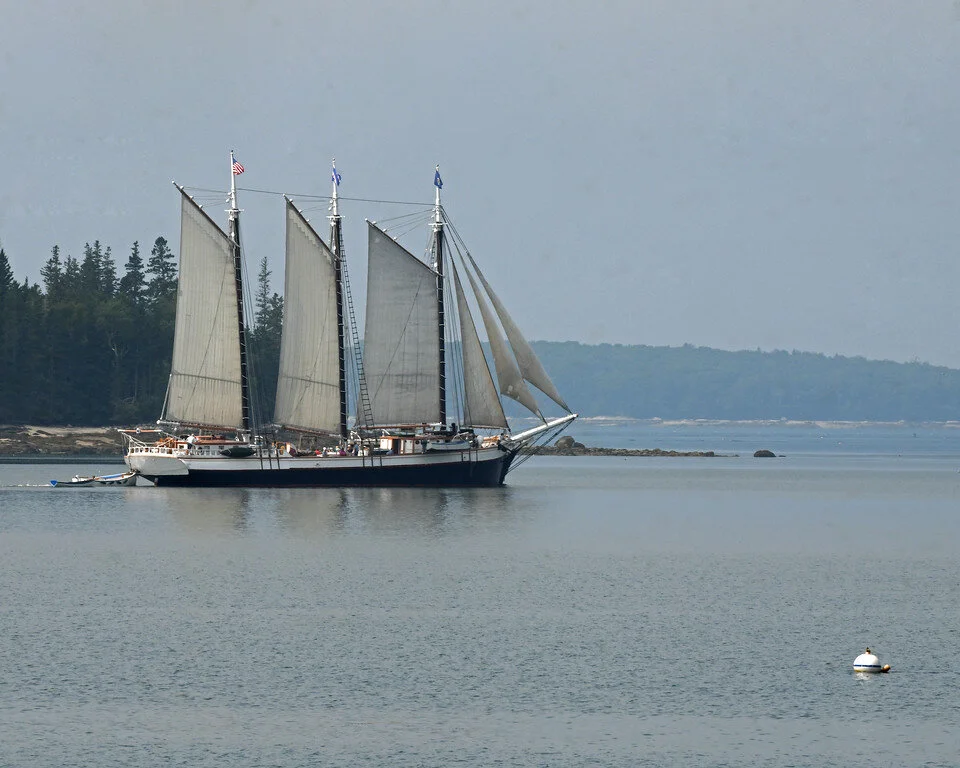
Here you see the 170-foot Schooner Victory Chimes (launched in 1900) leaving Great Cove in the sunny morning of August 4:

S-1.jpg

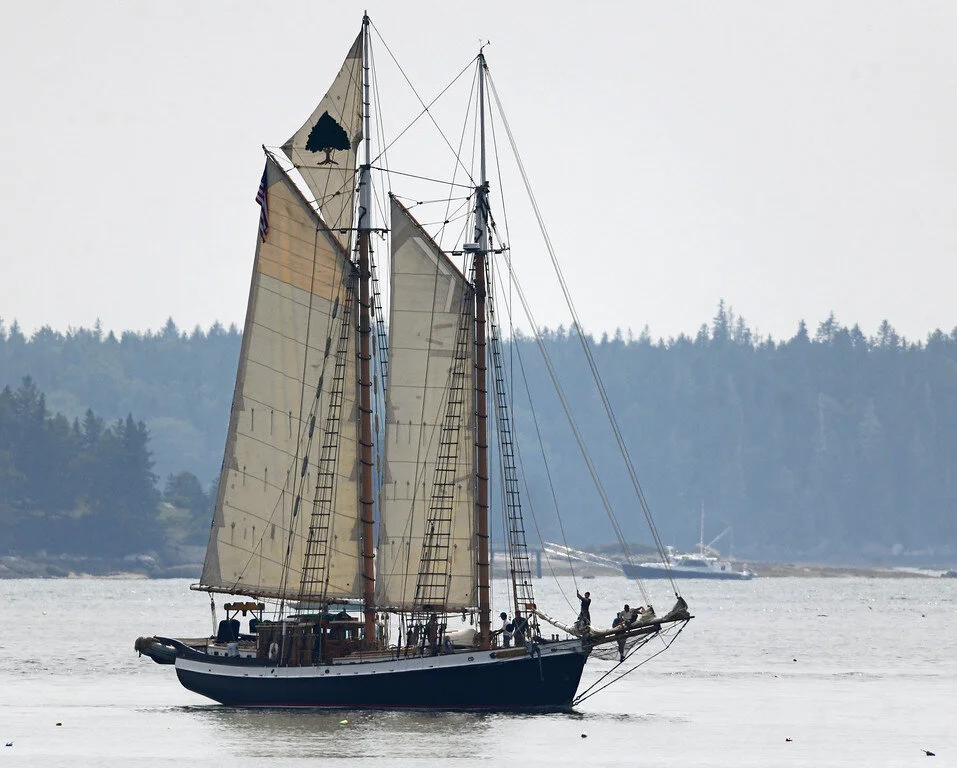
Here’s the 91-foot Schooner Tree of Life (launched in 1991) entering the Cove in the hazy-foggy afternoon of August 7:

S-2.jpg

Changing weather is the norm here on the coast. As this is written, it’s so foggy that we can’t see our North Field, no less the Cove and what’s in it. (Brooklin, Maine)

Comment

Comment

In the Right Place: Petal Power

Tiger Lilies (Lilium lancifolium) have come into full bloom here, their swept back petals giving them the appearance of pulsating sea forms swimming in the garden air.

T-1.jpg

They’re native to China, where they have been admired and depicted in literature and artworks since at least the 10th Century.

T-2.jpg

Those Tiger Lily petals and bulbs, by the way, are edible by humans, but not dogs and cats, which can have severe adverse reactions from eating them. Chinese chefs reportedly like to use the bulbs (when available) in moo shu pork. (Brooklin, Maine; images taken Sunday, August 8.)

Comment

Comment

In the Right Place: Heaven Reimagined

Yesterday was a high summer day here.  The temperatures were below 80 (F) with a breeze that provoked involuntary smiles. There was haze on the sea, but cumulonimbus clouds worthy of N.C. Wyeth were performing their now-you-see-it-now-you-don’t trick with the sunshine.

Our fields are now thick with proud Queen Anne’s Lace and emerging Goldenrod. The ponds are mostly carpeted with Fragrant Lily pads and flowers, but with room for clouds to float.

2.jpg

(Brooklin, Maine)

Comment

Comment

In the Right Place: Regatta Regalia

Here you see the fog lifting off Great Cove early this morning. Few are stirring on the sailboats that raced in the annual Eggemoggin Reach Regatta yesterday, but a breakfasting deer can be seen by those with keen eyesight:

X.jpg

The boats in that 15-mile race yesterday encountered heavy haze and difficult (sometimes nonexistent) winds. The air often was light near the finish line at the Cove entrance, where some boats had to tack across.

Y.jpg

The Schooner Tree of Life came into the Cove before the finish to allow her passengers to see the end of the race:

Z.jpg

The prestigious Regatta has been run for wooden boats since 1985 and has been cancelled only once by fog. (Nonetheless, the after-race party was held then.) The Regatta is sponsored by the Brooklin Boat Yard and Rockport Marine boat builders and the after-race party takes place at the WoodenBoat School campus, overlooking the Cove. (Brooklin, Maine)

Comment

Comment

In the Right Place: Painting

August is a good time to sneak up on Painted Turtles (Chrysemys picta) to see these natives basking. They’re usually very shy and will disappear under water if they see or otherwise sense your presence at a distance.

i-jrPNvq3-X4.jpg

I’ve found it best to approach them slowly while keeping a screen of cattails or other vegetation between us; usually there are small openings through which you can peer when you get close. That’s what we did yesterday to “catch” the young fellow above.

Painted Turtles have existed for at least 15 million years, according to fossil records. They reportedly evolved into four subspecies during the last glacial age, which ended almost 12 thousand years ago. Our subspecies, shown here, is the Eastern Painted Turtle (C.p. picta); it’s the only subspecies with shell segments (“scutes”) that occur in virtually straight rows and columns. (Brooklin, Maine)

Comment

Comment

In the Right Place: How Dry I Am

We had significant rain yesterday, through the early morning today, and there is a misty overcast here as this is written. The Viburnum berries are happy, the tourists are not, and Maine is still significantly dry. This image of the berries, was taken in yesterday’s rain:

i-NfZvJZX-X3.jpg

Yesterday’s U.S. Drought Monitor reported that most of Maine still has a dryness problem. The U.S. Department of Agriculture Drought Monitor Map, tabulating data as of August 3, shows that the majority of the State remains “abnormally dry” (yellow), in “moderate drought” (tan), or in “severe drought” (burnt orange):

080521 US Drought.jpg

(Brooklin, Maine)

Comment

Comment

In the Right Place: Ups and Downs

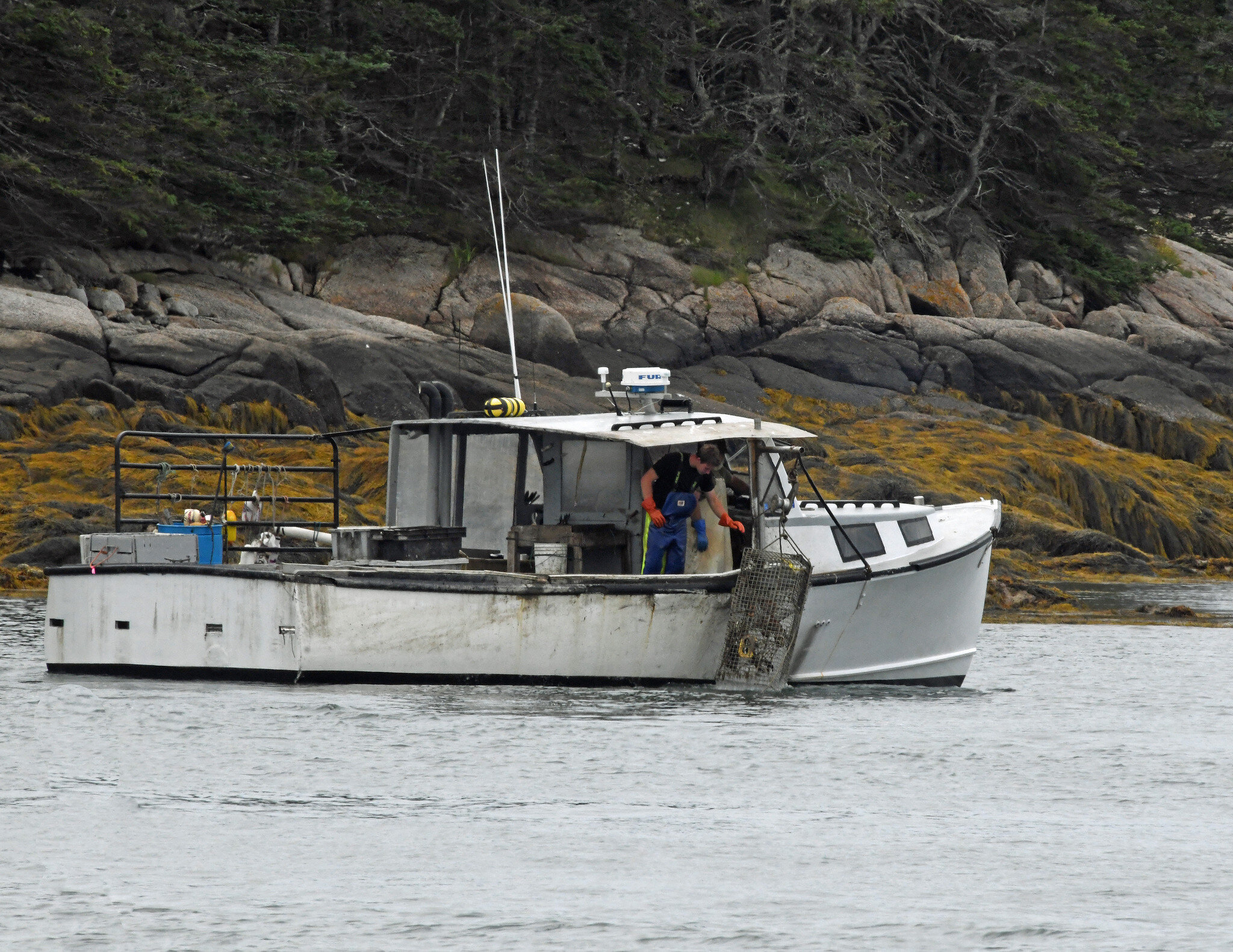
We hear that lobster prices paid to fishermen have been very good so far during this primary season, but that the catch numbers are down statewide.

2.jpg
1.jpg

Above, youl see Long Set, a local fishing vessel, catching lobsters right in our Naskeag Harbor on a cloudy Monday, August 2. (Brooklin, Maine)

Comment

Comment

In the Right Place: Osprey Nest Report 14

Progress: The three Brooklin hatchlings are flying or virtually flying now. Here you see David, the oldest of Ozzie and Harriet’s 2021 brood, returning to the nest from a long solo flight yesterday.

2.jpg

That’s his sibling June in the foreground,; Harriet is in the middle, and his other sibling, Ricky, is ducking behind David. (Names and sexes assumed for descriptive purposes.) Here, left to right, are Harriet, David, and June after the landing:

3.jpg

I'm almost certain that I’ve seen Ricky flying recently, but this second-born is now difficult to distinguish from David. We’ll know for sure soon when we see them flying together. Here, I think, is David coming out of the fog on Monday, August 2, with his two siblings in the background:

5.jpg

June, the smallest and last-born (in late June), was doing the Osprey Bounce yesterday – catching breezes with flapping wings so that she elevates above the nest and can practice landings:

She’ll be flying around the neighborhood soon.

1.jpg

Ozzie is still doing all of the family fishing, as far as I’ve seen, but Harriet does not need to feed her youngsters anymore. They sometimes compete with her at grabbing the fresh fish.

Leighton Archive Image

Leighton Archive Image

The next developmental step for the youngsters likely will be to trail along with Ozzie as he fishes and then to try their own hands (talons) at fishing. Here’s an archive image of Ozzie returning to the nest with a fish:

Most researchers seem to think that Ospreys are not taught to fish, they just do it innately when they are ready. However, flying in a group over water with a hunting parent seems to prepare them for the physiological and mental moment when they feel brave enough to dive and plunge under water to grab a fish. (Brooklin, Maine)

Comment

Comment

In the Right Place: Mysteries

Here you see the abundant berries of a Mountain Ash Tree in yesterday's morning fog. They appeared here in the mysterious trees about a week ago:

M1.jpg

These trees (Sorbus aucuparia) are neither Ash Trees nor especially fond of mountains. They’re members of the Rose Tree family.

They’re also called Rowan Trees because our early Scots and Irish settlers mistakenly thought that they were the same as European Rowans, which were believed to ward off witches and have other magical properties. In nearby Canada, they’re known as Dogberry Trees and their berries are used to make Dogberry Jam, which is popular there.

M3.jpg

Many old-timers here believe that an abundance of Mountain Ash berries in the summer and fall means a harsh winter. The theory is that this is one of the ways that Mother Nature protects the over-wintering birds. Of course, that was before we created Climate Change to ruin nature as it was. (Brooklin, Maine)

Comment

Comment

In the Right Place: The Day of Rest

August arrived with splendor yesterday– cool, sunny, and breezy with a few clouds scudding across a bright blue sky.  It was a hopeful sign after having just experienced the second wettest July in recorded Maine history, according to Portland records. But, our hopes were put in doubt when we awoke to fog and rain today. Nonetheless, after July, a one-out-of-two great day ratio seems fine.

Yesterday being the day of rest for most fishermen, we went to nearby Stonington on Deer Isle to see the fleet at anchor, which always is a reassuring sight. The small port ranks first in Maine for lobster landings by value: a reported $43.26 million last year, despite Covid 19.

1.jpg

The foreground of the image above shows part of the fishermen’s commuting system, which seems more refreshing than rides on buses or subways (except, perhaps, when it’s raining, densely foggy, very choppy, or cold and windy in predawn darkness).

2.jpg

It was low tide when we got there, so we got a bonus view of Stonington’s famous granite ledges.

3.jpg

(Stonington, Maine)

Comment

July Postcards From Maine

6 Comments

July Postcards From Maine

July of 2021 was different from prior Julys. To be sure, we had our traditionally grand vistas of sunlit fields, blue water bays, and Mount Cadillac Mountain in Acadia National Park across the way. The winding country roads and paths in dappled sunlight made walking and other local travel almost irresistible.

1.jpg

However, we had more fog and rain this July than we’ve had in recent memory, some of it made worse by drifting smoke from wildfires in the western states. After 1915, this July was the second wettest July in recorded Maine history, according to Portland records. Fields and harbors faded away in dense murk, flowers in gardens and ponds were pelted for hours by steady and hard rain.

14.jpg
15.jpg

Nonetheless, the precipitation was needed to remedy our unexpected and unusually dry winter and spring. The July ponds and wooded streams were full of water and the bogs were lush. When the sun did come out, the flora glowed; even when it didn’t, the soft greens around rushing water could be enchanting.

7.jpg
11.jpg

On the seas and bays, the tourists on coastal cruisers often never saw the beautiful sights that they had signed up to see. But, sometimes, the sun appeared and all was glorious again, especially for students learning to sail at the famous WoodenBoat School.

22.jpg
20.jpg

July is when our lobster fishermen (male and female) start their season in earnest. The convenience raft in Naskeag Harbor often is busy selling fuel and bait and buying lobsters, the traps are loaded and set, and the handsome vessels pose for us when the sun is fading and the fog is rolling in.

28.jpg
27.jpg

Although tourists complained, life went on as usual for our plentiful wildlife. White-Tailed Deer, their summer coats wet in the rain, grazed unconcerned in the succulent fields (and, unfortunately,, in many gardens).

32.jpg

Ozzie, Harriet, and their three youngsters, David, Ricky, and June — the local Osprey family that we monitor — flourished. As usual, Harriet had to be careful when feeding with her sharp beak and Ozzie would rise warlike to protect the nest every time a bald eagle passed by.

34.jpg

Other July bird favorites included male Red-Winged Blackbirds guarding their second brood in the marshes, Common Yellowthroat warblers hiding in the bushes, and Great Blue Herons fishing in the waters.

36.jpg

Among the most anticipated of our July insect visitors are the virtually endangered Monarch Butterflies. Their life cycle is being imperiled by Climate Change and the disappearance of milkweed, the leaves of which are the only food that their caterpillars eat. Those leaves also attract other leaf-munchers, including Red-Legged Locusts (Grasshoppers), which arrive in July.

The milkweed flowers, which appear and disappear in July, are favorite nectar fonts for the Monarch Butterflies and other pollinators.

39.jpg

This July, perhaps because of the rains and fogs, Black-Eyed Susans, Queen Anne’s Lace, Goldenrod, Bull Thistle, Bunch Berries, and Crown Vetch arrived early in the fields and woods.

59.jpg

Daylilies also came in a bit early in July, which was a great month to see Waxy-Caps and other mushrooms flourish in the wet woods.

68.jpg

Of course, perhaps the social highlight of the month is July 4, Independence Day. Last year, the Covid 19 Pandemic and rain assured that the traditional Brooklin grand celebration did not occur. This year, it did and we published a special entry on it in this Journal. The Brooklin Town Band, and plenty of flags, firetrucks,. and classic vehicles were on display

47.jpg
50.jpg

Finally, there was the July moon, which did not disappoint this year. Called the Buck Full Moon because it coincides with male deer starting to regrow their antlers, it arose shrouded in red out of our east-southeast sea horizon and silvered as it sailed high over Naskeag Harbor, illuminating fishing vessels there.

53.jpg

(All images here were taken in Brooklin and other Down East Maine locations during July 2021)

6 Comments

Comment

In the Right Place: Spiffy Stuff

FaceBook Friend Steve Lauermann spotted this vessel as little more than a speck in my July 29 Post image and asked for information about her. Here are images of her today in Great Cove, where she’s been moored as one of the WoodenBoat School’s sailing class vessels:

E1.jpg

She’s the Fishing Schooner Ellen C. Wells, out of Dutch Harbor, Jamestown, R.I. She was designed by William Garden and built and launched in 2015 in Kittery, Maine.

E2.jpg

She’s 45 feet long overall, has a 10-foot beam (widest part) and a Yanmar 3GM 27 HP diesel engine. She’s gaff-rigged and fast, judging by the few times I’ve seen her under sail. Spiffy. (Brooklin, Maine)

Comment

Comment

In the Right Place: Osprey Nest Report 13

Here you see David, the oldest of Ozzie and Harriet’s brood, doing the “Osprey Bounce” on July 24 – flapping his newly feathered wings and waiting for a breeze to lift him up above the nest, then plopping down again:

2.jpg

He and his siblings should be flying a bit now or soon, but they seem to refuse to do so when I visit. I visited this morning and could see only Harriet, looking regal at the end of the nest:

1.jpg

When she sits in that position, the three youngsters usually have been lying deep within the large nest. But, I like to think that they’re flying over Great Cove. (Brooklin, Maine)

Comment

Comment

In the Right Place: Wet and Dry

It rained hard overnight and into this morning here on the coast, reportedly bringing our precipitation level to over five inches from July 1 through July 30; that’s at least an inch (25%) more than the monthly average for this, historically our driest, month, which has a rainy day to go.

The rain and frequent fog seem to have had a positive effect on our field flora, which are appearing sooner and longer than in past years:

1.jpg

The above image, taken two days ago (July 28), shows our Common Milkweed still robust, albeit with faded florets; Queen Anne’s Lace, still strong after coming in early; and Goldenrod, which has been coming in for over a week, although it usually doesn’t arrive here until August.  (There’s also a Monarch Butterfly appreciating the Goldenrod, which seems to be Seaside Goldenrod [Solidago sempervirens] in this part of the field.) Other pollinators are loving the Goldenrod, as well:

3.jpg

The rain has relieved Maine from drought and dryness in the counties on our seacoast and along our northeast border with Canada. However, most of the State still has a dryness problem. Yesterday’s weekly U.S. Department of Agriculture Drought Monitor Map, tabulating data as of July 27, shows that the majority of Maine remains “abnormally dry” (yellow), in “moderate drought” (tan), or in “severe drought” (burnt orange):

Monitor 072721.jpg

(Brooklin, Maine)

Comment