
This image of October “wild” apples appeared yesterday in our monthly column in the Ellsworth American. (Image taken in Brooklin, Maine, on October 5, 2021.)
To read the column, click here: http://www.5backroad.com/montly-column
JOURNAL
This image of October “wild” apples appeared yesterday in our monthly column in the Ellsworth American. (Image taken in Brooklin, Maine, on October 5, 2021.)

To read the column, click here: http://www.5backroad.com/montly-column
Here you see the end of a day’s fishing at the convenience raft in Naskeag Harbor, where freshly caught lobsters are sold by fishermen (male and female) and fuel and lobster bait for the next trip out are bought by them.

We hear that the overall lobster harvest this year continues to be lower than expected, but at least the market continues to react by raising lobster prices. However, the fishermen’s lives have been further complicated by the 2020-2021 State and regional protective restrictions (quotas) on harvesting Atlantic Herring.
Herring are the fishermen’s favorite lobster bait. Alternative bait must be used now and, we hear, it has become harder to get; which means more expensive for fishermen to buy; which means they keep less of those higher prices. Some of the fishermen are taking traps out of the water early to put an end to this strange season.

Nonetheless, many seem to be carrying on and having great weather to do so. We wish them the best of luck. (Images taken in Brooklin, Maine, on October 12, 2021.)
Our wet but mild (some would say hot) summer and early fall seem to have produced record numbers of mushrooms in our woods. Some of them can be characterized by how they feel on the fingers. At the extremes, we have pleasurable Touchy-Feelies and unpleasant “Ugh”-Producers.

Above, you see two in the unpleasant category. They have very sticky caps that will make you want to wash your hands or rub them on your pants immediately after touching. (I often touch mushrooms to see to see if they have gills. These don’t.) With the help of our local Mushroom Maven, David Porter, we think that these may be dark-capped varieties of the wonderfully named Slippery Jack Mushrooms (Suilliu luteus).
Below, you’ll see a member of the touchy-feely category. It can arouse the sense of stroking very good velvet or suede when touched lightly. It also has a wonderful common name based on its color and its milk-like oozes: It’s a Chocolate Milky Mushroom (Lactarius lignyotus):

(Images taken in Brooklin, Maine, on October 7 [Slippery] and 9 [Milky], 2021.)
This feisty fellow came over to give me a real sassing yesterday while I was taking a morning walk and minding my own business. (Sex assumed.) Of course, he has that right, being The State Bird and all.

He doesn’t understand that he’s only a piece of mostly colorless fluff that weighs about half an ounce. He seems to think that he and his kind deserve special recognition because they’re native, all-year residents that live outside in the harsh winter. He’s proud to come from a tough, local family known as Black-Capped Chickadees.

He gets his first name from the cap that he likes to wear pulled down over his eyes and ears. His family name mimics his favorite call, which sounds like a kazoo playing “chick-a-dee-dee-dee.” The more “dees” at the end, the more alarmed or annoyed the bird is. Five or more “dees” at the end usually means that there is an imminent danger, such as a crouched barn cat, nearby. (Images taken in Brooklin, Maine, on October 11, 2021.)
There are only a few small, but tough, dragonflies around our ponds now, virtually all of them red autumn Meadowhawks, as far as I’ve seen recently. My guess is that this one is either a Cherry-Faced Meadowhawk (Sympetrum internum) or a Ruby Meadowhawk (S. rubicundulum).

Dragonflies historically have been revered in Eastern cultures. However, they were feared in earlier Western cultures that believed they were the devil’s insects. (Their English name reportedly is derived from the Romanian “drac,” meaning both devil and dragon.) Perhaps the fear was in recognition of the insect’s voraciousness in capturing prey and viciousness in dealing with its captured victims.
Most of their kind hunt in the air where their remarkable eyes can lock onto a chosen smaller insect, even if it’s within a swarm of other insects. Then, their even more remarkable flying capability – using each of their four wings together and/or independently – allows them to out-fly their prey in both speed and maneuverability.
The dragonflies can grab another insect with their legs, tear off its wings to prevent distraction and further flight, and rip and chew the victim to pieces with strong jaws and serrated mandibles – all in mid-air, where they eat and eat and eat voraciously.
We should be glad that they evolved into much smaller species than their primordial ancestors, which had wingspans of two and one-half feet. (Image taken in Brooklin, Maine, on October 7, 2021.) C
We’re beginning to see trees change color and skeletons riding motorcycles. Both are, in their own way, celebrations of death and an expected life thereafter. These also are signs that we’re approaching one of humankind’s more bizarre celebrations, Halloween.

We apparently can thank the Celts for Halloween, which reportedly originated thousands of years ago with their festival of Samhain (pronounced “SOW-in”). It occurred in October at the end of harvest and the onset of the cold, dark winter.
That was the beginning of the season in which human deaths increased and when the dead were thought to briefly return to life in desiccated form. The “spirits” – a word derived from the Latin “to breathe” – were welcomed or warned away (depending on what you’re reading) by huge, artificial bone fires, now called “bonfires.”

Human skeletons have been symbols of death and the risking of life since time immemorial. Crusaders, Nazi SS troops, and pirates, among others, used skull and crossbone flags and decorations to scare others and warn of their bloodthirstiness. (Images taken in Surry, Maine, on October 9, 2021.)
Climate Change research is raising serious questions as to whether this cute little fellow and others of his kind will get enough sleeping done this winter to survive.

Yes, he’s your favorite official “nuisance,” the Eastern Chipmunk (Tamias striatus). Historically, Chipmunks hibernate in their long burrows during winter, where they sleep for several days, wake up and feed on stored food, defecate, and go back to sleep without leaving the burrows.
However, decades of research at Fordham University now show that exceptionally high winter temperatures due to Climate Change correlate positively with reduced Chipmunk hibernation in burrows. That, in turn, results in findings of severely lower winter survival rates for the little rodents that continue to forage due to warming insomnia. They’re very predator-susceptible without leafy cover and can get caught without sufficient food in fatal freezing spells.

The research also increases concerns about the dangers of Climate Change for the rest of the 75 mammal species that historically hibernate in winter. (Images taken in Brooklin, Maine, on October 4, 2021 [standing], and May 21, 2018 [all fours].).
Here you see Great Cove enjoying Wednesday’s sunset afterglow. As the days get shorter, the sunsets and their afterglows will get increasingly more colorful, with more and more orange and red light reaching us.

These displays will be at their most intense from November through February here in the Northeast United States, according to a National Oceanic and Atmospheric Administration explanation. October is when Mother Nature’s meteorological troupe rehearses without all of its costumes.
As I understand it, the coloration phenomenon involves light scattering. This is what makes the sky, which is purple according to its wavelengths, appear pale blue to us during the day. All the colors of the rainbow are in sunlight, but they can reach us in different concentrations depending on conditions.
At sunset, the sunlight reaches us from a flatter perspective and, therefore, has to travel a longer distance through our dirty atmosphere to reach our eyes. The atmosphere filters out more of the blue, green, and some yellow visible light, which can make the reds and oranges more concentrated to our eyes.
Among other things, our atmosphere contains water-attracting aerosols from vegetation, animal and industrial pollutants, and other sources that also filter out colors. As the air gets increasingly colder and dryer, fewer and fewer of these aerosols survive to filter out the remaining red and orange light waves. Here’s the afterglow on October 5:

Sunsets get increasingly dramatic as you travel north in the winter toward colder, cleaner air. Anyone who has seen the Christmas evening sky in the Arctic will never forget it. (Image taken in Brooklin, Maine, on October 5 and 6, 2021.)
We recently looked across this small bay to that 940-foot hill that looms over a small town, all of which share a name – the sheltered Blue Hill Bay, the tree-covered Blue Hill, and the quaint Town of Blue Hill.

When the Town was settled in 1762, the Hill was densely covered with trees, mostly fir and spruce. They emitted a dark blue hue when seen from a distance and still do under certain conditions. These conifers were harvested in great numbers and much of the wood transported elsewhere over the Bay.
Now, many deciduous trees have grown on the Hill where the conifers were cut. But, as you see, there is little fall color there yet. (Image taken in Blue Hill, Maine, on October 5, 2021.)
The WoodenBoat School’s fleet of small craft are now out of the water and being stored in the School’s BoatShed or BoatShop buildings. This is the BoatShed yesterday.


Soon, the boats will be closed into semi-darkness. Here’s the BoatShed in winner:

Finding these warm wind voyagers this way on a chilly day is like finding summer clothes hanging slack in the back of a closet or even seeing cheetahs lazing in cages, but it’s for their own good. (Images taken in Brooklin, Maine, on October 5, 2021 [open] and February 26, 2018 [closed].)
There are places of ever-changing natural beauty that become supernatural to many of those who are fortunate to see them frequently. Mount Fuji in Japan easily comes to mind as a famous cultural and sacred symbol loved by peasant and poet alike.
Many communities have their own, little-known local Mount Fuji vista by another name. For some of us here on the Naskeag Peninsula, it’s the Mount Cadillac view as seen across Blue Hill Bay. After we round the big curve and reach Amen Ridge, we find it impossible not to slow down and look left at the familiar distant Mountain in Acadia National Park.

It’s a vista that compels us to take in a wide swath of our environment under the conditions of the moment and to think about those conditions at least for a moment. As you see here, the conditions yesterday were beautiful by all conventional standards and, as usual, they evoked feelings of good fortune. (Image taken in Brooklin, Maine, on October 4, 2021.)
September usually is the prime field-mowing time here, but rainy and relatively warm fall weather have delayed things. They have made an often-difficult job even more difficult for the hard-working tractor drivers who are confronted with longer-growing, thicker, and often wet vegetation in the rough fields.

Above, we see master mower Richard Black on his Massey Ferguson 2850 workhorse, mowing our sloping North Field in yesterday’s light rain. He generously worked into the night in often miserable weather to get our difficult fields done.

The mower attached to Richard’s tractor is commonly, and often incorrectly, called a “Bush Hog®,” a brand name that applies to only one of the many rotary field and brush mowing machines. (The company says that, when it first demonstrated its novel product in 1951, an amazed farmer said: “That thing eats bushes like a hog.”)

Non-agricultural fields usually are mowed in the fall to assure that the summer homes of multitudes of birds, insects, and other animals are not disturbed while the fauna are in residence.
Mowing annually also preserves the environmentally-crucial, but disappearing, field habitats. Without mowing, the fields here soon turn to thick brambles and incipient forests. (Images taken in Brooklin, Maine, on September 3, 2021.)
I was taking some photographs of fishing vessels in Naskeag Harbor last month. All was quiet, but I got that spooky somebody’s-looking-at-me feeling. I slowly turned around and saw these two oldtimers, apparently taking stock of me the way only successful dogs can judge mediocre humans.
The dogs appeared to have life jackets on, so I guessed that they might have retrieved quite a few ducks in their canine careers. I don’t hunt, but the calm and assured stares of these two veterans made me wonder what duck hunters look for in a “good dog.”

A quick Internet search convinced me that duck hunters expect a lot from a good hunting dog. As you might think, the recommended quest for a good retriever begins with picking the right puppy of the right breed from the right breeder.
Then, one looks for signs of key inherent tendencies that can be developed by training and mutual love and respect. Priorities for these traits apparently vary by hunter, but the following often were mentioned: intelligence, playfulness, curiosity, fearlessness, chase-proneness, sociability, athleticism, aggressive drive, speed, coat condition, versatility, nose (“sniff-happy”), and (of course) personality.
(Image taken in Brooklin, Maine, on September 3, 2021.)
Most of our White-Tailed Deer seem to have already acquired their winter coats. Their waterproof winter “guard” (top) hair is longer, thicker, and grayer than their brownish summer hair. They also apparently have already grown their thicker undercoats.

The winter coats not only provide better camouflage when the woods became mostly gray, they provide extraordinary insulation from the cold and protection from snow and rain. They absorb more sunlight and capture more body heat than the summer coats.

(Images taken in Brooklin, Maine, on October 1, 2021.)
The most memorable thing about September of this year was the weather. To be sure, we had days of iconic blue skies and bright sun, when the clouds sailed above and on the surface of ponds , when the country lanes were dappled with light, and when it appeared that we could see forever across the sea. But, the clouds often got angry at what we’ve been doing to the environment.


We had an unusually large number of days when the clouds hurled their rain in seeming anger at us, overpowering the the rain chain, bouncing off deck furniture, and making our birdbath do a cold boil.


And, with the rain, we often had that seacoast scene stealer, fog. At times, Great Cove would waver between invisible and poorly visible.


However, the rain did help with another effect of Climate Change: All summer, much of Maine has been ranging from abnormally dry into extreme drought. Here along the coast, however, the rains have been keeping wells full, making woodland streams frantic, and giving bog plants wet feet.


Nonetheless, the temperatures remained mild and the wildlife seemed to enjoy September. It’s the month when the White-Tailed Deer fawns are big enough to accompany their mothers into the open fields and fast enough to escape from coyotes. It’s when young bucks learn that some apples are too tart and spit them out, and when the smallest of fawns sometimes have to go to bed early.


September also is a poignant month for wildlife lovers. Its when we see the last of some of our favorite species for the year. The Osprey family that we’ve been monitoring all summer flew south during the month. However, we got a few images before they abandoned their great nest.


This month also is when we see the last of Monarch Butterflies transform from caterpillars into the migrating phase of this year’s visitors. It seemed that this year we saw fewer of this beleaguered species collecting for the migration than last year.


Of course, September is an important time for our resident wildlife. Red Squirrels start to hide food for the winter during the month and Wild Turkeys better make themselves scarce for awhile — their hunting season begins in September.


From fauna we turn to flora. There were relatively few fall colors in September, but some of the Viburnum was purple already; the leaves of a few Maples and most Dogwoods began to show; the Barberry berries turned bright red, and the leaves of Virginia Creeper became dusky red.


Our last climbing Rose bloomed and faded during September. Its distant cousins, Beach Rose flowers, start to disappear during the month. but their hips remain and wild Asters take over the fields. The last of the wild Blackberries, still red, always is eaten during the month. but Winterberry berries remain.


The Sunflowers peak during September and are at their best when their hairdos are being tussled by the fall winds. It’s also the month to buy Chrysanthemums and hope that they will last through October.


September is when we can tell whether the “wild” (abandoned) apple trees will produce a good crop. We now know that they will, which means that it’s going to be a “hard winter,” according to some oldtimers.


We turn from sylvan to sailing: September is when the annual windjammer sail-in occurs in Great Cove. This year, nine of the high-masted vessels came. Below, we see the Stephen Taber entering the Cove. There were dusk and dawn appearances of the Heritage and Angelique and the Lewis R. French caught a good breeze in the Cove.


The last WoodenBoat School boat building and sailing classes of year are in September. That’s when the work of students is displayed and the WBS small fleet is removed from the water and tucked into winter storage.


On the working waterfront, we’re told that the season has been slow so far, but there is hope that it will pick up as the water cools. However, some fishing vessels took in at least some of their traps in September.


Last, but not least, the Harvest Moon rose in September this year on the day before the Fall Equinox — she rose big and red, cooled to yellow, froze icy-white when she got into the upper atmosphere, and gave us a glittering goodbye as she sailed over Blue Hill Bay and then the Atlantic Ocean.


(All images in this post were taken in Down East Maine during September 2021.)
Of visual interest on the waterfront recently: At least one Fishing Vessel brought in some of her lobster traps a bit early in this unusual fishing season and a local crane barge “ground out” on the Naskeag Harbor sand spit, leaving no mystery as to the broadness of her bottom.

More specifically, above you see FV Long Set off-loading traps at the Town Dock. Below, you’ll see A. H. Marine’s unnamed “workboat” resting on the spit for minor repairs before she continues her fall routine. Among other things, she and her crew remove local pier floats and gangways for winter storage.

(Images taken in Brooklin, Maine on September 20 [FV] and 28 [Barge], 2021.)
It was reassuring yesterday to see a young buck confirm our own reaction to the state of many apples that are now falling from our “wild” (long-abandoned) apple trees.

As you see above, he picked up a just-fallen apple and bit into it with watering mouth. Within a second, he spit it out explosively and shuddered all over – a reaction identical to ours of a few days ago when we tried a wild apple that looked ripe:

Some of the wild apples are so bitterly tart that they never will sweeten up sufficiently to be eaten. We knew that oldtimers around here call them “spitters,” but we thought that referred only to human reactions and that the White-Tailed Deer could stomach them.
Nonetheless, you can press a fairly decent cider from even the tartest of apples, we hear. (Images taken in Brooklin, Maine, on September 28, 2021.)
Rainy September has dispersed plenty of water along the Maine coast and in the eastern half of the State, according to the weekly U.S. Drought Monitor.

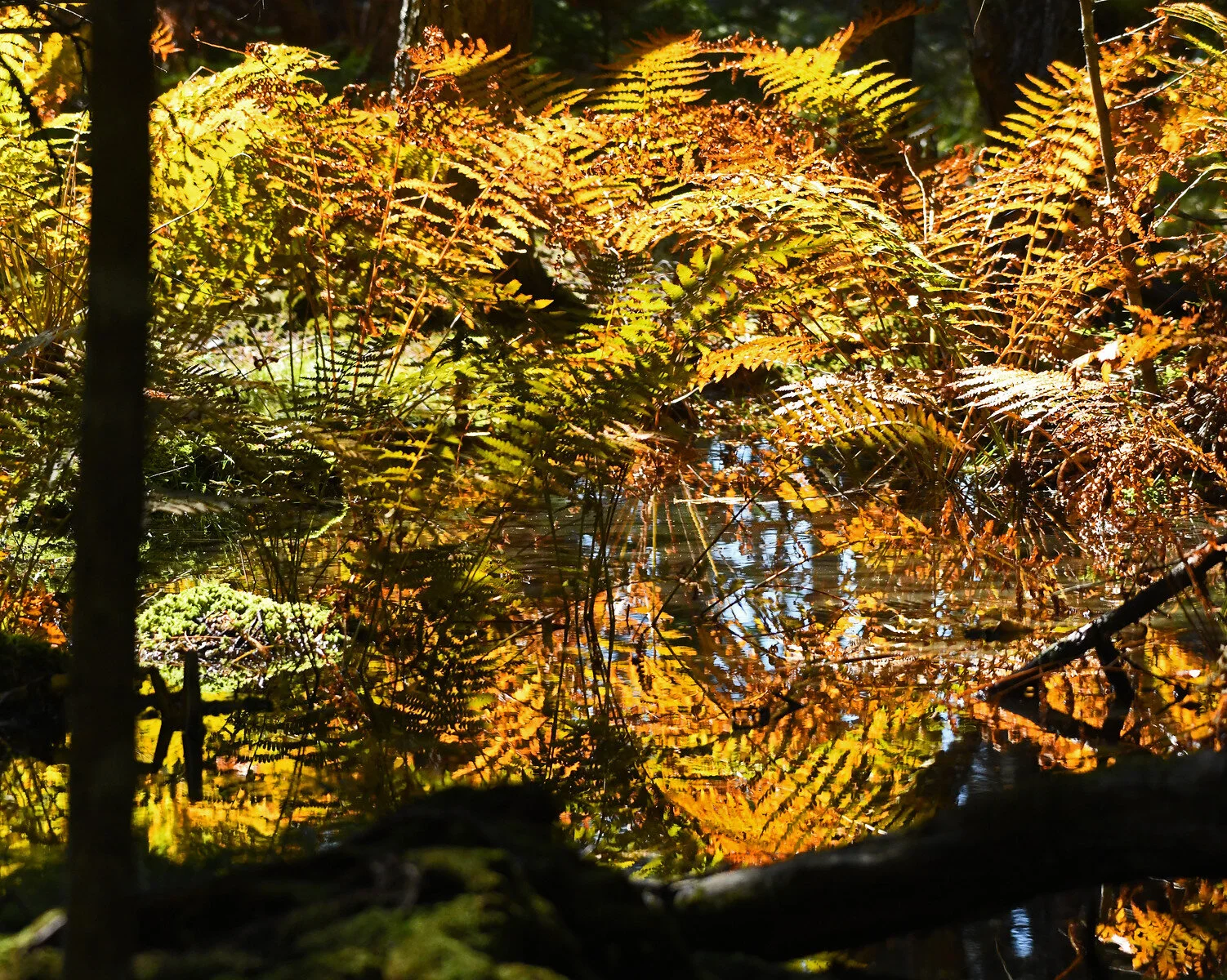
Here in Brooklin, as you can see above, the spring-fed streams continue to race recklessly through their mossy banks. Our fern-filled bogs remain filled with reflective pools:
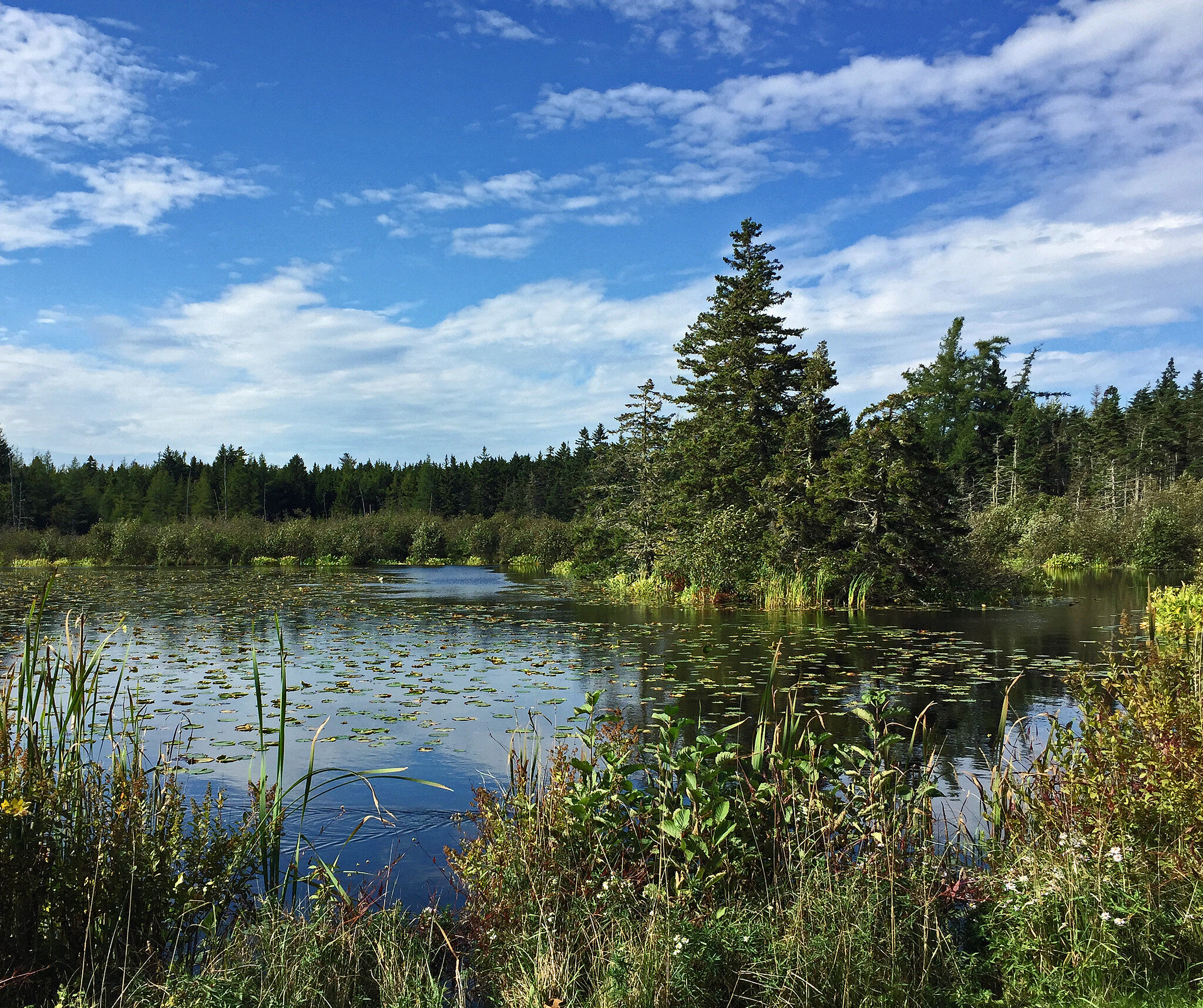
The water lilies are disappearing from our ponds, but not the water:

Yet, one of the cruel ironies of Climate Change is that about half of the state has continued to be “abnormally dry” (yellow), in “moderate drought” (tan), or in “severe drought” (burnt orange). as of September 21, according to the Monitor:

(Photographic images taken in Brooklin, Maine, on September 27, 2021.)
After days of waking up to fog and rain, or rain then fog, or fog then rain; mornings of wondering “When will this dismal weather end?,” the answer came this morning. It’s a physical thrill to wake up – as we did today -- and find yourself within the dream of a perfect September morning here.

As you see above, the sun rises over the wooded ridge to the southeast and makes shadows creep across the field; the islands in Eggemoggin Reach pop up out of rich blue waters in super-three-dimensional clarity; most of the deciduous trees and bushes are still green, a sight that we try to imprint, knowing that we’ll soon have trouble remembering them lushly green, and the air is a cool, crisp, delectable appetizer.

By the time that we get outside, the temperature is 56 degrees (F) and the dew point is 50 (F), as close to perfect as we can expect.

We now can breathe deeply and try to forget yesterday’s Patriots game. (Images taken in Brooklin, Maine on September 27, 2021.)
We’ve been having record amounts of rain lately, some of it in the form of driving sheets hurled from the heavens with the seeming force of a car wash. Between midnight last night and 9:30 this morning, we had a reported 1.9 inches at the Brooklin School meteorological site and probably more here directly on the coast. We have seen Climate Change and one of its ugly moods is wet.

Above, you see one of our outside pumpkins taking a pummeling this morning with rain bouncing off its table. Below, you’ll see our last climbing rose bravely standing up to the onslaught today.

We hope that she makes it. (Images taken in Brooklin, Maine, on September 26, 2021.)
