Comment

In the Right Place: Showoffs

All or virtually all of our sailboats and other recreational boats are out of the water now. This gives the fishing vessels space to pose and show off their utilitarian beauty in our spectacular coastal waters.

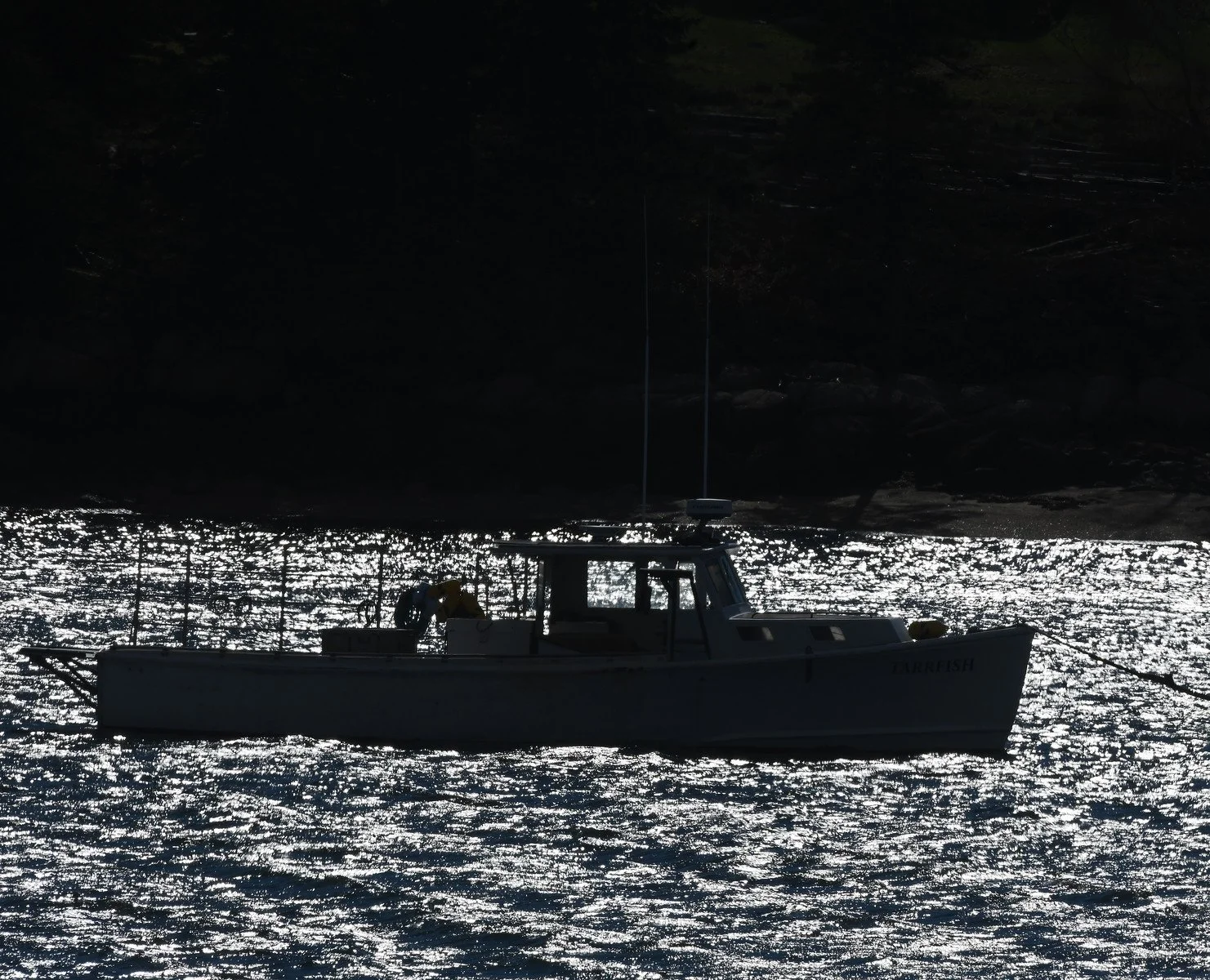
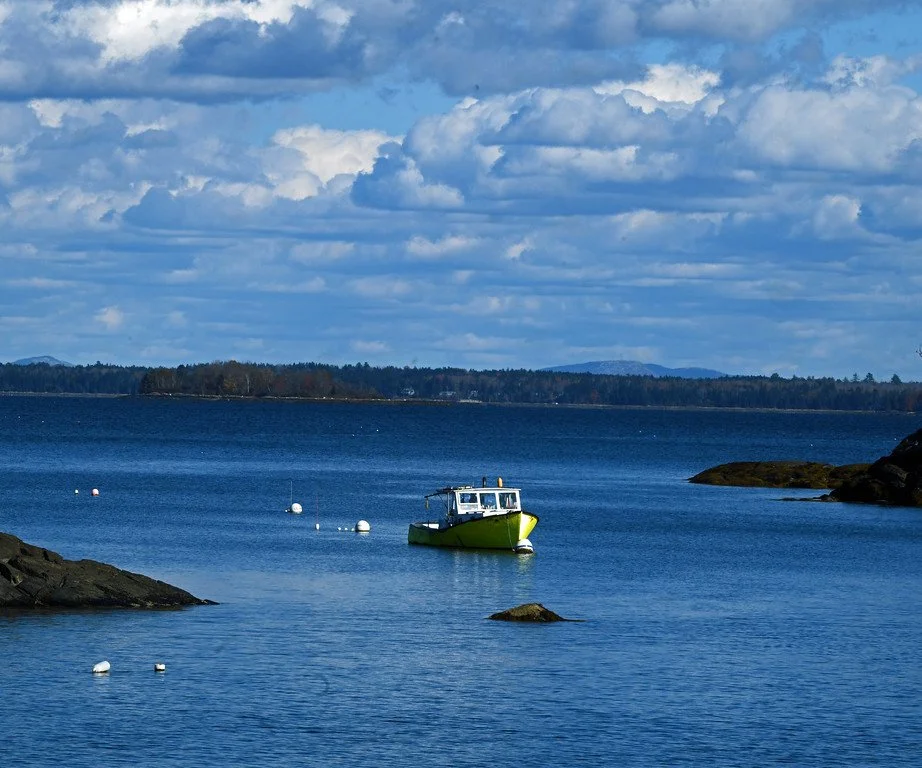
Above, you see Sun’s Up adding the final touch to a breath-taking scene at Blue Hill’s Connery Cove. Below, you’ll see Tarrfish being backlit by strong sunlight in Brooklin’s Naskeag Harbor.

(Images taken on November 1 [Tarrfish] and 2 [Sun’s Up], 2021.)

Comment

Comment

In the Right Place: A Small Ressurrection

Yesterday was a beautiful September day; unfortunately, it occurred in November. I worry that my grandchildren will have to pay dearly for our pleasurable negligence.

Nonetheless, below, you’ll see a scene from yesterday that is a positive thing: a pond and field that were resurrected in the 1990s to replicate wildlife habitats that are getting scarcer and scarcer. The stone wall was rebuilt on the line of a 19th Century sheep pasture border that had crumbled away.

When raising sheep became unprofitable here, the field was abandoned and allowed to grow up into a soaring forest. It was packed with trees, bushes, and brambles that stood closer than subway-goers in rush hour. Re-clearing the field was a mechanized adventure that made you wonder how pioneers could do such things by hand and horse.

The field is allowed to stay fallow now. In the summer, it hosts, among others, wildflowers, grasses, and sedges; climbing and flying insects; ground-nesting birds, including wild turkey families; at least one bobcat, skulking coyotes, browsing and sleeping deer, and the occasional black bear whose cubs invariably walk on the wall where snakes sunbathe.

In the fall, however, the field must be mowed because, at that time, hundreds of little tree and bramble seedlings have sprouted there and must be discouraged. (You can see this year’s mower’s paths in the Image, which was taken in Brooklin, Maine, on November 2, 2021.)

Comment

Comment

In the Right Place: Plant Pythons

Now that many leaves have dropped, we can see that the golden husks on the Asian Bittersweet vines (Celastrus orbiculatus) are opening and their glossy red berries are ready for the birds to eat. It’s a tragic collaboration.  

The birds spread this tree-assassin’s seeds so profusely that all known countermeasures to eradicate or even to get ahead of the invader’s propagation have been failures. The vines continue to climb and wrap themselves around their sylvan victims and squeeze them to death like militarized pythons.

It’s a reminder that the impulsive pursuit of beauty can be disastrous. These constrictors were introduced here in the 19th Century to bring spectacular colors to gray winter landscapes. They create gray spring and summer trees.

Maine has given up on trying to eradicate Asian Bittersweet, but it has listed it as an invasive species that may not be sold or distributed here. There is a native version, aptly named American Bittersweet (Celastrus scandens), that is environmentally innocuous. But, that’s another story. (Image taken in Brooklin, Maine, on November 1, 2021.)

Comment

October Postcards From Maine

3 Comments

October Postcards From Maine

October followed our summer’s trend: It was warmer and wetter than average. The month’s signature features, the fall colors, were slightly below average — which means that they still were beautiful.

Before the end of the month, the wooded trails were leafy carpets that crunched with each footstep.

The many rainstorms swelled moss-banked streams and filled marsh ponds to the brim. The excess water and fallen leaves, however, also at times filled culverts; small floods damaged gravel roads and driveways.

The ample rain produced bumper crops of Mushrooms, Beach Rose hips, and wild apples.

Our fields turned dark with white sprinkles of dying Queen Anne’s Lace and Daisy Fleabane. Those that had not been given their fall cuts in September were mowed in October.

October is when our White-Tailed Deer get their lush, winter-woods-colored coats. This year’s coat change may have been premature, considering the warmth of the month. That warmth has kept Chipmunks awake, Meadowhawk Dragonflies and their gnat and mosquito food in the air, and Great Blue Herons still hanging around.

Despite the warm weather, some of our fiishermen (male and female) began pulling their lobster traps out of the water in October and trailoring them to winter storage. But many fished on, even though the harvest was less than expected. All or virtually all recreational boats, however, were stored before the end of the month.

The October full moon is the Hunter’s Moon and usually is spectacular. It did not disappoint this year.

Of course, October is the Halloween month. It’s celebrated annually by the Brooklin School with a march of its costumed students and staff down Bay Road, with protective Town fire trucks in front and in back.

Finally, October here is when the sunsets and their afterglows can become pumpkin orange and, next month, fiery red.

(All above images were taken in Down East Maine during October, 2021.)

3 Comments

Comment

In the Right Place: A Weakened Glow

It’s the last morning of October. Power has been on and off several times; the sun has just broken through the clouds that brought us torrential rain overnight. Wind gusts in the night exceeded 40 miles per hour and still are in the mid-30’s. It’s a “hot” 59 degrees (F) already and clearly will be in the 60’s before Noon.

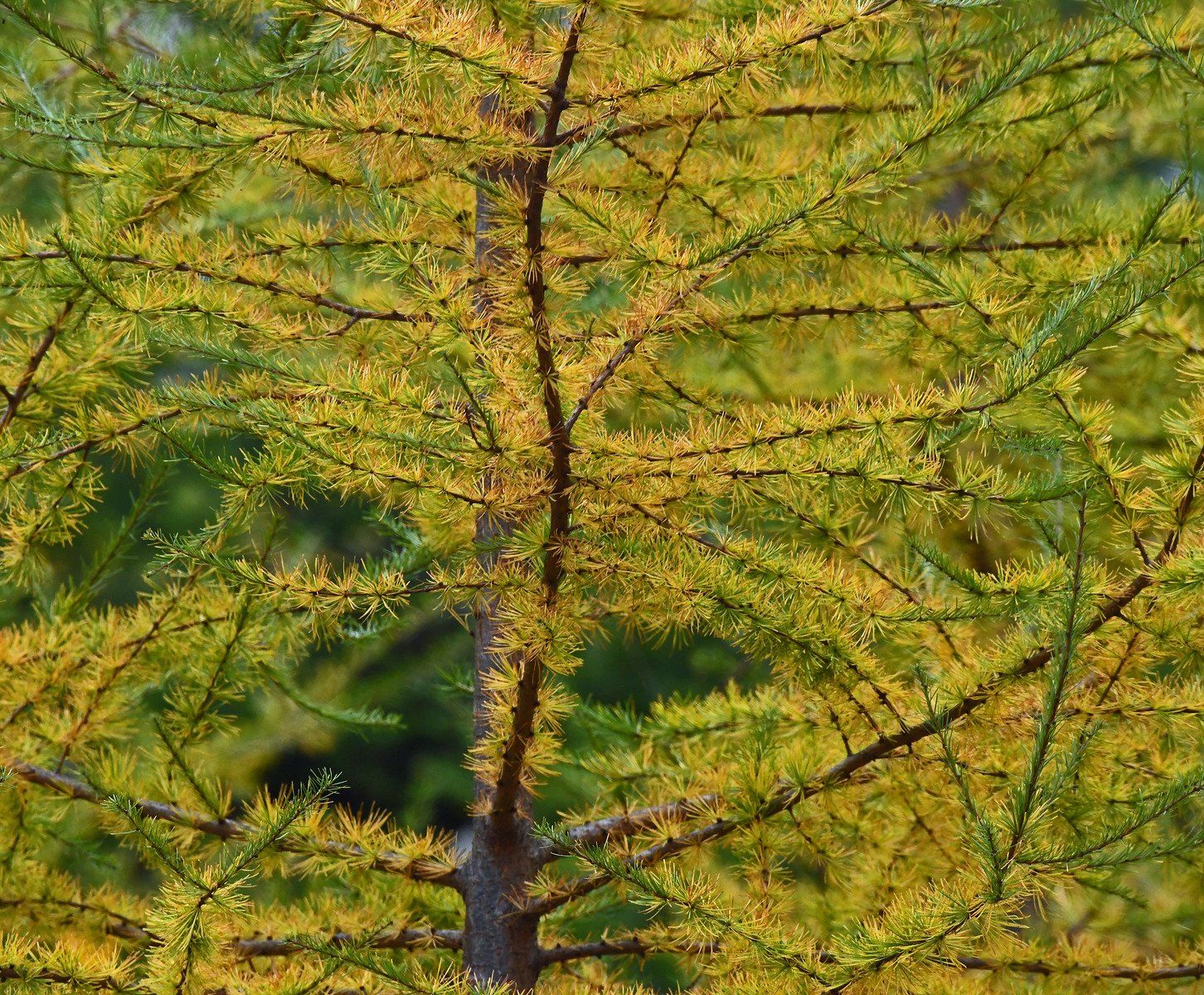
Mosquitos and dragonflies were flying yesterday, and no doubt will do so today; some trees have not yet lost their leaves and barely have turned to fall colors – and, as you see below, the Tamarack Trees have only now started to glow weakly, which signals that their needles won’t become incandescent and fall until mid- to late-November.

It’s not right. But, we all know that and most of us are not doing enough to right the increasing list of the world’s environment or to worry about tipping points.

Nonetheless, for a while, we can admire the “Tamarack,” an Algonquin Tribe name for “snowshoe wood.” The tree also is called a Larch or Hackmatack by many. It’s different from most trees: it’s “deciduous” (not evergreen), but also “coniferous” (cone-bearing), and “monoecious” (producing male and female cones).

(Images taken in Brooklin, Maine, on October 30, 2021.)

Comment

Comment

In the Right Place: Boo!

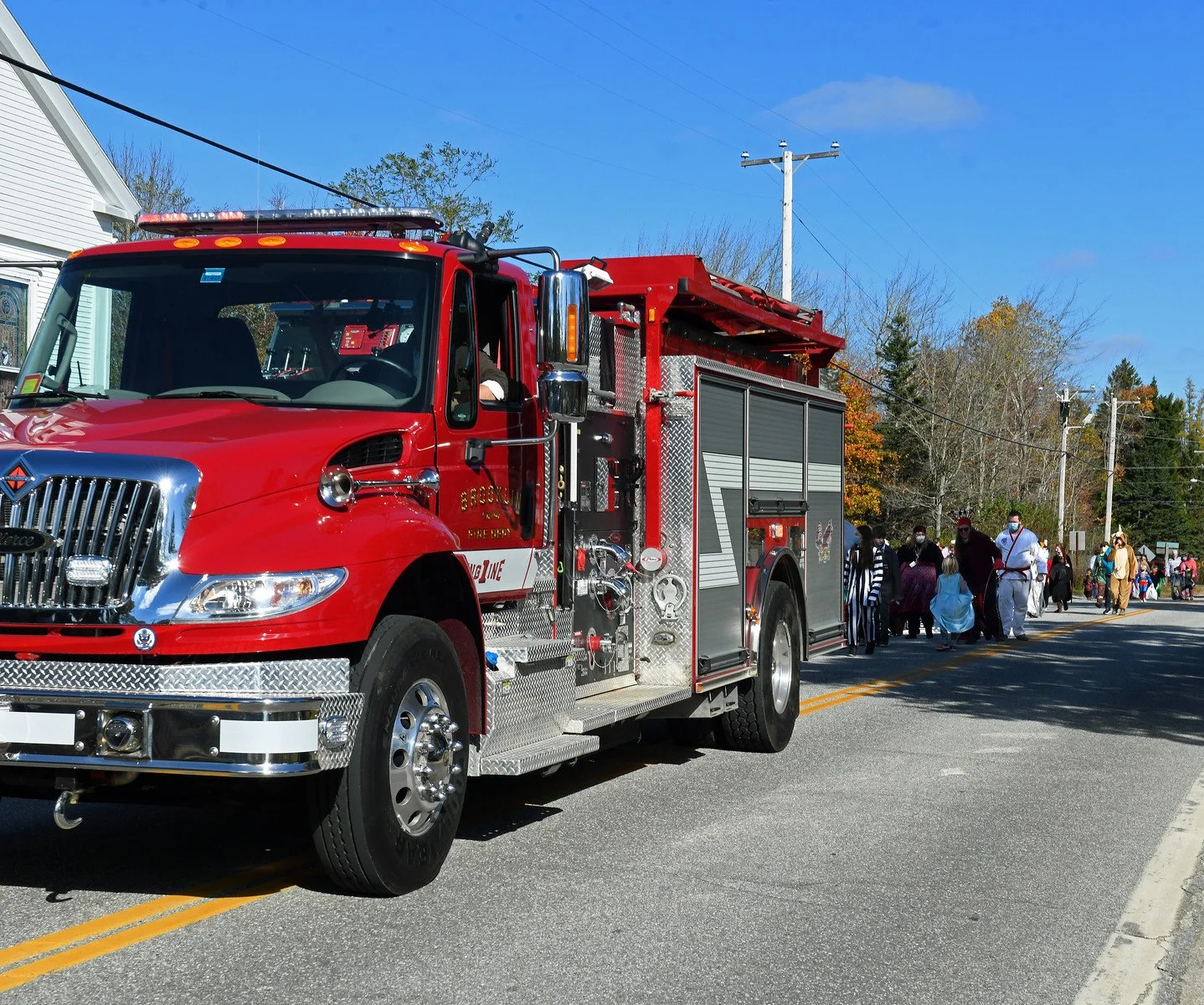
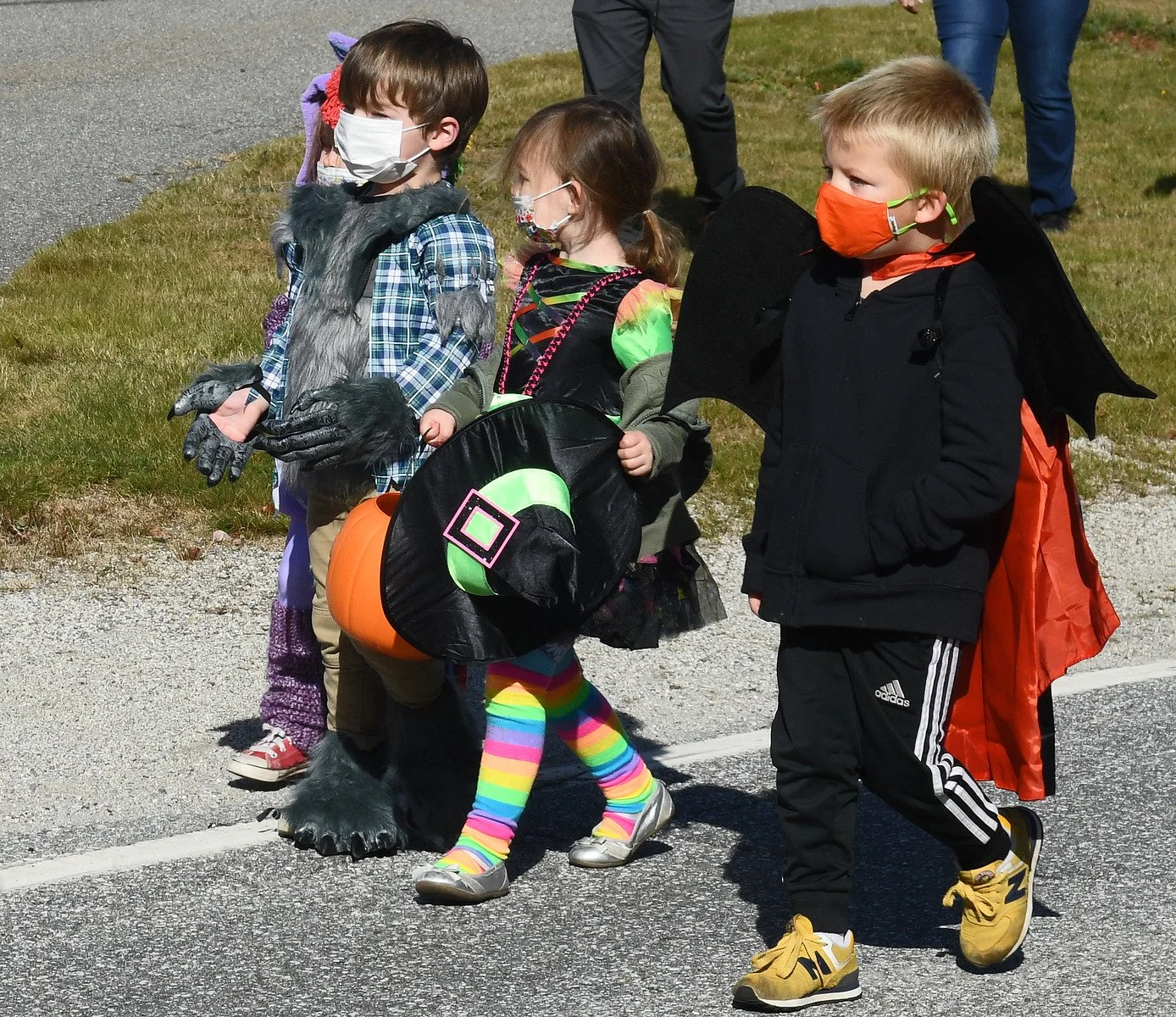
One of Brooklin’s most charming annual events took place yesterday: the annual Halloween march of Brooklin School goblins. Students and staff, convoyed safely between Brooklin fire trucks, marched from the School to the General Store, scaring all the traffic off Bay Road for a time.

(Images taken in Brooklin, Maine, on October 29, 2021.)

Comment

Comment

In the Right Place: Holy

The fall of leaves has created side lights in the darker, columned parts of the woods. Memories of ancient Italian cathedrals lighted through stained glass can be aroused here.

Except, the holy water doesn’t stand still; it runs quickly through moss, giving the fallen one last joyous ride.

(Images taken in Brooklin, Maine, on October 28, 2021.)

Comment

Comment

In the Right Place: Eateries

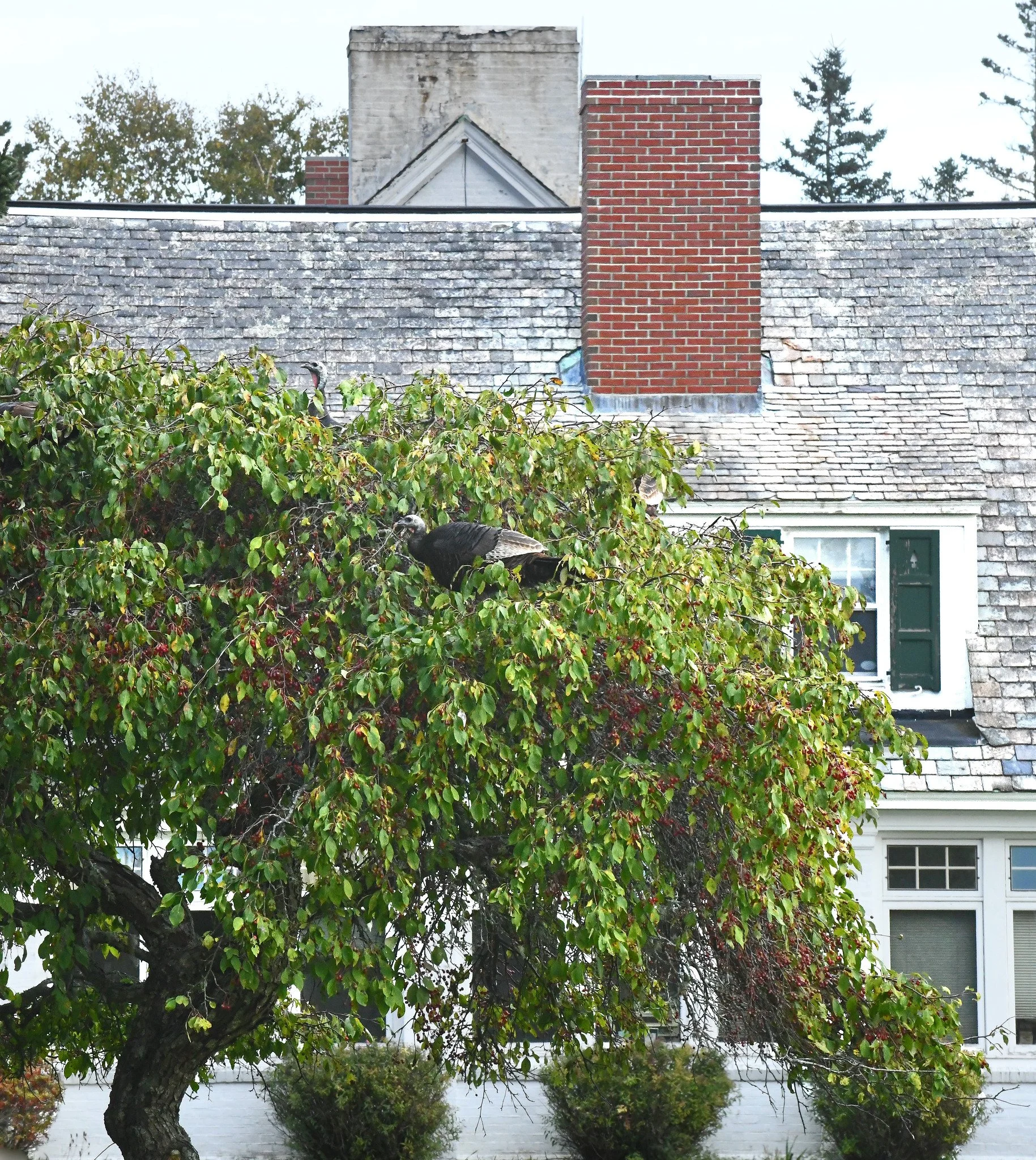
Choice crabapples seem to be featured on local wildlife menus recently. Here you see a favorite fast-food spot that caters to a furry and feathered clientele. It’s an ornamental Japanese crabapple tree on the WoodenBoat School campus.

It has at least four wild turkeys dining in its higher-priced terrace seats, although only two are visible in this image. Beneath the tree, there was ample evidence that white-tailed deer have been feeding from the cheaper standup-eating section below. Deer often stand on their hind legs and nibble apples off their branches.

(Image taken in Brooklin, Maine, on October 18, 2021.)

Comment

Comment

In the Right Place: Nor'easter Report

IWe’re under a wind advisory until noon today and it’s been raining steadily all morning. However, the first nor’easter of the season apparently has yet to do significant damage here on the Down East coast. Our local weather station in central Brooklin shows that our highest gusts never quite reached 50 miles per hour in the early morning hours and that the wind speed seems to be subsiding.

In the image above, you see the rain coming down this morning on our garden, fields, and in Great Cove. We’re still getting occasional rainy wind gusts in the 30s that are proving to be leaf-rippers:

We never lost power here on the Naskeag Peninsula and few trees apparently came down in all of Brooklin. But news reports indicate that there were some significant power outages in other parts of Maine and especially along the coastal areas in states south of us. (Images taken in Brooklin, Maine, on October 27, 2021.)

Comment

Comment

In the Right Place: "Pendulocity"

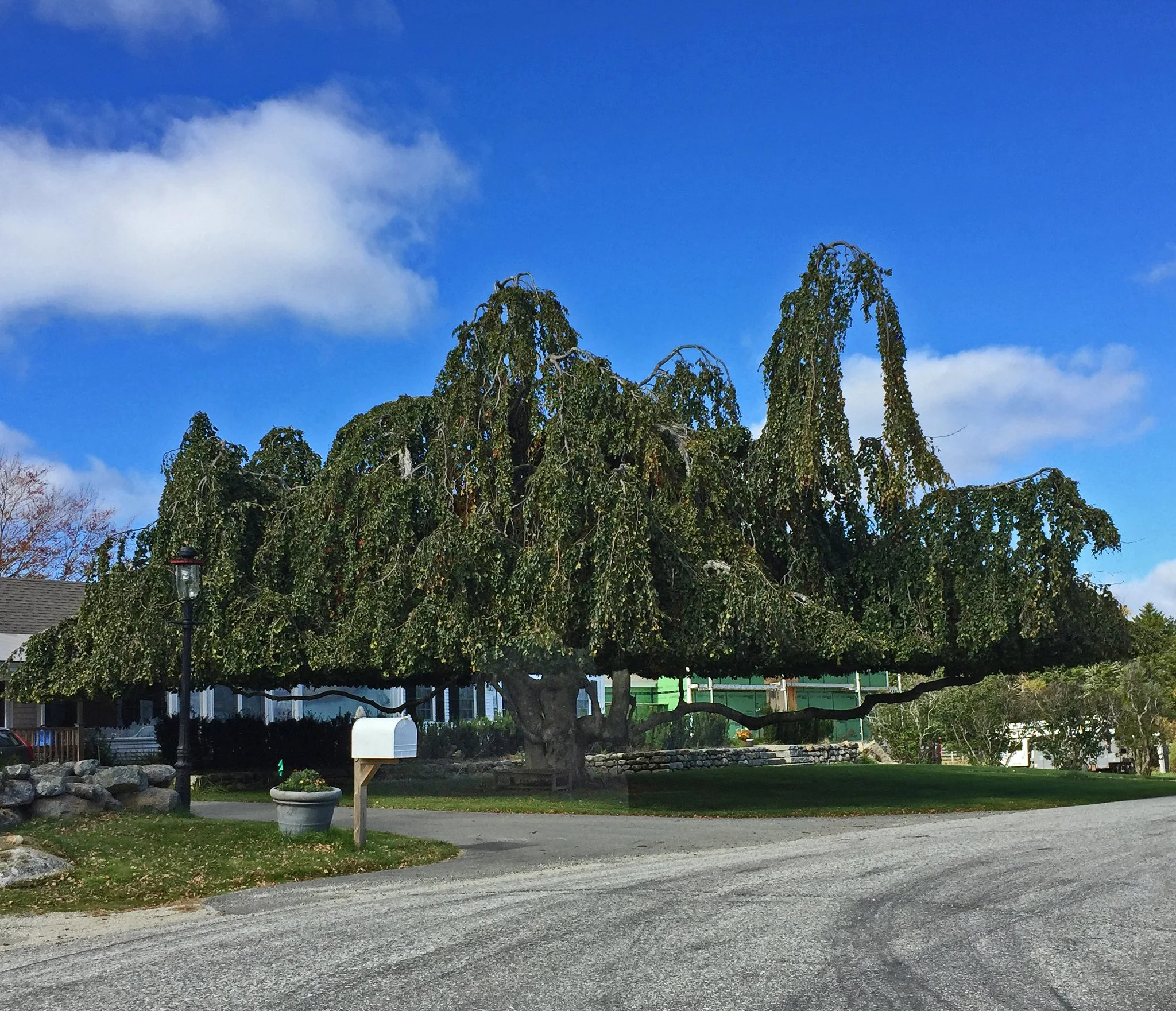
This Weeping Beech (Fagus sylvatica 'Pendula') at Amen Farm is one of the world’s more unusual types of tree. Its scientific name is derived from its most noticeable characteristic: pendulous branches.

These trees can grow to more than 80 feet in height and often are wider than they are high. They were selectively bred from European Beeches in England in 1836 and were introduced into the United States in 1847.

Beeches usually don’t lose all of their leaves in the fall or winter (a phenomenon called “marcescence”); many of the leaves dry out and hang on tightly to sing a rustling chorus to the winter winds. The remaining Beech leaves drop when new growth is ready to appear in the spring.

This one is more than 70 years old and is still growing and being specially pruned for an intriguing flat-bottom-branch effect. Most Weeping Beeches reportedly live between 150 and 200 years. (Image taken in Brooklin, Maine, on October 20, 2021.)

Comment

Comment

In the Right Place: Finding the Way

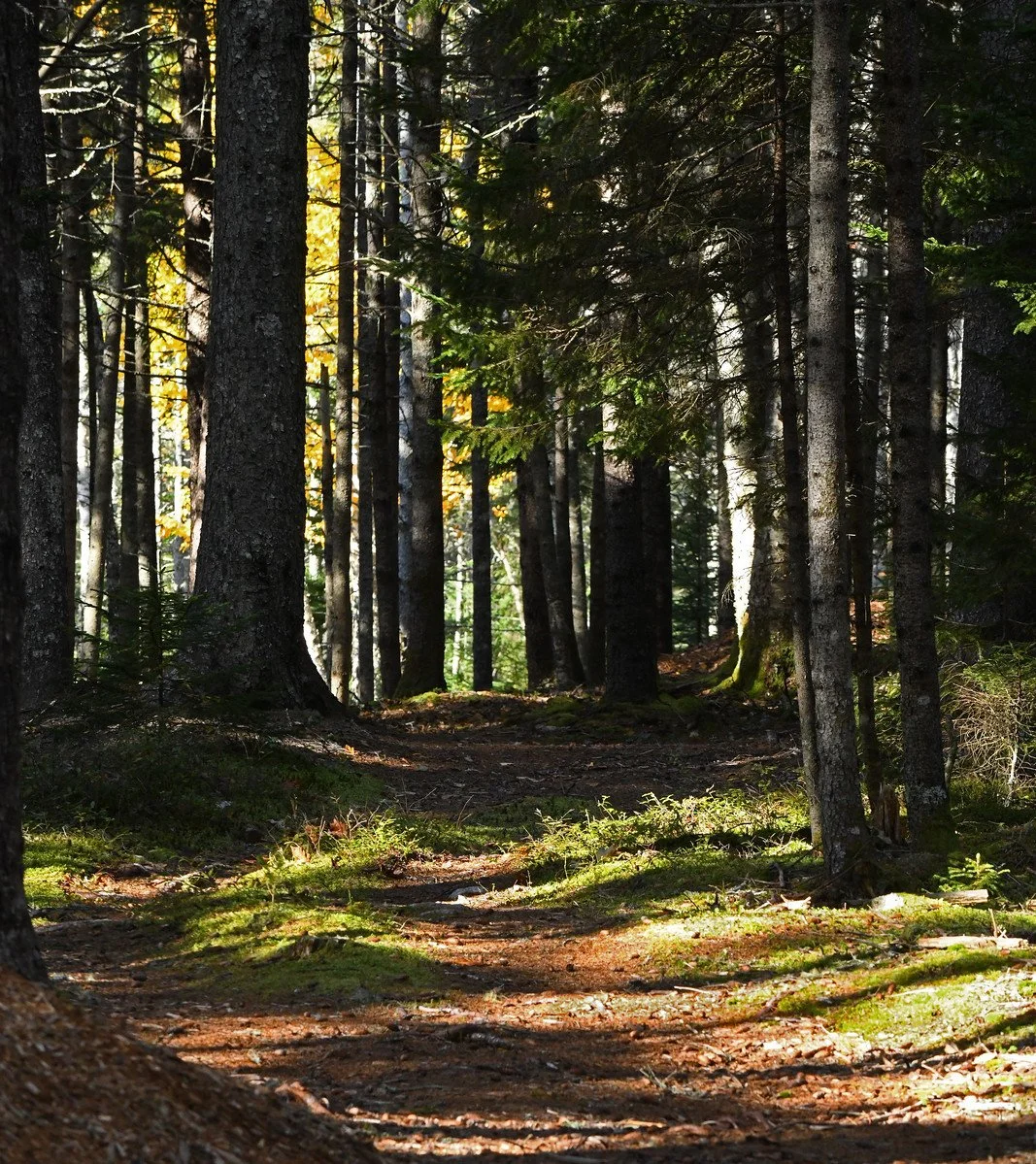
I’m beginning to think that there’s a relationship between winding wooded lanes and quality of rural life: the more wooded lanes that a community creates, the better its quality of life. Here you see a nearby lane with yesterday’s low sunlight filtering through the trees.

Brooklin has many wooded lanes, most of them hidden and privately maintained, but available for public walking.

Vehicular traffic on these lanes usually is minimal, often just people returning to homes that are further hidden in the woods or on the coast, with long driveways that intersect the lanes.

A typical dictionary definition for “lane” is “a narrow road, especially in a rural area.” The word derives from the Old English word “lanu,” meaning “narrow, hedged-in road.” In today’s conflicted world, a walk on a country lane is more about “hedging-out” than “hedging-in.” (Images taken in Brooklin, Maine, on October 24 [no people] and 18 [people], 2021.)

Comment

Comment

In the Right Place: Skinny, Dipping

This Great Blue Heron youngster apparently is trying to figure out what he was doing wrong after he failed to catch a fish in three unsuccessful – although grandly exuberant – tries.

Youth is an accelerated learning semester for Great Blues:

In recent years, many Great Blues apparently have been postponing their migration flights. In fact, an increasing number of GBHs, especially juveniles, have been reported to over-winter in Maine as that season gets milder. This is yet another Climate Change phenomenon that we need to ponder.

Although Great Blues are our largest (hence, “great”) Herons, they’re not built for the cold. They’re painfully skinny. They can reach almost five feet in length, but usually weigh much less than eight pounds. (Images taken in Surry, Maine, on October 22, 2021.)

Comment

Comment

In the Right Place: Waterfront Report

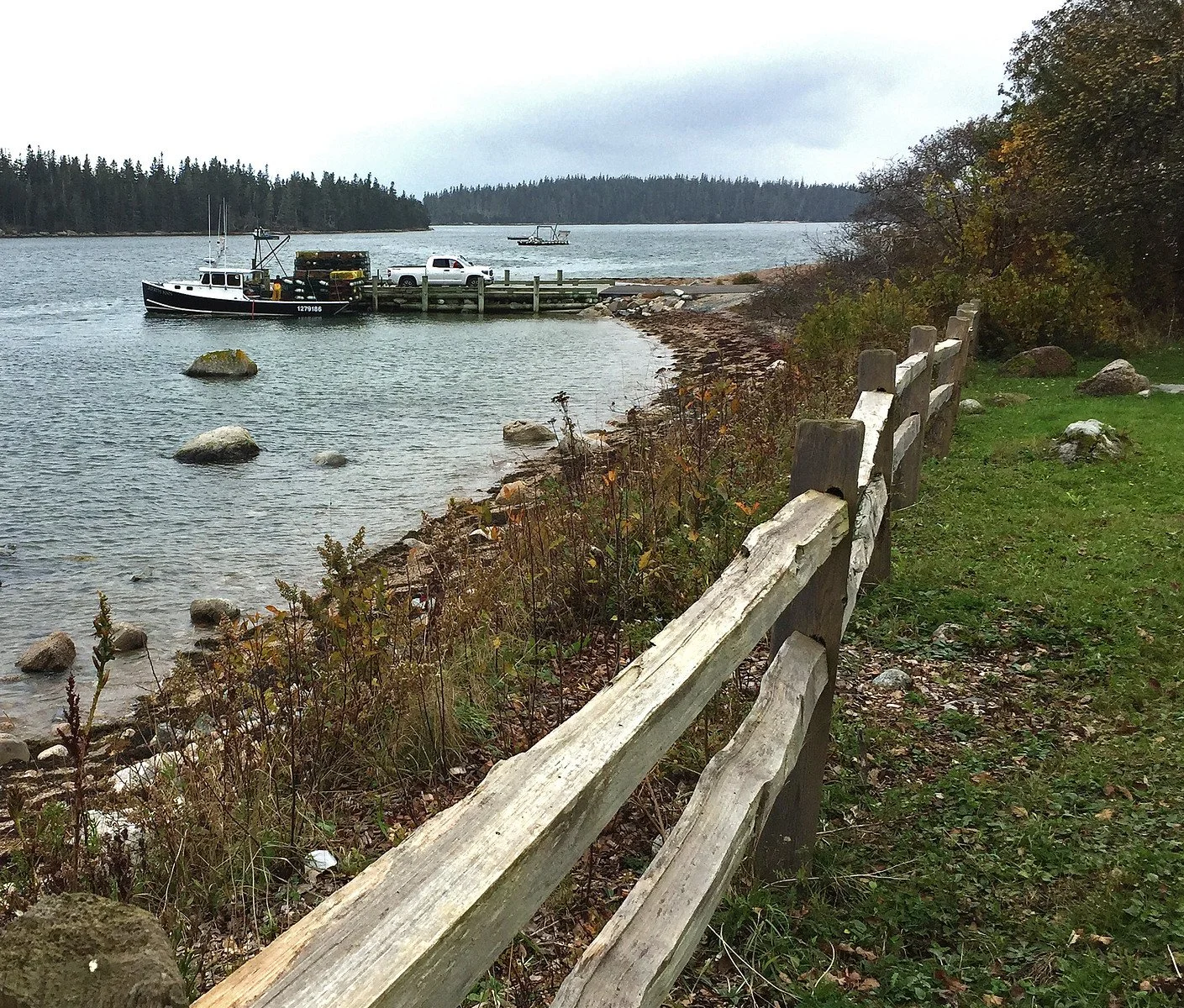
Fishermen here continue to pull their lobster traps from the water and take them to storage. All or virtually all local lobster fishing will be ended before December.

Some of the vessels will be converted into winter scallop trawlers with masts, booms, and nets; some will remain unchanged and be used as scuba diving platforms for “divers’ scallops,” and the rest will be hauled ashore for winter storage “on the hard.”

Here you see traps being off-loaded from Judith Ann in Naskeag Harbor during the misty aftermath of a severe thunder and lightning storm yesterday. (Images taken in Brooklin, Maine, on October 22, 2021.)

Comment

Comment

In the Right Place: Self-Defense

The paths through our woods now have a thick, crunchy carpet that, when dry, announces my strides to my furry fellow-mammals who also tread there. But, if I remain still long enough, it announces their strides to me. Fair enough.

This fall, it seems that the yellow leaves are holding on longer than the red leaves. These red leaves on trees along the path shown above are long-gone now:

As I understand it, the yellow leaf color is caused primarily by the natural loss of a chemical (chlorophyll), while the red is caused primarily by the energetic production of a new chemical (anthocyanin). But, why would a tree go to the trouble of producing a new chemical before it shuts down many operations for the winter?

A little (probably inadequate) online research indicates that there are two popular scientific theories that suggest it is a matter of self-protection, but in defense against different dangers. One theory suggests that red leaves help trees absorb damaging sunlight during their transition; that is, red is a “sunscreen.” The other theory suggests that red leaves keep away harmful insects, especially aphids. Some scientists think that both theories may be correct.

(Images taken in Brooklin, Maine, on October 20 [carpet] and 9 [branches], 2021.)

Comment

Comment

In the Right Place: Weaponizing

Here we see last night’s full Hunter’s Moon “rising” yellow from behind a wooded island in Blue Hill Bay.

It’s our dirty atmosphere that discolors and distorts the moon as we see it rise initially from a flatter perspective. Below, as you’ll see, it turns silver to us as it gets higher and we view it through less of the lower atmosphere. (That hump on the left is Acadia National Park.)

The October full moon reportedly was named by Native Americans to commemorate the period after the harvest when they would hunt deer and other animals scavenging in the newly cleared fields.

Curiously, this Hunter’s Moon occurred during Maine’s bow- hunting season for deer (October 2-29). Guess what was the weapon of choice for many Native Americans when hunting deer before the Europeans arrived? (Images taken from Flye Point in Brooklin, Maine, on October 20, 2021.)

Comment

Comment

In the Right Place: Above It All

Yesterday we had an exceptionally large herd of clouds migrate over and around our little peninsula, mostly of the cumulus and stratocumulus breeds, I think. They created one of those days of now-you-see-sun; now-you-don’t.

Above you see them galloping northeast (to the left) over Acadia National Park’s Cadillac Mountain. They were more crowded in the southwest over Great Cove and Eggemoggin Reach:

(Images taken in Brooklin, Maine, on October 19, 2021.)

Comment

Comment

In the Right Place: Cozy

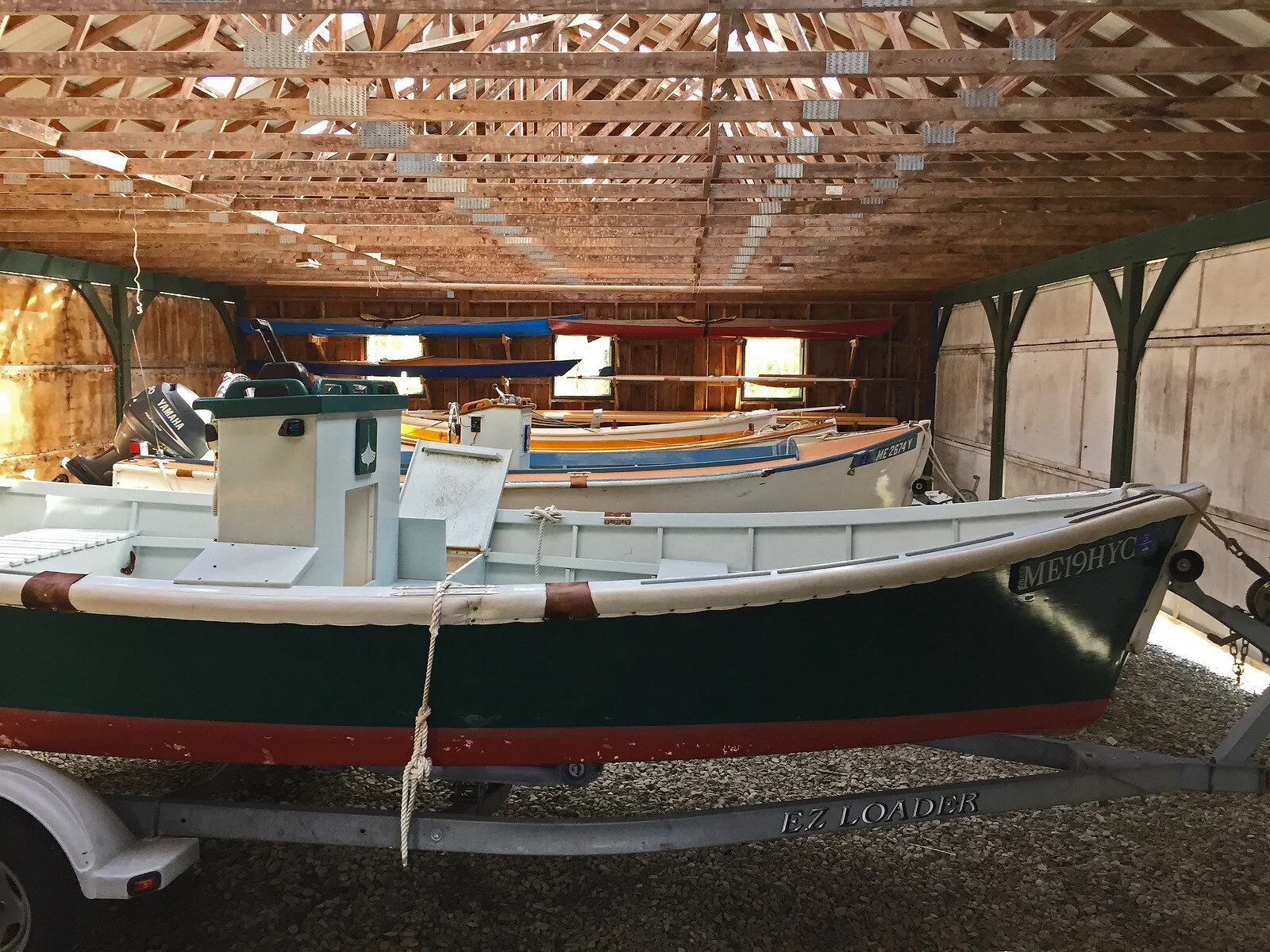
You might think that this is not an architectural masterpiece that you’re seeing here, soaking up yesterday’s sun.

But, architects will tell you that “form follows function.” And, the function of this shed is to protect some of the WoodenBoat School’s fleet of small boats during the winter. Stated another way, you’re looking at a jewel box.

On days like yesterday, the summer-frisky boats inside the cozy boatshed bask in the sunlight streaming through the skylights.

(Images taken in Brooklin, Maine, on October 18, 2021.)

Comment

Comment

In the Right Place: First Light

After a weekend of rain, the weather gods favored us this morning with a glorious October dawn. Here, the first light has just risen above the wooded ridge to the southeast, on your left, and is spreading slowly over the North Field. It already has found Babson Island, which protects Great Cove.

i-NDdMjZN-XL.jpg

We’re just getting used to seeing the Cove without moored sailboats swaying in its tides and winds. The boats are being replaced by waterfowl convoys, which provide a different kind of visual pleasure through a spotting scope. (Image taken in Brooklin, Maine, on October 18, 2021.)

Comment

Comment

In the Right Place: Hanging Around

October rains and winds have blown down the leaves on many old “wild” apple trees here, but many trees continue to hold tightly onto all or some of their apples. The curious result is that we see gnarly gray trunks and branches decorated with green and red fruit like Christmas lights.

i-tfZQhZV-X3.jpg

The dropping of an apple apparently is not a simple matter. As we understand it, apples usually are dropped twice a year. Some are shed in the summer when the tree decides to drop (“abcises”) a number of its immature apples to preserve energy that will be used to help the rest of the fruit mature. As the days get colder in the fall or early winter, the tree eventually will drop its mature fruit.

i-H7bzRv2-X4.jpg

The process apparently involves the apple stem cells secreting enzymes that eat away their cellular walls. This weakens the stems’ grips and, eventually, gravity causes the fruit to fall, perhaps on a physicist’s head as the story goes. Warm and wet weather here may have slowed the process. (Images taken in Brooklin, Maine, on October 14 [full tree] and 5 [branches], 2021.)

Comment

Comment

In the Right Place: Hold Ups

Here you see the woods bordering a not-quite-red-yet blueberry field on Thursday.

1.jpg

It’s been a strange fall for deciduous tree and bush leaves. Some have turned and dropped en masse like panicked crowds, others are just turning and dropping a leaf here and there, and still many others remain vibrantly green and appear to be holding onto their branches for dear life.

4.jpg

Last night, it rained here in Brooklin and has continued to rain hard and steadily as we speak. Red, orange, and yellow leaves are being pelted to the ground in sodden clumps, yet those feisty green holdouts remain steadfastly aloft. (Images taken in North Sedgwick, Maine, on October 14, 2021.)

Comment