Comment

In the Right Place: Lest We Forget

Lord of our fathers, known of old

--God of our fathers, known of old --
Lord of our far-flung battle line --
Beneath whose awful hand we hold
Dominion over palm and pine --
Lord God of Hosts, be with us yet,
Lest we forget -- lest we forget!

That’s the first stanza of Rudyard Kipling’s famous “Recessional” (1897), which was published at the height of England’s colonizing military might. It should be read in full for full effect. Although Kipling frequently references a watchful and wrathful Christian God, the poem is respected by those of many religious faiths and of no religious faith.

It’s a reflection on the need for a “humble and contrite heart” instead of pride in military might. It warns of the dire consequences of forgetting the costs of military success and (in his view) the divine help that was needed  to achieve such success in the first place. 

Some people, including non-religious ones, take it as a call to avoid the hubris of military might and the need to always remember the enhanced value of lives lost while in the service of protecting other lives and ways of life.

(Leighton Archive image taken at Arlington National Cemetery.)
Comment

Comment

n the Right Place: Love’s Scent and Taste

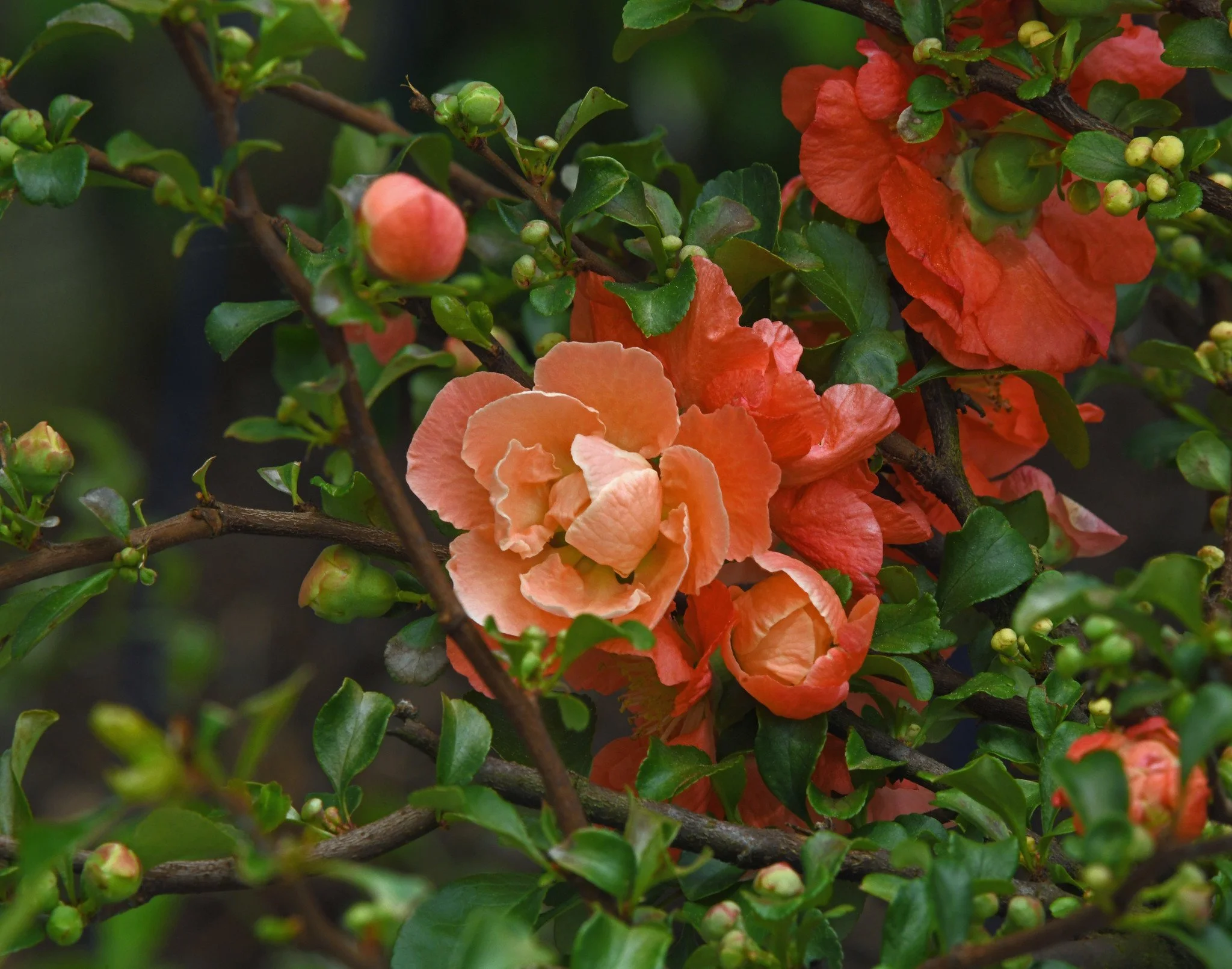
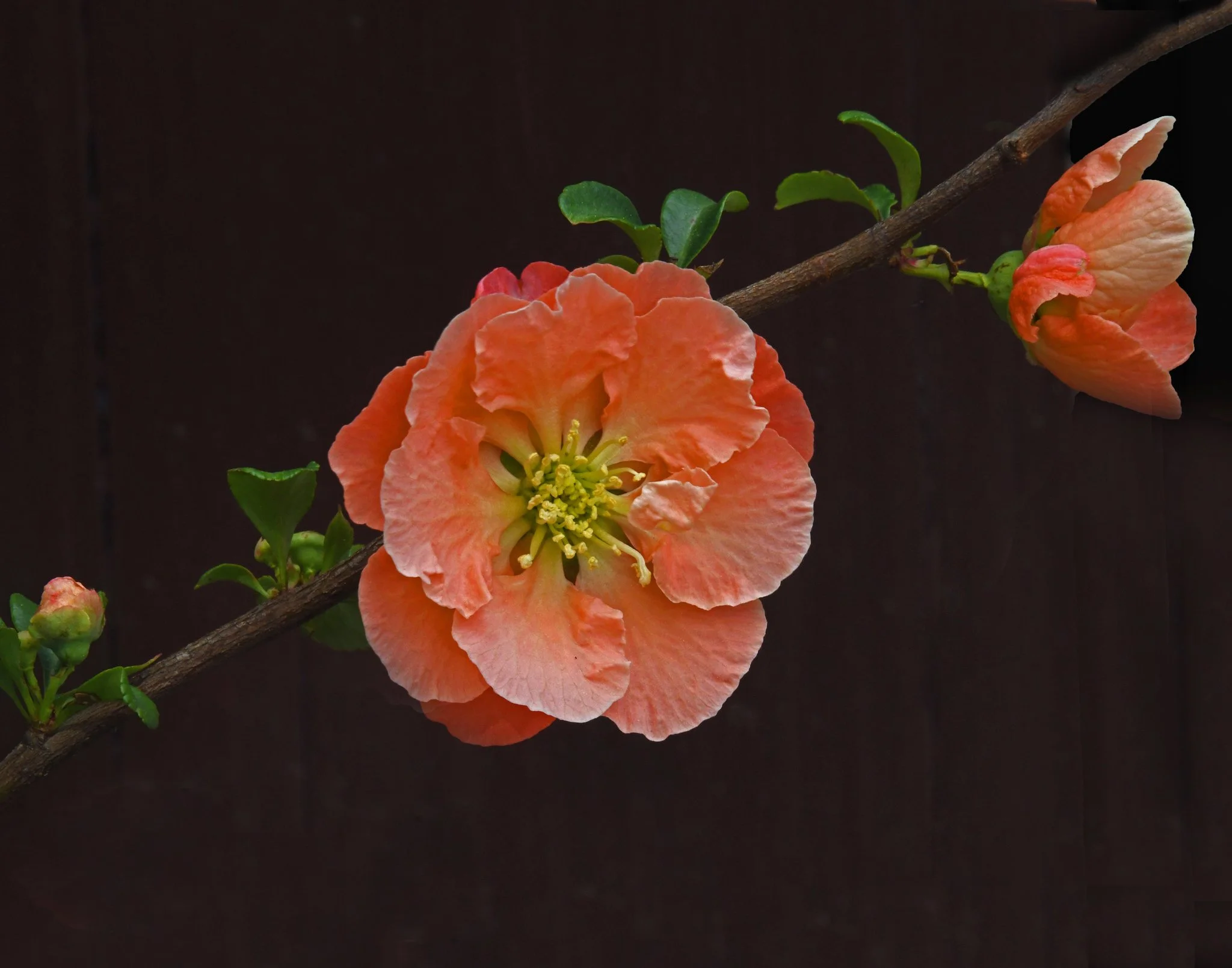
Fragrant quince flowers, such as these, are beautifying the neighborhood now. These ancient blooms and their cousins, the gold, apple-like quince fruits, are part of the rose family and have an ancient and noble heritage.

In Greek and Roman times, quince flowers and fruit reportedly were the love goddess Aphroditte’s sacred symbols of love, passion and fertility. They were used to decorate weddings, and the bride often was expected to taste of the fruit to sweeten her breath and bless the marriage before she entered the bridal bed with the groom, according to the literature.

I love the flowers. As for the raw fruit, I pity those brides if that’s the way they sweetened their breath. A raw quince “golden apple” is so tart that some garden enthusiasts recommend that it not be tasted by humans.

But I hear that there are ways of cooking the fruit to make it a delicious topping for breakfast cereals and pancakes or waffles, a tangy-sweet relish for meats and fowl, and a dessert enhancer, especially with cream, ice cream and pastry.

(Images taken in Brooklin, Maine, on May 21, 2026.)

Comment

Comment

In the Right Place: Mind If I Join You?

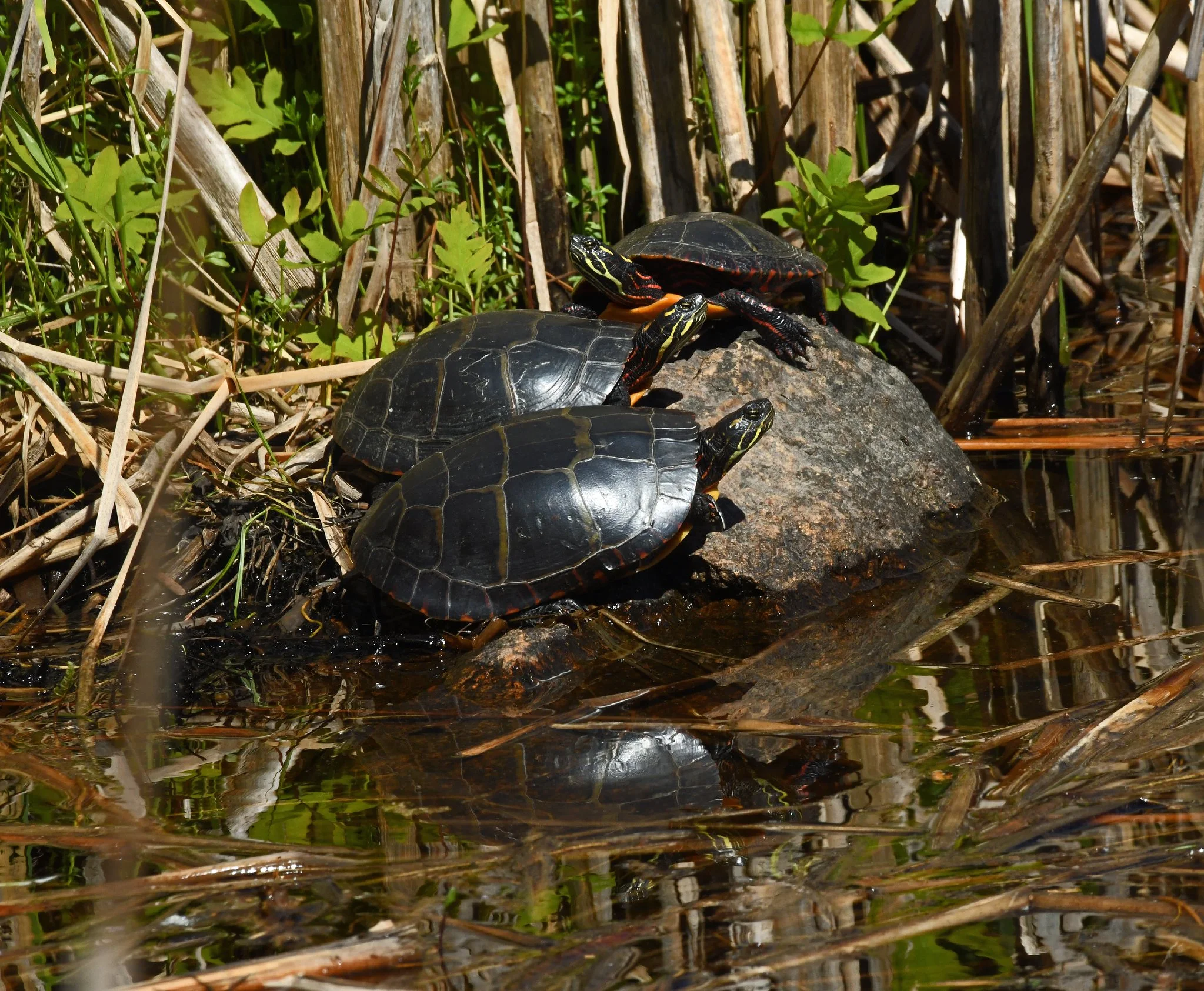
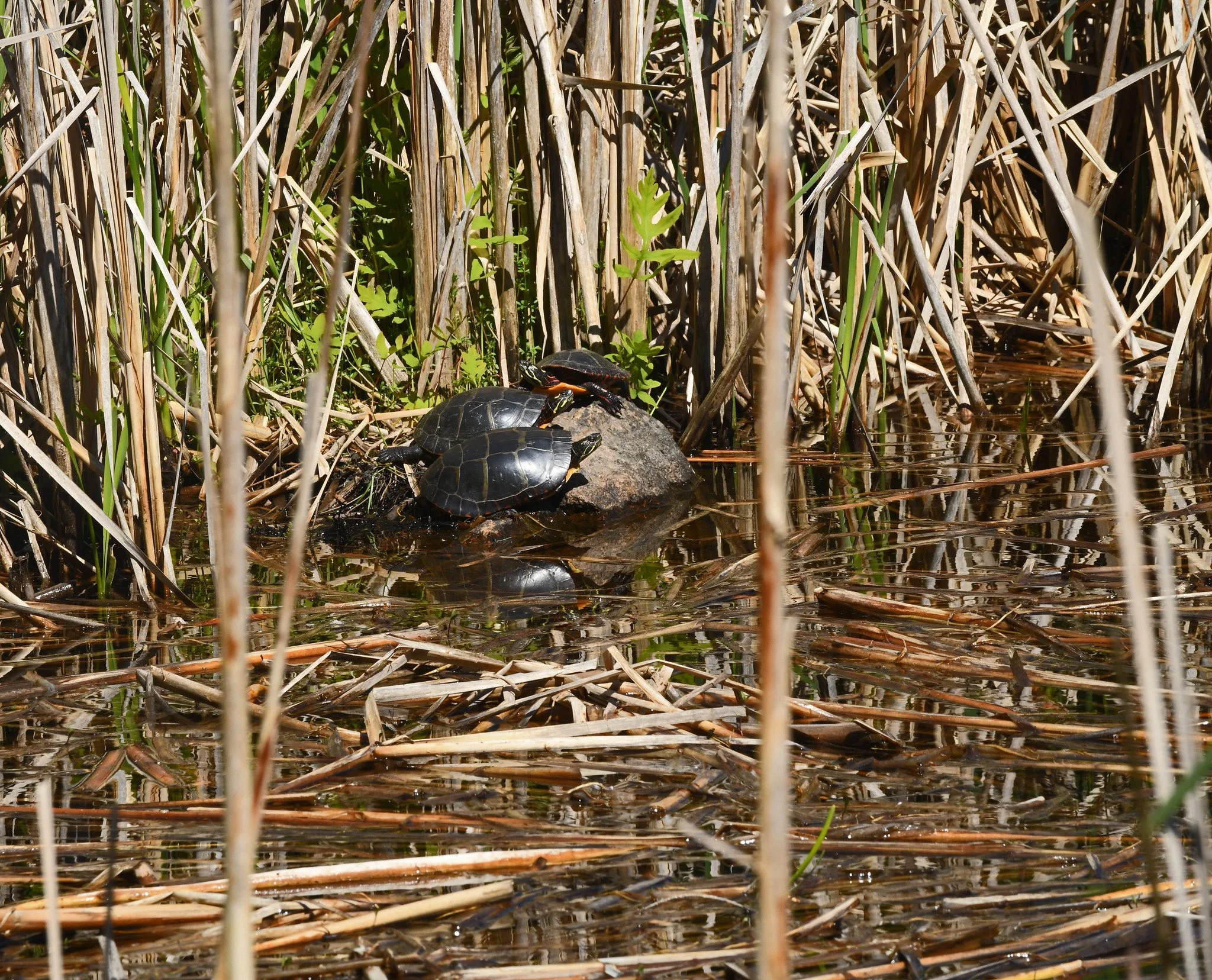
Here you see three members of the Brooklin Sunbathing Club spending yesterday morning together at their favorite meeting spot in our big pond. These eastern painted turtles and their spot are warmed by direct sunlight from early morning to mid-afternoon – when the sun is shining.

I’ve seen that rock (which we call Turtle Rock) totally covered by six PT members of the Club, large and small, sometimes stacked atop each other. Such turtle gatherings often are called “bales,” because they look like cargo, especially when the reptiles are stacking. 

Why do freshwater turtles bask  in the sun? Well, of course, they’re cold-blooded animals whose bodies can’t regulate heat. They need to get to a certain temperature before they can feel good, metabolize well and synthesize needed vitamin D from sunlight.

But why the bale bit? After all, they’re not affectionate, social animals. The literature contains multiple reasons, but the one that rings most true is that they all want the best basking spot and there often aren’t many real good spots that will allow them to literally chill-out a little in relative safety. Being non-aggressive, they don’t object when another of their kind joins them or even clambers over them, so long as they have a warm spot.

There also is the evolved animal-gathering defense that probably comes into play in turtle baling: The more eyes, ears and noses, the better the early-warning system is for many animals; the more numbers, the greater the odds of not being the one the predator catches.

You may have noticed that there are many ripped out cattail leaves in this pond. We can thank Bernie and Bernice Beaver and their successors for that. Beavers are messy creatures that cut down much more than they need and leave it lying around. Nonetheless, I haven’t seen any sign of beaver activity in 12 days. I suspect that the beavers have left us, but you never can be sure.

(Images taken in Brooklin, Maine, on May 22, 2026)

Comment

Comment

In the Right Place: At the BBY, IX

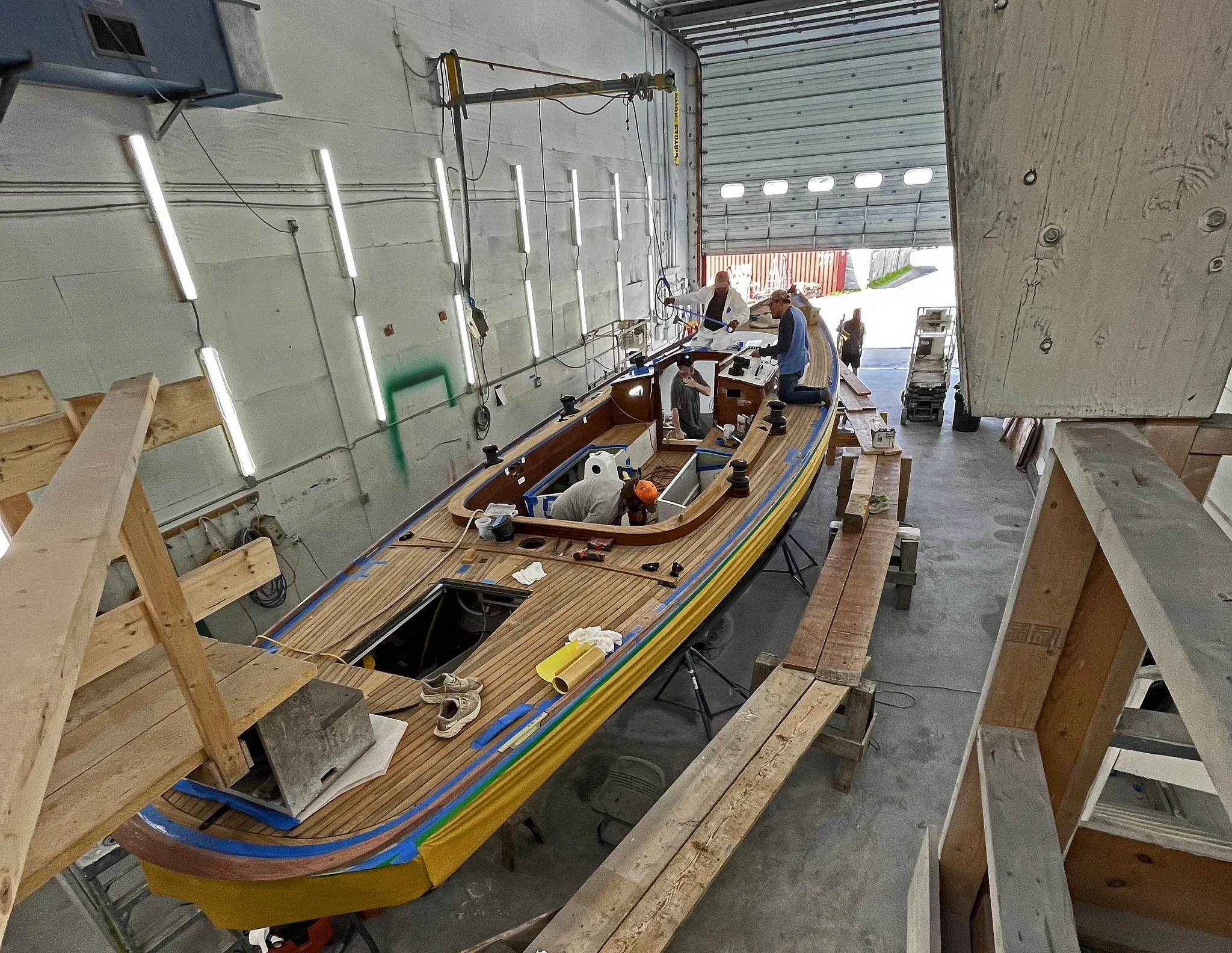
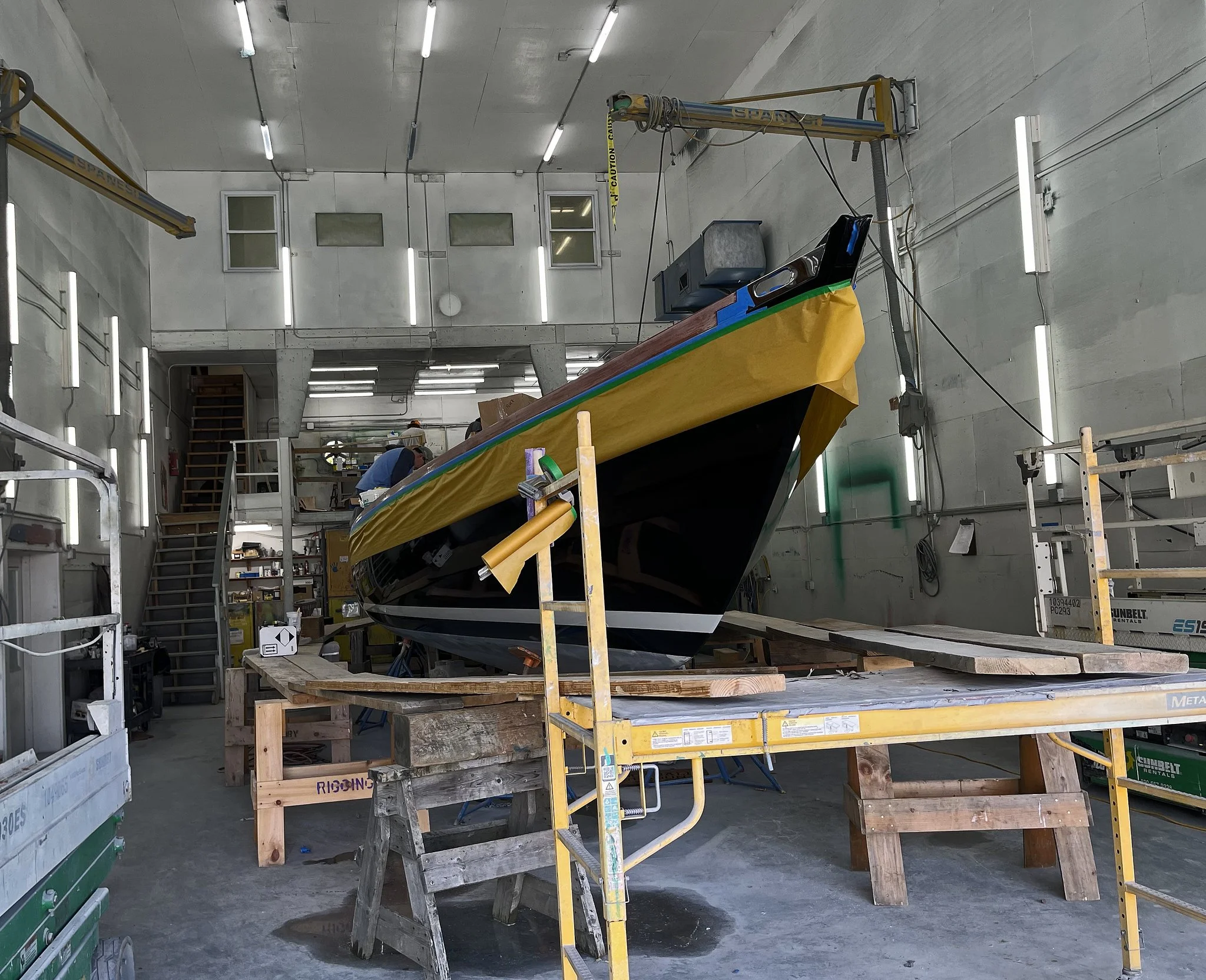
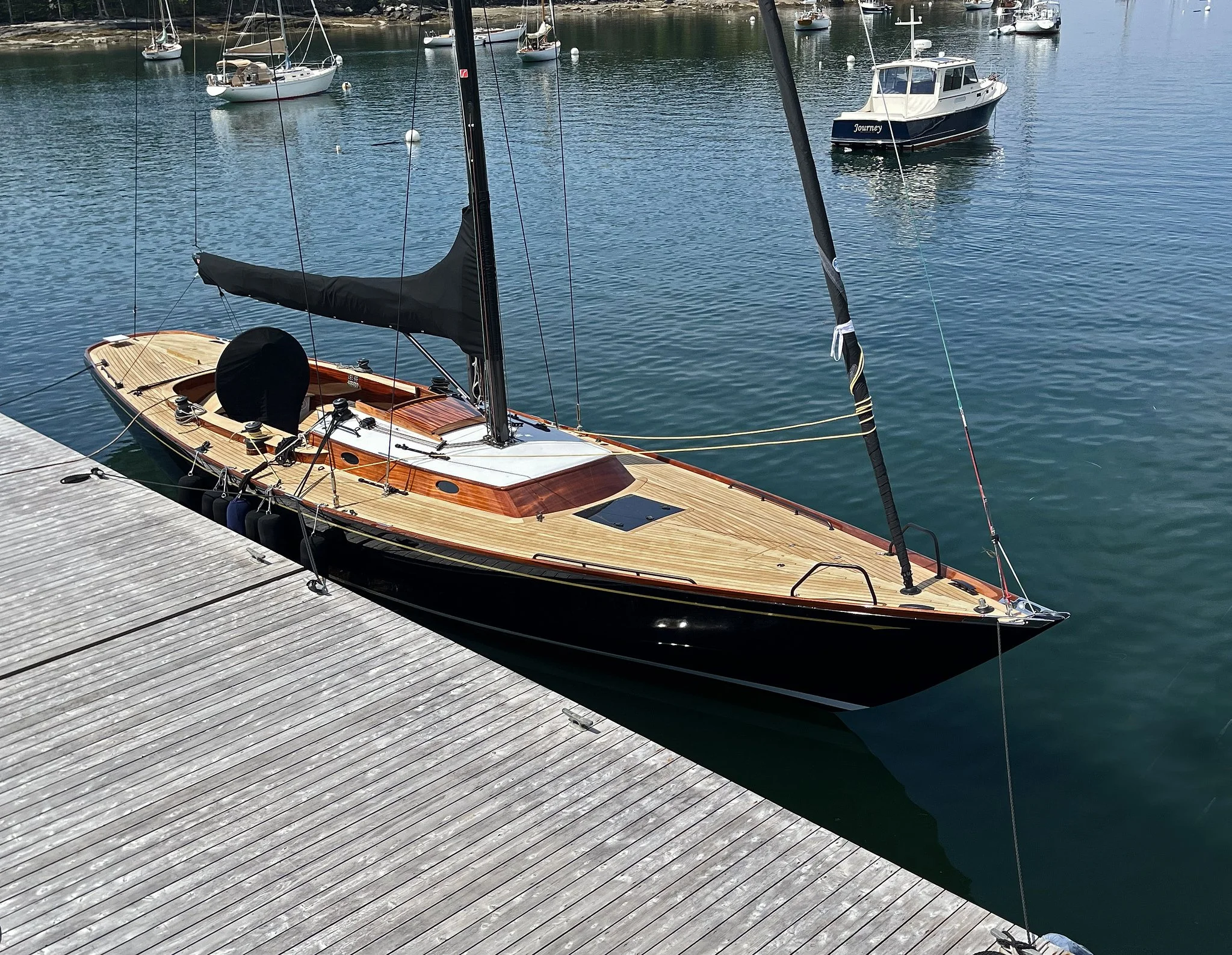
Here’s a visual update of DYLAN being expertly crafted as of Wednesday. She’s still in the Brooklin Boat Yard paint shop, where work continues throughout her. As you may know from reading these or BBY’s posts, DYLAN is to be part of a matched pair of exquisite BBY-designed-and-built Eggemoggin 47+s (which have a 47’ 6” overall length). These are among the most stylish of high performance racing sailboats.

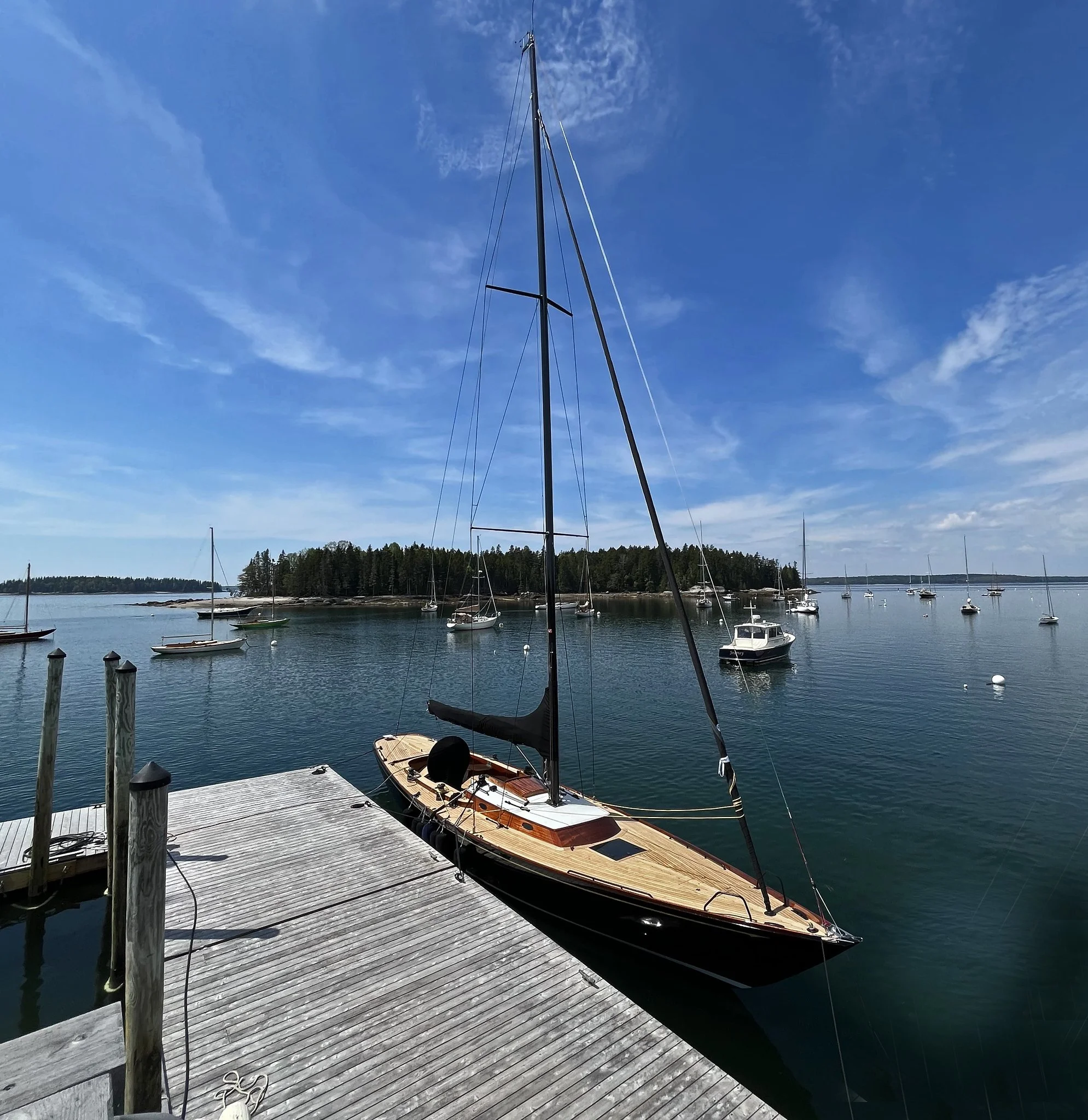
DYLAN’s sistership, HARPER, was launched by BBY in 2023 and was returned this year to get updates that would match the emerging DYLAN’s state-of-the-art equipment. That may have been accomplished already; HARPER was back in the water on Tuesday:

Both E-47+s are what have become known as “spirit-of-tradition” sailboats that maintain the classic grace of traditional sailboats while embodying the latest technology that takes sailing to new levels of speed, maneuverability and pleasure.

(Images taken in Brooklin, Maine, on May 20, 2026.)

Comment

Comment

In the Right Place: Pending Investigation

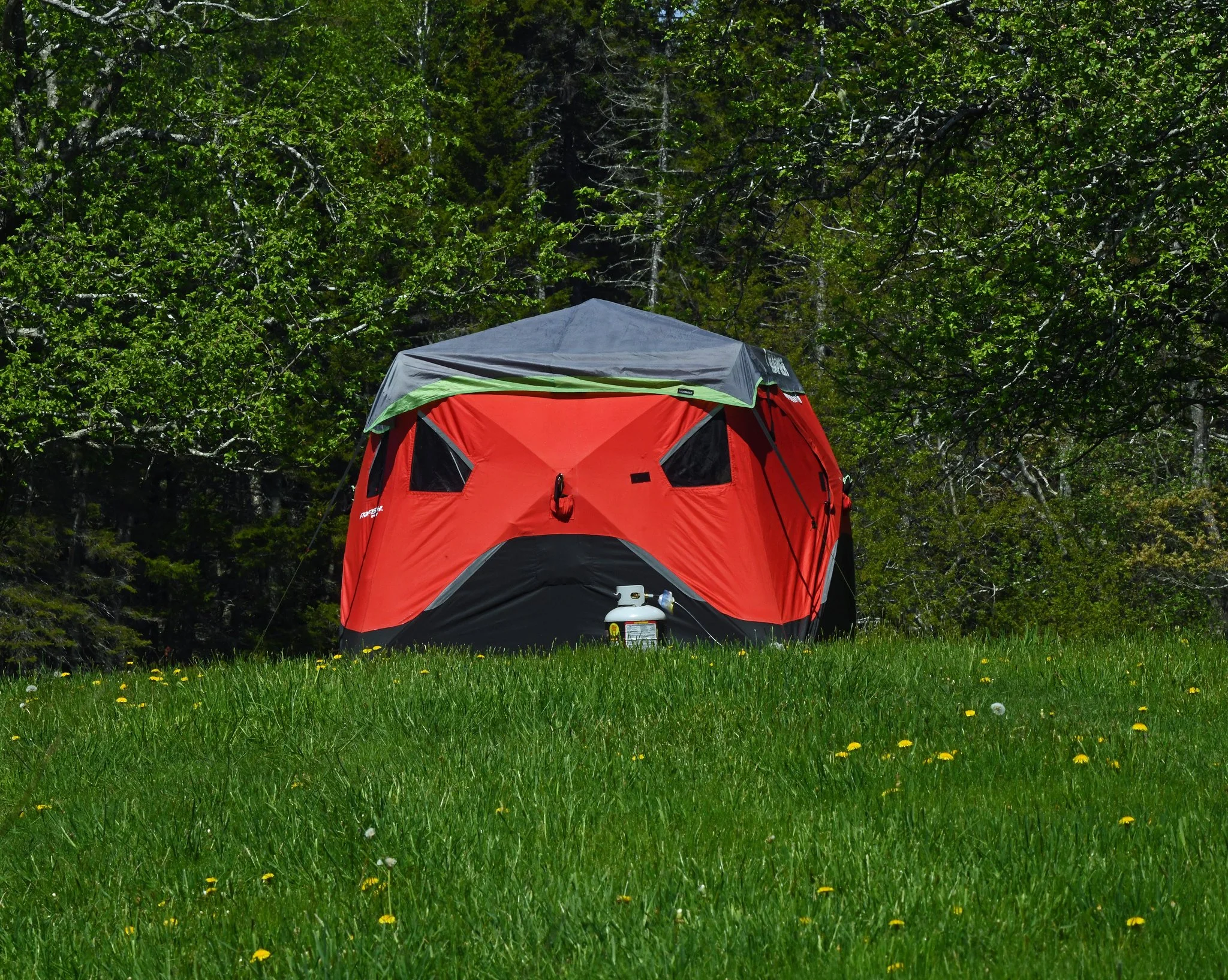
There are rumors that we’ve been visited by a huge, alien parasites that eat everything before them – from dandelions to propane tanks. When Washington was called, no one could agree on what these creatures might be or what to do about them. We were told that it might be Democratic fake news, Republican looters or the ever-vengeful Iranians.

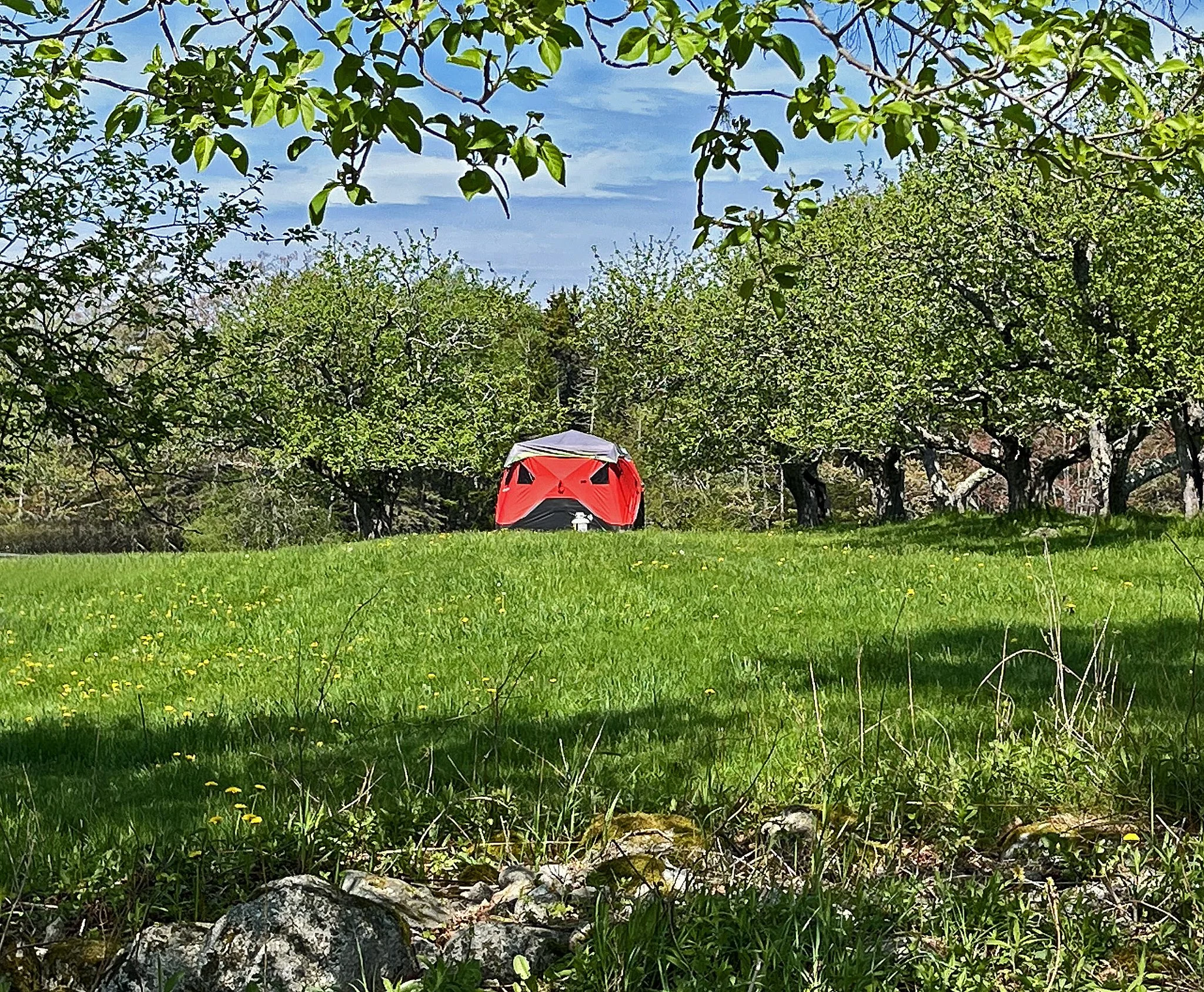
On the other hand, based on what I’ve seen (shown here), perhaps the rumors are only about WoodenBoat School Alumni campers and their good equipment. The investigation still is pending. (Images taken in Brooklin, Maine, on May 20, 2026.)

Comment

Comment

 In the Right Place: She’s Back!

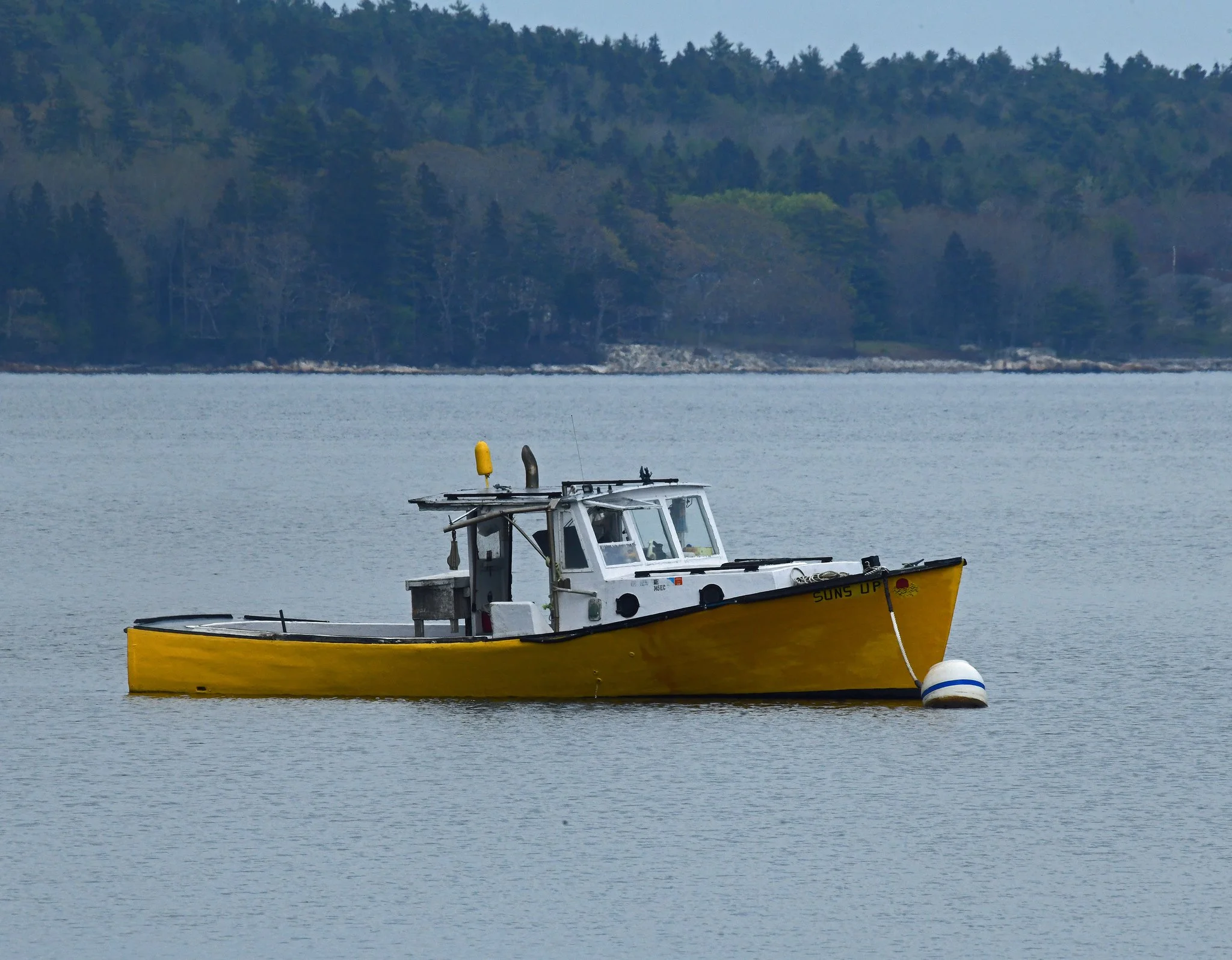
Here’s SUN’S UP brightening Conary Cove during yesterday’s cloudy afternoon – much to the relief of her many fans. There were rumors that this cheery little yellow lobster boat had been sold and shipped away or was going to be scrapped.

Well, whatever the story, the important thing is that she’s back as a seamark in the picturesque Cove that many of us scan as we pass by. Seeing her in the summer has become one of life’s small, reliable pleasures around here. (Image taken in Blue Hill, Maine, on May 19, 2026.) Click on the image to enlarge it.

Comment

Comment

In the Right Place: Slouching Toward Euphoria

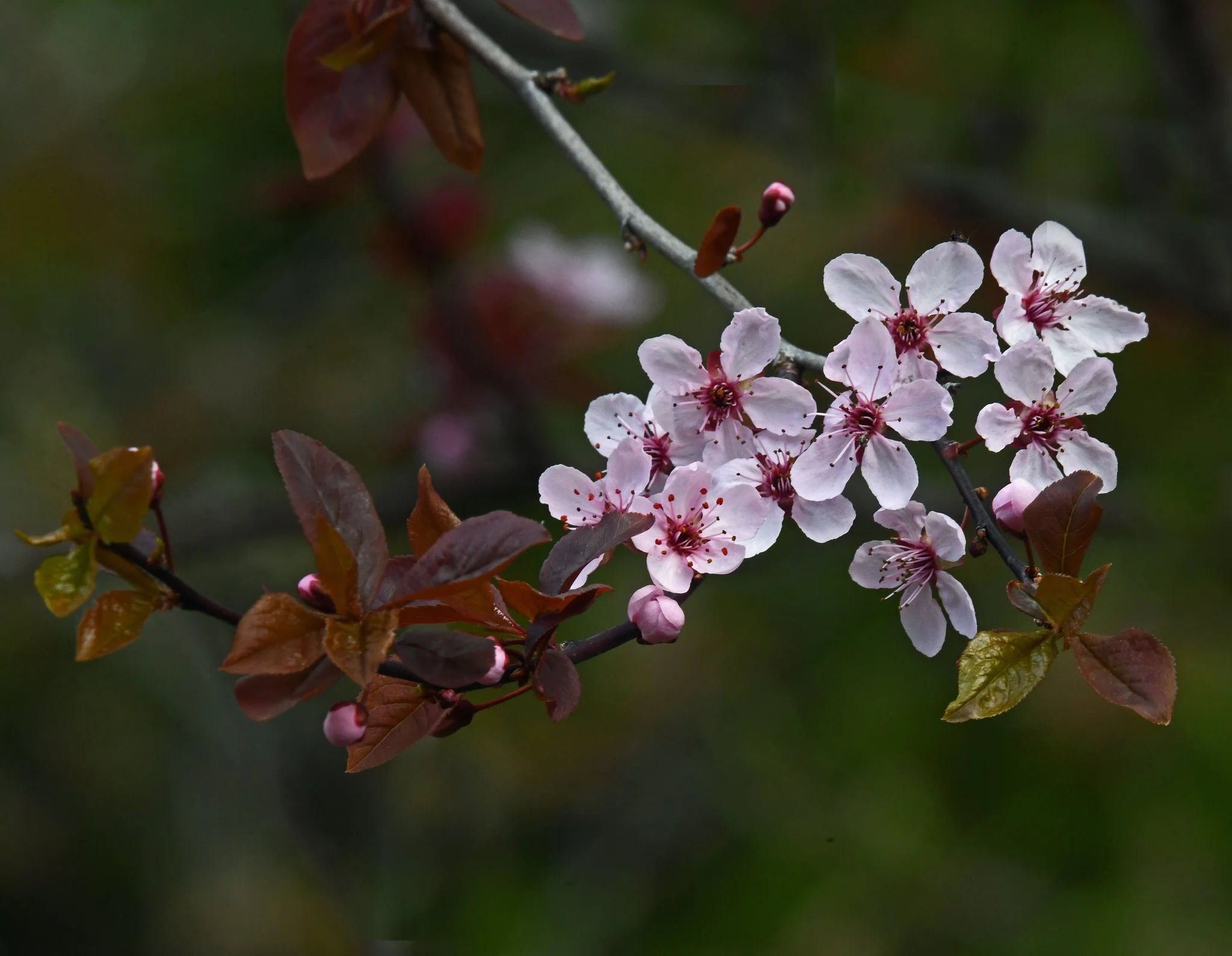
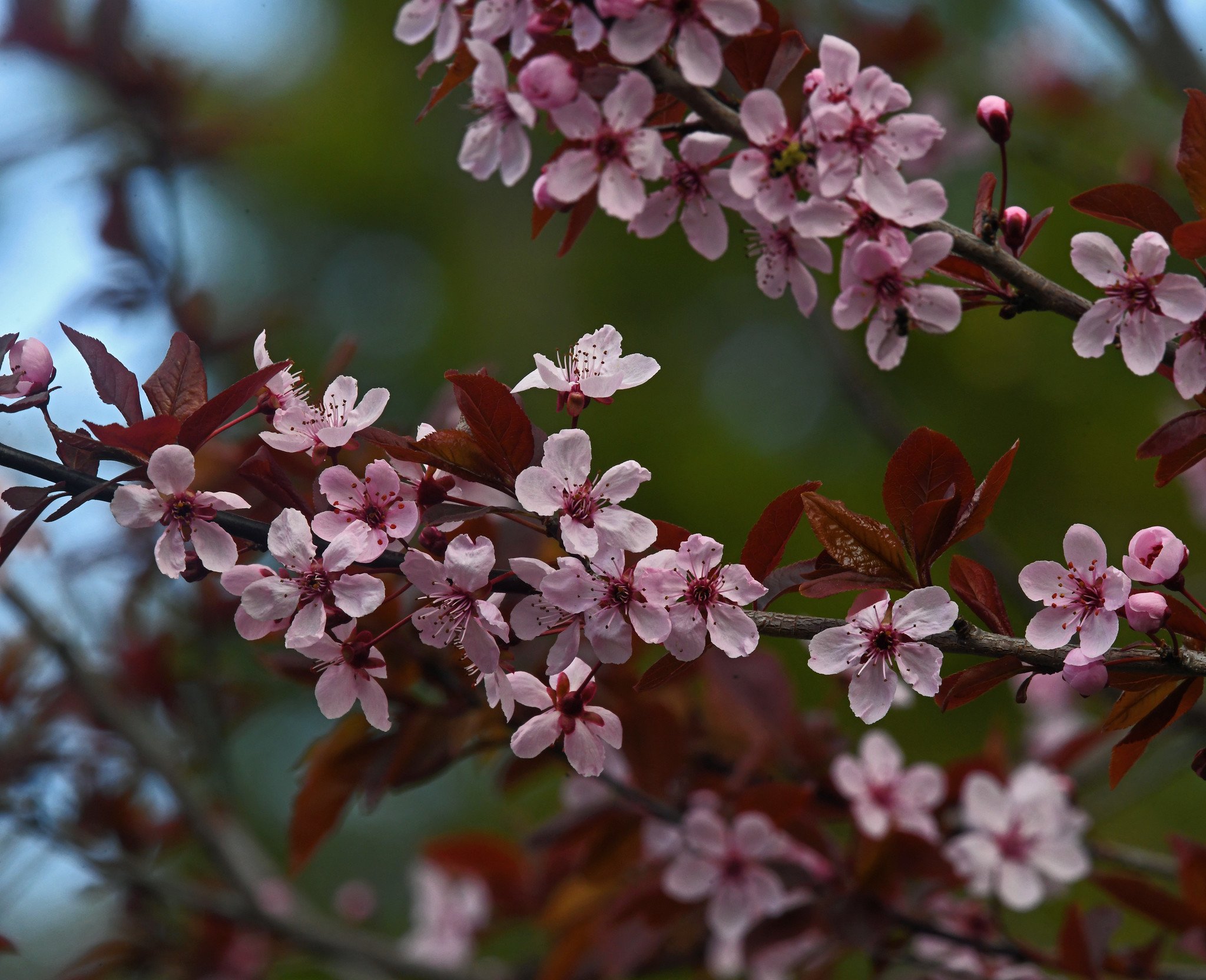
Asiatic plum trees can be spiritual, especially when their exquisitely delicate flowers are blossoming. Which is now. Despite their English name, they’re apparently a special part of the apricot family. In Japan, they’re known as ume and public viewing of them there was popular long before viewing cherry blossoms, according to the literature.

To be sure, cherry blossoms are beautiful. But Asiatic plum blossoms are not only beautiful, they greet you eagerly with a mixed scent that can induce near-euphoria to people who have good-working noses connected to their minds. It’s a subtle and indescribable greeting, something like a mixture of undulating fragrances of peppered-sweetness, tangy-fruitiness and sexual scents.

Moreover, these trees are guardians, if you believe in feng shui. For centuries in China, Asiatic plum trees have been planted in the northeast corners of properties to defend against the misfortune and evil that tries to sneak in with the northeast winds.  That might be something to think about here on the Maine coast. (Images taken in Brooklin, Maine, on May 17, 2026.)

Comment

Comment

In the Right Place: Another Rosie?

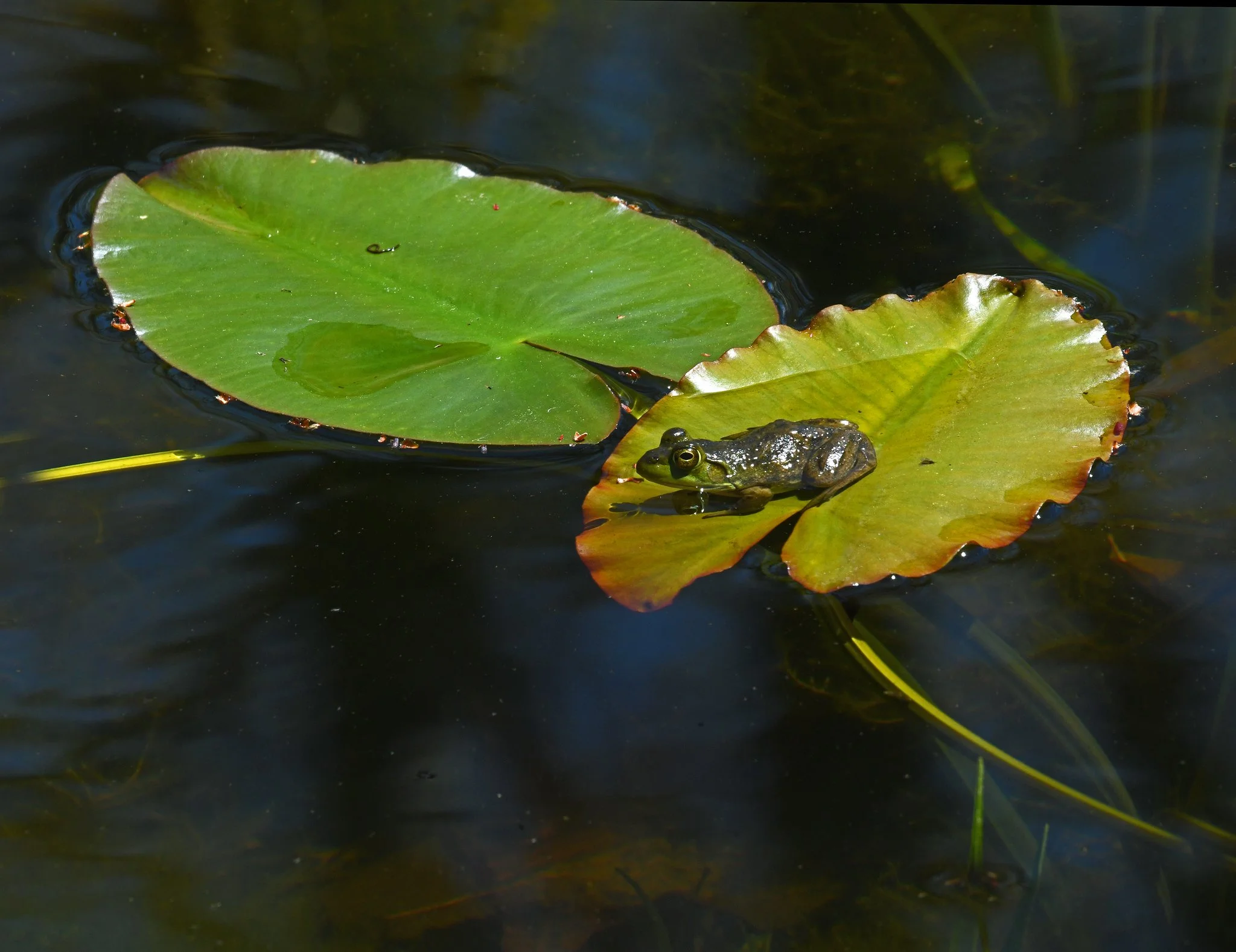
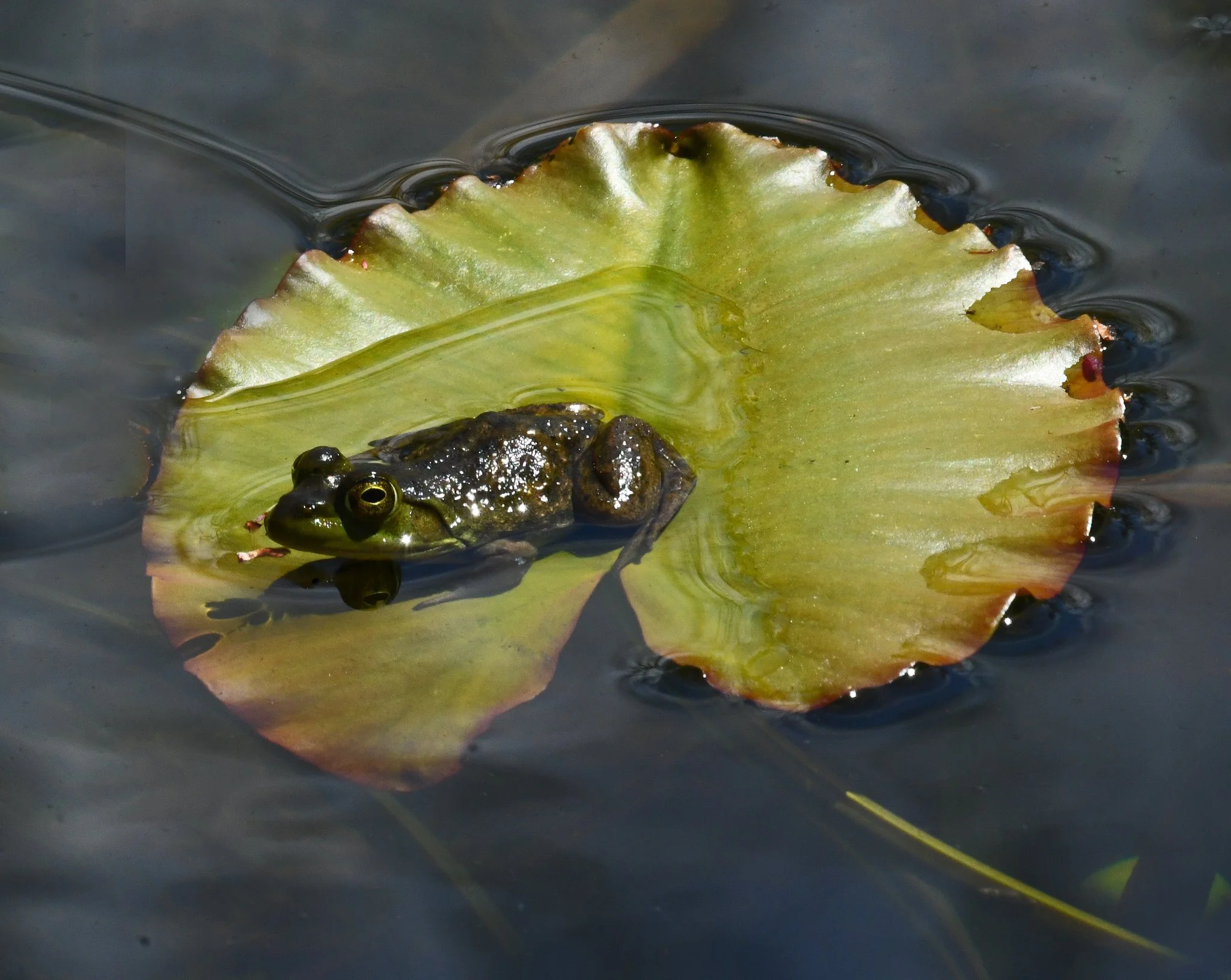
I almost didn’t see this little froglet, who appeared to be less than two inches long. Judging from the stocky shape, color and absence of back ridges (“dorsolateral folds”), my guess is that this is a baby American bullfrog, a little female. (The eardrums on female bull frogs are about the size of their eyes; on males, they’re much larger.)

She’s in a typical bullfrog ambush position, waiting to catch passing prey with her sticky tongue. Assuming that she’s a bullfrog, she’ll gobble up any passing creature that will fit in her very big mouth, even if the prey is bigger than her head, which is stretchable. She’ll soon become 6 to 8 inches long and be able to jump at least 6 or 7 feet in one amazing bound.

The jumping record at the annual Calaveras County Fair & Jumping Frog Jubilee (named after Mark Twain’s amusing jumping frog story) reportedly is held by “Rosie the Ribeter.” And it’s legendary. Rosie launched herself from a sitting position and landed an incredible 21 feet and 5.75 inches away in 1986. (Images taken in Blue Hill, Maine, on May 16, 2926.)

Comment

Comment

In the Right Place: The View, Without Politics

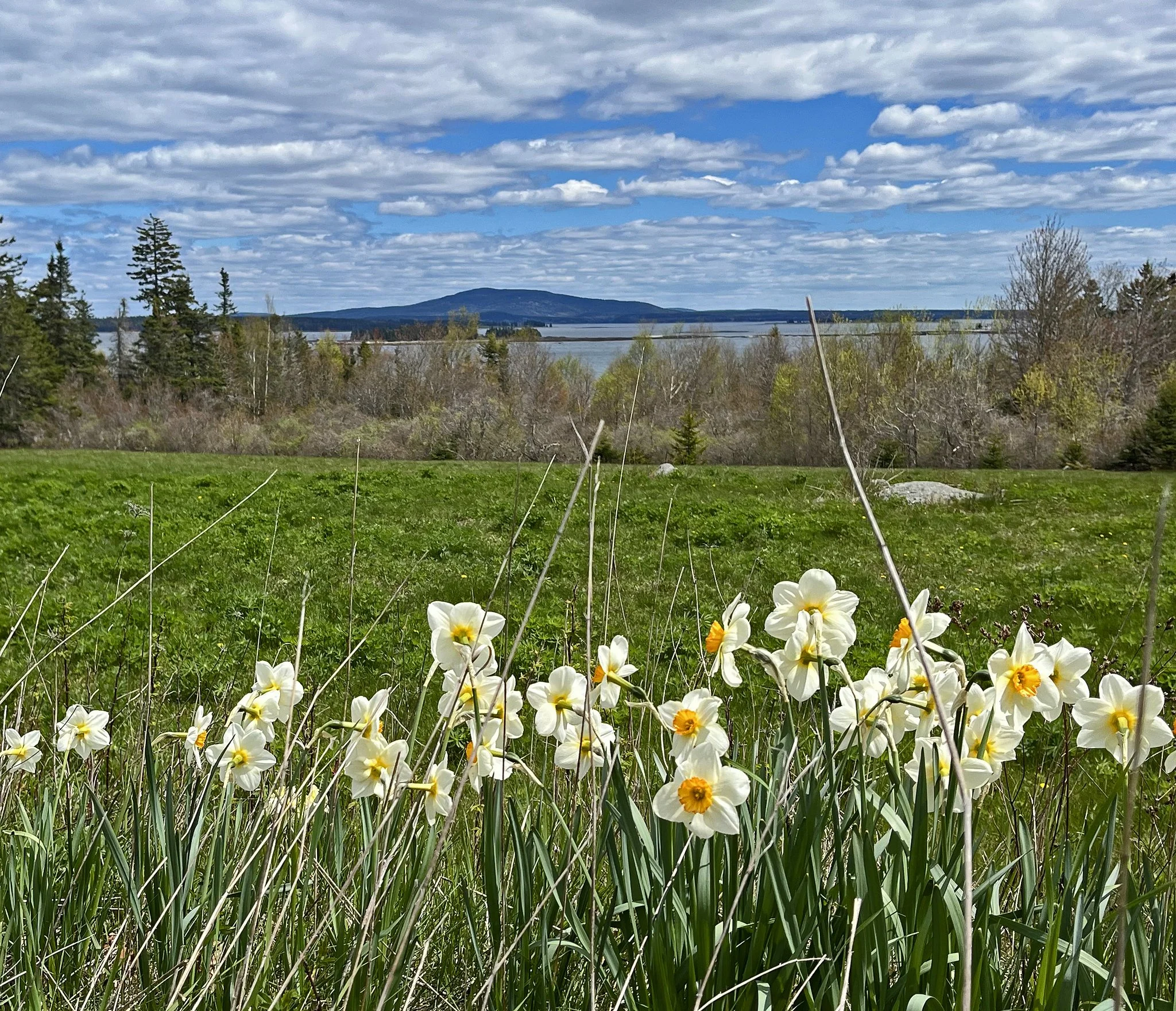
Here you see the view of the western mountains of Mount Desert Island, Maine’s largest island, as seen from the edge of a greening field on Amen Ridge in Brooklin. Daffodils are all the flowers that the field offers now, but it will be full of blooming lupines next month. Blue Hill and Jericho Bays appear gray because the day was “Mostly Cloudy,” according to the weather tellers.

I’ve always wondered whether such weather descriptions had some uniform science behind them. Well, it turns out that they do: accepted definitions for these terms have been  issued by the National Weather Service, which divides the sky in eighths (“oktas”) for world-wide standardization:

 “Overcast” or “Cloudy” means 7/8 to 8/8 cloud cover;

“Mostly Cloudy,” as you see here, is when there is 5/8 to 7/8 cloud cover;

“Partly Cloudy” or “Partly Sunny” means 3/8 to 5/8 cloud cover;

“Mostly Sunny” or “Mostly Clear” mean 1/8 to 3/8 cloud cover, and

“Sunny” or “Clear” mean 1/8 or less cloud cover.

(Image taken in Brooklin, Maine, on May 12, 2026.) Click on the image to enlarge it.

Comment

Comment

In the Right Place: Seeing Stars

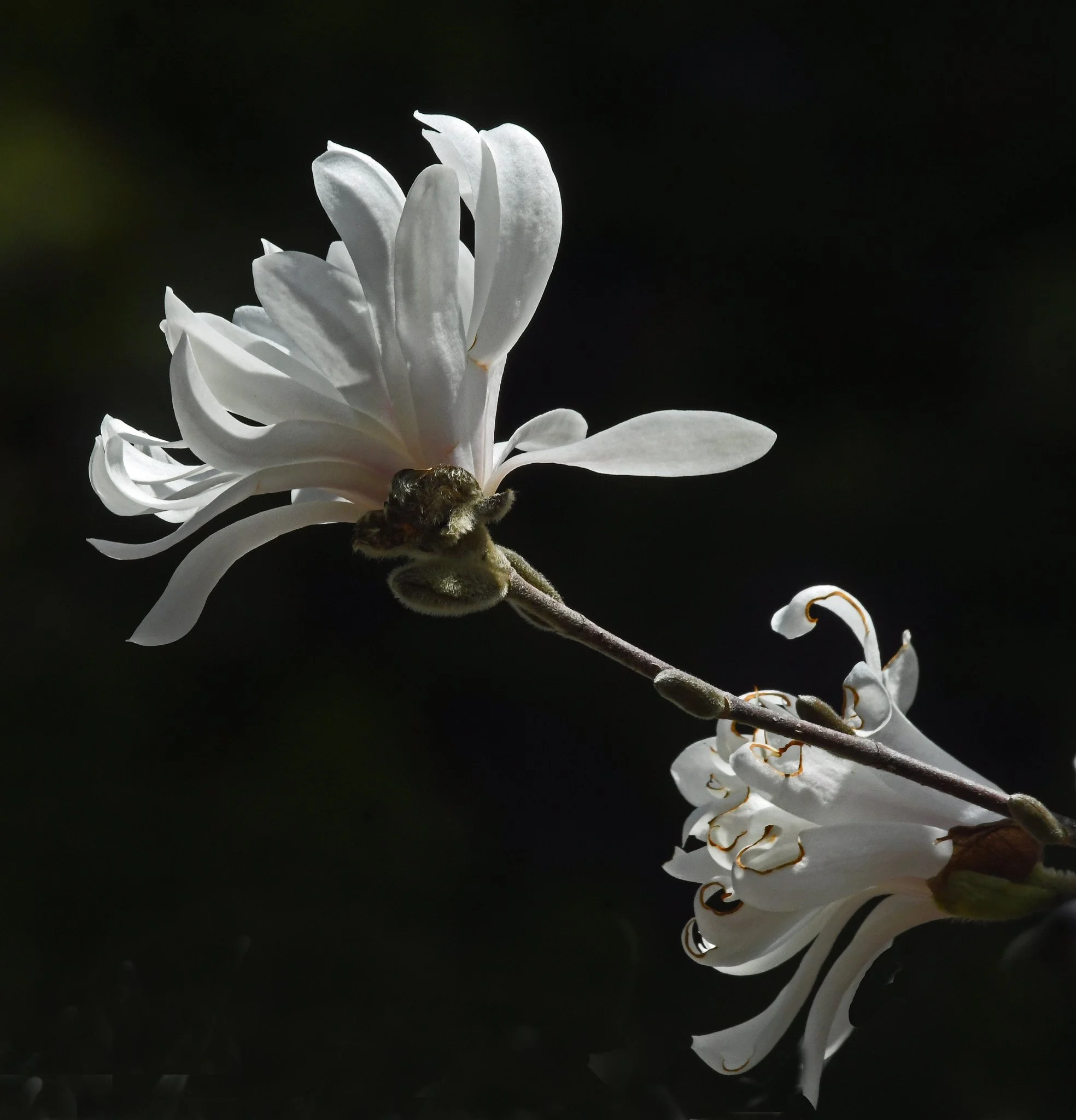
Star magnolia blossoms have been peaking here for about a week. One of the smallest of the magnolia trees and shrubs, the stars seem to like a wet, chilly (but not freezing) spring. Perhaps this is because they originated in the high areas of Japan’s Honshu Island.

When there’s a good breeze and the star magnolia branches are swaying, the blossoms’ many white tepals make the plant look like a swarm of ancient deep-sea life caught in a light. In fact, magnolias are very old plants. They’re so old, they originated before bees evolved, according to the literature. But, of course, there were plenty of early flies and beetles to do the magnolia  pollen-carrying in the Early Cretaceous period. And, flies and beetles pollinate the shrubs to this day.

(Image taken in Brooklin, Maine, on May 9, 2026.)

Comment

Comment

In the Right Place: In the Shops, VIII

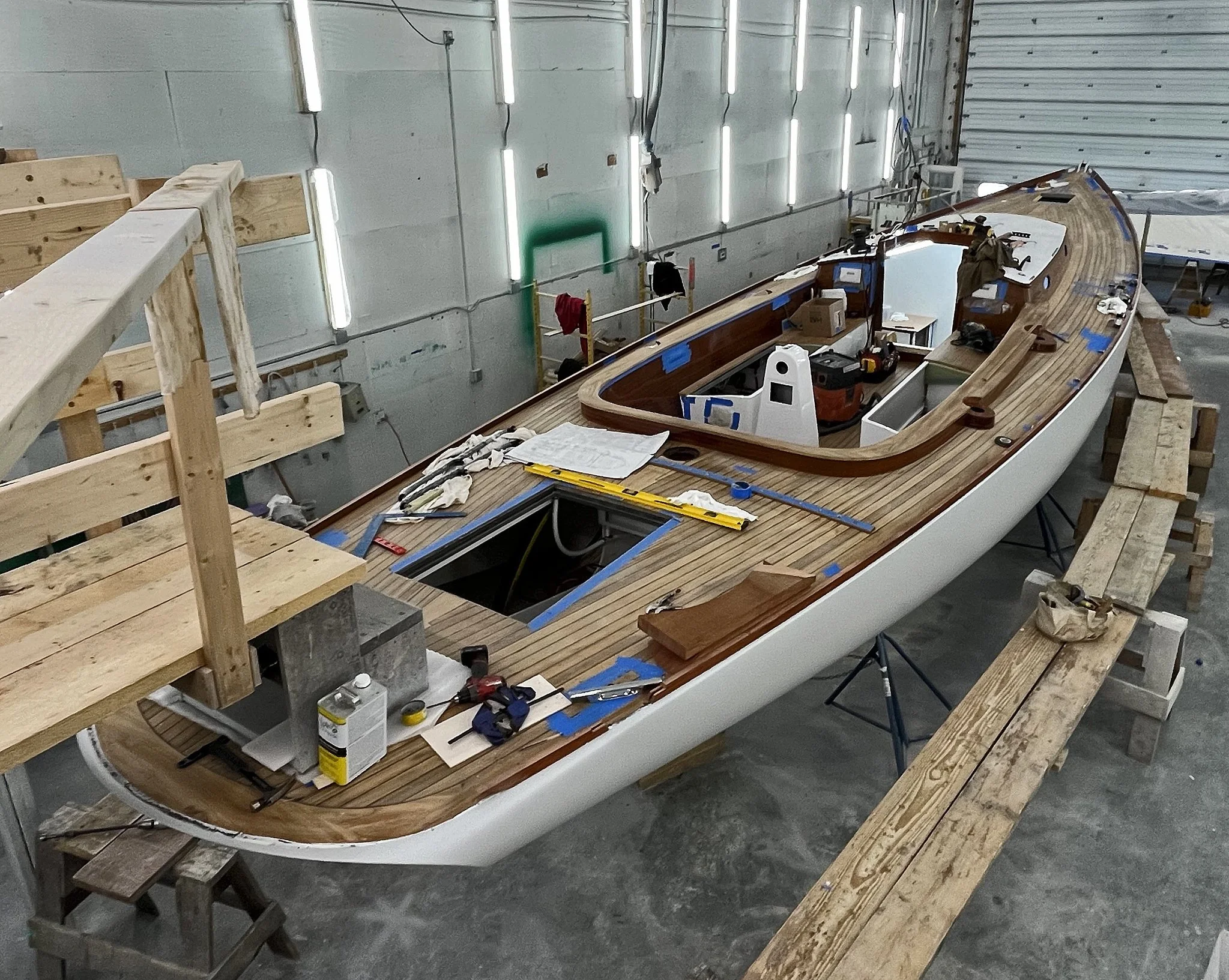
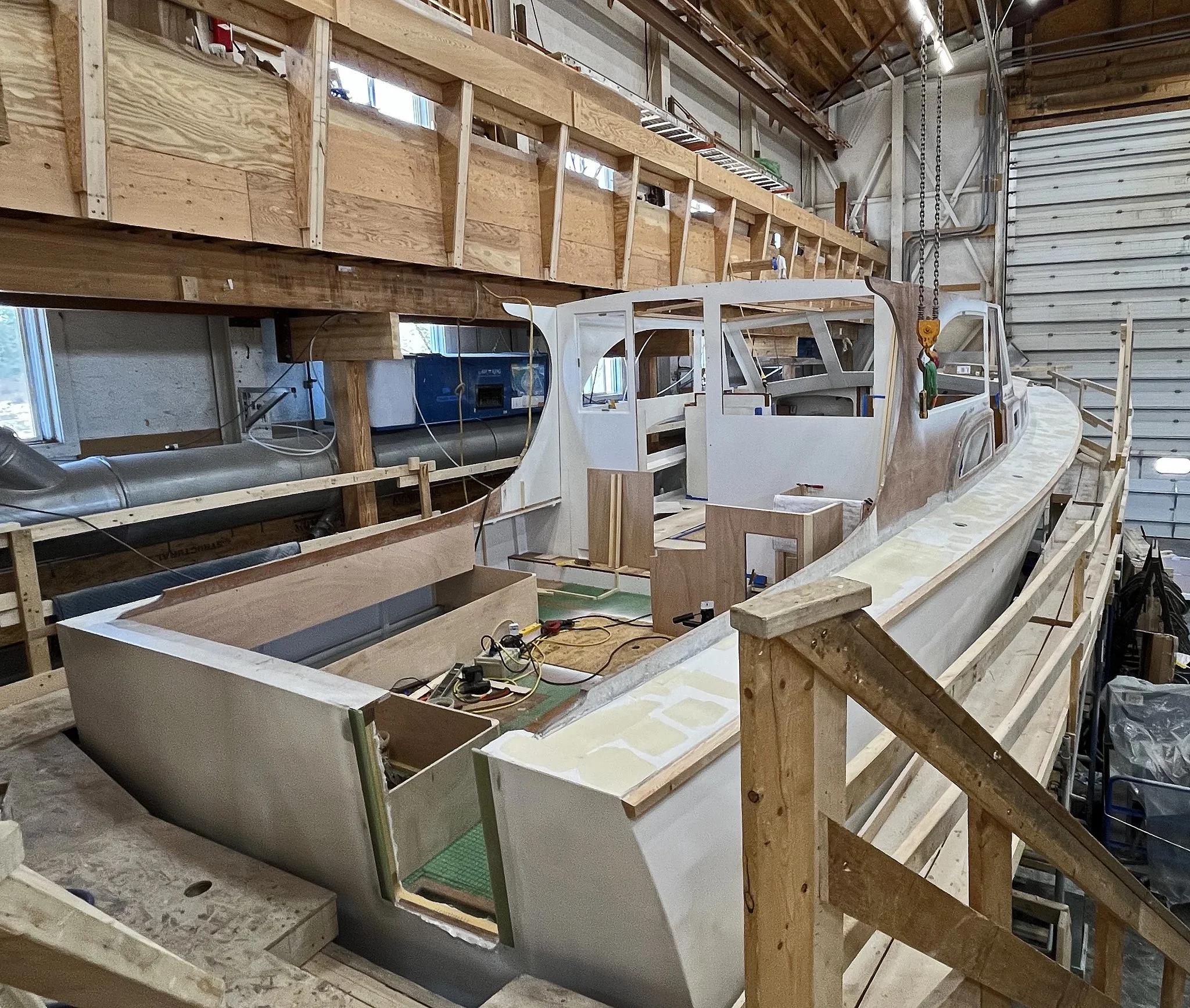
Here’s a quick update on two of the boats-in-progress that we’ve been monitoring at the renowned Brooklin Boat Yard. It’s a pleasure to see expert craftsmanship making something elegant and grand out of so many rough and functional parts.

DYLAN, shown above, has been moved from the main shop to the paint shop, where she can be sanded and have details worked on simultaneously. As you know, she’ll be an Eggemoggin  47+ (47’6” overall) type racing sailboat.

The powerful, unnamed 47’ (overall) Express Cruiser, shown below, remains in the main shop, where she’s looking more like her drawings every day. I bet there’ll be many a wonderful cruise in her.

(Images taken in Brooklin, Maine, on May 11, 2026.)

Comment

Comment

In the Right Plce: The Coverup

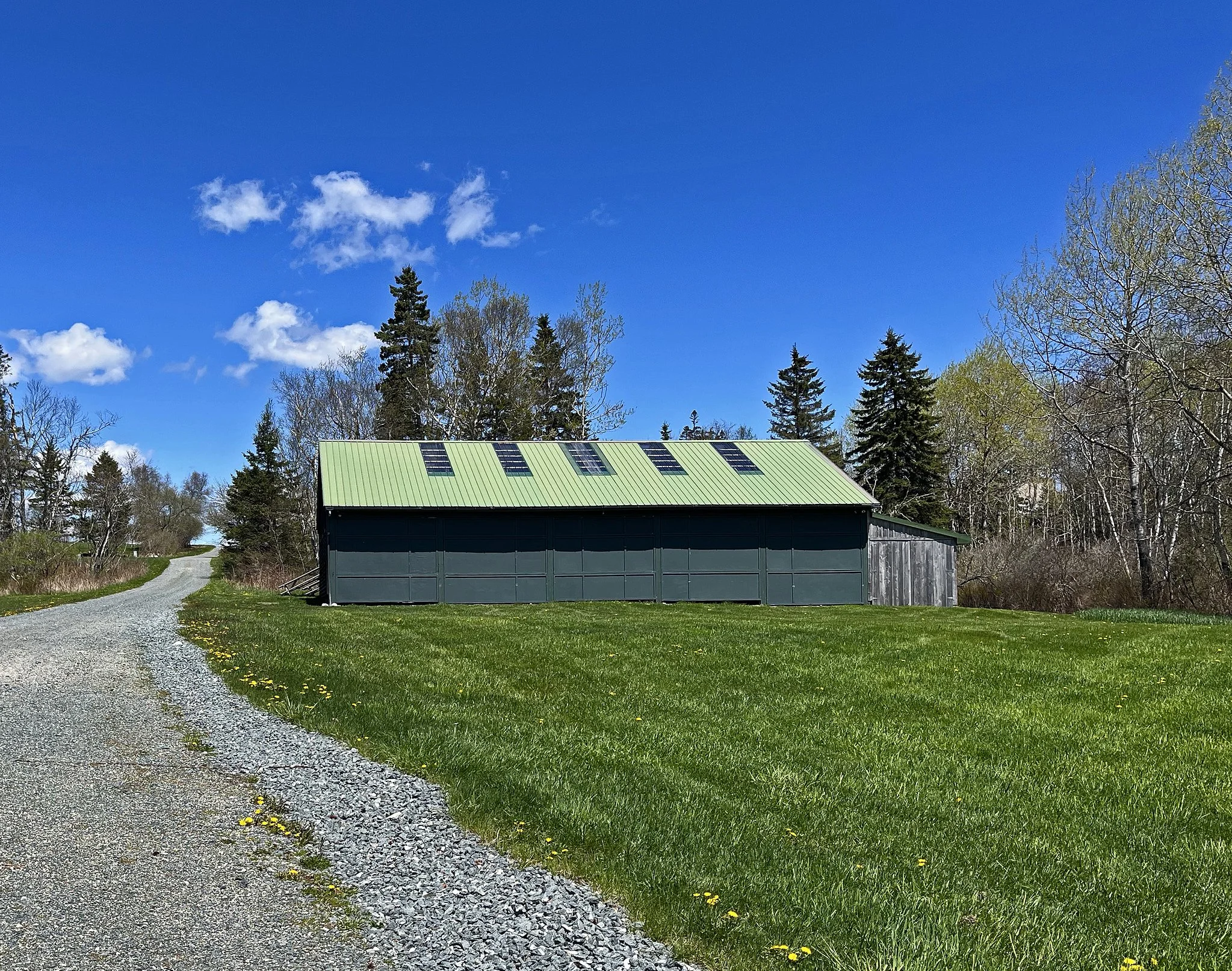
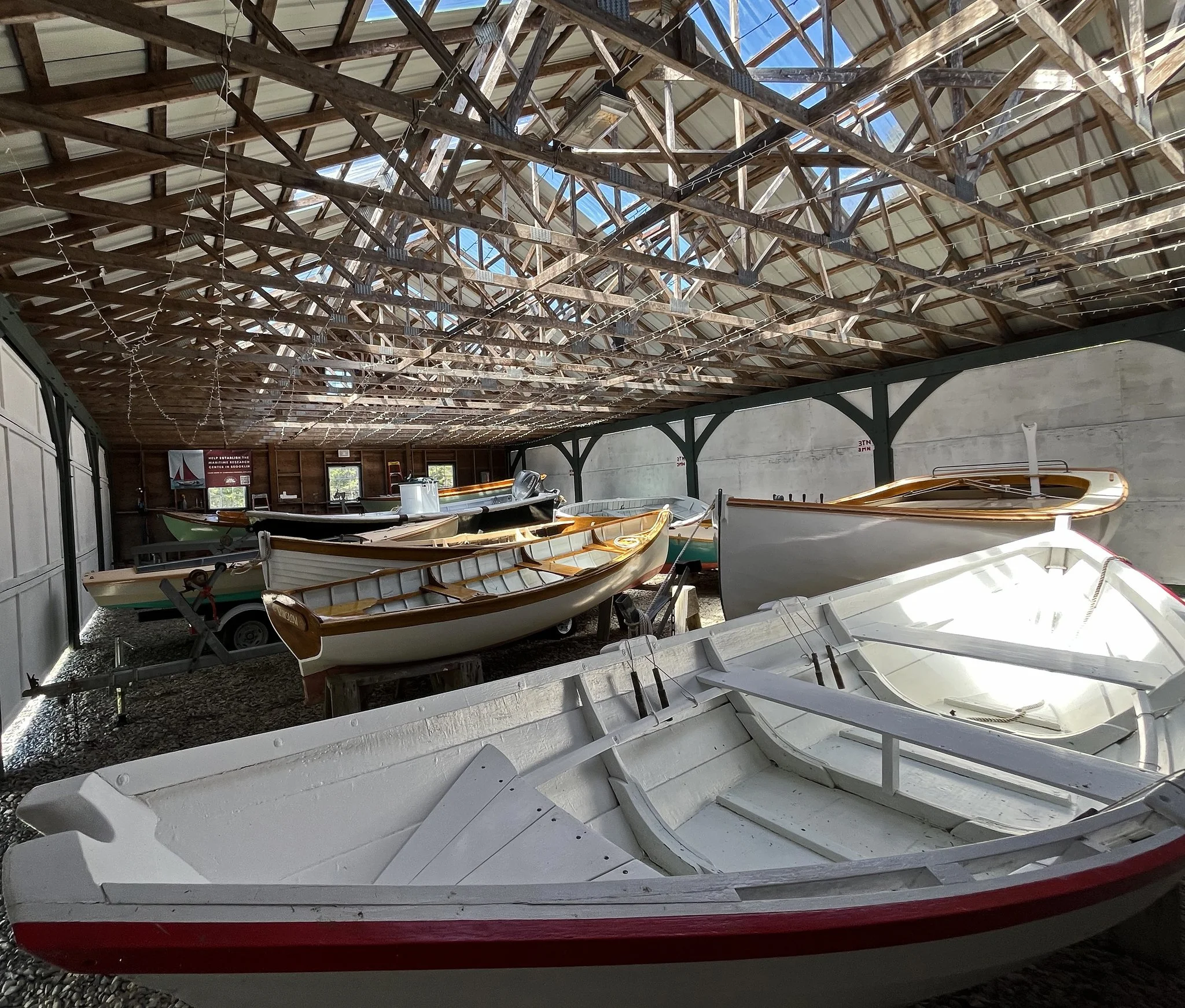
Here, you the viewer are on the campus of renowned Wooden Boat Publications and School. That’s Great Cove Drive coming down the hill right at you. It ends immediately behind you with a ramp into the waters of Great Cove.

The building in front of you probably is not the most beautiful you have seen; perhaps it’s even boring for you to look at, certainly (and thankfully) it’s not Trumpian. Yet, as they say in architecture school, form follows function. And, this building is beautifully functional.

In a way, this building is a jewel box in the late fall and winter and a place to feel good during the late spring through early fall. The jewels that it protects are finely-crafted WBS boats that sometimes even are gilded in gold by sunlight dollops dripping through the skylights:

It’s a post-and-panel structure and soon all of those green panels on this side and the opposite side of the building will be taken away. The boats will be led eagerly into Great Cove and the plain building will become a lovely pavilion between green woods and blue waters.

Sea airs will waft through the pavilion while classes are taught to students at tables there, or while food is being served there to visitors, or while theatrical performances are being given to local residents, or while people are hanging out, waiting for a spring shower to stop and hoping to see a rainbow over the Cove.

(Images taken in Brooklin, Maine, on May 11, 2026.)

Comment

Comment

In the Right Place: B&B, the Sequel

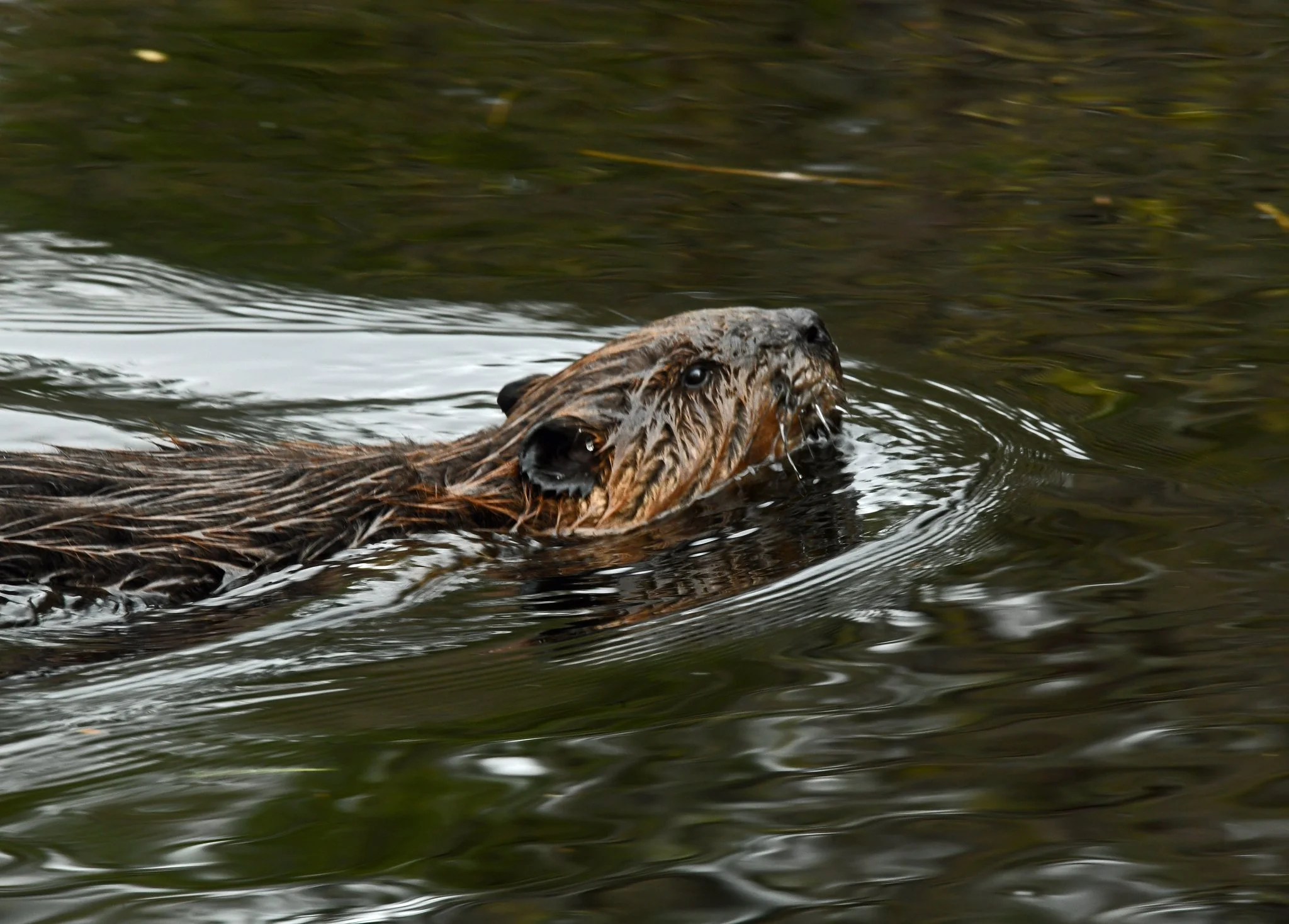
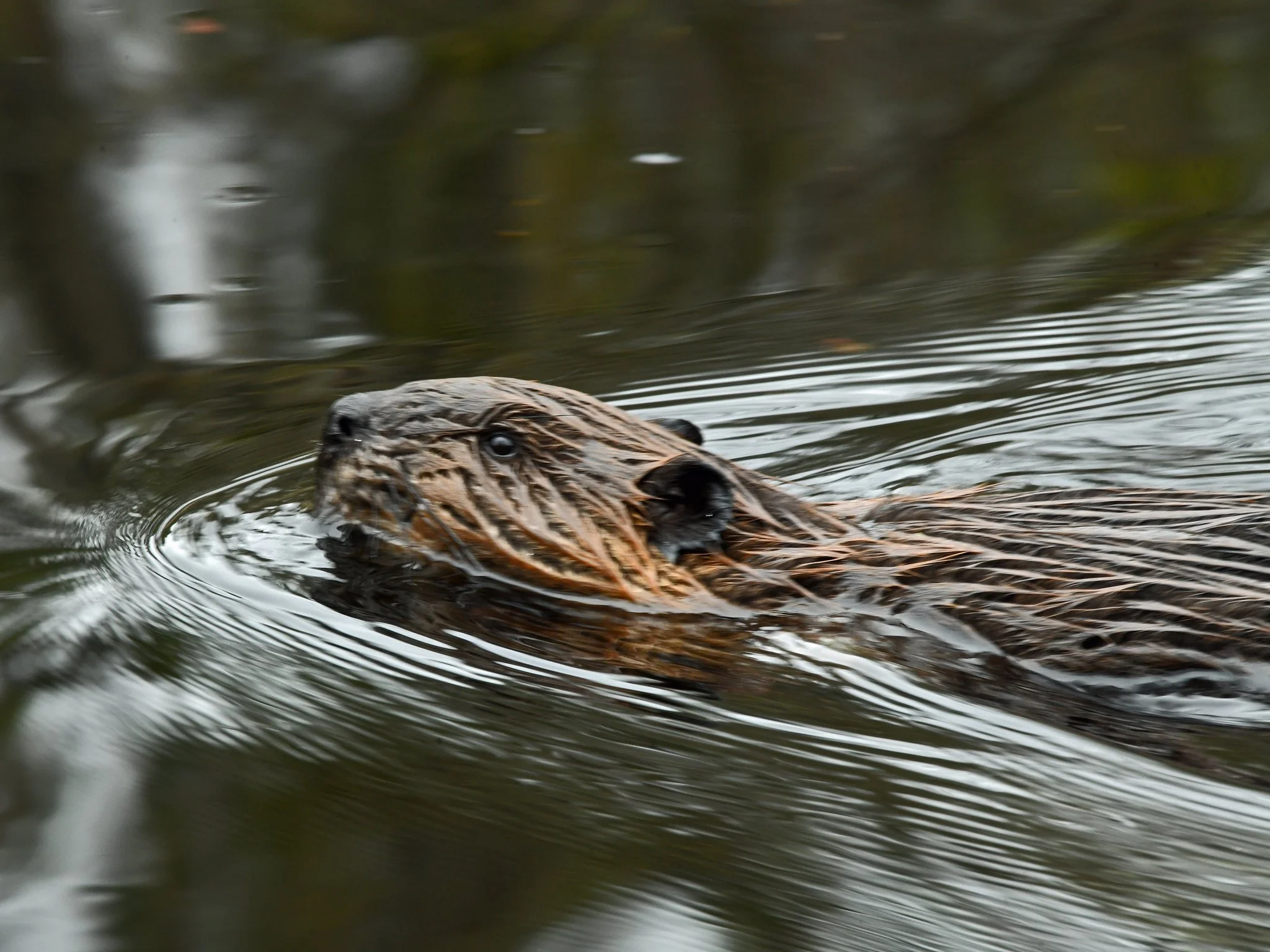
Many of you shared our ups and downs last year with Bernie and Bernice Beaver. They dammed our three ponds, took down at least 50 trees and large shrubs and generally were a pleasurable problem. Then they disappeared and peace returned.

Well, two beavers are now back in those ponds and, therefore, we’ll also be reporting on them as Bernie and Bernice – if they decide to stay and lay claim to our ponds. They seem to be mostly scouting out the area now::

However, being beavers, they can’t resist closing up the gurgling channels I dug to keep the pond waters from flooding due to the original B&B dams. And I, being human, can’t resist re-digging those channels almost daily. It’s like the war with Iran; neither side is winning; disparity in resources doesn’t matter, and we can’t figure out a suitable compromise. Here we go again; stay tuned.

(Images taken in Brooklin, Maine, on May 10, 2026.)

Comment

Comment

In the Right Place: Boggling

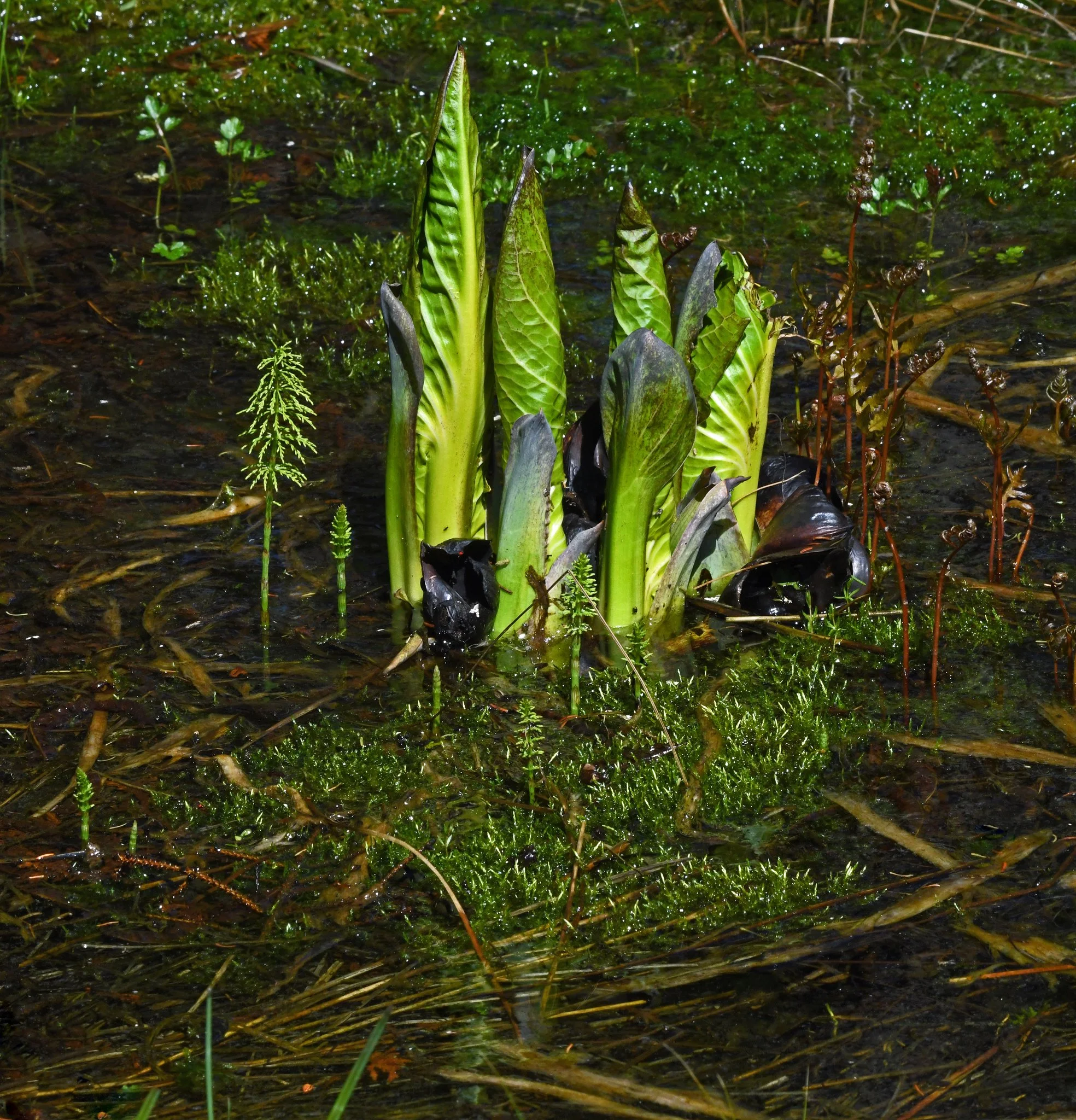
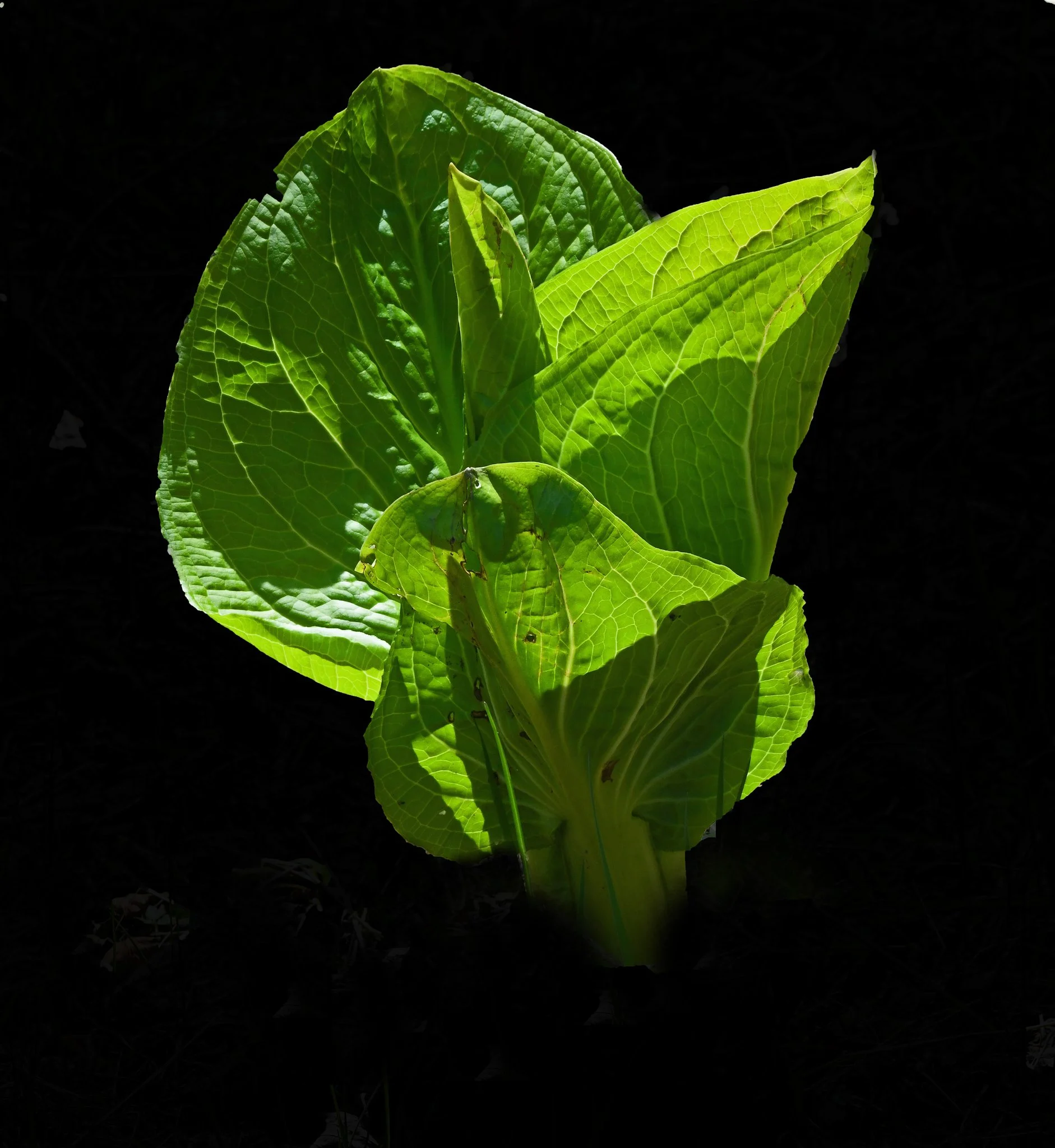
Most skunk cabbage plants in the bogs have shed their colorful, jester-hatted spathes and are sprouting what will become their glorious leaves. As you see here, some of these plants’ leaves are still twirled tightly like rockets on the launch pad:

Others are beginning to fling their leaves open, causing a series of green explosions in the wetlands:

Skunk Cabbage is  a paradoxical plant – gorgeously pleasing to the eye, not so much to the nose. (Imagine Grace Kelly or George Clooney with very bad breath.) Nonetheless, I’m a big fan of theirs. (Images taken May 9, 2026.)

Comment

Comment

In the Right Place: Here’s to All Moms!

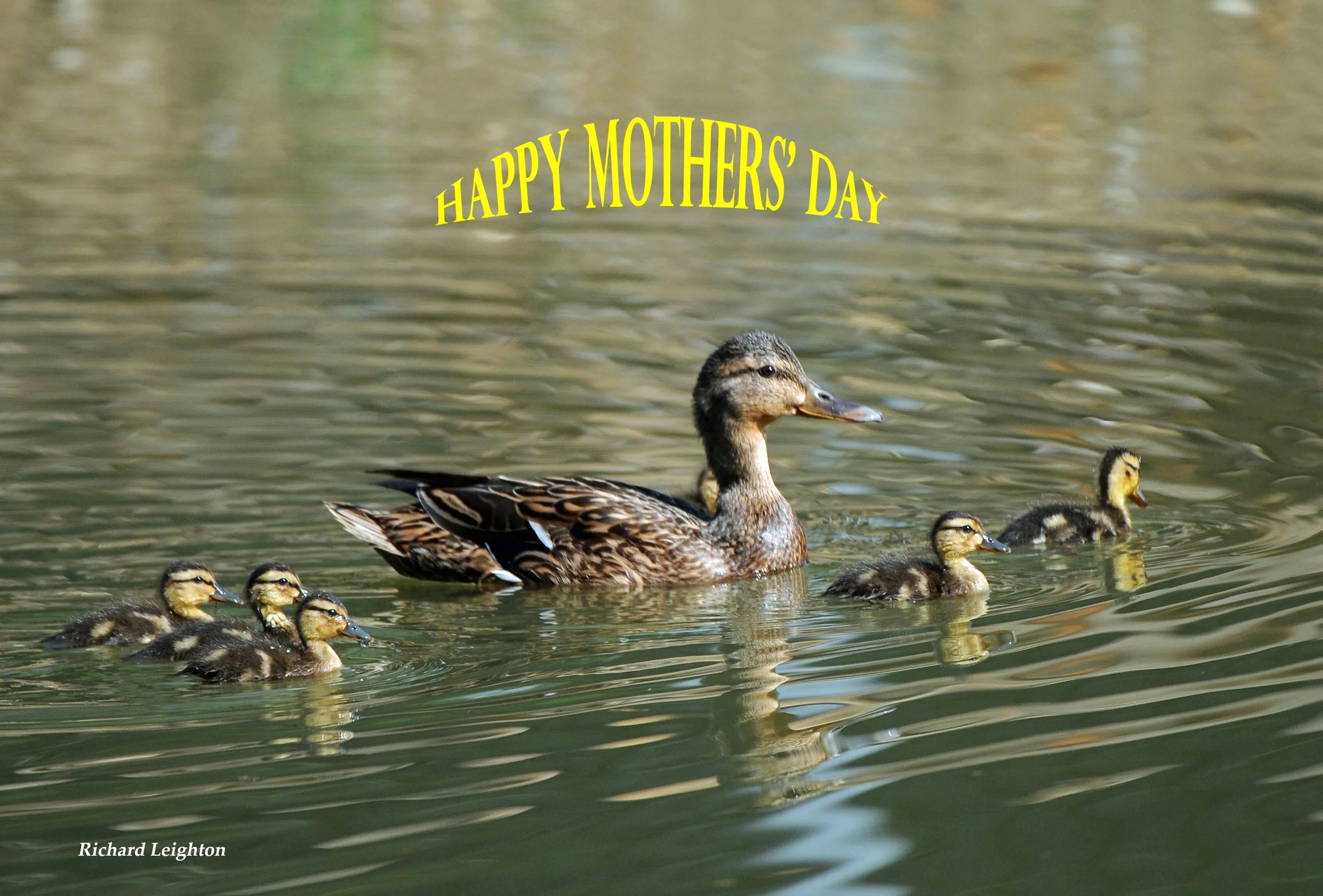
My mother taught me to be curious, so I did a little research on her day. It turns out that about 50 countries celebrate some form of Mother’s Day and most of them designated the second Sunday in May as its date.

In the U.S., Anna Jarvis get’s most of the credit for convincing President Woodrow Wilson to sign a bill designating that Sunday as a national holiday for mothers in 1914. Anna wanted to honor her mother, Ann Jarvis Reeves, who created the concept of “Mother’s Day Work Clubs” for healthful activities and who also was a peace activist during those war times.   Anna later came to criticize Mother’s Day as being too commercialized. Click on the Leighton Archive image to enlarge it.

Comment

Comment

In the Right Place: It’s a Small World

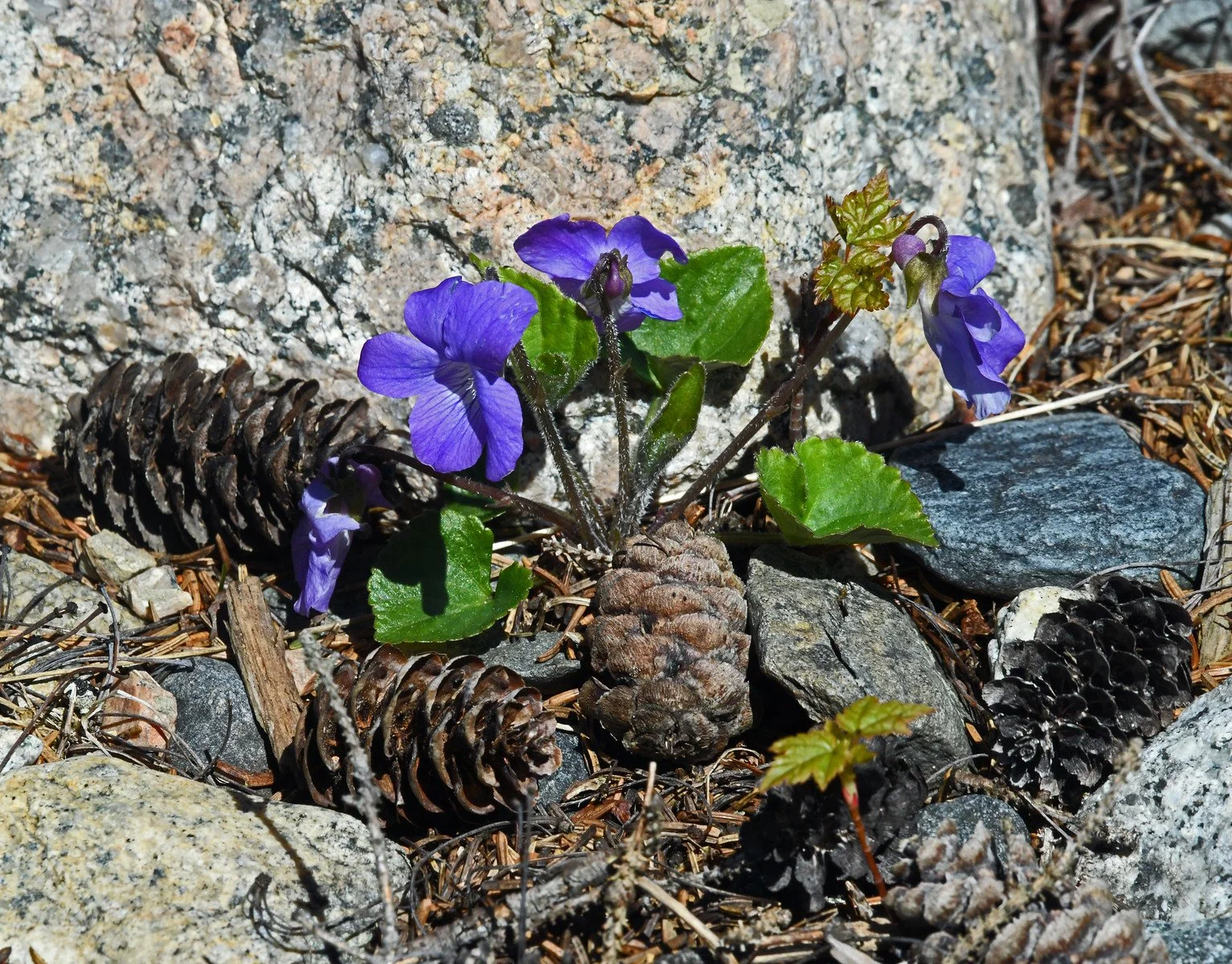
Here, I think, are some volunteer hookedspur (aka “dog”) violets that are so small they would be easy to overlook -- except for their bright purple glow among the riff-raff they like to hang out with. If they are hookedspurs, they’ll host the caterpillars of the many fritillary butterflies that we hope soon will be fluttering in Barbara’s garden. (Image taken in Brooklin, Maine, on May 8, 2026.)

Comment

Comment

In the Right Place: A Road for All Seasons

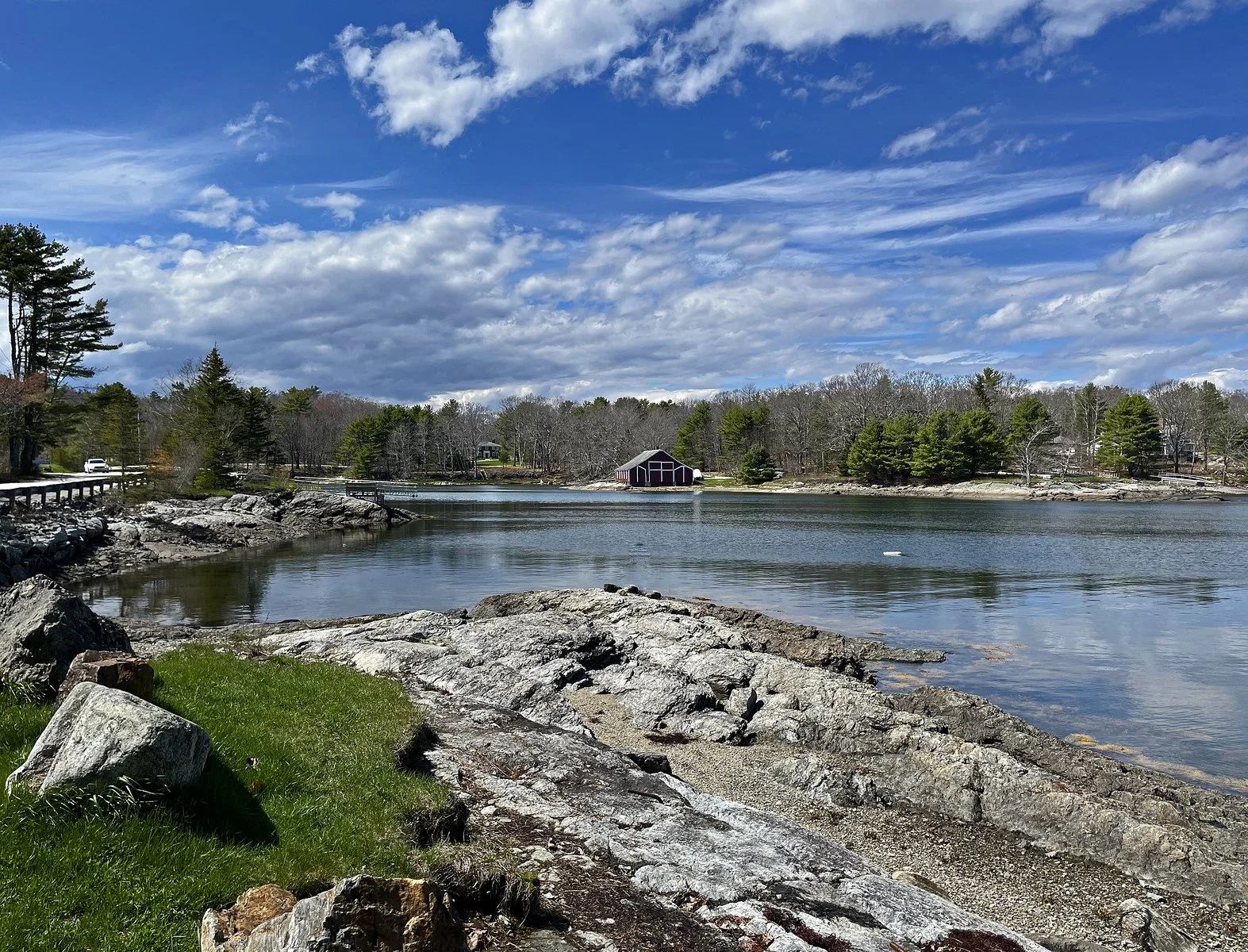
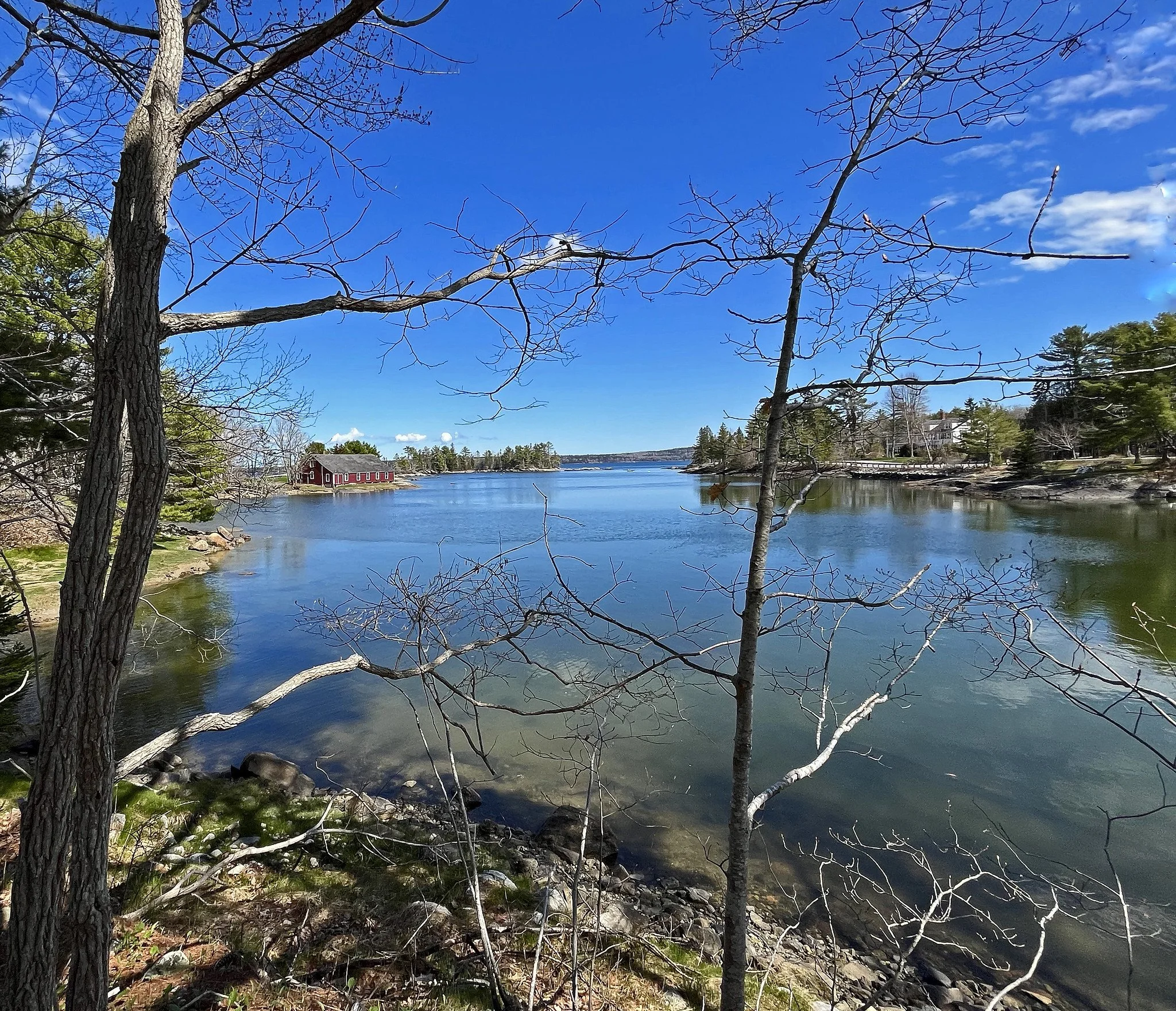
The scenic route to and from Blue Hill, Maine, is on a winding road that has been given an uninteresting name that’s mostly the number 175; Route 175, that is. But don’t let that fool you.

The road bridges over a reversing falls where tidal white water rushes in and out of Salt Pond. It traverses a causeway that sometimes is about a foot above that Pond. And, it twists and turns around the rockbound shores of Conary Cove, which hosts the old red boat house that you see here.

It’s a road for all seasons with ever-changing performances of spring, summer, fall and winter; in sun, overcast, rain, snow and fog; at high, low, ebb and other attitudes of the waters of Blue Hill Bay, where there often are interesting boats and birds (and, rarely, a lost seal or two). At one time, the owner of the boat house even took off and landed in Conary Cove as travelers on the road watched.

It’s a good place for motorists to forget the costs of the gas they’re using and their other passing problems. (Images taken in Blue Hill, Maine, on May 7, 2026.)

Comment

Comment

In the Right Place: Shhh!

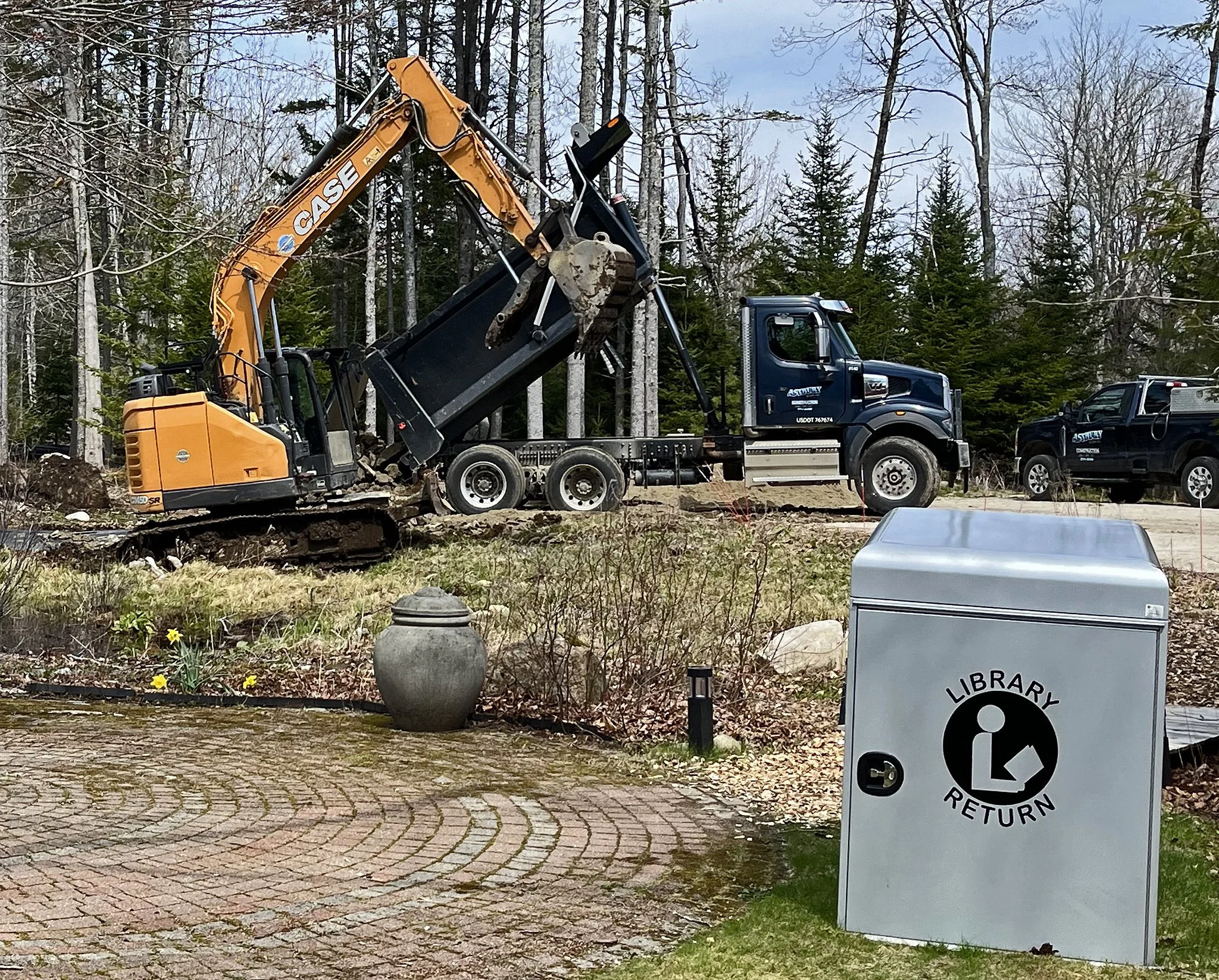
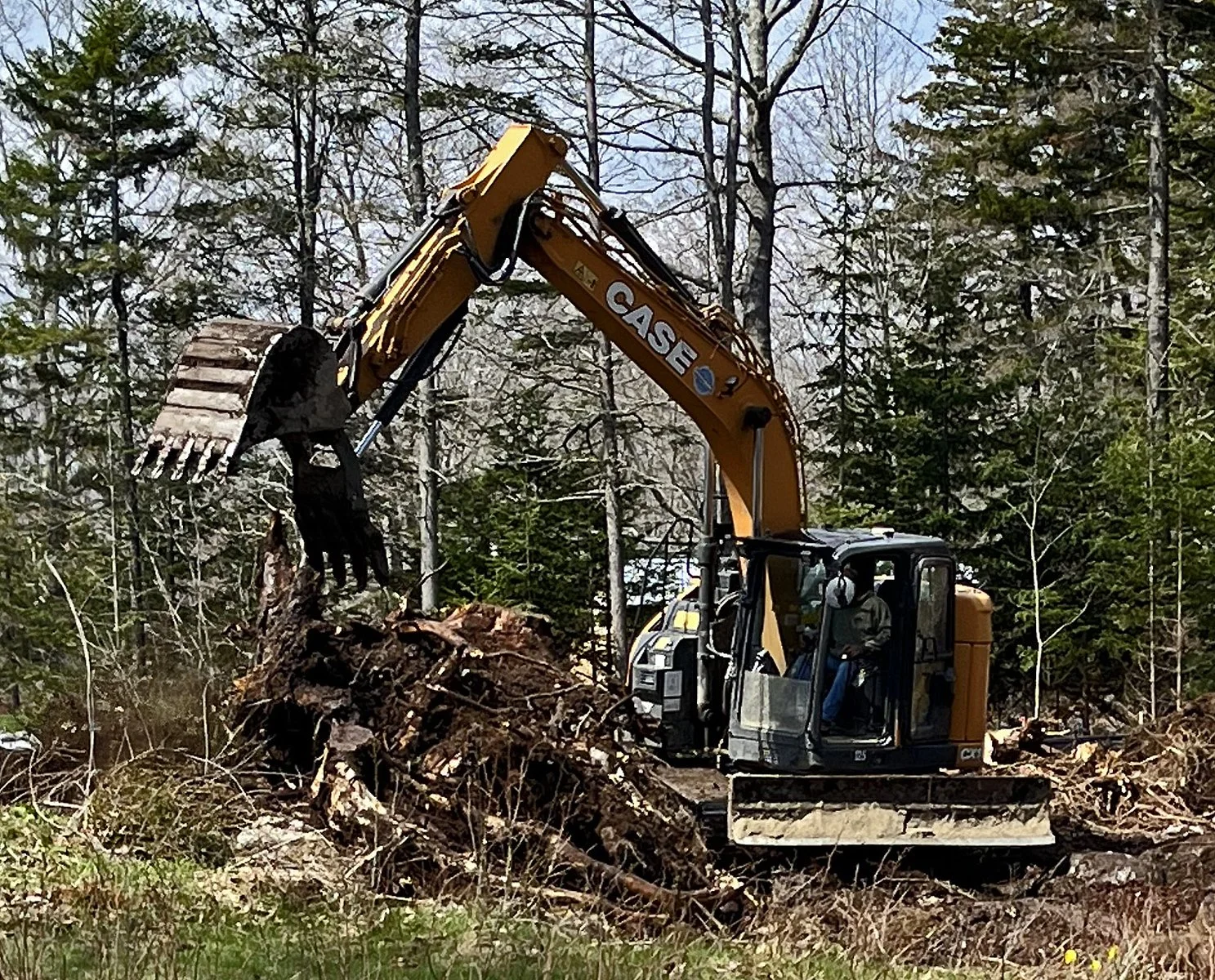
The traditional warnings about keeping quiet around libraries don’t apply these days to Brooklin’s Friend Memorial Public Library. As you see, heavy machinery is busy excavating a foundation for another expansion and revitalization of our Library.

Libraries have been important community centers in New England for centuries and the FMPL is no exception. A small library was located in Brooklin during the 19th century. It was enlarged primarily through efforts of summer residents in the 1890s. The current building was constructed in 1912 and funded primarily by Leslie, Robert and Victor Friend, who ran a successful baked bean business.

New Yorker editor Katherin Sargent White and her author husband, E.B. White, were among Brooklin residents who were instrumental in significantly improving the FMPL in 1940. The building was again expanded and renovated in 1998 and reportedly had some architectural work done in 2000.

It’s hoped that the current expansion will be completed by early 2027, when there again will be all quiet on the library front.  (Images taken in Brooklin, Maine, on May 4, 2026.)

Comment

Comment

In the Right Place: Catch-as-Catch-Can

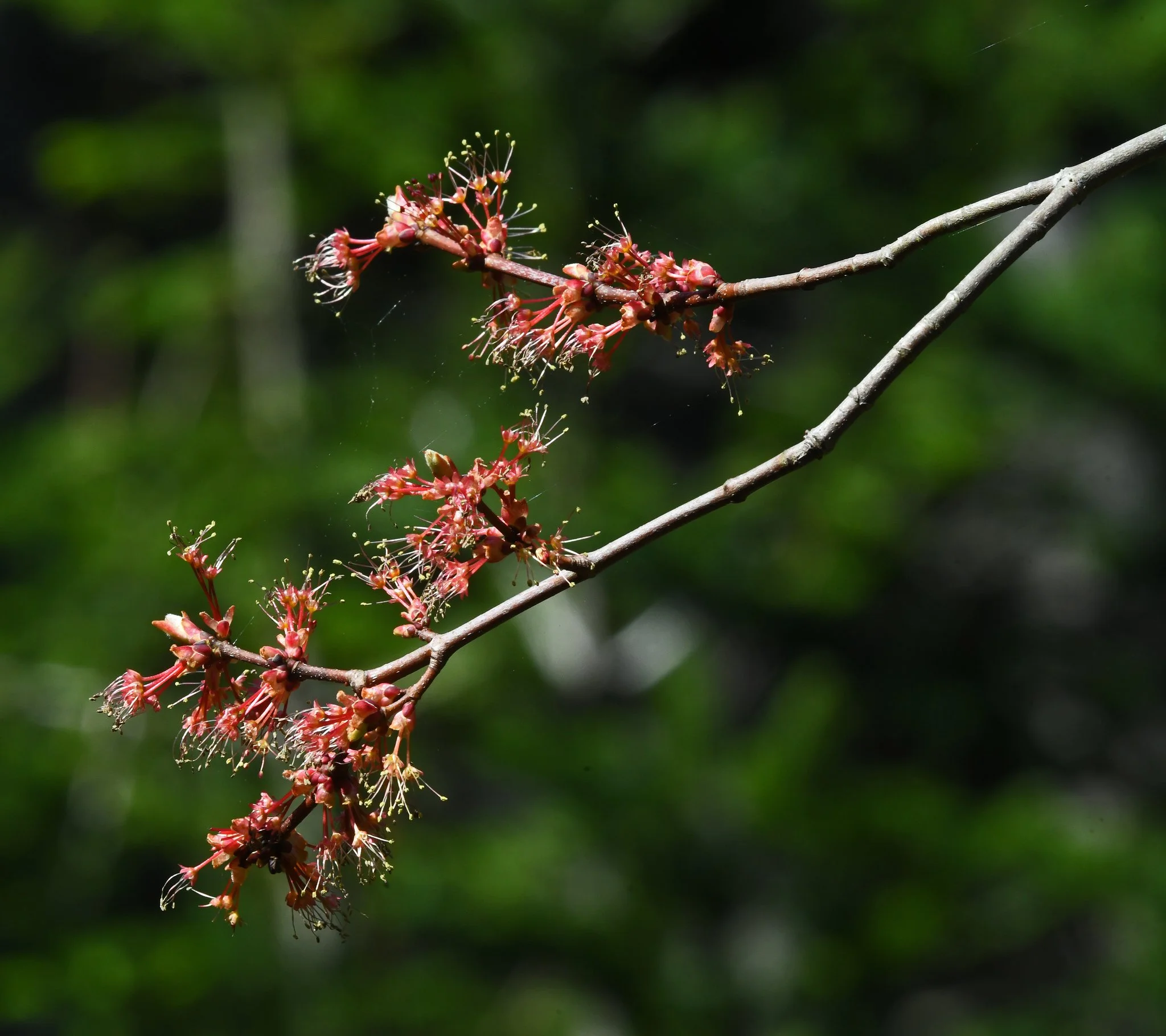
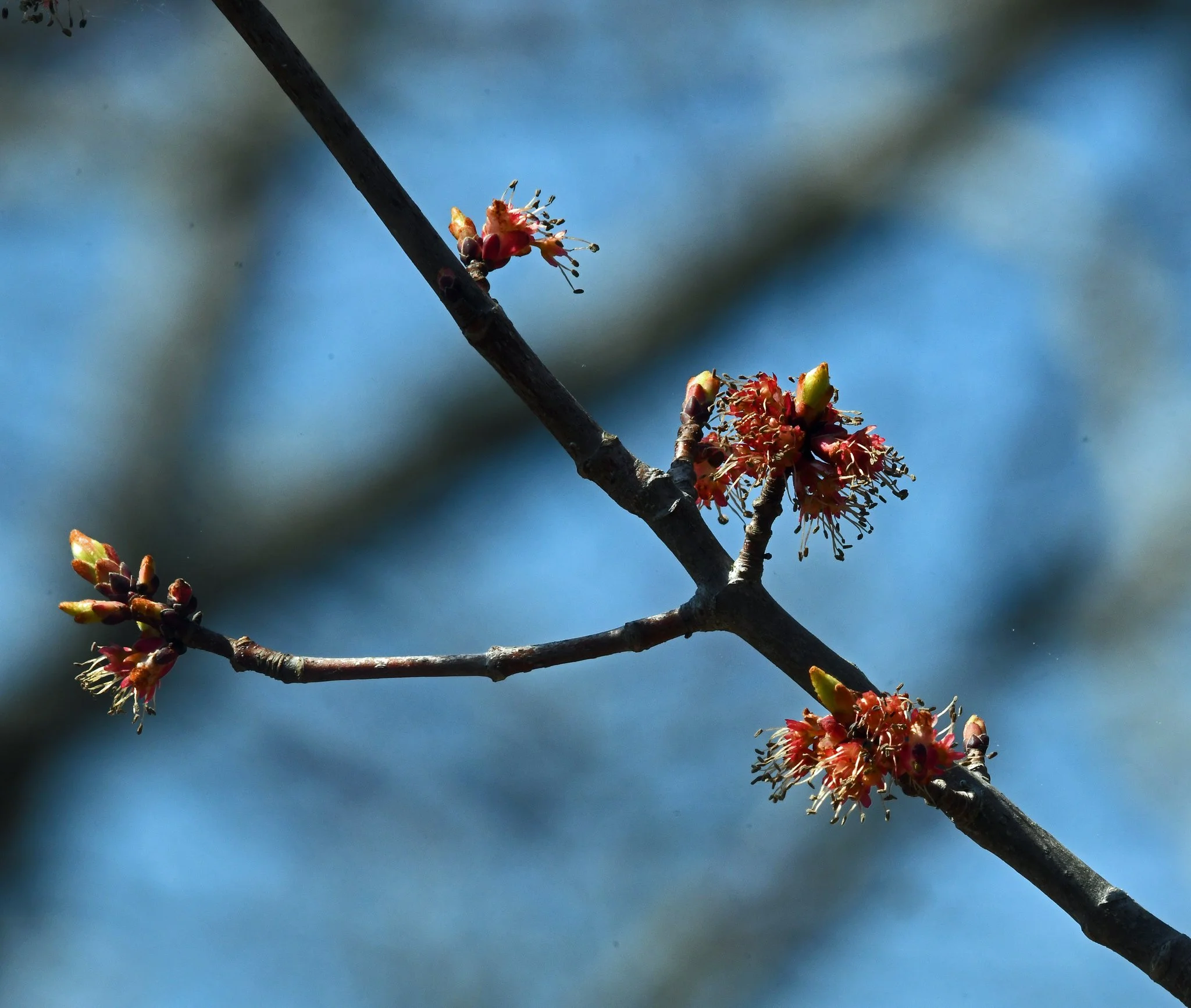
Our red maple trees are blooming before their own leaves appear, as usual. Here you see two images of the male red maple flowers:

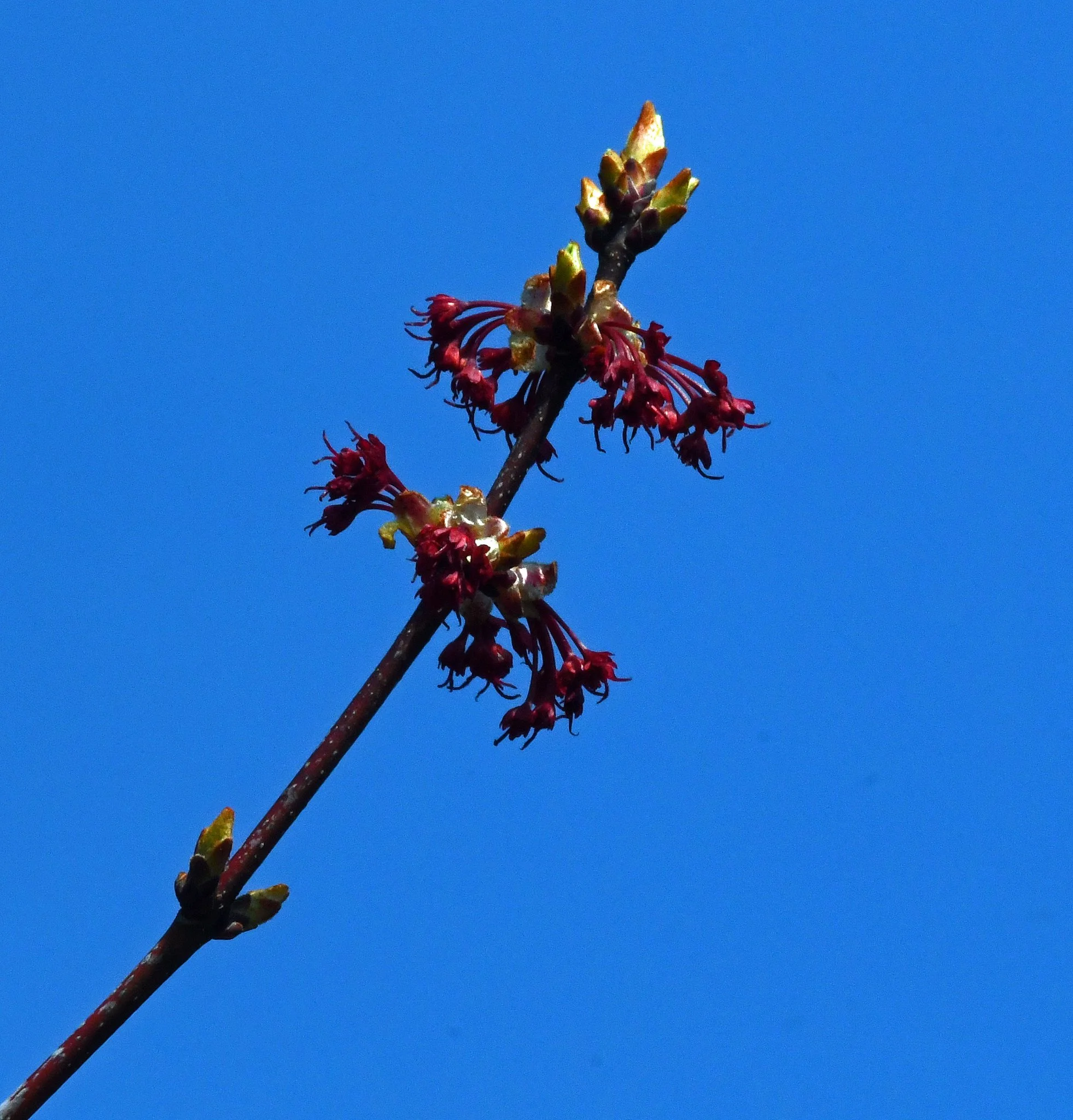
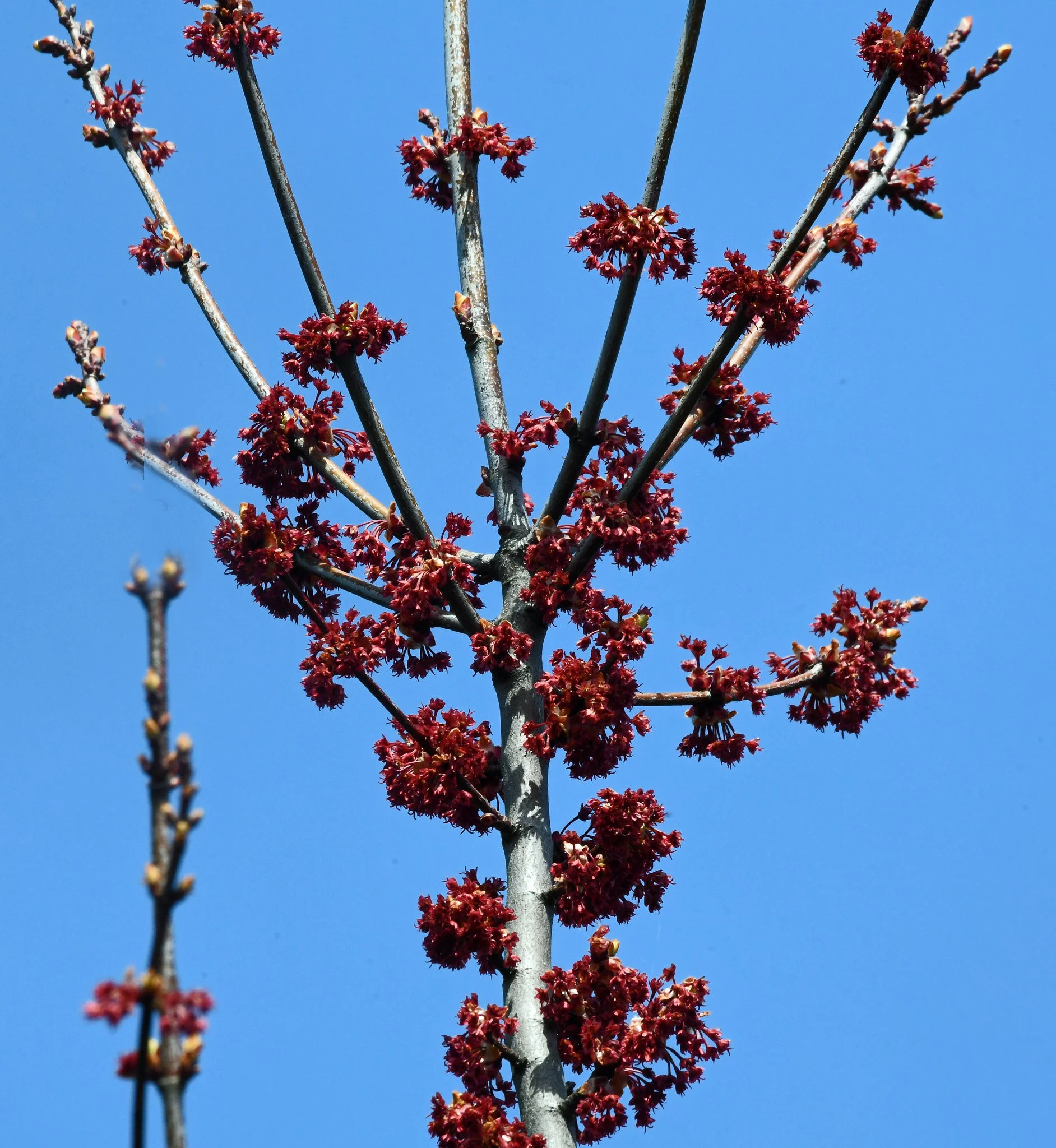
Below, you’ll see two images of the tree’s female flowers:

Red maples are -- don’t try to pronounce it -- "polygamo-dioecious." That merely means that some red maple trees have only male flowers, some only female flowers, and some both male and female flowers.

The male flowers have long anthers with beads of pollen at their ends; they look a bit like small pin cushions. The females have clusters of flowers with "Y-shaped" stigmas sticking out of them, a bit like a snake’s tongue. The females try to catch the pollen that is cast into the wind by the males.

(Images taken in Brooklin, Maine, on May 5, 2026.)

Comment