Comment

In the Right Place: Contentment

It’s cold here as we speak late this morning (16F with a 4F wind chill), but there’s no significant wind to induce pain. Yesterday morning, it was just as cold, but there were wind gusts of up to about 20 miles per hour coming off the sea and creating ghosts from the powdery snow on the field:

1.jpg

It was beautiful, but too cold for softies like us to stay out long. By dusk yesterday, however, it was only cold again and the deer dined al fresco in contentment where the snow once blew:

7.jpg

(Brooklin, Maine)

Comment

Comment

In the Right Place: Ageing Issues

Yes, it’s strange, but apparently true: When you’re an old and bent apple tree; and, when your enzyme juices can’t flow well enough for you to drop all of your apples; and, when you think that no one is watching – you organize your senior community into a conga line dance (one-two-three kick right; one two three kick left) and try to shake those little devils off.

2.jpg

Well, maybe it’s our biology that’s a little bent, but note the apples still in the trees in the image above. taken Monday (December 16). In fact, note these apple tree images, taken yesterday.:

5.jpg

Some of those little devils appear to think that, if you’re future is to rot, it’s better to rot in the air than on the ground. (Brooklin, Maine)

Comment

Comment

In the Right Place: Little Mysteries

It snowed a bit last night (no more than a sneeze, really), but a fine snow is drifting down as we speak – so fine that you can’t see it in the image below, which was taken a few minutes ago.

2.jpg

Snoopy got more snow yesterday than we did as he waited for it alongside Naskeag Road. The late Judith Fuller’s road banners are still appearing there, thanks to her family.

121819.jpg

It’s one of those enjoyable little mysteries that we‘ve come to expect as we turn the corner on our way down to the Harbor and look to see whether a new banner has gone up yet. (Brooklin, Maine)

Comment

Comment

In the Right Place: Winter Wonder

If you want to keep some color in your garden during a Maine winter, you can’t go wrong with cultivated Heather. It remains colorful, has a fascinating texture, and – perhaps most important – the deer seem to hate it. Cultivars of Heather come in a variety of colors, but our favorite is the one shown here, which turns dark red in winter and is stunning in snow.

i-2S88qnh-X3.jpg

In its uncultivated form, Heather is a hardy native of the rocky and windy heaths of Scotland, where it is common and its twigs were once used for making brooms. Hence, its scientific name is Calluna vulgaris, from the Greek verb kallune, to brush or clean, and the Latin word vulgaris, meaning common. Its English name, Heather, is thought to be a transliteration of the Scottish word for heath, haeddre. (Brooklin, Maine)

Comment

Comment

In the Right Place: Torment and Temptation

Here on the Down East coast, it seems that we have a fourth dimension. But, it’s often hard to take that additional dimension – weather – for granted the way we do the other three.

Last night, under a bright moon in a clear sky, we had wind gusts coming off the sea in excess of 35 miles per hour. As we speak, it’s a beautiful, calm December day that is tempting us to come hither. Yesterday, especially in the morning, we had rain that came down harder than can be explained by gravity. It was being tormented by strong wind gusts that regularly whipped water that wanted to fall vertically into water that had to fly horizontally. In Naskeag Harbor, the strong winds frenzied the flood tide there, as you can see in the image below (taken through heavy rain). Fortunately, no damage was done in the Harbor, as far as we could tell.

5.jpg

That was not the case a short distance up Naskeag Road yesterday, as you can see below. That Road had to be closed in part because several courageous conifers were slayed in the onslaught; they fell across the Road onto power and communication lines, with the usual consequences for the connected neighbors.

6.jpg
7.jpg

The wind also drove the rain onto windows and filtered the views:

2.jpg

Rain chains worked overtime:

4.jpg

As the wind abated and the rain tapered into a drizzle, familiar spruce trees and winterberry stalks appeared elegant in the soft light:

3.jpg

But now? Now it’s time to relent to the temptation to walk in the woods. (Brooklin, Maine)

Comment

Comment

In the Right Place: Super

From where we stood, last night’s full moon seemed to bubble up from the sea behind Acadia National Park like a huge, molten cannonball:

2.jpg

As it rose, it became a blinding searchlight sweeping Blue Hill Bay:

3.jpg

When it reached high orbit, we could see that it had become our old, scarred companion again:

4.jpg


This moon was historic for two reasons. First, it was the last full moon that we’ll see in this troubled decade (2010-2019). Second, it also was a Supermoon; that is, it was a full moon that was at its closest orbital point to earth. Thankfully, this December moon didn’t live up to two of its historic Native American names: the Full Snow Moon and the Full Storm Moon. (Brooklin, Maine)

Comment

Comment

In the Right Place: Hairy Experiences

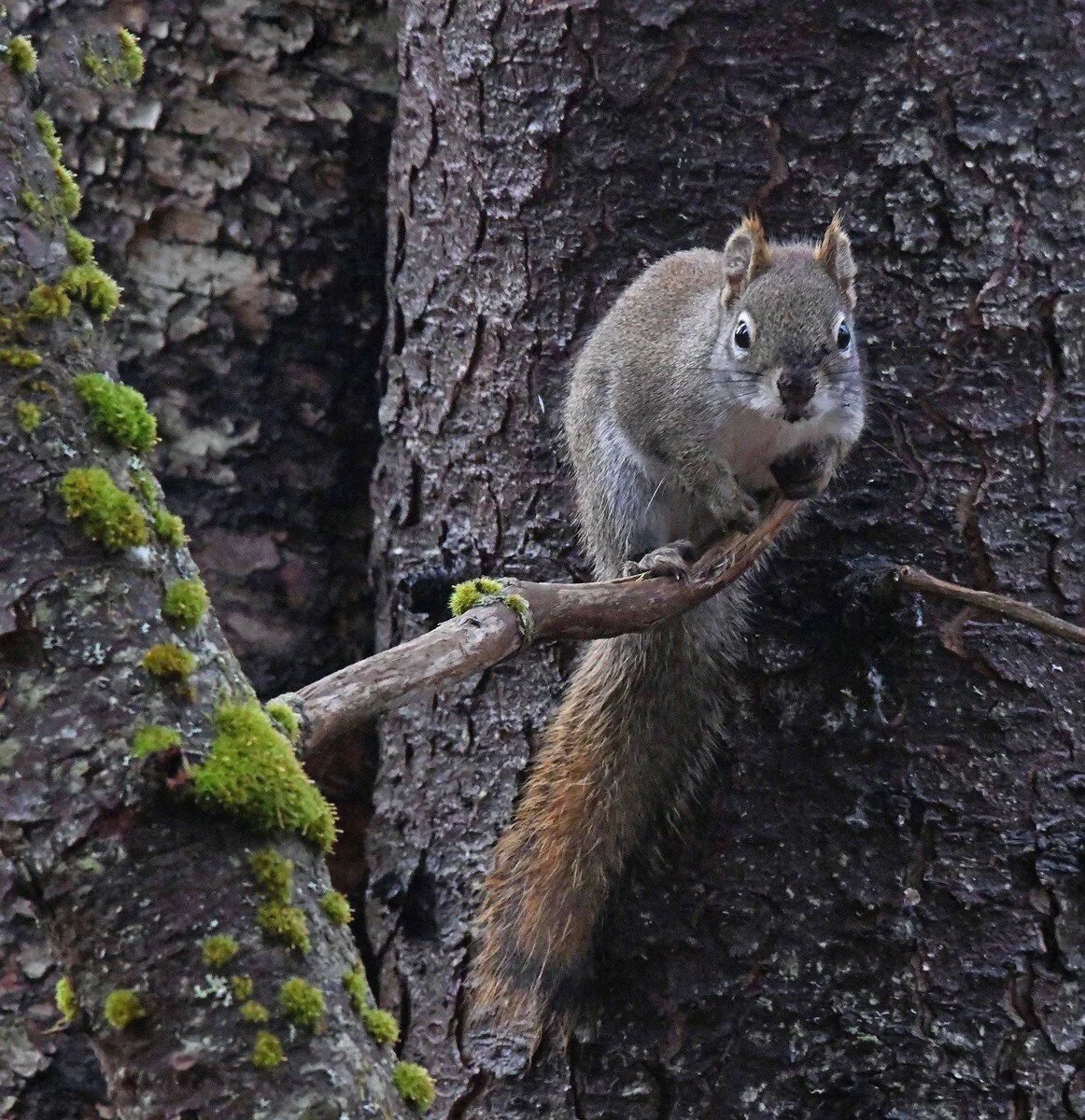
It looks like our Red Squirrels have finally finished their fall molt. Their namesake color appears only on the tails of their thicker gray winterwear.

4.jpg

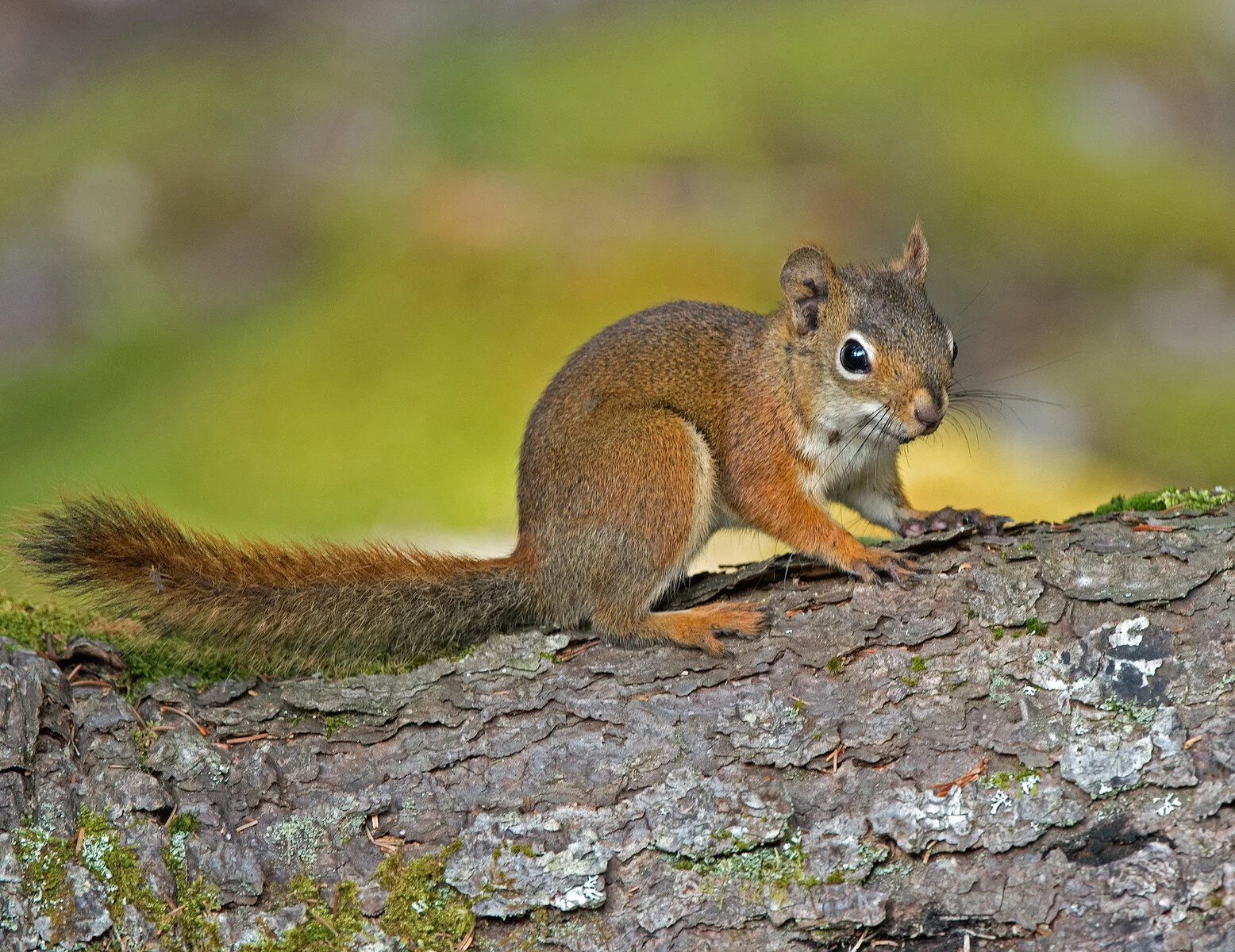
These little squirrels will molt again in the spring and gradually return to their greatly variable reddish-orange-brown colors by summer. Their bellies will remain white or cream-colored all year, however. The image above of one of our now-gray neighbors was taken on Tuesday (December 10), while the image below of the then-reddish one was taken in August:

3.jpg

As with many other winter-foraging mammals, the coats of Red Squirrels have insulating double layers. Longer and thicker guard hairs on the outside protect against the severities of the winter environment, especially water, wet snow, and wind; short and thin hairs on the inside trap air between the two layers, where it warms. (Brooklin, Maine)

Comment

Comment

In the Right Place: Choices

The woods are alive with the sound of water. This image, taken yesterday, is of a stream that can be a trickle or even a memory in the summer woods.

i-HJZf6HN-X3.jpg

A Monday/Tuesday overnight storm here dumped a near record 1.4+ inches of precipitation on us, according to the weather data. Yesterday evening’s rain added to the accumulation, while today’s freezing weather may ice-up the considerable pooled water in the woods. We’re not sure whether we should start building an ark or get out our ice skates. (Brooklin, Maine)

Comment

Comment

In the Right Place: Quality

This is the Brooklin General Store during yesterday evening’s rain and fog, which eventually became a howling storm. Most people will not be able to see the odd beauty hidden in this scene. But many residents here have seen and felt it.

#1.jpg

When returning to Brooklin down the Blue Hill peninsula at night, we travel mostly dark, winding roads. Suicidal deer live along those roads, as do night-strolling porcupines that look like moving potholes. When you add fog, rain, ice, and/or snow to the mix, it takes concentration, at the least, to get to Brooklin on a winter’s night.

But, as you pass the shadowy Brooklin Cemetery on your left, you can see the welcoming lights of the General Store ahead and think of the friendly neighbors in there. That’s when you can get that sense of warm relief – that “Finally-Back-Home” feeling – and see and feel the beauty. It’s probably part of a quality of life quest. (Brooklin, Maine)

Comment

Comment

In the Right Place: Seeing Red

We seem to be seeing fewer Northern Cardinals this winter, and now is the leafless time to see the startlingly red males, such as this one.

#4.jpg

The males’ plumage is as bright as the vestment of a Roman Catholic Cardinal, hence the species’ name. The female doesn’t wear a bright vestment, but she does wear lipstick when she reaches sexual maturity:

#3.jpg

Juvenile Cardinals have gray-black beaks:

#1.jpg

You might wonder whether the male Cardinal’s bright winter cloak is a case of evolution going wrong, but researchers have discovered that female Cardinals will select the brightest of their suitors to mate. It seems that the females know that the brighter the red of the male, the healthier he likely will be. (Brooklin, Maine)

Comment

Comment

In the Right Place: Mostly True

Here, we’re watching the alchemy of dusk change the sea in Great Cove into hammered silver. We’re looking southwest through one of the two passages into the island-sheltered Cove. The moment lasted about a minute on Thursday (December 5).

#2.jpg

In the background, slightly right of center, we can barely see Champlain Mountain rising like a blue whale above and well behind the islands in Eggemoggin Reach.  The mountain is on Isle au Haut (“High Mountain Island”), about 11 miles out in the Atlantic. That island was “discovered” and named in 1604 by French explorer Samuel de Champlain, perhaps the best of the original European explorers of North America. The mountain, of course, was named in his honor.

Oldtimers here tell us that, when Champlain Mountain disappears from our view during the day, it’s going to rain or snow. In our experience, that’s true most of the time. (Brooklin, Maine)

Comment

1 Comment

In the Right Place: Machine Guns

Here we have a Black-Capped Chickadee complaining about being watched, or the cold, or a Chickadee’s hard life. Chickadees are a half ounce of complaints.

#3.jpg

They get their family name from those complaints, which sound like a kazoo playing “chick-a-dee!”, or “chick-a-dee-dee!”, or “chick-a-dee-dee-dee!”, and so forth. The more “dees” at the end, the more annoyed or alarmed the bird is; when a hawk is around, they’re virtual “dee” machine guns.

#3A.jpg

There are seven native species of Chickadee in North America, but the Black-Capped one is our most common, which may be why it’s our state bird. For such a small creature, it does well during our often-frigid winters (when it stores and eats seeds), as well as during our lush summers (when it eats mostly insects). (Brooklin, Maine)

1 Comment

Comment

In the Right Place: Glee

Our marsh and field ponds are mostly iced-in now with a thin meringue of the latest snow. From a distance, they look placid, if not moribund. When we get close, however, we see that the snow is a diary of the hectic night before, with many comings and goings of furry neighbors as big as deer and as small as squirrels and voles.

i-9LV9WKd-X3.jpg

The ice breathes, heaves. groans and, sometimes, issues a “CRACK!” as loud and startling as an unexpected rifle shot. We’re hoping that the river otters come again this year to belly slide and remind us that glee is still possible. (Brooklin, Maine)
Comment

Comment

In the Right Place: Escape

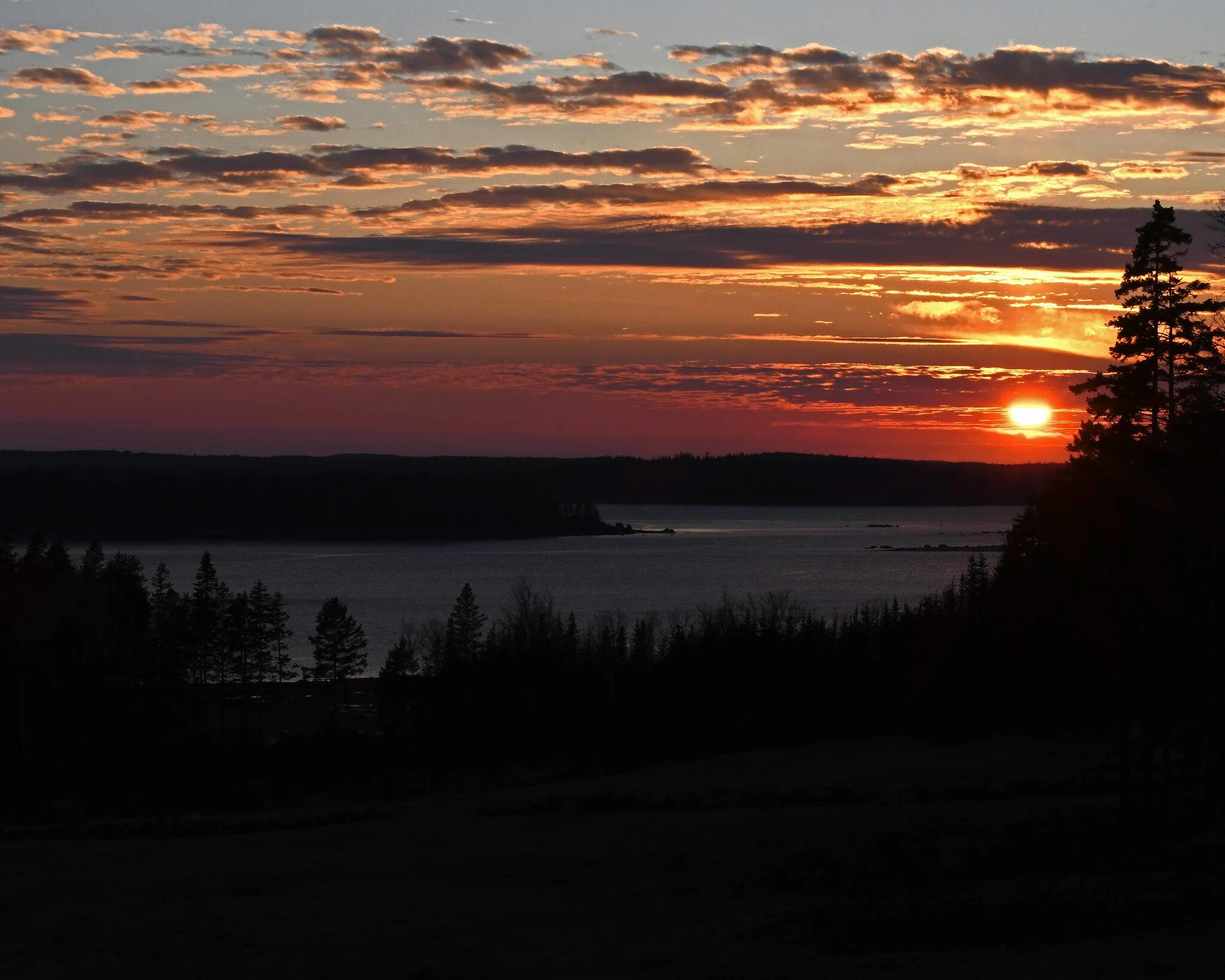
Yesterday dawned sunny, crisp, and breathtakingly clear – until about Noon. Then, the clouds decided to huddle and the sun became just a round brightness behind layers of a silvery gray canopy – until about 4 p.m. That’s when, from our perspective, the sun escaped under the clouded canopy to set in the west. For a very few moments, we felt as if we were standing in one of the dark areas of a J.M.W. Turner nightscape.

i-jTHjjfK-X3.jpg

(Brooklin, Maine)
Comment

Comment

In the Right Place: Quaint

 Well, we got very little snow and bother from yesterday’s storm -- an inch of snow at most, with virtually no drifts.

#1.jpg

There wasn’t enough accumulation to plow the driveways and wooded lanes, although the main roads were plowed and chemicalized for safety.

#2.jpg

As we speak, it’s clear, cold (31 F), and kind of quaint. (Brooklin, Maine) See also the image in the first Comment space.
Comment

Comment

In the Right Place: Wimpy

If Mr. Rogers lived around here, he would come back from his morning walk singing “It’s a miserable day in the neighborhood ….” As we speak, we’re under a Hancock County Winter Storm Warning, but we don’t need a warning; we need a stimulant.

A.jpg

As we speak, we’re watching one of those boring, wimpy weather bouts. We have almost-real snow slowly wrestling with almost-real rain as almost-real wind (23 MPH gusts) and almost-real cold (29F that “feels like 15”) try to encourage some action. We’ll see what round three turns into. (Brooklin, Maine)

Comment

Comment

In the Right Place: The Next Season


Today is the opening of scallop dredging season in our zone.

2.jpg

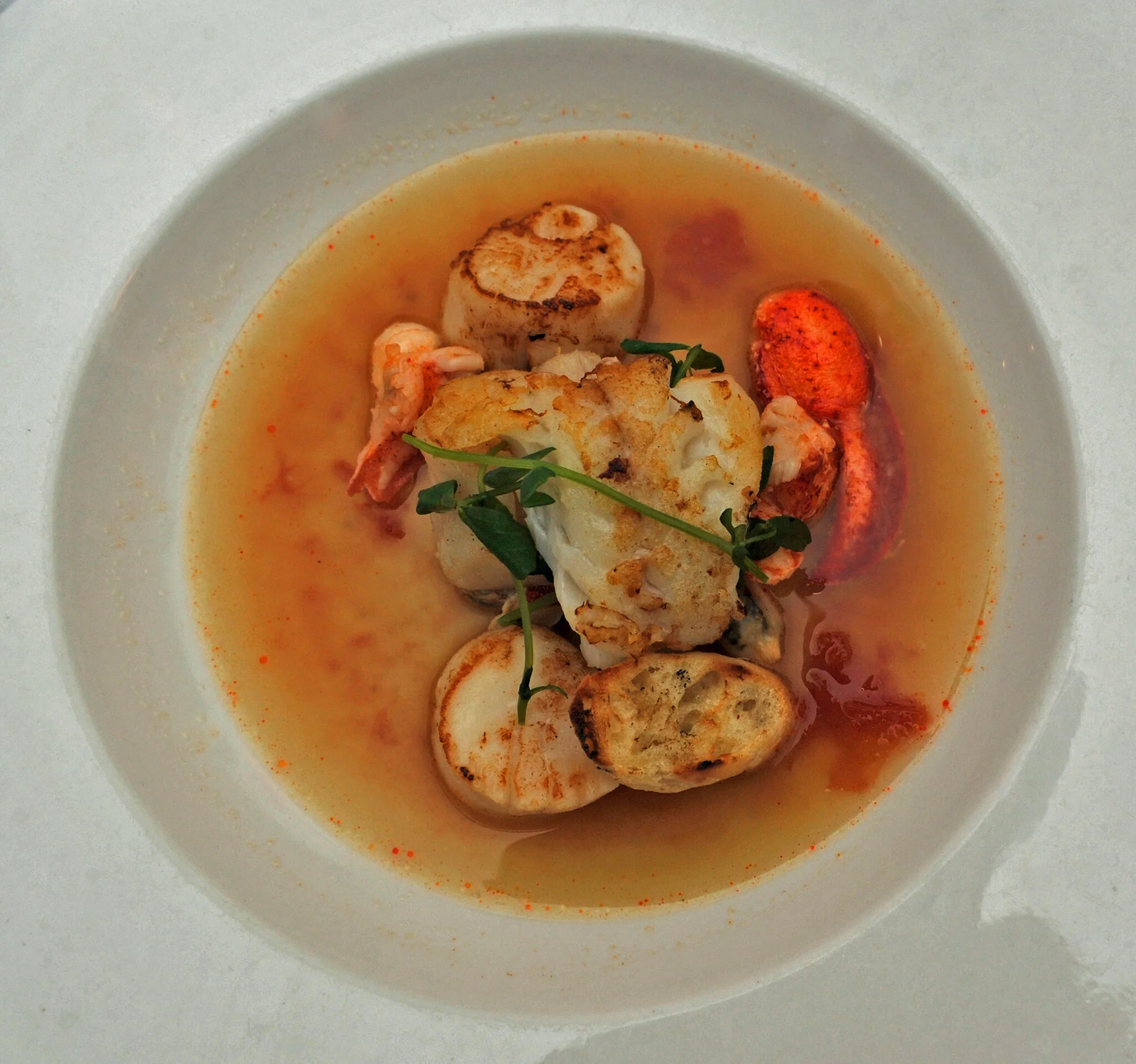
For those lucky enough to live on the Down East coast of Maine, it’s time to make sure that you’ve placed your order with your favorite scallop fisherman. There’s nothing better for dinner than very fresh scallops, except perhaps very fresh lobster. But, we now will have both here! Time to get out the recipe for lobster-scallop bouillabaisse.

2a.jpg

(Brooklin, Maine) Prior year images.

Comment

November Postcards From Maine

3 Comments

November Postcards From Maine

November in Down East Maine is for weather lovers — good and bad and in between weather that seems to enjoy being fickle. This November was no exception. There were crisp, clear days to make us think that we could see forever; hard and soft rainy days to transform the woods into green dreams; fog to do its now-you-see-it-now-you-don’t magic, and weak snows that lightly frosted the fields and then disappeared.

1.jpg
41.jpg

This year, November was warmer and wetter than usual here. The result was fast-running small streams meandering through still-vital mosses and robust larger streams pouring tons of clear, fresh water into the salty sea.

Maine is a place where hunting is a cultural imperative for many; it’s especially a coming-of-age time for youths in our many hunting families. And, November is a special time for those hunters. It’s the peak and last month for hunting white-tailed deer with firearms and the end of the general hunting seasons for wild turkey and black bear. (It’s also the end of moose season, but we see very few moose here on the coast.)

19.jpg

November also is a transformational time here on the Atlantic coast. Many of our fishermen pull up their lobster traps, trailer them to storage, and “hardscape” their vessels until June.

20.jpg

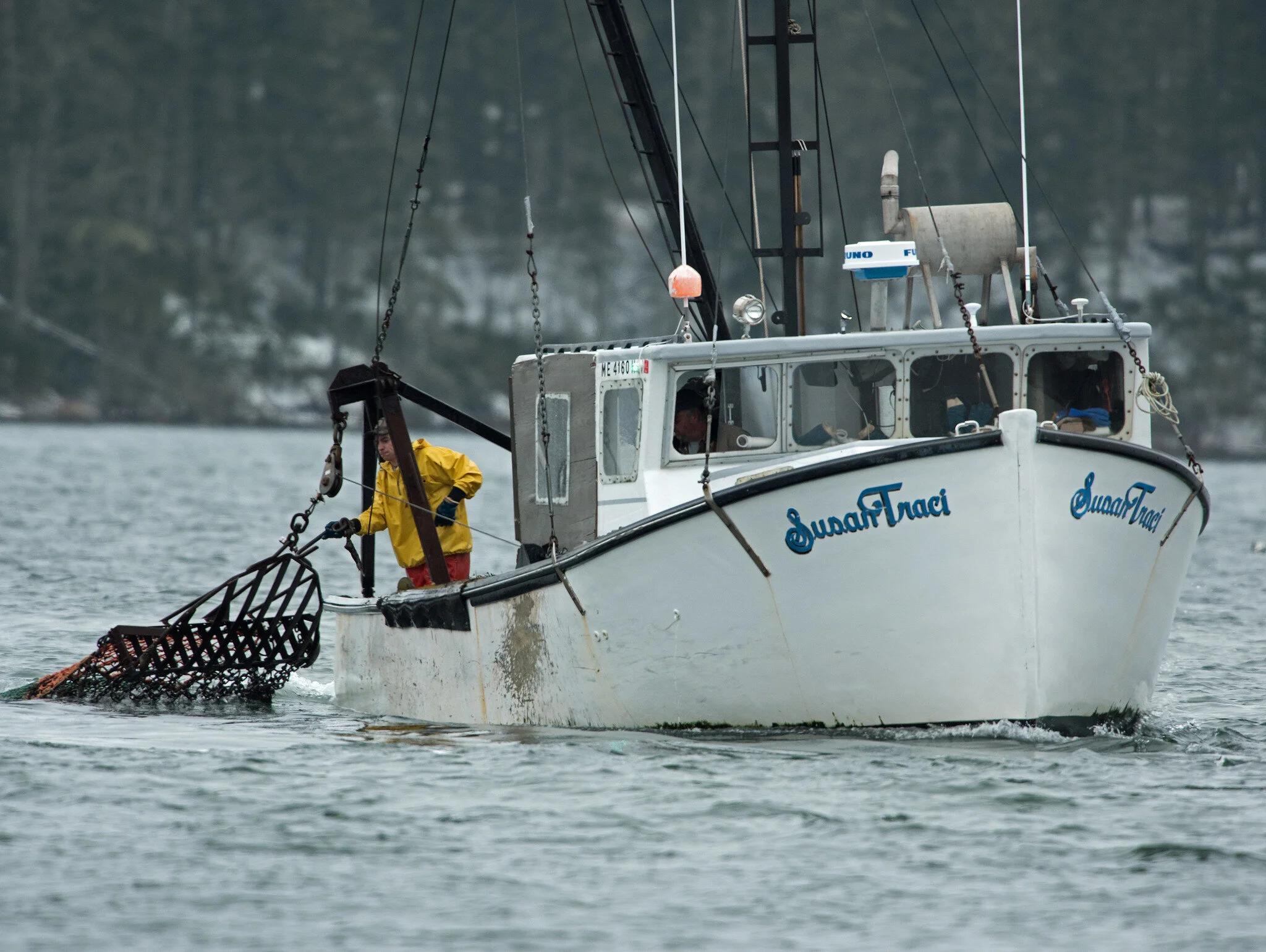
But not all fishermen get off the water during winter. Late November is when some fishing vessels are converted from lobster boats into trawlers to participate in the Atlantic scallop dredging season, which begins during the first week of December. The vessels sprout masts and booms to drag and maneuver the heavy metal and rope dredges and “shelling houses” are constructed aft of the cabins to protect shell schuckers from the sharp winter sea winds. Toward the end of November, the dredges appear like colorful fungi on piers, awaiting transfer to vessels.

23.jpg
26.jpg

By the end of November, most of the leaves have taken their fatal flight and the woods are transformed into largely gray areas pillared with dark green spruce, fir, and pine trees above and populated with clusters of colorful berries and grass heads below. The native winterberry along the roads has been the best in decades this November, as has (unfortunately) the invasive Asian Bittersweet. Silver grass tossing in the wind and red-on-gray Barberry tangles also are uplifting monthly sights.

28.jpg
29.jpg

However, it’s usually our old wild apple trees that are most memorable after their leaves desert them. Some hold onto their rotting fruit until December; others become gnarled residents of the landscape that flaunt their age and defy the elements.

33.jpg

Speaking of trees, this November had one of the best cone cycles in recent years for our spruce trees. Exceptionally large clusters appeared. which old-timers say means a hard winter.

As you have already seen, we have much to be thankful for here and November is the time to express it, as was done by a member of Brooklin’s Fuller family this year with one of the road banners of the late and beloved Judith Fuller:

37.jpg

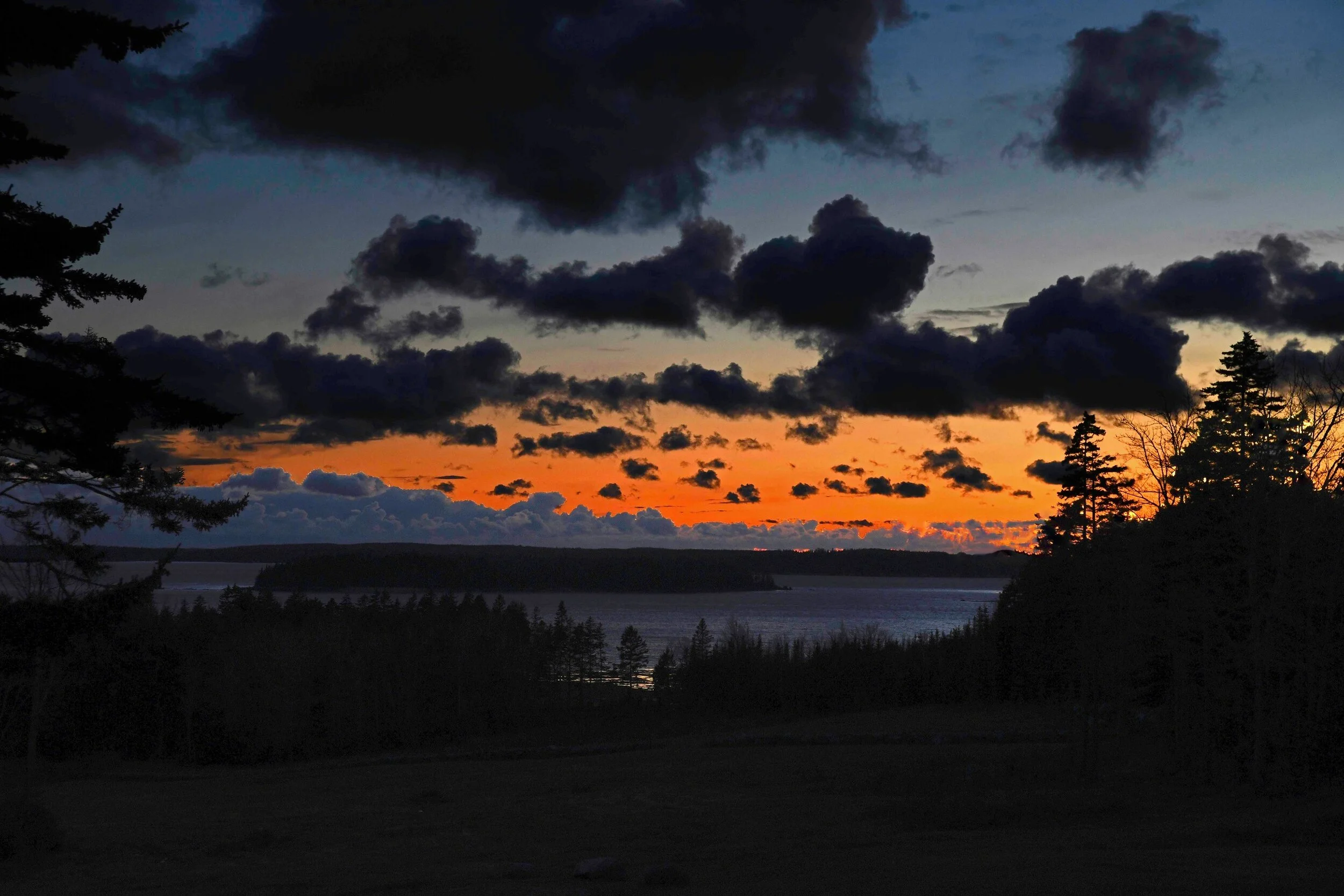
Finally, November here on the coast is when the breathtaking winter sunsets and their afterglows start. Some of the month’s days may be gray, but many of its nights begin with a spectacular visual overture that becomes a brightly-starred night.

9.jpg

(All images above were taken in Down East Maine. With the exception of the three hunting section images, which were taken here at prior times, all images were taken in November 2019.)

3 Comments

Comment

In the Right Place: A New Season

The scallop dredging season begins next week in our zone. Many fishing vessels in Naskeag Harbor have brought their lobster traps ashore and are now sprouting masts and booms to become scallop trawlers. “Shelling houses” have been erected behind their cabins to help protect the shuckers from winter sea winds.

1.jpg

Metal and rope scalloping dredge gear was decorating the Town Pier yesterday, soon to be transferred to a vessel.

2.jpg

(Brooklin, Maine)

Comment